Isaac and Rebekah’s twin boys grew but had different viewpoints. This devotional reading looks at their controversy over the birthright.
Nuggets
- Isaac had a dysfunctional family — probably because he came from one.
- Jacob had something Esau wanted, so there had to be a means to trade.
- Jacob seemed to be helping Jehovah along with transferring the birthright to him.

Let’s do a check. When Isaac was 60 years old and Rebekah was probably 33, their family expanded with the birth of Esau and Jacob.
Even before they were born, Jehovah told Rebeka that the older would serve the younger. In other words – once again – birth order meant nothing in the covenant line. The covenant would proceed through Jacob’s line.
We are not told that Rebekah told the others, but it is logical she did. Why would she keep that to herself when it was Jehovah that spoke?
Unfortunately, the family didn’t proceed as if they knew that information – or some just didn’t accept it. At least that is how it looked 15 years later.
Let's Put It into Context
To read devotions in the Creating Everything theme, click the button below.
Devotions in the Isaac the Patriarch series
Let's Put It into Context #2
Let’s make a timeline for Isaac.
1860 BC — Isaac was born (Gen. 21: 2)
c. 1858 BC — Isaac was weaned (Gen. 21: 8)
c. 1845 – 1830 BC — God tested Abraham, at the age of 115- 130, by commanding he sacrifice his only son Isaac, making Isaac 15-30 (Gen. 22)
c. 1823–1820 BC – Abraham sent Eliezer to Paddan-Aram to find a wife for Isaac (Gen. 24)
1820 BC – Isaac, at age 40, married Rebekah (Gen. 25: 20)
1800 BC – Jacob and Esau were born (Gen. 25: 24-26)
1785 BC – Esau sold the birth right to Jacob in exchange for lentil stew Jacob was cooking while mourning for Abraham
1723 BC – Jacob cheated Esau out of the birthright blessing given by Isaac (Gen. 29: 1-20)
Based on Timeline from
Let's Put It into Context #3
We know that a right is a basic human freedom. This encompasses several aspects that we acknowledge is inherent to all people.
- the right to life, liberty, and security
- freedom from slavery and torture
- right to fair trials, expression, assembly, and religion
- social rights to work, education, health, food, and housing
Biblical birthright had to do with spiritual heritage. Brown gave a great definition. He said that it “… combines high [honor] with sacred duty; it confers dignity and power, but it demands self-abnegation and unselfish work.”
Resource
But now it isn’t just the firstborn, as it was in Jacob and Esau’s day, that has these birthrights. Every individual is inherently endowed with certain birthrights.
- We have a duty to Jehovah.
- We have access to His power.
- Being His child gives us dignity.
- It does come through submission to His Will.
Isaac loved Esau, but Rebekah loved Jacob
“As the boys grew up, Esau became a skillful hunter. He was an outdoorsman, but Jacob had a quiet temperament, preferring to stay at home. Isaac loved Esau because he enjoyed eating the wild game Esau brought home, but Rebekah loved Jacob” (Gen. 25: 27-28 NLT)
Isaac had a dysfunctional family — probably because he came from one.
In a way, it seems strange that — since Isaac was a meditative man (Gen. 24: 63) — the quiet son was not Isaac’s favorite. I guess opposites do attract.
But then if we think about it, doesn’t Esau sound a lot like Ishmael? “And God was with the boy as he grew up in the wilderness. He became a skillful archer, and he settled in the wilderness of Paran …” (Gen. 21: 20-21 NLT).
Where Ishmael grew up in the wilderness, Esau was similarly an outdoorsman. As an archer, Ishmael probably hunted as Esau did.
Was Isaac wanting to be everything Ishmael was and he wasn’t? Was he wanting this to be the relationship he could never have with Ishmael?
Jacob was more like Isaac than he was Ishmael. He comes across as more contemplative, more spiritual. Farrar described him as a harmless shepherd.
Resource
Many times, we look at this only as Jacob deceiving Esau for the birthright. The narrative changes slightly when we consider that the whole family knew of Jehovah’s choice all along. It makes us wonder if Rebekah had filled Jacob’s head with the notion that Esau would serve him.
How was Jacob supposed to get the birthright? Since he was quiet, it is easy to think that Jacob wouldn’t take Esau in a test of strength.
Cooking Some Stew
“One day when Jacob was cooking some stew, Esau arrived home from the wilderness exhausted and hungry. Esau said to Jacob, ‘I’m starved! Give me some of that red stew!’ (This is how Esau got his other name, Edom, which means ‘red.’)” (Gen. 25: 29-30 NLT)
Jacob had something Esau wanted, so there had to be a means to trade.
We might consider it strange that Jacob was cooking. Remember Abraham put most of the meal together when God and His angels came down to destroy Sodom and Gomorrah (Gen. 18: 6-8).
But still, Bradford said that the men usually did not do the cooking. He offered an explanation for Jacob cooking.
Lentil stew, a practical, common dish for peasants, was made from what was produced from the land. Lentils were a staple food in the ancient Near East as its short growing season and long storage period were ideal for the nomads moving as their flocks required. It would have been cooked over a fire pit, as communal food was cooked during that time.
Lentil stew, according to Bradford, was usually served while sitting Shiva. This led him to believe the family might have been in mourning for Abraham.
Resource
Even back then, neighbors brought food when there was a death in the family as immediate family members, such as Rebekah – the normal cook – were not supposed to cook. Jacob would not have been an immediate family member.
Eats History also had an interesting take on the stew that Jacob was cooking. It said, “The dish itself becomes a symbol of choice — the immediate hunger of the body against the enduring inheritance of the spirit.”
Resource
The stew, though, also had symbolism. Bread and stew (noted in verse 34 as the menu for this meal) were used in the meal portion of a covenant. Sharing was considered an act of peace. Withholding was considered an act of power.
That made this more of a sacred transaction. It would be easy to see Jacob thinking that, but would Esau have been?
Adams pointed out the words that Esau used.
- Give me what I want now.
- I don’t care about the future – now is what is important.
- You have to satisfy my need, or I’ll die.
Resource
On top of this, Esau later swore an oath. Remember, oaths were legally binding. It was like entering into a covenant agreement.
Esau came home and all but demanded Jacob feed him. Jacob said, “Okay, but not so fast.”
Trade Me Your Rights as the Firstborn Son
‘All right,’ Jacob replied, ‘but trade me your rights as the firstborn son.’ ‘Look, I’m dying of starvation!’ said Esau. ‘What good is my birthright to me now?’ But Jacob said, ‘First you must swear that your birthright is mine.’ Esau swore an oath, thereby selling all his rights as the firstborn to his brother, Jacob. Then Jacob gave Esau some bread and lentil stew. Esau ate the meal, then got up and left. He showed contempt for his rights as the firstborn” (Gen. 25: 31-34 NLT)
Jacob seemed to be helping Jehovah along with transferring the birthright to him.
That is what I always figured. Remember in the last devotion, we said that we have to accept Jehovah’s response to our prayer requests because they may contain temptation as well as mercy.
Resource
Jacob had been promised the mercy in being chosen as the covenant son. But there was precedence that the covenant son had to wait for the promise.
- Abraham waited 25 years for Isaac to be born.
- Isaac waited 20 years for Jacob to be born.
- Jacob was 15 years old, and we haven’t been told that Jehovah had communicated with him yet.
But let’s chase a rabbit for a second. If this was when Abraham died, Jacob didn’t give Jehovah time to do His work to switch the birthright to him.
True, Jacob probably grew up with the story that Abraham didn’t wait and fathered Ishmael. But that should have been used as a wait-on-the-covenant-promises lesson.
What was the holdup? And how long did he have to wait?
So, Jacob succumbed to the temptation to make it happen before Jehovah kept His promise.
It makes even more sense if we look at the lentil stew as a covenant meal.
If we look at the lentil stew as a mourning meal, that begs the question as to why Esau was hunting. Am I the only one who thinks it is strange that, instead of being with family during a time of mourning, Esau is out having fun?
If Abraham just died, why is Esau teasing about him starving to death? That is insensitive. Even if he was a rebellious teenager, he is making a very inappropriate statement for the situation.
It doesn’t say Esau questioned this. It sounds like he just went along with it.
Well, he did make the statement that he was about to starve to death (Gen. 25: 32). But Bradford thought that was more of a who cares statement.
Bradford made a great observation. He said, “Of course, since God had long ago settled the issue, in reality Esau had no birthright to sell, for it already belong to Jacob. And, Jacob had no need to resort to treachery to obtain the birthright, because the Lord had already assigned it to him: but neither Jacob nor Esau had the faith to accept it as fact.”
Resource
But was Esau focusing on the common food aspect or the covenant aspect?
Whether it be considered a covenant meal or a mourning meal, the last verse sums it up Esau’s attitude. He showed contempt for his birthright.
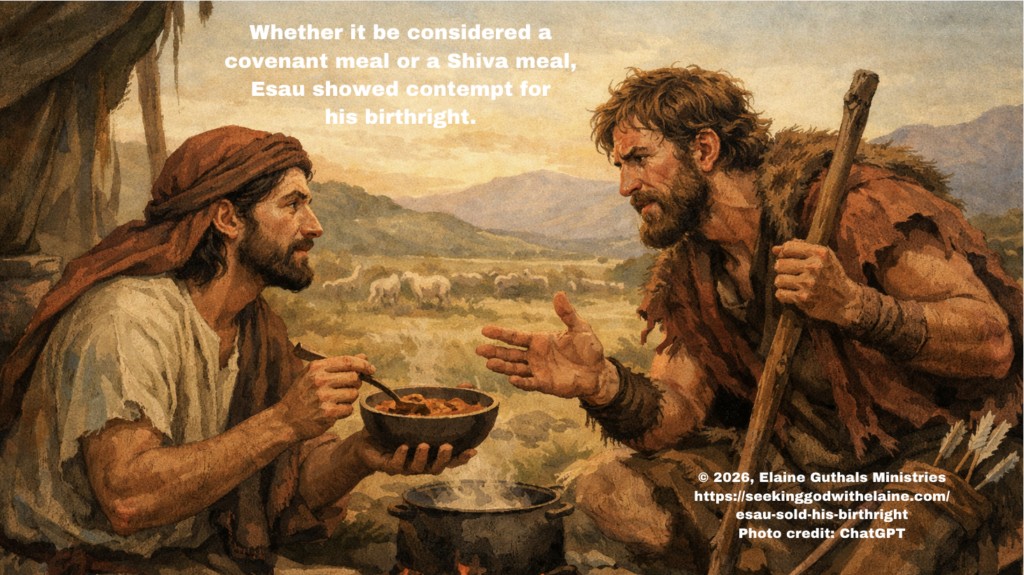
Esau had already made his choice about serving Jehovah. He said no.
It also shows a lot about Esau’s character. He was passionate, but not in a good way. He lacked integrity and goodness. He was impulsive, worldly, greedy, reckless, and I want to say shallow. He took no thought to responsibilities but rather thought only of himself.
That was not what Jehovah was looking for in a covenant son. Esau was no more qualified for that position than Ishmael.
But still, we can feel for Esau. Going on the assumption Rebekah did tell Esau he was born first but he wasn’t the firstborn, how would that have made him feel?
Remember, the firstborn got the double portion of the wealth. They were made head honcho after the man in power no longer was in power.
Esau – being a human being – would probably have always wondered if that was why Rebekah favored Jacob more. Did she see Jacob as a winner and Esau as a loser? Was she aligning herself with the future power?
Was there anything Esau could have done to win Rebekah’s love? Did this create a bitterness within him?
Or did he cultivate the who cares attitude as a defense mechanism? “If I don’t care, it won’t hurt me.”
Or did Esau see the covenant responsibilities that came from Abraham through Isaac and say, “I don’t want to have anything to do with that”? That carried duties beyond the normal leader of the family responsibilities.
If Jacob saw Esau’s attitude as wanting to not accept covenant duties and family responsibilities, he chose a good time to make his bid for the birthright.
But does that mean Jacob went about this the right way? No.
This isn’t how you treat a brother. He was cunning and deceitful because he took advantage of Esau.
Worst of all, Jacob didn’t wait for Jehovah’s promise. It showed a lack of faith and irreverent.
Jacob reduced the birthright to a business transaction.
Making the Connections #1
Esau was given a nickname because of the color of the stew he ate. Let that sink in a second.
Once his in-the-moment needs were met, did Esau think what he had given up? No, “… He showed contempt for his rights as the firstborn” (Gen. 25: 31-34 NLT)
Farrar said something interesting. He wrote, “Beware lest, in a moment of weakness and folly, you sell your birthright and barter your happy innocence for torment and fear and shame.”
Resource
Hmmmm. I never thought of Esau as being tormented, fearful, or full of shame.
This choice that Esau made would follow him around for the rest of his life. It is bad enough that he had so little respect for the tradition surrounding the firstborn inheritance.
But this nickname would mean that it would have been thrown in Esau’s face every time he would have been called that.
Making the Connections #2
Esau was said to have had a ruddy appearance. Another described in that manner was King David (I Sam. 16: 12).
Making the Connections #3
Bradford reminded us that only one other person in God’s Word is described as a hunter. That was Nimrod, who may or may not have helped build the Tower of Babel.
Further, Bradford said that it refers to a stone-cold killer.
Resource
On the other hand, Jacob was described as a peaceful man, a quiet man. He was blameless or righteous.
I would say that Esau not only didn’t value his birthright, but he also didn’t value life – where Jacob did.
Making the Connections #4
We hate to think about division in families. But Jehovah expects it. Yeshua even said so.
“Do you think I have come to bring peace to the earth? No, I have come to divide people against each other! From now on families will be split apart, three in favor of me, and two against — or two in favor and three against. ‘Father will be divided against son and son against father; mother against daughter and daughter against mother; and mother-in-law against daughter-in-law and daughter-in-law against mother-in-law’” Lk. 12: 51-53).
Making the Connections #5
Esau and Jacob did reconcile. “Then Esau ran to meet him and embraced him, threw his arms around his neck, and kissed him. And they both wept” (Gen. 33: 4 NLT).
I know their descendants were enemies, and Jacob still feared Esau. But Esau seemed to make peace with the fact he was not the covenant son.
Making the Connections #6
Remember, Esau wasn’t just giving up the earthly recognition that went along with the birthright. Until Jehovah set up the priestly system after the exodus, the firstborn was the priest of the family.
Esau was turning his back on Sovereign God and all the covenant promises.
- Esau gave up being the priest of the family, therefore, being the person with whom Jehovah spoke.
- He gave up the promise of land.
- He gave up being the ancestor of the Messiah.
But isn’t that what Adam and Eve did? They gave up their birthright as children of Sovereign God because of the shiny, attractive object of the moment and how it satisfied earthy needs.
Making the Connections #7
Meyer had a great sermon reminding us of Jacob’s character. He looks a lot like the ordinary human.
- Schemer but spiritual
- In exile but attached to the land
Resource
We know Jacob was chosen from the womb. We see his many failings.
But we also see Jacob’s unwavering faith. What did Hosea say about him?
“Even in the womb, Jacob struggled with his brother; when he became a man, he even fought with God. Yes, he wrestled with the angel and won. He wept and pleaded for a blessing from him. There at Bethel he met God face to face, and God spoke to him — the Lord God of Heaven’s Armies, the Lord is his name!” (Hos. 12: 3-5 NLT emphasis added).
Jacob believed wholeheartedly in Jehovah.
Making the Connections #8
Look at this reminder from Roberts. He wrote, “Although Jacob obtained, in virtue of his election, a certain priority over Esau, yet was Esau also, equally with Jacob, the subject of Divine sovereignty.”
Resource
We are all created in Jehovah’s image whether we acknowledge His as Sovereign God or not. We are all under His rule as our Creator.
Being Jehovah’s creation does not secure our eternal destiny. Only Jehovah’s children will live with Him in eternity.
Only those who believe in Yeshua being our Savior and submitting our lives to Him are Jehovah’s children. “But to all who believed him and accepted him, he gave the right to become children of God. They are reborn — not with a physical birth resulting from human passion or plan, but a birth that comes from God” (Jn. 1: 12-13 NLT).
But non-believers are still creations of Jehovah.
Roberts made another great point. Sovereign God works everything out for His good (Rom. 8: 28 NLT).
This was also Esau’s good — even though he had to give up some things to get it.
Making the Connections #9
Is this a good argument for the nature/nurture debate? Maybe.
The boys were brought up in the same household, but they were not treated equally. True, both were a favorite of a parent; but that doesn’t guarantee they were treated equally.
To me, it comes down to both had a choice to make. Were they going to submit to Jehovah or not? They chose differently because, even though they were twins, they were different people.
Making the Connections #10
Fuller distilled things for us. He said that
- Esau would have wanted the birthright if it consisted of worldly advantages.
- Jacob, in his lifetime, gained none of the benefits of the birthright.
Resource
So, why did Jacob want it?
- Spiritual privilege
- Leadership
- Double inheritance
How Do We Apply This?
- Raise our children to worship Jehovah.
- Recognize our children’s need of love.
- Find ways to cement a good relationship between siblings.
- Recognize one sin leads to another.
- Set our hearts on spiritual things.
Resources
Father God. Forgive us when we refuse to wait for the fullness of Your time on Your promises. Help us to keep focused solely on You. Amen.
If you don’t understand something and would like further clarification, please contact me.
Father God. Forgive us when we refuse to wait for the fullness of Your time on Your promises. Help us to keep focused solely on You. Amen.
If you have not signed up for the email providing the link to the devotions and the newsletter, do so below.
If God has used this devotion to speak with you, consider sharing it on social media.