Blog

  • How Can We be Alive but Dead? (2.0)

    Excuse me. My heart is still beating. How can You say I am dead when I am alive? This devotion explores how the spiritual meaning of being dead and how we can become truly alive.

    Nuggets

    • Many times, the sinful state is referred to as being dead.
    • All mankind, at birth, are spiritually dead because Adam and Eve’s original sin condemned mankind to spiritual death.
    • We are bondslaves of Satan because Satan rules this world.
    • Because mankind chose to not follow God’s laws and commandments, mankind is the subject of divine wrath.
    • When we ask God to take control of our lives, we pass from eternal death into eternal life.
    • We need Jesus to be our Savior.

    Devotions in the The Letter of Paul to the Ephesians series

    There are some concepts in the Bible that can make non-believers scratch their heads. Case in point: Ephesians 2: 1.

    Hello! We are still very much alive. How can we be dead?

    The problem is that we look at this from a physical viewpoint. God, on the other hand, is looking at this from a spiritual viewpoint.

    Let’s look at the different lenses.

    Let’s Put It into Context

    Here is a running list of nuggets for the series.

    How Does the Bible Refer to the Sinful State?

    “And you were dead in the trespasses and sins” (Eph. 2: 1 ESV)

    The Bible uses several words to describe man’s sinful state. First Thessalonians 5: 6 says, “So then let us not sleep, as others do, but let us keep awake and be sober” (ESV). This can tie into the concept of death as sometimes it is said that a dead person looks like they are just sleeping.

    The sinful state has also been likened to a tree that is not producing. “A healthy tree cannot bear bad fruit, nor can a diseased tree bear good fruit” (Mt. 7: 18 ESV). A poor, sickly tree can be dying.

    Darkness has also been uses to describe the sinful state. “But you aren’t in the dark about these things, dear brothers and sisters, and you won’t be surprised when the day of the Lord comes like a thief” (I Thess. 5: 4 NLT). There will be lights out when we die.

    Why Dead?

    Many times, however, the sinful state is referred to as being dead.

    “You were dead because of your sins and because your sinful nature was not yet cut away. Then God made you alive with Christ, for he forgave all our sins” (Col. 2: 13 NLT).

    Col213

    To me, dead seems like a good description. When we don’t have Christ in our lives, we are filled with a suffocating presence that sucks the life out of us.

    We have no hope. Our joy is gone.

    Oh, the worldview people may argue that they have wonderful lives that do contain hope and joy. But they don’t.

    They are talking physical lives again. We are talking spiritual lives.

    The spiritual life is the one that is important. It will be for eternity.

    We can be walking around enjoying our physical life without knowing that we are spiritually dead. We don’t have a clue.

    We understand the concept of death, so it is easy to equate not believing in God as bringing death to us. But physical death also brings consequences to our spiritual condition.

    There is a finality to it. Non-believers no longer have the opportunity to become believers — their future is set.

    Death makes the body useless. There will be no more passion or enjoyment. We can’t visit with family and friends.

    Many people fear death. Spiritual death should be feared. Hopefully, it will be feared enough to encourage non-believers to start searching for God.

    Searching for and Seeking God

    Hearing His Word (Rom. 10: 17).
    Reading His Word (Rev. 1: 3).
    Praying to Him (Heb. 4: 16).
    Studying His Word (Ac. 17: 11).
    Meditating on His Word (Ps. 1: 1-2).
    Memorizing His Word (Ps. 119: 11).

    Who Is Dead?

    Spiritually Dead

    All mankind, at birth, are spiritually dead because Adam and Eve’s original sin condemned mankind to spiritual dea

    What does spiritual death mean? Spiritual death is the separation from God that occurred as a consequence of Adam and Eve’s original sin.

    • Sins are actions by humans that disobey God and break one of His reasonable, holy, and righteous laws and commandments, goes against a purpose He has for us, or follows Satan’s promptings.
      • Holy means to be set apart — because of our devotion to God — to become perfect, and morally pure while possessing all virtues.
        • Perfection means we reach a state of maturity because the combination of the spiritual graces form, when all are present, spiritual wholeness or completeness — holy, sanctified, and righteous.
          • Spiritual graces are worldly morals that have been submitted to God to further His kingdom instead of enhancing this world.
          • Sanctified means to be set free from sin.
          • Righteous means we are free from sin because we are following God’s moral laws.
        • Pure means not being sinful or having the stain of sin.
        • Virtues are standards of moral excellence.
    • The consequences of sin are spiritual death and separation from God.
    • The spiritually alive are those who have ABCDed, so they are no longer separated from God.

    The ABCDs of Salvation

    If you have not become a believer in Christ, please read through the
    Plan of Salvation and prayerfully consider what God is asking you to do.

    A – admit our sins
    B – believe His Son Jesus is our Redeemer
    C – confess God as Sovereign Lord

    D – demonstrate that commitment by making any changes needed in our lives to live the way in which God has called us

    The Disciple’s Job Description

    Glossary

    When God was giving Adam and Eve instructions, He said that they could eat from any of the trees except one.

    “But the Lord God warned him, ‘You may freely eat the fruit of every tree in the garden — except the tree of the knowledge of good and evil. If you eat its fruit, you are sure to die’” (Gen. 2: 16-17 NLT).

    Unfortunately, they did eat from the tree. No, they did not physically die (toward which Satan was trying to steer the conversation). They did die spiritually and were separated from God.

    Bondslaves of Satan

    We are bondslaves of Satan because Satan rules this world.

    That we are bondslaves of Satan may be a little harder for some to recognize. That is especially true since we talked several devotions ago that even believers do not believe Satan exists.

    To read a related devotion, click the button below.

    Satan rules this world. When we follow him, we walk in sin.

    Let’s look again at the verse in Ephesians 2, but go on a little farther. Remember, Paul was writing to the church who no longer was following Satan. He was telling them what they no longer were.

    “And you were dead in the trespasses and sins in which you once walked, following the course of this world, following the prince of the power of the air, the spirit that is now at work in the sons of disobedience — among whom we all once lived in the passions of our flesh, carrying out the desires of the body and the mind, and were by nature children of wrath, like the rest of mankind” (Eph. 2: 1-3 ESV).

    Let’s get a list going. Followers of Satan

    • Are spiritually dead.
    • Are disobedient to God.
    • Allow our fleshly desires to be unchecked.
    • Have an angry disposition.

    Satan eventually will be defeated by God. Scriptures prophesy that.

    • “Now is the judgment of this world; now will the ruler of this world be cast out” (Jn. 12: 31 ESV).
    • “and the devil who had deceived them was thrown into the lake of fire and sulfur where the beast and the false prophet were, and they will be tormented day and night forever and ever” (Rev. 20: 10 ESV).

    Satan is ruling this world — right now. He will not always be in charge. The day is coming where God’s army will defeat him and sin. The consequences of sin — death, disease, hunger, poverty — will go away.

    Subjects of Divine Wrath

    Because mankind chose to not follow God’s laws and commandments, mankind is the subject of divine wrath.

    We have to deal with the consequences of the original sin. That sin placed us under the wrath of God; the sins we commit just add to the load.

    Ephesians 2: 1 describes our sinful nature as being “… dead in the the trespasses and sins” (ESV). That, to me, implies that the corruption caused by the breaking of the laws and commandments invites God’s wrath.

    Sin has caused God’s peace and love to leave us. So we don’t even have that to help comfort us.

    Coming Back to Life

    When we ask God to take control of our lives, we pass from eternal death into eternal life.

    We have to remember that what we have been talking about describes the Ephesians — and us — before conversion. Then conversion happens when the Ephesians — and us — admit our sins, believe on Jesus as Redeemer, and confess God as Sovereign Lord.

    When we ask God to take control of our lives, it is said that we are passing from death into life. We no longer have eternal death but eternal life.

    How can this happen? The how is one of the things we will not be able to totally understand.

    That doesn’t mean it can’t happen. God did raise Jesus from the grave and bring Him back to life, didn’t He? He is raising us back to life.

    Don’t worry. God’s got this.

    Again, there are several different terms that are used to describe this. Here it says, “And you hath he quickened …” (Eph. 2: 1 KJV). Let’s look at some of the others.

    • “Jesus answered him, ‘Truly, truly, I say to you, unless one is born again he cannot see the kingdom of God’” (Jn. 3: 3 ESV).
    • “For God, who said, ‘Let light shine out of darkness,’ has shone in our hearts to give the light of the knowledge of the glory of God in the face of Jesus Christ” (II Cor. 4: 6 ESV).
    • “For this is the covenant that I will make with the house of Israel after those days, declares the Lord: I will put my law within them, and I will write it on their hearts. And I will be their God, and they shall be my people” (Jer. 31: 33 ESV).

    We will have to take it on faith that God will do what He says. Faith is a gift from God that enhances the conviction that the doctrines revealed in God’s Word are true, even if we do not understand all aspects of them, a belief which impacts our lives and distinguishes us from others.

    Glossary

    Through Whom and By Whom?

    We need Jesus to be our Savior.

    No, Paul didn’t think the laws could save us. In fact, he knew that all the laws did was show us how they could not save us.

    Salvation only comes through belief that Jesus Christ is our Savior and Redeemer. Salvation is the gift of life through the deliverance from condemnation and sin to acceptance and holiness and changes us from being spiritually dead to spiritually alive.

    • Holiness is the transcendent excellence of His nature that includes elements of purity, dedication, and commitment that lead to being set apart.
      • Purity means possessing God’s moral character, having eliminated the stain of sin.

    Glossary

    To read a related devotion, click the button below.

    We’ve talked about this in depth in the past several devotions.

    Because of God’s infinite grace, He devised the Plan of Salvation that made Jesus, through propitiation, our Redeemer in order to forgive us of our sins. Becoming saints when we accept the gift of salvation, we are set apart to be holy through being justified. Justification is the act of sanctification. Jesus is the substitute (propitiation) so that His blood can justify and sanctify us.

    To read devotions in the Forgiveness of Sins through Grace by Redemption series, click the appropriate button below.

    To read devotions in the Churchy Words series, click the appropriate button below.

    God is the source. God devised the plan through which mankind would be restored. He did this because of His great grace, mercy, and love.

    how-can-we-be-alive-but-dead-2.0FB

    Making the Connections

    We have to remember the living-in-my-sins lifestyle came before the God-has-redeemed-justified-and-forgiven me state. We have to remember the contract all we can thank God for what He has done for us.

    But we also have to get on with our eternal lives. We can’t keep reliving the sinful past.

    We have to concentrate on living the life He has called us as children and heirs of God. We have to accomplish the mission to which He has called us.

    How Do We Apply This?

    The change from eternal death to eternal life has to come at the initiation and completion of God working in our lives. We can do nothing in and of ourselves.

    God just wants us to sit back and accept those things. He doesn’t want us to make it about us — it has to be about Him and His plan.

    So, we have to make Him Sovereign God do our lives. We have to keep the focus on Him and His power.

    Loving Heavenly Father. We thank You that You did have a plan. You created us and raised us from eternal death to eternal life. We thank You for Your love, grace, and mercy. Help us to live for You. Amen.

    What do you think?

    Leave me a comment below (about this or anything else) or head over to my Facebook group for some interactive discussion.

    If you don’t understand something and would like further clarification, please contact me.

    If you have not signed up for the email daily or weekly providing the link to the devotions and the newsletter, do so below.

    If God has used this devotion to speak with you, consider sharing it on social media.

  • How Do We Open the Eyes of Our Hearts? (2.0)

    Paul uses an obscure term “… eyes of your heart …” in Ephesians 1: 18 (CSB). At first glance, it may seem confusing. This daily devotional discusses what eyes of your hearts means and how we can use it to seek God.

    Nuggets

    • God uses the insights that He puts in our hearts through our observations so we can use that, rather than our own understanding, to determine what He is telling us.
    • God calls all of mankind; however, not all of mankind accept God’s gift of salvation.
    • All who are chosen because they have chosen to accept the gift of salvation receive the eternal blessings.

    Devotions in the The Letter of Paul to the Ephesians series

    We said in What Is the Spirit of Wisdom? that Ephesians 1: 18 was part of this long run-on sentence. (Paul was good at that. I think he squirreled while he was thinking a thought and took the scenic route and back.)

    To read a related devotion, click the button below.

    Besides the twists and turns of the sentence, Paul uses — to us — a funny expression. He talks about the eyes of the heart. What in the world is he talking about?

    Let’s Put It into Context #1

    Here is a running list of nuggets for the series.

    Eyes of Our Hearts

    “I pray that the eyes of your heart may be enlightened so that you may know what is the hope of his calling, what is the wealth of his glorious inheritance in the saints” (Eph. 1: 18 CSB)

    Let’s think about the heart first. Since the heart is at the center of our chest, many times we think of it as our center.

    In a previous devotion, we said that God’s peace, mercy and love are at our center. Those three prongs make a strong foundation.

    To read a related devotion, click the button below.

    If we put that devotion and this one together, we say that God’s peace, mercy, and love are at our center, which is our heart.

    Our eyes see things. We use them to observe.

    But don’t we also say that the eyes are the windows to our hearts? That means if you look into someone’s eyes, you can sometimes see what they are thinking and feeling.

    Let’s take it another way. What if it means we have to believe something in our hearts rather than understand it with our minds?

    When I think about opening the eyes of my heart to God, I think — first of all — I am never going to fully understand. We are told to “trust in the LORD with all your heart, and do not lean on your own understanding” (Prov. 3: 5 ESV).

    God is Creator and so far above me that there is no way I am going to fully understand the how and why of everything. He is God, and I am not. 

    But God wants me to understand what He reveals to me. He is going to reveal things to me a little at a time.

    God opens the eyes of our heart when we say we don’t have to fully understand it all. We acknowledge that we just have to trust Him.

    Because that is what it is all about. If we say we have to understand it, we aren’t really trusting Him to be God. We are putting ourselves on His level. We aren’t.

    We have to believe in God enough to say it may not make sense to us, but we can worship Him as the Creator of the Sovereign God. He deserves our praise.

    This is how God sanctifies us. It is how he changes us.

    What if we open the eyes of our hearts to see the insights that God has put in them? We “see” them when we meditate on what God is telling us.

    Let me try summing that up. God uses the insights that He puts in our hearts through our observations so we can use that, rather than our own understanding, to determine what He is telling us.

    We’ve got to make sure Satan doesn’t try to close our eyes. He is going to try to put clouds and blinders in our way – anything to get us to not see what God wants us to see.

    Hope in Our Hearts

    “… that you may know what is the hope of His calling …” (Eph. 1: 18 ESV).

    The middle part of verse 18 says that there is “… the hope of His calling …” (Eph. 1: 18 ESV). Hope is the expectation, also called a living hope, based on the confidence that, because of our relationship with God, our names will be found in the book of life.

    It also says we are called. This term is probably tied in with a previous devotion. We said that God elected us to be saints.

    Saint means holy one who has been set apart.

    • Holy means to be set apart — because of our devotion to God — to become perfect, and morally pure while possessing all virtues.
      • Perfection means we reach a state of maturity because the combination of the spiritual graces form, when all are present, spiritual wholeness or completeness — holy, sanctified, and righteous.
        • Spiritual graces are worldly morals that have been submitted to God to further His kingdom instead of enhancing this world.
        • Sanctified means to be set free from sin.
        • Righteous means we are free from sin because we are following God’s moral laws.
      • Pure means not being sinful or having the stain of sin. 
      • Virtues are standards of moral excellence.

    To read a related devotion, click the button below.

    Glossary

    That is our calling. God calls all mankind.

    “Come, everyone who thirsts, come to the waters; and he who has no money, come, buy and eat! Come, buy wine and milk without money and without price” (Isa. 55: 1 ESV emphasis added). We are all thirsty because everyone has sinned and fallen short of God’s saving Presence (Rom. 3: 23). If we are not drinking from the well of living water, we are still thirsty (Jn. 4: 10).

    God calls all mankind. “Come, everyone who thirsts, come to the waters; and he who has no money, come, buy and eat! Come, buy wine and milk without money and without price” (Isa. 55: 1 ESV emphasis added). We are all thirsty because everyone has sinned and fallen short of God’s saving Presence (Rom. 3: 23). If we are not drinking from the well of living water, we are still thirsty (Jn. 4: 10).

    However, not all mankind accept God’s gift of salvation.

    Salvation is the gift of life through the deliverance from condemnation and sin to acceptance and holiness and changes us from being spiritually dead to spiritually alive.

    • Sin is not believing that Jesus is our Savior to save us from our actions by humans that disobey God and break one of His reasonable, holy, and righteous laws and commandments, goes against a purpose He has for us, or follows Satan’s promptings.
      • Holy means to be set apart — because of our devotion to God — to become perfect, and morally pure while possessing all virtues.
        • Perfection means we reach a state of maturity because the combination of the spiritual graces form, when all are present, spiritual wholeness or completeness — holy, sanctified, and righteous.
          • Spiritual graces are worldly morals that have been submitted to God to further His kingdom instead of enhancing this world.
          • Sanctified means to be set free from sin.
          • Righteous means we are free from sin because we are following God’s moral laws.
        • Pure means not being sinful or having the stain of sin. 
        • Virtues are standards of moral excellence.
    • Holiness is the transcendent excellence of His nature that includes elements of purity, dedication, and commitment that lead to being set apart.
      • Purity means possessing God’s moral character, having eliminated the stain of sin.
    • Spiritual death is the spiritual separation from God that occurred as a consequence of Adam and Eve’s original sin.
      • The spiritually alive are those who have ABCDed, so they are no longer separated from God.

    The ABCDs of Salvation

    If you have not become a believer in Christ, please read through the
    Plan of Salvation and prayerfully consider what God is asking you to do.

    A – admit our sins
    B – believe His Son Jesus is our Redeemer
    C – confess God as Sovereign Lord

    D – demonstrate that commitment by making any changes needed in our lives to live the way in which God has called us

    The Disciple’s Job Description

    Glossary

    Even though He comes personally through the Holy Spirit, some still chose not to ask Jesus to be their Redeemer and Savior and God to be their Sovereign God.

    Let’s read that section of the verse again a second. “… the hope of His calling. …” (Eph. 1: 18 ESV). So, hope is where we desire for something that we believe is obtainable. To me, that reads we desire that to which He has called us, believing it is obtainable.

    Inheritance in the Saints

    “… what are the riches of his glorious inheritance in the saints” (Eph. 1: 18 RSV).

    We previously talked about what our inheritance from God was. Three specific rewards that are mentioned are the Holy Spirit, eternal life, and the kingdom.

    To read a related devotion, click the button below.

    Hebrews 9: 15 says, “Christ died to rescue those who had sinned and broken the old agreement. Now he brings his chosen ones a new agreement with its guarantee of God’s eternal blessings!” (CEV). The Holman Christian Standard Bible says, “… so that those who are called might receive the promise of the eternal inheritance …” (Heb. 9: 15 HCSB).

    All who are chosen are chosen because they have chosen to accept the gift of salvation receive the eternal blessings.

    how-do-we-open-the-eyes-of-our-hearts-2.0FB

    Making the Connections

    Our eyes are the gateway to our hearts. We have to open our eyes to see the opportunities of learning about God. We have to use our eyes to read and study His Word.

    That is taking “open the eyes of my heart” literally. What if it is also figuratively? We have to be observant. Even though we are reading the printed word, we may not be really observing all that it has to tell us.

    We have to be observant when other disciples talk with us. What are they saying to us that is really God talking to us?

    When we are just sitting there with our minds squirreling, what is God saying to us in all that chaos? He will talk with us through the promptings of the Holy Spirit.

    Let’s look at it this way, too. What do we need to see? Light. Who is the Light of the world? Jesus. We need Jesus to make sure we want to be observant. He need the Holy Spirit to guide us while we are observing and meditating on what we have observed.

    But then let’s take it a step further. When we see through the eyes of our hearts and seek the insights from God, Who already lives at our core? Jesus.

    Through the Light of Jesus, we have our hope increased. We believe – even those things that seem impossible.

    When we see through the eyes of our hearts and seek the insights from God, Who already lives at our core? Jesus.

Through the Light of Jesus, we have our hope increased. We believe – even those things that seem impossible.

    How Do We Apply This?

    We apply this by surrendering our will to God so that we can be observant to what He is telling us. We have to keep the eyes of our hearts open to Him.

    Let me repeat myself here. When we see through the eyes of our hearts and seek the insights from God, Who already lives at our core, through the Light of Jesus, we have our hope increased. We believe – even those things that seem impossible. That gives us assurance.

    So, use the eyes of your hearts today to gain insight into what God is telling you. Let the Light of Jesus shine in you so you can clearly what He is telling you.

    Father God. You come to us in so many ways, urging us to accept Your gift of salvation. Help us to want to reach out and grab it. Lord, as we seek You, Light the core of our beings where You reside in us so that we can use the eyes of our hearts to see whatever You would have us see. Amen.

    What do you think?

    Leave me a comment below (about this or anything else) or head over to my Facebook group for some interactive discussion.

    If you don’t understand something and would like further clarification, please contact me.

    If you have not signed up for the email daily or weekly providing the link to the devotions and the newsletter, do so below.

    If God has used this devotion to speak with you, consider sharing it on social media.

  • Love Makes Neighbors

    God wants us to meet the needs of others as necessary. This daily devotional looks at how loving others helps us to serve those in our proximity to make them neighbors.

    Nuggets

    • Love is an investment.
    • We serve others through love.

    Devotions in How to Love Our Neighbors series

    We’ve been looking at the Parable of the Good Samaritan. We finish up by looking at the Samaritan himself. He is a good example of love in action and how this love makes us neighbors.

    Let’s Put It into Context

    Here is a running list of nuggets for the series.

    The Good Samaritan

    “But a Samaritan, as he journeyed, came to where he was, and when he saw him, he had compassion. He went to him and bound up his wounds, pouring on oil and wine. Then he set him on his own animal and brought him to an inn and took care of him. And the next day he took out two denarii and gave them to the innkeeper, saying, ‘Take care of him, and whatever more you spend, I will repay you when I come back’” (Lk. 10: 33-35 ESV)

    Love is an investment.

    In the last devotion, we talked about the symbolism of the parable. Let’s chase a rabbit a second before we get back to the symbolism surrounding the Samaritan.

    Aitken pointed out the symbolism of the victim going from Jerusalem to Jericho. He was leaving God’s city to go to worldly Jericho. He was turning his back on God.

    Resource

    Back on track.

    It is logical that the Samaritan represents Jesus. The binding of the wounds represents how Jesus has provided His Spirit to grow us to a restored relationship through grace (the oil).

    Resource

    Jesus had compassion on us, also. Jesus, “who, though he was in the form of God, did not count equality with God a thing to be grasped, but emptied himself, by taking the form of a servant, being born in the likeness of men” (Phil. 2: 6-7 ESV).

    Jesus not only loved us enough to be born into this world, but He also loved us enough to die for us.

    The Samaritan did have to invest in the victim. It may not have been convenient for him to stop and minister him, but he did.

    Ministering to the victim also meant the Samaritan gave up some comforts. When he put the victim on his animal, that meant that he had to walk.

    Time was not only invested, but the Samaritan also paid a significant amount for his care. I hadn’t really thought about it before as to what the robbers had taken. They had taken his money and his clothes – everything.

    And the Samaritan did all of this for a man who may or may not have looked down upon him because of who he was! Who the victim was or what he had done or his opinions did not enter into the equation of whether the Samaritan was going to minister to him.

    But isn’t that how serving God is going to be? It is going to be challenging. We can’t expect an easy road.

    Satan is going to do everything in his power to cause us not to be successful in our doing God’s work. He can really cause us grief.

    And isn’t that how Jesus is? He is going to meet all of us where we are to offer us salvation.

    Spurgeon put it into perspective. He wrote, “If God forgive little sinners only, then He is little in His mercy.” He will forgive all who ask.

    Resource

    The Samaritan had to invest his time to get God’s character. He didn’t just show up that day and say, “Hey! I am going to turn over a new leaf and show kindness to this person.” He was a compassionate person before he needed to be.

    For us, that means we need to serve others regardless of their religion and other differences from us. It shouldn’t be based on what we like and where we want to serve. We have to serve where God calls us to serve.

    We have to possess God’s character so we can minister to all who are in need. We need to have enough to get it out of our head thinking about it and into our hands and feet doing it.

    Love

    “‘Which of these three, do you think, proved to be a neighbor to the man who fell among the robbers?’ He said, ‘The one who showed him mercy.’” And Jesus said to him, ‘You go, and do likewise’” (Lk. 10: 36-37 ESV)

    We serve others through love.

    Let’s look at the Samaritan’s act of love for a second. There were three things that it was not.

    • It was not dependent on anything other than someone was in need. The Samaritan met the victim’s needs without asking any questions.
    • It was not a “let’s think this through” situation. The Samaritan didn’t hesitate but went right over to minister to the one in need.
    • It was not a situation where he considered whether the robbers would come back. He wasn’t afraid to do what needed to be done.

    Dods gave us a good definition of neighbor. He wrote, “The true neighbour is the man who has a compassionate heart and a friendly spirit.”

    Resource

    We bestow this compassion and friendly spirit on anyone who is in our proximity.

    To me, this parable shows that we are dependent on each other. Things happen. We shouldn’t be so independent that we don’t ask for help or allow others to help. It tells me we shouldn’t be so arrogant or hardhearted that we do not offer help or do what we can when we are asked.

    One thing has stuck with me from when Mom was battling cancer 30 years ago. Independent Old Gray Mare said that she had to let others help her so that they could get their blessing. If we continue to try to do things on our own, others lose.

    They get their blessing and happiness. Hughes said something I really like. He wrote, “Happiness is not an emotion, but the fruit of love.”

    Resource

    love-makes-neighborsFB

    Making the Connections

    Let’s contrast the lawyer and the Samaritan. They are totally opposite.

    The lawyer had it all going for him. He was an orthodox Israelite who knew the law. He had the right answer. He just wasn’t applying it correctly.

    Seiss thought there was some sincerity in the lawyer. He had to have some desire to follow God.

    The problem the lawyer had was, even though he was following the law, he wasn’t righteous. He had some head knowledge, but he didn’t have the correct heart knowledge.

    The Samaritan, on the other hand, would have been labeled a heretic. He was one of those dreaded half Jews. Seiss wrote, “His churchliness was thoroughly defective and reprehensible.”

    Resource

    Instead, the Samaritan had mercy and compassion for his fellow man.

    Too bad we couldn’t add the lawyers knowledge of the law with the Samaritan’s practical application of it.

    How Do We Apply This?

    • Know the law and apply it with compassion.
    • See all of mankind as needing our compassion and give it.
    • Practice self-denial.
    • Serve others voluntarily in whatever way is needed.
    • See the work through until the end.
    • Know there will always be more work to do for God.
    • Find ways to identify with others so that we may serve them.
    • Be humble.
    • Regardless of recipient or act, serve God in the way He calls.
    • Pay attention when opportunities of service are dropped into our pathway.
    • Look for opportunities to serve.
    • Don’t put ourselves above others.

    Resource

    Father God. Thank You for the example of the Samaritan. More importantly, thank You for Jesus as our example. Thank You for His salvation. Help us to look for ways to serve others. Amen.

    What do you think?

    Leave me a comment below (about this or anything else) or head over to my Facebook group for some interactive discussion.

    If you don’t understand something and would like further clarification, please contact me.

    If you have not signed up for the email daily or weekly providing the link to the devotions and the newsletter, do so below.

    If God has used this devotion to speak with you, consider sharing it on social media.

  • How not to Show Love 

    When the lawyer asked Jesus for clarification on who we are to love, Jesus answered him by showing him what not to do. This daily devotional looks at the beginning of the Parable of the Good Samaritan. 

    Nuggets

    • We show what is in our hearts when we try to justify ourselves. 
    • Jesus started the Parable of the Good Samaritan off with a description of how not to show love. 

    Devotions in How to Love Our Neighbors series

    Sometimes, we can start out on a strong foot. But then we soon stick that foot in our mouths. 

    The lawyer telling Jesus that we gained eternal life by obeying the greatest commandments started out strong. But then he asked for clarification of who is our neighbor. 

    Let’s take a look. 

    Let’s Put It into Context

    Here is a running list of nuggets for the series.

    Asking the Right Question Wrong 

    “But he, desiring to justify himself, said to Jesus, ‘And who is my neighbor?’” (Lk. 10: 29 ESV) 

    We show what is in our hearts when we try to justify ourselves. 

    Ooo, baby. We are so quick to justify our actions and opinions! 

    I get it. We don’t want to be wrong. 

    The lawyer sure didn’t want to be wrong. He was an educated man — a Pharisee. He couldn’t be seen as weak or not knowing what he was talking about. 

    So, the lawyer asked a good question that was supposed to limit who was to be loved. 

    Yes, prejudice is learned. But oftentimes our environment — not saying this is right — does a pretty good job of teaching us what to consider right or wrong. 

    That, coupled with the fact that we gravitate to likeminded people, may hinder us from breaking out when we realize that we do have a flawed opinion. 

    Parker argued that the question really didn’t need to be asked. In our hearts, we know the answer is everyone. 

    Resource

    The problem is that, when we are fighting a battle with self-justification, we aren’t focusing on our need for a Savior. 

    Jesus said we need to die to self. “And he said to all, ‘If anyone would come after me, let him deny himself and take up his cross daily and follow me’” (Lk. 9: 23 ESV). 

    To read a related devotion, click the button below.

    To read a devotion in the What Does It Mean? series, click on the appropriate button below. 

    The issue the lawyer had with that, according to Parker in another sermon, was he saw himself no worse than those around him. He was behaving exactly as the world was behaving. 

    Resource

    God doesn’t call us to be like the world. What they call right and good is not always what God calls right and good. 

    We need to use God’s standards. 

    Parker brings up a good point. How does the fact that we have many denominations impact the witness of a church? 

    I’ve read things about how worldview people question which set of beliefs are correct because there are so many differences within the different churches. Parker thought that was an invalid excuse to not believe in Christ. 

    To put it into context, it is like saying we are going to give up on dieting because there are so many different diet plans. That is crazy! 

    There are different interpretations of things. We have to remember no one is going to get it totally right because God’s ways are higher than ours (Isa. 55: 8-9). 

    We just have to make sure we believe the essential doctrines. We won’t gain eternal life if we don’t believe these and have submitted our lives to God. 

    Glossary

    Doing Things Wrong 

    “Jesus replied, ‘A man was going down from Jerusalem to Jericho, and he fell among robbers, who stripped him and beat him and departed, leaving him half dead. Now by chance a priest was going down that road, and when he saw him he passed by on the other side. So likewise a Levite, when he came to the place and saw him, passed by on the other side’” (Lk. 10: 30-32 ESV) 

    Jesus started the Parable of the Good Samaritan off with a description of how not to show love. He didn’t recommend this. 

    Let’s get the symbolism out of the way first. Keach helped us with this. 

    • Wounded man — all fallen mankind 
    • Fallen among robbers — mankind became sinful 
    • Stripped him — took our original righteousness 
    • Half dead — left us spiritually dead even though we are living 
    • The priest — the law 
    • The Levite — sacrifices 
    • Passing by — there is no salvation found in either the law or sacrifices. 

    Resource

    If we see love as wanting to fulfill the needs of others, the priest and the Levite did not show love. The man obviously had a need. He was seriously wounded. 

    If we consider Satan is symbolized by the thieves, Keach really put into perspective how Satan and evil steal from us. He wrote,  

    1. “Because they are soul-thieves, and seek to rob us of our choice and chiefest treasure.
    2. “Because they are cruel and bloody thieves, murdering thieves.” 

    Resource

    We lose when Satan steals from us. 

    It is important to note the direction in which everyone was traveling. The victim was “… going down from Jerusalem to Jericho …”  (Lk. 10: 30 ESV). The priest “… was going down that road …”  (Lk. 10: 31 ESV). It also says, “So likewise a Levite …” (Lk. 10: 32 ESV). 

    The priest and Levite were not heading to Jerusalem to perform their duties. Their becoming unclean by helping the victim would not have kept them from performing their duties in the temple. 

    There was no excuse for not showing love to the victim. They were just being selfish. 

    But then how many times have we passed on the other side? When have we not shown love for whatever reason? 

    Oh, yeah. Sometimes, we aren’t any better than the priest and the Levite. 

    how-not-to-show-loveFB

    Making the Connections #1 

    We don’t have to be out and about very long before we realize that everyone has needs. Everyone is fighting some kind of battle. 

    That really raises the opportunities for service! 

    We just have to remember two things. 

    We are called to serve where God wants to use us. We need to ask Him where He is working and join Him there. 

    The last thing we want to do is limit where we will serve to our own ideas. We may be doing that because of the wrong motivation. 

    Our goal is not to be a social server. Jesus wasn’t a social savior. 

    Jesus was a spiritual Savior. We have to be more concerned about someone’s spiritual condition than their physical condition. We are to be a spiritual server. 

    Making the Connections #2 

    Jesus didn’t answer the lawyer’s question. He didn’t tell him what he should “… do to inherit eternal life?’” (Lk. 10: 25 ESV). 

    But then again, in all practicality Jesus did. When we love others and show them compassion in Jesus’ name, we are fulfilling both of the greatest commandments. We are gaining perfection, which we will get when we begin our eternal life. 

    Don’t read that too fast and read over that we have to do it in Jesus’ name. We can’t do it just because we are a good person. 

    How Do We Apply This?

    • Join God where He is working. 
    • Focus on the spiritual, not the physical. 
    • Die to self daily. 
    • Recognize everyone not only as a neighbor but as a brother. 
    • God calls us to love. 
    • We are to choose good, not evil. 
    • Selfishness is not a part of love. 
    • Learn to question the right way. 
    • Live out the greatest commandments. 
    • Don’t focus on religion — focus on relationship with God. 
    • Fulfill the law by showing love. 
    • Write God’s laws into our heart. 

    Resource

    Father God. We praise You because You are love. Thank You for interacting with us in love. Help us to show that love to others. Amen. 

    What do you think?

    Leave me a comment below (about this or anything else) or head over to my Facebook group for some interactive discussion.

    If you don’t understand something and would like further clarification, please contact me.

    If you have not signed up for the email daily or weekly providing the link to the devotions and the newsletter, do so below.

    If God has used this devotion to speak with you, consider sharing it on social media.

  • Who Is Our Neighbor?

    Loving one another is how we fulfill the second greatest commandment. This daily devotional begins looking at what that means by determining who are our neighbors.

    Nuggets

    • The lawyer asked how to gain eternal life, but he already knew the answer.
    • Loving our neighbors mean we love them as God does.
    • We gain eternal life by obeying God’s command to love. 

    Devotions in How to Love Our Neighbors series

    In our Sunday Morning Bible Study, we are starting to look at how to love our neighbors. The first lesson discusses the Parable of the Good Samaritan.

    Let’s start out by looking at the question the lawyer asked that resulted in the parable.

    Let’s Put It into Context

    Here is a running list of nuggets for the series.

    The Inquisitor

    “And behold, a lawyer stood up to put him to the test, saying, ‘Teacher, what shall I do to inherit eternal life?’ He said to him, ‘What is written in the Law? How do you read it?’ And he answered, ‘You shall love the Lord your God with all your heart and with all your soul and with all your strength and with all your mind, and your neighbor as yourself’” (Lk. 10: 25-27 ESV)

    The lawyer asked how to gain eternal life, but he already knew the answer.

    Hmmm. How do these verses give us knowledge as to how to love our neighbor?

    One answer to that question is that they are setting up the context of why Jesus told the parable He is going to tell.

    The more important answer is our love for others have to come from our love for God.

    We’ve talked many times that these are the two greatest commandments. The first one is love God. The second one is love others.

    Glossary

    One problem with the lawyer’s question is that it is asking what he can do. We know perfection is more about being.

    This is because perfection means maturity. We only gain maturity by growing.

    We can do and do and do. But if we aren’t growing into God’s character, we are just going through the motions, regardless of the motivation.

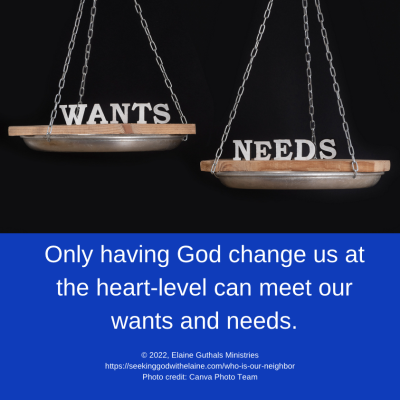
    That is why loving God is the greatest commandment. Only having God change us at the heart-level can meet our wants and needs.

    Only having God change us at the heart-level can meet our wants and needs.

    Another problem with the lawyer’s question was the motivation through which it was asked. He wanted to tempt Jesus, not really to learn from the answer he received.

    The Pharisees had a hard time finding something with which to condemn Jesus because He was fulfilling all the laws they so pushed. They kept looking for ways to trip Him up.

    Parker thought the lawyer was asking Jesus for His interpretation. The lawyer asked the question in hopes that Jesus would show how much he was against the Pharisees’ beliefs.

    Resource

    Jesus made the lawyer answer his own question. The answer was Deuteronomy 6: 5. “You shall love the Lord your God with all your heart and with all your soul and with all your might” (Deut. 6: 5 ESV).

    I see advantages both ways. If Jesus would have answered first, He would tell us exactly what God is expecting.

    But Jesus’ point was that the answer had already been given. The lawyer, as a Pharisee – an educated man – should be able to give the answer. It ended up he had the head knowledge (but did he have wisdom????)

    Ooo, yes! You have an eagle eye!

    The lawyer did add the part about loving our neighbor as ourselves. No, he didn’t rewrite Scriptures.

    It is in Leviticus. “You shall not take vengeance or bear a grudge against the sons of your own people, but you shall love your neighbor as yourself: I am the Lord” (Lev. 19: 18 ESV)

    The Practical Definition of Loving Our Neighbor

    “And he answered, ‘You shall love … your neighbor as yourself’” (Lk. 10: 25, 27 ESV)

    Loving our neighbors mean we love them as God does.

    But I, personally, don’t think the neighbor part is totally right. He said we are to love “… your neighbor as yourself” (Lk. 10: 27 ESV).

    If you have read past devotions, you know I have a problem with that. I’m not going to look them up right now, but I know I have gotten up on my soap box and talked about how we don’t love ourselves. If we don’t love ourselves, how are we going to love others?

    No, I am not supposed to love my neighbor only as I love me. I am supposed to love my neighbor as God loves me. To me, that is what the “… as yourself” (Lk. 10: 27 ESV) means.

    But I also see how this helps us approach others humbly. We know how flawed we are, so maybe our pride will take a day off while we love our neighbors.

    This all brings up a really good point. The law is about doing, but it is also about believing. We have to believe and obey.

    So, who is our neighbor? Jesus said that everyone is our neighbor – but Scriptures say in many instances that this especially refers to disciples loving other disciples.

    Foote gave us some practical ways that we are to love our neighbors.

    • Speak well of others.
    • Don’t repeat prejudicial reports about others.
    • Believe mistakes are made by negligence than wickedness.
    • Deal faithfully with others.

    Resource

    To me, this says that we look for the positive in others rather than the negative.  It does rest some on choosing to love others.

    But Robertson says there is more to it than that. He wrote, “… love cannot be produced by a direct action of the soul upon itself. You cannot love by a resolve to love.”

    Resource

    We have to love by doing the things that love require. We can only do this by meditating the love of God.

    Since God is love, we tap into it to love others. Dykes explained it this way. He wrote, “The affection which fulfils the whole law is an ethical principle, and not simply an instinctive or generous affection.”

    Resource

    Hmmm, an ethical principle. That circles back to spiritual graces.

    God isn’t interested in us just being a good, ethical person. He wants us focused on Him.

    Eternal Life

    “And he said to him, ‘You have answered correctly; do this, and you will live’” (Lk. 10: 28 ESV)

    We gain eternal life by obeying God’s command to love. 

    Let’s circle back to the discussion on eternal life.  The greatest commandments require love for fulfillment. We show that love by obeying all the other laws and commandments.

    But that isn’t why we have eternal life. Emmons wrote, “God does not promise eternal life to all who obey His commands, because their sincere and cordial obedience atones for their sin, and lays a foundation for pardon, for forgiveness, or justification in His sight. … Nor does God promise eternal life to those who obey Him, because their obedience merits eternal life. … He does promise eternal life to them because their obedience is a proper ground, reason, or condition, for bestowing upon them such a gracious and unmerited reward.”

    Resource

    We don’t earn eternal life by merit. We can’t earn it by doing the do’s and not doing the don’ts.

    We gain eternal life by asking Jesus to be our Savior and Redeemer. We get it by loving God.

    who-is-our-neighborFB

    Making the Connections

    When we say love, we are talking love, not tolerance. We have to obey God’s definition.

    We can’t compromise with the world.

    How Do We Apply This?

    Searching for and Seeking God

    Hearing His Word (Rom. 10: 17).
    Reading His Word (Rev. 1: 3).
    Praying to Him (Heb. 4: 16).
    Studying His Word (Ac. 17: 11).
    Meditating on His Word (Ps. 1: 1-2).
    Memorizing His Word (Ps. 119: 11).

    Father God. We look to You for the pure definition of love. That is what we want to possess for You and for others. Help us to love as You love us. Amen.

    What do you think?

    Leave me a comment below (about this or anything else) or head over to my Facebook group for some interactive discussion.

    If you don’t understand something and would like further clarification, please contact me.

    If you have not signed up for the email daily or weekly providing the link to the devotions and the newsletter, do so below.

    If God has used this devotion to speak with you, consider sharing it on social media.

  • Grace for Moral Principles and Social Affections

    We gain a renewed inner life in our spirits and minds through our moral principles and social affections. This daily devotional looks at how we grow and show the world evidence of that growth.

    Nuggets

    • We must diligently evaluate our relationship with God and pray for growth.
    • We show God within us by showing the world the fruit of the Spirit rewards.

    To read devotions in the At the Heart Level theme, click the button below.

    Devotions in The Goodness of Grace series

    For this series, we are looking at Griffith’s sermon entitled Grace, the Only Source of Goodness. In the first two devotions, we looked at our lives without God.

    Resource

    In the last devotion, we started looking at our lives with God. This focused on a renewed, inner life in our spirits and minds.

    Griffith said we did this through our moral principles and social affections. Let’s see if we can figure out where he was heading with this.

    Let’s Put It into Context

    Here is a running list of nuggets for the series.

    Moral Principles

    “Watch and pray that you may not enter into temptation. The spirit indeed is willing, but the flesh is weak” (Mt. 26: 41 ESV)

    We must diligently evaluate our relationship with God and pray for growth.

    During last year’s Redo for Godliness theme, we talked a lot about morals and spiritual graces. Spiritual graces are worldly morals that have been submitted to God to further His kingdom instead of enhancing this world.

    It isn’t enough to just be a moral person. We have to submit our lives to God — then be a moral person because that is how we exhibit God’s character.

    So, I was kind of scratching my head when I copied in the verse Griffith cited. How does it fit?

    Watchfulness is a continual conscious examination of ourselves and all events so that we may follow God in all things. Prayer is a two-way communication with God in which we pour out our soul to Him.

    How does examination and communication inform our moral principles?

    Well, think about it. If watchfulness is being cognizant of where we are in our spiritual walk, we are evaluating how close to the mark we are in our moral principles.

    How close are we to having God’s character? Where will the Holy Spirit being working in us to fix where we fall short?

    One way we grow in our spiritual graces is through prayer. We can’t grow ourselves. Only God can do that.

    But that means we are to expect answers to our prayers. In this case, we expect God go strengthen our spiritual graces.

    Edmond really slammed us as to our attitude about prayer. He wrote, “But it is to be greatly feared that many people feel, when their prayers are over, as if they had quite done with them; their only concern was to get them said.”

    Resource

    Ooo, baby. How many times do we just say the words because we know we are suppose to be praying, but we really don’t have the desire to be praying? Or we say we don’t know what to pray.

    This goes a step further, too. It implies we don’t expect God to answer our prayers. Ouch!

    We’ve talked before that sometimes we doubt God. Oh, we don’t doubt that He can do something. We doubt that He will do it for us in this instance.

    But how do we circle this back to moral principles and spiritual graces?

    Maybe that is where the second part of the verse comes in. “… The spirit indeed is willing, but the flesh is weak” (Mt. 26: 41 ESV).

    Pilkington reminded us that we are made up of a body, soul, and spirit. Our body is our physical body. Our soul is our spiritual part that is immortal. Our spirit is our renewed mind: God’s law has been written within us at the heart-level, so it has changed our character.

    Resource

    Our renewed mind where God’s laws are written on our hearts in order to change our character is willing to obey God. Our body, sometimes, feels like it has a mind of its own.

    It is back to that tug of war that Satan wages to get us to keep our focus off God. He keeps trying to get us to be disobedient.

    Notice Jesus didn’t put any qualifiers on who had the weak flesh — or the willing spirit. All disciples should have the willing spirit, but all will have the weak flesh.

    Screen Shot 2022-07-19 at 11.33.03 PM

    Let’s roost on willing spirit for a second. That means we are not to put qualifiers on our willingness to serve, either.

    • God, I want to witness for You, but only to my family.
    • God, I want to serve You in the church, but not somewhere where I have to do a lot of prep work.
    • God, I want to serve You, but don’t make me be a teacher.

    Oh, yeah. We are good at qualifiers.

    We are called to submit ourselves to whatever God calls us to do. We have to perform those services to the best of our abilities.

    One thing we have to be careful about is committing sins of will. Oh, we will commit the sins of the flesh.

    But when we commit sins of the will, we choose to sin. It is conscious disobedience toward God.

    Stillingfleet noted that one way we identify these sins is from the nature of moral actions. Does it have to do with the actions we perform or our condition at the time we perform it?

    Resource

    Our willing spirit should focus on growing our character to be more like God’s so that we will be more obedient to His Will than before.

    Social Affections

    “But the fruit of the Spirit is love, joy, peace, patience, kindness, goodness, faithfulness” (Gal. 5: 22 ESV)

    We show God within us by showing the world the fruit of the Spirit rewards.

    We’ve talked about this verse a lot lately. We’ve talked how the fruit of the Spirit are rewards given to us by the Holy Spirit. We also noted that these are attributes of God to which we are supposed to be striving to make our own dispositions.

    Think about the disposition part, but hook it to the word social. What are we supposed to learn here?

    Just as the song and Scriptures say (Mt. 5: 15), we are not to hide the light of God away. This includes evidence of the fruit of the Spirit within us.

    Instead, Toplady told us how the Holy Spirit’s work is to impact us. He wrote, “When the Holy Ghost shines upon our souls, part of the grace He inspires is absorbed to our own particular comforts; part of it is reflected back in acts of love, joy, prayer, praise; and part of it is refracted every way in acts of benevolence, beneficency, and all moral and social duty.”

    Resource

    We don’t keep our rewards and newfound character to ourselves. We use what God has given us to work to expand His kingdom.

    Sanderson compared the love, peace, patience, kindness, goodness, and faithfulness that the Spirit gives us to that of the world. He argued that the worlds brand is very thin.

    Resource

    Worldview people would probably argue that. They see the world’s form of love, which includes tolerance, as greater than that of disciples’ love.

    To me, the tolerance does not fortify love. It cheapens it.

    We also need to look at this from the perspective that we cannot out love God. Because we have been given much, we should give much. “… Everyone to whom much was given, of him much will be required, and from him to whom they entrusted much, they will demand the more” (Lk. 12: 48 ESV).

    Making the Connections

    We talked in the last devotion that we have two natures in us. The sinful pull is strong within us.

    We have to choose to keep our spirit, mind, and the inward man focused on God. We do that by choosing daily to renew our inner life through getting our moral principles and social affections to be mature.

    How Do We Apply This?

    • Totally commit ourselves to whatever service God calls us to do.
    • Diligently watch for evil that will tarnish our character.
    • Evaluate our strengths and weaknesses when it comes to our spiritual graces.
    • Determine which sins we commit are sins of will and which are sins of the flesh.
    • Nurture all of the spiritual graces.
    • Grow in grace.
    • Be filled with the Holy Spirit.
    • Pray for growth.

    Resource

    Father God. We pray that we grow in Your grace so that we may show the world Your love. We want to have Your character. Amen.

    What do you think?

    Leave me a comment below (about this or anything else) or head over to my Facebook group for some interactive discussion.

    If you don’t understand something and would like further clarification, please contact me.

    If you have not signed up for the email daily or weekly providing the link to the devotions and the newsletter, do so below.

    If God has used this devotion to speak with you, consider sharing it on social media.

  • The Spirit, the Mind, and the Inward Man

    The spirit, mind, and inward man are opposite to our sinful, fleshly nature. This daily devotional looks at the conflict between our sinful nature and our renewed nature.

    Nuggets

    • Our spirit, mind, and the inward man are all intricately tied together.
    • The problem is that our desire to delight in God’s laws comes into conflict with our sinful nature.

    To read devotions in the At the Heart Level theme, click the button below.

    Devotions in The Goodness of Grace series

    For this series, we are looking at Griffith’s sermon entitled Grace, the Only Source of Goodness. In the first two devotions, we looked at our lives without God.

    Resource

    Our lives with God focus on a renewed, inner life in our spirits and minds.

    Let’s Put It into Context #1

    Here is a running list of nuggets for the series.

    Tied Together

    “For I delight in the law of God, in my inner being” (Rom. 7: 22 ESV)

    Our spirit, mind, and the inward man are all intricately tied together.

    Our hearts and minds are the core of us. The heart is the seat of our thoughts, intellect, will, and affections that produces our character, from which all things spring, including controlling our spiritual position. Our mind is a component of the soul that controls our will — where we process and make judgments and decisions.

    Our spirit is our renewed mind: God’s law has been written within us at the heart-level, so it has changed our character.

    Delight in the law has to do with satisfaction and pleasure. Lyth equated the it with the tendency of the heart. We sure want our inclinations to be to want to do what is good and right in God’s standards.

    Resource

    Well, think about it. Once we accept God’s Plan of Salvation, we are to begin to imitate Him and gain His character. We learn what His character is through the laws and commandments. Salvation regenerates our spirit and makes us a new creation.

    Salvation is the gift of life through the deliverance from condemnation and sin to acceptance and holiness and changes us from being spiritually dead to spiritually alive.

    • Sin is not believing that Jesus is our Savior to save us from our actions by humans that disobey God and break one of His reasonable, holy, and righteous laws and commandments, goes against a purpose He has for us, or follows Satan’s promptings.
      • Holy means to be set apart — because of our devotion to God — to become perfect, and morally pure while possessing all virtues.
        • Perfection means we reach a state of maturity because the combination of the spiritual graces form, when all are present, spiritual wholeness or completeness — holy, sanctified, and righteous.
          • Spiritual graces are worldly morals that have been submitted to God to further His kingdom instead of enhancing this world.
          • Sanctified means to be set free from sin.
          • Righteous means we are free from sin because we are following God’s moral laws.
        • Pure means not being sinful or having the stain of sin. 
        • Virtues are standards of moral excellence.
    • Holiness is the transcendent excellence of His nature that includes elements of purity, dedication, and commitment that lead to being set apart.
      • Purity means possessing God’s moral character, having eliminated the stain of sin.
    • Spiritual death is the spiritual separation from God that occurred as a consequence of Adam and Eve’s original sin.
      • The spiritually alive are those who have ABCDed, so they are no longer separated from God.

    Regeneration is being changed from spiritually dead to spiritually alive and the internal new birth and requickening that God brings about through the work of the Holy Spirit.

    The ABCDs of Salvation

    If you have not become a believer in Christ, please read through the
    Plan of Salvation and prayerfully consider what God is asking you to do.

    A – admit our sins
    B – believe His Son Jesus is our Redeemer
    C – confess God as Sovereign Lord

    D – demonstrate that commitment by making any changes needed in our lives to
    live the way in which God has called us

    The Disciple’s Job Description

    Glossary

    We can only truly delight in the law when the Holy Spirit opens the eyes of our heart.

    To read a related devotion, click the button below.

    The War within Us

    “but I see in my members another law waging war against the law of my mind and making me captive to the law of sin that dwells in my members” (Rom. 7: 23 ESV)

    The problem is that our desire to delight in God’s laws comes into conflict with our sinful, fleshly nature.

    We have two natures in us — God’s and Adam’s. Our sinful nature is pulling us to disobey God.

    To read a related devotion, click the button below.

    Ooo, baby. Does that breed conflict or what?!?

    We are like Paul. He had just told the Romans that “I do not understand what I do. For what I want to do I do not do, but what I hate I do. And if I do what I do not want to do, I agree that the law is good. As it is, it is no longer I myself who do it, but it is sin living in me. For I know that good itself does not dwell in me, that is, in my sinful nature. For I have the desire to do what is good, but I cannot carry it out. For I do not do the good I want to do, but the evil I do not want to do—this I keep on doing. Now if I do what I do not want to do, it is no longer I who do it, but it is sin living in me that does it” (Rom 7: 15-20 NIV).

    Oh, yeah. Paul knew what was right and wrong. He wrote the book on it!

    Paul couldn’t quit sinning after conversion — and He personally talked with Jesus!

    That tells us how strong the sinful inner pull is. That tells us two things:

    • We would never have been saved if Jesus hadn’t paid the penalty for our sins.
    • We can’t fight sin ourselves.

    Sometimes, I think that we believe we have to clean ourselves up. That isn’t what God wants. He wants to be the One to fight our sin battles because we never could.

    But look it this way. We’ve said before that we grow more when we have the struggles. Not only that, but the struggles also show that we are God’s children.

    Glossary

    Have you heard of non-believers saying they would never believe in God because they don’t want Him telling them what to do and not do? They are going to hate the law.

    McCheyne felt that non-believers hate the law because of its purity, breadth and unchangeableness. Judgement applies to all sin — the seen type or the unseen type.

    Resource

    The hatred for the law changes upon conversion. The laws get written on our hearts.

    Yep. Hearts and minds. Full circle to that.

    the-spirit-the-mind-and-the-inward-manFB

    Making the Connections #1

    Hodge made a statement that, to me, validates something I have been saying lately when he talked about different senses of the term law. He wrote, “That which binds: hence the law of God as a rule of life whether revealed in the Scriptures or in the heart.”

    I’ve been saying that God doesn’t tell us everything in the Scriptures. He leaves some to specific revelation to tell us in our hearts.

    But then Hodge did go on to disagree with me. He wrote, “The whole revelation of God as contained in the Scriptures.”

    Resource

    I just don’t think everything can be contained in a book. What God gives us is the framework on which to make our decisions when facing trials and testing.

    The Holy Spirit prompts us when we are in the struggle to apply what the Scriptures say. He is further revealing to us what is meant.

    If you are like me, you have sometime questioned God why we still have to struggle after we have accepted salvation. Bird explained that struggling — and obediently enduring — shows that we are fit to enter Heaven.

    Resource

    No, we are going to mess up and be disobedient. But our struggles will show God where our hearts are.////////////////////////////////////////////////////////////////

    Making the Connections #2

    But how does all of this tie to grace? Drake explained when he presented Grotius’ list of laws.

    • “The law of God …
    • “The law of the mind …
    • “The law of the members …
    • “The law of sin …
    • “The law of original sin propagated by generation …
    • “The law of sanctifying grace infused in regeneration …”

    Resource

    We are given the law of God. It is opposite to the law of sin.

    Mankind committed the original sin, causing it to be in all of us. Therefore, we have the law of the members within us.

    But we are given the law of the mind. We get to judge which we are going to follow — good or evil.

    When we choose to follow good, we are given the law of sanctifying grace because we are given regeneration.

    How Do We Apply This?

    • Show our changed spirit by studying and practicing — conforming to — God’s laws and commandments found in His Word.
    • Witness to others.
    • Take pleasure in the poetry of the Scriptures.
    • Take delight in its wisdom.
    • Take delight in its purity.
    • Delight in the law even when it is convicting us of our sin.
    • Seek God, which includes studying and meditating on His Word.
    • Don’t expect too much from this world.
    • Don’t get discouraged by failure.
    • Don’t give up when we struggle.
    • Put on — and appreciate — the armor of God.
    • Be humble.

    Searching for and Seeking God

    Hearing His Word (Rom. 10: 17).
    Reading His Word (Rev. 1: 3).
    Praying to Him (Heb. 4: 16).
    Studying His Word (Ac. 17: 11).
    Meditating on His Word (Ps. 1: 1-2).
    Memorizing His Word (Ps. 119: 11).

    Resource

    Father God. We praise You that You renew the inner us. Even though we still have the capacity to sin, we have the capacity to choose to obey You. Help us to navigate the Sanctification Road so that we may become more like You. Amen.

    What do you think?

    Leave me a comment below (about this or anything else) or head over to my Facebook group for some interactive discussion.

    If you don’t understand something and would like further clarification, please contact me.

    If you have not signed up for the email daily or weekly providing the link to the devotions and the newsletter, do so below.

    If God has used this devotion to speak with you, consider sharing it on social media.

  • What is the Spirit of Wisdom? (2.0)

    Paul wrote to the Ephesians that disciples in Christ should receive a Spirit of wisdom. God doesn’t want us to not be knowledgeable. He wants to be our Teacher. This daily devotional looks at what the Spirit of wisdom is.

    Nuggets

    • God uses the Holy Spirit to impart His wisdom.
    • God will reveal Himself to us — giving us understanding for what we can read in the Bible and understanding for things God Himself will reveal to us.
    • Knowledge comes before wisdom and holiness.
    • Our growth particularly comes when He supplies wisdom through experiences.

    Devotions in the The Letter of Paul to the Ephesians series

    The end of Chapter 1 in Ephesians is a prayer. God must be to whom we pray and the focus of our prayers. We need to approach Him asking for His gifts, knowing He will give them to us.

    One of the things for which we are to ask is the provision of wisdom. “If you need wisdom, ask our generous God, and he will give it to you. He will not rebuke you for asking” (Jas. 1: 5 NLT). Even though we are disciples, we still need wisdom from above. (Isn’t that what disciples means — being students?)

    Let’s Put It into Context #1

    Here is a running list of nuggets for the series.

    Let’s Put It into Context #2

    Wisdom is an enlightened acceptance of God’s principles, gained through knowledge, discernment, and good sense, that is put into practice through salvation, increasing our goodness and virtue.

    • Discernment means we can evaluate the situation and recognize right from wrong. 
    • God’s goodness is His holy, pure, and righteous behavior.
      • God’s holiness is the transcendent excellence of His nature that includes elements of purity, dedication, and commitment that lead to being set apart.
      • God’s purity stems from the fact that He cannot sin.
      • God’s righteousness is the result of His being pure.

    Knowledge is the intellectual comprehension of a fact or gaining familiarity with something by experiencing it.

    Spiritual Perception

    “I pray that the God of our Lord Jesus Christ, the glorious Father, would give you the Spirit of wisdom and revelation in the knowledge of him” (Eph. 1: 17 CSB)

    God uses the Holy Spirit to impart His wisdom.

    Most of all God wants us to have spiritual knowledge. “When the Spirit of truth comes, he will guide you into all the truth, for he will not speak on his own authority, but whatever he hears he will speak, and he will declare to you the things that are to come” (Jn. 16: 13 ESV emphasis added).

    God uses His Holy Spirit to grow our faith. The Holy Spirit will teach us what God has instructed Him to say.

    The promptings of the Holy Spirit influence us to to seek God and learn more of Him. The promptings urge us to learn more deeply of Him.

    Searching for and Seeking God

    Hearing His Word (Rom. 10: 17).
    Reading His Word (Rev. 1: 3).
    Praying to Him (Heb. 4: 16).
    Studying His Word (Ac. 17: 11).
    Meditating on His Word (Ps. 1: 1-2).
    Memorizing His Word (Ps. 119: 11).

    In verse 13 of Ephesians 1, it says, “In him you also were sealed with the promised Holy Spirit when you heard the word of truth, the gospel of your salvation, and when you believed” (CSB).

    Ephesus was a port city. It was also on several trade routes. Goods passed through the city, probably daily. In order to show who owned the goods being shipped, a seal was placed on it.

    There are several verses that talk about being sealed by God. One of those verses says, “And don’t grieve God’s Holy Spirit. You were sealed by him for the day of redemption” (Eph. 4: 30 CSB).

    God is the one who seals us. A second verse says, “But it is God who establishes us with you in Christ, and has commissioned us; he has put his seal upon us and given us his Spirit in our hearts as a guarantee as a down payment” (II Cor. 1: 21-22 CSB).

    Knowing God

    God will reveal Himself to us — giving us understanding for what we can read in the Bible and understanding for things God Himself will reveal to us.

    The Holy Spirit provides us with spiritual knowledge so that we may know God. When God opens the eyes of our hearts, we see Him more clearly. He reveals Himself to us in our core, which is where He lives in us.

    To read a related devotion, click the button below.

    As we learn more of Him each day, we are better equipped to live our lives as disciples of Jesus. It becomes easier to imitate Him.

    To read a related devotion, click the button below.

    Not Holiness

    Knowledge comes before wisdom and holiness.

    We have to have knowledge to learn of Jesus and what He has done for us. Remember, knowledge is comprehension.

    Wisdom is using that knowledge to make a choice. In this instance, the choice is whether we are going to accept Jesus as Savior and Redeemer or not.

    • Only then do we begin navigating the Sanctification Road, which brings us to holiness. Sanctification is the transformation of mind, body, and soul, which begins with regeneration; gradually changes our nature and morals through the promptings of the Holy Spirit; and ends with perfected state of spiritual wholeness or completeness.   
    • Regeneration is being changed from spiritually dead to spiritually alive and the internal new birth and requickening that God brings about through the work of the Holy Spirit to give us new character.
      • Spiritual death is the separation from God that occurred as a consequence of Adam and Eve’s original sin.
        • The spiritually alive are those who have ABCDed, so they are no longer separated from God.  
    • Perfection means we reach a state of maturity because the combination of the spiritual graces form, when all are present, spiritual wholeness or completeness — holy, sanctified, and righteous.
      • Spiritual graces are worldly morals that have been submitted to God to further His kingdom instead of enhancing this world. 
      • Sanctified means to be set free from sin. 
      • Righteous means we are free from sin because we are following God’s moral laws.

    The ABCDs of Salvation

    If you have not become a believer in Christ, please read through the
    Plan of Salvation and prayerfully consider what God is asking you to do.

    A – admit our sins
    B – believe His Son Jesus is our Redeemer
    C – confess God as Sovereign Lord

    D – demonstrate that commitment by making any changes needed in our lives to
    live the way in which God has called us

    The Disciple’s Job Description

    Glossary

    We are to strive to be holy like God? “But now you must be holy in everything you do, just as God who chose you is holy. For the Scriptures say, ‘You must be holy because I am holy’” (I Pet. 1: 15-16 NLT).

    We can only get to the holiness by having heart knowledge of Jesus and using our wisdom to daily choose to follow Him.

    Revelation

    Our growth particularly comes when He supplies wisdom through experiences.

    The verse said, “… would give you the Spirit of wisdom and revelation in the knowledge of him” (Eph. 1: 17 CSV). A revelation is communicating a previously unknown truth.

    Revelation is more how the wisdom is being presented to us. God can speak to us through His Word, through others, and through our experiences.

    I don’t know if you are like me. I have to learn by doing. Sometimes, that means I have to learn by making mistakes.

    It is during those times that we begin to feel that we aren’t worthy enough to earn the salvation. We aren’t worthy enough to earn the salvation. Luckily, God doesn’t have that as a criteria.

    To read a related devotion, click the button below.

    Whatever way God chooses to use, He is revealing Himself to us. He wants us to know Him — the Sovereign God, Creator, Ruler and Judge.

    what-is-the-spirit-of-wisdom-2.0FB

    Making the Connections

    If you look at the rest of the chapter, in some versions it is all in the same sentence actually started in verse 15. Let’s look at a version that breaks it up a little more.

    “For this reason, because I have heard of your faith in the Lord Jesus and your love toward all the saints, I do not cease to give thanks for you, remembering you in my prayers, that the God of our Lord Jesus Christ, the Father of glory, may give you the Spirit of wisdom and of revelation in the knowledge of him, having the eyes of your hearts enlightened, that you may know what is the hope to which he has called you, what are the riches of his glorious inheritance in the saints, and what is the immeasurable greatness of his power toward us who believe, according to the working of his great might that he worked in Christ when he raised him from the dead and seated him at his right hand in the heavenly places, far above all rule and authority and power and dominion, and above every name that is named, not only in this age but also in the one to come. And he put all things under his feet and gave him as head over all things to the church, which is his body, the fullness of him who fills all in all.” (Eph. 1: 15-23 ESV).

    Yep, still a classic Paul run-on sentence. It makes us want to just shake the boy and remind him the value of a period.

    Paul talks about hope and inheritance (along with a lot of other things). We talked about inheritance in a past devotion.

    To read a related devotion, click the button below.

    Think of all the hope that wisdom brings. When we know God and what He is expecting of us, we can tap into the joy that comes from God. Our whole outlook gets better, and we can hope for a brighter tomorrow.

    How Do We Apply This?

    Bottom line is we just have to get to know God better. If we haven’t surrendered our life to Him, we need to do so now.

    If we have, we have to learn more of God. To do that we need to be hearing His Word, reading it, studying it, meditating on it, and memorizing it. All through that, we need to be in prayer, asking God to provide the knowledge of Himself.

    To read a related devotion, click the button below.

    Yes, I have said it before, and I will say it again now and in the future. We have to dive into His Word. That is where He will make Himself known to us.

    If we will read something and then think about it, God will reveal Himself to us. He will make the connection to other verses for us. He will drop it all in our minds, where we can process it so we can understand Him.

    Understanding is good. Wisdom is even better. Be a seeker of wisdom.

    Searching for and Seeking God

    Hearing His Word (Rom. 10: 17).
    Reading His Word (Rev. 1: 3).
    Praying to Him (Heb. 4: 16).
    Studying His Word (Ac. 17: 11).
    Meditating on His Word (Ps. 1: 1-2).
    Memorizing His Word (Ps. 119: 11).

    Lord, we do feel so unworthy at times. Luckily, You don’t depend on our accomplishments to get us into heaven. Help us to grow in grace and knowledge of You (II Pet. 3: 18). May we keep our focus on You. Amen.

    What do you think?

    Leave me a comment below (about this or anything else) or head over to my Facebook group for some interactive discussion.

    If you don’t understand something and would like further clarification, please contact me.

    If you have not signed up for the email daily or weekly providing the link to the devotions and the newsletter, do so below.

    If God has used this devotion to speak with you, consider sharing it on social media.

  • Unity, not Dissension

    Disciples are to be unified under Christ. This daily devotional looks at how God unifies believers while Satan attempts to sow chaos.

    Nuggets

    • Baptism unifies all believers to Christ.
    • God promotes unity while Satan sows dissension.

    Devotions in the Never Alone: The Holy Spirit in Our Lives series

    God isn’t calling disciples to be divided. He wants us to be unified.

    But it is more than just agreement on worldview issues. God wants us to be unified in Jesus.

    Let’s Put It into Context #1

    Here is a running list of nuggets for the series.

    Let’s Put It into Context #2

    Spiritual gifts are skills and abilities given to us by God through the Holy Spirit so that we can serve Him.

    There are several lists identifying spiritual gifts. They are found in Romans 12: 6-8, 1 Corinthians 12: 8-10 and 28-30, Ephesians 4: 11, and 1 Peter 4: 11.

    Of course, they are not all the same. Here is a compilation of the lists.

    • Faith
    • Apostle
    • Prophecy
    • Pastor/preaching/speaker
    • Evangelist
    • Teaching
    • Miracles
    • Healer
    • Tongues and interpretation of tongues
    • Serving
    • Encouragement
    • Giving
    • Leadership/administration
    • Mercy
    • Word of wisdom
    • Word of knowledge
    • Distinguishing between spirits

    Baptized into Unity

    “For in one Spirit we were all baptized into one body — Jews or Greeks, slaves or free — and all were made to drink of one Spirit” (I Cor. 12: 13 ESV)

    Baptism unifies all believers to Christ.

    Let’s start at the last half of the verse. Only by growing to have God’s character is have we “… made to drink of one Spirit” (I Cor. 12: 13 ESV).

    Salvation and baptism must start us on the Sanctification Road. If we don’t unite with Christ and show how His redemption has really completed our repentance, we don’t show evidence of our salvation.

    Salvation is the gift of life through the deliverance from condemnation and sin to acceptance and holiness and changes us from being spiritually dead to spiritually alive.

    • Sin is not believing that Jesus is our Savior to save us from our actions by humans that disobey God and break one of His reasonable, holy, and righteous laws and commandments, goes against a purpose He has for us, or follows Satan’s promptings.
      • Holy means to be set apart — because of our devotion to God — to become perfect, and morally pure while possessing all virtues.
        • Perfection means we reach a state of maturity because the combination of the spiritual graces form, when all are present, spiritual wholeness or completeness — holy, sanctified, and righteous.
          • Spiritual graces are worldly morals that have been submitted to God to further His kingdom instead of enhancing this world.
          • Sanctified means to be set free from sin.
          • Righteous means we are free from sin because we are following God’s moral laws.
        • Pure means not being sinful or having the stain of sin. 
        • Virtues are standards of moral excellence.
    • Holiness is the transcendent excellence of His nature that includes elements of purity, dedication, and commitment that lead to being set apart.
      • Purity means possessing God’s moral character, having eliminated the stain of sin.
    • Spiritual death is the spiritual separation from God that occurred as a consequence of Adam and Eve’s original sin.
      • The spiritually alive are those who have ABCDed, so they are no longer separated from God.

    Baptism is the symbol of our conversion experience, providing the physical evidence that we have died and been buried to sin and have risen in a new spiritual life with Jesus.
    Sanctification is the transformation of mind, body, and soul, which begins with regeneration; gradually changes our nature and morals through the promptings of the Holy Spirit; and ends with perfected state of spiritual wholeness or completeness.

    • Regeneration is being changed from spiritually dead to spiritually alive and the internal new birth and requickening that God brings about through the work of the Holy Spirit to give us new character.

    The ABCDs of Salvation

    If you have not become a believer in Christ, please read through the
    Plan of Salvation and prayerfully consider what God is asking you to do.

    A – admit our sins
    B – believe His Son Jesus is our Redeemer
    C – confess God as Sovereign Lord

    D – demonstrate that commitment by making any changes needed in our lives to
    live the way in which God has called us

    The Disciple’s Job Description

    Glossary

    Salvation draws us into unity with Christ. We are told that He dwells within us and that we are in Him.

    • “To them God chose to make known how great among the Gentiles are the riches of the glory of this mystery, which is Christ in you, the hope of glory” (Col. 1: 27 ESV).
    • “And because of him you are in Christ Jesus, who became to us wisdom from God, righteousness and sanctification and redemption” (I Cor. 1: 30 ESV).

    That encompasses two different aspects. It means that – even though Jesus is a Spirit – He will provide for us. Our part is to have faith in Him.

    Faith is a gift from God that enhances the conviction that the doctrines revealed in God’s Word are true, even if we do not understand all aspects of them, a belief which impacts our lives and distinguishes us from others.

    Glossary

    We need to seek this oneness with Christ. That is how we navigate the Sanctification Road. That is how we validate our salvation.

    For me, one of the key concepts in the verse is “… into one body …” (I Cor. 12: 13 ESV). We can’t think that this just means everyone in the church should get along.

    What it tells me is that this follows the two greatest commandments. We are to put God first and mankind second.

    Glossary

    Fenner read this to mean that we are to have a common life with other disciples. We can read this in a couple of ways.

    Resource

    We have a common life because all disciples are to embody God’s character. Non-believers are to know we are disciples because we have a character different than theirs.

    All are to follow the same laws and commandments. We can’t compromise with the worldview to make ourselves appear more like them.

    Why does the Spirit tie all of us together? Only disciples have access to God. Non-believers only gain access to Him when they profess their faith in Jesus Christ.

    We are tied together because of the same Spirit is in all disciples. That makes us of one heart.

    We are tied together because of the same Spirit is in all disciples. That makes us of one heart.

    Unity under God or Dissension under Satan

    “For the body does not consist of one member but of many” (I Cor. 12: 14 ESV)

    God promotes unity while Satan sows dissension.

    Diversity among members is a favorite subject of Paul’s.

    • “For as in one body we have many members, and the members do not all have the same function” (Rom. 12: 4 ESV).
    • “Rather, speaking the truth in love, we are to grow up in every way into him who is the head, into Christ, from whom the whole body, joined and held together by every joint with which it is equipped, when each part is working properly, makes the body grow so that it builds itself up in love” (Eph. 4: 15-16 ESV).

    Murray argued that it is just the way God takes us through the stages of development. He makes a good point that we each have different wants.

    I also read that to mean we have are looking to a relationship for different reasons. Some see salvation as an opportunity to worship the One true God. Others see it as fire insurance or a way to get the good blessings out of Him. I am sure there are a slew of reasons in between those two.

    Murray made an interesting statement. He wrote, “There is no other way by which society can be held together save by the principle of mutual benevolence, ministering to mutual dependence. The strong must bear the infirmities of the weak, or the universal order of creation would become chaotic and destructive. For the universe is peopled with weakness.”

    Resource

    Satan wants to delude us into thinking that belief in God tears us apart. It doesn’t.

    Satan tears society apart. He thrives in chaos. He sows dissension.

    God wants unity.

    unity-not-dissensionFB

    Making the Connections

    Stennett discussed some issues that we raised in the last devotion. He reminded us that mankind is given different intellectual capacities and natural tempers. He wrote, “There are, in the language of Scripture, babes, young men, and fathers in Christ; some weak, and others strong in faith.”

    Resource

    What Stennett stressed was that these are not ways that God tests us. Instead, he argues that we may be given different dispensations, forms, and means of religion.

    But we can’t read into that the idea that religion itself is diverse. Over and over again Paul tells us that “there is one body and one Spirit — just as you were called to the one hope that belongs to your call — one Lord, one faith, one baptism, one God and Father of all, who is over all and through all and in all” (Eph. 4: 4-6 ESV).

    We have to let God work in someone else’s life the way He chooses to work. We may all get to the same end of the Sanctification Road – we just go on different narrow paths to get there.

    How Do We Apply This?

    • Seek God, especially by reading and hearing His Word.
    • Grow in faith of Christ.
    • Humble ourselves before God.
    • Faithfully navigate the Sanctification Road.
    • Allow others to navigate their Sanctification Road in the way in which God calls them.
    • Embrace our calling to be a holy priesthood.
    • Be different than the world – don’t compromise with the worldview.

    Searching for and Seeking God

    Hearing His Word (Rom. 10: 17).
    Reading His Word (Rev. 1: 3).
    Praying to Him (Heb. 4: 16).
    Studying His Word (Ac. 17: 11).
    Meditating on His Word (Ps. 1: 1-2).
    Memorizing His Word (Ps. 119: 11).

    Resource

    Father God. We long for unity with You and other disciples. We don’t want to fall into Satan’s chaos. Help us to navigate the Sanctification Road as we should and allow others to navigate theirs. Amen.

    What do you think?

    Leave me a comment below (about this or anything else) or head over to my Facebook group for some interactive discussion.

    If you don’t understand something and would like further clarification, please contact me.

    If you have not signed up for the email daily or weekly providing the link to the devotions and the newsletter, do so below.

    If God has used this devotion to speak with you, consider sharing it on social media.

  • Unity in Christ

    Regardless of what spiritual gifts we have and what level they are, we are called to be unified in Christ. This daily devotional looks at how our focus must remain on Jesus as head of the Church.

    Nuggets

    • The emphasis should be on unity in Christ rather than diversity of gifts. 
    • The Church is one because we serve One Savior — Jesus Christ our Lord 
    • God ties our spiritual gifts with abilities that He has already given us. 
    • Gifts provide structure to the church. 

    Devotions in the Never Alone: The Holy Spirit in Our Lives series

    Disciples are to use their spiritual gifts to expand God’s kingdom. That includes growing the Church – our local churches and the Church as a whole. 

    Let’s look at what Paul has to say. 

    Let’s Put It into Context #1

    Here is a running list of nuggets for the series.

    Let’s Put It into Context #2

    Spiritual gifts are skills and abilities given to us by God through the Holy Spirit so that we can serve Him.

    There are several lists identifying spiritual gifts. They are found in Romans 12: 6-8, 1 Corinthians 12: 8-10 and 28-30, Ephesians 4: 11, and 1 Peter 4: 11.

    Of course, they are not all the same. Here is a compilation of the lists.

    • Faith
    • Apostle
    • Prophecy
    • Pastor/preaching/speaker
    • Evangelist
    • Teaching
    • Miracles
    • Healer
    • Tongues and interpretation of tongues
    • Serving
    • Encouragement
    • Giving
    • Leadership/administration
    • Mercy
    • Word of wisdom
    • Word of knowledge
    • Distinguishing between spirits

    Multiples of One 

    “For just as the body is one and has many members, and all the members of the body, though many, are one body, so it is with Christ” (I Cor. 12: 12 ESV) 

    The emphasis should be on unity in Christ rather than diversity of gifts. 

    There are many multiples in this world. No two are alike. 

    This doesn’t just apply to people, even twins. Think about when a cat has kittens. Some may look alike. Some may look totally different. 

    Growing up, when a baby was born that didn’t look like either parent, the saying went that s/he looked like the milkman. Looking different didn’t make them not their parents’ child. 

    Paul was talking about unity and diversity in the church. There is diversity in unity, but there is unity because of Whose we are. 

    There is diversity in unity, but there is unity because of Whose we are. 

    Unity in One 

    The Church is one because we serve One Savior — Jesus Christ our Lord. 

    No, we aren’t supposed to rejoice in our differences. We are to serve God the way in which He calls. 

    When we work together, we are better able to withstand Satan’s darts. 

    Gifts from the One 

    God ties our spiritual gifts with abilities that He has already given us. 

    Goulburn explained how he believes our spiritual are chosen for us. He wrote, “These supernatural gifts had something in the natural endowments of the possessor’s mind corresponding to them. Thus, e.g., corresponding to the gift of tongues, some persons have now a great facility of acquiring languages; corresponding to the girt of prophecy, we find in others a natural gift of high and fervid eloquence; some persons even nowadays have such a wonderful art of imparting what they know, that we can hardly be said to have lost the gift of teaching; others are admirably adapted for government; while even the gift of miracles itself rests on the power of mind over matter, of which power we have exemplifications in a natural way even nowadays.” 

    Resource

    That makes being jealous of another’s spiritual gifts fruitless. We can be jealous all we want, but if we don’t have the ability within us, we would never be successful. 

    Let’s say God relents and does give us the spiritual gift we really want. That doesn’t mean we are going to have the opportunities to use it. 

    If God doesn’t call us to the work, He is not going to provide opportunities for us to do it. 

    God will provide opportunities for the work to which He has called us. 

    Gifts in the Church 

    Gifts provide structure to the church. 

    Boardman put a whole different spin on it. Where Goulburn looked at what spiritual gifts meant individually, Boardman looked at spiritual gifts as to their importance in the church.

    Resource

    We know God is a God of order. We also know that God likes structure. 

    Case in point. Remember when Moses was leading the Wilderness Wanderers in wandering around the wilderness, they wandered to where his father-in-law lived. Jethro was concerned for Moses, so he suggested a structure. 

    “You and these people who come to you will only wear yourselves out. The work is too heavy for you; you cannot handle it alone. Listen now to me and I will give you some advice, and may God be with you. You must be the people’s representative before God and bring their disputes to him. Teach them his decrees and instructions, and show them the way they are to live and how they are to behave. But select capable men from all the people—men who fear God, trustworthy men who hate dishonest gain—and appoint them as officials over thousands, hundreds, fifties and tens. Have them serve as judges for the people at all times, but have them bring every difficult case to you; the simple cases they can decide themselves. That will make your load lighter, because they will share it with you. If you do this and God so commands, you will be able to stand the strain, and all these people will go home satisfied.” (Ex. 18: 18-23 NIV). 

    Those officials appointed over thousands would need different gifts than those appointed over tens. Yet, there is a structure to perform the work that God calls His church to perform. 

    Why wouldn’t God have several different versions of the church – all professing Jesus as our Savior and Redeemer – because He knows we all come from different places and are searching for different things? Yes, our search leads us ultimately is Him. 

    But how we get there differently. Just like the Sanctification Road is different for all of us. Sanctification is the transformation of mind, body, and soul, which begins with regeneration; gradually changes our nature and morals through the promptings of the Holy Spirit; and ends with perfected state of spiritual wholeness or completeness.  

    • Regeneration is being changed from spiritually dead to spiritually alive and the internal new birth and requickening that God brings about through the work of the Holy Spirit to give us new character.
      • Spiritual death is the separation from God that occurred as a consequence of Adam and Eve’s original sin.
        • The spiritually alive are those who have ABCDed, so they are no longer separated from God.  
      • Perfection means we reach a state of maturity because the combination of the spiritual graces form, when all are present, spiritual wholeness or completeness — holy, sanctified, and righteous.
        • Spiritual graces are worldly morals that have been submitted to God to further His kingdom instead of enhancing this world. 
        • Sanctified means to be set free from sin. 
        • Righteous means we are free from sin because we are following God’s moral laws. 

    The ABCDs of Salvation

    If you have not become a believer in Christ, please read through the
    Plan of Salvation and prayerfully consider what God is asking you to do.

    A – admit our sins
    B – believe His Son Jesus is our Redeemer
    C – confess God as Sovereign Lord

    D – demonstrate that commitment by making any changes needed in our lives to
    live the way in which God has called us

    The Disciple’s Job Description

    Glossary

    We can’t be having fights of interpretation on the minor things. We have to stand firm on the essential doctrines. 

    These essential doctrines are 

    • God is the eternal God Who has authority and control of our lives.
    • Jesus is the Messiah come to pay the penalty for our sins by shedding His blood.
    • He came to call all people to salvation.
    • He could do this because He was sinless and divine.
    • We have to believe in Jesus and repent of our sins.
    • When we accept His Plan of Salvation, God becomes our Father.
    • Believe Jesus is the only way to gain salvation and is the head of the church.
    • We are called to follow God’s laws and commandments as described in the Scriptures.

    We have to remember that we are all dependent on Jesus for salvation and God for everything else. 

    unity-in-christFB

    Making the Connections

    We all come from different places. Someone who lost a parent early in life is going to have totally different experiences than I did, growing up with two loving parents. Someone who grew up in New York, Los Angeles, even Chicago, is going to have different experiences than I did growing up on a farm outside of a little village that seemingly had more coon dogs than people. 

    Their religion is going to be different – let alone their relationship with God. 

    Goulburn said something that I thought was very important. He wrote, “God’s purpose is that each Christian should exhibit, in the peculiarity of his circumstances, education, moral temperament, and mental endowments, a new specimen of redeeming love and grace. By various discipline here He fits and polishes each living stone for the place which it is destined to occupy in the spiritual temple; and when all the stones are made ready, He will build them together each into his place, and exhibit to men and angels their perfect unity.” 

    Resource

    God puts us in situations and in specific environments so that we can grow the abilities He has given us. He has given us what we need to do His work. 

    How Do We Apply This?

    • Rejoice in the gifts God has given others. 
    • Use our character and experiences along with the diversity of gifts  to perform God’s work.  
    • Unite the church in sympathy 

    Resource

    Father God. We want to be unified in Jesus. We want to love others while we serve Him. Help us to live as You want us to live. Amen.

    What do you think?

    Leave me a comment below (about this or anything else) or head over to my Facebook group for some interactive discussion.

    If you don’t understand something and would like further clarification, please contact me.

    If you have not signed up for the email daily or weekly providing the link to the devotions and the newsletter, do so below.

    If God has used this devotion to speak with you, consider sharing it on social media.