Blog

  • God’s Reaction to Cain’s Response

    Cain became very angry when God didn’t accept his sacrifice. This devotional reading looks at how God showed Cain mercy while He was correcting him.

    Nuggets

    • Cain saw that his offering wasn’t accepted and became very angry, and God called him on it.
    • We must be righteous in the eyes of God.
    • When we choose to sin, we still have to watch out.
    • Sin was waiting to overtake Cain.
    gods-reaction-to-cains-response

    Cain and Abel both offered sacrifices to God. God accepted Abel and his sacrifice, but He didn’t accept Cain and his sacrifice.

    We don’t have to imagine Cain’s response. This made Cain very angry, and he looked dejected” (Gen. 4: 5 NLT).

    How did God react to that?

    Let’s Put It into Context

    To read devotions in the Creating Everything theme, click the button below.

    Devotions in the The Influence of Sin  series

    Cain’s Anger and Dejection Acknowledged by God

    “‘Why are you so angry’ the LORD asked Cain. ‘Why do you look so dejected? You will be accepted if you do what is right. But if you refuse to do what is right, then watch out! Sin is crouching at the door, eager to control you. But you must subdue it and be its master’” (Gen. 4: 6-7 NLT)

    Cain saw that his offering wasn’t accepted and became very angry, and God called him on it.

    Up to this point, we don’t know exactly why Cain’s sacrifice was not accepted. What we do know here is that God confronted him.

    God didn’t have to converse with Cain, but He chose to do so. God is like that. He will confront us so that we will confess our sins.

    “Come now, let us reason together, says the Lord: though your sins are like scarlet, they shall be as white as snow; though they are red like crimson, they shall become like wool” (Isa. 1: 18 NLT).

    It is also important to note that God didn’t appear to Cain as He did on Mount Sinai.

    “On the morning of the third day, thunder roared and lightning flashed, and a dense cloud came down on the mountain. There was a long, loud blast from a ram’s horn, and all the people trembled. Moses led them out from the camp to meet with God, and they stood at the foot of the mountain. All of Mount Sinai was covered with smoke because the Lord had descended on it in the form of fire. The smoke billowed into the sky like smoke from a brick kiln, and the whole mountain shook violently. As the blast of the ram’s horn grew louder and louder, Moses spoke, and God thundered his reply” (Ex. 19: 16-19 NLT).

    On that day, God appeared to Cain almost like he did to Elijah. “And after the earthquake there was a fire, but the Lord was not in the fire. And after the fire there was the sound of a gentle whisper” (I Kgs. 19: 12 NLT).

    God is primarily interested in our spiritual condition. He knows that is the most important for eternity.

    Dods explained why Cain’s anger wasn’t the right response. He wrote, “… that is, if thou doest not well, the sin is not Abel’s nor anyone’s but thine own, and therefore anger at another is not the proper remedy, but anger at yourself, and repentance.”

    Resource

    Our sin is our consequence and responsibility.

    God wanted to know why Cain was envious. Cain shouldn’t have been focusing on the fact that Abel’s sacrifice was accepted and his wasn’t.

    Cain should have been focusing on why his sacrifice wasn’t accepted. Abel’s sacrifice — accepted or not accepted — was between him and God.

    God was showing His mercy to Cain by trying to guide him from where he was to where He wanted him to be.
    Yes, God comes to us where we are. No, God doesn’t leave us there. He is in the business of cutting out our sin.

    Do What Is Right

    We must be righteous in the eyes of God.

    When we read right in God’s Word, we usually need to read righteous. We aren’t talking right and wrong here. We are talking good and evil.

    A sacrifice is a God thing. We can’t keep it on our creature level.

    Did Cain think that God should accept his sacrifice regardless of whether it was true worship or not?

    This is the first if/then situation — stated as a since/then situation. If Cain would have offered the correct offering with the right attitude, then God would have accepted it along with Abel’s.

    Since God did not accept Cain’s sacrifice, the if/then turned into a since/then.

    Or Watch Out!

    When we choose to sin, we still have to watch out.

    We who know the rest of the story know that sin won. Still, at this point, God was telling Cain that — at this point — he still had a choice.

    To me, this drives home a very important fact. A sacrifice given without the relationship will be rejected because we are making our choice of obeying God or not without even knowing Him.
    If we make a sacrifice to God without ABCDing, it could be for a number of wrong reasons.

    • We don’t really understand our sin and God’s forgiveness.
    • We understand, but we don’t care.
    • We want to act like we want God’s forgiveness, but we only want the fire insurance.

    I’ve told you that God told Pastor Steve three years ago that the Church was missing Jesus. About a year and a half later, He told him that we were missing Jesus through ignorance and apathy.

    We don’t know, and we don’t care!

    In a way, that is what the Pharisees were doing in Jesus’ time. Jesus was telling them they were misinterpreting God’s Word, and they said they weren’t going to change.

    Lately, God has been telling Pastor Steve that we are missing His presence. What does God’s Word say about His presence and how we get there?

    • “The Lord replied, ‘I will personally go with you, Moses, and I will give you rest — everything will be fine for you’” (Ex. 33: 14 NLT).
    • “You will show me the way of life, granting me the joy of your presence and the pleasures of living with you forever” (Ps. 16: 11 NLT).
    • “God blesses those whose hearts are pure, for they will see God” (Mt. 5: 8 NLT).
    • “So let us come boldly to the throne of our gracious God. There we will receive his mercy, and we will find grace to help us when we need it most” (Heb. 4: 16 NLT).
    • “You have said, ‘Seek my face.’ My heart says to you, ‘Your face, Lord, do I seek’” (Ps. 27: 8 ESV).
    • “You will seek me and find me, when you seek me with all your heart” (Jer. 29: 13 NLT).
    • “The Lord is near to all who call on him, to all who call on him in truth” (Ps. 145: 18 NLT).
    • “Then times of refreshment will come from the presence of the Lord, and he will again send you Jesus, your appointed Messiah. For he must remain in heaven until the time for the final restoration of all things, as God promised long ago through his holy prophets” (Ac. 3: 20-21 NLT).

    We have to actively seek God to call on Him and receive His blessings and peace.

    It tells me that we have to be all in with respect to our worship of God. We can’t do it halfway. We can’t do it part of the time.

    We must worship God the way He requires at all times.

    Sin Is At the Door

    Sin was waiting to overtake Cain.

    Try this visual. Satan is sitting on the porch swing just outside the door of your heart. He is just swinging away, patiently waiting.

    Maclaren put it this way. He wrote, “The key to the interpretation of these words is to remember that they describe what happens after and because of wrong-doing.”

    Resource

    After and because of. Because of our desire to sin — once we do — it rules over us.

    Maclaren reminded us of Eve’s punishment for the original sin. “… ‘And you will desire to control your husband, but he will rule over you” (Gen. 3: 16 NLT).

    Substitute sin. You will desire to control sin, but it will rule over you.

    Yeah, sometimes it feels like we are married to sin.

    Even Paul struggled with sin, but he didn’t blame it on God.. “So the trouble is not with the law, for it is spiritual and good. The trouble is with me, for I am all too human, a slave to sin” (Rom. 7: 14 NLT).

    This is the passage where Paul said he did what he didn’t want to do and didn’t do what he wanted — even though he wanted to do right.

    How did Paul resolve that? “But if I know that what I am doing is wrong, this shows that I agree that the law is good. So I am not the one doing wrong; it is sin living in me that does it” (Rom. 7: 16-17 NLT).

    No, this is not Paul comforting us that this is a license to sin. But it enhances the picture of sin at the door.

    Sin is always at our hearts’ door, regardless of how strong a disciple we imagine ourselves.
    Think about it. We talked about Satan making sin bright and shiny in order to tempt us. Now we learn that this bright, shiny temptation is always just outside our hearts. It is laying in wait for the tiniest of cracks in our faith in God.

    It is shiny, but it is subtle, too. It can slip in, and we can sin before we even recognize it.

    Spurgeon reminded us that the temptation can not only be a stumbling block, but it also can pounce on us unawares.

    How can we withstand temptation? How can we keep from sinning?

    Look at how at how Spurgeon’s described Cain. He wasn’t happy with his today, and he didn’t have any hope for tomorrow. Cain couldn’t defeat sinning because he didn’t believe God could do what He promised.

    • “The faithful love of the Lord never ends! His mercies never cease. Great is his faithfulness; his mercies begin afresh each morning” (Lam. 3: 22-23 NLT).
    • “So don’t worry about tomorrow, for tomorrow will bring its own worries. Today’s trouble is enough for today” (Mt. 6: 34 NLT).
    • “‘For I know the plans I have for you,’ says the Lord. ‘They are plans for good and not for disaster, to give you a future and a hope’” (Jer. 29: 11 NLT).
    • “Don’t worry about anything; instead, pray about everything. Tell God what you need, and thank him for all he has done. Then you will experience God’s peace, which exceeds anything we can understand. His peace will guard your hearts and minds as you live in Christ Jesus” (Phil. 4: 6-7 NLT).
    • “Trust in the Lord with all your heart; do not depend on your own understanding. Seek his Will in all you do, and he will show you which path to take” (Prov. 3: 5-6 NLT).
    • “Don’t be afraid, for I am with you. Don’t be discouraged, for I am your God. I will strengthen you and help you. I will hold you up with my victorious right hand” (Isa. 41: 10 NLT).
    • “For God has not given us a spirit of fear and timidity, but of power, love, and self-discipline” (II Tim. 1: 7 NLT).
    • “You can make many plans, but the Lord’s purpose will prevail” (Prov. 19: 21 NLT).
    • “And this same God who takes care of me will supply all your need from His glorious riches, which have been given to us in Christ Jesus” (Phil. 4: 19 NLT).

    Yes, we are going to struggle in our lives. We have to be content where God plants us. We have to choose Him always.

    Making the Connections #1

    Okay. So, both Cain and Abel came from Adam and Eve. Sin and righteousness were both within Adam and Eve.

    So, nature or nurture?

    Well, sort of nature. We each have a sinful nature thank you to the hereditary aspect of sin.

    But since Jesus was 100% human, He had the same sinful nature. What is a sinful nature?

    • “So put to death the sinful, earthly things lurking within you. Have nothing to do with sexual immorality, impurity, lust, and evil desires. Don’t be greedy, for a greedy person is an idolater, worshiping the things of this world. Because of these sins, the anger of God is coming. You used to do these things when your life was still part of this world. But now is the time to get rid of anger, rage, malicious behavior, slander, and dirty language. Don’t lie to each other, for you have stripped off your old sinful nature and all its wicked deeds. Put on your new nature, and be renewed as you learn to know your Creator and become like him” (Col. 3: 5-10 NLT).
    • “When you follow the desires of your sinful nature, the results are very clear: sexual immorality, impurity, lustful pleasures, idolatry, sorcery, hostility, quarreling, jealousy, outbursts of anger, selfish ambition, dissension, division, envy, drunkenness, wild parties, and other sins like these. Let me tell you again, as I have before, that anyone living that sort of life will not inherit the Kingdom of God” (Gal. 5: 19-21 NLT).
    • “Those who belong to Christ Jesus have nailed the passions and desires of their sinful nature to his cross and crucified them there” (Gal. 5: 24 NLT).
    • “We know that our old sinful selves were crucified with Christ so that sin might lose its power in our lives. We are no longer slaves to sin. For when we died with Christ we were set free from the power of sin” (Rom. 6: 6-7 NLT).

    Well, sort of nurture.

    Jesus made a choice to follow God’s Will. We have a choice as to what we are going to choose to do.

    What did we start this devotion saying? Adam and Eve raised Cain and Abel right. They made different choices.

    Abel choose God. Cain choose Satan.

    Making the Connections #2

    “And you must love the Lord your God with all your heart, all your soul, all your mind, and all your strength.’ The second is equally important: ‘Love your neighbor as yourself …” (Mk. 12: 30-31 NLT)

    Isn’t it interesting that the sins in Genesis 3 and 4 mirror the greatest commandments?

    We are to put God first. That is the reason why the first sin dealt with obedience v. disobedience.

    We think the second sin was about social issues. It was about human relationships. But the root of it is still putting God first.

    Can we get into Heaven if we have unconfessed second commandment sins?

    We won’t get into Heaven if we have unconfessed first commandment sins.

    Making the Connections #3

    We try to tell ourselves that sin is only temporary. We won’t have to worry about it when we get called to Heaven.

    Well, yes and no. Sin won’t be a thing in Heaven, but our deeds will follow us.

    Maclaren explained it this way. He wrote,

    “Every human deed is immortal; the transitory evil thought, or word, or act, which seems to fleet by like a cloud, has a permanent being, and hereafter haunts the life of the doer as a real presence. This memory has in it everything you ever did.”

    Resource

    Think about it. Books are going to be opened on Judgment Day. There are going to be books of memory opened. No, God didn’t forget anything that has happened.

    • “For we must all stand before Christ to be judged. We will each receive whatever we deserve for the good or evil we have done in this earthly body” (II Cor. 5: 10 NLT).
    • “I saw the dead, both great and small, standing before God’s throne. And the books were opened, including the Book of Life. And the dead were judged according to what they had done, as recorded in the books” (Rev. 20: 12 NLT). 

    We are also going to have our personal books. They will tell us what we have done that will be the foundation of our judgement.

    Making the Connections #4

    God’s definition of success is different than ours.

    We can’t rely on just being a good person. We can’t think doing everything right is it, no matter what we think the Matthew 25 to-do list says.

    Yes, it talks about wining and dining people, being good to strangers, and helping those who are downtrodden, sick, or in prison.

    But we miss the beginning of that section of the story. “Then the King will say to those on his right, ‘Come, you who are blessed by my Father, inherit the Kingdom prepared for you from the creation of the world’” (Mt. 25: 34 NLT emphasis added).

    Those who are blessed means those who are saved. We have to have the correct relationship with God.
    How do we have a good relationship with God? We search for and seek Him.

    Searching for and Seeking God

    Hearing His Word (Rom. 10: 17)
    Reading His Word (Rev. 1: 3)
    Praying to Him (Heb. 4: 16)
    Studying His Word (Ac. 17: 11)
    Meditating on His Word (Ps. 1: 1-2)
    Memorizing His Word (Ps. 119: 11)

    If we don’t have a good relationship with God, we only have ourselves to blame.

    Making the Connections #5

    We shouldn’t forget the fact that Cain was the older brother. Abel should have been the one to look up to Cain, but Cain wasn’t a good role model.

    Yes, this is just another example where God did not follow the established firstborn provision. That tells me birth order is, while honored, arbitrary if the character isn’t right.

    Look what Spurgeon said about this. He wrote,

    “Christianity does not come into a nation to break up its arrangements, or to break down its fabric. All that is good in human society it preserves and establishes. It snaps no ties of the family; it dislocates no bonds of the body politic. Let all who are in authority, whether as kings or petty magistrates, beware of wantonly molesting a people who cause them no trouble, lest they be found in this matter to be fighting against God.”

    Resource

    There is no social agenda behind Christianity. Society’s ills are not righted.

    God is concerned about our spiritual issues, regardless of who we are.

    How Do We Apply This?

    • Resist sin to ensure our peace.
    • Recognize that sin breeds sin.
    • Thank Jesus for His work in defeating sin.

    Resource

    Father God. It is our choice to sin against You. Forgive us when we do. Also, forgive us when we kick against the consequences You give us for our sins. We know You use these trials to perfect our character and make us holy and righteous as You are. Amen.

    What do you think?

    Leave me a comment below (about this or anything else) or head over to my Facebook group for some interactive discussion.

    If you don’t understand something and would like further clarification, please contact me.

    If you have not signed up for the email providing the link to the devotions and the newsletter, do so below.

    If God has used this devotion to speak with you, consider sharing it on social media.

  • Only One Sacrifice Accepted

    Adam and Eve had raised their sons to sacrifice to the Lord. This devotional reading looks at, though both had offered sacrifices, only one was accepted.

    Nuggets

    • Abel’s sacrifice was accepted because God was pleased with his life and offering.
    • Just as we said God accepted Abel and his offering, God rejected Cain and his offering.
    only-one-sacrifice-accepted

    We aren’t told here why Abel’s gift was accepted while Cain’s gift was rejected. Abel’s was okay, but something was wrong to cause God not to accept Cain’s.

    But if we dig in, I think we can get a pretty good idea why Cain’s wasn’t accepted.

    Let’s Put It into Context

    To read devotions in the Creating Everything theme, click the button below.

    Devotions in the The Influence of Sin series

    Abel’s Offering

    “Abel also brought a gift — the best portions of the firstborn lambs from his flock. The LORD accepted Abel and his gift, but he did not accept Cain and his gift. This made Cain very angry, and he looked dejected” (Gen. 4: 4-5 NLT)

    Abel’s sacrifice was accepted because God was pleased with his life and offering.

    We aren’t told how God notified Abel that his sacrifice was acceptable. Maybe it was because Abel’s sacrifice was consumed by fire, so he didn’t need any other communication.

    • “Fire blazed forth from the LORD’s presence and consumed the burnt offering and the fat on the altar. When the people saw this, they shouted with joy and fell face down on the ground” (Lev. 9: 24).
    • “Then the angel of the LORD touched the meat and bread with the tip of the staff in his hand, and fire flamed up from the rock and consumed all he had brought. And the angel of the LORD disappeared” (Jdgs. 6: 21 NLT).
    • “Immediately the fire of the LORD flashed down from heaven and burned up the young bull, the wood, the stones, and the dust. It even licked up all the water in the trench!” (I Kgs. 18: 38 NLT).

    Later, we are told why Abel’s sacrifice was accepted. “It was by faith that Abel brought a more acceptable offering to God than Cain did. Abel’s offering gave evidence that he was a righteous man, and God showed his approval of his gifts. Although Abel is long dead, he still speaks to us by his example of faith” (Heb. 11: 4 NLT).

    The fact that Abel brought a meat offering showed His commitment to God. He accepted the obligation to make an animal sacrifice to God.

    We are also given another clue as to why Abel’s sacrifice was accepted.

    • “But Samuel replied, ‘What is more pleasing to the LORD: your burnt offerings and sacrifices or your obedience to his voice? Listen! Obedience is better than sacrifice, and submission is better than offering the fat of rams’” (I Sam. 15: 22 NLT).
    • “The LORD is more pleased when we do what is right and just than when we offer him sacrifices” (Prov. 21: 3 NLT). 
    • “I want you to show love, not offer sacrifices. I want you to know me more than I want burnt offerings” (Hos. 6: 6 NLT).

    Obedience, righteousness, justice, steadfast love. “… The LORD accepted Abel and his gift” (Gen. 4: 4 NLT emphasis added).

    • Doing what God tells us to do.
    • Having the characteristics of God.
    • Bringing order back to God’s creation so that all people receive the rewards He has for His children.
    • Having all-encompassing favor that is not dependent on actions.

    Abel gave the best that he had from a willing, contrite heart. He knew he needed atonement for His sins.

    That goes along with the first item on the disciples’ job description. “And so, dear brothers and sisters, I plead with you to give your bodies to God because of all he has done for you. Let them be a living and holy sacrifice—the kind he will find acceptable. This is truly the way to worship him. Don’t copy the behavior and customs of this world, but let God transform you into a new person by changing the way you think. Then you will learn to know God’s will for you, which is good and pleasing and perfect” (Rom. 12: 1-2 NLT).

    Our worship is our unwavering love and praise God for Who He is that permeates the life we live.

    We have to worship though our lives, not just an occasional gift/sacrifice to God. We have to live through the week what God teaches us on Sunday.
    Abel’s sacrifice was accepted because of his attitude. He acknowledged his sinfulness, rather than tried to justify his actions and beliefs. He had the mind/attitude of Christ.

    Bonar agreed. He wrote, “Abel comes acknowledging death to he his due; for he brings a lamb, and slays it before the Lord, as a substitute for himself.”

    Resource

    Abel would have killed the goat or sheep, so there would be blood on his hands.” And Hevel [Abel], he also brought of the bechorot [firstborn] of his tzon [goats and sheep] and of the chelev [fat] thereof” (Gen. 4: 4 OJB).

    Remember, blood is the only thing that covers our sins.

    Only living and worshiping as Abel did will ensure our sacrifice is accepted by God. We’ve got to be all in. Salvation has to change us from the inside out.

    Cain’s Offering

    “… Cain presented some of his crops as a gift to the Lord” (Gen. 4: 3 NLT)

    “but he did not accept Cain and his gift. This made Cain very angry, and he looked dejected” (Gen. 4: 5 NLT)

    Just as we said God accepted Abel and his offering, God rejected Cain and his offering.

    We aren’t told here how or why God notified Cain that his sacrifice was unacceptable. We are just told God didn’t accept it. (It was probably obvious it wasn’t accepted when the same thing that happened to Abel’s sacrifice didn’t happen to Cain’s.)

    We ask about why the burnt offering was accepted, but the grain offering wasn’t. Later when God gave the law about sacrifices, He allowed grain offerings along with burnt offerings. In fact, there is a whole festival designed around the first fruits.

    “Then the Lord said to Moses, ‘Give the following instructions to the people of Israel. When you enter the land I am giving you and you harvest its first crops, bring the priest a bundle of grain from the first cutting of your grain harvest. On the day after the Sabbath, the priest will lift it up before the Lord so it may be accepted on your behalf. On that same day you must sacrifice a one-year-old male lamb with no defects as a burnt offering to the Lord. With it you must present a grain offering consisting of four quarts of choice flour moistened with olive oil. It will be a special gift, a pleasing aroma to the Lord. You must also offer one quart of wine as a liquid offering. Do not eat any bread or roasted grain or fresh kernels on that day until you bring this offering to your God. This is a permanent law for you, and it must be observed from generation to generation wherever you live” (Lev. 23: 10-14 NLT).

    True, in Cain and Abel’s time, the law about sacrifices had not yet been given. But we don’t know that for sure. We do know God had given them at least one law. “But the Lord God warned him, ‘You may freely eat the fruit of every tree in the garden — except the tree of the knowledge of good and evil. If you eat its fruit, you are sure to die’” (Gen. 2: 16-17 NLT).

    This may have been the or a precursor to the Festival of the Harvest. The timing is right. But then, it may have been a Shabbat sacrifice.

    We can come up with some reasons the offering wasn’t accepted. Cain’s offering did not indicate it was the first fruits, just some of his crops. It did not even say it was the best.

    Most importantly, we can understand why Cain’s sacrifice wasn’t accepted. His heart wasn’t right. Pastor Steve said in a recent sermon, “The problem with Cain’s offering wasn’t the offering, but the problem was his heart.”

    I never thought of it this way. The Essex Remembrancer wrote that Cain’s offering came from an attitude of thankfulness instead of an attitude of faith.

    Resource

    God wants our thanks, but He requires more than that.

    Yes, Cain lacked faith. Since he didn’t have faith, he didn’t have obedience.

    All Cain had to do was say, “I’m sorry for not being the sacrifice. I needed to have genuine faith in You and offer the sacrifice in a humble manner.”

    Cain chose not to do that.

    So, Cain got angry. He didn’t understand why God neither accepted his gift nor the way it was given.

    Why did Cain get so angry? His anger probably had a strong foundation of envy.

    On top of that was the feeling of humiliation that had to have been a major element. Our feelings of being wronged does much too flame of the fires of anger.

    I can’t but think that there has to be an ingredient of self-will in here. Did Cain leave? God should just accept what he offered regardless of how or what was offered?

    God will only accept true worship.

    Grantham likened Cain to a Pharisee. I can see that — especially if he added the indignation they felt at being told they were wrong.

    Cain had neither latched on to the realization that he had sinned nor the was cognizance that he had to repent.

    Making the Connections #1

    Go back to Genesis 3: 15. “And I will cause hostility between you and the woman, and between your offspring and her offspring. He will strike your head, and you will strike his heel” (Gen. 3: 15 NLT).

    Hostility would occur between humans when one follows good and the other, evil. Isn’t that what happened here – with deadly consequences?

    Yes, God is in the business of establishing families, but He is also in the business of separating people — the goats from the sheep.

    As the parents weren’t shielded from temptation to sin, the children were not shielded from division.

    In Elaine-speak, the problem — this time — wasn’t about the offering. The problem — always — is the condition of our hearts. Do we choose to obey God or not?

    Making the Connections #2

    I love what Babington had to say. Yeah, he wrote in King James Version, but we get it. He wrote, “They both offer, but the one thinketh anything good enough, and the other in the zeal of his soul and fulness of his Lord thinketh nothing good enough.”

    Resource

    Cain thought God should accept as good enough whatever way he offered as worship. He more than likely didn’t see the sacrifice as a substitute. “I’ll just offer God this grain, and He won’t expect anything more.”

    Abel thought nothing we have to offer is good enough because we aren’t good enough.

    Dods noted that God isn’t going to accept our sacrifice if we are not right. Leavitt explained that by saying right is a life of faith.

    Resources

    How many of us worship as Cain did? How many of us are going to be surprised to find out we are goats masquerading as sheep?

    Making the Connections #3

    Abel wasn’t the only one to have a lock on faith. Abraham did. Noah did. They offered sacrifices to God.

    Abraham was even going to sacrifice his son Isaac because God told him to do so. That was a test of his faith — and he passed with flying colors.

    Knowing His will gives us what we need to know what is required of us.

    It is essential that we appropriately respond to God’s love for us. That response is ABCDing. That response is walking in His Spirit and offering appropriate sacrifices to acknowledge that love.

    Making the Connections #4

    How many of us still today worship as Cain does?

    Pastor Steve made an interesting comment in his sermon this morning. He said that the society in first-century Ephesus mirrored today’s society.

    In the letter to the church of Ephesus, they were called lukewarm. They were neither hot nor cold.

    Isn’t that what many disciples today are? They have compromised with the worldview so that they no longer reflect the character of God. Their actions may reflect godliness, but their motivation screams that of the devil.

    We can’t stand on the fact that we attend services every time the doors are open. Disciples touting worldview philosophies are just as false in their worship as Cain was.

    We can’t do the right thing for the wrong reasons any more than we can do the wrong things for the right reasons.

    It was interesting. Jackson equated Cain’s offering to taking the Lord’s supper and Abel’s offering to Jesus’ purpose — atonement.

    Resource

    We are not to just go through the motions — as right as they might be. Our worship for God must produce a change in us — and continue changing us until we are called home.

    We can’t go to worship because it is expected of us. We must go out of our desire to be in God’s presence so that He can sanctify us.

    We must be going into worship with the intent of placing our sins at the foot of the cross and asking God to forgive us for them.

    Making the Connections #5

    How far does God have to go to spell out what is right and what is wrong?

    Maurice helped us with that. He wrote,

    “Although we should certainly have expected Moses to inform us plainly if there had been a direct ordinance to Adam or his sons concerning the offering of fruits or animals, we have no right to expect that he should say more than he has said to make us understand that they received a much more deep and awful kind of communication.”

    Resource

    What has God told us He wanted?

    • For us to have total, unswerving faith that He is Who He says He is.
    • Act totally and sincerely in obedience to Him — having the appropriate motivation fueling that obedience.
    • For us to actively listen to His revelations.
    • Examine ourselves to determine motives — and make sure those motives are to enhance God’s kingdom.

    Making the Connections #6

    Where was Abel when Cain was wrestling with his envy? Worshiping God.

    Abel was doing everything he was supposed to be doing. We can read into that loving Cain.

    And look what Abel got for that. In this devotion, it would be hatred. Stay tuned.

    How Do We Apply This?

    • Understand that humankind is presumed guilty until proven innocent — condemned until saved by Christ.
    • Never forget that forgiveness of sin must be accomplished through a substitute of person.
    • Honor God by more than going through the sacrifices; rather, have a humble attitude in serving Him through sacrifice.
    • Recognize that sacrifices are more about getting right than giving up.
    • Don’t be too prideful to refuse to knowledge that we are sinners.
    • Participate in pure worship of God.
    • Shoot to just serve God acceptably — give God our best.

    Resources

    Father God. We want to have the faith and obedience of Abel. Grow us so that we become more faithful. Forgive us when we are like Cain and are envious and angry. Help us not to murder our relationship with You. We want to give You true worship and honor. Amen.

    What do you think?

    Leave me a comment below (about this or anything else) or head over to my Facebook group for some interactive discussion.

    If you don’t understand something and would like further clarification, please contact me.

    If you have not signed up for the email providing the link to the devotions and the newsletter, do so below.

    If God has used this devotion to speak with you, consider sharing it on social media.

  • The First Recorded Sacrifice by Humans

    An important aspect of worship is our asking God for forgiveness of sin. This devotional reading looks at the Old Testament ceremony of sacrifice and how that applies to Cain and Abel.

    Nuggets

    • Both sons worshipped the One true God but in different ways.
    • We aren’t really sure what time to which the verse was referring.
    • While each brought offerings, they were different.
    the-first-recorded-sacrifice-by-humans

    God must have been the one to initiate sacrifices. He is very specific as to what is acceptable worship and what isn’t.

    Let’s Put It into Context

    To read devotions in the Creating Everything theme, click the button below.

    Devotions in the The Influence of Sin series

    Two Offerings Given

    “When it was time for the harvest, Cain presented some of his crops as a gift to the LORD. Abel also brought a gift — the best portions of the firstborn lambs from his flock …” (Gen. 4: 3-4 NLT)

    Both sons worshiped the One true God but in different ways.

    If we stop and think about it, we realize that we aren’t told how Adam and Eve worshiped God in the Garden of Eden. All that we can glean from it is that they regularly met with God.

    In other words, the most important thing is being in God’s presence.

    But that is one thing we lost in the original sin. Adam and Eve were kicked out of the Garden of Eden, so they lost that presence.

    We don’t know how long after the eviction this sin took place. If we would describe is based on child development stages, I would say sin was probably still a child — a teenager at the most.

    That being said, I would envision Cain and Abel to be teenagers at the youngest, somewhere in their 20s at the oldest. Yes, that would have them born before the regions sin, but we know God’s Word isn’t always chronological.

    Once an animal was sacrificed to make clothes for Adam and Eve to cover the original sin, a sacrificial system could be set up. We talked about Moses writing down oral tradition of creation.

    The sacrificial system was a foreshadowing that we need blood to cover our sins. The only blood that could do that once and for all was through Jesus shedding His blood on the cross.

    Maybe God did give instructions, but Moses didn’t record the oral tradition on sacrifices. That doesn’t mean it wasn’t initiated.

    I know. We would have thought Moses was all-inclusive on the laws. But maybe he wasn’t as inclusive on what we would call ceremonies.

    We can’t gloss over the fact that Adam and Eve raised their boys to worship God. They must have had regular Shabbat times He instituted this at the end of creation.

    Those times would have included being in His presence and sacrificing to Him.

    Adam and Eve would have shown them the right way to offer sacrifices. That would include how to pick the sacrifice (without blemish) and how to offer it. They would have seen how God accepted it.

    That brings up the question whether this was the first time a sacrifice was not accepted. Was this an ongoing issue, or was it the first time?

    We don’t know. That is something for the UNR book – understanding not required.

    When It Was Time

    “And in ketz yamim [end of days or last days] it came to pass, that Kayin [Cain] brought of the p’ri haadamah [the fruit of the earth] a minchah [offering] unto Hashem [God]. And Hevel [Abel], he also brought of the bechorot [firstborn] of his tzon [goats and sheep] and of the chelev [fat] thereof …” (Gen. 4: 3-4 OJB).

    We aren’t really sure what time to which the verse was referring.

    Now, we think of the end of days as the Day of the Lord. This earth will pass away, and we will be called to Paradise to live eternally with God. That is one meaning, since we are all here today, that didn’t happen.

    It also refers to the Messianic time. But then all the way up to the crucifixion, Jews thought the coming of the Messiah would be the Day of the Lord. Again, still here or has come and gone.

    The third meaning is the one that makes sense in this passage. It means a significant historical endpoint.

    It doesn’t necessarily mean harvest. It does mean a transition from what was to a new normal.

    How would this apply here? This will be the first instance of God dividing and separating. Those disobedient to God would be driven away from the obedient.

    God doesn’t do this to be mean. He does this to remove some temptation from us.

    It is just like when God drove the current inhabitants out of the Promised Land. “You must destroy all the nations the Lord your God hands over to you. Show them no mercy, and do not worship their gods, or they will trap you” (Deut. 7: 16 NLT emphasis added).

    God wanted those who may lead His people astray to be removed.

    Bottom line is God removes those who do not believe and obey Him.

    Cain Presented Some Crops, and Abel Brought the Best Firstborn Lambs

    While each brought offerings, they were different.

    In this instance, both sons wanted to take the fruits of their labors and honor God. Cain offered some of his crops, and Abel offered a firstborn lamb.

    To put it this way, Cain and Abel both came to the Lord for mercy and salvation. They agreed that God deserved their worship and adoration.

    There has been some discussion as to whether these were gifts (as the New Living Translation says) or sacrifices.

    We should want to give gifts to God – over and above our sacrifices. “You must each decide in your heart how much to give. And don’t give reluctantly or in response to pressure. ‘For God loves a person who gives cheerfully’” (II Cor. 9: 7 NLT).

    But sacrifices have a specific purpose. Only blood can cover the stain and guilt of sin. That wouldn’t be relegated to a gift. Our confession wouldn’t be seen as a gift.

    Alexander – I think, if I read it right – said that there would be no way that slaying an animal would be seen as a gift to God. We talked about God using the animals to make clothing for Adam and Eve after the original sin. He would not give an animals’ life lightly.

    Resource

    Only blood can cover the stain and guilt of sin. That wouldn’t be relegated to a gift. Our confession wouldn’t be seen as a gift.

    It is our duty to give sacrifices. In the Old Testament, I see that as their form of confession.

    Whenever it was, it seems like the boys offered their respective offerings through the same ceremony.

    Bradford dove into what the Hebrew words meant. Minchah is interpreted differently in Genesis than in Leviticus.

    In Leviticus, minchah is the grain offering. In Genesis, minchah is the sacrifice animal.

    Bradford felt that meant sacrifice here, not designating what that sacrifice was. This may just reflect an evolution of the Hebrew language.

    Bradford clarified that the emphasis was placed on the way the sacrifice was offered, not what was offered. He wrote,

    “In other words, its not so much about it being grain, as it is that it is meant as tribute, or a gift to God. So in both of the first two types of sacrifices we’re studying, the ‘Olah [burnt offering] and now the Minchah [grain offering], part of their basic essence is that they are gifts to God. But, they are also REQUIRED gifts…..which is the nature of tribute.”

    Resource

    We are not told why it wasn’t accepted here. Later, we are told why Abel’s sacrifice was accepted. “It was by faith that Abel brought a more acceptable offering to God than Cain did. Abel’s offering gave evidence that he was a righteous man, and God showed his approval of his gifts. Although Abel is long dead, he still speaks to us by his example of faith” (Heb. 11: 4 NLT).

    Making the Connections

    How should we offer our sacrifices?

    • We should acknowledge that it is our duty to offer sacrifices to God.
    • We should perform that duty with a faithful heart without seeking personal gain.
    • The sacrifices must be an expression of our true worship felt all the way in the soul.

    Resource

    We are expected to worship God in who we are. Cain and Abel brought sacrifices from who they were – their occupation.

    Think about it. God gives us an occupation as a calling. Ness noted that it is a sin for us to live without a calling.

    Resource

    I can see that. If we live without a calling, that means we are living without God. Living without God is a sin.

    How Do We Apply This?

    • Examine our offerings to God to ensure they come through faith.
    • Recognize that it is our duty to make sacrifices to God.
    • Work to raise our family to understand their duty toward God.
    • Understand our obligation to give offerings to God.
    • Present to God our offerings a worship to Him.

    Resources

    Father God. You want our praise and worship. Most of all, You want our lives to reflect You Help us to give ourselves to You daily so that we can become more like You. Amen.

    What do you think?

    Leave me a comment below (about this or anything else) or head over to my Facebook group for some interactive discussion.

    If you don’t understand something and would like further clarification, please contact me.

    If you have not signed up for the email providing the link to the devotions and the newsletter, do so below.

    If God has used this devotion to speak with you, consider sharing it on social media.

  • The Beginning of the Family

    Adam and Eve obeyed God’s command to multiply. This devotional reading looks at two of their children, Cain and Abel.

    Nuggets

    • Adam and Eve were obedient to God’s command to go forth and multiply (Gen. 1: 28).
    • Though Adam and Eve probably raised their sons the same way, their relationships with God were totally different.
    the-beginning-of-the-family

    Adam and Eve had an interesting new normal going on. They were no longer in the Garden of Eden, but they were in this huge world – bigger than they probably realized.

    And they were alone. They weren’t even in God’s “physical” presence at the end of Genesis 3.

    The couple had been restored to God’s favor. They had repented.

    True, they had the animals, but they didn’t have the face-to-face relationship with God, and there were no other humans – yet.

    Ooo, baby. Their new normal was about to change again. Adam and Eve were obedient to God’s command to go forth and multiply (Gen. 1: 28).

    Let’s Put It into Context #1

    To read devotions in the Creating Everything theme, click the button below.

    Devotions in the The Influence of Sin  series

    Let’s Put It into Context #2

    Families were meant to be cohesive and harmonious. No, that doesn’t happen because of sin.

    Blaikie addressed that. He wrote,

    “One thing is very certain: if this unity be not realized, the relation of husband and wife, instead of being beneficial, must be irksome and even disastrous to both. To be forced to live, eat, sleep, and worship together, while their hearts are at open discord, is simply awful. On the other hand, where there is substantial unity, the necessary interlacing of all the events of their life makes the unity the greater, and invests the relation with a more tender interest and a profounder sanctity.”

    Resource

    Families are dysfunctional because of our sinful nature. Through faith in God, our relationships with our family members can be restored. This restores the unity to which God calls us.

    Two Sons Named

    Now Adam had sexual relations with his wife, Eve, and she became pregnant. When she gave birth to Cain, she said, ‘With the Lord’s help, I have produced a man!’ Later she gave birth to his brother and named him Abel …” (Gen. 4: 1-2 NLT)

    Adam and Eve were obedient to God’s command to go forth and multiply (Gen. 1: 28).

    They had two sons whom they named Cain and Abel. We aren’t told the age difference between Adam and Eve’s boys.

    We know they aren’t twins.  We don’t know if their age difference is 10 months, 5 years, or more or less.

    All we know is that Cain is the eldest. We can also interpret this to say that Adam and Eve raised their sons to acknowledge and love God because Eve acknowledged help from the Lord (Gen. 4: 1). (This is more evidence that Adam and Eve asked for forgiveness for the original sin.)

    Gilfillan said something I don’t see. He said that Eve was disappointed at Cain’s birth. He wrote, “Overestimate of children may be traced sometimes to extreme love for them; it may also arise on the part of parents from an overweening estimate of themselves.”

    Resource

    That makes it sound like Eve knew from birth that Cain was going to be a bad egg. I never thought of it that way.

    Eve was correct if she meant “… ‘With the LORD’s help, I have produced a man!’” (Gen. 4: 1 NLT).  Child rearing is hard. Mothers do need to look to God for guidance.

    I don’t see where there is anything negative here.

    Maybe Gilfillan got this because of the names the children were given. We know names were very important in Old Testament times.

    Babington helped us out there. Cain means possession. Abel means vain or unprofitable.

    Resource

    Did they think Cain was going to want physical things, as they had wanted the fruit? Did they choose a name meaning vanity and unprofitable because that was where they went wrong leading to their experience?

    Or did they think Cain was going to have lots of possessions? Did they think their firstborn was going to be the best and the brightest? We know the firstborn was to be dedicated to God.

    • “Then the Lord said to Moses, ‘Dedicate to me every firstborn among the Israelites. The first offspring to be born, of both humans and animals, belongs to me’” (Ex. 13: 1-2 NLT).
    • “And the Lord said to Moses, ‘Look, I have chosen the Levites from among the Israelites to serve as substitutes for all the firstborn sons of the people of Israel. The Levites belong to me, for all the firstborn males are mine. On the day I struck down all the firstborn sons of the Egyptians, I set apart for myself all the firstborn in Israel, both of people and of animals. They are mine; I am the Lord’” (Num. 3: 11-13 NLT).
    • “Suppose a man has two wives, but he loves one and not the other, and both have given him sons. And suppose the firstborn son is the son of the wife he does not love. When the man divides his inheritance, he may not give the larger inheritance to his younger son, the son of the wife he loves, as if he were the firstborn son. He must recognize the rights of his oldest son, the son of the wife he does not love, by giving him a double portion. He is the first son of his father’s virility, and the rights of the firstborn belong to him” (Deut. 21: 15-17 NLT).
    • “The firstborn of every mother, whether human or animal, that is offered to the Lord will be yours. But you must always redeem your firstborn sons and the firstborn of ceremonially unclean animals” (Num. 18: 15 NLT).

    But this is one more example where God didn’t call the firstborn. He wasn’t putting His eggs in the Cain basket. He put them in the Abel basket.

    • God called Isaac. He did not call Ishmael, the firstborn.
    • God called Jacob. He did not call Esau, the firstborn.
    • God called Judah. He did not call Reuben, the firstborn.
    • God called Ephraim. He did not call Manasseh, the firstborn.
    • God called David. He did not call Eliab, Abinadab, Shimea, — or any of his other four brothers.

    So, why did God establish the firstborn double portion? Because He wanted to.

    Why did God call younger brothers? The younger brothers were more righteous than the older brothers.

    What these verses highlight is the fact that both sons had the same parents. Sure, that would highlight the nature/nurture debate.

    Bottom line is each one of us make our own decisions as to whether we will obey God. Our parents don’t make it for us any more than our siblings do.

    But they were brothers, not clones. They were similar, not the same.

    The Shepherd and the Farmer

    “… When they grew up, Abel became a shepherd, while Cain cultivated the ground” (Gen. 4: 2 NLT)

    Though Adam and Eve probably raised their sons the same way, their relationships with God were totally different.

    At first glance, it would seem good that Cain and Abel chose different occupations. That is true, but both were tied directly to the farm.

    We know Adam was tied to the land. “And to the man he said, ‘Since you listened to your wife and ate from the tree whose fruit I commanded you not to eat, the ground is cursed because of you. All your life you will struggle to scratch a living from it” (Gen. 3: 17 NLT).

    With it being a struggle to make a living from the farm, it is logical that Adam enlisted his sons’ help.

    It was also good that each chose a separate aspect of farming. They weren’t competing against each other.

    Knowing how the story ends, we don’t want to say that God approves growing sheep over growing crops. That wasn’t the problem – but we’ll get into that.

    But look at Adam’s descendants. Abel, Abraham, Jacob, and David were all shepherds. Jesus is the Good Shepherd.

    Even though both occupations are clearly acceptable, shepherds show the meaning of the Gospel. Disciples are to nurture and grow others’ relationships with God.

    What God doesn’t approve of is idleness.

    • “Lazy people sleep soundly, but idleness leaves them hungry” (Prov. 19: 15 NLT).
    • “Laziness leads to a sagging roof; idleness leads to a leaky house” (Ecc. 10: 18 NLT).
    • “Lazy people want much but get little, but those who work hard will prosper” (Prov. 13: 4 NLT).
    • “Lazy people are soon poor; hard workers get rich” (Prov. 10: 4 NLT).

    Some probably think Paul took a harsh stand on this. “Even while we were with you, we gave you this command: “Those unwilling to work will not get to eat” (II Thess. 3: 10 NLT).

    God knows it is better for us to work than be given a handout. He wants us to work.

    A similar thing happens in the Church. “Now these are the gifts Christ gave to the church: the apostles, the prophets, the evangelists, and the pastors and teachers” (Eph. 4: 11 NLT).

    We all have different jobs to do. If we all did one job, another wouldn’t get done.

    Making the Connections

    What would have happened if God created — as He is the One Who fertilizes the egg and the sperm — all people like Abel? Oh, yes. It would have been more of a straight line to another descendant — Jesus.

    But free will would have gone out the door. God would have been a dictator. He didn’t want that.

    God is in the business of separating disciples from non-disciples. It started from the first children and will end at the sheep and goats.

    How Do We Apply This?

    • Live as God would have us live – obedience to Him.
    • Make our life of faith our sacrifice to Him.
    • Raise our children to work honestly.

    Resource

    Father God. You don’t want us to be a lawless society. You want us to be ruled by order. But more importantly, You want us to be ruled by You. Birth order means nothing if You are not in our hearts and lives. Grow us to be more like You. Amen.

    What do you think?

    Leave me a comment below (about this or anything else) or head over to my Facebook group for some interactive discussion.

    If you don’t understand something and would like further clarification, please contact me.

    If you have not signed up for the email providing the link to the devotions and the newsletter, do so below.

    If God has used this devotion to speak with you, consider sharing it on social media.

  • The Influence of Sin: Genesis 3 Newsletter #3

    influence-of-sin-genesis-3-newsletter-3

    Setting Up Forgiveness in the Garden

    God came to the couple in the Garden in the cool of the day as He always did. Yes, they had changed because now they were disobedient — aka sinful.
     
    Just think how heartbroken God was stepping foot into that Garden. Where before He had always looked forward to being with them, I wonder if this time He would have rather skipped it.
     
    How many times have we heard that God can’t be in the proximity of sin? Then we said that, even if God did not create sin, He create the opportunity for us to choose not to obey Him — which is a sin.
     
    Doesn’t that kind of bear out that He can? God was standing next to the couple, talking with them. He hadn’t banished them from the Garden yet. If God can’t be in the proximity of sin, why is He in it here? Was this the first and last time?
     
    Take that a step further. If God can’t be in the presence of sin, how then does He send the Holy Spirit to convict us? The Holy Spirit is part of the Trinity – meaning God and the Holy Spirit are One – just as God and Jesus are one (Jn. 10: 30).
     
    So, it isn’t that God can’t be in the proximity of sin. It is He doesn’t want to be.
     
    When God came to the couple, He called them as He was walking. It was His way of approaching them as He always did.
     
    God didn’t come running for the couple. He walked as He called them.

    • God wasn’t coming quickly to punish them, though He was coming to judge them.
    • He didn’t wait until the dead of the night to come when it might have been more terrifying, especially after more time for the couple to worry over what they had done.
    • He didn’t come immediately with a passionate response.

    The couple didn’t go to God to repent and ask for forgiveness.  They should have been running through the Garden, crying to God, “Where are You? Forgive us.” Maybe they didn’t know they had to do so.
     
    But they didn’t.
     
    God was going to find the couple even if they hid. He was going to have them acknowledge and face their sin.

    The Couple Hiding

    When the couple heard God coming, they hid because they knew they had disobeyed Him.
     
    Instead of going to God, they hid. That didn’t do them any good.
     
    The couple surely were terrified of facing God once they had broken the one law He had established. They knew they had become separated from God. The shame and fear drove them away from Him as we want to ignore what we know will be bad.
     
    It is logical that they felt the same shame and fear when they came back into His presence. The man and the woman had reason to fear God. They had disobeyed His direct order – His only law.
     
    The couple knew fear, but did they feel remorse? They knew guilt, but did they feel repentance?
     
    If we are true children of God, we have no need to fear Him. If we aren’t, there should be a whole lot of shaking going on. Anyone who isn’t God’s child – who is godless – will not survive the fire (Rev. 20: 15).
     
    If we stay stuck in terror fear and never get to reverence fear, we will never confess Jesus as our Savior and Redeemer.
     
    They could have run. They could have made the decision to leave the Garden, but they didn’t. They stayed and hid.
     
    It is easy to assume that, when their eyes were opened (Gen. 3: 7), the couple just focused on their physical nakedness. They may or may not have looked at their spiritual nakedness.
     
    But then, wouldn’t God have made it so that their disobedience would immediately showcase the loss of their righteousness? Our spiritual condition has always been more important to Him than our physical condition.
     
    Who needed fig leaves when you were clothed in innocence, light, and glory. You were made in God’s image. Didn’t you glory in that? Didn’t you value your gifts from God?
    Sin brings a sad consciousness, which is fertile ground for the fear.
     
    The problem was hiding in the trees wasn’t going to cut it. Making clothes out of fig leaves really wasn’t going to give them the coverage they would need.
     
    Concealment is a characteristic of sin. It piggy backs on the hiding theme.
     
    We can’t conceal our sin.
     
    How can we think our measly little efforts are going to pull the wool over the Omnipotent, Omniscient Sovereign God?
     
    True, part of the reason for this subterfuge is because we are trying to vindicate ourselves. We want to either clear ourselves of blame or prove ourselves to be right.
     
    They had to get to the point where they would ask for forgiveness. The root of asking forgiveness is confession of the sin. We will not confess what we do not acknowledge our wrongdoing.
     
    So, the confession also gives honor to God. It acknowledges His justice.
     
    God forgives our sins when we confess them to Him and ask for forgiveness.
     
    God was patient with the couple – as He is with us. Having patience – His mercy – doesn’t mean He doesn’t punish us.
     
    God’s mercy was He didn’t kill us. Mercy is when God’s response is something we don’t expect.
     
    The bottom line is we have sinned.

    God Confronts Them

    God didn’t have to ask the couple why they were hiding or who had told them they were naked. He already knew they had sinned.
     
    We shouldn’t look at God’s question as one searching for knowledge. God already knew what had happened, and He knew why they found out they were naked.
     
    God was more concerned that the man had found out that he was naked than that he was naked.
     
    This question was just emphasizing the loss of communication.

    God gave them a chance to admit they had disobeyed Him. He wanted them to tell Him why.

    God would much rather we come to Him than make Him come to us. He would rather we choose to submit to Him.

    God didn’t address the man’s fear, but then the man didn’t answer the first question either. He didn’t address how he knew he was naked. It should have been a given that the God of Love doesn’t cause us abject terror.

    But there are times when we need the shake-in-our-boots fear. The fear acknowledges our understanding that we did wrong.

    When we disobey, we need to be concerned about what our punishment will be. We should expect God to punish us for our sins.

    But what is the motivation? Was the man afraid because he know he had disobeyed God, or was the man afraid of the punishment he would deserve because of being disobedient?

    What was the man’s response to God’s question of where are you? I heard, I was afraid, I was naked, and I hid. That is a lot of I statements. This is especially true when we said that the couple should have been running to God.

    But since their focus was off God and on themselves, what they had done, and what transpired, their human nature kicked in.

    The man did answer the second question. “Have you eaten that which I forbid you to eat?” Well, the second question is the question of greatest importance.

    The main thing is God wants us back. As many times as the Hebrews/Wilderness Wanderers/Israelites/Jews walked away from Him, He wanted them back.

    God Provides Salvation

    We can deal with our spiritual death. God designed the Plan of Salvation so that we can be regenerated to spiritual life.
     
    Before we were even created, God knew our relationship with Him would break, and He set a path to lead us back. It looks like two seconds after God confronted the couple about their sin, the Plan of Salvation was unveiled.
     
    No, God did not come up with the Plan of Salvation on the fly. It was designed long before it was needed.
     
    The Plan of Salvation cuts off the spiritual separation and restores our relationship with God through the Messiah. Only belief in the Messiah was the way to the path of restoration. Jesus was the only one to stand firm against Satan.
     
    Isn’t it amazing that God gave the solution two verses before He gave the curse?
     
    Not long after Satan succeeded in unleashing sin on the world, he got a sentence of losing to the Son of God. I don’t think he knew about the lake of fire yet (Rev. 20: 10).

    The loss would be a crushing defeat. Satan’s head was going to get smashed. I bet knowing that was a blow to Satan. He thought humans were worse than second-class citizens – and One of them was going to defeat him!
     
    Salvation came through a curse. God cursed Satan by telling him that he would lose through our turning back toward good.
     
    The Gospel had to come through a curse because, even today, there are those who feel a good works salvation is enough. It isn’t. We can’t earn our way back into Heaven. It doesn’t address our disobedience to God.
     
    We have to commit to being obedient to God and His laws and Will.
     
    God, when He had to have been upset and hurt because the couple had sinned, immediately became the first Preacher. God is not going to sit idly by and just let sin take over. He has always been in the business of forgiving us when we ask for forgiveness.
     
    When the Messiah was promised here, there is no mention of Him being a military Messiah. It is clearly – and only – about spiritual freedom from sin.
     
    Jesus came as our substitute. He stands between God and us to take God’s wrath for our sin.
     
    Not only did Jesus have to suffer the pain and humiliation of the cross — not just spill His blood — but He also had to experience normal human trials. He had to be one of us.
     
    I don’t think this means only the way the battles between good and evil will occur. I believe it means the battles will be continuous.
     
    Satan striking out at a human’s heel isn’t too life threatening to the human on its own. Jesus striking Satan’s head is fatal.
     
    The outcome, however, was always secure. The Prince of Life would defeat the devil of death.
     
    Not only would Jesus be victorious over Satan, but also all humans who accept Him as our Savior and Redeemer also kick him in the head. Not bad for mere humans!
     
    So, the very first promise God ever gave to us was that He had a way to restore our relationship with Him. Even though we had rebelled and been disobedient, He had a way to love us back into His fold.
     
    God went from Adam’s covenant to Christ’s covenant.

    God does come to restore us when we sin. He sends the Holy Spirit to convict us so that we may repent and restore our relationships with God.
     
    When we sin, our relationship with Him is patched with a confession. We have no need to hide.
     
    Once we repent of our sins, God forgets them. That means all of our sin is gone after repentance – the stain of sin, the guilt, the shame. God totally forgets it once we have asked His forgiveness.
     
    It is only through a genuine repentance that we can be blessed with this forgiveness. We have to be truly sorry for the sin and vow to turn away from it.
     
    Only God can deal with our sin. God made the covering for Adam and Eve’s nakedness. Nothing we can do is enough to cover our sins. Only God can do that.
     
    Jesus had to come and shed His blood for an eternal covering of our sins. God’s goal at this point was to restore blessedness.
     
    God still does not accept disobedience from His children. He still demands obedience.
     
    Adam acknowledged the promise and promised to do his part. In other words, he would complete his end of the covenant.
     
    The garments were made of animal skins. This is said to be the first sacrifice.
     
    Sin can’t be covered by taking something that would be easily replaced – the leaves would grow back on the plant the next year.
     
    Yet, they are not living, breathing beings in terms that they have the organs we do, certainly not the ability to think, speak, and reason. The plant’s death is not the same as our death.
     
    Animals — one had to die for each of them — had to be sacrificed so that blood could be shed. Sin is only covered by blood.
     
    This is what the sacrifices are all about in Leviticus. The sacrifices, which constitutes a the loss of life, provide a substitute for as payment of sins, foreshadowing the sacrifice of Jesus. The sins of the one doing the sacrifice is transferred onto the animal.
     
    Adam – and Eve when she was created – had no concept of what death was when God made the covenant with Adam. They bit (Gen. 3: 6), but they didn’t die a physical death. They now knew what disobedience was, but they may or may not have equated that to spiritual death – and certainly not physical death.
     
    The animals had to die to show then what physical death was – what was in store for them. It had to suffer for them. Suffering plays a big role in punishment for sin.
     
    Every time a sacrifice was made – all the way from Abel’s sacrifice to those offered until the temple was destroyed – it reminded them that death was a result of sin.
     
    Our sins must be covered by blood of a pure sacrifice. That sacrifice was Jesus.
     
    We cannot be the sacrifice as our blood is not pure. Face it, not many people would calmly go to their death to atone for their sin.
     
    It would be useless if we did. We would be dead and not reap the benefits of the forgiveness of our sins.
     
    Enter Jesus. He died spilling His blood and rose again so that we may have a perfected life in Him. He is the only way.

    creating-everything-theme

    To read devotions in the Creating Everything theme, click the button below.

    Devotions in the The Influence of Sin series

  • The Influence of Sin: Genesis 3 #2

    influence-of-sin-genesis-3-newsletter-2

    Since this is Chapter 3 (and chapter and verse are manmade designations) of fifty chapters, we assume the original sin is early on in the history of humankind. But we don’t know for sure.

    How long did it take the woman to sin? The way it reads is one question and one rebuttal.

    That didn’t take long!

    Don’t we think that Garden of Eden citizens should have put up a bigger resistance? Doesn’t sound like it happens in this case.

    They had one test. Yes, they had all but unlimited access to the fruit in the Garden of Eden, but their grade was based on one pass or fail test.

    And they failed.

    Yes, Adam wasn’t a murderer, as his son was. We would rank that as a worse sin than disobedience. (God probably wouldn’t, but we would.)

    If we don’t obey God, none of the other sins matter. If we do obey God and don’t do what would be considered sins, it still doesn’t matter either.

    What matters above all else is that we obey God.

    It isn’t a salvation of works, but works are an important part of showing our salvation.

    Part of me thinks God would want the test of our obedience right away. Are you surprised at that?

    It would be easy to think that God would want the perfectness of the Garden to last as long as possible. Well, it would be easy to think God wouldn’t want it to happen at all.

    If it wouldn’t be allowed to happen at all, that would make God a dictator. God isn’t that.

    The man and the woman were offered a choice starting in Genesis 2: 15-17. We had to know right away what their choice will be.

    Even though humankind was made in God’s image at creation, Adam and Eve became more like God in knowing the difference between good and evil.

    Wait! What??? What happened to made in God’s image?

    I take this to mean that the singular issue we are discussing here is we now possess knowledge of good from evil. We are still like God because we have the fundamental aspects of His character.

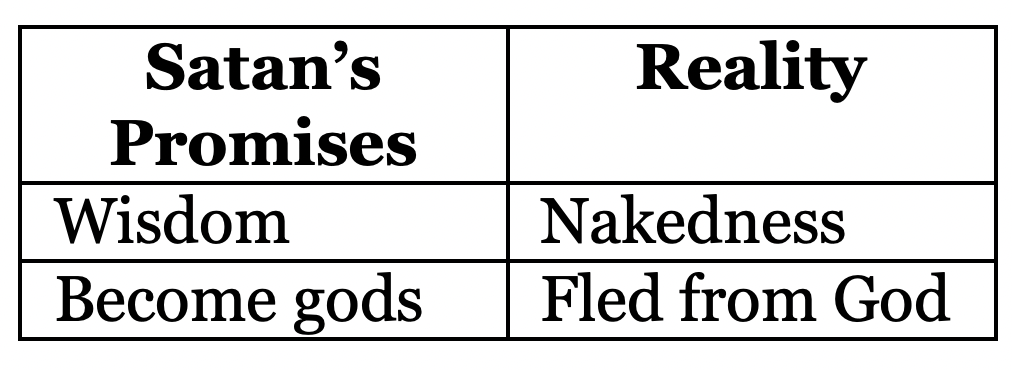
    But then, this was part of the truth part that Satan told them when he was tempting Eve to sin. “‘You won’t die!’ the serpent replied to the woman. ‘God knows that your eyes will be opened as soon as you eat it, and you will be like God, knowing both good and evil’” (Gen. 3: 5 NLT emphasis added).

    Satan is going to use scripture, tell us half-truths, not explain things fully, flat out lie – anything – to get us to sin against God. He will use whatever it take to make his story bright and shiny to attract us to the sin.

    But let’s think about this a second. We become like God. Wouldn’t that be a good thing?

    Well, yes, but not this way. The ends do not justify the means.

    We aren’t to become like God and have His character any way we can. Our godliness is grown through the long process of sanctification.

    Adam and Eve tried to be gods — which, to a point, was possible — but fell on their face because that took them to the opposite of God. They were like God “on the outside” but not on the inside.

    In finding out that it is the inside that is most important, Adam and Eve lost access to the Heavenly Father. Their selfish desires destroyed their relationship with Him.

    The problem is that Satan was promising them something that was never going to happen. We will never be divine like God. We won’t even become angels.

    That is further evidence that the “… have become like us …” (Gen. 3: 22 NLT) only refers to gaining the knowledge of sin’s existence.

    Committing the Sin

    If Satan thought God was going to strike Adam and Eve down right then when they bit, he was wrong. God is a God of mercy. That means He doesn’t give us the punishment we deserve.
     
    Once the woman took the bite and nothing really happened, it made it look like Satan was telling the truth and God was lying. She didn’t fall down dead. She kept right on breathing.
     
    But then, there are times when there is something going on spiritually while we are expecting only the physical. There were things happening to her spiritual condition.
     
    What we don’t always catch is the first sin occurred in church. The Garden of Eden was designed as our Heaven on earth. God’s Temple is holy, but our free will switch is not switched off when we traverse its threshold.
     
    If they, who had a face-to-face relationship with the Creator, couldn’t not sin, how are we to withstand temptation so we don’t sin?
     
    The couple was no longer innocent. Even though they were still made in the image of God, they also now had a sinful nature.
     
    The couple just wanted to be independent. They didn’t think they needed to obey God.  They thought that they could be just as important as He is.
     
    The couple were promised by Satan that they would become gods. Instead, they are called before God by God Himself, trying to justify their actions.
     
    We could suppose that Adam and Eve, when they took the bite, did not lose their basic faith that God is Sovereign Lord and Creator. Yes, it was bad that they wanted to be gods themselves.

    It is interesting to note that the woman’s judgment was just this one verse. Satan got two verses; the man got three verses. But the man’s punishment was for humankind regardless of gender.

    The Woman’s Sin and Punishment

    The woman was going on about her business, planning on obeying God. Then this snake popped up and blindsided her. She probably thought she was working and worshiping, and here came this temptation.
     
    But Eve’s answer to Satan’s initial question wasn’t exactly correct. She didn’t say anything about eating freely from all the other trees. God didn’t say anything about not touching this one tree.
     
    We can’t change God’s laws to fit our opinions.
     
    When Satan asked Eve if she couldn’t eat from any of the trees, look what she said the punishment was in the King James Version. “… Ye shall not eat of it, neither shall ye touch it, lest ye die” (Gen. 3: 3 KJV).
     
    To me, lest you die means you run the risk of dying – but maybe not.
     
    That is not what God said. He said, “… you shall surely die” (Gen. 2: 17 ESV).

    Maybe the woman was already having doubts about being obedient before Satan started in on her. We really don’t know.

    The woman made a choice to sin. She disobeyed God’s direct command. She bit.

    The woman must have thought the fruit tasted okay, so she gave it to the man to eat. Not only did Eve sin, but she also led others to sin. She became a stumbling block to Adam. Satan loves to get one person to lead another person away from God.

    It was also appropriate that Eve’s sin was addressed first as she sinned first. When God started questioning her, she deflected as Adam had done. Her excuse was the serpent

    If we read this another way, we can read it as Eve was taking responsibility for her sin. He deceived me, and I ate. She didn’t say so I ate.

    God had blessed the woman and man, calling them to multiply. The childbirth processes happens exclusively within the woman’s body. This may be a reason why it was chosen for the woman’s judgment.

    Childbirth would no longer be easy. A woman would now suffer from physical pain during the birth process.

    We know it takes two to tango, but God talked about her offspring, not theirs. The woman was the first to sin, but it is through her offspring that salvation would come.
     
    ·       Even after we disobeyed Him, God interacted with the couple in grace and truth.
    ·       Adam, being created from dust – therefore made of flesh – was as he was. He became sinful, so even if we believe that he asked for and was granted forgiveness for his sin, there was nothing he personally could do to rectify the matter.
    ·       The woman, on the other hand, through childbirth, could fulfill the promise of a Man to be born in the future, Who would save the world from its sin.
     
    This creation of a new life (the ability to have children) is what salvation through this Man is all about. Eve is “… the mother of all who live” (Gen. 3: 20 NLT).
     
    The woman’s punishment is also psychological and social because it deals with Eve’s relationship with her husband. A woman’s desire is psychological; a man’s rule is social.
     
    No, this does not mean all women are to be submissive to all men. God expects wives to be obedient to their husbands, only submissive to her husband. This is to be a loving role, not subjugation. Our work has to be done from the heart, not just going through the motions.
     
    This submission was not present before the sin. In God’s perfect world, men and women are equal.
     
    Our relationship with each other was damaged. Shame, jealousy, envy, and hate were now elements causing that damage.
     
    The relationship between people and God’s creation was strained. Adam was told that “… All your life you will struggle to scratch a living from it” (Gen. 3: 17 NLT).
     
    But that also changed the way we view God’s creation. Some can view our role as owner or controller. God has not given us authority over the earth. He maintains that for Himself.
     
    Our view of ourselves have changed. We became self-conscious. We see ourselves as fat or ugly – along with a lot of other derogatory ways.
     
    True, God sees us as sinners now – until we accept His Plan of Salvation. Then He seems us as redeemed.
     
    It is only through Jesus’ sacrifice on the cross that we are able to restore our relationship with God.

    Was the Couple Together?

    Some sermons I looked at said that the couple were not together at the woman’s temptation. I can see that. In Genesis 3: 1-3, the serpent addressed the woman alone.

    It is easy to think that the man wasn’t there. It is easier for Satan to talk us into a sin when we are by ourselves.

    Satan didn’t want them to double-team him. He didn’t want to have to convince both at the same time. One may have convinced the other not to bite.

    Plus, Satan may have thought the woman would cave before the man did. Maybe it could have been better if the man would have been there to talk her out of it. More on that later.

    Moses said differently, however. “… Then she gave some to her husband, who was with her, and he ate it, too” (Gen. 3: 6 NLT).”

    It doesn’t say the woman went to the other side of the Garden, to their home, or to wherever the man was working. Yes, that might have been scriptural shorthand not adding in unneeded clarification.

    The couple earned the consequences of sin. The consequences of sin are spiritual death and separation from God.

    I see God mainly focused on our spiritual conditions. Because of that, the consequences of sin would address those conditions.

    The couple’s solution was to sew fig leaves together so that they could hide from God, but our efforts do not disguise sin. Adam and Eve tried to atone for their sins their own way. They failed miserably.

    Only God can fix the stain of sin. He can only do that when we believe that Jesus died just for that purpose.

    The couple’s sin opened the door for the consequences of their actions. It may not have seemed like a big deal, but it sure was. Humankind have never been the same since the couple sinned.

    We went as a race from not sinning at all to sinning multiple times in a variety of ways.

    There was a good reason to banish Adam and Eve from the Garden of Eden – and not just for punishment reasons. Adam and Eve got kicked out of the Garden for their own good.

    A very important component of our disobedience to God means we become His enemies when we sin.

    We’ve gotten really blasé about sinning against God. We look for the boundaries of what is and isn’t sin, we look for levels, and we look to argue what is an isn’t sin.

    Our looking is not true obedience.

    We must never gloss over the fact that we choose whether to sin or not. We could just as easily choose to obey than disobey.

    True, we might have to realign our beliefs and actions to His Will. We might have to let go of some very important things — even people — in our lives.

    We are obedient and blessed when we obey God’s laws and commandments. In other words, we gain salvation.
     
    Salvation is a change of nature when we choose to obey God.
     
    Having a regenerated heart lets us eat from the tree of life. It shows we have the right character, the character of God. That character is shown through our obedience to God’s laws.
     
    We shouldn’t feel guilty that we were caught. We should feel guilty because we disobeyed and committed the sin.
     
    Eden was about purity and devotion — most of all obedience. Adam and Eve would no longer be happy there.
     
    In other words, sin made that choice for them, too. They chose the impure and disobedient, so they chose against staying in the Garden of Eden.
     
    We can’t forget that there was a vast world outside of the Garden of Eden. The problem was it was condemned and uncultivated.

    The Man’s Sin and Punishment

    Adam ate it, but Eve didn’t force him to eat. He made his own decision. He didn’t have to eat it, but he chose to do so.
     
    There is no indication that the man raised any objections. But neither does it say that he even questioned her decision or her offering. It looks like he just chowed down.
     
    We don’t make someone else sin. Satan doesn’t even make us sin. (Sorry, the devil made me do it isn’t a valid argument.)

    It usually doesn’t take long after we have sinned to realize we have broken God’s laws. The way it is written says that she ate, he ate, and they knew. Boom, boom, boom.

    We don’t see it until after the sin has been committed that, instead of being a good thing, it led to our ruin. And sin always leads to our ruin.

    God gives us time to make sure our repentance is genuine. He doesn’t want lip service. In other words, our faith has to be genuine.

    When God began questioning Adam, he must have been feeling really guilty. He immediately tried to deflect, showing his guilt. Adam blamed it all on the woman — except where he blamed God.

    Excuses won’t work with God any more than our dog ate our homework does with teachers.

    It is interesting that Adam really didn’t say anything about his decision. It was all couched in wording that put the blame on the woman.

    That isn’t the way confessions work. Adam may have been admitting, but he definitely wasn’t confessing.

    We have to say, “I disobeyed You, God. I’m sorry, and I repent.” God doesn’t accept, “I was duped.”

    If God would have looked at the woman the way Adam wanted Him, too, all guilt for the sin would have fallen on her. He wanted God to look at him as, basically, an innocent bystander who went along with crowd. Going along with the crowd is a sin when our actions commit sins.

    The man was trying to say the woman sinned because she tempted him, but he did not sin because he yielded. Wrong.

    Even though the man just went with the flow, he encountered punishment, too. The man didn’t get a pass when God was handing out punishment because someone else led him to sin. While he was offered the fruit, it was his decision alone to go ahead and bite.

    Maintaining life became a struggle. It takes work to till the land. It takes more work now than it did before the original sin.

    This may be where weeds came into being (thorns and thistles). Those may have been around before the original sin. At a minimum, this means the weeds took on a more invasive existence.

    Some of us don’t see work as a blessing. For some, working for a living is a curse in itself.

    That goes against some thinking that there should be more leisure time and less work time. At the same pay, of course.

    Instead, we should see secular work a being done for the Lord. When we work in His name and for His glory – regardless of the hob we are doing — we will be fruitful.

    The sanctification process – spiritual cultivation – is hard and a slow process. In other words, we have to toil in order to restore our relationships with God. We have to want to.

    We can only be sanctified by God’s power. We can’t do it on our own.

    Because of the original sin, every human will suffer physical death. Before the man and woman bit the fruit, they would have lived eternally as they were. That was a reward of obedience.

    That ended when they disobeyed God. Physical death – brought about disease, natural causes, murder, accidents, etc. – became the new normal.

    Since death had entered the picture (Gen, 3: 19), we had to have a cause of death. This is where disease reared its ugly head. Everything from wars to I-want-the-money-in-your-wallet-or-I’ll-kill-you also showed up. This is where the body started to just wear out (with the help of accidents).

    Returning to dust shows how fragile the human body really is. The consequences and results of the original sin are still being felt today in a significant way.

    When we read Genesis 3: 17-19, do we sense any anger? I don’t. I don’t know if I even read severity in them.

    Oh, don’t get me wrong. The punishment is severe.

    I think God’s attitude is more of discouragement here.  It is rimmed with sadness.

    The sadness doesn’t come, I think, from all that God has lost. He lost the couples’ companionship, as well as their worship and obedience.

    I think, more, the sadness comes from what they have lost. He knows what a huge price they have paid for disobedience. What a huge price humankind has paid for their disobedience.

    If God was this sad, why did He put us through all of this? Why have us disobey just to be reinstated?

    There is a couple of reasons I can think of off the top of my head. Doing it any other way wouldn’t have given us free will.

    Think about it. How we would have kicked back if we would have been forced into it! Even something as good as what the couple had!!!

    God isn’t a dictator. He doesn’t force us.

    People still to this day have the option to choose to not obey God. Yes, they will have to pay the consequences for that choice in the end, but it is their choice.

    God isn’t going to send them to hell. They chose to go there themselves.

    The man — and the woman and all of us — lost the initial salvation.

    God, the man, and the woman had a unique relationship. They met face to face.

    If they had not lost their salvation – the perfect condition in which they were made – how could anyone who chose to sin be separated from God?

    Aren’t sin and salvation are all about that? Sin makes us lose access to God. Salvation restores it.

    Old Testament salvation is based on obedience. Yet, the man wasn’t killed immediately. He was given the opportunity to repent.

    God’s Word really doesn’t say the man repented, but I think he did. Just because he wasn’t allowed back in the Garden of Eden doesn’t mean he won’t be in Heaven.

    Obedience – therefore salvation – was something they would have wanted to keep. Their free will should have been ruled by the desire to keep that.

    But instead, they weren’t content with the status quo, implying they were experiencing from mental suffering. Both the fruit of the tree and the knowledge it would impart was attractive to the couple. If they weren’t having qualms about their obedience to God, they would have not been in this situation.

    In other words, their doubts would have sabotaged their contentment. Their disobedience was neither sudden nor unpremeditated to some degree.

    The couple chose what they could see rather than choose to modify their actions. 
    The couple who committed the original sin were punished, but not with judgments aimed specifically at them and no one else.

    That is true. All women suffer in childbirth and are to be submissive to their husbands. All men must struggle to earn a living. All suffer the consequences and results of sin.

    Sin changes the person who committed the sin. The effects of sin are felt for generations.

    creating-everything-theme

    To read devotions in the Creating Everything theme, click the button below.

    Devotions in the The Influence of Sin series

  • The Influence of Sin: Genesis 3 Newsletter #1

    influence-of-sin-genesis-3-newsletter-1

    God’s Law

    God’s law in Genesis 2: 16-17 is all about obedience.

    Too many disciples, though, think that loving God is good enough. Nothing else is needed for salvation.

    But there is something else. We have to choose to obey God daily. That is how we show God we love Him.

    Our love for God should be an even bigger deterrent for sin. We love Him so much we want to do what He says.

    Was it a good thing that God gave humankind this one law? If God knew that the man and woman would disobey Him, did God set them up for failure?

    Yes, it was and no, God didn’t. He provided them with grace to strengthen them to be obedient. God gives us grace to strengthen us to make the right decision, but God does not force us to choose Him.

    The command in Genesis 2: 17 clearly lists the consequence of sin — death. But if death is some sort of nebulous concept out there, is it really a deterrent? Maybe. Maybe not.

    The knowledge that there would be a punishment if the woman did eat the fruit should have been some deterrent. We don’t have to understand all the consequences to know that something bad is going to happen when God point blank tells us what to do.

    God doesn’t have to spell out every consequence fully. All He should need to say is, “Obey Me.” Yeah, God can say, “Because I said so.”

    We will only be strong enough to not sin when we have been perfected. We won’t be perfected until we are called home or the end of the age.

    The breaking of the law of God is sin. It is a practice — a decision.

    Sin

    On the surface, the original sin doesn’t look like it is much of a sin at all. What is the big deal about eating a piece of fruit?

    The first sin was about obedience to God. Are we going to listen to what He says or disobey Him? That is a big deal.

    Sin is a moral disease that brings many devastating consequences. Even if God did not create sin, He created the opportunity for us to choose not to obey Him — which is a sin.

    God alone determines what is a punishable offense – what is a sin. Subsequently, He is the One to establish the punishment. It is our choice to follow the law or break it — and suffer the consequences when we break it.

    Two moral forces battle for control of this world. One is the worldview led by Satan, and the other is the Godview. These are polar opposites.

    If the root of our worldview moral feelings is not cut out of us, we will not be obedient to God. It addresses the motivations and character, not just the actions.

    There is an order to sin.

    • We have to doubt that God is good.
    • We have to disbelieve that He wants our relationships restored.
    • We have to reject His holiness.

    Satan tempts us in many ways.

    • Satan tries to catch us by surprise.
    • Satan tries to convince us that restrictions on our lives are too impulsive, unequal, unkind or unnecessary – leaning in on his concern for us.
    • Satan tries to convince us that God’s character should not be respected, lowering our gratitude towards Him.
    • Satan tries to cast doubt on God and our faith in Him.
    • Satan tries to coach our disobedience out of our unbelief.
    • Satan tries to convince us that we should have that which we lust after.
    • Satan will flat out lie to us about consequences of disobedience.

    Sin is a hereditary disease as it entered into the world when the couple sinned. Every man, woman, and child from every nation, culture, socioeconomic status – everyone – has a sinful nature.

    That means every person who ever was born or ever will be born comes into this world spiritually dead and separated from God. On top of that, we know that every single person since the couple committed the original sin has also sinned.

    Still, we are responsible for our own sins. Each and every one of us is going to have to deal with our sin.

    We cannot quit sin on our own. That may be why sin is so prevalent. We think we can come and go into a sinful situation on our own, never realizing it is beyond our abilities.

    It is not a sin to be tempted. It is a sin for us to tempt someone else. If I know someone has a weakness to sin in a certain area, it is a sin if I put that person in circumstances that create that certain area.

    By allowing us to stumble and fall, stumble and fall, God is showing us how much He loves us. By sending His Son to die and be the sacrifice for us, He is showing us there is nothing He wouldn’t do in His power to show us that love.

    Sin does have to be tangible – if not visible. How else do we know if its existence? And Satan sure does want us to know of its existence!

    God wants us to know what happens when we disobey Him. Think if the couple hadn’t sinned – and no one from that time until now had either. If no one had ever sinned, we would not know the value of obedience or the true cost of disobedience.

    Satan

    Satan’s fall from God’s grace would have already happened, although we aren’t told about it in Genesis. We don’t know where he went after he got kicked out of Heaven.

    All we read in God’s Word is Satan was kicked out of Heaven. We are not told if or how his appearance changed. We assume he had wings, which he may or may not have lost.

    Satan convinced supposedly one-third of the angels to believe he was a god, turn into demons, and leave with him (Rev. 12: 4).

    Satan’s sin came from himself. It certainly wasn’t from God. Satan didn’t have any external nudging, pushing, or prodding.

    In a recent sermon, Pastor Steve said, “Satan’s sin was wanting to be like God and take over Heaven.” Satan wanted to be God.

    The enemy of God knew about our world. He has been known to roam earth.

    Satan may have hated humankind because he was kicked out of Heaven while humans were given this beautiful garden in which to live. Not only that, but they were also very happy in their lives.

    Have we ever considered why Satan tried to tempt mankind to sin in the first place? Was he only trying to steal us away from God? Or was he trying to get us to ally with him against God?

    We almost have to wonder if Satan had presented himself to the humans before. I mean, why did the woman just automatically believe someone she had never met before over Someone who had created her and had provided for her?

    It can be argued, if God created humans because of Satan’s revolt, that would escalate his hatred of us.

    On the other hand, Satan may have been trying to extract revenge. If he knew how greatly God valued humankind, he may have been jealous of our relationship with Him.

    This is especially true if Satan knew of God’s Plan of Salvation before the promise in Genesis 3: 15. He knew mankind would be restored where he and the other demons wouldn’t.

    The Serpent and His Punishment

    Satan was disguised as a serpent when he went to tempt the woman.

    Most of us have queasy stomachs when we think about serpents – or snakes, as many of us call them. But back in the Garden of Eden, I don’t think there was any fear among the different species.

    It is hard for us to visualize the snake doing anything but slithering on the ground. But that brings us back to the question of whether it was a snake or a serpent.

    There may have been serpents prior to this who had crawled on their bellies. That does not mean this serpent did.

    Either way, we can read this animal used to walk upright. After the judgment, it couldn’t.

    We don’t really know what the animal looked like. We will need to put that in the UNR book – understanding not required. Along with that, we would have to include how the serpent talked with the humans. They understood, but we sure don’t at this point.

    The serpent was told his punishment first, which is logical. The serpent was the root of sin.

    Basically, the snake was going to slither on the ground and not be liked. God cursed the serpent/snake on that day, the punishment to begin that very minute.

    It is easy to look at the passage and say the serpent/snake  was tricked just as much as Adam and Eve were. Or maybe we like to think that he was just taken over by Satan, like he took over demoniacs.

    Didn’t matter. The serpent was punished regardless of how it was taken over. It was punished because it was taken over. “… Because you have done this …” (Gen. 3: 14 NLT).

    It was perfectly within God’s authority as Creator of the serpent/snake to punish it. We shouldn’t argue against that any more than we should argue that He has no authority over us.

    If it wasn’t the physical serpent being punished to crawl on his belly, it would be Satan himself as the object of this punishment. Remember, Satan had been an angel before he rebelled. Do we visualize Satan as crawling on his belly? No, so it was the serpent/snake that received punishment.

    If Satan uses us as an instrument to cause someone else to sin, we share in the blame. We will be punished.

    We think sin only affects us, but it doesn’t. Sin spreads to others and contaminates relationships and integrity.

    Satan and His Punishment

    But the serpent wasn’t the one calling the shots – Satan was.

    Satan was the real tempter in this occurrence. He enticed the couple to disobey God, not the serpent/snake.

    The punishment in Genesis 3: 14 could be directed to the serpent, but it is also directed toward Satan. It not only shows the opposition, but it also identifies the victor. Good will strike evil’s head – our moral feelings.

    We shouldn’t gloss over the fact that Satan can only reach the heel. What power Satan has over us is what we give him.

    Ooo, baby. That would bite. Satan was trying for a complete overthrow of God, and all he was going to accomplish was a swat at the heel.

    No, there will be a new — and more definitive — judgment.

    The important thing is that Satan tempted the couple to disobey God, and they did.

    Satan’s insistence that what God has presented as good is really evil is heartbreaking. Portraying God as Someone Who can’t follow through on His promises or flat out promising something He has no intention of supplying is so totally out of God’s character.

    Satan succeeded in separating us from God. He was trying to set up His own kingdom on earth. But he failed in that he did not win our full-blown allegiance. God stepped in so that allegiance didn’t happen, His first act of grace.

    God didn’t want Satan and humankind to expand their newly formed relationship, so He established a hostility between us. God did not want to make it easy for us to sin.

    If Satan was an adversary with God, He wanted him to be an adversary with us. In fact, the word Satan means adversary in Hebrew.

    Satan’s goal is to manipulate us so that we will sin. Though he is good at disguising himself so that his true character is concealed from us, he hides in plain sight.

    Satan is not one to back down from a challenge when we resist him. He may finally back down, but not before he has tried the most daring, reckless, foulest temptations.

    Even more than the hostility, God gives us power to overcome Satan’s temptations when we ask. He wants us to succeed in withstanding sin.

    Satan’s Question

    Satan didn’t accuse God of being mean or selfish. He didn’t outright attack God. Satan didn’t really say that God shouldn’t give humankind laws.

    What he did know was the woman had a good relationship with her Creator. He didn’t want to trash Him outright.

    Satan gave Eve a lie that was shaded with the truth. It was a leading question because he knew that God had not said that. He knew good and well that God had not put all the trees off limits. In fact, Satan knew that God had given the humans permission to eat freely of all the trees — except the one, which they were supposed to leave alone.

    To Satan, the point wasn’t how many trees on which God placed restrictions. The point was God had put something off limits.

    What Satan was doing was questioning the severity of the law. He wanted to show the restriction as not in humankind’s best interest.

    There was nothing wrong with the fruit, such as it being poisonous. God told the humans that they couldn’t eat the fruit just because.

    Satan wanted Adam and Eve to doubt God’s Word. If we don’t know exactly what God said in His Word when Satan starts tempting us, we might fall for his lies as the woman did.

    We have to be doubly careful when we start to debate God’s Truth. The problem is we want to have options. We’ve got that little thing called free will.
     
    Instead, we should want to make the right decision.
     
    The tree of life and the tree of knowledge of good and evil were both in the Garden of Eden. The man and the woman were forbidden to eat from the tree of knowledge. There was no restriction on eating from the tree of life — until they ate from the tree of knowledge.
     
    At the beginning stage of the Garden, God would have had no problem with them eating that fruit. They were made in God’s image. They would have been fine living for eternity.

    Satan’s Response to the Woman

    Of course, Satan had a comeback to Eve’s response to his question— another misdirect.
     
    We can look at Satan’s response in two ways. The first way was, instead of correcting the woman’s error, Satan lied. He misrepresented the meaning of the words to make it look like God didn’t love them.
     
    Satan had to know the law that God gave them, or he wouldn’t be tempting her if this didn’t lead to a sin.
     
    Satan tried to use the fact that God will correct us through love to get us to fear and disobey Him. He knows we like to do things our own way without any consequences.
     
    Doesn’t the delay of our punishment of death show how much He does love us? He is postponing it to allow us to repent of our sins.
     
    Oh, Satan knew he was talking physical death while God was talking spiritual death. Did Satan even have a clue what physical death was? It had never happened before, and he isn’t all-knowing as God is.
     
    God may have explained the concept of physical death, but it may have seemed that He was talking a different language. We don’t always understand until we experience something.
     
    I think we tend to forget Satan had been at this juncture before. He had a choice whether to obey God or not.
     
    Satan chose not, but he was still alive and kicking. He just had a change of address.
     
    While he didn’t physically die, Satan knew exactly what spiritual death meant.
     
    So, Satan lied about the consequences of disobeying God. But, then, he is a liar.
    Satan likes telling us that we can do whatever we want, and God won’t do anything — even if He said He would. He switches off from telling us, “You can’t depend on what He says” to “God just won’t require that of you.”
     
    Satan had lied when he offered the woman promises. They sure didn’t get what they were promised.  In fact, they got the opposite: alienation and terror.

    They allowed Satan to seduce them into sin and steal their innocence.
     
    The second way we can look at this is that Satan was encouraging the woman to want to be a god. “Eat this, and you will be like Him.”
     
    Maybe the woman thought — since the name of the tree was the tree of knowledge of good and evil — it would make her smarter.
     
    But more than likely, the woman did want to be like God. She wanted to make her own choices. She didn’t want Anyone to have control over her.
     
    In other words, Satan wanted our sin to mirror his sin. The only way he could get that to happen was to convince the woman to think as he did. But he had no real facts to back up his lies.
     
    The woman, if she already was doubting God, was a sitting duck.

    creating-everything-theme

    To read devotions in the Creating Everything theme, click the button below.

    Devotions in the Celebrating Creation’s Story series

  • Staying Out of the Garden of Eden

    As we draw our discussion of the original sin to a close, this devotional reading looks at the extent God went to in order to keep Adam and Eve out of the Garden of Eden. Then we tie up our thoughts on sin and God’s redemption.

    Nuggets

    • God set up a guard at the gate of the Garden of Eden.
    • Satan still leaves out the death and destruction part of sinning, and he sure knows about it now if he didn’t then.
    • Sin is not accidental.
    • Yes, God allowed sin to happen even though it is totally against His nature.
    staying-out-of-the-garden-of-eden

    Genesis 3 is a packed chapter. We found lots of nuggets that shows us God’s love for us even when we disobey Him.

    Let’s see if we can wrap up our discussion in this devotion.

    Let’s Put It into Context

    To read devotions in the Creating Everything theme, click the button below.

    Devotions in the Celebrating Creation’s Story series

    Cherubim as a Guard

    “After sending them out, the LORD God stationed mighty cherubim to the east of the Garden of Eden. And he placed a flaming sword that flashed back and forth to guard the way to the tree of life” (Gen. 3: 24 NLT)

    God set up a guard at the gate of the Garden of Eden.

    This is the first time we see an angel in Genesis. And not just any angel, but a cherubim.

    We may think that Adam and Eve had to be physically forced from the Garden of Eden. Bevan agreed. Not only why would they not embrace change, but also why would they want to leave a good thing behind?

    Resource

    In the sermon The Plan of Redemption Exhibited at Eden, whoever wrote it didn’t think so. Remember that, if God had already seen Adam’s request for salvation in verse 20, his relationship with God had already been restored. He was back in God’s good graces.

    Resource

    What I don’t agree with Bevan on is that Adam and Eve could have returned anytime they wanted, cherubim or not. Wrong.

    Humans will not defeat God. Humans will not overpower one of Hod’s angels, especially the cherubim.

    But Adam and Eve couldn’t stay in the Garden. The Garden was of earth. Humankind has to aspire to Heaven.

    Thomas made an interesting observation. He wrote, “The tree of life was there in the garden within possible reach, and if man had conquered instead of being conquered, no cherubim could have prevented his tasting of this ambrosial fruit and so entering into life.”

    Resource

    But Thomas, as Bullock thought of the tree, believed the cherubim guarding the tree was figurative. Murphy disagreed, believing it was real.

    Resource

    The creatures in Revelation 4: 6-8 have been identified by some as the cherubim, a special order of angels, which represents God’s presence.

    “… And around the throne, on each side of the throne, are four living creatures, full of eyes in front and behind: the first living creature like a lion, the second living creature like an ox, the third living creature with the face of a man, and the fourth living creature like an eagle in flight. And the four living creatures, each of them with six wings, are full of eyes all around and within …” (Rev. 4: 6-8 ESV).

    When a distinction is made, most angels are identified as cherubim. “Then I looked, and behold, on the expanse that was over the heads of the cherubim there appeared above them something like a sapphire, in appearance like a throne” (Ezek. 10: 1 ESV).

    I am inclined to think the cherubim guard significant places, and the living creatures are a distant cousin of the cherubim but are more mobile.

    But making a definitive decision is above my pay grade.

    What it is after is the fulfillment of the law. “The person who sins is the one who will die. The child will not be punished for the parent’s sins, and the parent will not be punished for the child’s sins. Righteous people will be rewarded for their own righteous behavior, and wicked people will be punished for their own wickedness” (Ezek. 18: 20 NLT).

    Only allowing our sins to be cleansed through the sacrifice of Jesus can we eat of the tree of life and gain eternal life.

    And isn’t that a blessing in this whole sad tale? Jesus wants to return us to God’s presence.

    Another blessing is the description of the sword. “… And he placed a flaming sword that flashed back and forth to guard the way to the tree of life” (Gen. 3: 24 NLT).

    It was written in The Plan of Redemption Exhibited at Eden that means that the sword was turning back on itself. The cherubim was not focused on punishing Adam and Eve. He was focused on maintaining the purity of the Garden.

    Don’t gloss over the fact that God didn’t destroy the Garden of Eden. He didn’t chop down the tree of life. He didn’t burn the place to the ground.

    God kept the Garden of Eden intact. Remember this was Heaven on earth – the Tabernacle.

    God just put it off limits.

    For a while.

    “Enter by the narrow gate. For the gate is wide and the way is easy that leads to destruction, and those who enter by it are many. For the gate is narrow and the way is hard that leads to life, and those who find it are few” (Mt. 7: 13-14 NLT).

    God’s promised Messiah has provided a path back to fellowship with God. He has thrown open the gate of Heaven so that we may access the tree of life.

    Making the Connections #1

    I keep saying that God is trying to get us back to Eden. Thomas had some issue with that. He wrote,

    “Eden was but a garden, primitive, narrow, and circumscribed, suited for a life of simple innocence with little expansion or development of capacity and power. But redemption introduces us to a noble city with its complicated claims, its vast possibilities, and its myriad grandeurs. Leaving metaphor aside, God in Christ is calling us to a life full of large and noble and varied activity.”

    Resource

    Is God trying to get us back to the Garden of Eden. Well, yes and no.

    Yes, God wants to get us back to that character and innocence that Adam and Eve displayed in the Garden. He wants the relationship and the access back.

    No, once we die, God will have a different place for us. We will be in New Jerusalem.

    Making the Connections #2

    Satan still leaves out the death and destruction part of sinning, and he sure knows about it now if he didn’t then.

    The sales pitch is still, “Make your own decisions in this life. Eat, drink, and be merry. You aren’t going to die — you’ll live forever. Be a god.”

    Well, yes, we are all going to live forever. It is the location that is important.

    Are we going to live in Paradise with God or the fiery depths of hell with Satan?

    We get to choose.

    Making the Connections #3

    Sin is not accidental.

    God always knew humankind would sin. He wouldn’t have set up the Plan of Salvation before He created us if He didn’t know that.

    Ooo, baby. Did we fall into the plan! “But I did find this: God created people to be virtuous, but they have each turned to follow their own downward path” (Ecc. 7: 29 NLT).

    Brown argued that man was made for sin. God, being omniscient, knew that Adam and Eve would choose sin over perfection. Therefore, He made our bodies to withstand the toil and suffering.

    Brown further argued that this was the best. He wrote,

    “Had he remained in Eden the highest interest of heaven in man’s career would have been lost; and more would have been lost, the highest, fullest, most absolute manifestation of God. Him, redemption alone could fully declare. If man comes forth into full manhood through that perverse exercise of his freedom, which leaves human nature suppliant for redemption under peril of imminent death, God, in redeeming man from the penalties and fruits of that perverseness, reveals Himself most fully as God.

    Resource

    Okay. That is a fancy way of saying what I always say. We wouldn’t know the extent of God’s love if we hadn’t sinned. He couldn’t honor Jesus as our Savior if there was no reason for Him to sacrifice Himself for us.

    Brown really nailed it when he says that redemption has components of discipline and education. We have to know God and what He wants of us — and then we have to choose to do it.

    Making the Connections #4

    Alexander reminded us that this wasn’t the only time Adam and Eve would be tempted to sin. The conflict of the two wills was now present and would be in all humans.

    Resource

    It was the couple’s new normal. It is our normal.

    The difference is that the promise has now been fulfilled when it was just a promise to Adam and Eve (Gen. 3: 15). Jesus is our Savior and Redeemer.

    Making the Connections #5

    God is still a loving God even though He takes us out of our comfort zones and from what is familiar as a result of sin. Regardless of our opinion of the punishment, God is lovingly correcting us.

    I don’t think I’ve heard it stated the way Hughes did. He wrote, “The habitation of innocency is no place for sinners.”

    Resource

    We think of Adam and Eve as innocents in the Garden of Eden. But that innocence was tarnished after the sin.

    Imperfect humans could no longer live in the purity of the Garden.

    It’s that habitation that is interesting. We can look at habitation a couple of ways.

    It is a lodging or dwelling. That talks about physical location. If we equate innocence with purity, that means sin shouldn’t be in the building.

    It is a state or process. That leads us to the spiritual aspect.

    We can’t become complacent, or sin might overtake us. (I almost didn’t use that word because we still have a choice, but our choice is so bombarded that we can do almost anything but.)

    We talked about the world outside of the Garden being corrupt. That is the lodging or dwelling. Sin isn’t really a process, but it is a state. It is our normal state since humankind became sinful creatures.

    Making the Connections #6

    Yes, God allowed sin to happen even though it is totally against His nature.

    Why? We talked way back in Genesis 1 that God created the universe to honor His Son, Jesus Christ our Lord. We were made to worship Him and God.

    We talked about God couldn’t show His love for us until He really showed it. We had to see how much He was willing to give up when we were totally not worth it.

    “But God showed his great love for us by sending Christ to die for us while we were still sinners” (Rom. 5: 8 NLT).

    We just have to accept Jesus as our Lord and Savior.

    How Do We Apply This?

    The ABCDs of Salvation

    If you have not become a believer in Christ, please read through the
    Plan of Salvation and prayerfully consider what God is asking you to do.

    A – admit our sins
    B – believe His Son Jesus is our Redeemer
    C – confess God as Sovereign Lord

    D – demonstrate that commitment by making any changes needed in our lives to live the way in which God has called us

    The Disciple’s Job Description

    Searching for and Seeking God

    Hearing His Word (Rom. 10: 17)
    Reading His Word (Rev. 1: 3)
    Praying to Him (Heb. 4: 16)
    Studying His Word (Ac. 17: 11)
    Meditating on His Word (Ps. 1: 1-2)
    Memorizing His Word (Ps. 119: 11)

    Father God. You loved us enough to give us choice as to whether we would obey You. You allowed sin in this word in order to show us how much You loved us. You sent Your Son to die in our place so that we might be restored to You. You still give us the choice as to whether we would obey You. Thank You for Your love. Amen.

    What do you think?

    Leave me a comment below (about this or anything else) or head over to my Facebook group for some interactive discussion.

    If you don’t understand something and would like further clarification, please contact me.

    If you have not signed up for the email providing the link to the devotions and the newsletter, do so below.

    If God has used this devotion to speak with you, consider sharing it on social media.

  • Paradise Lost

    Sin always leads to some form of punishment. This devotional reading looks at the results of the original sin – banishment from the Garden of Eden.

    Nuggets

    • Even though humankind was made in God’s image at creation, Adam and Eve became more like God in knowing the difference between good and evil.
    • It is imperative that we have eaten of the fruit from the tree of life.
    • There was a good reason to banish Adam and Eve from the Garden of Eden – and not just for punishment reasons.
    paradise-lost

    Adam and Eve had committed the original sin. They had stood by while they and Satan were given their punishment.

    But God wasn’t done with handing out punishment. He had another big thing left – banishment from the Garden of Eden.

    We could say this this punishment was only for them, as they were the only humans to have lived there. But because of that, everyone lost access to a face-to-face life with God.

    I had intended to complete Genesis 3 in this post, but it went long. I had to cut it in an interesting place. The connections and application will be added to the completion of the verses in the next devotion.

    Let’s Put It into Context

    To read devotions in the Creating Everything theme, click the button below.

    Devotions in the Celebrating Creation’s Story series

    Paradise Lost

    “Then the LORD God said, ‘Look, the human beings have become like us, knowing both good and evil. What if they reach out, take fruit from the tree of life, and eat it? Then they will live forever!’” (Gen. 3: 22 NLT)

    Become like Us

    Even though humankind was made in God’s image at creation, Adam and Eve became more like God in knowing the difference between good and evil.

    Wait! What???

    What happened to made in God’s image? “Then God said, ‘Let us make human beings in our image, to be like us …’” (Gen. 1: 26 NLT).

    I take this to mean that the singular issue we are discussing here is we now possess knowledge of good from evil. We are still like God because we have the fundamental aspects of His character.

    But then, this was part of the truth part that Satan told them when he was tempting Eve to sin. “‘You won’t die!’ the serpent replied to the woman. ‘God knows that your eyes will be opened as soon as you eat it, and you will be like God, knowing both good and evil’” (Gen. 3: 5 NLT emphasis added).

    Satan is going to use scripture, tell us half-truths, not explain things fully, flat out lie – anything – to get us to sin against God. He will use whatever it take to make his story bright and shiny to attract us to the sin.

    But let’s think about this a second. We become like God. Wouldn’t that be a good thing?

    Well, yes, but not this way. The ends do not justify the means.

    We aren’t to become like God and have His character any way we can. Our godliness is grown through the long process of sanctification.

    Brown had an interesting nugget. He thought our in God’s image part was dormant prior to this point. It was awakened and grown through the disobedience.

    Look what Brown said. He wrote,

    “It was a step out, a step on for man in the unfolding of the latent powers and possibilities of his being as an embodied spirit; but it brought him within peril and under the hand of woes and evils, which have made his history one long wail, and his life one long night. Adam, the child of Eden, made in God’s image, could find the completeness of his life in Eden. … God made man in His own image,” is the original description of the constitution of man.”

    Resource

    Adam and Eve tried to be gods — which, to a point, was possible — but fell on their face because that took them to the opposite of God. They were like God on the outside but not on the inside.

    In finding out that it is the inside that is most important, Adam and Eve lost access to the Heavenly Father. Their selfish desires destroyed their relationship with Him.

    Brown is right. On the surface, it looks like a growth. They became like God.

    But they already were, so it really wasn’t a growth. Instead, the results of sin have weakened them.

    • They are going to die now.
    • They are going to have to navigate through chaos.
    • Conflict will rear its nasty head.
    • Confusion will occur.

    I’m sure Satan left all that out of the marketing spiel — if he even knew it.

    The problem is that Satan was promising them something that was never going to happen. We will never be divine like God. We won’t even become angels.

    That is further evidence that the “… have become like us …” (Gen. 3: 22 NLT) only refers to gaining the knowledge of sin’s existence.

    Fruit from the Tree of Life

    It is imperative that we have eaten of the fruit from the tree of life.

    We mostly talk about the tree of knowledge of good and evil in the Garden. There was another tree there – the tree of life.

    When we were introduced to the tree of life’s existence in Genesis 2, we said its life-giving or life-sustaining properties focused on our spiritual conditions. If we hadn’t sinned, we would have had eternal spiritual life.

    It would do us well to read again how Bonar clarified what that meant. He wrote, “Not that one eating of it could confer immortality; but the continuous use of it was intended for this. The link between soul and body was to be maintained by this tree. So long as he partook of this, that tie could not be broken.”

    Resource

    What that means here is, if they would have eaten that, they would have lived forever in their sinful state. God didn’t want the choice to return to Him taken away.

    I think this is part of the reason Bullock called it a figurative tree. It presents a state of unending happiness.

    Resource

    But I think it was a literal tree. The eating-the-leaves-and-gaining-eternal-life may be figurative, as I see it. But the tree is real.

    Think about what a tree is. It is a living, growing thing. It probably bears fruit.

    According to Edwards, our faith begins a as a germ until it grows and produces fruit.

    Resource

    Boston reminded us that it is not the tree itself that makes us immortal. That is God Himself.

    Resource

    Again, it is God’s mercy to keep us from accessing the tree. “Good people pass away; the godly often die before their time. But no one seems to care or wonder why. No one seems to understand that God is protecting them from the evil to come” (Isa. 57: 1-2 NLT).

    Banished from the Garden of Eden

    “So the LORD God banished them from the Garden of Eden, and he sent Adam out to cultivate the ground from which he had been made” (Gen. 3: 23 NLT)

    There was a good reason to banish Adam and Eve from the Garden of Eden – and not just for punishment reasons.

    Adam and Eve got kicked out of the Garden for their own good.

    Oh, I am sure it didn’t feel like it at the time. We probably know these without being told.

    • Their happiness was really nonexistent at the moment.
    • Their purity and uprightness was gone.
    • Their conscience was damaged.
    • Access to God was lost.

    I think we forget a very important component of our disobedience to God. We become His enemies when we sin.

    So, yes. God had every right to banish Adam and Eve from the Garden.

    Yes, Adam and Eve probably had guilty consciences. And you know — they should. It should not be a light thing when we disobey Sovereign God, our Creator.

    We’ve gotten really blasé about sinning against God. We look for the boundaries of what is and isn’t sin, we look for levels, and we look to argue what is an isn’t sin.

    Our looking is not true obedience.

    White noted that Adam and Eve probably left the Garden thinking they couldn’t depend on God anymore for help. And in a way, God did set them loose to whatever life they wanted to have.

    Resource

    But we have to go back to Genesis 3: 15. God had already promised His Messiah. He had already promised the best help that He could — a way to restore their relationships with Him.

    We must never gloss over the fact that we choose whether to sin or not. We could just as easily choose to obey than disobey.

    Parsons put it this way. He said, “Let no one for a moment suppose that man sins by decree; he is saved by decree, but he is not lost by decree.”

    Resource

    We choose to disobey. We choose to obey.

    True, we might have to realign our beliefs and actions to His Will. We might have to let go of some very important things — even people — in our lives.

    Obeying God is worth whatever we need to give up in order to remain so.

    Pastor Steve always tells us that the blessings are in the obedience. It says that in God’s Word.

    • “Blessed are those whose lawless deeds are forgiven, and whose sins are covered; blessed is the man against whom the Lord will not count his sin” (Rom. 4: 7-8 ESV).
    • “Blessed is the one whose transgression is forgiven, whose sin is covered. Blessed is the man against whom the Lord counts no iniquity, and in whose spirit there is no deceit (Ps. 32: 1-2 ESV).

    We are obedient and blessed when we obey God’s laws and commandments. In other words, we gain salvation.

    No, that doesn’t make it a works-based salvation. Only belief in Jesus gains us salvation.

    • “Salvation is not a reward for the good things we have done, so none of us can boast about it” (Eph. 2: 9 NLT).
    • “There is salvation in no one else! God has given no other name under heaven by which we must be saved” (Ac. 4: 12 NLT).
    • “You must not have any other god but me. You must not make for yourself an idol of any kind or an image of anything in the heavens or on the earth or in the sea” (Ex. 20: 3-4 NLT).
    • “Jesus told him, ‘I am the way, the truth, and the life. No one can come to the Father except through me’” (Jn. 14: 6 NLT).

    Salvation is a change of nature when we choose to obey God.

    Bullock described it this way. He wrote,

    “The persons in the text have the right, because God has declared and promised in His Word, which can never be broken, that they who possess that character which manifests itself in aiming at a holy and constant obedience to His law, shall have the right, or more properly the privilege of eating of the tree of life, and of entering in hereafter through the gates into the city. To the [fulfillment] of this promise it is by no means necessary that obedience and right should be connected together as cause and effect.”

    Resource

    Having a regenerated heart lets us eat from the tree of life. It shows we have the right character, the character of God. That character is shown through our obedience to God’s laws.

    Bevan made a distinction between being banished from the Garden and guilt. Guilt is partially caused by the banishment, but it should be more so caused by committing the sin itself.

    We shouldn’t feel guilty that we were caught. We should feel guilty because we disobeyed and committed the sin.

    Resource

    Exell made a great point. Adam and Eve were banished from the Garden before they could feel they were entitled to be there.

    Resource

    To my way of thinking, it wasn’t only that Adam and Eve should feel entitled to eat of the tree of life. Also included would have been their frustration at their lives being harder. It is human nature to think things should go back to the way they were — and ignore the circumstances that brought about the change in the first place.

    Exell reminded us that God’s laws and commandments aren’t just about this life. They are preparing us for eternal life — where we will get to eat from the tree of life.

    • “For our present troubles are small and won’t last very long. Yet they produce for us a glory that vastly outweighs them and will last forever!” (II Cor. 4: 17 NLT).
    • “… On each side of the river grew a tree of life, bearing twelve crops of fruit, with a fresh crop each month. The leaves were used for medicine to heal the nations” (Rev. 22: 2 NLT).

    Think of it this way. Eden was about purity and devotion — most of all obedience.

    Adam and Eve would no longer be happy there.

    In other words, sin made that choice for them, too. They chose the impure and disobedient, so they chose against staying in the Garden of Eden.

    We can’t forget that there was a vast world outside of the Garden of Eden. The problem was condemned and uncultivated.

    Father God. You knew that the best for us would be to chose You as our Father. You allowed the original sin to happen. You banished them from the Garden of Eden for their — and our — best interests. Thank You, Lord.  Amen.

    What do you think?

    Leave me a comment below (about this or anything else) or head over to my Facebook group for some interactive discussion.

    If you don’t understand something and would like further clarification, please contact me.

    If you have not signed up for the email providing the link to the devotions and the newsletter, do so below.

    If God has used this devotion to speak with you, consider sharing it on social media.

  • Covering Our Sins with Blood

    Once the couple had received their punishment, God was ready to forgive them of their sin – if they would commit to obey Him. This devotional reading looks at how God accomplished covering their sins – and foreshadowed how He would do it on a more permanent basis later.

    Nuggets

    • The man and the woman were finally named.
    • Only God can deal with our sin.
    covering-our-sins-with-blood

    God knew before we were created that humankind would disobey Him. He had the Plan of Salvation ready before the couple ever showed up.

    God had to provide the opportunity for repentance. The couple had to feel repentant and want restoration.

    How was God going to pull that off?

    Let’s Put It into Context

    To read devotions in the Creating Everything theme, click the button below.

    Devotions in the Celebrating Creation’s Story series

    The Couple Named

    “Then the man — Adam — named his wife Eve, because she would be the mother of all who live” (Gen. 3: 20 NLT)

    The man and the woman were finally named.

    Moses introduced us to humans in Genesis 1: 26-27. “Then God said, ‘Let us make human beings in our image, to be like us. They will reign over the fish in the sea, the birds in the sky, the livestock, all the wild animals on the earth, and the small animals that scurry along the ground.’ So God created human beings in his own image. In the image of God he created them; male and female he created them (Gen. 1: 26-27 NLT).

    We get a more in-depth look at man’s creation in Genesis 2: 7. “Then the Lord God formed the man from the dust of the ground. He breathed the breath of life into the man’s nostrils, and the man became a living person” (Gen. 2: 7 NLT).

    The woman’s creation is detailed in Genesis 2: 21-22. “So the Lord God caused the man to fall into a deep sleep. While the man slept, the Lord God took out one of the man’s ribs and closed up the opening. Then the Lord God made a woman from the rib, and he brought her to the man” (Gen. 2: 21-22 NLT).

    We aren’t told their names until here in Genesis 3: 20. A lot has happened to them in those 38 verses, hasn’t it?

    Did they not have names before this? Did they think they didn’t need them because there was only the two of them?

    Well, Adam probably did. Mah in Hebrew is man or human — earth man.

    Bevan showed us the importance of the man being the one to name the woman after the fall. Put it into context.

    • “And I will cause hostility between you and the woman, and between your offspring and her offspring. He will strike your head, and you will strike his heel” (Gen. 3: 16 NLT emphasis added).
    • “By the sweat of your brow will you have food to eat until you return to the ground from which you were made. For you were made from dust, and to dust you will return” (Gen. 3: 19 NLT emphasis added).
    • “Then the man — Adam — named his wife Eve, because she would be the mother of all who live” (Gen. 3: 20 NLT emphasis added).

    Look what Bevan said. He wrote,

    “It is not because the man refused to accept the judgment of God, not because he refused to submit to the doom. He did not refuse, he did not set himself up against God. He caught the tenderness of the Divine voice even as it pronounced the judgment. He saw the gleam of grace in the darkness of the doom. It is then that he turned to his wife and said, ‘Eve, the living one?’”

    Resource

    We talked about in a past devotion whether Adam had asked God to forgive him. By so naming Eve, I see this as a strong proclamation of his faith.

    We could suppose that Adam and Eve, when they took the bite, did not lose their basic faith that God is Sovereign Lord and Creator. Yes, it was bad that they wanted to be gods themselves.

    But it looks like Adam and Eve’s disobedience didn’t shake their overall faith in God.

    Eve really gets a bum rap for biting first. Yet, she is “… the mother of all who live” (Gen. 3: 20 NLT).

    Bevan stressed the dignity of motherhood. We don’t hear of Adam and Eve’s kids until Genesis 4, but here, she is considered a mother. To me, that means the mother of all humans who are children of God.

    If we look at the blessing given in Genesis 1: 28, one of the most important purposes women have is to produce children. “Then God blessed them and said, ‘Be fruitful and multiply …’” (Gen. 1: 28 NLT)

    No, it doesn’t say Adam is the father of all who live. That is logical. The Father of all who live is God.

    Don’t worry, guys. Adam’s immediate acceptance of God’s promise is important. What was God’s promise? The salvation of the race through the one of Adam and Eve’s descendant.

    Yeah, Adam has an important part to play in the continuance of the race.

    Adam acknowledged the promise and promised to do his part. In other words, he would complete his end of the covenant.

    Bonar had an interesting take. God named Adam when he called him Mah. God did not name Eve; Adam did.

    Resource

    Bonar came up with good explanations for this. Along with Adam’s acceptance of God’s promise, he felt this showed several things.

    • To show God’s grace.
    • To show Adam as the head of the family unit.
    • To show the couple’s solidarity even after Adam had tried to place the blame on Eve.

    All that is true. But then God created the animals, but Adam named them. Is this any different? He named the animals as he was looking for a helper. That helper ended up being Eve. Why shouldn’t he name her, too?

    Let’s go back to the first bullet. God’s grace has always been free. We cannot earn it or produce it ourselves.

    “God saved you by his grace when you believed. And you can’t take credit for this; it is a gift from God. Salvation is not a reward for the good things we have done, so none of us can boast about it” (Eph. 2: 8-9 NLT). Grace is always a God thing.

    Forgiving the Sin

    “And the LORD God made clothing from animal skins for Adam and his wife” (Gen. 3: 21 NLT)

    Only God can deal with our sin.

    Verse 21 is a simple statement that is packed. Let’s try to unpack it.

    God made the covering for Adam and Eve’s nakedness. Nothing we can do is enough to cover our sins. Only God can do that.

    Dods talked about it being a covering because God could no longer look at us in our sinful state. In reality, this covering was only temporary.

    Jesus had to come and shed His blood for an eternal covering of our sins. God’s goal at this point was to restore blessedness.

    Jukes’ noted that God ended His resting period to work to make the covering for sin. This was important to Him.

    Resource

    He is not going to sit idly by and just let sin take over. He has always been in the business of forgiving us when we ask for forgiveness.

    Song

    Tauren Wells/We the Kingdom/Davies

    The garments were made of animal skins. This is said to be the first sacrifice.

    But then I had never really thought of it the way Dods did. He wrote, “Adam took leaves from an inanimate, unfeeling tree; God deprived an animal of life, that the shame of His creature might be relieved.”

    Resource

    I am not sure I would have said it the way he did. I do see what he was saying, though.

    While Adam tells me I am a bad plant lady because my plants seem to die on me, they are living and growing. Dods made the comment that sin couldn’t be covered by taking something that would be easily replaced – the leaves would grow back on the plant the next year.

    Yet, they are not living, breathing beings. They don’t have the organs we do, certainly not the ability to think, speak, and reason. The plant’s death is not the same as our death.

    Animals had to be sacrificed so that blood could be shed. Sin is only covered by blood. “In fact, according to the law of Moses, nearly everything was purified with blood. For without the shedding of blood, there is no forgiveness” (Heb 9: 22 NLT).

    Yes, it is animals plural. An animal had to die for each of them.

    This is what the sacrifices are all about in Leviticus. The sacrifices provide a substitute for the loss of Life as payment of sins, foreshadowing the sacrifice of Jesus. The sins of the one doing the sacrifice is transferred onto the animal.

    But look at it this way, too. Adam – and Eve when she was created – had no concept of what death was when God made the covenant with Adam. “But the Lord God warned him, ‘You may freely eat the fruit of every tree in the garden — except the tree of the knowledge of good and evil. If you eat its fruit, you are sure to die’” (Gen. 2: 16-17 NLT).

    They bit (Gen. 3: 6), but they didn’t die a physical death. They now knew what disobedience was, but they may or may not have equated that to spiritual death – and certainly not physical death.

    The animals had to die to show then what physical death was – what was in store for them. It had to suffer for them. Suffering plays a big role in punishment for sin.

    Every time a sacrifice was made – all the way from Abel’s sacrifice to those offered until the temple was destroyed – it reminded them that death was a result of sin.

    Making the Connections #1

    If Satan thought God was going to strike Adam and Eve down right then, he was wrong.

    Oh, make no mistake. God can and will kill disobedient people, sometimes on the spot. Sometimes not.

    • “The ten men Moses had sent to explore the land — the ones who incited rebellion against the Lord with their bad report — were struck dead with a plague before the Lord. Of the twelve who had explored the land, only Joshua and Caleb remained alive.” (Num. 14: 36-38 NLT).
    • “And Moses said, ‘This is how you will know that the Lord has sent me to do all these things that I have done — for I have not done them on my own. If these men die a natural death, or if nothing unusual happens, then the Lord has not sent me. But if the Lord does something entirely new and the ground opens its mouth and swallows them and all their belongings, and they go down alive into the grave, then you will know that these men have shown contempt for the Lord.’ He had hardly finished speaking the words when the ground suddenly split open beneath them. The earth opened its mouth and swallowed the men, along with their households and all their followers who were standing with them, and everything they owned. So they went down alive into the grave, along with all their belongings. The earth closed over them, and they all vanished from among the people of Israel” (Num. 16: 28-33 NLT).
    • “So the Lord sent poisonous snakes among the people, and many were bitten and died. Then the people came to Moses and cried out, ‘We have sinned by speaking against the Lord and against you. Pray that the Lord will take away the snakes.’ So Moses prayed for the people” (Num. 21: 6-7 NLT).

    But God is a God of mercy. That means He doesn’t give us the punishment we deserve.

    Satan tries to use the fact that God will correct us through love to get us to fear and disobey Him. He knows we like to do things our own way without any consequences.

    Doesn’t the delay of our punishment of death show how much He does love us? He is postponing it to allow us to repent of our sins.

    Making the Connections #2

    What does all that has transpired in Genesis 3 have to do with justification? Justification is the act through the merits of Christ that makes us free from sin because we are following God’s moral laws. Jesus justifies us when we put our lives in His hand.

    Adam and Eve tried to atone for their sins their own way. They failed miserably.

    Part of the reason is because we can’t restore God’s righteousness. Our righteousness is but a poor knockoff of God’s righteousness.

    Trench put it this way. He wrote, “There is no robe of our own righteousness which can cover us and conceal our shame.”

    Resource

    Our sins must be covered by blood of a pure sacrifice. That sacrifice was Jesus.

    We cannot be the sacrifice as our blood is not pure. Face it, not many people would calmly go to their death to atone for their sin.

    It would be useless if we did. We would be dead and not reap the benefits of the forgiveness of our sins.

    Enter Jesus. He died spilling His blood and rose again so that we may have a perfected life in Him. He is the only way.

    • “Salvation is not a reward for the good things we have done, so none of us can boast about it” (Eph. 2: 9 NLT).
    • “There is salvation in no one else! God has given no other name under heaven by which we must be saved” (Ac. 4: 12 NLT).
    • “You must not have any other god but me. You must not make for yourself an idol of any kind or an image of anything in the heavens or on the earth or in the sea” (Ex. 20: 3-4 NLT).
    • “Jesus told him, ‘I am the way, the truth, and the life. No one can come to the Father except through me’” (Jn. 14: 6 NLT).

    Yes, the Plan of Salvation was finished upon the cross, but the results of sin were not addressed until Jesus rose from the grave.

    How Do We Apply This?

    Remember that, even in our worse condition, God will provide for us.
    Remember that God always calls us to faith.
    Fully embrace God’s promises.
    Document God’s mercies to and provisions for us.

    Resource

    Father God. Your love for us is so everlasting. We disobey You so many times. Thank You that You don’t accept our disobedience. Thank You for holding us accountable when we break Your laws and commandments. And thank You for taking us back with open arms. Amen.

    What do you think?

    Leave me a comment below (about this or anything else) or head over to my Facebook group for some interactive discussion.

    If you don’t understand something and would like further clarification, please contact me.

    If you have not signed up for the email providing the link to the devotions and the newsletter, do so below.

    If God has used this devotion to speak with you, consider sharing it on social media.