Blog

  • The Blessedness of Practical Godliness

    When looking at Adam’s descendants listed in Genesis 5, Enoch is one of the most important. This devotional reading looks at how we put righteousness into practice as we walk with God.

    Nuggets

    • Enoch was the son of Jared, making Enoch the great-great-great-great grandson of Adam.
    • We walk with God by faithfully showing our love to Him.
    • Once we love God, we have to repent and turn from our sinful ways.
    • When we have faith in God, we want to please and obey Him.
    • Constantly walking with God takes persistence and determination.
    • Because we love God, we want to spend time with Him in meditation, prayer, and praise.
    • We are to tell others about God.
    • We need to walk in truth, love, and justice.
    • Walking with God must be put into practice in our everyday lives.
    • God takes us where we are and grows us to where He wants us to be.
    • The only way we can truly walk with God is to have a deep knowledge and extraordinary wisdom of Him.
    • Each of us must decide for ourselves what our relationship with God will be.
    • We have to have a genuine relationship with God.
    the-blessedness-of-practical-godlines

    Enoch is credited with walking with God.

    We only get the regular information about Enoch. But we got one other tidbit about Enoch. He walked with God.

    Ooo, baby! Three simple, complex words. So, what does that phrase mean?

    Walking with God means we are humble, reverent, teachable servants of God. Okay, so what does that mean?

    It is all about walking with God. This is how we are perfected.

    Maclaren talked about that. He wrote, “… the perfected condition is not reached by surrender only, but by assimilation; and that assimilation comes by contemplation.”

    Resource

    Okay, so how do we not only contemplate but also put into practice this surrender and assimilation?

    Note: This ran long, so I have split it into two devotions.

    Let’s Put It into Context

    To read devotions in the Creating Everything theme, click the button below.

    Devotions in the The Influence of Sin series

    Who Was Enoch?

    “When Enoch had lived 65 years, he fathered Methuselah. Enoch walked with God after he fathered Methuselah 300 years and had other sons and daughters. Thus all the days of Enoch were 365 years. Enoch walked with God, and he was not, for God took him” (Gen. 5: 21-24 NLT)

    Enoch was the son of Jared, making Enoch the great-great-great-great grandson of Adam.

    Enoch’s father was 162 years old when Enoch was born. He was 65 years old when his son Methusaleh was born.

    Cain’s descendants were credited with inventing several societal things. Enoch was the only one that had more than dates listed for him. His was about his righteousness.

    Enoch was the first one mentioned to have a relationship with God. It is important that we study that to help us in our walk with God.

    Walking with God

    Love God

    We walk with God by faithfully showing our love to Him.

    Walking with God starts with faith in God. “It was by faith that Enoch was taken up to heaven without dying — ‘he disappeared, because God took him.’ For before he was taken up, he was known as a person who pleased God. And it is impossible to please God without faith. Anyone who wants to come to him must believe that God exists and that he rewards those who sincerely seek him” (Heb. 11: 5-6 NLT).

    That faith is bound up in the greatest commandments. “Jesus replied, ‘The most important commandment is this: “Listen, O Israel! The Lord our God is the one and only Lord. And you must love the Lord your God with all your heart, all your soul, all your mind, and all your strength.” The second is equally important: “Love your neighbor as yourself.” No other commandment is greater than these’” (Mk. 12: 29-31 NLT).

    We have to surrender our will to God, and then we have to obey His Will in our dealings with others.

    Reconcile with God

    Once we love God, we have to repent and turn from our sinful ways.

    While Jesus is the only way to salvation, it is easy to think that believing in Jesus is the only thing we need. Wrong. “There is salvation in no one else! God has given no other name under heaven by which we must be saved” (Ac. 4: 12 NLT).

    Believe is really a two-step action verb. It does have the heart-knowledge part. It also has an action part. “Since we are living by the Spirit, let us follow the Spirit’s leading in every part of our lives” (Gal. 5: 25 NLT).

    It is easy to equate believe with love. Our faith has to be more than that.

    When we perform the action part, we truly resolve to fix our impurity issue. Sin corrupted our pure nature and made us impure.

    That has to be fixed so that we can come before God.

    Think about it. This is a two-step deal. Believe. Repent. If we only do one of the steps, we don’t gain salvation.

    I know. The thief on the cross only believed, and he gained Paradise. With nails in his hands and on his last breath, he couldn’t be baptized, He couldn’t do the Matthew 25 to-do list.

    But isn’t the thief on the cross witnessing to us? He shows us the complete turnaround that we need.

    Please and Obey God

    When we have faith in God, we want to please and obey Him.

    Pleasing and obeying God doesn’t have anything to do with our nationality. It has to do with the condition of our hearts.

    “For you are not a true Jew just because you were born of Jewish parents or because you have gone through the ceremony of circumcision. No, a true Jew is one whose heart is right with God. And true circumcision is not merely obeying the letter of the law; rather, it is a change of heart produced by the Spirit. And a person with a changed heart seeks praised from God, not from people” (Rom. 2: 28-29 NLT).

    We talk a lot about self-denial. “Then Jesus said to his disciples, ‘If any of you wants to be my follower, you must give up your own way, take up your cross, and follow me’” (Mt. 16: 24 NLT). We know that means we have to follow God’s Will instead of our own.

    But how do we do that? We walk obediently, humbly, and patiently.

    Walking obediently means more than just diligently obey the commandments. We can do the actions without having the desire to please God.

    McNeile told us how we showed our obedience. He wrote, “And let your obedience be an unreserved, warm-hearted, zealous, faithful obedience, an obedience of love which is ready at all times, as love is ready.”

    Resource

    I think a good way to summarize what McNeile said is that we need to have cheerful obedience. We follow God because we love Him, not kicking back or doing it for some selfish purpose.

    That type of walking would need a huge dose of humility. We acknowledge and act to show God’s superiority over us. We have to revere and respect Him.

    Pleasing God also means that we will patiently endure. Things won’t magically right themselves when we become disciples. They/ won’t instantly become easier.

    Jesus addressed this.

    • “Then they will deliver you up to tribulation and put you to death, and you will be hated by all nations for my name’s sake” (Mt. 24: 9 NLT).
    • “But the one who endures to the end will be saved.” (Mt. 24: 13 NLT).

    Pleasing and obeying God leads to real life.

    Our Walk

    Constantly Walk with God

    Constantly walking with God takes persistence and determination.

    Think about the time in which Enoch lived. Not only had the original sin been committed, but also Cain had separated himself from God to follow a worldview existence. The timeline was closer to Noah than it was to Cain, so the people populating the earth had become more and more sinful.

    But here was Enoch. For 635 years, he had walked with God. He hadn’t been 100% fruit of the Spirit perfect, but he is credited as being the first saint.

    Life wouldn’t have been easy for Enoch. But he had stayed true to God.

    Walking with God isn’t going to be easy. Disciples will find themselves – as Jesus did – as being countercultural.

    What does that mean? We will have beliefs, customs, and desires that are polar opposite than others. We will face persecution and possibly physical harm.

    And we have to stand for God.

    Oh, yeah. We have a wonderful reward waiting for us when we are persistent and determined.

    But it could be a really hard row to hoe to get there. We still have to stand.

    That means our walk with God isn’t a start/stop/repeat journey. It should be 24/7/356/eternity.

    It also means we don’t believe only certain things found in God’s Word. We have to believe and obey it all. We can’t rewrite passages or laws and commandments that we want to keep as pet sins.

    Boston got it right. We have to make walking with God a habit.

    Resource

    It becomes easier to do these things when we do them constantly.

    Spend Time with God in Meditation, Prayer, and Praise

    Because we love God, we want to spend time with Him in meditation, prayer, and praise.

    Yes, God is an unseen, divine Being. But we can — and just — spend time with Him.

    Baker gave us a list of how to remain in constant communication with God. He wrote,

    “1. By studying the Scriptures.
    “2. By constant and earnest prayer.
    “3. By watching the dealings of God without.
    “4. The motions of God within.
    “5. Walking in ordinances.
    “6. Walking in providences.
    “7. In the communion of saints.
    “8. And by meditation.”

    Resource

    It is only by completing these eight practices that we find God’s guidance. The LORD says, ‘I will guide you along the best pathway for your life. I will advise you and watch over you’” (Ps. 32: 8 NLT).

    We don’t have to worry about it being hard or confusing to figure out. God will help us follow Him.

    Pleasing Testimony

    We are to tell others about God.

    Wow! No one except Elijah —that we know of — had the same testimony as Enoch.

    Both were men of God. Both understood the marching orders: we are to tell others about God.

    • “And then he told them, ‘Go into all the world and preach the Good News to everyone’” (Mk. 16: 15 NLT).
    • “Therefore, go and make disciples of all the nations, baptizing them in the name of the Father and the Son and the Holy Spirit. Teach these new disciples to obey all the commands I have given you. And be sure of this: I am with you always, even to the end of the age” (Mt. 28: 19-20 NLT).

    Enoch understood that and acted on those orders. “Enoch, who lived in the seventh generation after Adam, prophesied about these people. He said, “Listen! The Lord is coming with countless thousands of his holy ones to execute judgment on the people of the world. He will convict every person of all the ungodly things they have done and for all the insults that ungodly sinners have spoken against him” (Jude 1: 14-15 NLT).

    Both Enoch’s and later Elijah’s exit from earth showed God’s pleasure in them.

    Walk in Truth, Justice, and Love

    We need to walk in truth, love, and justice.

    Three churchy words are truth, love, and justice. What do they mean?

    John talked about living in truth in his second letter. “How happy I was to meet some of your children and find them living according to the truth, just as the Father commanded” (II Jn. 1: 4 NLT).

    What John was talking about was he was happy to see disciples living out their faith. They saw God’s ways — His commandments — as truth, and they were using them upon which to build their lives. “Teach me your ways, O LORD, that I may live according to your truth! Grant me purity of heart, so that I may honor you” (Ps. 86: 11 NLT).

    We are to walk according to justice. “No, O people, the LORD has told you what is good, and this is what he requires of you: to do what is right, to love mercy, and to walk humbly with your God” (Mic. 6: 8 NLT).

    This says we are to do what is right. It isn’t focusing on doing the do’s and not doing the don’ts. Justice is bringing order back to God’s creation so that all people receive the rewards He has for His children.

    What God requires of us is to bring order back to God’s creation. In other words, witness. Do the spiritual Matthew 25 to-do list rather than the social.

    God wants us to walk in love. This isn’t talking about all the love-one-another commands. “And walk in love, as Christ loved us and gave himself up for us, a fragrant offering and sacrifice to God” (Eph. 5: 2 NLT).

    God wants us to show others Who He is by imitating Him in our walk.

    Boston made an observation.  He wrote, “He gives one rule of walking, extending to man’s whole conversation; and so he that walks with Him, walks regularly, aiming at a holy niceness, preciseness, and exactness, in conformity to that rule in all things (Ephesians 5:15).”

    Resource

    Remember, God gave Adam and Eve only one law. Walking with God has only one rule: be constant.

    Practical

    Walking with God must be put into practice in our everyday lives.

    I agree, and I disagree with Boston. He wrote, “Walking with God is no bodily motion, but a spiritual motion, a moving of the heart and affections; and so it must import necessarily the heart’s going along with Him.”

    Resource

    If you’ve read prior devotions, you know I stress that God is more concerned about the spiritual condition over the physical condition. Before all, we must admit we are sinners, believe Jesus is the only way our relationship with can be restored, and confess God is Sovereign Lord.

    The way we do that is to demonstrate that through our walk – our journey – through life. That is the practical part.

    If our conversion to Christ makes no changes in how we go through our lives through our thoughts and actions, it wasn’t a conversion.

    Jesus Himself said this. “Now that you know these things, God will bless you for doing them” (Jn. 13: 17 NLT).

    Don’t just have the head knowledge. Don’t just have the heart knowledge. Put that knowledge into action.

    Grow in God

    God takes us where we are and grows us to where He wants us to be.
     
    When we come to God for forgiveness and salvation, He accepts us where we are. He doesn’t make us stop sinning before He offers us salvation.
     
    But God doesn’t leave us there. He wants us to become more like Him. “Dear friends, you always followed my instructions when I was with you. And now that I am away, it is even more important. Work hard to show the results of your salvation, obeying God with deep reverence and fear. For God is working in you, giving you the desire and the power to do what pleases him” (Phil. 2: 12-13 NLT).
     
    What we should have is a steady progression toward what God wants us to be. The churchy word is sanctification. It takes us from regeneration to perfection.
     
    We have to grow. We have to change.
     
    No, people do not like change. Get over it. Being a disciple of Jesus is all about change.

    Possessing Knowledge and Wisdom of God’s Character and Laws

    The only way we can truly walk with God is to have a deep knowledge and extraordinary wisdom of Him.

    Enoch had to have had a profound knowledge and great wisdom of God. He knew what God was looking for in our character and actions. He used his knowledge of what God told him to discern His Will.

    The laws and commandments that God would have revealed to Enoch would serve the same purpose as they do with us — they show us God’s character. “And we can be sure that we know him if we obey his commandments” (I Jn. 2: 3 NLT).

    Spurgeon made a great point. Enoch not only walked with God, but God also walked with Enoch. God sends unholy men away from Him — like He did Cain.

    Resource

    We have to have the intelligence and wisdom to discern God’s Will. We have to see what His Word says and apply that to our lives.

    Independent

    Each of us must decide for ourselves what our relationship with God will be.

    Hmmmm. Independent? Where did this come from?

    Griffiths said that. He didn’t clarify that.

    Resource

    My first thought was free will thinking allowed us to think we could have independent thinking. We don’t want anyone or anything to control us.

    Let’s consider what Boston said. He believed walking with God is to be the foundation on which our relationship with God.

    Resource

    That I agree with. I think the independence comes in where we have to choose to do that.

    What Does That All Mean?

    We have to have a genuine relationship with God. That includes surrendering ourselves to Him. “Can two people walk together without agreeing on the direction?” (Amos 3: 3 NLT).

    We have to do things God’s way.

    Father God. We want to walk with You. We want to be closer to You. Amen.

    What do you think?

    Leave me a comment below (about this or anything else) or head over to my Facebook group for some interactive discussion.

    If you don’t understand something and would like further clarification, please contact me.

    If you have not signed up for the email providing the link to the devotions and the newsletter, do so below.

    If God has used this devotion to speak with you, consider sharing it on social media.
  • When We Pray

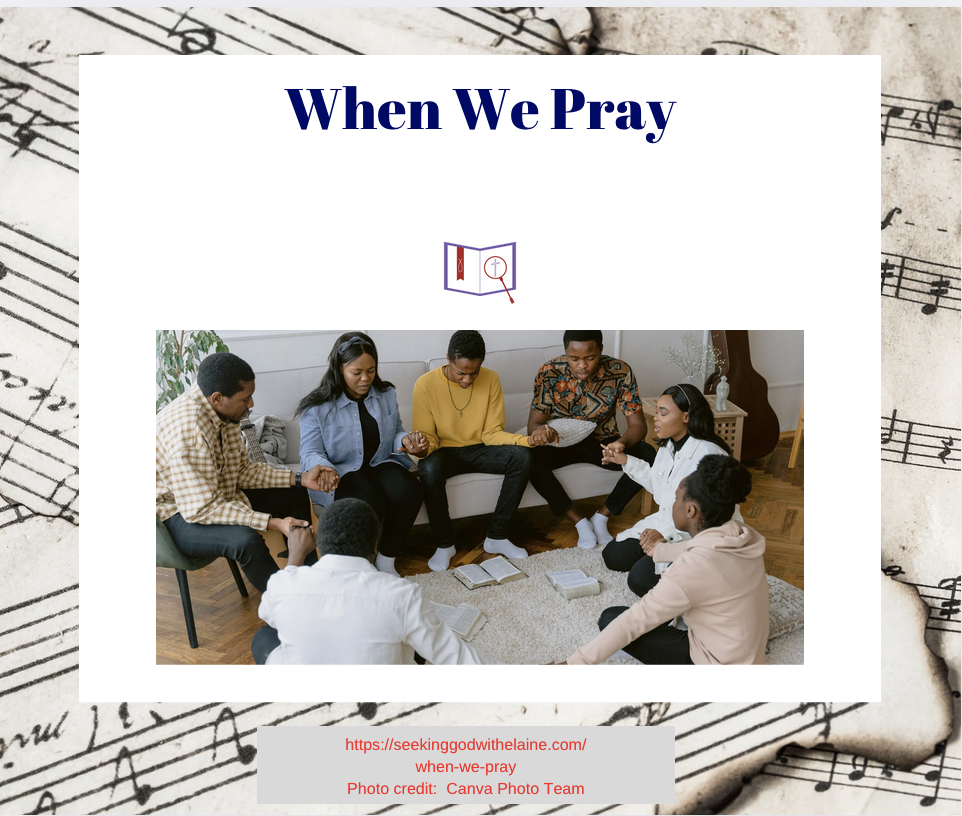
    Today is going to be a music day. The front is going through my head, so I didn’t get as far along in my writing as I wanted.

    I recorded this for a Sunday morning service when I wasn’t sure I was going to have the voice to sing. It is a strong statement about what happens when the Church prays.

    When We Pray
    Vocalist: Elaine Guthals
    Keyboard: Louise Guthals Weiss

    What do you think?

    Leave me a comment below (about this or anything else) or head over to my Facebook group for some interactive discussion.

    If you don’t understand something and would like further clarification, please contact me.

    If you have not signed up for the email daily or weekly providing the link to the devotions and the newsletter, do so below.

    If God has used this devotion to speak with you, consider sharing it on social media.

  • Adam’s Descendants to Enoch

    Adam and Eve were charged with populating the earth. This devotional reading looks at their line from the birth of Seth to the birth of Enoch.

    Nuggets

    • Creating humankind was tied to the line of Adam.
    • Moses used Genesis 5 to start another section in his writing.
    • Yes, God created only male and female as genders.
    • We are not only made in the image of God, but we are also made in the likeness of man.
    • Adam and Eve had more than three children.
    • Adam died at the age of 930.
    • Seth’s line as firstborn provided little insight into the sons listed.
    adams-descendants-to-enoch

    Genesis 5 is a transition section. In a way, I am surprised that Genesis 4: 25-26 wasn’t Genesis 5: 1-2. This is because we talk about that issue again.

    Part of me, though, can see why. Genesis 4 was a heavy chapter about sin. Moses wanted to offer hope.

    That was probably a good idea since Genesis 5 transitions to the heartbreak of Genesis 6.

    Let’s transition.

    Let’s Put It into Context

    To read devotions in the Creating Everything theme, click the button below.

    Devotions in the The Influence of Sin series

    Creating Humankind

    “This is the written account of the descendants of Adam. When God created human beings, he made them to be like himself. He created them male and female, and he blessed them and called them ‘human’” (Gen. 5: 1-2 NLT)

    Creating humankind was tied to the line of Adam.

    Not much new information is given in Genesis 5: 1-2. This is a rehash of what we were told in Genesis 1.

    But then, we need to hear things over and over again. We may not come to totally understand them, but we have to have a dose of faith to accept what is best not understood.

    Generations of Adam

    Moses used Genesis 5 to start another section in his writing.

    Genesis 1 through 2:4 was the first section. It was a large overview of the creation story.

    Genesis 2: 5 through Genesis 4 was the second section. It not only gave us a more detailed account of creation, but it also showed us a rocky start to human history.

    Creation was quickly tarnished by the stain of sin. Humankind had chosen against God.

    Genesis 5 is another section. However, there is no mention of sin — except one little phrase. We’ll talk about the significance of that when we get there.

    Created in the Likeness of God

    God patterned humankind after Himself.

    God formed us from dust of the ground and breathed life into us to put spirit into us. He made us to be sympathetic. He wants us to be connected with others so that we can make relationships in order to spread the word about His love for us.

    God originally made our moral character like His. He made us holy and righteous.

    Being made in God’s image, then, is about our moral and spiritual nature being in a kinship with God.

    The problem is that our character changed after the original sin, not our nature. While we still have a soul, it was tarnished by sin.

    One thing that did not change was the immortality of our souls. Like God, we will live eternally — not our physical bodies, but our souls.

    Male and Female

    Yes, God created only male and female as genders.

    All the rest are manmade through the influence of Satan. Yes, that makes them a sin.

    Are they the unpardonable sin? No. When we ask God for forgiveness, He will forgive us.

    Yes, we have to repent and turn from our sin. We shouldn’t think it is acceptable to go on sinning.

    This is the first opportunity for relationships. “So God created man in his own image, in the image of God he created him; male and female he created them” (Gen. 1: 26-27 ESV).

    But it was more than that. Think of all the different relationships this started.

    • Man with God.
    • Man and woman — interacting with someone of the opposite sex from friendship to marriage.
    • Family — being a cohesive unit of parent, siblings, and parent with children.
    • Neighbors — living around others.
    • Coworkers — dealing with someone else while you do the job assigned to you.

    It goes beyond this. Every person who has been born, is alive now, and will be born is a descendant of Adam and Eve.

    Race and ethnicity does not matter. That separation came, I think, after the Tower of Babel, which we will talk about eventually.

    The Days of Adam

    “When Adam was 130 years old, he became the father of a son who was just like him — in his very image. He named his son Seth. After the birth of Seth, Adam lived another 800 years, and he had other sons and daughters. Adam lived 930 years, and then he died” (Gen. 5: 3-5 NLT)

    Fathered a Son in His Own Likeness, After His Image

    We are not only made in the image of God, but we are also made in the likeness of man.

    I once wrote a devotion asking whether we were made in God’s image or were we made in Adam’s image. Some didn’t like it when I said it was both.

    Yes, Adam and Eve were made in God’s image. But we, as their children, are also made in Adam’s likeness. Once sin entered through Adam and Eve’s disobedience, sin was within us from birth.

    “And the result of God’s gracious gift is very different from the result of that one man’s sin. For Adam’s sin led to condemnation, but God’s free gift leads to our being made right with God, even though we are guilty of many sins. For the sin of this one man, Adam, caused death to rule over many. But even greater is God’s wonderful grace and his gift of righteousness, for all who receive it will live in triumph over sin and death through this one man, Jesus Christ. Yes, Adam’s one sin brings condemnation for everyone, but Christ’s one act of righteousness brings a right relationship with God and new life for everyone. Because one person disobeyed God, many became sinners. But because one other person obeyed God, many will be made righteous” (Rom. 5: 16-19 NLT).

    Are likeness and image synonymous? Well, yes. Likeness is a synonym of image, and both are synonymous with resemblance.

    That is logical to me. It goes back to God using patterns. Not only do we individually resemble God, but also the family structure resembles God. We have God’s intellectual and moral character.

    Our sinful nature is not part of being made in the image of God. It came from Adam. His image of God was tarnished by sin.

    Every one of Adan’s descendants have the same tarnish on our nature.

    In churchy words, that means we are unclean or unholy. We are no longer pure.

    We are called to be holy as God is (I Pet. 1: 16). How can we get there?

    Luckily, there is an answer to Job’s question. “Who can bring a clean thing out of an unclean? There is not one” (Job 14: 4 ESV).

    Jesus can.

    Other Sons and Daughters

    Adam and Eve had more than three children.

    When we are faced with reading genealogies, we tend to get all glassy-eyed and start skipping. We don’t want to do that because we could miss something very important.

    Take Adam, for instance. It might be easy to think that Adam had only three sons: Cain, Abel, and Shem. That is all Moses talked about in his book of origins.

    But Moses slipped in a little nugget when we might not be looking. “… he had other sons and daughters” (Gen. 5: 4 NLT).

    Adam and Eve were not going to populate the earth — “… ‘Be fruitful and multiply. Fill the earth …’” (Gen. 1: 28 NLT).

    Why did Moses not even name Adam and Eve’s other children? Well, Moses appears to be a man of few words. He only includes information that furthers the narrative.

    If it is not included, it is not germane to what God wants us to know.

    Besides, it would be like John said about writing an accounting of all Jesus said or did.

    • “The disciples saw Jesus do many other miraculous signs in addition to the ones recorded in this book. But these are written so that you may continue to believe that Jesus is the Messiah, the Son of God, and that by believing in him you will have life by the power of his name” (Jn. 20: 30-32 NLT).
    • “Jesus also did many other things. If they were all written down, I suppose the whole world could not contain the books that would be written” (Jn. 21: 25 NLT).

    God wants us to take it in faith. “Faith shows the reality of what we hope for; it is the evidence of things we cannot see” (Heb. 11: 1 NLT).

    Adam Died

    Adam died at the age of 930.

    Wait! What???? Adam was pushing 1,000 years old???????

    I can see that. Adam and Eve were charged to go forth and multiply. They weren’t going to have just three kids.

    It is conceivable that they would have had hundreds of kids — both male and female as we said. They had to live long enough to do that.

    Let’s look what was written about that in the Christian Age’s sermon entitled Lessons from the Longevity of the Antidiluvians. It says,

    “The race of antediluvians were blessed with all possible capacities and facilities for indefinite improvement in knowledge and happiness. They were not called to die when they had just began to live, nor to quit their investigations forever when they had just learned how to study. Men’s minds might have been formed and disciplined in the revolution of nine hundred years under an accumulation of influences and circumstances in the highest degree powerful and [favorable].”

    Resource

    I know. Adam lived almost 1,000 years, and his life story is told in five verses here, two verses in Genesis 4, 12 verses in Genesis 3, 11 verses in Genesis 2, and four verses in Genesis 1.

    But in those 34 verses, God told us all we needed to know.

    We really don’t know why people started living fewer and fewer years. We assume the root cause is sin. We aren’t told in God’s Word the practicality of that.

    Just another think for the UNR book — understanding not required.

    The focus shouldn’t be the numbers. Focus should be on how the line of Seth led to the birth of Jesus. It shouldn’t be on individuals, but on the forerunner of the Church.

    We will see in the coming verses the one thing that each have in common is they died. This began with the man that was created to live forever.

    When Adam and Eve chose to sin, they brought judgment on all humankind. Spiritual death was not the only type of death we would experience. Humankind would suffer physical death because of their original sin.

    God doesn’t want us to stress about our death. He wants us to have faith in Him.

    Adam’s Descendants

    “When Seth was 105 years old, he became the father of Enosh. After the birth of Enosh, Seth lived another 807 years, and he had other sons and daughters. Seth lived 912 years, and then he died. When Enosh was 90 years old, he became the father of Kenan After the birth of Kenan, Enosh lived another 815 years, and he had other sons and daughters. Enosh lived 905 years, and then he died. When Kenan was 70 years old, he became the father of Mahalalel. After the birth of Mahalalel, Kenan lived another 840 years, and he had other sons and daughters. Kenan lived 910 years, and then he died. When Mahalalel was 65 years old, he became the father of Jared. After the birth of Jared, Mahalalel lived another 830 years, and he had other sons and daughters. Mahalalel lived 895 years, and then he died. When Jared was 162 years old, he became the father of Enoch. After the birth of Enoch, Jared lived another 800 years, and he had other sons and daughters. Jared lived 962 years, and then he died” (Gen. 5: 6-20 NLT)

    Seth’s line as firstborn provided little insight into the sons listed.

    Adam, Seth, Enosh, Kenan, Mahalalel, Jared, and Enoch. We’ve got six biographies here. Once we get done talking about Enoch, we will be given Methuselah, Lamech, and Noah.

    Other than Adam, Seth, Enoch, Methuselah, and Noah, the other half are unknown to us. They are just names and dates.

    Ooo, baby! That tells us how much God really needs us. Zip. Nada.

    Once we hit Genesis 12, we will come to realize how important genealogies are. They will come even more important in Matthew and Luke.

    Look how every one of them says Adam and Eve’s descendants had more sons and daughters. Not all sons and daughters are named — just the one who is a direct line to Noah.

    God is the One Who selected the sons and daughters and separated them out to do His Will.

    Ouch! Parker said that the unlisted others weren’t listed because they were boring.

    But then Parker said something else. He wrote, “Family life, patient service, quiet endurance, the training of children, the resistance of temptation — these things are never mentioned by the historian. Because we admire brilliance we need not despise usefulness.”

    Resource

    Everyday life can be routine. Patient service and quiet endurance are what each one of us is called to do. Training others is a marching order. Resisting sin is imperative.

    We can’t think they were excluded because they were not living in obedience to God. They might have been. They may not have been.

    How much bigger would God’s Word be if more information is given on those listed — and more were listed?

    Read John 20: 30-32 and John 21: 25 again. And John just wrote that about One Man. Imagine if each person got their life story told!

    Making the Connections #1

    Adam was a very important person in the history of the world. But all in all, we really don’t know much about him.

    We know Adam did right. We know Adam did wrong.

    Most of all, we know that Adam and Eve were the grandparents of every single person that came after them. That includes you, me, our family, our friends, our enemies, and strangers. That includes everyone who was ever alive, everyone who is alive now, and everyone who will be born until the Day of the Lord.

    • “Then the man — Adam—named his wife Eve, because she would be the mother of all who live” (Gen. 3: 20 NLT).
    • “From one man he created all the nations throughout the whole earth. He decided beforehand when they should rise and fall, and he determined their boundaries” (Ac. 17: 26 NLT).

    Because we are all the same, you would think that would promote unity. “How wonderful and pleasant it is when brothers live together in harmony!” (Ps. 133: 1 NLT).

    Unfortunately, it doesn’t work that way. We exercise our right to free will for far more than just deciding whether or not to obey God.

    These days, it is woe to the person who thinks differently than we do. That creates a further divide in unity because no one wants to be told we shouldn’t think what we do.

    We need to love as Jesus did. He didn’t force everyone to believe in Him or believe what He believed.

    Jesus loved.

    Making the Connections #2

    You would think that as righteous as Abel was, the chosen line would have stemmed from him. Fuller noted that was a good argument as to why Abel died childless.

    Resource

    Think about it. “It was by faith that Abel brought a more acceptable offering to God than Cain did. Abel’s offering gave evidence that he was a righteous man, and God showed his approval of his gifts. Although Abel is long dead, he still speaks to us by his example of faith” (Heb. 11: 4 NLT).

    Abel was a righteous man. He is still a role model for us.

    Once Cain would have forfeited his firstborn status, it would have gone to one of Abel’s children. Since he didn’t have children, it went to Seth.

    Yes, Seth. The first son to be born in Adam’s image.

    Talk about the grace of God!

    Making the Connections #3

    Candlish made an interesting comparison. By now in Cain’s line, we would have learned about musicians, artists, and those who worked with animals.

    Resource

    Those have a worldview slant in today’s society. That would have generated power, wealth, and luxury — the same as now.

    Seth’s line didn’t have any indication of what their occupation or accomplishments were. It leaves us to believe their focus was on God.

    How Do We Apply This?

    • Acknowledge that God rewards walking in righteousness.
    • Don’t worry about death but think about it to ensure eternal life with God.
    • Don’t trust in our own merits or self-righteousness to ensure eternal life.
    • Have confidence in God.

    Resources

    Father God. Thank You for creating humans — even though You knew they would disobey You. Thank You for using us to be a small part of Your redemption plan. Thank You. Amen.

    What do you think?

    Leave me a comment below (about this or anything else) or head over to my Facebook group for some interactive discussion.

    If you don’t understand something and would like further clarification, please contact me.

    If you have not signed up for the email providing the link to the devotions and the newsletter, do so below.

    If God has used this devotion to speak with you, consider sharing it on social media.

  • The Influence of Sin: Genesis 4

    the-influence-of-sin-genesis-4

    Families were meant to be cohesive and harmonious. No, that doesn’t happen because of sin.
     
    Adam and Eve were obedient to God’s command to go forth and multiply (Gen. 1: 28).
     
    They had two sons whom they named Cain and Abel. We aren’t told the age difference between Adam and Eve’s boys. We know they aren’t twins.
     
    We shouldn’t forget the fact that Cain was the older brother. Abel should have been the one to look up to Cain, but Cain wasn’t a good role model.
     
    We assume Cain didn’t see Adam and Eve sin because the original sin happened in Genesis 3, and they were born in Genesis 4. But they could have. They weren’t said to have been conceived in the image of Adam like Seth was (Gen. 5: 3).
     
    Either way, Adam and Eve would have kept sinning, so they would have seen sin. Cain may even — probably — have sinned himself.
     
    At first glance, it would seem good that Cain and Abel chose different occupations. That is true, but both were tied directly to the farm. It was also good that each chose a separate aspect of farming. They weren’t competing against each other.
     
    Even though both occupations are clearly acceptable, shepherds show the meaning of the Gospel. Disciples are to nurture and grow others’ relationships with God.

    Two Offerings Given

    Both sons worshipped the One true God but in different ways.
     
    Though Adam and Eve probably raised their sons the same way, their relationships with God were totally different. Each one of us make our own decisions as to whether we will obey God. Our parents don’t make it for us any more than our siblings do. They were brothers, not clones.
     
    If we stop and think about it, we realize that we aren’t told how Adam and Eve worshiped God in the Garden of Eden. All that we can glean from it is that they regularly met with God.
     
    In other words, the most important thing is being in God’s presence.
     
    Adam and Eve raised their boys to worship God. They must have had regular Shabbat times He instituted this at the end of creation. Those times would have included being in His presence and sacrificing to Him.
     
    The boys would have been shown the right way to offer sacrifices. That would include how to pick the sacrifice (without blemish) and how to offer it. They would have seen how God accepted it.
     
    If God created — as He is the One Who fertilizes the egg and the sperm — all people like Abel, free will would have gone out the door. God would have been a dictator. He didn’t want that.
     
    God is in the business of separating disciples from non-disciples. It started from the first children and will end at the sheep and goats.
     
    We don’t know how long after the eviction this sin took place.
     
    Once an animal was sacrificed to make clothes for Adam and Eve, a sacrificial system could be set up. Sacrifices have a specific purpose.
     
    The sacrificial system was a foreshadowing that we need blood to cover our sins. Only blood can cover the stain and guilt of sin. The only blood that could do that once and for all was through Jesus shedding His blood on the cross.
     
    Cain and Abel both came to the Lord for mercy and salvation. They agreed that God deserved their worship and adoration.
     
    The boys offered their respective offerings through the same ceremony. While each brought offerings, they were different. In this instance, both sons wanted to take the fruits of their labors and honor God. Cain offered some of his crops, and Abel offered a firstborn lamb.

    One Offering Accepted

    Abel’s sacrifice was accepted because God was pleased with his life and offering. The fact that Abel brought a meat offering showed His commitment to God. He accepted the obligation to make an animal sacrifice to God.

    We have to worship though our lives, not just an occasional gift/sacrifice to God. We have to live through the week what God teaches us on Sunday.

    Abel’s sacrifice was accepted because of his attitude. He acknowledged his sinfulness, rather than tried to justify his actions and beliefs. He had the mind/attitude of Christ.

    Just as God accepted Abel and his offering, God rejected Cain and his offering.

    We ask about why the burnt offering was accepted, but the grain offering wasn’t. Later when God gave the law about sacrifices, He allowed grain offerings along with burnt offerings. In fact, there is a whole festival designed around the first fruits.

    We can come up with some reasons the offering wasn’t accepted. Cain’s offering did not indicate it was the first fruits, just some of his crops. It did not even say it was the best.

    Most importantly, we can understand why Cain’s sacrifice wasn’t accepted. His heart wasn’t right. Cain only gave a thanks offering. He failed to admit and repent of his sins.

    Cain lacked faith. Since he didn’t have faith, he didn’t have obedience.

    So, we can’t say loving God is enough. Being a good person isn’t enough.
     
    We must worship God the way He requires at all times. But we can’t worship like Cain.

    One Offering not Accepted

    Cain thought his sacrifice was going to be accepted. But it was offered neither in faith nor obedience.

    Look at the goats masquerading as sheep. People will get to Heaven and say, “Why aren’t you welcoming me with open arms?”

    Yeah, they are worshiping. They aren’t worshiping in faith and obedience. Both elements are needed.

    God removes those who do not believe and obey Him.

    Cain saw that his offering wasn’t accepted and became very angry, and God called him on it.

    So, Cain got angry. He didn’t understand why God neither accepted his gift nor the way it was given.

    Cain’s anger probably had a strong foundation of envy. On top of that was the feeling of humiliation that had to have been a major element. I can’t but think that there has to be an ingredient of self-will in here.

    Our sin is our consequence and responsibility.
     
    Where was Abel when Cain was wrestling with his envy? Worshiping God.
     
    Abel was doing everything he was supposed to be doing. We can read into that loving Cain.
     
    And look what Abel got for that.
     
    God wanted to know why Cain was envious. Cain shouldn’t have been focusing on the fact that Abel’s sacrifice was accepted and his wasn’t. He should have been focusing on why his sacrifice wasn’t accepted. Abel’s sacrifice — accepted or not accepted — was between him and God.

    We must be righteous in the eyes of God.
     
    A sacrifice is a God thing. We can’t keep it on our creature level.
     
    Cain thought God should accept as good enough whatever way he offered as worship. He more than likely didn’t see the sacrifice as a substitute. “I’ll just offer God this grain, and He won’t expect anything more.”
     
    Abel thought nothing we have to offer is good enough because we aren’t good enough.
     
    If Cain would have offered the correct offering with the right attitude, then God would have accepted it along with Abel’s. Since God did not accept Cain’s sacrifice, the if/then turned into a since/then.

    If we make a sacrifice to God without ABCDing, it could be for a number of wrong reasons. We don’t really understand our sin and God’s forgiveness. We understand, but we don’t care. We want to act like we want God’s forgiveness, but we only want the fire insurance.
     
    Sin was waiting to overtake Cain. Because of our desire to sin — once we do — it rules over us. We desire to control sin, but it rules over us.

    Satan makes sin bright and shiny in order to tempt us. This bright, shiny temptation is always just outside our hearts. It is laying in wait for the tiniest of cracks in our faith in God.
     
    We have to choose Him always.

    One Sin Leads to Another

    Unchecked envy can lead to hatred and murder.
     
    If the original sin was a test of obedience and disobedience, we look at the second sin as human interaction. If truth be known, some think this sin — murder — is a bigger sin than the original sin.
     
    In reality, the second sin was false worship.

    Cain’s disobedient heart became envious, angry, and hateful. That led to murder.
     
    I don’t think Cain lured Abel out into the fields to kill him. It doesn’t say right then, the next day, or any indication of the time frame. We don’t know how long it took for Cain’s passion to bubble over.
     
    Could Cain have planned the murder? Maybe. We just don’t have enough to make that determination.
     
    We aren’t told if Cain picked up a rock and bashed in Abel’s head. Maybe Cain didn’t use a weapon but just strangled him.
     
    As usual, the how isn’t as important as the why. Cain killed Abel because he threw a temper tantrum toward God. He lost one thing that God is adamant that we need to be — self-control.

    Whether Cain lost it and attacked Abel or planned that outcome, he did not discipline himself to always follow God.

    The Opportunity to Repent

    It doesn’t sound like it took long for God to catch up with Cain. At a minimum, it could mean it was after Cain came back from the field. At most, it does mean that it is after he killed Abel. But again, we aren’t told the time frame.

    Even though God knew Cain had killed Abel and didn’t have to ask, He allowed Cain the opportunity to repent. Just as He had done with Adam and Eve in the Garden, God was giving him the opportunity to confess and repent to increase his faith.
     
    Cain did not do as Adam and Eve tried to do — deflect and excuse. Cain refused to acknowledge his actions as sin.
     
    Yeah, read that again. Cain thought it should be okay that he killed his brother.

    Satan is the one that says we don’t need to take responsibility for our actions. He tells us to do the exact opposite of what God wants.
     
    Sin cannot be forgiven if we don’t acknowledge what we did was disobedient to God.
     
    Cain didn’t want to be questioned about what happened to his brother. God asked Cain where Abel was, and Cain immediately lied.
     
    Cain tried to deflect God’s question by claiming ignorance. Did Cain really think his anger was going to fix everything? Was his sarcasm going to earn points with the Sovereign God?
     
    Talk about selfish! That just shows us how hard Cain’s heart was. He was only thinking about himself and his hatred of Abel because of his perceived slight.
     
    Abel had to take responsibility for his actions, just as Cain did for his. Abel had to decide on his own whether he would follow God or not.
     
    But that tells us that we have a spiritual responsibility to others. This is very evident in our marching orders.

    But isn’t that what the Plan of Salvation is all about? Jesus didn’t say, “Am I my brother’s keeper?” No, He said, “I will be the substitute for everyone because I care that much for them.”
     
    How do the two greatest commandments describe what morality reality is? True morality is the love of God and the love of others. When we do not have that, we may find the very element of murder within us.

    Cain’s Punishment

    Cain received his punishment. He broke both of the greatest commandments when he chose not to repent.
     
    God did not accept Cain’s worship, but He did not banish him forever. He gave him a second chance.
     
    Cain killed Abel, and God punished him from His presence. There was no third chance.
     
    That is what mercy is. God doesn’t punish us as we deserve. He also holds off our punishment until it is our time to be punished.
     
    But if we think that we aren’t going to be punished, we read right over the part about being cursed. We don’t want to be cursed, which is more than being cussed at.
     
    There is a link between sin and its punishment. God does not want the sin to happen. But when it does, He wants the punishment to show us what needs correcting in our lives.
     
    One thing we may or may not recognize is part of Cain’s punishment was giving up his birthright. We would say Cain’s punishment hit him in the pocketbook.
     
    Cain not only had his occupation taken from him, but he also had his purpose taken. He lost what he offered God. The one we would see as a homebody would after that be homeless and a wanderer.
     
    Cain lamented his punishment. But he still wasn’t repentant for killing Abel. He was sorry he got caught.
     
    Cain’s first thought was he was being banished from the land. He was still focusing on worldly issues.

    While Cain was right in the laws broken were God’s laws, he was wrong to think God was the One in fault. Cain made his own choice whether to obey the law or not. He chose not to obey.
     
    Cain was cut off from God, the worst punishment that there is. He was being banished from was God’s Shekinah, His glory.
     
    Cain was concerned for his safety. He was afraid his brothers would kill him for killing Abel. Seth wasn’t the only other brother Cain had.
     
    We have no idea what kind of mark God placed on Cain. Whatever the physical mark, Cain would have to live a long life with the mental mark on his conscience.
     
    Sin takes us to the polar opposite than salvation. The most important element of any sin is disobedience to God. The punishment for that sin had already been declared.
     
    We don’t have GPS coordinates for the Land of Nod. All we know about Nod was it was east of Eden.
     
    Nod is a Hebrew word that means wanderer, exile, or fugitive. It may not be a specified piece of land. It may be wherever he wandered.
     
    The main thing for Cain would have been that the Land of Nod was not the Land of Eden. He was leaving everything that he had always known. He was leaving his mother and father.
     
    Cain was leaving God. No matter what he did, no matter wherever he went, he would never get back to the presence of God. Cain was always in Nod, never in Eden.
     
    God was showing us, through the story of Cain, what it is like to be outside His presence. It is misery based on exile. It is unsettled living.

    Descendants of Cain

    Cain, even though he was an ungodly man, did his part to go forth and multiply. At some point in his life, Cain became a family man.
     
    Cain’s wife may have been his sister. But then, some think that the world was also populated at this time by angels and daughters hooking up.
     
    Enoch, named for Cain’s son, was the first city.

    Even though Lamech was prosperous, he didn’t have everything he needed — he didn’t have God.
     
    Lamech ignored God’s design of marriage. He was a polygamist, having two wives at the same time.
     
    The family was to be the nucleus of society. Families were to take care of widowed family members.
     
    The first son, Jabal, herded livestock as he lived in tents. Was Jabal trying to go back to Abel’s occupation but not his God.
     
    The second son, Jubal, became a musician.

    The third, Tubal-Cain, not only became an inventor of metal tools, but he also taught the craft.
     
    If music and inventions aren’t sinful, what is? The motivation is what needs to be evaluated.
     
    It is interesting to note that a daughter was named here. Naamah is Tubal-Cain’s sister. Women generally aren’t not listed in genealogy lists unless it says they are the wife of someone.
     
    After Lamech killed a man, he compared his situation with that of Cain’s.
     
    Both had killed another man. Both allowed one sin to lead to another. To me, neither was remorseful.
     
    Cain tried to cover up the murder of Abel. Lamech didn’t.
     
    What I notice in Lamech’s poem is the arrogance. Cain came off more as guilty and defensive. He definitely was not bragging.
     
    Cain purposefully attacked and murdered Abel. While we aren’t given any information about the murder, a man attacked Lamech. Wouldn’t that be self-defense? That isn’t murder – unless Lamech started it.
     
    God protected Cain with a mark when he felt others would kill him. But Cain also probably saw it as the punishment it was.
     
    Lamech just saw the mark of Cain as protection, not punishment. Protection he didn’t get. Maybe that is why he, himself, tried to up the punishment of anyone who killed him.
     
    God weighed in on Cain. He was silent on Lamech.

    The Birth of Seth

    Adam and Eve had a third son. I bet, in a way, this birth was bittersweet.
     
    Eve knew God patiently allows us to turn back to Him. Her faith was shown front and center here.
     
    God promised Eve redemption through One of her descendants. Yeah, Seth was the anointed one

    Seth had a son he named Enosh. We don’t know much about him. Circumstances in the world were very bad some time after Enosh was born.
     
    We all have opportunities to choose to sin. It is imperative that we have discernment to choose between right and wrong.
     
    Humans chose to worship God corporately.
     
    Adam and Eve praised God by the name of which they knew Him. Anyway, we should focus on the worship, not the name. They openly aligned themselves with God.
     
    We shouldn’t think that they hadn’t individually worshiped God through prayer before this. That is probably the first corporate worship.
     
    Prayer didn’t have to wait until Matthew 6. It was an Old Testament habit. Abraham was considered righteous. That was pre-Christ. That was not pre-prayer.

    We are not to just go through the motions — as right as they might be. Our worship for God must produce a change in us — and continue changing us until we are called home.
     
    We can’t go to worship because it is expected of us. We must go out of our desire to be in God’s presence so that He can sanctify us.

    God will tell us about bad stuff — disobedience, persecution, exiles. He wants us to know that He will punish us when we sin.
     
    But God mostly focuses on saving us. He loves us and wants our relationship with Him restored.

    creating-everything-theme

    To read devotions in the Creating Everything theme, click the button below.

    Devotions in the Celebrating Creation’s Story series

  • Seth Becomes the Firstborn

    After the heartache of Cain and Abel, Adam and Eve had a third son. This devotional reading looks at the birth of Seth.

    Nuggets

    • Adam and Eve had a third son.
    • Seth had a son he named Enosh.
    • Circumstances in the world were very bad some time after Enosh was born.
    • Humans chose to worship God corporately.
    seth-becomes-the -firstborn

    The rest of Genesis 4 dealt with Cain and sin. Starting with these verses and beyond, the chosen line is discussed. Seth is the one from whom that line comes.

    So, let’s jump from sin to righteousness.

    Let’s Put It into Context

    To read devotions in the Creating Everything theme, click the button below.

    Devotions in the The Influence of Sin series

    The Birth of Seth

    “Adam had sexual relations with his wife again, and she gave birth to another son. She named him Seth, for she said, ‘God has granted me another son in place of Abel, whom Cain killed.’ When Seth grew up, he had a son and named him Enosh. At that time people first began to worship the Lord by name” (Gen. 4: 25-26 NLT)

    Adam and Eve had a third son.

    Ooo, baby. I bet, in a way, this birth was bittersweet. At least, Eve felt that way. “… ‘God has granted me another son in place of Abel, whom Cain killed.” (Gen. 4: 25 NLT).

    I hope Eve stated that in praise. At that time, Eve was 50-50 in raising kids. She may have had some trepidation in the back of her mind.

    Come on. Eve was human. She probably couldn’t have felt differently.

    This is especially true if Eve still had fallout from being the first to sin. She opened the door for Cain to have the ungodliness he showed.

    It looks like Eve named all of her children. Remember what she said when Cain was born. “… When she gave birth to Cain, she said, ‘With the Lord’s help, I have produced a man!” (Gen. 4: 1 NLT).

    Hopefully, Eve did see Seth as a child of hope and love, as Bonar said. Well, his name does mean set, placed, or appointed.

    Resource

    Yes, Eve sinned. Yes, Cain sinned.

    God is more interested in repentance than judgment. Giving us the ability to repent was what the cross was all about.

    Don’t get me wrong. Judgment for sin will occur on the Day of the Lord.

    Eve knew God patiently allows us to turn back to Him. Her faith was shown front and center here.

    • “So the Lord must wait for you to come to him so he can show you his love and compassion. For the Lord is a faithful God. Blessed are those who wait for his help” (Isa. 30: 18 NLT).
    • “The Lord isn’t really being slow about his promise, as some people think. No, he is being patient for your sake. He does not want anyone to be destroyed, but wants everyone to repent” (II Pet. 3: 9 NLT).

    We have to remember God’s punished for Eve when she committed the original sin. God promised her redemption through One of her descendants. “And I will cause hostility between you and the woman, and between your offspring and her offspring. He will strike your head, and you will strike his heel” (Gen. 3: 15 NLT).

    Yeah, Seth was the anointed one.

    Seth Had a Son

    Seth had a son he named Enosh.

    We don’t know much about Seth’s son Enosh. Here is what we do know.

    • Seth was 105 years old when Enosh was born (Gen. 5: 6).
    • Enosh was not an only child (Gen. 5: 7).
    • Enosh was 90 years old when his son Kenan was born (Gen. 5: 9).
    • Enosh had a number of sons and daughters (Gen. 5: 10).
    • Enosh was 905 years old when he died.

    At That Time

    Circumstances in the world were very bad some time after Enosh was born.

    Hambleton told us about that. He wrote, “There were evidently two parties — the children of men and the sons of God — the men of this world and the men not of this world — the faithful in Christ Jesus and the unbelieving and ungodly.”

    Resource

    No, this isn’t a Cain v. Abel deal. This is a daughter of men/sons of God issue.

    That is talked about in Genesis 6. We touched on this when we were wondering where Mrs. Cain came from but said we were going to wait. I think we need to figure it out now.

    • “Then the people began to multiply on the earth, and daughters were born to them. The sons of God saw the beautiful women and took any they wanted as their wives” (Gen. 6: 1-2 NLT).
    • “In those days, and for some time after, giant Nephilites lived on the earth, for whenever the sons of God had intercourse with women, they gave birth to children who became the heroes and famous warriors of ancient times” (Gen. 6: 4 NLT).

    Oh, yeah. Who are the sons of God, and who are the daughters of men?

    Some think the sons of God were fallen angels. That is what the word Nephilim, the word used to describe the offspring of the sons of God and the daughters of men, means — fallen.

    “We even saw giants there, the descendants of Anak. Next to them we felt like grasshoppers, and that’s what they thought, too!” (Num. 13: 33 NLT).

    I know. That verse muddied the waters. Sort of.

    The Anakim (descendants of Anak) were also the descendants of the Nephilim. So the way I see it, the Nephilim is like their race (mixed race giants) with the Anakim being a specific branch of the family tree.

    Does that seem fanciful? Some think so.

    Part of me says that explains a lot. If some are descendants of fallen angels — angels that left Heaven with Satan — that explains the great divide between worldview people and disciples.

    Some believe the Nephilim to be descendants of Cain. That would describe the divide as well. I can see, at this point, the only societies would be the line of Cain and the line of Seth.

    Geikie had another explanation. He wrote,

    “On the other hand, it is continually used of heathen idols, and hence it may well point in this particular case to intermarriages between the adherents of idolatry and the daughters of the race of Seth, and a consequent spread of heathenism, far and near, with its attendant violence and moral debasement.”

    Resource

    I could see that if Geikie would have said intermarriages between the daughters of adherents of idolatry and the sons of the race of Seth. Those practicing idolatry would not be called the sons of God.

    Geikie seems to have recognized this himself. He felt we should interpret this to be “… ‘the sons of the godly race’ took wives of ‘the daughters of men.’” In other words, godly disciples intermarried with ungodly worldview people.

    But again, I can see that referring to the line of Seth and the line of Cain.

    Since this is from Genesis 6 — right before the flood — we know that things became even more corrupt.

    But we also know that God does not want His chosen people to intermarry with non-believers.

    • “Don’t team up with those who are unbelievers. How can righteousness be a partner with wickedness? How can light live with darkness?” (II Cor. 6: 14 NLT).
    • “You must not intermarry with them. Do not let your daughters and sons marry their sons and daughters, for they will lead your children away from me to worship other gods. Then the anger of the Lord will burn against you, and he will quickly destroy you” (Deut 7: 3-4 NLT).

    C. H. M. thought this uniting was a exceptional form of evil. Of course, my mind went to disciples who compromise with the worldview. It may not necessity be a marriage, but it is an association God does not want us to foster.

    Resource

    The desire of the godly for the ungodly is understandable. We still have that today — and not just for a marriage partner.

    That is the pull of sin, the attractiveness of it.

    Calthrop made an interesting observation— and very correct. The godly have marching orders to witness to the ungodly.

    Resource

    • “And then he told them, ‘Go into all the world and preach the Good News to everyone’” (Mk. 16: 15 NLT).
    • “Therefore, go and make disciples of all the nations, baptizing them in the name of the Father and the Son and the Holy Spirit. Teach these new disciples to obey all the commands I have given you. And be sure of this: I am with you always, even to the end of the age” (Mt. 28: 19-20 NLT).

    We start off with the right attitude and zeal, and we get pulled over to the dark side.

    We all have opportunities to choose to sin. It is imperative that we have discernment to choose between right and wrong.

    Worship the Lord by Name

    Humans chose to worship God corporately.

    I’m confused. How can the people in Genesis worship God by name when they didn’t know His name until Exodus 3?

    But was that correct? Who did Eve call to when Cain was born? “… When she gave birth to Cain, she said, ‘With the Lord’s help, I have produced a man!’” (Gen. 4: 2 NLT).

    Adam and Eve praised God by the name of which they knew Him.

    Anyway, we should focus on the worship, not the name. Hambleton thought this was the first time they said they were God’s people. They openly aligned themselves with God.

    Resource

    Remember what we said in the last devotion. “… I lay the sins of the parents upon their children; the entire family is affected — even children in the third and fourth generations of those who reject me” (Ex. 20: 5 NLT).

    First generation was Adam. Second generation was Seth. Third generation was Enosh.

    We shouldn’t think that they hadn’t individually worshiped God through prayer before this. That is probably the first corporate worship.

    This is logical. “And I will cause hostility between you and the woman,  and between your offspring and her offspring. He will strike your head, and you will strike his heel” (Rom. 10: 9-10 NLT).

    Vaughan stated that prayer is both an instinct and a mystery. It is probably safe to say that – at least once in our lives – we have raised our faces up to the sun to let its rays wash over us.

    In that instance, we are raising our faces to God, the Creator of the sun. We are thanking Him by enjoying His creation.

    Surprised that non-believers have that worship?  Vaughan argued they did. He wrote,

    “Even in the depth of lost knowledge and depraved feeling, the instinct of prayer will assert itself. … Just as the instinct of nature brings the child in distress or hunger to a father’s knee or to a mother’s bosom, even so does created man turn in great misery to a faithful Creator, and throw himself upon His compassion and invoke His aid.”

    Resource

    Ooo, baby. Put someone in a difficult situation. Just watch them calling out for protection, success, and provision.

    Oh, but isn’t prayer a mystery! How does God hear us? How does He hear everyone at the same time? How does He know what is going to happen when we haven’t made the choice – not even gotten into the situation that offers the choice?

    Vaughan addressed that, too. How can we say the answer came from us when we have all these questions? How can we say it is anyone but God when the answer we get is something we didn’t thought of before?

    Prayer didn’t have to wait until Matthew 6. It was an Old Testament habit.

    Think about Elaine-speak of what Vaughan said. Abraham was considered righteous. That was pre-Christ. That was not pre-prayer.

    Making the Connections #1

    Prayer is something we don’t understand fully. Look what Vaughan said. He wrote,

    “The idea of holding a communication with a distant, an unseen, a spiritual being, is an idea too sublime, too ethereal for any but poets or philosophers to have dreamed of, bad it not been made instinctive by the original Designer of our spiritual frame.”

    Resource

    One issue, I think in these days, in the communication part. We have trouble communicating.

    It could be social media. It could be scrolling. It could be video games.

    It could be feelings of not fitting in. It could be bullying. It could be being introverted.

    If we have trouble communicating one-on-one, how are we going to communicate with – second issue – a spiritual being.

    Yep, God is unseen, but He isn’t distant. He is near to us.

    • “It is the Lord who goes before you. He will be with you; he will not leave you or forsake you. Do not fear or be dismayed” (Deut. 31: 8 ESV).
    • “Keep your life free from love of money, and be content with what you have, for he has said, ‘I will never leave you nor forsake you’” (Heb. 13: 5 ESV).
    • “Be strong and courageous. Do not fear or be in dread of them, for it is the Lord your God who goes with you. He will not leave you or forsake you” (Deut. 31: 6 ESV).
    • “No man shall be able to stand before you all the days of your life. Just as I was with Moses, so I will be with you. I will not leave you or forsake you” (Josh. 1: 5 ESV).
    • “Fear not, for I am with you; be not dismayed, for I am your God; I will strengthen you, I will help you, I will uphold you with my righteous right hand” (Isa. 41: 10 ESV).
    • “Have I not commanded you? Be strong and courageous. Do not be frightened, and do not be dismayed, for the Lord your God is with you wherever you go” (Josh. 1: 9 ESV). 
    • “Keep your life free from love of money, and be content with what you have, for he has said, ‘I will never leave you nor forsake you.’ So we can confidently say, ‘The Lord is my helper; I will not fear; what can man do to me?’” (Heb. 13: 5-6 ESV).
    • “Behold, I am with you and will keep you wherever you go, and will bring you back to this land. For I will not leave you until I have done what I have promised you” (Gen. 28: 15 ESV).

    Ooo, baby. How many of us feel we are poets and philosophers? Like, none.

    God doesn’t want us to be what we are not. He wants us to come to Him as we are. Then, He will grow us to be more like Him.

    Making the Connections #2

    Oooo. Look what Hambleton said. He wrote, “Religion never flourishes without diligent and faithful use of the appointed means of grace.”

    Resource

    Belief in God doesn’t flourish without constant and obedient use of the grace God gives us in that moment.

    Making the Connections #3

    A change was needed in their worship. I applaud them for making that change.

    They evaluated what they were doing, saw that something was wrong, and fixed it.

    Why is it so hard for us to change?

    How Do We Apply This?

    • Participate in corporate worship services as well as individual worship activities.

    Father God. You can turn heartache into hope. Lord, You used feeble, sinful people to fulfill Your promise. Thank You for using us –  feeble, sinful people – for Your work. Amen.

    What do you think?

    Leave me a comment below (about this or anything else) or head over to my Facebook group for some interactive discussion.

    If you don’t understand something and would like further clarification, please contact me.

    If you have not signed up for the email providing the link to the devotions and the newsletter, do so below.

    If God has used this devotion to speak with you, consider sharing it on social media.
  • The Descendants of Cain

    Even though Cain himself does not appear again in God’s Word, his name does. This devotional reading looks at Cain’s descendants, especially Lamech, who compares himself to Cain.

    Nuggets

    • Even though Lamech was prosperous, he didn’t have everything he needed — he didn’t have God.
    • The first son, Jabal, herded livestock as he lived in tents.
    • The second son, Jubal, became a musician.
    • The third, Tubal-Cain, not only became an inventor of metal tools, but he also taught the craft.
    • After Lamech killed a man, he compared his situation with that of Cain’s.
    the-descendants-of-cain

    In the last devotion, we started looking at the descendants of Cain. We talked about son Enoch, grandson Irad, great-grandson Mehujael, great-great grandson Methushael, and great-great-great grandson Lamech.

    In this devotion, let’s look at Lamech and his children

    Let’s Put It into Context

    To read devotions in the Creating Everything theme, click the button below.

    Devotions in the The Influence of Sin series

    Lamech the Family Man

    “Lamech married two women. The first was named Adah, and the second was Zillah. Adah gave birth to Jabal, who was the first of those who raise livestock and live in tents. His brother’s name was Jubal, the first of all who play the harp and flute. Lamech’s other wife, Zillah, gave birth to a son named Tubal-cain. He became an expert in forging tools of bronze and iron. Tubal-cain had a sister named Naamah” (Gen. 4: 19-22 NLT)

    Lamech

    Even though Lamech was prosperous, he didn’t have everything he needed — he didn’t have God.

    Lamech seems to have prospered. He had a couple of wives and some sons. Each of the three sons had a unique talent.

    But Lamech was a chip off the old block. Where Cain had killed his brother, Lamech killed someone else.

    Talk about the selfish and the hateful. But we’ll get to that in a little bit.

    Watkinson blamed part of Lamech’s sinfulness on the society of cities. The argument was that the cities were not only stained by selfishness but also extortion.

    Resource

    We know some cities — if only sections — can be breeding grounds for unrighteousness. That was the spirit of Cain, the first founder of a city — which we talked about in the last devotion.

    So, how did all of this play out in Lamech? First, he ignored God’s design of marriage. “This explains why a man leaves his father and mother and is joined to his wife, and the two are united into one” (Gen. 2: 24 NLT).

    Wife singular, not plural.

    This wasn’t talking about Abraham having two wives. “Abraham married another wife, whose name was Ketura” (Gen. 25: 1 NLT). He married Ketura after Sarah died (Gen. 23: 1-2).

    This is talking about Lamech having two wives at the same time. Lamech was a polygamist — and Cox thought that was worse than being a murderer!

    Resource

    Why was that important? Bonar was spot on when he answered that question. He wrote, “It was the foundation of family peace, of true religion, of social order, of right government in the state. Take away this foundation, or place two instead of one, and the whole fabric shakes, the nation crumbles to pieces.”

    Resource

    The family was to be the nucleus of society. I see this as including mom, dad, kids, and extended family. Families were to take care of widowed family members.

    Jabal

    The first son, Jabal, herded livestock as he lived in tents.

    Lamech had three sons that were talented. The first son, Jabal, followed his ancestors into animal husbandry. (To me, that isn’t city living.)

    Dods agreed. He highlighted the nomadic nature because Jabal didn’t have a fixed dwelling place.

    Resource

    Was Jabal trying to go back to Abel’s occupation but not his lifestyle? Unfortunately, even if he was, it doesn’t say anything about him turning back to Abel’s God.

    Wait! Wasn’t Abel named the first shepherd? “… When they grew up, Abel became a shepherd, while Cain cultivated the ground” (Gen. 4: 2 NLT).

    So, what is this? “Adah gave birth to Jabal, who was the first of those who raise livestock and live in tents” (Gen. 4: 20 NLT).

    Oh, okay. Jabal raised livestock. Livestock did not limit the animals to sheep, but also included cattle, goats, and donkeys. The animal population was diversified.

    Kalisch brought up a good point. Even though Abel may not have had children when he was murdered, his occupation did not end when his life ended. He felt this was a way that Cain’s family could atone for the sin. “… I lay the sins of the parents upon their children; the entire family is affected — even children in the third and fourth generations of those who reject me” (Ex. 20: 5 NLT).

    In my way of counting, great-great grandson Methushael would be the fourth generation. That would make Lamech the fifth generation and Jabal the sixth.

    Dods commented about shepherd being outside of civilization. We know that, after the Hebrews’ relocation to Egypt, shepherds were disrespected. In fact, they were not even allowed in synagogue.

    Jubal

    The second son, Jubal, became a musician.

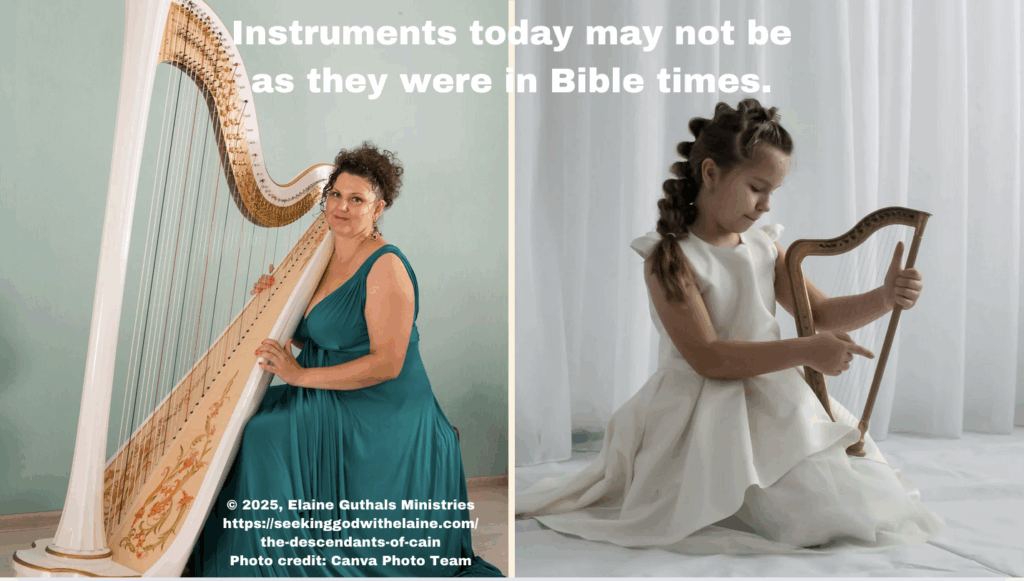
    It depends on what version we read as to what the instruments are called: stringed instruments, pipes, harp, flute, lyre, pipe, and organ. It probably doesn’t matter.

    Case in point, the harp. Instruments today may not be as they were in Bible times.

    Don’t get me wrong. Music itself is not sinful. We know there will be singing in Heaven!

    Instead, Kalisch stressed that the instruments personifies the human family in music. Jubal may have invented some instruments so that Jabal could sing to the herd.

    Tubal-Cain

    The third, Tubal-Cain, not only became an inventor of metal tools, but he also taught the craft.

    Inventing new things in whatever medium is not itself sinful. Tools are important in everyday life.

    Kilisch thought these implements made by Tubal-Cain were used in agriculture. That would allow Cain’s occupation to continue and flourish.

    If music and inventions aren’t sinful, what is? The motivation is what needs to be evaluated.

    • Are we singing to worship God?
    • Is the purpose of our inventions to replace God in our lives?
    • Is our focus a worldly focus or a heavenly focus?

    Gilfillian seemed to think it was understandable why sinful motivation happened — not right but understandable. He wrote, “Feeling themselves estranged from God, they are stung to derive whatever solace they can from natural research, artistic skill, and poetic illusion.”

    Resource

    It is interesting to note that a daughter was named here. Naamah is Tubal-Cain’s sister. Women generally aren’t not listed in genealogy lists unless it says they are the wife of someone.

    No more information is given about her. Dods thought Naamah may have been involved in the creation of the arts.

    Lamech the Murderer

    “One day Lamech said to his wives, ‘Adah and Zillah, hear my voice; listen to me, you wives of Lamech. I have killed a man who attacked me, a young man who wounded me. If someone who kills Cain is punished seven times, then the one who kills me will be punished seventy-seven times!’” (Gen. 4: 23-24 NLT)

    After Lamech killed a man, he compared his situation with that of Cain’s.

    These two verses have always been a bit of a head-scratcher for me. Let’s see if we can figure it out.

    Lamech was the first poet. Life was hard! They needed something for their souls and minds to help them get through.

    Cox reminded us that this is the only pre-flood poem to have survived. In it, Lamech informed his wives that he killed a man.  

    Resource

    We aren’t given any information about the murder. Did Tubal-Cain invent and make a sword that was used?

    What provoked the attack? Did Lamech start it or the other man?

    Lamech was comparing himself to Cain. Both had killed another man. Both allowed one sin to lead to another.

    Some tend to think that Lamech was remorseful, but I don’t agree. Cain sure wasn’t — and the man he killed was his biological brother!

    To me, that is where the similarities end.

    Cain tried to cover up the murder of Abel. Lamech didn’t.

    What I notice in Lamech’s poem is the arrogance. “He who kills me should get a far worse punishment than he who killed Cain.” Lamech may have said this tongue-in-cheek, but it comes off as him feeling a superiority over Cain. He was also boasting.

    •  “For people will love only themselves and their money. They will be boastful and proud, scoffing at God, disobedient to their parents, and ungrateful. They will consider nothing sacred” (II Tim. 3: 2 NLT).
    • “Look what happens to mighty warriors who do not trust in God. They trust their wealth instead and grow more and more bold in their wickedness” (Ps. 52: 7 NLT).
    • “For they brag about their evil desires; they praise the greedy and curse the LORD” (Ps. 10: 3 NLT).

    Cox called that an immunity from vengeance. What he was doing, in Cox’s estimation, was giving himself permission to do violent, resentful deeds.

    Cain came off more as guilty and defensive. He definitely was not bragging.

    Cain purposefully attacked and murdered Abel. A man attacked Lamech. Even though the man was younger than him, he killed him.

    Wouldn’t that be self-defense? That isn’t murder – unless Lamech started it.

    God protected Cain with a mark when he felt others would kill him. But Cain also probably saw it as the punishment it was.

    Lamech just saw the mark of Cain as protection, not punishment. Protection he didn’t get. Maybe that is why he, himself, tried to up the punishment of anyone who killed him.

    If the murder weapon was a sword, it reads to me that Lamech was putting more faith in the sword than he was in God. He didn’t need God – wrong!

    Dickson felt Lamech saw it as protection with a touch of permission. He wrote, “He interprets Cain’s case as a premium put by God upon violence; as a Divine connivance at murder.”

    Resource

    Hmmm. Then Lamech probably did know about God. He just didn’t know God.

    Yes, God shows mercy and grace to murderers – look at David. But murder does break God’s law. “You must not murder” (Ex. 20: 13 NLT).

    Besides, God takes care of judgment Himself. “Dear friends, never take revenge. Leave that to the righteous anger of God. For the Scriptures say, ‘“I will take revenge; I will pay them back,” says the Lord’” (Rom. 12: 19 NLT).

    God weighed in on Cain. He was silent on Lamech.

    Making the Connections #1

    I shake my head when I am told that God is a dictator. We just need to point to Cain to say it isn’t so.

    Look how Bonar described it. He wrote,

    “God suffers them to go on forgetting Himself, and occupying themselves with these engrossing employments. He does not interfere; and this not only because He is long suffering, but because one of His great purposes is, that man shall have full scope to develop himself mentally, morally, and physically. Man has torn himself off from God; and God will let it be seen how the branch can unfold its leaves and fruit, or rather what kind of leaves and fruit it can put forth when thus severed from Himself. God will let the world roll on its own way, that it may be seen what a world it is.”

    Resource

    • Allows them to forget Him.
    • Allows them to do what they want to do.
    • Doesn’t interfere.
    • Allow them to develop mentally and morally.
    • Journey down its own road away from Him.

    How does that sound like someone Who is an oppressor and controlling?

    We just have to look to Cain and his descendants – especially Lamech – to see that isn’t true.

    Make no mistake. The Day of the Lord is coming when those who think this will be held accountable.

    Making the Connections #2

    We talked about Lamech being a polygamist. Jacob was, also, but what is the difference?

    I see two big differences right away. Jacob had not planned to marry Leah, let alone have the two maids as concubines. That marriage got crowded through no fault of Jacob’s.

    The other difference was that Jacob was following God. He was the branch of the chosen.

    Lamech was as far away from God as he could get.

    How Do We Apply This?

    • Submit to God and be obedient.
    • Ask God to give us His character, not a worldview character.

    Father God. We don’t want to be far away from You. We want to have a heart knowledge of You. Help us to tell our children and grandchildren – everyone – about You. Amen.

    Resource

    Glossary

    What do you think?

    Leave me a comment below (about this or anything else) or head over to my Facebook group for some interactive discussion.

    If you don’t understand something and would like further clarification, please contact me.

    If you have not signed up for the email providing the link to the devotions and the newsletter, do so below.

    If God has used this devotion to speak with you, consider sharing it on social media.
  • Farewell to Cain

    God banished Cain from the Land of Eden. This devotional reading looks at what that banishment may have meant.

    Nuggets

    • We don’t have GPS coordinates for the Land of Nod.
    • At some point in his life, Cain became a family man.
    • Enoch, named for Cain’s son, was the first city.
    • Cain, even though he was an ungodly man, did his part to go forth and multiply.
    farewell-to-cain

    We are heading toward the end of Genesis 4. In this devotion, we will look at Cain beginning his banishment.

    But what happened from there? While we don’t get much information, we do get some.

    Let’s Put It into Context

    To read devotions in the Creating Everything theme, click the button below.

    Devotions in the The Influence of Sin series

    Cain

    “So Cain left the Lord’s presence and settled in the land of Nod, east of Eden. Cain had sexual relations with his wife, and she became pregnant and gave birth to Enoch. Then Cain founded a city, which he named Enoch, after his son” (Gen. 4:  16-17 NLT)

    The Land of Nod

    We don’t have GPS coordinates for the Land of Nod.

    The main thing for Cain would have been that the Land of Nod was not the Land of Eden. He was leaving everything that he had always known. He was leaving his mother and father.

    Cain was leaving God.

    Nod is a Hebrew word. It means wanderer, exile, or fugitive.

    All we know about Nod was it was east of Eden. That would bring him first into what we know today as Arab nations. If he kept going, he may have gotten all the way into what we know today of as India and Asia.

    But then, remember, the word means wanderer. It may not be a specified piece of land. It may be wherever he wandered.

    Ooo, baby. Think about that. Everywhere Cain went – even though he knew it only as Nod –it was changing all the time. He would have gotten out of one land into another; but even though it changed, it didn’t change.

    Cain was always in Nod, never in Eden.

    That, to me, is just emphasizing the fact that Cain was outside of God’s presence. No matter what he did, no matter wherever he went, he would never get back to the presence of God.

    Remember, Cain was going to be a wanderer, a nomad. God’s Word – in a variety of ways – addresses that.

    • “Then the Lord will shake Israel like a reed whipped about in a stream. He will uproot the people of Israel from this good land that he gave their ancestors and will scatter them beyond the Euphrates River, for they have angered the Lord with the Asherah poles they have set up for worship (I Kgs. 14: 15 NLT).
    • “‘O Israel,’ says the Lord, ‘if you wanted to return to me, you could. You could throw away your detestable idols and stray away no more (Jer. 4: 1 NLT).
    • “My enemies will retreat when I call to you for help. This I know: God is on my side!” (Ps. 56: 9 NLT).
    • “I trust in the Lord for protection. So why do you say to me, ‘Fly like a bird to the mountains for safety!” (Ps. 11: 1 NLT).
    • “Run for your lives,’ says the Lord. ‘Hide yourselves in deep caves, you people of Hazor, for King Nebuchadnezzar of Babylon has plotted against you and is preparing to destroy you” (Jer. 49: 30 NLT).
    • “They may sprout on the day you set them out; yes, they may blossom on the very morning you plant them, but you will never pick any grapes from them. Your only harvest will be a load of grief and unrelieved pain” (Isa. 17: 11 NLT).

    Whipped, retreat, fly, and run. Very descriptive words of things going the wrong way.

    Kalisch had an interesting observation. Nod is only identified as being east of Eden. However, the location of Eden is unknown. So, how in the world would we know where Nod lie?

    Resource

    So, the most important thing here is as we said. Cain was where God wasn’t.

    God was showing us, through the story of Cain, what it is like to be outside His presence. It is misery based on exile. It is unsettled living.

    Cain’s Wife

    At some point in his life, Cain became a family man.

    Genesis 4: 17 talks about Cain’s wife. Where did she come from?

    It doesn’t necessarily mean that there were other humans who were not in Adam and Eve’s family.

    Well, Cain’s wife may have been his sister.

    If Cain was married when he killed Abel, Mrs. Cain would have become a wanderer like Cain. While God told Cain he would be a wanderer, He didn’t say he would be a lonely wanderer. He would have someone with whom to share his sorrow.

    But think about it. Was Mrs. Cain being punished for Cain’s sin? Was she obedient to God but forced out of His presence by her husband’s sin? Or did she stoke the fires of jealousy, anger, and hatred?

    Gilfillan thought about it this way. He wrote,

    “He goes out alone, save for his poor weeping wife, for children as yet he had none. He goes out in silence, without venturing to utter one word of remonstrance or regret. He goes out withered and accursed, although not utterly crushed. He goes out bearing, and showing that he is conscious of bearing, his character burnt and branded on his brow. He goes out, preserved indeed, but preserved as the criminal on the scaffold is preserved from the guns of the soldiery and the missiles of the crowd, that he may abide the executioner’s axe, or feel the hangman’s gripe. He goes out alone, but you see in him the representative of the giant race of transgressors, who are yet in his loins as he goes forth. He goes out into a thinly peopled earth, but into an earth where he knows that every man is aware of his crime, and would kill him but for a mark which identifies and renders infamous while it secures him.”

    Resource

    In other words, I think Gilfillan hit all the bases because he had no clue what was what.

    But then, some think that the world was also populated at this time by angels and daughters hooking up. “Then the people began to multiply on the earth, and daughters were born to them. The sons of God saw the beautiful women and took any they wanted as their wives” (Gen. 6: 1-2 NLT).

    We’ll address this somewhere down the road. But for this discussion, we’ll say we don’t know what Mrs. Cain’s maiden name was.

    Look at the contrast. “The Lord had said to Abram, ‘Leave your native country, your relatives, and your father’s family, and go to the land that I will show you. I will make you into a great nation. I will bless you and make you famous, and you will be a blessing to others. I will bless those who bless you and curse those who treat you with contempt. All the families on earth will be blessed through you” (Gen. 12: 1-3 NLT).

    In the last devotion, we talked about all the I will statements in those verses. God drove Cain away, but He guided Abram back.

    Abram was a man of righteousness and obedience. Cain was a man of sin and disobedience.

    Founded a City

    Enoch, named for Cain’s son, was the first city.

    Okay. So, the tale wove us around from chosen ones to outcasts to murder to banishment to a city.

    Hmmm. I would say the population was growing.

    Not only growing, but I would say the people were becoming more civilized.

    But then, it sounds like Cain and Mrs. Cain were no longer wanderers. They were going to be city folk.

    In fact, Enoch means beginning. Cain probably did see this as a renew.

    Hmmmmm. Does this mean Cain is telling himself, “This life is pretty good. I don’t need God.”

    Kalisch described this as lawlessness being corralled by self-imposed laws. Babington felt the city allowed the people of the day to extol their own praises, and not God’s. They would be able to implement their own desires, and totally disobey God’s Will.

    Resources

    While this does increase civilization, if the laws are not based on God’s laws, we gain nothing.

    Look how Watkinson said. He wrote,

    “The spirit of Cain was the spirit of ungodliness. It was the spirit of worldliness, it was the fastening to the earthly side of things and the leaving out of the spiritual and divine; it made material life a substitute for God, and in all things aimed to make man independent of God. It was government without God. ‘Cain builded a city’ — he laid the foundation of the worldly rule, and laid it in the spirit of pride and independence. It was culture without God.”

    Resource

    Civilization is nothing without God.

    The Descendants of Cain

    “Enoch had a son named Irad. Irad became the father of Mehujael. Mehujael became the father of Methushael. Methushael became the father of Lamech” (Gen. 4:  18 NLT)

    Cain, even though he was an ungodly man, did his part to go forth and multiply.

    Cain and his wife stated their family. This fulfills the blessing given in Genesis 1: 28. “Then God blessed them and said, ‘Be fruitful and multiply …’”

    To me, this shows me that God is not a dictator. Even though Cain and his descendants did not obey God, He allowed them to further his line. God didn’t cut off their ability to have kids.

    Make no mistake. God could have done that. If He had done, they would have brought it on themselves.

    So far, that is a generalization of all Cain’s descendants. In the next devotion, we’ll look at a couple of them.

    Making the Connections

    Babington made an interest observation that I hadn’t thought of before. We never hear about Cain ever again.

    Resource

    God will tell us about bad stuff — disobedience, persecution, exiles. He wants us to know that He will punish us when we sin.

    But God mostly focuses on saving us. He loves us and wants our relationship with Him restored.

    How Do We Apply This?

    Obey God.

    Father God. While You have not given us much information about Cain, You have given us enough. We know we need to choose You. Strengthen us so that we can obey You. Amen.

    What do you think?

    Leave me a comment below (about this or anything else) or head over to my Facebook group for some interactive discussion.

    If you don’t understand something and would like further clarification, please contact me.

    If you have not signed up for the email providing the link to the devotions and the newsletter, do so below.

    If God has used this devotion to speak with you, consider sharing it on social media.

  • Cain’s Reaction to His Punishment

    Cain had killed his brother Abel, but he had been given an opportunity to repent. This devotional reading looks at how he was cursed and banished because he did not repent.

    Nuggets

    • Cain lamented his punishment.
    • Cain’s first thought was he was being banished from the land.
    • Cain was cut off from God, the worst punishment that there is.
    • Sin takes us to the polar opposite than salvation.
    • Cain was concerned for his safety.
    cains-reaction-to-his-punishment

    Abel was murdered by Cain, his brother. This stemmed from Cain’s jealousy that Abel and his sacrifice was accepted by God, but he and his sacrifice wasn’t.

    God gave Cain a chance to repent and become obedient to God. Cain wasn’t interested in doing that.

    Because of Cain’s turning away from God, he was cursed and banished from God’s presence. Let’s see what happened there.

    Let’s Put It into Context

    To read devotions in the Creating Everything theme, click the button below.

    Devotions in the The Influence of Sin series

    Too Hard to Bear

    “Cain replied to the Lord, ‘My punishment is too great for me to bear!” (Gen. 4: 13 NLT)

    Cain lamented his punishment.

    Oh, come on. Cain still wasn’t repentant for killing Abel.

    Cain was sorry he got caught. He didn’t like his punishment.

    Warren saw it a different way. He wrote, “Cain slays himself more than Abel. Sin ravages him more than he can bear.”

    Resource

    I agree that Cain did this to himself. He made the choice not to follow God and kill his brother.

    I agree that sin ravages us to more than we can bear. I disagree that is what Cain was feeling.

    I think Cain was still acting like the two-year-old. He was upset he got caught, not that he did the crime. He had too much insolence.

    Still, Parker brought up an interesting thought. He wrote, “The punishment which a man inflicts upon himself is infinitely severer than any punishment that can be inflicted upon him.”

    Resource

    We are very adept at kicking ourselves. We may be kicking ourselves for the wrong reasons, but our offense may deserve that hard of a kick.

    However, we may be kicking at life itself because of an imagined infraction. Sadness, though warranted, should not grow to bitterness. But there it is.

    We are not good at forgiving ourselves. The cause of that may be our inability to just get over it.

    That is one reason we need repentance and God’s forgiveness. It uproots and cuts out our sin.

    Banished

    “You have banished me from the land and from your presence; you have made me a homeless wanderer …’” (Gen. 4: 14 NLT)

    Banished Me from the Land

    Cain’s first thought was he was being banished from the land.

    Cain hadn’t learned his lesson yet. He was still focusing on worldly issues.

    If Cain would have been focusing on God, he would have repented. We know he didn’t because he was cursed and banished.

    Cursed means that we are unrepentant and not a child of God. If we are a child of God, He never leaves us.

    Bonar felt that Cain believed he didn’t deserve his punishment. In Cain’s mind, according to Bonar, God was responsible for it all – the banishment from the Garden, his banishment.

    Resource

    While Cain was right in the laws broken were God’s laws, he was wrong to think God was the One in fault. Cain made his own choice whether to obey the law or not. He chose not to obey.

    Banished Me from Your Presence

    Cain was cut off from God, the worst punishment that there is.

    From what was Cain being banished when it says he was banished from God’s presence?

    True, Adam and Eve lost the face-to-face presence of God when they sinned in the Garden. Cain still had His presence, because Moses wrote that God pulled it. “So Cain left the LORD’s presence and settled in the land of Nod, east of Eden” (Gen. 4: 16 NLT).

    Edwards reminded us that God’s presence was with Enoch, Noah, and Abraham. God still has us in His presence, just not face-to-face.

    Resource

    Cain was being banished from was God’s Shekinah, His glory.

    This has so many thoughts rumbling around in my head. Cain was cursed – Cain did not have the Old Testament Salvation – and he was not given another chance.

    1)     We can lose our salvation.
    2)    There is a point where God stops offering us salvation.

    Edwards felt that the loss of salvation was shown by the cessation of growth of the tree of life within Cain’s soul. That would bring a feeling of darkness within him.

    I just have trouble thinking Cain is so upset about being banished from God’s presence. God has not been Cain’s priority before. Why should He be now.

    Yes, God does use situations like this to bring us back to Him. No, it didn’t work this time. Cain was cursed and banished.

    I think that Cain was more upset about losing his occupation and home than he was losing God.

    Homeless Wanderer

    Sin takes us to the polar opposite than salvation.

    As we said, Cain was tied to the land. He may not have gone very far away from the Garden of Eden.

    Now, Cain was going to be a homeless wanderer. He would not take roots in one certain place. Nothing would be permanent.

    Mark on Cain

    “… Anyone who finds me will kill me!  The Lord replied, ‘No, for I will give a sevenfold punishment to anyone who kills you.’ Then the Lord put a mark on Cain to warn anyone who might try to kill him” (Gen. 4: 14-15 NLT)

    Cain was concerned for his safety.

    Why was Cain concerned for his safety? He was afraid his brothers would kill him for killing Abel.

    Wait! What???? Brothers??????

    Most of us probably remember Seth. “Adam had sexual relations with his wife again, and she gave birth to another son. She named him Seth, for she said, ‘God has granted me another son in place of Abel, whom Cain killed’” (Gen. 4: 25 NLT).

    But that wasn’t all. “After the birth of Seth, Adam lived another 800 years, and he had other sons and daughters” (Gen. 5: 4 NLT).

    What if one or some of them would want to avenge their brother’s death?

    We know the sixth commandment. “You must not murder” (Ex. 20: 13 NLT).

    God did set up cities of refuge (Num. 35: 15) for those who had murdered someone to flee to, but Cain wouldn’t have been eligible for those. They were for those who had unintentionally killed someone.

    Cain was very intentional in killing Abel.

    We have no idea what kind of mark God placed on Cain. Gilfillan speculated what it could have been. Though he listed five suggestions, the one that intrigued me was when he wrote, “… or it might simply be the stain of his brother’s blood left by his own fingers, which he had raised up while yet wet and reeking to cover his forehead, rendered miraculously indelible …”

    Resource

    I can see Cain doing that, thinking, “What have I done?” But that would indicate remorse, and I don’t think Cain had that.

    It may have been more of, “How do I cover this up?” The indelible mark would have been a fitting reminder that we cannot hide anything from God.

    Dods thought this may be from where the idea came to brand criminals.

    Resource

    But why would God preserve Cain’s life if he was cursed? Bonar gave us a list.

    • God is gracious as He doesn’t want even the wicked to perish (Rom. 5: 8).
    • Cain living after the murder was a better testament to God than his execution would have been.
    • Cain could have partially repented.

    Resource

    I don’t know. I don’t see the last one. We are either saved, or we aren’t. We are either His child, or we aren’t.

    If God would have accepted Cain’s half-hearted repentance, He would not have cursed and banished him.

    Yes, God wants to bless us. But that doesn’t mean happiness and goodies.

    Blessedness means we have been perfected. We aren’t perfected unless we have gone through the processes of salvation and sanctification.

    Murphy thought God was making a distinction between spiritual and physical death. The punishment of the original sin was both. If He made physical death the punishment for murder, that would mean murder was an unpardonable sin.

    Resource

    We know it isn’t. God forgave David for ordering the murder of Uriah (II Sam. 11: 14-27).

    The most important element of any sin is disobedience to God. The punishment for that sin had already been declared.

    Don’t get me wrong. God’s Word shows us times when God did immediately take someone out.

    • Lot’s wife (Gen. 19: 26)
    • Korah, Dathan, Abiram, and their families (Num. 16: 27-32)
    • Nadab and Abihu (Lev. 10: 1)
    • Nabal (I Sam. 25: 38)
    • Uzzah (II Sam. 6: 6-7)
    • Ananias and Sapphira (Ac. 5: 1-11)

    Thing is, none of those were murderers. They all either refused to do a direct order from God, actively rebelled against God, disrespect for one of His chosen ones, or lying about a vow to Him.

    Besides, God did later state the punishment for death. “If anyone takes a human life, that person’s life will also be taken by human hands. For God made human beings in his own image” (Gen. 9: 6 NLT).

    Kalisch thought the exception here was because the avenger would be another brother. How would one brother avenge the death of a brother by killing another brother?

    Resource

    I can see that. God is always thinking of us. Adam and Eve’s dysfunctional family really wouldn’t have a chance.

    Whatever the physical mark, Cain would have to live a long life with the mental mark on his conscience.

    Making the Connections #1

    Zondervan Academic talked about Old Testament salvation. He wrote, “Grace is that aspect of divine action by which God blesses his rebellious creatures, whether through preservation (common grace) or salvation (special grace).”

    Resource

    Let’s look at the covenant with Abraham. “The Lord had said to Abram, ‘Leave your native country, your relatives, and your father’s family, and go to the land that I will show you. I will make you into a great nation. I will bless you and make you famous, and you will be a blessing to others. I will bless those who bless you and curse those who treat you with contempt. All the families on earth will be blessed through you’” (Gen. 12: 1-3 NLT emphasis added).

    See how many times God said that He would preserve and provide for Abraham and his descendants? (By the way, that is still in effect today.)

    Yes, Jesus hadn’t come to make the sacrifice so His blood would cover our sins permanently. So, no this isn’t salvation as we now about it.

    But this is God’s grace providing salvation to those who lived before it was time for Jesus to come.

    Think about it this way. A major element of salvation is our identify of being God’s children. A major element in the Old Testament was their identity as God’s people. Same difference to me.

    Making the Connections #2

    If Cain got it wrong, who got it right? David did in Psalms 51.

    • “Have mercy on me, O God, because of your unfailing love. Because of your great compassion, blot out the stain of my sins. Wash me clean from my guilt. Purify me from my sin. For I recognize my rebellion; it haunts me day and night” (Ps. 51: 1-3 NLT).
    • “Create in me a clean heart, O God. Renew a loyal spirit within me” (Ps. 51: 10 NLT).
    • “Do not banish me from your presence, and don’t take your Holy Spirit from me” (Ps. 51: 11 NLT).
    • “Restore to me the joy of your salvation, and make me willing to obey you” (Ps. 51: 12 NLT).
    • “Forgive me for shedding blood, O God who saves; then I will joyfully sing of your forgiveness” (Ps. 51: 14 NLT).
    • “You do not desire a sacrifice, or I would offer one. You do not want a burnt offering. The sacrifice you desire is a broken spirit. You will not reject a broken and repentant heart, O God” (Ps. 51: 16-17 NLT).

    If Cain would have done this, he wouldn’t have been banished to Nod.

    How Do We Apply This?

    Repent.

    Father God. You knew we would disobey You and sin. Yet, You designed the Plan of Salvation so that we may be restored. Forgive us when we repent and turn from our sins. Amen.

    What do you think?

    Leave me a comment below (about this or anything else) or head over to my Facebook group for some interactive discussion.

    If you don’t understand something and would like further clarification, please contact me.

    If you have not signed up for the email providing the link to the devotions and the newsletter, do so below.

    If God has used this devotion to speak with you, consider sharing it on social media.

  • The Opportunity to Repent

    In the last verse, Cain had killed his brother Abel. This devotional reading looks at God questioning Cain in order to give him the opportunity to repent and Cain’s sentence when he doesn’t.

    Nuggets

    • It doesn’t sound like it takes long for God to catch up with Cain.
    • Even though God knew Cain had killed Abel and didn’t have to ask, He allowed Cain the opportunity to repent.
    • Cain didn’t want to be questioned about what happened to his brother.
    • God wasn’t buying anything Cain was selling.
      Cain received his punishment.
    the-opportunity-to-repent

    Cain went and did it. In his anger, he killed Abel.

    What was God going to think? More importantly, what would God do?

    Let’s Put It into Context

    To read devotions in the Creating Everything theme, click the button below.

    Devotions in the The Influence of Sin series

    Questions Asked and Answered

    “Afterward the Lord asked Cain, ‘Where is your brother? Where is Abel?’ ‘I don’t know,’ Cain responded. ‘Am I my brother’s guardian?’ But the Lord said, ‘What have you done? Listen! Your brother’s blood cries out to me from the ground!’” (Gen. 4: 9-10 NLT)

    Afterward

    It doesn’t sound like it took long for God to catch up with Cain.

    Afterward is a transition word. That makes us go back to the last verse. One day Cain suggested to his brother, ‘Let’s go out into the fields.’ And while they were in the field, Cain attacked his brother, Abel, and killed him” (Gen. 4: 8 NLT).

    At a minimum, it could mean it was after Cain came back from the field. At most, it does mean that it is after he killed Abel.

    But again, we aren’t told the time frame.

    Did you catch that God came to Cain after he had sinned, just as He had come to Adam and Eve in the Garden after they had committed the original sin?

    Yes, sinful Cain was in God’s presence. “So Cain left the LORD’s presence and settled in the land of Nod, east of Eden” (Gen. 4: 16 NLT).

    Where Is Your Brother?

    Even though God knew Cain had killed Abel and didn’t have to ask, He allowed Cain the opportunity to repent.

    I wonder if God had asked Cain before where Abel was. Depending on the age spread between them, I’d bet big brother was in charge of little brother at some point in their lives.

    God didn’t say, “Get away from me, you murderer!” He said, “Let’s talk this through and see if you can take responsibility for what you did and be sorry about it.”

    Satan is the one that says we don’t need to take responsibility for our actions. He tells us to do the exact opposite of what God wants.

    Instead – just as He had done with Adam and Eve in the Garden – God was giving Cain the opportunity to confess and repent.

    Sin cannot be forgiven if we don’t acknowledge what we did was disobedient to God. The churchy word for that is confession of sin. God will always allow us to do that.

    Melvill had an interesting thought. What if Cain would have repented? Yes, Abel would still be dead, but Cain’s life would have been totally different.

    Resource

    No, Cain didn’t repent. Instead, he acted more like a two-year-old.

    Am I My Brother’s Guardian?

    Cain didn’t want to be questioned about what happened to his brother.

    God asked Cain where Abel was, and Cain immediately lied. Some don’t think lies are that important, but they are. “For you are the children of your father the devil, and you love to do the evil things he does. He was a murderer from the beginning. He has always hated the truth, because there is no truth in him. When he lies, it is consistent with his character; for he is a liar and the father of lies” (Jn. 8: 44 NLT).

    Oops. Cain did both those things. Plus, he lied to God’s face.

    God was looking for humble. Instead, Cain’s words carry a snippy, snarky tone.

    Cain tried to deflect God’s question by claiming ignorance. Why should I know where Abel is? How dare you ask me!

    Did Cain really think his anger was going to fix everything? Was his sarcasm going to earn points with the Sovereign God?

    Nope.

    It is good to remember that the person asking this question had just committed a heinous sin. He had blood on his hands.

    What was God feeling at that time? He was sad that Cain had killed Abel, and He was sad that he wasn’t accepting responsibility for his actions.

    Champney had an interesting take. He questioned whether Can’s choice of words —brother’s keeper — was a dig at Abel’s profession of shepherd.

    Resource

    A shepherd takes care of his sheep. Was Cain supposed to take care of Abel?

    Well, yes. Jesus told Peter three times that he was supposed to take care of His sheep (Jn. 21: 15, 16, 17).

    Spurgeon made an interesting statement. He wrote, “The more needy, the more destitute people are, the greater is their claim upon us …” He backs this up by referencing the Matthew 25 to-do list, which we will talk about in the connections.

    Resource

    Talk about selfish! That just shows us how hard Cain’s heart was. He was only thinking about himself and his hatred of Abel because of his perceived slight.

    This brings up a good point. We know Jesus was asked who is our neighbor. (Lk. 10: 25-37).

    Jesus also addressed who is our brother. “Jesus asked, ‘Who is my mother? Who are my brothers?’ Then he pointed to his disciples and said, ‘Look, these are my mother and brothers. Anyone who does the will of my Father in heaven is my brother and sister and mother!’” (Mt. 12: 48-50 NLT).

    Don’t read this wrong. Abel had to take responsibility for his actions, just as Cain did for his. Abel had to decide on his own whether he would follow God or not. 

    But that tells us that we have a spiritual responsibility to others. This is very evident in our marching orders.

    • “And then he told them, ‘Go into all the world and preach the Good News to everyone’” (Mk. 16: 15 NLT emphasis added).
    • “Therefore, go and make disciples of all the nations, baptizing them in the name of the Father and the Son and the Holy Spirit. Teach these new disciples to obey all the commands I have given you. And be sure of this: I am with you always, even to the end of the age” (Mt. 28: 19-20 NLT emphasis added).

    Preach, baptize, teach – not push. We are to encourage and help others grow in their relationship with God.

    Is the answer to this question that important? YES!!!!

    Warren stressed that the answer describes what kind of law God would have. Would it be a law of self or a law of love?

    Resource

    God would have a law of love.

    Think about what else Spurgeon said. If we say we aren’t our brother’s keeper, we are blaming God for our sin since He is everyone’s keeper.

    But isn’t that what the Plan of Salvation is all about? Jesus didn’t say, “Am I my brother’s keeper?” No, He said, “I will be the substitute for everyone because I care that much for them.”

    Cain was deceiving himself. His sacrifice was unacceptable, not only because it did not atone for his sins, but it also did not cut out his love of self.

    How do the two greatest commandments describe what morality reality is? True morality is the love of God and the love of others. When we do not have that, we may find the very element of murder within us.

    God doesn’t want us to respond with murderous rage. He wants us to respond with mercy.

    Your Brother’s Blood

    God wasn’t buying anything Cain was selling.

    We know that God knows everything. He is omnipresent and omniscient.

    God didn’t have to ask where Abel was. He knew. He didn’t have to ask what Cain did. He knew.

    But God said that Abel’s blood called to Him. Let’s see what Maclaren said. He wrote,

    “That [the innocent blood having a voice which pierces the heavens] teaches in the most forcible way the truth that God knows the crimes done by ‘man’s inhumanity to man,’ even when the meek sufferers are silent.”

    Resource

    Let’s say that in plain English. Good knows everything we do — the good and the bad. What we think we have hidden isn’t.

    Cain may have buried Abel. He may have washed off the blood from whatever ground or plant it splashed on.

    But God can still see. He knows.

    Apply that to our situations. We think God doesn’t see when we sin. We think He is just as blind when someone sins against us.

    Rest assured, God sees us. He knows what we do and what happens to us.

    Think about this. Abel’s sacrifice was accepted because it was a blood sacrifice. Only blood covers sins – an animal’s blood temporarily, Jesus’ blood permanently.

    Tie this to Revelation.

    • “When the Lamb broke the fifth seal, I saw under the altar the souls of all who had been martyred for the word of God and for being faithful in their testimony” (Rev. 6: 9 NLT).
    • “Then a white robe was given to each of them. And they were told to rest a little longer until the full number of their brothers and sisters — their fellow servants of Jesus who were to be martyred—had joined them” (Rev. 6: 11 NLT).

    The martyrs’ blood was shed for their faith in God and Jesus Christ. Oh, I bet their blood called to God. They were killed only because of their belief in Jesus as our Savior.

    Cursed and Banished

    “Now you are cursed and banished from the ground, which has swallowed your brother’s blood. No longer will the ground yield good crops for you, no matter how hard you work! From now on you will be a homeless wanderer on the earth” (Gen. 4: 11-12 NLT)

    Cain received his punishment.

    Let’s review a second. What was the second sin, and what was God’s response?

    • “… The Lord accepted Abel and his gift, but he did not accept Cain and his gift …” (Gen. 4: 4-5 NLT).
    • “You will be accepted if you do what is right. …” (Gen. 4: 7 NLT).

    God did not accept Cain’s worship, but He did not banish him forever. He gave him a second chance.

    Cain killed Abel, and God punished him from His presence. There was no third chance.

    Does that surprise us? It seems like God didn’t kick Cain for his lack of faith, but He totally punished him for a social issue.

    That is what mercy is. God doesn’t punish us as we deserve. He also holds off our punishment until it is our time to be punished.

    But if we think that we aren’t going to be punished, we read right over the part about being cursed. We don’t want to be cursed, which is more than being cussed at.

    • “Then the King will turn to those on the left and say, ‘Away with you, you cursed ones, into the eternal fire prepared for the devil and his demons” (Mt. 25: 41 NLT).
    • “But if you refuse to listen to the Lord your God and do not obey all the commands and decrees I am giving you today, all these curses will come and overwhelm you” (Deut. 28: 15 NLT). 
    • “The Lord himself will send on you curses, confusion, and frustration in everything you do, until at last you are completely destroyed for doing evil and abandoning me” (Deut. 28: 20 NLT).

    Cursed means that we are unrepentant and not a child of God.

    So, Cain broke both of the greatest commandments when he chose not to repent. “And you must love the Lord your God with all your heart, all your soul, all your mind, and all your strength.’ The second is equally important: ‘Love your neighbor as yourself …” (Mk. 12: 30-31 NLT).

    Smith agreed. He noted that Cain’s answer contained held “Defiance of God” and “Disregard of humanity.”

    Resource

    Wow! Did you see Cain’s punishment? We would say it hit him in the pocketbook.

    • “… When they grew up, Abel became a shepherd, while Cain cultivated the ground” (Gen. 4: 2 NLT).
    • “No longer will the ground yield good crops for you, no matter how hard you work! From now on you will be a homeless wanderer on the earth’” (Gen. 4: 12 NLT).

    Cain not only had his occupation taken from him, but he also had his purpose taken. He lost what he offered God.

    Candlish had an idea as to why this happened. He wrote, “This employment of a cultivator of the soil seems originally to have possessed a certain preeminence of rank, and it had this manifest advantage, that it was a stationary occupation — a settled line of life.”

    Resource

    Ooo, baby! A farmer is tied to the land. I remember that the only reason Dad got to go to Grandma’s funeral was because it was winter and one of my uncles was on vacation and could milk the cows. He couldn’t go to my cousin’s wedding because it was planting season.

    Cain, who we would see as a homebody, would after that be homeless and a wanderer.

    Talk about a culture shock!

    Making the Connections #1

    We see in Genesis 4 how sin had progressed. Eve was tempted by fruit. Cain was tempted to corrupt what was in his heart.

    Remember, we said Cain had envy, anger, and hatred in his heart. That led to murder.

    Some of us may be able to justify Eve’s sin as she was wanting knowledge – to be better than she was. Cain just was angry and hurt.

    Making the Connections #2

    Look what Spurgeon said. He wrote,

    “He would not have proceeded to the cruel deed of bloodshed if he had not first cast off the fear of God and been ready to defy his Maker. Having committed murder, the hardening influence of sin upon Cain’s mind must have been intense, and so at last he was able to speak out to God’s face what he felt within his heart, and to say, ‘Am I my brother’s keeper?’”

    Resource

    If Cain would have seen God for Who He truly is – a God of love – he would not have feared Him.

    We need to know the real God. That starts with head knowledge, but we’ve got to get it down to heart knowledge.

    If we approach God thinking He is some cruel judge that is going to sentence us for any perceived infraction, that raises the fear factor. That makes us not want to be in God’s presence.

    But when we get to know God, we learn of His love, grace, and mercy. Yes, He is the Judge, but that position is carried out through the attributes that make up His character.

    Cain could not do it. Don’t be like Cain.

    Making the Connections #3

    So many worldview people think that being a good person should be good enough. In that way, all could be eligible for heaven because all have the capacity to be a good person.

    True, we may not all have the gift to serve others in certain ways.

    But that is not what God says. We were created to worship Him. It is our decision to obey Him or not.

    Worldview people see the Matthew 25 to-do list and think that is all we need to do to earn salvation. No, Jesus is the only way to salvation.

    • “Salvation is not a reward for the good things we have done, so none of us can boast about it” (Eph. 2: 9 NLT).
    • “There is salvation in no one else! God has given no other name under heaven by which we must be saved” (Ac. 4: 12 NLT).
    • “You must not have any other god but me. You must not make for yourself an idol of any kind or an image of anything in the heavens or on the earth or in the sea” (Ex. 20: 3-4 NLT).
    • “Jesus told him, ‘I am the way, the truth, and the life. No one can come to the Father except through me’” (Jn. 14: 6 NLT).

    Worldview people think disciples should not judge them. Spurgeon doesn’t call it judging, but he argues that we cannot witness to others — and keep the first greatest commandment — if we do not try to ascertain where others are in their relationship with God. He wrote, “… without looking to other men’s souls, we cannot keep the first of the two great commands in which our Lord has [summarized] the moral law.

    Resource

    No, knowing God’s laws, seeing someone else is breaking those laws, and witnessing to them is not our judging them. It is loving them enough to not want God to have to judge them — which He eventually will.

    We need to keep the social Matthew 25 to-do list; but if we don’t keep the spiritual Matthew 25 to-do list, the social list means nothing.

    Making the Connections #4

    Even from the get go, families have been dysfunctional. Sherwood says that this is the polar opposite of how it was created. He wrote, “The family institution was ordained as the first and fundamental condition of society, in order to imbed the idea of responsibility in the very foundation and structure of society.”

    Resource

    Families were supposed to be a cohesive unit. Yes, we were supposed to take responsibility for each other. We were given each other to love.

    Jesus came into the world to restore the meaning is family. “But to all who believed him and accepted him, he gave the right to become children of God” (Jn. 1: 12 NLT).

    Take this a step further. We need to realize the great responsibility parents have to raise their children to be godly men and women. My son Adam’s eternal life is within my hands.

    Yes, it is Adam’s responsibility alone to choose to follow God. It is my duty to mold him into someone who will take responsibility for his actions and to see the necessity of choosing God.

    How Do We Apply This?

    • Don’t lie to God and try to deny our sin.
    • Keep God’s laws so that we don’t deny He has the right to make them.
    • Show mercy to others so that we don’t deny claim to God’s mercy.

    Resources

    Father God. Forgive us when we sin against You and others. Guide us to take responsibility for our actions. Help us to find our way back to You. Amen.

    What do you think?

    Leave me a comment below (about this or anything else) or head over to my Facebook group for some interactive discussion.

    If you don’t understand something and would like further clarification, please contact me.

    If you have not signed up for the email providing the link to the devotions and the newsletter, do so below.

    If God has used this devotion to speak with you, consider sharing it on social media.

  • One Sin Leads to Another

    Once we let sin into our lives, it snowballs from there. This devotional reading looks at how Cain’s sin evolved.

    Nuggets

    • Unchecked envy can lead to hatred and murder.
    one-sin-leads-to-another

    We’ve been talking about Cain’s anger felt because he and his sacrifice were not accepted by God. Unfortunately, it didn’t stop there.

    Cain didn’t evaluate himself and his gift to see what he needed to change. Truth be known, he probably still didn’t believe he had done anything wrong.

    Why do I say that? Cain was still fixated on Abel and the acceptance of his gift. He couldn’t move on.

    Then things went from bad to worse. Sin led to other sins.

    Let’s Put It into Context

    To read devotions in the Creating Everything theme, click the button below.

    Devotions in the The Influence of Sin series

    Committing Sin

    “One day Cain suggested to his brother, ‘Let’s go out into the fields.’ And while they were in the field, Cain attacked his brother, Abel, and killed him” (Gen. 4: 8 NLT)

    Unchecked envy can lead to hatred and murder.

    If the original sin was a test of obedience and disobedience, we look at the second sin as human interaction. If truth be known, some think this sin — murder — is a bigger sin than the original sin.

    In reality, the second sin was false worship.

    Ooo, baby. How many of us think God should just accept our worship any way we do it? That is what the goats masquerading as sheep think. I remember when I was younger, that thought crossed my mind. Luckily, it didn’t stay long.

    God has specific instructions as to how to worship Him. Bottom line is, if we are not growing closer to Him, we aren’t worshiping Him.

    Cain couldn’t accept that. His disobedient heart became envious, angry, and hateful.

    That led to murder.

    I don’t think this translation is quite right. Cain didn’t lure Abel out into the fields to kill him.

    “Kayin [Cain] had words with Hevel [Abel] his brother; then one time, when they were in the field, Kayin turned on Hevel his brother and killed him” (Gen. 4: 8 CJB).

    Had words has nothing to do with suggesting something. To my way of thinking, Cain was still biting on Abel because Abel and his sacrifice were accepted, and Cain’s wasn’t.

    Suggesting they go to the fields makes it sound like the attack and murder were premeditated. Having words could mean they were just talking.

    The verse begins, “One day …” (Gen. 4: 8 NLT). It doesn’t say right then, the next day, or any indication of the time frame. We don’t know how long it took for Cain’s passion to bubble over.

    Could Cain have planned the murder? Maybe. We just don’t have enough to make that determination.

    Part of us hurt because of the animosity that Cain had for Abel. We don’t want to see harsh words between brothers.

    I tend to believe the harsh words were only on Cain’s part. If Abel contributed his fair share, would the writer of Hebrews have had such a glowing character assessment? “… Although Abel is long dead, he still speaks to us by his example of faith” (Heb. 11: 4 NLT).

    We aren’t told if Cain picked up a rock and bashed in Abel’s head. Maybe Cain didn’t use a weapon but just strangled him.

    As usual, the how isn’t as important as the why.

    Cain killed Abel because he threw a temper tantrum toward God.

    Some would say that we have to go easy on Cain. Human death hadn’t occurred yet, so he may not have known whatever he did would end Abel’s life.

    But Cain lost one thing that God is adamant that we need to be — self-control.

    • “But the Holy Spirit produces this kind of fruit in our lives: love, joy, peace, patience, kindness, goodness, faithfulness, gentleness, and self-control. There is no law against these things!” (Gal. 5: 22-23 NLT).
    • “… Supplement your faith with a generous provision of moral excellence, and moral excellence with knowledge, and knowledge with self-control, and self-control with patient endurance, and patient endurance with godliness” (II Pet. 1: 5-6 NLT).
    • “Because of the privilege and authority God has given me, I give each of you this warning: Don’t think you are better than you really are. Be honest in your evaluation of yourselves, measuring yourselves by the faith God has given us” (Rom. 12: 3 NLT).
    • “All athletes are disciplined in their training. They do it to win a prize that will fade away, but we do it for an eternal prize. So I run with purpose in every step. I am not just shadowboxing. I discipline my body like an athlete, training it to do what it should. Otherwise, I fear that after preaching to others I myself might be disqualified” (I Cor. 9: 25-27 NLT).
    • “A person without self-control is like a city with broken-down walls” (Prov. 25: 28 NLT).
    • “For God has not given us a spirit of fear and timidity, but of power, love, and self-discipline” (II Tim. 1: 7 NLT).

    When we lose self-control, sin is mastering us.

    Whether Cain lost it and attacked Abel or planned that outcome, he did not discipline himself to always follow God.

    Gray argued that Abel’s death was probably unintentional. Maybe because we aren’t given cause of death.

    Resource

    Focus. The important issue is Cain was angry and envious and caused the death of Abel.

    Yes, the brothers were as different as night and day. Yet, both chose their paths.

    Making the Connections #1

    Ooo, baby! Maclaren was correct. We don’t know how many millions of people have been killed on religious grounds.

    Resource

    All the way back to the Crusades — and further — to present day, people have been killed for their beliefs. Plus, that isn’t killed just because of their belief in Sovereign God.

    Yep. Maclaren’s description of oceans of blood is probably very accurate.

    We would characterize it as persecution for some, punishment for others.

    Making the Connections #2

    I have to process what Carey said. He wrote,

    • “Cain’s sin appears to have been of a three-fold character, and consisted first in this: that, though he was a sinner both by nature and by practice, yet, as if unconscious that he was such, he made no acknowledgment of guilt.”

    Resource

    We assume Cain didn’t see Adam and Eve sin because the original sin happened in Genesis 3, and they were born in Genesis 4. But the could have been. They weren’t said to have been conceived in the image of Adam like Seth was (Gen. 5: 3).

    Either way, Adam and Eve would have kept sinning, so they would have seen sin. Cain may even — probably — have sinned himself. 

    Cain did not do as Adam and Eve tried to do — deflect and excuse. Cain refused to acknowledge his actions as sin. 

    Yeah, read that again. Cain thought it should be okay that he killed his brother.

    “God, therefore, instituted the ordinance of sacrifice, typical of that blood which should one day be shed upon the cross; and therefore it was only when a sacrifice had been first offered, by way of typical atonement, that then God could delight in the thanksgiving of the reconciled sinner. Now, Cain brought a thank offering only; clearly, then, he was practically unconscious of his guilty state before God.”

    Resource

    Just because we don’t acknowledge something as a sin — or don’t think it is — doesn’t mean it isn’t. God alone gets to choose what is and isn’t sin, and it is still a sin whether we acknowledge it or not.

    So, we can’t say loving God is enough. Being a good person isn’t enough.

    Cain tried that with the thanks offering. He had to admit and repent of his sins.

    • “It is just in this way that thousands now, who, like Cain, are without faith, argue respecting God’s ordinances, especially respecting His great ordinance, Christ. Some will satisfy themselves with an ideal or speculative faith, who nevertheless have never really come to Christ, have never pleaded earnestly the merit of His sacrifice, or sought, as Abel did, the blood of sprinkling. Others altogether exclude from their religion faith in Christ as the only means by which they can be accepted of God; and this they do, not avowedly perhaps, but by a garbled sophistry.”

    Resource

    Ooo, baby. The scariest words in God’s Word is when the goats masquerading as sheep are going to find out they aren’t spending eternity where they think they are.

    We can’t put God in a box and say, “This is how You are holy, and this is how we are going to worship You. We don’t care about right or wrong.”

    Disobedience, Carey’s third character, is what got us in this mess in the first place. We have to get out of it the way He says will make us obedient.

    Because obedience is an element of our faith, it requires true repentance. But then we know that Cain lacked true faith, Carey’s second character.

    Still, God gave Cain the opportunity to repent – to increase his faith.

    There is a link between sin and its punishment. God does not want the sin to happen. But when it does, He wants the punishment to show us what needs correcting in our lives.

    One thing we may or may not recognize is part of Cain’s punishment was giving up his birthright. We’ve talked about how the firstborn frequently loses this privilege in Genesis. It happened here, too.

    How Do We Apply This?

    • Experience real joy when our brothers and sisters in Christ succeed.
    • Don’t be envious of others.
    • Don’t use words or looks as weapons.
    • Give God our best worship because He will not accept false worships that do not have faith as their foundation.
    • Don’t let our angry feelings get the best of us.
    • Love everyone.
    • Confess to God when we sin.
    • Ask God for forgiveness when we sin.

    Resource

    Father God. We have a sinful nature since the original sin was committed. We know that we have all sinned and fallen short of Your standards. Increase our faith and obedience. Amen.

    What do you think?

    Leave me a comment below (about this or anything else) or head over to my Facebook group for some interactive discussion.

    If you don’t understand something and would like further clarification, please contact me.

    If you have not signed up for the email providing the link to the devotions and the newsletter, do so below.

    If God has used this devotion to speak with you, consider sharing it on social media.