Blog

  • Abram Rescued Lot

    Lot may have been out of sight, but he was not out of Abram’s mind and heart. This devotional reading looks at Abram’s response to Lot being carried off after a suppression of a rebellion.

    Nuggets

    • Kedorlaomer (Cherdorlaomer) was King of Elam.
    • The Cities of the Plains had been under the rule of King Kedorlaomer (Cherdorlaomer).
    • In the 13th year, five kings, most descendants of Canaan, rebelled against Kedorlaomer.
    • Those not in the fight also feel the effects of war.
    • Uncle Abram went to the rescue.
    • Abram didn’t let past history affect his desire to rescue Lot.
    abram-rescued-lot

    We aren’t told when Lot and Abram separated, but sometime between 1880 and 1875 BC the events of Genesis 14 take place. Rebellion takes place that spews over onto Lot and then Abram.

    Let’s Put It into Context

    To read devotions in the Creating Everything theme, click the button below.

    Devotions in the Abraham the Emigrant series

    War

    “About this time war broke out in the region. King Amraphel of Babylonia, King Arioch of Ellasar, King Kedorlaomer of Elam, and King Tidal of Goiim fought against King Bera of Sodom, King Birsha of Gomorrah, King Shinab of Admah, King Shemeber of Zeboiim, and the king of Bela (also called Zoar). This second group of kings joined forces in Siddim Valley (that is, the valley of the Dead Sea). For twelve years they had been subject to King Kedorlaomer, but in the thirteenth year they rebelled against him” (Gen. 14: 1-4 NLT)

    Kedorlaomer (Cherdorlaomer) was King of Elam.

    Before we talk about the situation discussed in the beginning of Genesis 14, we need to talk about the kingdom of Elam. It was located in what is currently southwestern Iran from 2700 BC to 539 BC.

    We know cities and kingdoms are named for individual people. This is no different.

    Elam was the son of Shem. “The descendants of Shem were Elam, Asshur, Arphaxad, Lud, and Aram” (Gen. 10: 22 NLT).

    War Broke Out

    The Cities of the Plains had been under the rule of Kedorlaomer (Cherdorlaomer), King of Elam.

    We don’t know why the Cities of the Plains were invaded in the first place. We just know that 12 years earlier, the five city came to be under the room of the King of Elam. (We don’t know how long Kedorlaomer had been ruling.)

    Gray made an interesting observation. He said that the marauding chieftains came from the Plain of Shinar. Yep. That was where they tried to build the Tower of Babel.

    Resource

    I know. The Tower of Babel was tied to Ham’s descendants, not Shem’s and Japheth’s.

    But remember what we said in Genesis 11. All of Ham’s descendants, including Nimrod, were supposed to go to Africa, but they didn’t. Since the territory was supposed to be allotted to Shem, they probably did a hostile takeover.

    When they were dispersed after the Tower of Babel fiasco, God probably allowed Shem’s line to stay in that area with Japeth’s descendants around Mt. Ararat.

    Since Elam was Shem’s descendant, they would have remained in the area.
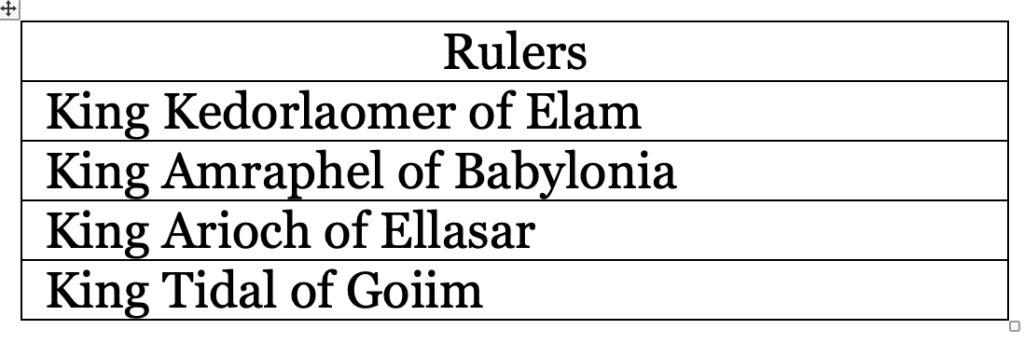
    Let’s see who the rest of the players were.

    A close ally would have been the king of Goiim. It is interesting that, in the Complete Jewish Bible, Tidal is the king of Goyim. That is the word used for Gentiles. “… K’dorla‘omer king of ‘Elam and Tid‘al king of Goyim” (Gen. 14: 1 CJB).

    We talked about the Goyim – Gentiles – before. Japheth, Seth’s brother, was the forefather of the Gentiles.

    “From these the coastland peoples of the Gentiles were separated into their lands, everyone according to his language, according to their families, into their nations” (Gen. 10: 5 NKJV).

    We have to try to figure out what we are talking about when we talk about Babylon. Babylon was the capital of the ancient region of Babylonia. However, the term Babylonia also refers to the entire culture.

    The region of Babylonia was developed in around 4000 BC. It rose to political prominence around 1850 BC,

    It was located in southeastern Mesopotamia between the Tigirs and Euphrates Rivers. This is currently from Bagdad in southern Iraq to the Persian Gulf.

    At one point, Babylonia was divided into two countries. They were Sumer and Akkad. That time was filled with constant fighting.

    Still, many things came out of Sumer. The Sumerians were responsible for the first system of writing, called cuneiform. The Akkadians were responsible for inventing the potter’s wheel, sailboat, plow, and codes of law.

    I couldn’t make heads or tails about Ellasar. I also couldn’t find anything beyond Zoar being a city. So, were the four other rebels descendants of Canaan?

    Joined Forces in the Siddim Valley

    In the 13th year, five kings, most descendants of Canaan, rebelled against Kedorlaomer.
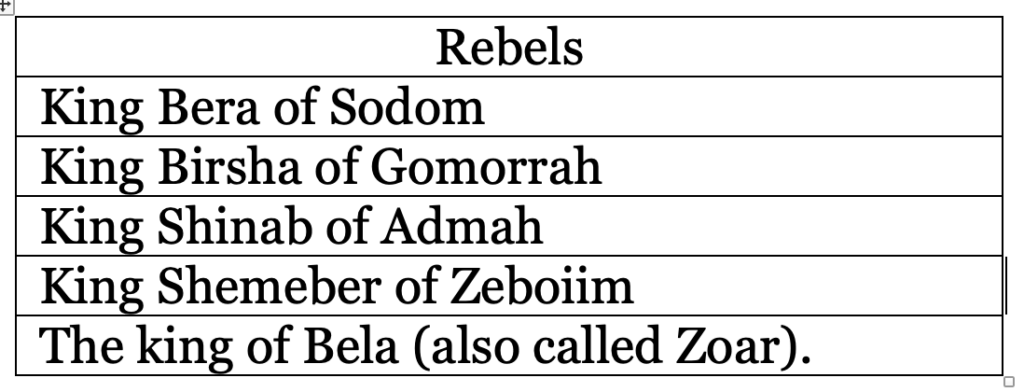
    Yep, four of them were. “… The Canaanite clans eventually spread out, and the territory of Canaan extended from Sidon in the north to Gerar and Gaza in the south, and east as far as Sodom, Gomorrah, Admah, and Zeboiim, near Lasha” (Gen. 10: 18-19 NLT emphasis added).

    Biblestudy.org’s Life of Abraham timeline notes that this incident happens around 1880 to 1875.

    Resource

    Think about this. How many times have we championed the freedom to govern ourselves? That is exactly what the rebels were trying to do.

    Wilson agreed that it is par for the course. He wrote, “It is a reminder that there are moments in our lives when we must challenge the powers that oppress us, whether they be external forces or internal fears.”

    Resource

    But we can see Kedorlaomer’s desire to keep the territory that he would see as his. Ooo, baby. We don’t want to give up our stuff, do we?

    Moses called the sea in the Siddim Valley the Yam HaMelach or Salt Sea. Regardless of bringing in a significant amount of fresh water each year, Williston told us that it remains the same level all year long.

    Resource

    We call it the Dead Sea. This is because the salt makes it so no fish can live within it.

    The problem with the Siddim Valley was it was littered with tar pits. It was like a minefield. Those traversing it would have to pay attention.

    Rebellion

    “One year later Kedorlaomer and his allies arrived and defeated the Rephaites at Ashteroth-karnaim, the Zuzites at Ham, the Emites at Shaveh-kiriathaim, and the Horites at Mount Seir, as far as El-paran at the edge of the wilderness. Then they turned back and came to En-mishpat (now called Kadesh) and conquered all the territory of the Amalekites, and also the Amorites living in Hazazon-tamar. Then the rebel kings of Sodom, Gomorrah, Admah, Zeboiim, and Bela (also called Zoar) prepared for battle in the valley of the Dead Sea. They fought against King Kedorlaomer of Elam, King Tidal of Goiim, King Amraphel of Babylonia, and King Arioch of Ellasar — four kings against five. 10 As it happened, the valley of the Dead Sea was filled with tar pits. And as the army of the kings of Sodom and Gomorrah fled, some fell into the tar pits, while the rest escaped into the mountains. The victorious invaders then plundered Sodom and Gomorrah and headed for home, taking with them all the spoils of war and the food supplies. They also captured Lot — Abram’s nephew who lived in Sodom — and carried off everything he owned” (Gen. 14: 5-12 NLT)

    Those not in the fight also feel the effects of war.

    Kedorlaomer was on a roll. The fighting was going his way.

    The fighting took place with the surrounding tribes first. I don’t know if this was an initial conquer or a preemptive conquer.

    Whichever, they were then ready to take on the rebellious kings.

    Again, Kedorlaomer and his coalition were victorious.

    The last we heard, Lot left Abram and moved near Sodom. “… Lot moved his tents to a place near Sodom and settled among the cities of the plain” (Gen. 13: 12 NLT). Gray thought Lot had moved into Sodom by now.

    That would be a bite. He wanted wealth and possessions, but here he was a captive stripped of his possessions.

    Leale said that was the way things go. He wrote, “That men often suffer who take no part in the quarrel.”

    Resource

    I don’t think Jerdan agreed with Leale. He noted that, when Lot settled in the Jordan valley, the kings of the Pentapolis recognized Chedorlaomer, king of Elam, as their suzerain and paid him a yearly tribute. By moving there, Lot was saying that he was good with that and accepted it on his behalf.

    Resource

    True, the rulers in authority made the decision to rebel. But the underlings would have had to go along with the idea because — well — they were underlings. They didn’t always get a say in the matter.

    Abram the Hebrew

    “But one of Lot’s men escaped and reported everything to Abram the Hebrew, who was living near the oak grove belonging to Mamre the Amorite. Mamre and his relatives, Eshcol and Aner, were Abram’s allies” (Gen. 14: 13 NLT)

    Uncle Abram went to the rescue.

    It seems Abram had found a place to settle down. Abram is still living by this grove in Genesis 18: 1.

    This is the first time that Abraham is called a Hebrew. Let’s look at in the Hebrew.

    “And there came one that had escaped, and told Avram HaIvri …” (Gen. 14: 13 OJB).

    It means to cross over. More literally, it means from the other side of the river.

    This is true. Abram had to cross over from the other side of the Euphrates River to enter Canaan.

    It is interesting that Moses listed three allies. It is nice to know Abram had allies in the area. God will put helpers in our path to accomplish His Will.
    Abram the Warrior

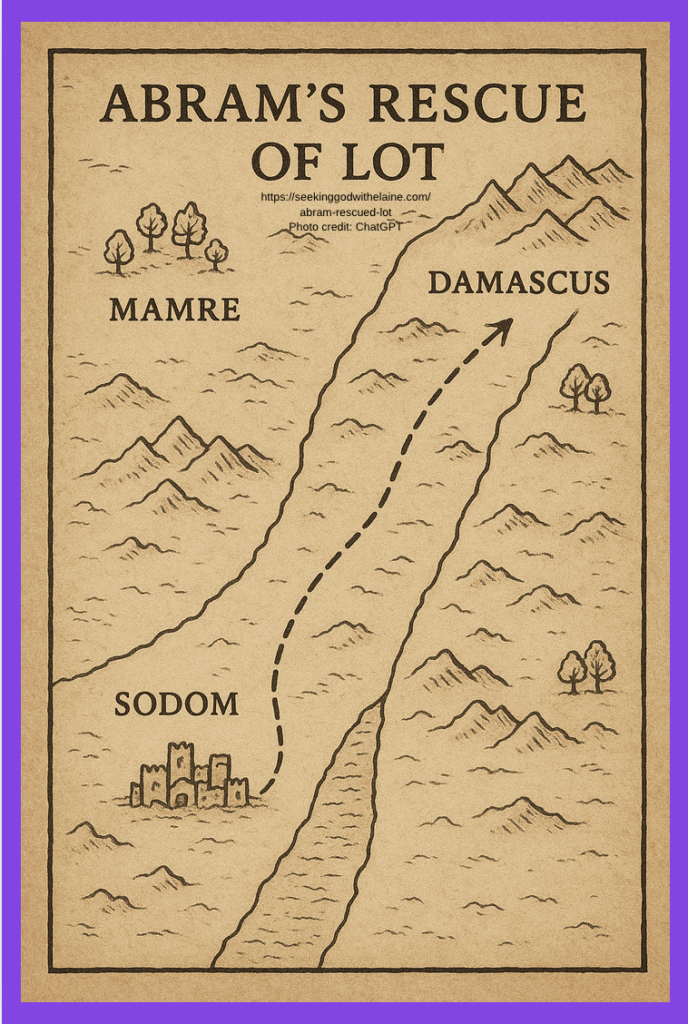
    “When Abram heard that his nephew Lot had been captured, he mobilized the 318 trained men who had been born into his household. Then he pursued Kedorlaomer’s army until he caught up with them at Dan. There he divided his men and attacked during the night. Kedorlaomer’s army fled, but Abram chased them as far as Hobah, north of Damascus. Abram recovered all the goods that had been taken, and he brought back his nephew Lot with his possessions and all the women and other captives.” (Gen. 14: 14-16 NLT)

    Abram didn’t let past history affect his desire to rescue Lot.

    Abram and Lot had parted ways because of a conflict. We think they parted on decent terms, but there may have been some residual resentment.

    That didn’t stop Abram. He and his 318 fighting men took off to rescue Lot.

    Abram didn’t need the numbers. He had God fighting with Him and for Him.

    Up to this point, we haven’t seen Abram as a warrior. We’ve seen him as a worshiper.

    But in that era, Abram had to have been at least a fighter. I doubt he would have survived if he didn’t know how to defend himself. Here, he was described more as a policeman.

    Resource

    But this was Kedorlaomer — the ruling power in those parts at the time. Abram as a private citizen had no right to wage war against a king.

    Walking with God does not mean Abram was turned into a doormat. He wasn’t a conscientious objector.

    God expects us to defend ourselves and our loved ones but also to submit to earthly authority.
    Now, whoever wrote this said that Abram caught whom he was pursuing at Dan. (Jerden thought that was Damascus.) This would have had to have been put into the account by someone other than Moses.

    Not only had the Promised Land not been divided by the 12 tribes as they weren’t born yet, but also Moses didn’t go into the Promised Land. How would he know?
    Abram did become a general in this instance. He knew enough about fighting to see the benefit of a nighttime offensive.

    This tells me that, even though it sounds like they picked up and went after Lot without much notice, they were ready. They already had the training. They may have had a generic contingency plan for being attacked, defending themselves, etc.

    Abram and his soldiers were ready.

    Gray seemed to think that Abram killed the kings. We aren’t really told that here. Yes, it would make sure that it didn’t happen again.

    But I wonder if Abram knew they were family.

    That is a kicker, isn’t it? Abram was going to save family from family.

    How many of us would have said Lot got his just deserts? Some of us may have left him to his fate.

    Abram said, “Nope. I’m going after him.”

    Making the Connections #1

    There is a huge contrast between Kedorlaomer and Abram. Kedorlaomer probably did all his fighting with the motivation of greed, covetousness, and pride.

    Abram on the other hand, went into this fight because of love. He loved his nephew, and he didn’t like to see how he and other innocent people were taken hostage.

    So, Abram did something about it.

    Making the Connections #2

    I like what Gilfillan had to say. He wrote,

    “Sometimes it is the Christian’s part to stay at home; and at other times to go far hence among the heathen. Sometimes it is his duty to sit under his family oak and attend to his family exercises; and at another time, like Abraham, to choose some post of peril, and do some good deed of daring.”

    Sometimes, God calls us to stay put. Sometimes, He calls us to move. We have to do what we are called to do.

    Making the Connections #3

    Taylor pointed our that, though Abram was in the world, he wasn’t of it. He wrote, “In all this we have another illustration of the strength of Abraham’s faith. It kept him equally removed from ascetic seclusion on the one hand, and worldly conformity on the other.”

    Resource

    We are in the world. We can’t refuse all interaction with worldview people.

    But we must not compromise our beliefs in order to get along with them. We have to say what God calls a sin remains a sin.

    Does that mean we don’t fight the battles that are clearly worldly? Not when they are impacting someone who shares our faith. We must ride to the rescue immediately when God calls us to do so.

    Making the Connections #4

    Sometimes, valleys can be figurative in God’s Word. It may symbolize going through a trial. It can also remind us of a place of shelter and security, symbolizing God’s protection and provision.

    How Do We Apply This?

    • Watch so that ambition does not look to meet its own ends instead of God’s.
    • Remember the wicked will persecute the faithful as well as other wicked people.
    • Be ready when God calls.
    • Be ready to come to another’s aid.
    • Understand sin is a captivity and be prepared to rescue someone chained to it.
    • Teach our children in God’s ways so they are ready to fight.
    • Stand up to those oppressing our faith.

    Resources

    Father God. You have put us in a world that does not follow You. Because of that, Your children are many times in danger. Help us to keep our focus on You. Send loved ones to rescue us. Let us rescue our loved ones. Bring us home to You. Amen.

    What do you think?

    Leave me a comment below (about this or anything else) or head over to my Facebook group for some interactive discussion.

    If you don’t understand something and would like further clarification, please contact me.

    If you have not signed up for the email providing the link to the devotions and the newsletter, do so below.

    If God has used this devotion to speak with you, consider sharing it on social media.
  • Giving Abram the Land

    Abram was starting a new chapter in his life. This devotional reading looks at the comfort God gave Abram after his separation from Lot.

    Nuggets

    • God gave the land of Canaan to Abraham as a permanent possession.
    • God gave the land to Abraham and his descendants — but Abraham didn’t have either promise yet.
    • God was already setting up His eventual blessing of the nation of Israel.
    • Abram made his home in Mamre in Hebron.
    giving-abram-the-land

    Abram’s world had been rocked. He and Lot separated.

    Since Lot’s father/Abram’s brother Haran died, uncle and nephew had been living closely, if not together. Surely since their emigration, they traveled together.

    But now both had become wealthy men. The problem was they did not own land in their new country on which to graze their flocks. This led to them separating.

    Let’s Put It into Context

    To read devotions in the Creating Everything theme, click the button below.

    Devotions in the Abraham the Emigrant series

    Land to Come

    “After Lot had gone, the Lord said to Abram, ‘Look as far as you can see in every direction — north and south, east and west. I am giving all this land, as far as you can see, to you and your descendants as a permanent possession’” (Gen. 13: 14-15 NLT)

    God gave the land of Canaan to Abraham as a permanent possession.

    Once Lot moved, God came to Abram. Yes, this is another instance of God coming to humans.

    God had a special reason for coming. He clarified what land He was giving to Abram and his descendants.

    God gave Abraham the land “… as far as you can see in every direction — north and south, east and west” (Gen. 13: 14 NLT). That is a lot of land.

    But wait a second. Where are we again?

    Bethel

    The last location reference we had was somewhere in the land of Canaan. “So Abram settled in the land of Canaan, and Lot moved his tents to a place near Sodom and settled among the cities of the plain” (Gen. 13: 12 NLT).

    In other words, Lot went east, and Abram went west toward the Mediterranean Sea.

    Can we get any closer than that? “From the Negev, they continued traveling by stages toward Bethel, and they pitched their tents between Bethel and Ai, where they had camped before” (Gen. 13: 3 NLT)

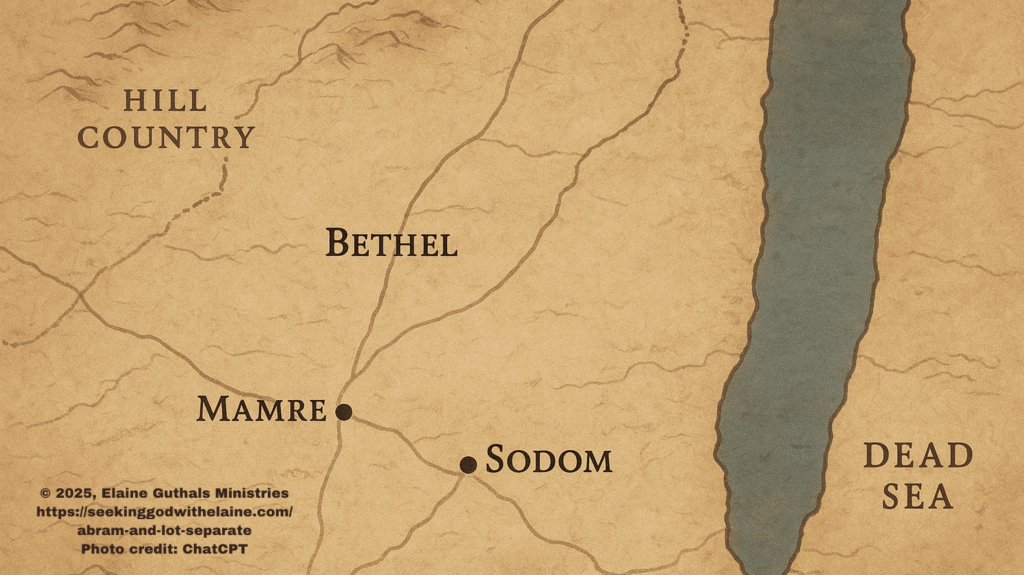
    Take a look at this map that ChatGPT created for me.

    This is important. I kept thinking, why would God tell Abram to look in all directions?

    Bethel was in the land that – in the future – would be given to the tribe of Benjamin. That was considered the middle of the Promised Land.

    It became an important place in the future.

    • It was a home for the Ark of the Covenant during the time of the Judges.
    • It was a buffer between the Northern Kingdom and the Southern Kingdom.
    • In fact, it was sanctuary city and religious center for the Northern Kingdom.

    So, yes, Abram could see all of the Promised Land from where he was standing.

    It is hard to tell it on this map, but Bethel was in the Hill Country. This area was a strategic position.

    The Covenant Extended

    We talked before about God’s covenant with Abram. We may think it is three different covenants, but it really is all part of one.

    • Covenant established (Gen. 12: 1-3)
    • Blessings of the covenant (Gen. 12: 7; Gen.13: 14-17)
    • Sign of the covenant (Gen. 15: 1-21)
    • Acceptance of the responsibilities of the covenant (Gen. 17: 1-27)
    • Promise of the covenant (Gen. 18: 9-15).

    When God initially called Abram, He didn’t say anything about land. He came back later and say, “Oh, yeah. There is land included.”

    Now, God probably blew Abram’s mind. It wasn’t, “Oh, I’ll give you and the son I am going to give you a couple of acres.”

    Ooo, baby. “Do a 360o turn. Everything you can see is yours.”

    Talk about a gift!

    What does Abram have to do for his part? He has to have faith and be obedient.

    Keep doing what you are doing!

    Children to Come

    “And I will give you so many descendants that, like the dust of the earth, they cannot be counted!” (Gen. 13: 16 NLT)

    God gave the land to Abraham and his descendants — but Abraham didn’t have either promise yet.

    Abram struggled with the promise of descendants for the next four chapters or so. Giving Abram the land meant nothing if he didn’t have descendants – and he doesn’t have any descendants at this point.

    Think about it. Abram’s Sanctification Road was about separation and faith. What is faith? “Faith shows the reality of what we hope for; it is the evidence of things we cannot see” (Heb. 11: 1 NLT). Faith that what we cannot see will come to fruition.

    At some point, Abram may have thought that Lot was going to be his descendant. But they were separated.

    Currier thought that God gave this reminder of the promise to Abram because Lot had just left. He wrote, “He gave him His own friendship in the place of Lot’s, for whose departure he sorrowed.”

    Resource

    What does Pastor Steve say? “Blessings are in the obedience” – even when the obedience is hard.

    Road Trip

    “Go and walk through the land in every direction, for I am giving it to you” (Gen. 13: 17 NLT)

    God was already setting up His eventual blessing of the nation of Israel.

    Yes, God has a plan. He doesn’t wait until the last minute to implement His plan.

    God knew that the only land Abram was going to own in his lifetime was where he was going to be buried. But He had something bigger in mind.

    God knew that, even though Abram would have a dysfunctional family, he was a family man.

    So, God made sure Abram saw the land that would be given to his descendants. “It’s not yours but look at it.”

    Isn’t that the same thing, basically, that God said to Moses (Deut. 3: 27). “You can’t go in the Promised Land, but you can see it.”

    This road trip would have made it more tangible for Abram. He could see the land on which he was walking.

    But think about it. Abram could only see that day. God could see hundreds of years into the future.

    God was already setting things up that would not be needed until those hundreds of years were past.

    Also, God was setting up things that would happen thousands of years in the future. It was all one big plan.

    Move to Mamre

    “So Abram moved his camp to Hebron and settled near the oak grove belonging to Mamre. There he built another altar to the Lord” (Gen. 13: 18 NLT)

    Abram made his home in Mamre in Hebron.

    Mamre was a village. Hood and Kalisch described it.

    • A small mountain hamlet.
    • A distance of 22 Roman miles from Jerusalem.
    • Fertile ground.
    • Closely tied to the city of Hebron.
    • Where Isaac was born.
    • Where Abraham, Sarah, Isaac, Rebekka, Jacob, and Leah were buried.

    Resource

    I like what Hood said when he compared Abram’s Mamre with Noah’s Ararat. He wrote, “If Ararat was the cradle of the races of our world, Mamre was the cradle of the Church.”

    Resource

    Because God chose to save Noah from the floodwaters, humans c0ntinued to live. Because Abram was faithful and obedient, because he was a righteous man, one of His descendants – Jesus – saved us from our sins.

    Hood had another great observation. He reminded us that Abram emigrated from the plain of Shinar where they tried to construct the Tower of Babel. He said that there were stories that have survived documenting Abram’s hatred of idolatry.

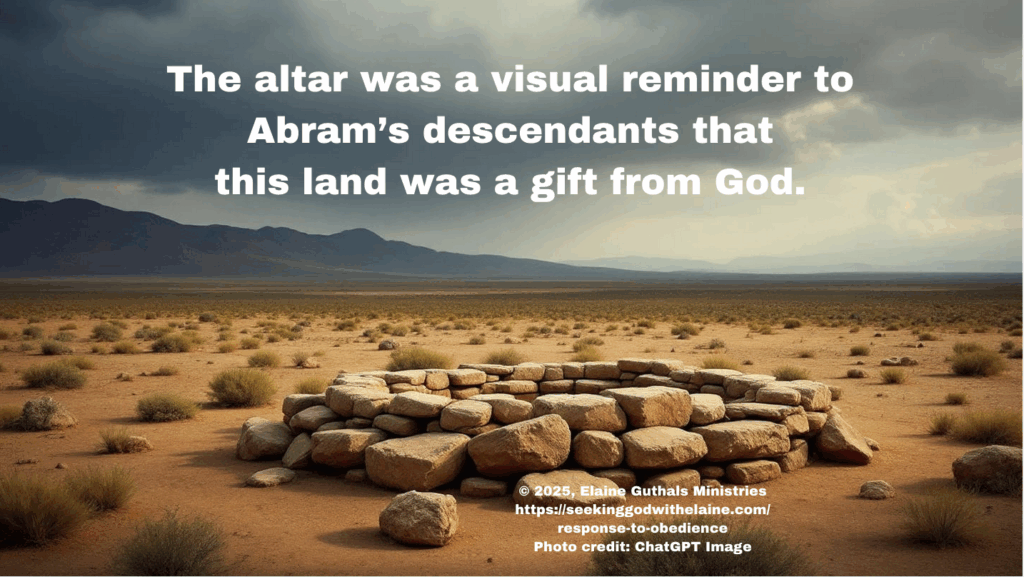
    In Mamre, Abram built another altar to worship and honor Sovereign God.  He used these altars as a place to worship God and as a visual reminder of His presence. Not only could Abram fulfill his duty toward God, but he could also pour out his gratitude toward Him on the altar.

    That devotion gave life to our faith today.

    Making the Connections #1

    We said that, after Lot left, God told Abram to keep on doing what he was doing.

    The Pharisees thought they were going to get the same thing. Jesus said, “But what you are doing is wrong.”

    Look at what I just read in Hebrew Yeshua v. Greek Jesus. Gordon wrote, “The second fundamental principle of Rabbinic/Pharisaical Judaism is the belief that the Rabbis have absolute authority to interpret Scripture, and what they say in religious matters is binding, even if it is known to be factually untrue.”

    Resource

    Even if it went against God’s commandment, the interpretation of the rabbis was law.

    Yeah, I can see why Jesus was biting on the Pharisees.

    God is not going to sanction that which goes against His laws and commandments. He makes the laws. He interprets them.

    Our opinions are not taken into consideration when God does this.

    Making the Connections 2

    Okay. Let’s say that Abram stayed in Ur. What may have happened?

    Well, Terah still would have died.

    But what else?

    • Abram may or may not have built altars because we aren’t told that he did build altars to God before he left.
    • He may or may not be promised descendants.
    • He may or may not have been promised land.

    Yeah, I said may or may not, but I really believe it was not.

    I say this because of what Meyer and Meyer said. In Elaine-speak, doing for ourselves brings us way worse results than doing it God’s way. He chooses who He will bless and what gifts they will receive.

    Resources

    We won’t get nearly as far alone as we do when we have our faith and obedience in God.

    Making the Connections #3

    No, Abram isn’t less of a person because he was faithful and obedient to God. He was not weak.

    Meek doesn’t not mean weak.

    Abram gave Sovereign God the glory that He is due. He listened to His Creator.

    Yes, God makes some choices for us. We have to determine if we are going to obey Him.

    How Do We Apply This?

    • Have a practical faith and righteousness by which we regulate our lives.
    • Live in peace with others.
    • Listen when God speaks to us so that our reverence and duty are deepened.
    • Believe in God’s promises.
    • Leave what God is calling us to leave for His honor.

    Resources

    Father God. Your promises to us are far more then we can imagine – and much more than we deserve. Grow us so that we have a faith as strong as Abram’s. May our obedience be like his. Amen.

    What do you think?

    Leave me a comment below (about this or anything else) or head over to my Facebook group for some interactive discussion.

    If you don’t understand something and would like further clarification, please contact me.

    If you have not signed up for the email providing the link to the devotions and the newsletter, do so below.

    If God has used this devotion to speak with you, consider sharing it on social media.
  • Abram and Lot Separate

    Abram and Lot both had large herds that were vying for limited resources. This devotional reading looks at how uncle and nephew separated to restore peace in the family.

    Nuggets

    • Abram and Lot both being wealthy caused problems.
    • Abram imitated the graciousness of God.
    • Lot chose wrong.
    abram-and-lot-separate

    Right when we think things are looking up, they go off the rails. Trouble in the family is a frequent reason.

    We said that Lot provided some of the troubles for Abram. This is one example.

    Let’s Put It into Context

    To read devotions in the Creating Everything theme, click the button below.

    Devotions in the Abraham the Emigrant series

    Disputes

    “But the land could not support both Abram and Lot with all their flocks and herds living so close together. So disputes broke out between the herdsmen of Abram and Lot. (At that time Canaanites and Perizzites were also living in the land.)” (Gen. 6-7 NLT)

    Disputes

    Abram and Lot both being wealthy caused problems.

    Some would say that Abram and Lot had a good problem. They were both prospering.

    We talked in the last devotion that we haven’t heard much about Lot. We just know he was Abram’s nephew and traveled with them from Ur to Canaan.

    The Essex Remembrancer called Lot a good man. He may have been when he left Ur. He would have had a good example in Abram.

    Resource

    Maybe Lot had started out from Ur following God’s call. Like salvation, our initial acceptance of God at conversion is only the beginning. We must then walk with God daily as we are sanctified.

    We just talked about the impact the wealth and opulence of Egypt had on Lot. Being dazzled by the country may have turned him away from God if he had called upon God previously.

    Pearse described Lot’s religion as being second-hand. It was Abram’s religion and only rubbed off on Lot because of association with Abram, not with God.

    Resource

    It appears that Abram was looking at the distant future — “I’ll give this land to you and your descendants.” Lot was focused on the here and then.

    Lot’s problem, we will find, is that he was amassing a worldly prosperity. His ambition did not seem to lead to growing a closer relationship with God.

    We can’t get to God by hanging onto someone else’s coattails.

    We’ve talked a couple of times about the altars that Abram built. Yeah, Abram. Not Abram and Lot.

    In the last devotion, we talked about the altars being a gathering place as well as a place of worship. We aren’t told that Lot gathered.

    Regardless of Lot’s relationship with Abram and God, the herdsmen were fighting.

    True, the herdsmen could be seen as doing their jobs — providing for and protecting their herd. They were surely frustrated that there was not enough resources for both.

    Why was resources so limited? Remember, Abram didn’t own the land. Neither did Lot.

    The Canaanites and Perizzites did. That would have limited the land to which Abram and Lot had access.

    The herdsmen were probably taking cues from their employers.

    Adamson had some great words to describe the disputes between the herdsmen: “unseemly, untimely, and unnecessary.”

    Resource

    We can’t really tell from verse 7 how far the disputes had progressed. Maybe the herdsman had gone to either Abram or Lot and discussed the problem. Maybe they didn’t until the matter got out of hand.

    However far it had progressed, the dispute doesn’t seem to have alienated Abram and Lot. They did come to a solution between themselves.

    But I don’t see Abram letting it get too bad. He knew that being family carries obligations with it. They should work through issues that arise between them.

    Major problems in families can lead to hurt feelings, anger, bitter dissension, and separation. God doesn’t want us to go there.

    Canaanites (Kena‘ani)

    We have to be careful to realize who the word Canaanites mean. It could mean the descendants of Ham’s son, Canaan. Or it could also be used to refer to to the seven nations of the region as a group. Those seven nations are the Canaanites, Hittites, Hivites, Perizzites, Girgashites, Amorites, and Jebusites.

    The Canaanites were known as being motivated by greed and lust. Their goal was acquire worldly wealth, shown by their advanced trade networks.

    Perizzites (P’rizi)

    The Perizzites were an undisciplined group of people. They separated themselves from by living in the hill country (Josh. 11: 3).

    Example

    “So, Abram said to Lot, ‘Let’s not have any quarreling between you and me, or between your herders and mine, for we are close relatives. Is not the whole land before you? Let’s part company. If you go to the left, I’ll go to the right; if you go to the right, I’ll go to the left’” (Gen. 13: 8-9 NIV)

    Abram imitated the graciousness of God.

    What Abram didn’t have to do was give Lot the first choice on the land as he was the elder, not Lot. Not only was he older, he also was now the head of the family.

    We talked about this a little bit in the last devotion. Abram was disinterested. Disinterestedness means a willingness to give up something for a greater good.

    Abram could have said he was top dog and taken whatever land he wanted. He was the elder in this instance. He probably had the bigger herd than Lot.

    Taylor reminded us that Abram was the one called. That would have made Lot tagging along with Abram, not the other way around.

    Resource

    But the herdsmen were already quarreling. Abram didn’t want to conflict to flood to include him and Lot.

    Abram showed us that pulling rank is not always the answer. Neither is always being right.

    So, Abram’s gentle, generous answer was, “Lot, you mean more to me than having the best land. I want to see you settled, happy, and thriving. Where do you want to live?”

    Abram showed us that God meant all to him. God meant more to him than his worldly interests.

    Is it because Abram was so unworldly, as Pearse said?

    Resource

    Maybe to a degree. But I have trouble with totally believing that.

    Abram’s life would have been hard. This was BC. Life was hard. Remember, they are living in tents.

    Think back to their time in Egypt. We said Abram may have told the Pharaoh Sarai was his sister because he didn’t want a confrontation. Abram was a peaceable man with a big heart.

    What Abram was doing was extending to Lot the type of grace that God extended to him. He didn’t have to treat Lot this way, just as we’ve done nothing to deserve the favor God gives us.

    It is easy to say that, regardless of where Abram ended up, God would bless him. And maybe Lot thought that in part, too.

    And yes, God will bless us in not-so-good circumstances when we are being obedient to Him. It wasn’t — and shouldn’t be — a test for Him to do that.

    Lot Made His Choice  

    “Lot took a long look at the fertile plains of the Jordan Valley in the direction of Zoar. The whole area was well watered everywhere, like the garden of the Lord or the beautiful land of Egypt. (This was before the Lord destroyed Sodom and Gomorrah.) Lot chose for himself the whole Jordan Valley to the east of them. He went there with his flocks and servants and parted company with his uncle Abram. So Abram settled in the land of Canaan, and Lot moved his tents to a place near Sodom and settled among the cities of the plain. But the people of this area were extremely wicked and constantly sinned against the Lord” (Gen. 13: 10-13 NLT)

    Lot chose wrong.

    This was a defining moment in Lot’s life. His choice here set in motion the rest of his story.

    Many of us wonder how Lot could have been so insensitive to his Uncle Abram. Abram was being generous while Lot was being selfish.

    Go back up to verse 7.

    The Canaanites were still living in the land. They had been cursed when Ham had seen Noah’s nakedness when he was drunk and told everyone about it (Gen. 9: 25).

    Lot didn’t choose – without consulting God – to stay away from them. In fact, he chose the city life to live among them.

    Wait! What? A shepherd chose to live in the city????

    Cain went to the city. Nimrod went to the city.
    
And that didn’t end well.

    Smith thought that this was just an example of making a hasty choice. He didn’t think things through.

    Resource

    Hmmm. I don’t really think so. I think he had become too worldly to pass up this opportunity.

    It is easy for us to say that Lot chose to live among the idolators. Horton said wait a minute. He reminded us that there were isolators all around Abram. He had to have been taking a big risk to worship God as he was the minority.

    Resource

    But Lot probably had been dazzled by the wealth and opulence he saw in Egypt. Ooo, baby. Pearse thought so. He wrote,

    “That sojourn in Egypt was damaging to Abraham; but it was fatal to Lot. He had seen a land that had kindled his greed; the possibility of his growing rich had seized him and mastered him. That which attracted him in Sodom was that it was like the land of Egypt, well-watered everywhere. The heathenism of Egypt had prepared him for the grosser wickedness of Sodom. His wife and daughters had seen the glitter and gaiety of a company that made the quiet of Abraham’s encampment seem very dull. And worst of all, they had seen a good man without his altar and his God; why then need they be so particular? So when the opportunity came, Lot was quite prepared to avail himself of it.”

    Resource

    Lot wanted to see a path that led to material wealth. He wanted to be able to make his own decisions without censure from anyone — human or divine.

    I would hope Lot didn’t think Abram had enough, and now it was his turn to prosper. Or maybe – worse yet – Abram is old and washed out. Let someone younger have his chance.

    Still worse yet, I hope Lot wasn’t laughing at Abram because of his generosity. He should have been humbled that he was loved so much.

    Hopefully – I guess in a way – Lot was enjoying his choice rather than smirking at Abram. There is probably little doubt that he was already counting his gain.

    Each of us probably know about three or four modern-day people who could be named Lot, don’t we?

    Our choices may seem inconsequential at the time. They do lead to the next decision — if not in relation to it, at least in mindset ousted to make the decision.

    Lot’s decision was based on selfishness. “Lot chose for himself the whole Jordan Valley to the east of them …” (Gen. 13: 11 NLT).

    We need to always choose God things rather than world things. We have to choose for the good of the family.

    Making the Connections #1

    Doesn’t it seem as though, when we are having a mountaintop experience, we get slammed with a trial? Hughes said it this way. He wrote, “Great straits may befall the saints of God in their greatest abundance.”

    Resource

    Yeah, it looks like this is about an over-abundance of wealth. But it wasn’t.

    It could have been about the squabbles. I wonder if it was – at least on Lot’s side – the as yet unfulfilled promise of land.

    True, the promise was to Abram. Lot was just tagging along without making a true commitment to God.

    Satan may have been puffing Lot up. I wonder if he thought he was putting his bid in for land when the promise was fulfilled.

    We know Satan certainly was trying to distract Abram. Satan is going to do all he can to take our focus off God. Utopia would be if he gets us to deny God.

    It feels like — sometimes — that Satan or his agent are just watching for us to get to a place where we are ripe for temptation. That is the time we have to double down on our focus of God.

    Making the Connections #2

    Wealth does cause problems, sometimes— even in families. Too much can be as bad as not enough.

    We have to make sure we don’t make money our god. Sovereign God is to have that honor.

    Making the Connections #3

    We talked about this a couple devotions back. We have to be willing to separate from family if that is what God is calling us to do.

    Hughes said that is grace. He wrote, “Grace is willing to part with its own, and all too, in some cases, to brethren.”

    Resource

    We must always put God first and be loving about it.

    Making the Connections #4

    I know. It’s hard not to get ahead of ourselves – especially if we know the rest of the story.

    Many would say that Abram got the short end of the stick. I’ve always thought that the land that Lot left for Abram was more desert. Abram would obviously have a harder time making a living on the land that Lot left for him.

    Ker said that Lot chose the richest area. All God’s Word says is that “Lot took a long look at the fertile plains of the Jordan Valley in the direction of Zoar. The whole area was well watered everywhere, like the garden of the Lord or the beautiful land of Egypt …” (Gen. 13: 10 NLT).

    Resource

    Lot chose the fertile ground compared to the Garden of Eden to live among the idolators – and lost everything.

    Abram took what was left – regardless of how good or bad the land was – went with God and gained everything.

    I like what Pearse had to say about it. He wrote,

    “This is the great lesson of this Book — that whilst we think of making a living, God is thinking of what our living makes us. That the man is more than all gain. This is the idea of life which runs through the New Testament — it is faith, the service of God, the utter surrender of all to Him. This alone can make life worth living. Choose anything, everything else; live for it, grasp it — and what then but die?”

    Resource

    We have to get our priorities straight. This world and all its shiny, garden wonders should not be our priority.

    Our priority should be our relationship with God.

    Making the Connections #5

    Abram walked with God in faith and obedience. Sure, he still sinned.

    But Abram clung to the promise. “You and your seed will possess this land. Forever.”

    Robinson had an interesting take on Abram and Lot’s quarrel. He called it a scandal of which even the Canaanites and Perizzites knew.

    Resource

    Ooo, baby. Abram wouldn’t have wanted that to wreck his witness.

    Making the Connections #6

    Sometimes, I think it is good to think about the What-Ifs that could have happened. That way, we know how God has protected us.

    What if the Canaanites and Perizzites learned of the quarreling? What if they had chosen to attack Abram and Lot.

    There could have been much blood shed. Satan would have loved it if Abram had been killed.

    No, it didn’t happen. That wasn’t in God’s plan. Thank You, God, that it wasn’t – that Abram’s Descendant became our Savior.

    Making the Connections #7

    It may look like we are prospering when we leave God out of our lives. We aren’t – at least not for long.

    True, we may not get full judgment until we stand in front of the Judgment Seat. God does judge us at times in this life.

    But we can’t have true success if we aren’t living within God’s Will. Worldly success is not godly success.

    Making the Connections #8

    I only have about four more pages of research to read through, and I come across where Robinson talked about Lot having Christian worldliness.

    Wait! What????

    Robinson argued that, however we may judge Lot here, by the time he left Sodom, he was a righteous man. He was sick of the culture in which he lived.

    “But God also rescued Lot out of Sodom because he was a righteous man who was sick of the shameful immorality of the wicked people around him. Yes, Lot was a righteous man who was tormented in his soul by the wickedness he saw and heard day after day” (II Pet. 2: 7-8 NLT emphasis added).

    That stops us, doesn’t it? As much as we want to bite on Lot here, he didn’t end this way.

    It sounds like Lot started good, got lost it in the middle, but came back to God before the end.

    Robinson reminded us of a word I read over. “… Lot moved his tents to a place near Sodom and settled among the cities of the plain” (Gen. 13: 12 NLT). Lot didn’t go directly to Sodom.

    Like us, Lot didn’t instantaneously choose evil. He inched toward it.

    Doesn’t that give us some comfort for when we turn away from God and backslide? We can be redeemed.

    But doesn’t that break our hearts? Abram’s nephew, though he ends up a righteous man, is an ineffective disciple. He is has a Christian worldliness.

    Talk about a lukewarm disciple.

    Robinson interpreted Peter’s verses for us. He wrote,

    “This shows, not only that Lot was saved, but that his salvation, so graciously achieved, was of so narrow a sort that it could be given as one of the extreme examples of Divine mercy towards the undeserving; and that it must be taken in connection with the fact that all the inhabitants of the wicked city, out of which he was so hurriedly rushed, were ‘turned into ashes.’”

    Resource

    We’d call it Lot being saved by the skin of his teeth.

    How many disciples only want to do enough to be saved and not be seen as righteous?

    God will show grace and mercy to those He chooses.

    How Do We Apply This?

    • Accept that some separations are for good – and others are for God’s good (Rom. 8: 28).
    • At all times – whether in fellowship or in separation – be unstinting, kind, and constant.
    • Look for ways to promote agreement, not quarrels.
    • Be honorable in our interactions with others, especially family.
    • Be peacemakers.
    • Don’t judge only from appearances.
    • Honor God.
    • Listen to God’s repeated warnings as He guides us to remain in His Will.
    • Be a friend of God’s and humans.

    Resource

    Father God. Thank You for giving us families in which to belong. Forgive us when worldly matters strain our relationships. Help us, as Abram, to resolve any issues generously and morally. Amen.

    What do you think?

    Leave me a comment below (about this or anything else) or head over to my Facebook group for some interactive discussion.

    If you don’t understand something and would like further clarification, please contact me.

    If you have not signed up for the email providing the link to the devotions and the newsletter, do so below.

    If God has used this devotion to speak with you, consider sharing it on social media.
  • Abram and Lot

    After Abram and his family left Egypt, they wandered around, looking to find their home. This devotional reading looks at the group finding its way back to God.

    Nuggets

    • Abram wandered around heading back to Canaan from Egypt.
    • God made Abraham prosper.
    • When we sin, God calls us back to where we were with Him.
    • Lot didn’t find his way back to God because he hadn’t been with God previously.
    abram-and-lot

    We’ve talked about Abram’s Sanctification Road being built on bricks formed by separations.

    • Left his country and kin (Gen. 11: 31).
    • Father died (Gen. 11: 32).
    • Left Haran (Gen. 12: 1)
    • Left Canaan for Egypt (Gen. 12: 10).
    • Left Egypt (Gen. 12:  20). 
    • Separated from Lot (Gen. 13: 13).
    • Separated from Ishmael (Gen. 21:  14).
    • Almost separated from Isaac (Gen. 22: 10).
    • Separated from Sarah (Gen. 23:  1-2).
    • Separated from worldly possessions (Gen. 25: 5).
    • Separated from life (Gen. 25:  7-8).

    Genesis 13 lists Abram’s next bout of separation.

    Let’s Put It into Context

    To read devotions in the Creating Everything theme, click the button below.

    Devotions in the Abraham the Emigrant series

    Coming Home

    “So Abram left Egypt and traveled north into the Negev, along with his wife and Lot and all that they owned. (Abram was very rich in livestock, silver, and gold.) From the Negev, they continued traveling by stages toward Bethel, and they pitched their tents between Bethel and Ai, where they had camped before. This was the same place where Abram had built the altar, and there he worshiped the Lord again” (Gen. 13: 1-4 NLT).

    Left Egypt

    Abram wandered around heading back to Canaan from Egypt.

    When we left Abram, Sarai, and Lot at the end of Genesis 12, they were being escorted out of Egypt. “Pharaoh ordered some of his men to escort them, and he sent Abram out of the country, along with his wife and all his possessions” (Gen. 12: 20 NLT).

    Moses took up the story where Abram was heading home. Not just heading home, but Abram was heading home forgiven and favored.

    True, Abram was returning home after a failure. As Dods said, at this point, he probably wished he had never gone in the first place.

    Abram couldn’t have lived in Canaan more than a couple of years before he headed for Egypt. Was he returning because of his love for the land?

    Was Abram going back just because it was promised to him? I think it was more than that.

    Yeah, the drought probably made things very real to Abram. Just because it was promised by God doesn’t mean it would be a snap.

    I don’t think God was upset that Abram was heading there “… by stages …” (Gen. 13: 3 NLT). Our sanctification happens in stages. It is a process that occurs from conversion to the last breath of our lives.

    Dods made a good observation. These stages were retracing the steps Abram took to get to Egypt. He was wiping the slate clean.

    Resource

    What Abram was showing through his camel steps was showing Sarai, Lot, and anyone in the caravan what true repentance was. Yes, they were along with him for the journey because where he lived, they lived – at least for now.

    How many times do we want to crawl under a rock when we have sinned? We don’t want anyone – especially those closest to us – to know anything about it.

    We hate saying we were wrong or did the exact opposite of what God wanted us to do.

    But Abram had it right. He turned away from his lie and deception and went back to God. He was in a better place spiritually.

    Very Rich

    God made Abraham prosper.

    No, that didn’t make it a prosperity gospel. It made it an obedience gospel. The blessings are in the obedience, as Pastor Steve always says.

    Same Place Abram Had Built the Altar

    When we sin, God calls us back to where we were with Him.

    Abram knew a response that God wanted was worship. He was constantly building altars. He was heading back to the altar he built.

    Correction. Abram was heading back to God.

    Leale said this altar was important because it was the pace where God had first appeared to him. Yeah, sometimes we have to go all the way back to the beginning.

    Resource

    Horton reminded us that Abram was no longer self-seeking and self-dependent. His testing/trial in Egypt got him to where God wanted him to be.

    Resource

    Abram possibly hadn’t learned an important principle yet. We have to take God and our relationship with us wherever we go.

    Lot

    “Lot, who was traveling with Abram, had also become very wealthy with flocks of sheep and goats, herds of cattle, and many tents” (Gen. 13: 5 NLT)

    Lot

    Lot didn’t find his way back to God because he hadn’t been with God previously.

    We know that Lot was the son of Haran, who had died back in Ur (Gen. 11: 27-28). He went with Terah when he left Ur. “One day Terah took his son Abram, his daughter-in-law Sarai (his son Abram’s wife) and his grandson Lot (his son Haran’s child) and moved away from Ur of the Chaldeans …” (Gen. 11: 31 NLT).

    Really, we have just heard Lot’s name mentioned a couple of times in conjunction with the trip to Canaan.

    Moses didn’t give us any clue as to how old Lot was. At first glance, we may say Terah had been raising Lot after Haran died. But Moses said Terah took Abram and Sarai, who were 70 and 60 respectively, in the same breath as he said Terah took Lot.

    Still, we get some clues.

    • “That evening the two angels came to the entrance of the city of Sodom. Lot was sitting there, and when he saw them, he stood up to meet them …” (Gen. 19: 1 NLT).
    • “Look, I have two virgin daughters …” (Gen. 19: 8 NLT).
    • “… ‘Do you have any other relatives here in the city?’ They asked. ‘Get them out of this place — your sons-in-law, sons, daughters, or anyone else’ …” (Gen. 19: 12 NLT).
    • “So Lot rushed out to tell his daughters’ fiancés …” (Gen, 19: 14 NLT).

    We know Lot had two daughters who were betrothed. They had fiancés but not husbands yet. That would put them around 13 probably.

    It is easy to think that these two girls are Lot and Mrs. Lot’s only children. However, I don’t see the angels asking about other sons and daughters if they knew he didn’t have any. If they didn’t know beforehand, I am sure God would have given them a manifest when He gave them this assignment. “Go get these specific people out.”

    Wait a second. Doesn’t that mean Mrs. Lot had to come from Ur with them????

    The timeline from biblestudy.org that I am using thinks so. “Abraham’s father Terah decides to move out of Ur (Genesis 11:28). Those leaving with him include Abraham (Abram), Sarah (Sarai), Abraham’s brother Nahor and his wife, as well as Lot and his wife (Genesis 11:29 – 31).”

    Resource

    So, why isn’t Mrs. Lot on the manifest? She does play a very brief but significant role in the future.

    Let’s go at this another way. The verses we used above from Genesis 19 is when God saved Lot and family from being destroyed along with Sodom and Gomorrah.

    When God warned Abraham that he was going to destroy the cities. He also gave him a promise.” Then one of them said, “I will return to you about this time next year, and your wife, Sarah, will have a son!’” (Gen. 18: 10 NLT).

    “Abraham was 100 years old when Isaac was born” (Gen. 21: 5 NLT). That would have made Abram 99 and Sarai 89 when this conversation was taking place. That would make the year 1861 BC.

    If even the oldest daughter was 13, that would mean she was born in 1874ish. They moved out of Ur in 1890 BC. She was born post-emigration.

    Very Wealthy

    Lot had become very wealthy himself.

    God told Abram that He will bless those who bless Him. “I will bless those who bless you and curse those who treat you with contempt” (Gen. 12: 3 NLT). Lot may have been blessed with prosperity because of his faith or because he was associated with Abraham.

    Lot had become a wealthy man in his own right. His problem, as we will see, is that he was self-seeking.

    Hughes told us what that meant. He wrote the problem was “Not possession of wealth, but inordinate affection and abuse of it, is the sin.”

    Resource

    What Abraham didn’t have to do was give Lot the first choice on the land. He was the elder, not Lot.

    Abraham may have believed that God would bless him either way he went. So, he let Lot choose because, to him, it didn’t matter.

    Horton said it was more that Abram loved his nephew and showed his disinterestedness. Remember, disinterested means a willingness to give up something for a greater good.

    Resource

    Jesus gave us the greatest example of disinterestedness. “Though he was God, he did not think of equality with God as something to cling to. Instead, he gave up his divine privileges; he took the humble position of a slave and was born as a human being. When he appeared in human form, he humbled himself in obedience to God and died a criminal’s death on a cross” (Phil. 2: 6-8 NLT).

    Jesus gave up Heaven for us. He gave up His life so that we may live.

    It is interesting that this translates as rich for Abram but wealthy for Lot. Where Lot probably focused on the money, Abram focused on Who the money came from — natural resources.

    Making the Connections #1

    God never said that having of money was bad. He wouldn’t have made Abram a rich man if it was.

    What God said was money couldn’t become our master. “No one can serve two masters. For you will hate one and love the other; you will be devoted to one and despise the other. You cannot serve God and be enslaved to money” (Mt. 6: 24 NLT).

    Serve sounds like a safe word. Enslaved is more what Jesus was talking about.

    Paul addressed being what it meant to be enslaved by something. “Don’t you realize that you become the slave of whatever you choose to obey? You can be a slave to sin, which leads to death, or you can choose to obey God, which leads to righteous living” (Rom. 6: 16 NLT).

    Here, money is just an example. It could be alcohol. It could be desiring a relationship with others.

    In essence, it is putting focus on something other than God. That is something we shouldn’t do.

    God doesn’t call us to be prosperous. He calls us to be godly – holy as He is (I Pet. 1: 16).

    The practical application of this is that we cannot put something about God’s call for our lives. We have to be obedient to Him.

    Making the Connections #2

    We know God did a do-over in Noah’s time. Sometimes, we just need a do-over – an individual do-over.

    Once we have sinned – especially a big-time sin – God gives us a chance for do-over We have to repent. 

    That means we ask for forgiveness of our sin – and turn away from it so we can do what God asks of us.

    That is our do-over. God wants us to move on from our failures of testings and move toward Him.

    Making the Connections #3

    We have to think about God giving Abram the land. Look what Gray said. He wrote, “He took possession of the land, not by issuing a decree, etc., but by thus acknowledging God.”

    Resource

    Well……

    God gave Abram the promise of the land. Stephen, when he was before the Sanhedrin, explained this. “So Abraham left the land of the Chaldeans and lived in Haran until his father died. Then God brought him here to the land where you now live. But God gave him no inheritance here, not even one square foot of land. God did promise, however, that eventually the whole land would belong to Abraham and his descendants — even though he had no children yet” (Ac. 7: 4-5 NLT emphasis added).

    The only land Abram owned was the cave in which he buried Sarah (Gen. 23: 17-20) – and where he, Jacob, and Leah were buried.

    Making the Connections #4

    Gray made another great observation. He compared altars to our sanctuaries of today.

    • Both were meeting places to come into God’s presence.
    • Both were designed as a place for us to worship God.
    • Both fostered fellowship among God’s disciples.

    Resource

    That is a good way to look at it. We are living sacrifices. We have to come to the altar in God’s house and commune with Him.

    But I have to try to hook this to what God has been giving me this week.

    We had Music Day at church Sunday morning. It is a time to sing favorite hymns. They gave me a list of their favorite hymns, I compiled them, and then on a 5th Sunday of the month, I pick the top ten of what we have done so far.

    One song we sang this week was Are You Washed in the Blood. The third verse has a line, “Will your soul be ready for the mansions bright.”

    Right after we sang it, God put on my heart was that “In my Father’s house are many mansions …” (Jn. 14: 2 KJV) is translated wrong.

    “There is more than enough room in my Father’s home …” (Jn. 14: 2 NLT) probably does a better job at translating it. The emphasis is on My Father’s house — a house of prayer (Mt. 21: 13).

    God’s house — His temple — is the place we worship Him, not some mansion we think is our reward for good service.

    When we were doing Revelation last year, we talked about the wall around New Jerusalem. We said we are to be living stones that builds on the foundation given through the Apostles and prophets. We are being built into a spiritual house, a dwelling place for God.

    Some of the sermons I read last year made it sound like we disciples are going to be the wall. I wasn’t sure how I felt about that — and I don’t think that is quite right.

    It may be right, though. I remembered last night about Rahab’s house. “Then, since Rahab’s house was built into the town wall, she let them down by a rope through the window” (Josh. 2: 15 NLT).

    Well, we are living stones. I just think the structure is off a little.

    “And you are living stones that God is building into his spiritual temple. What’s more, you are his holy priests. Through the mediation of Jesus Christ, you offer spiritual sacrifices that please God” (II Pet. 2:5 NLT).

    Then tonight I thought about the Tabernacle being in the middle of the Wilderness Wanderers when they camped. The divisions formed a wall around the Tabernacle.

    That’s probably the closest we are going to figure it out here in this life.

    How Do We Apply This?

    • Be more concerned what God thinks of us than what others think of us.
    • Be poor in the spirit.
    • Come back to God after we have sinned with a humble and repentant attitude.
    • Align ourselves with godly disciples.

    Resource

    Father God. We thank You for leading us out of trials and back to You. We thank You for the gift of family. Help us to rely solely on You. Amen.

    What do you think?

    Leave me a comment below (about this or anything else) or head over to my Facebook group for some interactive discussion.

    If you don’t understand something and would like further clarification, please contact me.

    If you have not signed up for the email providing the link to the devotions and the newsletter, do so below.

    If God has used this devotion to speak with you, consider sharing it on social media.
  •  Abram and Sarai in Egypt

    Abram and Sarai headed to Egypt when a famine hit Canaan. This devotion looks at the success or failure of Abram’s deception.

    Nuggets

    • Sometimes, what we are afraid of becomes a self-fulfilling prophecy.
    • God didn’t like how things were going down and stepped in.
    abram-and-sarai-in-egypt

    In the last devotion, we left Abram’s family on the way to Egypt. They left Canaan because of a famine.

    Abram had a strange request of Sarai. He wanted her to tell the Egyptians that she was his sister, not his wife.

    Well, Sarai technically was his sister. But that was a lie and a deception because she was his wife.

    I am not sure that Abram thought through the practice of passing Sarai off as his sister.

    Let’s Put It into Context

    To read devotions in the Creating Everything theme, click the button below.

    Devotions in the Abraham the Emigrant series

    Arrival in Egypt

    And sure enough, Abram arrived in Egypt, everyone noticed Sarai’s beauty. When the palace officials saw her, they sang her praises to Pharaoh, their king, and Sarai was taken into his palace. Then Pharaoh gave Abram many gifts because of her — sheep, goats, cattle, male and female donkeys, male and female servants, and camels” (Gen. 12: 14-16 NLT)

    Sometimes, what we are afraid of becomes a self-fulfilling prophecy.

    It turned out that there was reason for Abram to be fearful. “… Sarai was taken into his palace” (Gen. 12: 15 NLT) seems like an innocuous statement, but it really means she was kidnapped.

    But Abram set Sarai up for the kidnapping. He lied. He didn’t have faith that God would protect him.

    Remember, Abram didn’t tell a total lie. Sarai was his stepsister.

    What Abram did was mislead everyone.

    Think of the position Abram put Sarai in. When they took her into the palace, was she just supposed to sit back and let whatever happened to her happen?

    Pharoah married Sarai. Was she supposed to commit adultery because her husband sanctioned it?

    Sarai sure got the raw end of the deal.

    But Sarai did agree to go along with the lie and followed through. Maybe she didn’t think she had any choice; but in the end, she chose to go along with the ruse.

    Did Abram get a conscience once they were separated? Was he remorseful for the situation that he put Sarai in?

    Consequences of the Kidnapping

    “But the Lord sent terrible plagues upon Pharaoh and his household because of Sarai, Abram’s wife. So Pharaoh summoned Abram and accused him sharply. ‘What have you done to me?’ he demanded. ‘Why didn’t you tell me she was your wife? Why did you say, “She is my sister,” and allow me to take her as my wife? Now then, here is your wife. Take her and get out of here?’ Pharaoh ordered some of his men to escort them, and he sent Abram out of the country, along with his wife and all his possessions” (Gen. 12: 17-20 NLT)

    God didn’t like how things were going down and stepped in.

    When we tell a lie, we tell ourselves that no one will know. Well, maybe no human will know.

    God always knows. God is all-seeing and all-present.

    He knows.

    God stepped in the situation to put things back to right.

    Yes, Abram had sinned. He didn’t trust God.

    That didn’t stop God.

    Remember when God came to Adam and Eve in the Garden of Eden after they had sinned? “When the cool evening breezes were blowing, the man and his wife heard the Lord God walking about in the garden …” (Gen. 3: 8 NLT).

    God came to Adam and Eve. He stepped in for Abram.

    We aren’t told how Pharaoh figured out that it was because he was messing with Abram’s wife. Yeah, this may be Moses picking and choosing what to tell of the story.  What is important to know is God instigated the tell-all, and Abram’s secret was made known.

    The Pharaoh found out that God is all-powerful. Pharaoh may have thought he was, but he was no match for God.

    If Moses did write this chronologically, the trip to Egypt would have happened somewhere between 1885 and 1880 BC, according to the Old Testament Timeline. Jacob’s family emigrated to Egypt in 1680 BC.

    Resource

    We aren’t told here what the plagues were and how many (since it is plural). I doubt that they were to the level of the plagues Moses saw God do.

    This time God didn’t send a Moses-type to warn the Pharaoh the plagues were coming. We aren’t told how Pharaoh figured out that it was because he was messing with Abram’s wife.

    Yeah, this may be Moses picking and choosing what to tell of the story.  What is important to know is God instigated the tell-all, and Abram’s secret was made known.

    Think about Abram. Yes, he was concerned for his life. Instead, his integrity took a hit. He probably would have used the word dishonored instead of integrity.

    What the Egyptians saw was Abram was not, in God’s terms, pure and righteous. They probably would have just said he was a liar and untrustworthy.

    Did you see the Egyptians’ response? They were quick to point out that Abram caused the problem by not telling them Sarai was his wife.

    And they would be right. But … “When the palace officials saw her, they sang her praises to Pharaoh, their king, and Sarai was taken into his palace” (Gen. 12: 15 NLT).

    Yes, Abram told a lie. That lie did not force them to take Sarai into the palace. That was their choice alone.

    This is just another example of deflection of sin. Pharaoh said, “I did it, but it isn’t my fault.”

    But the Egyptians were done with Abram. In fact, he and his family were escorted out of the country of Egypt. “Pharaoh ordered some of his men to escort them, and he sent Abram out of the country, along with his wife and all his possessions” (Gen. 12: 20 NLT).

    Making the Connections #1

    Part of us wants to say that we shouldn’t bite too hard on Abram. His fears came to fruition.

    But this was an intentional sin. If we were to look at the Book of Leviticus, all the sacrifices there were for unintentional sin. The purpose of the first three offerings is to restore our relationship with God. Period. It isn’t until those have been offered and accepted that God would even consider forgiving us of our sins.

    Not until Jesus came was there a sacrifice that even touched intentional sins. That is why we say that the law – and the sacrifices – cannot save us. We must be saved through the blood of Jesus.

    Bottom line is that Abram should have trusted God. We can’t let our fears run roughshod over us.

    Because of this lie, Abram and Sarai had to leave Egypt. We don’t know how long they had been there. We don’t know whether they smoothed over their relationship with the Pharaoh.

    Making the Connections #2

    This whole incident came to be because Sarai was a beautiful woman. We don’t know exactly how old she was. Since the biblestudy.org website says that the events of Genesis 14 probably took place around 1880 to 1875, Sarah was probably 65-70 tops.

    Resource

    Sarah may have been an ageless beauty. Beauty may have been in the eye of the beholder.

    We do know Satan is going to try every trick in his arsenal to get us to turn a blind eye toward God. He is going to find the shiniest, most beautiful thing to tempt us. We can’t let him succeed in getting us to cave.

    Making the Connections #3

    I feel like I have to bring it up again. Abram – a righteous, blameless man – sinned even though He loved God.

    Making the Connections #4

    Yeah, we may say Abram only lied, but it was more than that. Abram wrecked his witness with the Egyptians.

    It was even more than that. The Homilist wrote in Abram in Egypt that “… THE DIVINE IS THE ONLY STANDARD WHICH DETERMINES THE VALUE OF LIFE.”

    Resource

    Disciples have to live by God’s standard – His laws and commandments – His Will.

    We are nothing without God. Our very existence depends on Him.

    The laws and commandments show us the moral character by which we are to live. He gives us strength to live as He wants.

    Let’s think this through. We don’t know if Abram was called when he was still living in Ur. All we know is that he was when he was in Haran.

    Abram left Haran in 1885 BC. This is between 1885 and 1880. Let’s cut it in half and say this is 1882.

    Abram has only been a disciple for around three years. He is still a milk baby (Heb. 5: 13).

    Satan would have really been working on Abram. He would have been throwing doubts and temptations at him right and left.

    Abram probably didn’t have any idea what spiritual warfare was. If he did know spiritual warfare was going on, that it was an internal battle may have been outside his understanding.

    Truth be known, it is outside of our understanding sometimes.

    Think of it this way. Just like us, Abram would have hit potholes on his Sanctification Road. We just don’t get them written up in Scriptures.

    The way Dods said it was this way. He wrote,

    “It would seem that as yet he [Abram] had no very clear idea of God’s holiness. He had the idea of God which Mohammedans entertain, and past which they seem unable to get. He conceived of God as the Supreme Ruler; he had a firm belief in the unity of God and probably a hatred of idolatry and a profound contempt for idolaters. He believed that this Supreme God could always and easily accomplish His will, and that the voice that inwardly guided him was the voice of God. His own character had not yet been deepened and dignified by prolonged intercourse with God and by close observation of His actual ways; and so as yet he knows little of what constitutes the true glory of God. What he so painfully learned we must all learn, that God does not need lying for the attainment of His ends, and that double-dealing is always short-sighted and the proper precursor of shame.”

    Resource

    Since we’ve started talking about Abram, we’ve said that he had the faith and obedience – to what God had revealed to him. God doesn’t give us a data dump upon conversion. He continued to reveal Himself to Abram throughout his life.

    We also have to remember Abram didn’t have an Old Testament book which he could read by firelight. He didn’t have the internet to search when he had questions and wanted to learn.

    When do we learn best? When we mess up.

    Making the Connections #5

    Dod’s made an interesting comment. He wrote,

    “A weaker man would have shrunk from going into Egypt, and would have preferred to see his flocks dwindle rather than to take so venturesome a step. No such hesitations could trammel Abram’s movements. He felt himself equal to all occasions.”

    Resource

    We bite on Abram because he lied. But he went.

    Abram could have stayed – and lost his flocks — maybe his, Sarai’s, and Lot’s lives. But he knew that God was Sovereign God. He knew God could and would take care of him.

    So, what happened? Abram didn’t know that lying was a sin?

    Or was Abram trying to help God out?

    Ooo, baby. Don’t we do that? When God doesn’t do something on our time table, He doesn’t do it the way we expect, or – worse – He tell us no, we get upset!

    We take things into our own hands. Wrong move.

    Making the Connections #6

    Another thing Dods talked about was what Abram learned in this trial. Abram’s happiness wasn’t in his hands.

    Abram’s happiness was in God’s hands.

    We just have to surrender.

    Making the Connections #7

    The Pulpit Analyst had a great comment in their Abram in Egypt sermon. It said,

    “‘O that he had died when he built the altar!’ we may be inclined to exclaim. Have there not been times in our own history when we have uttered the same exclamation? Had we been caught up into heaven in some ecstatic mood of devotion, we should have been saved from this sin and from that. Why were we spared, when God must have foreseen that our very next act was to be one of [dishonor]? Spared to sin!”

    Resource

    • We think failing the testings and trials will make us lose our salvation.
    • We think the best thing to happen would be no testings and trials.
    • We see Heaven as get-out-of-jail-for-free card.

    We shouldn’t be looking for fire insurance – even looking for fire assurance.

    Testings and trials are used to grow us. God wants us to be faithful to Him. He is more interested in how we grow closer to Him because of the testings and trials.

    How Do We Apply This?

    • Depend on God’s faithfulness and sufficiency.
    • Tell the truth, the whole truth, and nothing but the truth.
    • Trust God in the big things as well as the little things.
    • Trust God when we don’t see how it will go.
    • Understand that God will protect His children.

    Resources

    Father God. Forgive us when we don’t put our full trust in You. Show us again how You are always with us and keep Your promises. Help us grow through the testings and trials. Amen.

    What do you think?

    Leave me a comment below (about this or anything else) or head over to my Facebook group for some interactive discussion.

    If you don’t understand something and would like further clarification, please contact me.

    If you have not signed up for the email providing the link to the devotions and the newsletter, do so below.

    If God has used this devotion to speak with you, consider sharing it on social media.
  • A Famine in Canaan

    We don’t know how long Abram was in Canaan before his next separation and testing took place. This devotional reading looks at Abram, Sarai, and Lot’s trip to Egypt and the lie that got them in trouble.

    Nuggets

    • Even when we are where God calls us to be, testings and trials arise.
    • Abram chose to move his family to Egypt because of the famine.
    • As obedient as Abram had been, he succumbed to the temptation of sin by not believing God could handle what his new circumstances were.
    a-famine-in-canaan

    Abram’s family was really a dysfunctional family.

    Abram was in a pickle. He didn’t feel that he could provide for his family and flocks during the famine where they were at, but this doesn’t say God told him to go to Egypt.

    Then again, it doesn’t say God didn’t tell him to stay.

    Ooo, baby. We have to stay obedient to God regardless of the circumstances. We need to trust Him through it all.

    Let’s Put It into Context

    To read devotions in the Creating Everything theme, click the button below.

    Devotions in the Abraham the Emigrant series

    Leaving Home Again

    “At that time a severe famine struck the land of Canaan, forcing Abram to go down to Egypt, where he lived as a foreigner” (Gen. 12: 10 NLT)

    Famine

    Even when we are where God calls us to be, testings and trials arise.

    In the last devotion, we talked about the unpredictability of the region. It had both fertile land and unpredictable weather.

    The unpredictable weather reared its ugly head as a famine. We don’t know how long Abram and Sarai had been in the region, but they were on the move again.

    This was the first of two famines Abram would encounter. The other we will discuss when we get to Genesis 20.

    We’re getting a little ahead of ourselves, but Abram did come back to the Promised Land (even though they weren’t calling it that yet).

    Back to this famine.

    Think of it. We are going to face natural setbacks. We have to have faith.

    The famine must have been really bad for Abram to even consider moving. It must have been widespread for him to consider moving to another country. Candlish said that he was starved out.

    Resource

    Meyer tried to give us an idea of what Abram’s situation was. He wrote.

    “A stranger in a strange land; surrounded by suspicious and hostile peoples; weighted with the responsibility of vast flocks and herds — it was no trivial matter to stand face to face with the sudden devastation of famine. Did it prove that he had made a mistake in coming to Canaan?”

    Resource

    Oh, yeah. Abram probably had some of the doubts we have, too. We get really good at questioning God after the fact when things don’t turn out the way we think they should.

    That has the potential of making us take our focus off God. Makes it a good test, doesn’t it? Can we focus on God over and above the chaos?

    Pearse argued that we are selfish when we think testing and trials – even from natural causes – happen. How are we going to endure if these don’t occur to challenge us? “But the one who endures to the end will be saved” (Mt. 24: 13 NLT).

    Resource

    The onset of these trials doesn’t mean that God has forsaken us. It means He is sanctifying us.

    Ooo, baby. Leale had a good question. How do our current testings and trials make us look at our past ones? He fears we may exaggerate estimations of what we have gone through before.

    Resource

    We say we take what we have learned from past experiences, evaluate what we are going through now, and grow. But if our perception of the past is flawed, the growth is flawed, isn’t it?

    I can just see Satan using that to ensure that we are thinking we’re good to go — but we aren’t.

    Egypt

    Abram chose to move his family to Egypt because of the famine.

    There is one tidbit on which this section that is glaringly silent. Did God tell Abram to go to Egypt? Maybe. Maybe not.

    Did Abram have any business being in Egypt? Not if God didn’t tell him to go.

    Something just occurred to me. We don’t see Abram calling on the name of the Lord here.

    We know that happened. “… At that time people first began to worship the Lord by name” (Gen. 4: 26 NLT).

    Maybe that was part of the problem.

    We aren’t told how long Abram and Sarai stayed in Egypt, but we are given only one chapter of their story there – and it isn’t a flattering one.

    That may tell us they weren’t supposed to go.

    But isn’t that how it goes? One sin leads to another.

    Since it said Abram lived as a foreigner in Egypt, I would think he took his whole household. Jacob did when he moved to Egypt in that famine.

    • “So Jacob set out for Egypt with all his possessions …” (Gen. 46: 1 NLT).
    • “So Jacob left Beersheba, and his sons took him to Egypt. They carried him and their little ones and their wives in the wagons Pharaoh had provided for them. They also took all their livestock and all the personal belongings they had acquired in the land of Canaan. So Jacob and his entire family went to Egypt — sons and grandsons, daughters and granddaughters — all his descendants” (Gen. 46: 5-7 NLT).

    Abram probably didn’t know how long the famine was going to last. He didn’t have a Joseph-type down in Egypt prophesying there was even going to be a famine.

    Pearse had a great observation. There was one thing that Abram did leave behind – his altar.

    Resource

    We lose a lot when we don’t consistently meet with God in His house. But we lose even more if we do not have a strong daily devotional time. Meeting God once a week for an hour or two doesn’t make us a stronger disciple.

    I did come across an interesting statement. In a sermon by The Congregational Pulpit, it was written that Egypt was, as in Joseph’s time, the granary of the world.

    Resource

    We may question why God sent a famine that would lead to another road trip. It was another testing of his obedience.

    It was a little more than that, I think. “Then the Lord appeared to Abram and said, ‘I will give this land to your descendants’ …” (Gen. 12: 7 NLT).

    Abram wasn’t given the land in Canaan. He wasn’t even given possession of any of it until later in life.

    That may have caused Abram to still have the urge to wander. If he doesn’t own the land, how can he put down roots?

    But surely, Abram considered God’s provision getting him from Ur to Shechem. Whether obedient or not, Abram and Sarai headed down to Egypt.

    The Lie

    As he was approaching the border of Egypt, he said to his wife, Sarai, ‘Look, you are a very beautiful woman. When the Egyptians see you, they will say, “This is his wife. Let’s kill him; then we can have her!” So please tell them you are my sister. Then they will spare my life and treat me well because of their interest in you’” (Gen. 12: 11-13 NLT)

    As obedient as Abram had been, he succumbed to the temptation of sin by not believing God could handle what his new circumstances were.

    Abram thought he would run into trouble in Egypt. He was concerned for his life. He thought the men of Egypt would kill him to take Sarai ig he told them he was her husband..

    Moses doesn’t tell us how much of a struggle Abram had making this decision. We have no way of knowing if Abram immediately thought God wouldn’t be able to take care of them or if he had to talk himself into it.

    Abram decided to tell, and Sarai agreed to go along with, a lie. He forfeited truth for safety.

    True, Sarai was Abram’s sister. But she was more – she was his wife. “And yet indeed she is my sister; she is the daughter of my father, but not the daughter of my mother; and she became my wife” (Gen. 20: 12 NLT).

    Isn’t it easier to live the lie when it has an element of truth? But it is still a lie in God’s eyes.

    Our affection for others can cause fear to enter into our hearts. Yes, we are to love our family.

    But Abram wasn’t really worried about Sarai in this instance. He was worried for himself! He was asking Sarai to lie for him for his benefit.

    Faith opposes false practicality. We can’t conceal the truth because a lie would be easier or more rewarding.

    God’s Word talks a lot about lying. It is always the same outcome – don’t.

    • “You must not testify falsely against your neighbor” (Ex. 20: 16 NLT).
    • “The Lord detests lying lips, but he delights in those who tell the truth” (Prov. 12: 22 NLT).
    • “So stop telling lies. Let us tell our neighbors the truth, for we are all parts of the same body” (Eph. 4: 25 NLT).
    • “Don’t lie to each other, for you have stripped off your old sinful nature and all its wicked deeds” (Col. 3: 9 NLT)
    • “For you are the children of your father the devil, and you love to do the evil things he does …” (Jn. 8: 44 NLT).
    • “A false witness will not go unpunished, nor will a liar escape” (Prov. 19: 5 NLT).

    Pearse had an interesting take. Instead of not trusting God, he thought it was more like Abram didn’t like confrontation. He was a peaceful man.

    Resource

    Yeah, that goes down better. Abram was so steadfast up until now. He obeyed when he was going even though he didn’t know where.

    How could Abram not trust God now?

    Don’t we hate it when Hall of Famers disobey God? If they mess up, how will we not?

    But Abram — like us — probably thought this was a small thing. It was just a lie. We don’t like to bother God with the small things.

    Why is God so concerned about the small things? “Trust in the LORD with all your heart; do not depend on your own understanding. Seek his will in all you do, and he will show you which path to take” (Prov. 3: 5-6 NLT).

    God says, “Nothing you go through is a small thing to me. You must decide in every situation whether nor not you are going to trust me and obey me.”

    God knows we are not going to be 100% fruit-of-the-Spirit perfect. He knows He will forgive us when we ask.

    Making the Connections #1

    Maybe God did want Abram and Sarai to go to Egypt. Gibson thought so.

    We know God separated Abram from “…  your country and your kindred and your father’s house …” (Gen. 12: 1 NLT). Isn’t this just another separation?

    God was training Abram by a sequence of separations. We say it was to increase Abram’s faith.

    Look what Gibson said. He wrote, “We are accustomed to consider faith as the key to Abraham’s life. Certainly it is; but did not his faith manifest itself in just this, that he was willing to separate himself from all for the Lord’s sake?”

    Resource

    How was Abram separated?

    • Left his country and kin (Gen. 11: 31).
    • Father died (Gen. 11: 32).
    • Left Haran (Gen. 12: 1)
    • Left Canaan for Egypt (Gen. 12: 10).
    • Left Egypt (Gen. 12:  20).
    • Separated from Lot (Gen. 13: 13).
    • Separated from Ishmael (Gen. 21:  14).
    • Almost separated from Isaac (Gen. 22: 10).
    • Sarah died (Gen. 23:  1-2).
    • Separated from worldly possessions (Gen. 25: 5).
    • Died (Gen. 25:  7-8).

    Abram was willing to obey God’s commands regardless of what he had to surrender.

    Making the Connections #2

    Gibson took it a step farther.

    We’ve been talking about separation since Cain and Abel — maybe even since Adam and Eve and the Garden.

    Abram’s covenant is based on separation and grace. But now we add in restriction. This is where we really hone in on the fact that Abram’s line is the chosen line.

    Gibson said that God’s mercy had been offered and rejected three times. I would say those times are the following.

    • In the Garden.
    • During the building of the ark.
    • At the construction of the Tower of Babel.

    It would be easy to say — especially at the flood but here also — God was choosing to bless only one family. But God’s Word quickly debunks that.

    • “For this is how God loved the world: He gave his one and only Son, so that everyone who believes in him will not perish but have eternal life” (Jn. 3: 16 NLT).
    • “But God showed his great love for us by sending Christ to die for us while we were still sinners” (Rom. 5: 8 NLT).

    Even God’s covenant with Abram says it is for all. “… All the families on earth will be blessed through you” (Gen. 12: 3 NLT).

    God is right there to hear the sinner’s sincere prayer of repentance and submission.

    How did Gibson describe it? He wrote, “‘The sons of the stranger’ have simply to leave their country and their family, and come and join themselves to the family of Abraham, and to the nation of the Jew, and they are made welcome.”

    Resource

    • We have to turn our back on sin.
    • We have to choose to align ourselves with the Church.
    • We have to follow God’s laws and commandments.

    Pastor Steve and I question often how much of the Jewishness has been stripped from how we worship. We know there is evidence that it has been.

    So, it begs the question: are we really worshiping God or following oral traditions of our denominations, just as the Pharisees did?

    Take heart at what Leale said. He wrote, “When a man has the habitual intention of pleasing God, and when his faith is real and heart sincere, the lapses of his infirmity are graciously pardoned. God makes for him a way of escape, and grant the comfort of fresh blessings and an improved faith.”

    Resource

    Real faith + sincere heart = forgiveness, pardon, and increased faith.

    Making the Connections #3

    Have you ever thought of the irony that Abram and Jacob spent time in Egypt?

    A couple of chapters down the road, Abram will be told that his descendants will go to a foreign land, but he was not told which. “Then the Lord said to Abram, “You can be sure that your descendants will be strangers in a foreign land, where they will be oppressed as slaves for 400 years” (Gen. 15: 13 NLT).

    But what would Abram have seen in Egypt then? Stanley helped paint a picture. He wrote.

    “Egypt was to Abraham — to the Jewish people — to the whole course of the Old Testament, what the world, with all its interests, and pursuits, and enjoyments, is to us. It was the parent of civilization, of art, of learning, of royal power, of vast armies.”

    Resource

    The Hebrews learned many things when they sojourned in Egypt. True, it didn’t end well for Abram’s immediate descendants. Plus, future relations weren’t good for the two nations.

    Abram saw Egypt. Jacob saw it. Joseph saw it. Jesus saw it.

    What was Stanley’s moral of the story? Disciples can utilize the world and its enjoyments to help us develop and to glorify God for its beauty and usefulness.

    Making the Connections #4

    It has always amazed me that Abram would stoop to saying that Sarai was his sister, and not his wife. It has always flabbergasted me that she went along with the lie.

    How does one demean their life partner like that?

    Maybe I don’t understand the culture of that time. Maybe I don’t fully grasp the barbarisms of people then.

    Maybe love between husband and wife meant something totally different to Abram and Sarai. But I don’t think so.

    Sarai was Abram’s only wife. Yes, he took Hagar as his concubine, but not as his wife.

    But this is not the way God wanted families to work. He wants us to be proud of our family members and present a united front.

    We don’t do this when we lie about our relationships.

    How Do We Apply This?

    Don’t rely on our own understanding.
    Remember that God works everything for His good (Rom. 8: 28)
    Watch so that we don’t fall to our pride and arrogance.
    Expect trials in our walk with God.
    Be honest in our dealings with others, not deceptive.
    Recognize that our relationship with God is built on our moral character.

    Resources

    Father God. Thank You for the trials of life that bring us closer to You. Help us use them to grow stronger in our faith. Amen.

    What do you think?

    Leave me a comment below (about this or anything else) or head over to my Facebook group for some interactive discussion.

    If you don’t understand something and would like further clarification, please contact me.

    If you have not signed up for the email providing the link to the devotions and the newsletter, do so below.

    If God has used this devotion to speak with you, consider sharing it on social media.

  • Response to Obedience

    Our band of travelers have reached their destination in Canaan. This devotional reading looks at God extending the blessings of the covenant and Abram’s response to that.

    Nuggets

    • Genesis 12: 7 was the first time the promise of land was involved.
    • Throughout Abram’s lifetime, he built altars to memorialize the mercies of God.
    • Abram didn’t stay put at Shechem.
    response-to-obedience

    Abram, Sarai, and Lot have come the long way from Haran. They land at Shechem.

    How is God going to reward Abram’s obedience? How is Abram going to respond?

    Let’s check it out.

    Let’s Put It into Context

    To read devotions in the Creating Everything theme, click the button below.

    Devotions in the Abraham the Emigrant series

    God Extended the Blessings of the Covenant

    “Then the Lord appeared to Abram and said, ‘I will give this land to your descendants.’ And Abram built an altar there and dedicated it to the Lord, who had appeared to him” (Gen. 12: 7 NLT)

    Genesis 12: 7 was the first time the promise of land was involved.

    Remember that God entered into a covenant with Abram. I would say that we need to add this to the blessing section of the covenant.

    • Covenant established (Gen. 12: 1-3)
    • Blessings of the covenant (Gen. 12: 7; Gen.13: 14-17)
    • Sign of the covenant (Gen. 15: 1-21)
    • Acceptance of the responsibilities of the covenant 17: 1-27)
    • Promise of the covenant (Gen. 18: 9-15).

    When Abram left Haran, he wasn’t promised land of his own. In fact, when I got the list above, nothing was said about these verses.

    But I think they are important. Land is a part of the promise to Abram.

    We’ll wait to have a discussion about the land when we get further in.

    Abram Built an Altar

    Throughout Abram’s lifetime, he built altars to memorialize the mercies of God.

    We have had minimal glimpses of altars previously in Genesis. We saw the sacrifices of Cain and Abel – which had to have been done on an altar even though it doesn’t say (Gen. 4: 3-4). We also know Noah built an altar as he existed the ark and sacrificed a slew of animals (Gen. 8: 20).

    We aren’t told Abram built an altar in Haran. Personally, I don’t think he did.

    Abram built an altar to exclusively honor God. He wanted to show his thankfulness for the promise of provision. The altar was a visual reminder to his descendants that this land was a gift from God.

    Kalisch put the location of the altar into perspective. He wrote,

    “The place of the ancient tree, which so long witnessed superstitious and cruel rites, was hallowed by a Divine vision, and converted into a sacred spot; and at the side of the idolatrous temple rose an altar dedicated to the God of heaven and earth.”

    Resource

    Just to keep it straight in my mind, we know of four altars Abram/Abraham built.

    • Shechem: Abram built his first altar upon entering the land of Canaan (Gen. 12: 7).
    • Bethel: He constructed an altar between Bethel and Ai as a place of worship (Gen. 13: 3).
    • Hebron: Abram built an altar in the region of Mamre, near Hebron (Gen. 13: 18).
    • Mount Moriah: Abraham prepared an altar for the sacrifice of Isaac, demonstrating his faith (Gen 22: 9).

    Yes, Abram kept building altars because they were in different places. He wanted something where he was.

    More importantly, Abram kept building altars because He kept worshiping God whatever the circumstance.

    But Abram was taking a chance, wasn’t he? The Canaanites were not followers of God. They had their own gods they followed.

    They could have disagreed strenuously – and probably painfully for Abram. Abram built them anyway.

    Isn’t that what we are supposed to do? We are supposed to be in the world but not of the world.

    Yeah, Abram had Sarai and Lot – who had issues of their own. I bet he felt alone a lot of the time.

    So, why did Abram build this altar? Since he just finished his journey, I bet his mind was going all the way back to Ur. How different his life would have been then

    God is a more hands-on God than those false idols. Abram wouldn’t have seen that as an intrusion. He had just traveled however many miles under God’s leadership He knew without a doubt that he c0ould rely on Him.

    Abram now knew what dependence on God really was. It wasn’t slavery. It wasn’t subjugation. It was a relationship with the all-knowing, all-powerful Sovereign God. It was being the recipient of His mercy.

    Hasting said something that got me thinking. How did God view this altar? He didn’t see it as just a pile of stones.

    God saw, as Hastings said, “…  ABRAHAM’S READINESS TO CONSECRATE HIMSELF ENTIRELY TO GOD.” He saw Abram’s heart. It was built because of character, mindset, and purpose.

    Resource

    Abram worshiped God where he was, in whatever circumstance he was in. He left a visible sign of the highs and lows of his journey.

    Ness used God’s Word to tell us how we are priests, have altars, and Who sanctifies the sacrifice.

    • “And you are living stones that God is building into his spiritual temple. What’s more, you are his holy priests. Through the mediation of Jesus Christ, you offer spiritual sacrifices that please God” (I Pet. 2: 5 NLT).
    • “He has made us a Kingdom of priests for God his Father. All glory and power to him forever and ever! Amen” (Rev. 1: 6 NLT).
    • “We have an altar from which the priests in the Tabernacle have no right to eat” (Heb. 13: 10 NLT).
    • “And I will give you a new heart, and I will put a new spirit in you. I will take out your stony, stubborn heart and give you a tender, responsive heart” (Ezek. 36: 26 NLT).
    • “How blind! For which is more important—the gift on the altar or the altar that makes the gift sacred?” (Mt. 23: 19 NLT).

    So, our heart is the altar. It has to be visible to worldview people.

    Isn’t that what Jesus said? We need to be lights on a hill.

    • “You are the light of the world — like a city on a hilltop that cannot be hidden. No one lights a lamp and then puts it under a basket. Instead, a lamp is placed on a stand, where it gives light to everyone in the house. In the same way, let your good deeds shine out for all to see, so that everyone will praise your heavenly Father” (Mt. 5: 14-16 NLT).
    • “… Live clean, innocent lives as children of God, shining like bright lights in a world full of crooked and perverse people” (Phil. 2: 15 NLT).
    • “Be careful to live properly among your unbelieving neighbors. Then even if they accuse you of doing wrong, they will see your honorable behavior, and they will give honor to God when he judges the world” (I Pet. 2: 12 NLT).

    After That

    “After that, Abram traveled south and set up camp in the hill country, with Bethel to the west and Ai to the east. There he built another altar and dedicated it to the Lord, and he worshiped the Lord.  Then Abram continued traveling south by stages toward the Negev” (Gen. 12: 5-9 ESV)

    Abram didn’t stay put at Shechem.

    Sometimes, God moves us from the farm to city. Sometimes, He moves us from Illinois to Missouri. Sometimes, God moves us from the USA to another country. (No, I am not planning on moving again.)

    When God says, “Go,” we need to go.

    There are all kinds of different reasons. The generic answer is God moves us through the stages of our lives.

    As painful as it might be, we don’t want to skip a stage. We don’t want to miss those lessons.

    I like what Hughes said. He wrote, “Faith [causes] souls to adhere unto and make profession of the true religion of God in all places; faith is never ashamed of God, truth, worship, or way.”

    Resource

    If we haven’t made a true profession to God, the stimulant isn’t faith – it is something else. Only genuine faith results in salvation.

    Our goal must be set on obeying God. That means we have to distance ourselves from engaging in current, worldly events.

    Making the Connections #1

     Robertson put Genesis 12: 7 into perspective. It didn’t have to do with Abraham.

    It had to do with Moses. Robertson believed Moses was writing this record right before the Israelites made the exodus from Egypt.

    Resource

    Wouldn’t that have given the Israelites a boost before the start of their journey?

    Hey, Abraham (the name by which they knew the man) had a journey of his own. He took it with faith and obedience — just like you should. His destination was Canaan — which is your destination, too — it’s called the Promised Land.

    Why is it the Promised Land? God promised it to Abram as a permanent possession.

    • Then the Lord appeared to Abram and said, ‘I will give this land to your descendants.’ And Abram built an altar there and dedicated it to the Lord, who had appeared to him” (Gen. 12: 7 NLT).
    • “After Lot had gone, the LORD said to Abram, ‘Look as far as you can see in every direction — north and south, east and west. I am giving all this land, as far as you can see, to you and your descendants as a permanent possession’” (Gen. 13: 14-15 NLT emphasis added).
    • “Then the LORD said to Abram, “You can be sure that your descendants will be strangers in a foreign land, where they will be oppressed as slaves for 400 years. But I will punish the nation that enslaves them, and in the end they will come away with great wealth. (As for you, you will die in peace and be buried at a ripe old age.) After four generations your descendants will return here to this land, for the sins of the Amorites do not yet warrant their destruction’” (Gen. 15: 13-16 NLT emphasis added).

    What were they doing? They were fixing to return.

    Sure, they didn’t know they were going to become the Wilderness Wanderers.

    • They probably heard the “… they will come away with great wealth” (Gen. 15: 14 NLT) part and thought they would be millionaires.
    • They probably heard the it’s-a-permanent-possession part and think there were going to waltz right in and take possession.

    Their misinterpretation of what God was going to do didn’t keep God from doing what He was going to do.

    But this was a great pep talk for them as they were preparing the first Passover meal. The uncertainty and drama of the exodus may have been minimized by the expectation of the fulfillment of the promise.

    Making the Connections #2

    How did Abram’s journey follow our journey to salvation? Temple told us.

    • We have to stop fighting the promptings of the spirit and go forth into a relationship with God.
    • That means we abandon the road leading to the wide gate and enter the narrow gate towards grace.
    • We let You direct every aspect of our lives. We make Your principles our own.
    • We look to You in the good times and, especially, in the bad times — whatever the time frame.
    • We successfully complete the journey we start.

    Resource

    Remember, Ur to Haran was an unsuccessful journey because the destination was Canaan. Haran to Canaan was the successful journey.

    Trumbull gave an explanation as to why Ur to Canaan was not have been successful. He wrote,

    “Terah’s journeying was only in search of pasture and an abode. So he dropped his wider scheme when the narrower served his purpose. It was an easy matter to go from Ur to Haran. Both were on the same bank of the Euphrates. But to cross the broad, deep, rapid river was a different thing, and meant an irrevocable cutting loose from the past life. Only the man of faith did that.”

    Resource

    Whether or not those excuses are the ones Terah used, ooo baby, do some use them today!

    • Isn’t it the going gets rough, and the weak-in-faith people stop going?
    • Why should we go on if we’ve gotten what we want, even if we did say our end goal was exactly the same as God’s?
    • Give up everything and everyone from our past life? That is unthinkable for You to even ask us.

    We would call these the lukewarm Christians. They aren’t cold because they think they have given their life to Jesus as their Savior and Redeemer. But they aren’t hot because they quit, their motivation is wrong, and they hold on to sin.

    Look at it this way. The starting immediately matters, but the enduring to the end is just as, even maybe more, important. “But the one who endures to the end will be saved” (Mt. 24: 13 NLT).

    Making the Connections #3

    Have you ever thought about why God chose Palestine to be the Promised Land? It was described as a land of milk and honey, right, so, it would be a wonderful piece of land.

    Ummm. Not according to Dykes. He wrote,

    “Another characteristic which qualified Palestine to be a training ground for the Hebrews was this: that it combined to an unusual degree high agricultural fertility with exposure to sudden and severe disasters.”

    Resource

    It had the both – fertility and disasters. The Promised Land had the good for providing for God’s people and the bad for growing God’s people.

    In other words, the Hebrews and later the Israelites that lived in this land could make a living off of it, but they would also be tested to ensure their reliance was on God.

    Isn’t that what sanctification is all about?

    How Do We Apply This?

    • Worship God by speaking in His name.

    Resource

    Father God. We pray that You find us as obedient as Abram. We give You our hearts as an altar. We are the living sacrifice. We praise and honor You. Amen.

    What do you think?

    Leave me a comment below (about this or anything else) or head over to my Facebook group for some interactive discussion.

    If you don’t understand something and would like further clarification, please contact me.

    If you have not signed up for the email providing the link to the devotions and the newsletter, do so below.

    If God has used this devotion to speak with you, consider sharing it on social media.

  • Obedience to the Call

    Abram received the call from God to go to a land which He would show him. This devotional reading looks at what he did with that call.

    Nuggets

    • Abram immediately set out as God instructed him for a new home.
    • Abram arrived at Haran without stopping.
    • Though the Canaanites were family, they were the enemies of God.
    obedience-to-the-call

    Abram and his family traveled from Ur to Haren, where they stopped for five years. Then Abram got the call from God.

    So, what did Abram do with it?

    Let’s Put It into Context

    To read devotions in the Creating Everything theme, click the button below.

    Devotions in the Abraham the Emigrant series

    Departure

     “So Abram departed as the Lord had instructed, and Lot went with him. Abram was seventy-five years old when he left Haran. He took his wife, Sarai, his nephew Lot, and all his wealth — his livestock and all the people he had taken into his household at Haran — and headed for the land of Canaan …” (Gen. 12: 4-5 NLT)

    Abram immediately set out as God instructed him for a new home.

    We hear about Abram’s faith time after time. Faith is nothing without obedience.

    Wait! What????

    Meyer called Abram’s obedience only partial. I have to process this.

    Resource

    • “It was by faith that Abraham obeyed when God called him to leave home and go to another land that God would give him as his inheritance. He went without knowing where he was going” (Heb. 11: 8 NLT emphasis added).
    • “One day Terah took his son Abram, his daughter-in-law Sarai (his son Abram’s wife), and his grandson Lot (his son Haran’s child) and moved away from Ur of the Chaldeans. He was headed for the land of Canaan, but they stopped at Haran and settled there” (Gen. 11: 31 NLT emphasis added).
    • “So Abram departed as the LORD had instructed, and Lot went with him. Abram was seventy-five years old when he left Haran” (Gen. 12: 4 NLT emphasis added).

    We talked before about whether Terah was called or Abram was called to leave Ur. Another question was if Genesis 11: 31 was Moses’ after-the-fact insertion of knowledge rather than Terah or Abram’s knowledge at the time.

    God wants total obedience. But, whoever got the call in Ur, Terah and Noah stopped at Haran for five years.

    Were they obedient in stopping?

    Maybe. Maybe not.

    If we put all of this together, this is about the only way I see it working.

    • Terah was not called.
    • Terah may have been prompted to go to Canaan, but he probably didn’t know it. Moses probably put that in after—the-fact.
    • Terah stopping may have been the plan.
    • Abram was called when he was in Haren.
    • Abram immediately left when he was called and didn’t stop until he got to Canaan.

    Let’s go at this another way. God tests us to grow us. He knows Satan is going to tempt us to get us to fail the test. He knows we have to make choices — and that may be a struggle.

    Yes, the ultimate is we make the right choice immediately. But He knows that we grow more by our mistakes.

    So, is God more concerned about our journey where we learn to rely on and choose Him? Or does God want total immediate submission?

    Can it be both?

    Well, God is not a dictator. Does He want submission to His laws? Of course. But He gives us the free will to make obedience a choice.

    I am sure God would prefer us to make the choice sooner rather than later. He will forgive us when we make the wrong choice then repent and ask for forgiveness.

    What do I think? I think we each have our own Sanctification Road. Our roads are made up of the bricks made by our trials and testing.

    The time to my submission in obedience may be different to yours. I may take more off ramps than you do, but God needs those to get me to where He wants me to be.

    We can’t compromise with the worldview. We can’t place someone or something— like our father — over God.

    I said faith is nothing without obedience. Obedience is a product of faith.

    Does this mean we have to separate from our family? We’ve said that God is in the business of separating and dividing. So, maybe.

    But doesn’t that go against the first blessing we read in God’s Word? “Then God blessed them and said, ‘Be fruitful and multiply …’” (Gen. 1: 28 NLT).

    Maclaren argued that because Abram went “… from [his] country and [his] kindred and [his] father’s house …” (Gen. 12: 1 NLT), God was able to use him. Remember, Abram’s wife Sarai and nephew Lot went with him.

    Resource

    We know of Abram’s obedience because of the outward things he did. He left. He built an altar. He made the public profession of faith.

    But did Abram really follow God’s Word? “This explains why a man leaves his father and mother and is joined to his wife, and the two are united into one” (Gen. 2: 24 NLT).

    Did Abram lose five years of obedience because of Terah? Leale believed that showed Abram’s consideration of others.

    Resource

    Nice sentiment — until we put others before our call. That means we aren’t obeying God.

    Let’s take that a step farther. “I say this as a concession, not as a command. But I wish everyone were single, just as I am. Yet each person has a special gift from God, of one kind or another. So I say to those who aren’t married and to widows — it’s better to stay unmarried, just as I am” (I Cor. 7: 6-8 NLT).

    I get what Paul was trying to get at. We shouldn’t divide our focus. God must always be first with us.

    But I know God called me to be a pastor’s wife. I know Pastor Steve and I are a team because God called us to be together.

    Pearse made two excellent points. The first was that Abram’s call by God wasn’t harsh. It was a merciful call.

    Resource

    The second point made by Pearse was that some of the troubles Abram had did stem from Sarai and Lot. We’ll dive into those in later devotions.

    Arrival

    “… When they arrived in Canaan, Abram traveled through the land as far as Shechem. There he set up camp beside the oak of Moreh. At that time, the area was inhabited by Canaanites” (Gen. 12: 5-6 NLT)

    Arrived

    I think I read somewhere the distance our small party had to travel. It was a couple of hundred miles — first from Ur to Haran, then another couple of hundred miles from Haran to Canaan.

    There wouldn’t have been a Motel 6 on the way. No one, opposite to the tag line in the commercial, left the light on for them.

    They slept in tents. That means Abram went from being a ruler in Ur with the living arrangements for someone in that status to a nomad in a tent.

    Look what Pearse said about that. He wrote, “It was the outward and visible sign of the inward and invisible grace.”

    Resource

    It was the outward sign of Abram’s relationship with God. God commanded. Abram obeyed.

    We aren’t told if they had any difficulties on the way. All we know is they arrived.

    We would think that they were having a mountain-top experience, wouldn’t we? Abram was being obedient. Nothing should go wrong, right?

    Well, weather, robbers, camel step on something wrong and hurt a leg. And the big thing — “… At that time, the area was inhabited by Canaanites” (Gen. 12: 6 NLT). They probably wouldn’t look kindly on what they would see as a squatter.

    What can we learn about the journey? It took time. We don’t know how long the trip was; but going by camel with family, furniture, possessions, and people, it probably took more than a month. That was a long time for God to teach Abram about Who He is.

    This is a great example of sanctification. Pastor Steve found a great definition of sanctification in Finney’s book. Finney wrote, “Sanctification, as a process, means obeying him more and more perfectly.”

    Resource

    Sanctification is the process of learning to be obedient.

    Inhabited by Canaanites

    Though the Canaanites were family, they were the enemies of God.

    As much as the Canaanites warred with the Israelites, it is hard to remember that they were distant cousins. Abram was a descendant of Shem’s. The Canaanites were descendants of Ham.

    Yeah, both of them were sons of Noah. Their kids looked at themselves as anything but distant cousins.

    We have to assume that the Canaanites didn’t know Abram from Adam. He was a stranger, not family.

    • “Also I give to you and your descendants after you the land in which you are a stranger, all the land of Canaan, as an everlasting possession; and I will be their God” (Gen. 17: 8 NKJV).
    • “Here I am, a stranger and a foreigner among you. Please sell me a piece of land so I can give my wife a proper burial” (Gen. 23: 4 NLT).
    • “By faith he made his home in the promised land like a stranger in a foreign country; he lived in tents, as did Isaac and Jacob, who were heirs with him of the same promise” (Heb. 11: 9 NIV).

    Let’s talk a little about where in Canaan Abram first settled after crossing the Jordan River. Kalisch gave us an idea of what Shechem was like.

    • It was located in the exact middle of Palestine.
    • The oak of Moreh was a gathering place for all the tribes of the country.

    Kalisch went on to tell us more significantly about its location. He wrote,

    “Shechem, perhaps one of the oldest towns of Palestine, and in early times inhabited by the Hivites, is situated in a narrow but beautiful valley, between 1,200 to 1,600 feet wide, seven miles south of Samaria, not far from the confines of the ancient provinces of Ephraim and Manasseh, and in the range of the mountains of Ephraim, at the foot both of Mount Ebal and Gerizim, which enclose it north and south, which were themselves famous by early altars and sanctuaries, and were of the highest religious interest by the blessing and the curse proclaimed on them for the observance or the neglect of the Law. The town was not only important in the history of the patriarchs, but in the theocratical and political history of the Israelites; it was a city of refuge and a Levitical town.”.

    Resource

    I wonder if Abram knew he was going to the innermost town of the territory which would be given to his descendants. I can see God telling him, and I can see God letting it all play out.

    We do know that God did give him a clue fairly quickly. “After Lot had gone, the LORD said to Abram, ‘Look as far as you can see in every direction — north and south, east and west. I am giving all this land, as far as you can see, to you and your descendants as a permanent possession. And I will give you so many descendants that, like the dust of the earth, they cannot be counted! Go and walk through the land in every direction, for I am giving it to you” (Gen. 13: 14-17 NLT)

    Wilkins gave us a snapshot of what Abram would have seen.

    • The inhabitants of Canaan lived in cities instead of being nomadic.
    • Still, they lived in a primitive society.
    • At times, they labeled the patriarch as king, but it was only a title.
    • As yet, the society was not totally corrupted countries that would fight the Israelites after the Exodus.

    Resource

    This is also the land of the wicked in which God dropped Abram to be a missionary.

    Hadn’t thought of it that way before, had we? But Abram would have been a witness for God.

    Ham’s descendant: “Why did you move here?”
    Abram: “God told me to.”

    Doesn’t it feel sometimes today like we are Abram? We are homeless people wandering through a world governed by people who are supposed to be like-minded but is anything but.

    To many, that seems backwards. We are God’s children. We are trying to be obedient while we surrender our lives to Him. Why are we the ones under attack and deprived?

    The worldview people are the ones mired in their sins. Why are they the ones who are successful by the world’s standards?

    Horton had a great observation. He said our Canaan is within us.

    Resource

    Ooo, baby. It sure feels that way.

    Why? Because Satan is the one attacking us, not the worldview people. They are already his children. He wants to get us back.

    Making the Connections #1

    Faith is nothing without obedience. Obedience is a product of faith.

    Gray told us how faith with obedience helps build our character.

    • We gain courage when we don’t have others on whom to rely.
    • We do God’s Will because of our disinterestedness — our willingness to give up things to put God first.
    • We understand there is no retirement from doing Good’s Will.

    Resource

    We have to realize that when we say family ties were broken, we don’t mean they had some big fall out. If Abram had a cell phone, he would have called Nahor — especially to tell him Terah died.

    Abram may have never seen Nahor again.

    Abram may have loved living in Ur. But he left to go on this amazing, dangerous journey.

    All Abram had to rely on was God. What more did he need?

    God still calls us to give up the love of our hometown. It is much easier to zip back for a family funeral these days, but we may still not be able to make it back. We may be facing the scary unknown.

    God never leaves us. What more do we need?

    We need to possess a relationship with God.

    Making the Connections #2

    Pearse really had some good points in his sermon. Look at this one trying Abram’s faith to Jesus’ salvation. He wrote, “The Cross of Christ is our three-fold death: death to sin, death to self, death to the world.”

    Resource

    • Death to sin: Abram exhibited great faith and obedience.
    • Death to self: Abram gave up the life as a ruler in Ur to be obedient to God’s call.
    • Death to the world: Abram left the idolatry in which his family participated in Ur to follow God.

    Making the Connections #3

    We talked in Genesis 5 and 11 how difficult it was to read the genealogies. Dad lived # years until he had son. Then he lived # years, having other sons and daughters, until he died.

    From here on out, we don’t get that. Here, Vaughan told us what was more important than numbers. He wrote, “The great secret of life is to have a strong aim. All through his life Abraham had one single object in view. It was Canaan.”

    Resource

    We say people lived from (date of birth) – (date of death). From here on out, more emphasis is put on what happens during the dash.

    How Do We Apply This?

    • Complete the action to which God has called us.
    • Do not substitute our plans for God’s plans.
    • Don’t give up — endure to the end.
    • Abide in our land of Canaan until God calls us home.
    • Be in the world but not of it.
    • Worship God in whatever territory in which we reside.
    • Keep on in our walk with God.
    • Work because the harvest is still coming.
    • Don’t fixate on worldly things.
    • Bear witness, as Abram did, to the significance of godliness.
    • Bear witness, as Abram did, of God’s love for us by offering us the Plan of Salvation.
    • Bear witness to God’s faithfulness in our lives.
    • Preach righteousness.

    Resource

    Father God.  You call us to do Your Will. Help us to hear Your still small voice. We always want to be obedient to You. Amen.

    What do you think?

    Leave me a comment below (about this or anything else) or head over to my Facebook group for some interactive discussion.

    If you don’t understand something and would like further clarification, please contact me.

    If you have not signed up for the email providing the link to the devotions and the newsletter, do so below.

    If God has used this devotion to speak with you, consider sharing it on social media.

  • The End Is Coming

    No one knows when Jesus will return, but it sure feels like it will be soon. This devotional reading encourages us to be ready.

    Nuggets

    • The way Fuller describes one world, one people sounds like the way many think today.
    • Christians are compassionate, but we are called to hate sin as God does.
    • Our following the do’s and don’ts does not determine the condition of our souls.
    • The earth is gearing up for Jesus’ return.
    the-end-is-coming

    When working on two blog posts for Tower of Babel, I found this quote by Fuller. The builders wanted a one world, one people monarchy without God at its head.
     
    Fuller wrote,
     
    “With respect to the world, if the whole earth had continued under one government, that government would, of course, considering what human nature is, have been exceedingly despotic and oppressive. The division of the world into independent nations has also been a great check on persecution, and so has operated in a way of mercy towards the Church. If the whole world had been under one government, and that government inimical to the gospel, there had been no place of refuge left upon the earth for the faithful.”

    Resource

    One World, One People

    The way Fuller describes one world, one people sounds like the way many think today. No borders, unity by allowing others to think and do as they want.

    But Fuller said be careful what you wish for. He cautioned us what that would mean.

    One world, one people government is tyrannical and cruel. “If you don’t believe as I do, you not only shouldn’t have a voice, you shouldn’t exist.” We’ve had a start of that for the past four years with the cancel culture.

    No, that is not compassion. That is dictatorship. It was a hidden agenda under the guise of compassion and independence.

    But it is dictatorship because all have to be under their authority and believe what they believe.

    It doesn’t work when there are no borders. And that was probably before the continents broke apart.

    One of their big beefs is we shouldn’t believe that sin is a sin.

    God and Sin

    Christians are compassionate, but we are called to hate sin as God does.

    God does not take our opinion under advisement when determining what is or isn’t a sin. What He says is a sin is and will always be a sin.

    God hates sin.

    “There are six things that the Lord hates, seven that are an abomination to him: haughty eyes, a lying tongue, and hands that shed innocent blood, a heart that devises wicked plans, feet that make haste to run to evil, a false witness who breathes out lies, and one who sows discord among brothers” (Prov. 6: 16-19 ESV).

    But are we supposed to hate sin but love sinners? God doesn’t follow that line of thought.

    • “The LORD tests the righteous, but his soul hates the wicked and the one who loves violence” (Ps. 11: 5 ESV emphasis added).
    • “For you are not a God who delights in wickedness; evil may not dwell with you. The boastful shall not stand before your eyes; you hate all evildoers” (Ps. 5: 4-5 ESV emphasis added).
    • “And you shall not walk in the customs of the nation that I am driving out before you, for they did all these things, and therefore I detested them” (Lev. 20: 23 ESV emphasis added).

    That is one reason we do not condone worldly sins.

    Yes, Christians sin, too — even after we become Christians. Sin is an innate part of human existence.

    How do the above verses mesh with these verses?

    • “But God shows his love for us in that while we were still sinners, Christ died for us” (Rom. 5: 8 ESV emphasis added).
    • “For God so loved the world, that he gave his only Son, that whoever believes in him should not perish but have eternal life” (Jn. 3: 16 ESV emphasis added).

    God loves His creation. That would include humankind.

    But God doesn’t love what we have become.

    Are We Christians or Not?

    Our following the do’s and don’ts does not determine the condition of our souls.

    Our actions do not indicate whether we are Christians or not. Our relationship with God does. And no one but God knows what that truly is.

    There are a lot of people in the world who are thinking their ticket to Heaven has been punched. They have the second greatest commandment down pat — in their estimation — and that is enough.

    The problem is it hasn’t been punched. They aren’t Christians.

    “Not everyone who calls out to me, ‘Lord! Lord!’ will enter the Kingdom of Heaven. Only those who actually do the will of my Father in heaven will enter. On judgment day many will say to me, ‘Lord! Lord! We prophesied in your name and cast out demons in your name and performed many miracles in your name.’ But I will reply, ‘I never knew you. Get away from me, you who break God’s laws” (Mt. 7: 21-23 NLT).

    We have to make sure our conversation is genuine — God’s way.

    We’re not talking about a five-minute feeling at conversion. We aren’t even talking about several experiences that give us a warm fuzzy.

    We are talking a daily walk with God. “… ‘If any of you wants to be my follower, you must give up your own way, take up your cross daily, and follow me’” (Lk. 9: 23 NLT).

    That is our mission statement.

    • A conscious decision to submit to God.
    • God’s way, not our way.
    • Choose this daily, not a once-and-done.
    • Follow God’s laws and commandments, and don’t try to rewrite them or compromise with the worldview.

    That is what a lukewarm Christian is: someone who has compromised with the worldview. Someone you can’t tell is a Christian because they look too much like a worldview person.

    These are goats masquerading in sheep’s clothing.

    Don’t be a goat. Time is running out for you to choose to be a sheep.

    Time Is Running Out

    The earth is gearing up for Jesus’ return.

    Earthquakes are up. Flooding is up. Wildfires are up. Earth is spinning slower. Earth’s core is leaking — some all the way up to the surface.

    “Jesus told them, ‘Don’t let anyone mislead you, for many will come in my name, claiming, ‘I am the Messiah.’ They will deceive many. And you will hear of wars and threats of wars, but don’t panic. Yes, these things must take place, but the end won’t follow immediately. Nation will go to war against nation, and kingdom against kingdom. There will be famines and earthquakes in many parts of the world. But all this is only the first of the birth pains, with more to come. Then you will be arrested, persecuted, and killed. You will be hated all over the world because you are my followers. And many will turn away from me and betray and hate each other. And many false prophets will appear and will deceive many people. Sin will be rampant everywhere, and the love of many will grow cold. But the one who endures to the end will be saved. And the Good News about the Kingdom will be preached throughout the whole world, so that all nations will hear it; and then the end will come’” (Mt. 25: 4-14 NLT).

    This earth is still under God’s control. It is gearing up for His return. “… The earth and sky fled from his presence, but they found no place to hide” (Rev. 20: 11 NLT).

    No, it isn’t climate change. God has not abdicated control of the earth to humans. “And Jesus came and said to them, ‘All authority in heaven and on earth has been given to me’” (Mt. 28: 18 ESV).

    No, your name is not Jesus Christ our Lord.

    Not only that, but Jews are also worshiping on the Temple Mount more openly, according to Lidor in an August 1, 2025, article. That, too, is to be an end-times sign.

    Resource

    Punishment is coming to those who have not asked Jesus to be their Savior and Redeemer and God to be their Sovereign Lord — and who have not submitted their lives to His way daily.

    Yes, He is a God of Love. It is understandable that He would have wrath toward those who are not His children.

    Don’t expect a free pass because God is love. Expect Sovereign God to do as He has promised.

    Be ready for that day. Repent of your sins, turn from them, and walk with God.

    Father God. You are Sovereign God. The universe is still Yours. Lord, we want to be genuine in our devotion to You. Show us where we need to repent and submit to You. Help us to see Your hand moving in our world today. We look forward to the day Jesus returns for His Church. Amen.

    What do you think?

    Leave me a comment below (about this or anything else) or head over to my Facebook group for some interactive discussion.

    If you don’t understand something and would like further clarification, please contact me.

    If you have not signed up for the email providing the link to the devotions and the newsletter, do so below.

    If God has used this devotion to speak with you, consider sharing it on social media.
  • The Blessing in Abram’s Covenant

    When God called Abram, He established a covenant with him. This devotional reading looks at the last blessing in that call.

    Nuggets

    •  We use this verse to say that those who bless Israel will be blessed, and those who curse Israel will be cursed.
    • God had an ideal in view when He made the choice of Israel to be His peculiar people.
    the-blessing-in-abrams-covenant

    God’s call to Abram – His first covenant with him – promised that his descendants would become a great nation. They would be blessed.
     
    But God said that all would be blessed through him. What was that all about?

    Let’s Put It into Context

    To read devotions in the Creating Everything theme, click the button below.

    Devotions in the Abraham the Emigrant series

    Blessing to Others

    “I will bless those who bless you and curse those who treat you with contempt …” (Gen. 12: 3 NLT)

    We use this verse to say that those who bless Israel will be blessed, and those who curse Israel will be cursed.

    Maybe. Maybe not.

    I think the bless those that bless you part is talking about Jesus. God has already talked about the Messiah (Gen. 3: 15). He is going to take care of our spiritual condition before a physical condition.

    Don’t get me wrong. The bless/curse Israel part is written out specifically later. “The nation is like a mighty lion; When it is sleeping, no one dares wake it. Whoever blesses Israel will be blessed, And whoever curses Israel will be cursed” (Num. 24: 9).

    So those calling for global intifada best be careful.

    This is a general, descendant-wide blessing. But this is also an individual blessing. It is for Abram, Isaac, Jacob, Joseph, David, Mary, Peter, Paul – and every other Tom, Sally, and Elaine.

    Evans made a good point. The Jews almost made Abraham into a god himself.

    Resource

    • “‘But we are descendants of Abraham,’ they said. ‘We have never been slaves to anyone. What do you mean, “You will be set free”’? (Jn. 8: 33 NLT).
    • “‘Our father is Abraham!’ they declared. ‘No,’ Jesus replied, ‘for if you were really the children of Abraham, you would follow his example’” (Jn. 8: 39 NLT).

    The Jews thought salvation came through Abraham. Jesus said, “Wrong. It comes through Me.”

    Pearse told us exactly how God blessed Abram. He blesses us in the same way.

    • God Himself came to Abram and told him what was required.
    • God Himself told Abram what He wanted Abram to know about Him.
    • God Himself told Abram what He wanted Abram to do.

    Resource

    God comes to us. He doesn’t force Himself on us. We have to be obedient, like Abram, and listen to His call.

    Bless You; Blessing to Others

    “… All the families on earth will be blessed through you” (Gen. 12: 3 NLT)

    God had an ideal in view when He made the choice of Israel to be His peculiar people.

    One promise was to bless everyone through Abram. Yes, he was going to have enough descendants to become a nation. But even people not his descendants were going to be blessed – even Ham’s descendants including Nimrod’s.

    We just have to grab hold of that blessing. “But blessed are those who trust in the Lord and have made the Lord their hope and confidence” (Jer. 17: 7 NLT).

    The opposite is to be cursed. “This is what the Lord says: ‘Cursed are those who put their trust in mere humans, who rely on human strength and turn their hearts away from the Lord” (Jer. 17: 5 NLT).

    God’s Word gives us another way to say that. “Trust in the Lord with all your heart; do not depend on your own understanding” (Prov. 3: 5 NLT).

    Aitken is correct. He wrote, “These two types of experience are contrasted with each other — not primarily, with respect to their outward moral characteristics.”

    Resource

    It has nothing to do with our moral characteristics – being a good person. Salvation is based only on our relationship with God. We have to be a good, not evil, person before we can do good for others – spiritual or physical.

    From our review of God’s Word, He hasn’t — at this point — really given us many clues on how He wanted us to live. He didn’t do this until after the Exodus.

    But we talked about the Noachite Laws. Some believe were given to Adam on Day 1 of creation.

    To read a related devotion, click the button below.

    If they were given to Adam — even if they weren’t given until Noah — God’s requirement for our behavior was already given. Even if they weren’t written down, Abram knew how God wanted him to act.

    Because Abram was obedient to the Noachite Laws, God gave Abram five promises.

    • I will make you a nation (Gen. 12: 2).
    • I will bless you (Gen. 12: 2).
    • I will make your name great (Gen. 12: 2).
    • I will bless those who bless you, curse those who curse you (Gen. 12: 3).
    • All will be blessed through you (Gen. 12: 3).

    We don’t want to miss this. God made one man – Adam – and, through his family, created all humankind. God made one man – Noah – and, through his family, saved humankind from distinction. God made one man – David – and, through him, really made Israel into a nation. God made one man – Jesus – and, through His sacrifice, saved all humankind from our sins when we accept Him as our Savior.

    Don’t think one person doesn’t have influence.

    Think of how many years it has been since Abram was alive. We still know his name and at least some of his descendants.

    We could call that being famous. But really, we know about him because we know about God.

    Yes, the “… Leave your native country, your relatives, and your father’s family …” (Gen. 12: 1 NLT) part meant Abram gave up a lot. God promised him a lot in return.

    The most important thing Abram gain was that his descendant – Jeus – became the Savior for all, not just the Hebrews/Israelites/Jews. That is what everyone from Adam on down needed/needs.

    Making the Connections #1

    The problem with the covenant with Abram was that the Israelites focused on the covenant. “I will make you into a great nation …” (Gen. 12: 2 NLT emphasis added).

    They took the you as a singular you instead of a plural you. They missed “… All the families on earth will be blessed through you” (Gen. 12: 3 NLT).

    It seems to me that — every once in a while — the Israelites felt that the covenant gave them a pass. (Ooo, baby. That sounds familiar.)

    Making the Connections #2

    The covenant with Abram — and the old laws — could not save them — or us.

    So, yes. They were God’s chosen people, but there was still this sin issue.

    That did not mean their election failed.

    It meant that was only Step One of the plan. God always intended to send Jesus to be our Savior and Redeemer.

    Making the Connections #3

    So, was the act of leaving – Abram’s works – what justified him? No.

    Abram wasn’t relying on his knowledge and abilities to make the journey. He was relying on God that he was to go to Canaan – without even knowing that was his destination. He believed God to make the plan and get his there.

    Making the Connections #4

    Whether Abram was called from Ur or Haran – or both – he was being called from the fallen people. He was coming from the Land of Nod – anywhere where the Garden of Eden wasn’t – to where God wanted hm to be.

    But even from the move from Ur, Abram had to have faith. Talking about Stephen’s speech at his stoning, Ness reminded us of this fact. He wrote,

    “This that blessed pro-martyr Stephen (being filled with the Holy Ghost) [intimated], to convince those superstitious and bloodthirsty Jews (who conceited that religion was confined to Canaan or Jerusalem) that Abraham had the true religion even in Chaldea and in Charan, before ever he saw Canaan or received circumcision, or before any ceremonies were appointed by the ministry of Moses, and before there was either tabernacle or temple.”

    Resource

    Abram moved from Ur to Haran to Canaan because the Sovereign God – the God of Shem – told him to go. Whatever he knew in Ur was enough to get him going – and he grew from there.

    Making the Connections #5

    Several sermons talked about this being the first time we see a personal religion. I don’t know if I agree with that.

    • Abel’s faith was personal because Cain did not share it.
    • Noah was thought to have been the only righteous man before the flood, even though three sons and all their wives went with him on the ark.
    • Enoch was taken without dying because he walked with God.

    Making the Connections #6

    Dods stated that this passage reported the first time that God revealed Himself to Abram. Yeah, God could have just nudged Abram to leave Ur.

    Resource

    If this would have been given in Genesis 11 when Abram was in Ur, I could see that.

    I don’t know. Wouldn’t Abram have needed a little more than a nudge? Wouldn’t God have wanted the call to be more than an unknown nudge from Someone?

    Wouldn’t Abram have thought it was just one of the false gods he was worshiping in Ur? Wouldn’t God have wanted him to know it wasn’t?

    I mean, how was Abram supposed to sell this to dear old dad? “I’ve got this feeling that I am supposed to leave everything here to go somewhere unknown.  You want to come with me?”

    I don’t think God wanted Abram to rattle off a name of one of the false gods he was worshiping and credit the move to it.

    This is God appearing to Abram just as He appeared to Noah to warn him of the flood. Did God use this as a type of conversion experience? Maybe.

    I think Moses put this out of place. He should have put the call before explaining all about Terah’s family.

    Whenever and wherever the call came, it did begin a lifelong journey of faith in an unseen God. What we do know is that Abram obeyed that call immediately.

    How Do We Apply This?

    • Go immediately when God calls, whether we know the complete plan or Step 1.
    • Trust on God, knowing that we are going to be different from the worldview people.
    • Make it a habit to always trust God.

    Resources

    Father God. You do ask us to give up sin. Sometimes, You ask us to give up other — harder — things: family, dreams, preferences. But when we are obedient, You bless us beyond our imagination. Thank You. Amen.

    What do you think?

    Leave me a comment below (about this or anything else) or head over to my Facebook group for some interactive discussion.

    If you don’t understand something and would like further clarification, please contact me.

    If you have not signed up for the email providing the link to the devotions and the newsletter, do so below.

    If God has used this devotion to speak with you, consider sharing it on social media.