Blog

  • Praying the Right Way

    Jesus told the Parable of the Pharisee and the Tax Collector to teach us how to pray. This daily devotional shows us how the tax collector prayed the right way.

    Nuggets

    • The tax collector’s prayer reflected what was in his heart; fortunately, it was after God’s heart.
    • The tax collector knew salvation was received only by grace and justification through the blood of Jesus.

    Devotions in the Luke’s Diagnosis and Prescription series

    Devotions in the How Should We Pray? series

    Let’s Put It into Context #1

    In the last devotion, we came up with the following nuggets:

    • It is right for us to go to God’s house to pray.
    • The Pharisee’s prayer reflected what was in his heart; unfortunately it was not after God’s heart.
    • The Pharisee mistakenly prescribed to a works-based salvation instead of salvation by grace.

    Let’s Put It into Context #2

    Publicans were seen as second-class citizens — if that. Because their employer was the Roman government, they were excommunicated. They couldn’t testify in court. Stapfer contended they had little more rights than the heathens. No fundamental Jew would talk to, let alone eat with, a publican.

    Resource

    Let’s see what we come up with through a deeper look.

    The Humble Tax Collector Prayed

    “But the tax collector, standing far off, would not even raise his eyes to heaven but kept striking his chest and saying, ‘God, have mercy on me, a sinner!’” (Lk. 18: 13 CSB)Bible Verse

    The tax collector’s prayer reflected what was in his heart; fortunately, it was after God’s heart.

    God only looks favorably on those who acknowledge they have broken His laws and commandments. He saves only those who are sorry for their sins and genuinely want to have His character.

    In the last devotion, we said that we need to approach God humbly. But what does that mean?

    Schmitt helped us out there. He wrote humility “… is when we acknowledge the infinite majesty of God and our own misery.”

    Resource

    That goes along with what we said in the last devotion. We have to determine what God is and what we are not. God is virtuous, perfect, and holy. We are not.

    Part of me is going, how can people be so arrogant when they approach the Sovereign God. The other part of me is going, silly willy, I bet everyone does it at one time or another — at the very minimum — me included.

    It amazes me sometimes how we think God is going to welcome our arrogance. Well, maybe welcome isn’t the right word. He is at least going to allow it.

    We just finished the first batch of devotions on the attributes of God. We started with the list of what He is and we aren’t.

    • Eternal and Infinite
    • Unchangeable and Immutable
    • Self-Sufficient/Self-Existent
    • Mysterious and Incomprehensible 
    • Unified and One
    • Sovereign
    • Omnipotent and Powerful
    • Omniscient and All-Knowing
    • Omnipresent
    • A Spirit
    • Transcendent
    • Pure
    • Three in One

    Our arrogance is pitifully small when compared to His attributes. Yet that is what we lead with time and time again.

    Vaughan stated it succinctly. He wrote, “In these few words of the contrite soul there is AN ARGUMENT WHICH GOD WILL NEVER REJECT. It is the plea God loves.”

    Resource

    We know God’s mercy is the unexpected way God responds in love to our needs. Yep, God treats us in ways that we do not deserve. He doesn’t treat us in the ways we deserve. You would think that would cut down our arrogance.

    Vaughan argued that we have to have the right view of what mercy is. Just saying the words isn’t enough. God has to accept our prayers.

    Vaughan wrote, “If God, simply by an act of sovereignty, forgave a sin and remitted the punishment, it would not be mercy. Before God can show Himself merciful to a sinner He must receive a satisfaction and an equivalent. That satisfaction is Christ.”

    Resource

    Yes, God could just forgive everyone and not make us repent. He isn’t going to do that.

    We’ve got to do our part. We have to know what we did wrong and be sorry for our wrong actions. We have to know God can fix it, and we can’t. We have to humble ourselves and come to Him.

    Remember what we said in The Prodigal Son Returns Home. For every step we take towards God, He runs ten steps toward us. He isn’t going to make it impossible for us — but we have to be sincere.

    To read a related devotion, click the button below.

    Look at how the tax collector approached God. He didn’t feel that God would reject his request. He wasn’t reluctant.

    I thought it was interesting how Talmage described the tax collector. He wrote, “He proved himself honourable, and there were a great many admirable things about him, and yet he utters this cry of self-abnegation.”

    Resource

    The tax collector proved to have moral character. What have we been talking about recently?

    We are working on a redo for godliness. We are looking to redo our character to be that of God’s.

    One way to do that is to be a moral person. We cannot, however, think that means to have worldly morals. We have to kick that up to spiritual graces.
    NotWorldlyMoralsSpiritualGraces

    What I hear Jesus saying about the tax collector was that he was being a moral person to honor God. He was using his moral actions to expand God’s kingdom.

    Back to what Talmage said. The tax collector was a moral person, but his cry told us that he thought the exact opposite. Keep this in mind as we wind around to explain this.

    Talmage made an interesting statement. “The Pharisee looked up; the publican looked down.”

    When I read that, part of me said, “But we have to look up to God because He is higher than us.”

    What Talmage was stressing here, I think, was that we have to humbly approach God. We have to be contrite about our sins. Our proud, entitled attitude has to be changed into a humble, repentant one.

    But we have to watch the flip side of that. Bruce talked about being so contrite that we think we are justified in God’s sight, but we aren’t in our own.

    Bruce wrote, “But a man who beats his breast, and dares not look up, and stands afar off in an attitude which seems an apology for existence, has some difficulty in trusting this instinct. To fear and despond suits his mood rather than to hope.”

    Resource

    We have to believe that God can and will save us when we ask. Even though we don’t deserve Him sending His only Son to die to pay for our sins, He did. He will not turn us away when we accept His gift of salvation.

    We just have to accept it and grow from there.

    What we are to get out of this is the tax collector’s total surrender to God. Talmage said he was earnest and humble.

    The tax collector’s prayer was all about what God could and would do because he surrendered himself to Sovereign God.

    Because the tax collector humbly asked for mercy, God granted his prayer. Gibson wrote that he showed his humility through his misery and sense of unworthiness.

    Resource

    We have to truly repent when coming to God for salvation.

    Where the Pharisee led with his arrogance, the tax collector led with helplessness and faith. Let’s see what Jesus had to say about this.
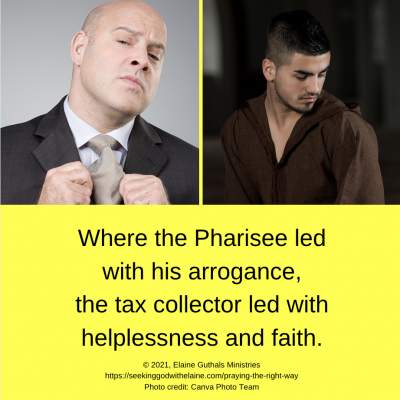
    Where the Pharisee led with his arrogance, the tax collector led with helplessness and faith.

    On Being Justified

    “I tell you, this one went down to his house justified rather than the other, because everyone who exalts himself will be humbled, but the one who humbles himself will be exalted” (Lk. 18: 14 CSB)

    The tax collector knew salvation was received only by grace and justification through the blood of Jesus. Justification is the act through the merits of Christ that makes us free from sin because we are following God’s moral laws.

    Winterbotham brought up an excellent point. It was not the tax collector’s humility and the words he spoke that justified him.

    What Jesus said was, “… this one [was] justified rather than the other …” (Lk. 18: 14 CSB). Winterbotham felt, “Far as he [the tax collector] yet was from the kingdom of heaven, he was not nearly so far as the Pharisee, for he was in the right way.”

    Resource

    I had to laugh when Winterbotham implied that the tax collector was knocking on the door, but the Pharisee was missed the gate entirely and was heading the wrong way.

    Glossary

    But then I stopped short with Winterbotham’s next words. He wrote, “But never let us think that our Saviour meant this for an example of sufficient repentance. If the publican went back, as so many do after the same outbreak of self-reproach, to his exactions and extortions, to his tricks of trade, his petty deceits, and his unrighteous gains — if he went home from the temple to cook his accounts with the government, or to sell up some poor wretch who could not meet his demands; do you think that his beating upon his breast and calling himself a miserable sinner would avail him aught? Nay, it would but increase his condemnation, because it would show that his conscience was alive to his sin.”

    Resource

    But isn’t that what I am always saying? (Yes, I know I sound like a broken record sometimes.)

    We have to be sincere in our repentance. Repentance has to be coupled with a change of heart and behavior. It can’t just be lip service.

    Heintzeler said we become justified by our temperamental makeup. He noted that it needed to be a pious, believing disposition.

    Resource

    Being justified means we have been forgiven of our sins. We are now children of God.

    PrayingTheRightWayPin

    Making the Connections

    Only God can save us, and it is only through His pity and pardon. Nothing the Pharisee thought would save him could.

    Our self-righteousness will not save us. Neither will our pride. In fact, it will keep us bypassing the gate and heading away from it.

    Only ABCDing can save us. In order to become children of God, we have to admit that mankind was separated from God after the original sin, making us sinners; believe Jesus paid the penalty for those sins to become our Savior and Redeemer; confess God as Sovereign God; and demonstrate that commitment by submitting our lives to living our lives following His laws and commandments.

    The ABCDs of Salvation

    If you have not become a believer in Christ, please read through the
    Plan of Salvation and prayerfully consider what God is asking you to do.

    A – admit our sins
    B – believe His Son Jesus is our Redeemer
    C – confess God as Sovereign Lord

    D – demonstrate that commitment by making any changes needed in our lives to
    live the way in which God has called us

    The Disciple’s Job Description

    How Do We Apply This?

    So, how do we get to heart level? Schmitt helped us out with that.

    • Only God can give us humility as it is one of the spiritual graces.
    • We have to have the correct perspective. Being made in God’s image will mean nothing if we aren’t one of His children. While our souls are infinite, these bodies are not. While God does have plans for us, He really doesn’t need us. That said, He wants our relationships restored.
    • God has splendor and majesty. He is Lord and Master. We don’t and aren’t.

    Resource

    What do we have to accept?

    • We cannot justify ourselves — not even our actions performing religious ceremonies.
    • We cannot change only our outside actions. It must be an inward change of heart and character.
    • We cannot come to God with a prideful, entitled attitude. We have to come humbly.
    • We must accept the mercy of God.

    Resource

    We have to come to God for salvation His way.

    Father God. “Where is another God like you, who pardons the guilt of the remnant, overlooking the sins of his special people? You will not stay angry with your people forever, because you delight in showing unfailing love” (Mic. 7: 18 NLT). “For the honor of your name, O LORD, forgive [our] many, many sins” (Ps. 25: 11 NLT). “Have mercy on [us], O God, because of your unfailing love. Because of your great compassion, blot out the stain of [our] sins. Wash [us] clean from [our] guilt. Purify [us] from [our] sin” (Ps. 51: 1-2 NLT). “LORD, don’t hold back your tender mercies from me. Let your unfailing love and faithfulness always protect [us]” (Ps. 40: 11 NLT). Amen.

    What do you think?

    Leave me a comment below (about this or anything else) or head over to my Facebook group for some interactive discussion.

    If you don’t understand something and would like further clarification, please contact me.

    If you have not signed up for the email daily or weekly providing the link to the devotions and the newsletter, do so below.

    If God has used this devotion to speak with you, consider sharing it on social media.

  • Praying the Wrong Way

    Jesus told the Parable of the Pharisee and the Tax Collector to teach us how to pray. This daily devotional shows us how the Pharisee prayed the wrong way.

    Nuggets

    • It is right for us to go to God’s house to pray.
    • The Pharisee’s prayer reflected what was in his heart; unfortunately it was not after God’s heart.
    • The Pharisee mistakenly prescribed to a works-based salvation instead of salvation by grace.

    Devotions in the Luke’s Diagnosis and Prescription series

    Devotions in the How Should We Pray? series

    The parable that Jesus told about the Pharisee and the tax collector teaches us how to pray. He also teaches us that prayer isn’t about appearances. The Israelites — and we — should have known God doesn’t look at the outside.

    What did God tell Samuel when He picked David to be the next king? “But the LORD said to Samuel, ‘Do not look on his appearance or on the height of his stature, because I have rejected him. For the LORD sees not as man sees: man looks on the outward appearance, but the LORD looks on the heart” (I Sam. 16: 7 ESV).

    By Jesus’ day, the Pharisees seemed to have forgotten that. They were content with their ceremony and religion.

    Jesus reiterated that God wants our relationship and submission. In this parable, He warned the Pharisees — and us — to not judge outward appearances and circumstances.

    Let’s Put It into Context

    Previously, we took a quick surface look at these verses. The nuggets we came up with were

    • We discipline ourselves by devoting ourselves to prayer.
    • God isn’t focusing on the minutes – He is focusing on the attitude.
    • But the Pharisee wasn’t devoted to prayer because he made the prayer all about himself. 
    • The tax collector knew he was still a sinner after conversion — he was just a forgiven sinner.

    To read a related devotion, click the button below.

    Let’s see what we come up with through a deeper look.

    Setting Up the Parable of the Pharisee and Tax Collector

    “He also told this parable to some who trusted in themselves that they were righteous and looked down on everyone else: ‘Two men went up to the temple to pray, one a Pharisee and the other a tax collector” (Lk. 18: 9-10 CSB)

    It is right for us to go to God’s house to pray.

    Jesus told this parable to Pharisees that were in the crowd listening to Him. He patterned the first character after them.

    Person of Interest

    The Pharisees in the crowd would have looked down on the tax collector. All of the newer versions translate publican as tax collector. The King James Version keeps the publican.

    Liddon reminded us what the Pharisee and the tax collector had in common. They both saw the value of prayer. They took their time to pray to God in His house.

    Resource

    The Pharisee’s True Colors Showed in His Prayer

    “The Pharisee was standing and praying like this about himself: ‘God, I thank you that I’m not like other people — greedy, unrighteous, adulterers, or even like this tax collector’” (Lk. 18: 11 CSB)

    The Pharisee’s prayer reflected what was in his heart; unfortunately it was not after God’s heart.

    The first character in the parable that we meet is the Pharisee. The Pharisee should have gotten it correctly, right? Well, apparently he didn’t. Let’s break it down.

    One problem is the Pharisee didn’t get it down to the heart level. We just looked at the Greatest Commandments.

    • “And you shall love the Lord your God with all your heart and with all your soul and with all your mind and with all your strength” (Mk. 12: 30 ESV).
    • “… You shall love your neighbor as yourself …” (Mk. 12: 31 ESV).

    To read a related devotion, click the button below.

    Other than the salutation, the Pharisee doesn’t mention God at all. He said nothing about having ABCDed. Cook was right. He really didn’t know God at all.

    Resource

    The prayer is only about him. (I think he forgot that prayer is a two-way communication with God.)

    In his prayer, the Pharisee just compared himself to other people — and of course, he found himself superior to them. (Why would he compare himself to someone he thought was better than him?)

    Seiss pointed out the same thing — he just said it better. He wrote, “The mistake of this Pharisee was, that he compared his outward life with the lives of disreputable people, and so took to himself the credit of exalted superiority.”

    Resource

    It is easy to see that there were a lot of people the Pharisee did not love. His heart was full of arrogance — and that was clearly on full display.

    Hughes made a very good observation. He felt that what Jesus was saying here was that we can become self-righteous.

    Resource

    The Pharisee’s self-righteousness could have been the result of two things. The first could have been self love. It manifests itself in that arrogant behavior.

    The second way we feel self-righteous is because we compare ourselves to others with whom we feel contempt. Censoriousness is about being critical of others. Jortin pointed out that, sometimes, this judgment can be groundless.

    Resource

    The Pharisee here was, at a minimum, being critical. Where is the second greatest commandment in that? Nowhere. In fact, it sounds like the exact opposite — hate instead of love.

    The Pharisee is making a very big assumption that God sees him as better than the tax collector. Liddon felt this assumption was because “he supposes that sin is measured solely by its quantity and weight, and not by the opportunities or absence of opportunities in the sinner.”

    Resource

    Instead of talking relationship, the Pharisee talked works. That is the things he controlled.

    A Wrong Conception of Works

    “I fast twice a week; I give a tenth of everything I get” (Lk. 18: 12 CSB)

    The Pharisee mistakenly prescribed to a works-based salvation instead of salvation by grace.

    What the Pharisee didn’t get was it isn’t about us. It isn’t about what we do or not do — how good we are.

    It is about accepting — in the Pharisee’s case — what God was going to do for him. God provided the Savior.

    Currier said it beautifully. He wrote, “It is not the spoken service that is regarded, but the hidden words of the heart.”

    Resource

    If God based salvation on a works-based system, none of us would ever step one toe into Heaven. We will never be able to consistently — constantly — keep God’s laws and commandments.

    We will never be 100% fruit-of-the-spirit perfect until we get our new bodies.

    Thank You, God, for looking at our hearts.

    But what is God really looking for when He looks inwardly? He is looking for motivation. Have we really submitted our lives to Him? Are we using the Sanctification Road to change our characters to be like His?

    Glossary

    God doesn’t want lip service. He wants changed lives.

    I keep remembering what I heard or read a couple of years ago. If our actions don’t match our words, our words are manipulative.

    How do we try to manipulate God? We do when we think we deserve His blessings without a full commitment to Him. We do when we think the ceremony of religion is enough without the submission to Him.

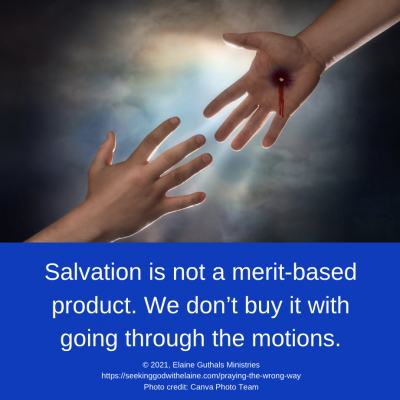
    Salvation is not a merit-based product. We don’t buy it with going through the motions.

    Salvation is not a merit-based product. We don’t buy it with going through the motions.

    As Robertson said, the Pharisee had the ceremonial goodness, but not the moral goodness. Hughes pointed out that the thanksgiving was there, but not the gratitude. I would contend, though, that the thanksgiving was skewed.

    Resource

    Instead of searching for God and loving him, we are deceiving ourselves when we think we can be self-righteous. That is not the way to salvation and eternal life.

    How are we self-righteous? We are when we think being a good person is good enough to get us eternal life. Ooo, baby. That really brings it home, doesn’t it?

    To read a related devotion, click the button below.

    Well, look at it. The Pharisee was banking on what he did to gain God‘s favor. Yes, they were things God approved of – fasting and tithing.

    But isn’t that basically what the Pharisee was saying? He felt he could be good enough and be accepted by God. Yes, he was using religious ceremony to justify himself, but some worldview people use only following the second greatest commandment as justification of being good enough.

    Taylor said something that stopped me in my tracks. He wrote, “How vain must be the hope of those who expect heaven because they are not so wicked as others.”

    Resource

    Ooo, baby. I never thought of it that way. We generally don’t think that Heaven will be filled with the holier-than-thou types. But when we add that some worldview people who think being good enough is enough, we realize how far some people are from having a right relationship with God.

    What Jesus was saying that the Pharisee needed — and the worldview people need — and all of us — was a personal relationship with God.

    The relationship is based on our humility. Humility is a character trait that diminishes pride and places dependence on God while holding a modest view of our importance with respect to others.

    PrayingTheWrongWayPin

    Making the Connections

    Wow! Liddon was brutal. He wrote, “Not to pray is not merely godless: it is, in the larger sense of the term, inhuman.”

    Resource

    What does all of this tell us? We need to pray, but we have to make sure we pray in the right way.

    Why do we pray to God? Liddon told us that, too.

    We have to determine what God is and what we are not. God is virtuous, perfect, and holy. We are not.

    Winterbotham argued that the Pharisee probably did have much to give God. He felt that the Pharisee did have a better character than the tax collector. Either way, the Pharisee had much for which to be thankful.

    Resource

    However, the Pharisee in the parable was like so many of the Pharisees of Jesus’ day. They were hypocrites.

    How Do We Apply This?

    • We can’t think we are equal to or above God. We have to humble ourselves before Him.
    • We can’t rely solely on religious ceremony. We have to have a personal relationship with the Father through the Son.
    • We need to replace our pride with humility.
    • Seiss suggested that we compare ourselves with someone we would want to emulate — how about Jesus?
    • Our works aren’t going to get us anywhere — only belief in Jesus’ atoning blood will.
    • Thank God for His grace and watchcare over us.

    Resource

    Liddon warned us to take care in our interactions with others. He wrote, “If any one point is clear in our Lord’s teaching it is this — that to whom much is given of him shall much be required, and, as a consequence, that in the case of the man to whom much is given a slight offence may be much more serious than a graver crime in another, at least in the eyes of the Eternal Justice. This consideration should prevent a readiness to compare ourselves with any others.” This advice takes on more weight when we consider that only God truly knows the heart of a person.

    Resource

    We don’t want God to be a symbol to us. We don’t want Him to be a character in a book we keep on the shelf.

    We want God to be our Father. We want to have His character. We want to be humble and thankful.

    Father God. You don’t look at our actions. You look at our hearts. You see how we really feel about You. Help us to have Your heart. We humbly submit to You. Amen.

    What do you think?

    Leave me a comment below (about this or anything else) or head over to my Facebook group for some interactive discussion.

    If you don’t understand something and would like further clarification, please contact me.

    If you have not signed up for the email daily or weekly providing the link to the devotions and the newsletter, do so below.

    If God has used this devotion to speak with you, consider sharing it on social media.
  • Attributes of God: Three in One

    We know the concept of a Trinity can sometimes be really hard to understand. But how does that tie with God’s attributes? This daily devotion looks to see if we can get a clearer understanding of the Trinity.

    Nuggets

    • It is difficult to understand the concept of the Trinity sometimes.
    • All that disciples do to expand the kingdom is in the name of the Trinity.
    • While their character is the same, there is a hierarchy.

    To read devotions in the Redo for Godliness series, click the appropriate button below.

    Devotions in the Finding Our Center series

    When I started this series, I said I was going to break it into chunks. This is the last devotion in this first chunk.

    We’ve been taking a look at attributes that make God uniquely God. He is eternal, all-powerful and all-knowing — and that is only a few of the attributes we’ve discussed.

    The last attribute we are going to talk about in this overarching “Who is God” chunk is the Trinity. Oh, yeah. That is a big topic.

    Let’s Put It into Context #1

    Here is a running list of what we’ve discussed previously.

    Let’s Put It into Context #2

    We have talked about the Trinity before. The Trinity is God the Father, God the Son, and God the Holy Spirit, three distinct Persons within one indivisible Divine nature. The nuggets we came up with were

    • God is all-knowing and all-powerful, so no other god is needed.
    • God is above all other gods.
    • It is through this Trinity that God reveals Himself to us.

    To read a related devotion, click the button below.

    We looked at a different verse than we are going to use in this devotion. Last time we used “The grace of the Lord Jesus Christ, and the love of God, and the fellowship of the Holy Spirit be with you all” (II Cor. 13: 13 CSB).” That is a great verse that tells us the function of each One.

    Why We Struggle with There Being a Trinity

    It is difficult to understand the concept of the Trinity sometimes.

    Okay, time to be confused. We are told that the Lord is One (Deut. 6: 4), but then we are told that He is Three in One.

    Hodges contends that part of our problem stems from trying to treat God’s Person as a human person. He wrote, “The word ‘person,’ which the old creed-makers used to express these different ideas of God, has given rise to endless confusion. With us a person is an individual. But this word ‘person’ comes into English out of Latin, and in Latin was a blundering translation of a wiser word in Greek. It means ‘distinction.’ There is one God in threefold distinction. The Divine nature is complex as our human nature is.”

    Resource

    Melvill makes a good point. Is the fact that there is a Trinity any harder to comprehend than God is eternal or omnipresent? Probably not.

    Resource

    While Scriptures never come right out and say there is a Trinity, it is mentioned.

    Disciples Are to Serve in the Name of the Trinity

    “Go, therefore, and make disciples of all nations, baptizing them in the name of the Father and of the Son and of the Holy Spirit” (Mt. 28: 19 CSB)

    All that disciples do to expand the kingdom is in the name of the Trinity.

    Matthew 28: 19-20 is the Great Commission. This is disciples’ marching orders.

    We would never have been told to go proclaim the gospel “… in the name of the Father and of the Son and of the Holy Spirit” (Mt. 28: 19 CSB) if they were not Three in One.

    In Exodus 20: 3, God says, “Do not have other gods besides me” (CSB). Yeah, the King James Version translates it before me, but I have to go with the modern translations here. (I know, mark this day in the record book!)

    No, God doesn’t want us worshiping any god more than Him. (Don’t make science your god.)

    But neither does God want us to be worshiping something alongside Him. He didn’t need any help in creating and maintaining all of this.

    God doesn’t want us worshiping any god more than Him. But neither does God want us to be worshiping something alongside Him.

    We have to worship only God and Jesus — I’ll have to dig deeper to see what Scriptures say about worshiping the Holy Spirit. (I’m thinking we don’t single the Holy Spirit out.)

    Still, Emmons reminded us that all three are equals. God the Father and God the Son have the same attributes as God the Holy Spirit. We shouldn’t short change the Spirit.

    Resource

    I’ve just been sitting here wondering what all of that has to do with our discussion of godliness and morality. Thank you, Dykes, for telling me.

    Dykes wrote, “What is the chief spiritual benefit which we derive from the knowledge of the unity of God? It is the only religious basis for a moral law of perfect and unwavering righteousness. Rival gods, who care each for his own separate interests, and for no other, must neglect moral law in pursuit of their partial ends.”

    Resource

    Okay, I get that. All God was talking about all along was being righteous. Righteous means we are free from sin because we are following God’s moral laws.

    God wrote His laws based on His character — His morals — His virtue — His social graces. He wants us to have His character.

    The Trinity maintains that. If each One in the Trinity had His own agenda, it would be chaos. Dykes basically said moral law would go out the window.

    In fact, Dykes went on to say that the Trinity enhances our understanding of the nature of God. He contended that God can show His love for us only through the Trinity.

    I can see that. Salvation is only through Jesus. If He was not part of God, we would not have deliverance from evil and the consequences of sins. Those sins would not be replaced with good and eternal life.

    SalvationOnlyThroughJesus

    I can also see the Trinity presenting us mind, body, and spirit, as Haweis said. God is the mind — from which the whole plan for mankind and their salvation came. It could only come through the bodily form of Jesus. It lives on in us as the Holy Spirit.

    Resource

    Haweis brought up another way of thinking of this. Elaine-speak —

    • God can be God the Father that we put up on His throne in Heaven because of all the attributes we’ve discussed so far in the series — but all of that can make Him feel more distant from us.
    • God the Son is closer because He actually was one of us. But He lived a long time ago on earth. No one alive today was able to shake His hand. We can only pray and worship Him.
    • So, we have God the Holy Spirit. That is how we do the prayer and worship. Along with that, He lives inside of us 24/7/365 — so He is more familiar.

    Really, we need to be familiar with all three.

    Is There a Hierarchy in the Trinity or Not?

    “or there are three that testify: the Spirit, the water, and the blood — and these three are in agreement” (I Jn. 5: 7-8 CSB)

    While their character is the same, there is a hierarchy.

    Where the hierarchy of the Trinity comes in is in the office and order of their work. Emmons also wrote, “Though they are absolutely equal in nature, yet in office the first person is superior to the second, and the second is superior to the third. The Son acts in subordination to the Father, and the Spirit acts in subordination to the Son and Father both.”

    God the Father is the Creator. God the Son is the Redeemer. God the Holy Spirit is the Advocate. Along with the three different functions, they have three different personalities — all while having the one nature.

    Emmons talked about the Trinity being self-existent. We just talked about that only called it self-sufficient. We said

    • God is self-sufficient because He is blessed.
    • God is self-sufficient because He can do it all — far more than we mere humans can do.
    • God is self-sufficient because He is King of kings and Lord of lords.
    • God is self-sufficient and meets our needs according to His riches and power.
    • Jesus is self-sufficient because He resembles God.

    To read a related devotion, click the button below.

    The last point that Jesus could be self-existent because He resembled God can be transferred to the Holy Spirit. The exact same can be said for Him.

    I am trying really hard not to chase too many rabbits with this devotion. That means keeping it to the discussion of godliness and morality.

    I think we can do that when we talk about the Holy Spirit is a witness. Morgan stressed that we have the permanent written Word. We know from past devotions that the Word came from God through the inspiration of the Holy Spirit.

    Resource

    The Spirit continues to testify by convicting us and interpreting the Scriptures for us. His guidance as to what God requires of us is invaluable.

    This guidance is how we change our character to be that of God’s.

    Yes, the water refers to baptism, and the blood refers to Jesus’ sacrifice on the cross to shed His blood for our redemption.

    ThreeInOnePin

    Making the Connections

    I think Melvill hit that nail on the head for some people. He wrote, “We admit that whilst the whole of a revelation may be above our reason, there may be parts which seem contrary to it; and if there exists a repugnance between reason and revelation, we do right in withholding our assent.”

    Resource

    It goes back to us having to understand everything before we can have faith that God is real, Jesus is our Savior, and the Holy Spirit is anything more than just our conscience. We want to use our intellect to become equals with God.

    We can’t do that!

    Faith doesn’t work that way. Faith is the conviction that the doctrines revealed in God’s Word are true, even if we do not understand all aspects of them, a belief which impacts our lives.

    How Do We Apply This?

    We have to believe, as Melvill said, that “the doctrine stated with simplicity, the doctrine that Father, Son, and Holy Ghost are so distinct as not to be one with the other, and so united as to be one God, carries nothing on its front to convict it of absurdity.” Bourdalone felt this belief was the greatest honor and praise that we could give God.

    Resource

    Remember, we just said belief is the process by which we gain faith in God. A process. Not a flip-on-the-light-switch-ah-ha moment. It is more Sanctification Road.

    Faith and belief produce hope. Hope is a future expectation, called a living hope, based on the confidence that our names will be found in the book of life.

    God Himself will show us that Robinson was correct when he said things are “… of the Father, through the Son, by the Spirit.”

    Resource

    The unity of the Trinity should comfort us. All three have the same moral character for which we are striving.

    Father God. We don’t understand how You can be One yet Three in One. But we are not called to understand. We are called to have faith. Lord, we believe in You. Amen.

    What do you think?

    Leave me a comment below (about this or anything else) or head over to my Facebook group for some interactive discussion.

    If you don’t understand something and would like further clarification, please contact me.

    If you have not signed up for the email daily or weekly providing the link to the devotions and the newsletter, do so below.

    If God has used this devotion to speak with you, consider sharing it on social media.

  • Attributes of God: Purity

    We get that God is holy. That means He is pure. This daily devotional looks at how God is pure and what that means for us.

    Nuggets

    • He is pure, faithful, and blameless in what He does because He is pure, faithful, and blameless.
    • God is pure and can’t tolerate sin, but He loves us and calls us to salvation.
    • Because God is pure, His laws and commandments are, too.
    • If God is pure, and His laws and commandments are pure, that means His Word is pure, too.

    To read devotions in the Redo for Godliness series, click the appropriate button below.

    Devotions in the Finding Our Center series

    Okay, let’s start this out by going Dictionary Chick. We’ve got to connect the dots and establish some what we mean before we get to the evidence.

    God is holy. Holy means to be set apart, perfect, and pure.

    God’s holiness is a result of His purity. Holiness is more than a character trait; it is purity, dedication, and commitment that lead to being set apart. Purity means without the stain of sin.

    Sins are actions by humans that disobey God and break one of His reasonable, holy, and righteous laws and commandments, goes against a purpose He has for us, or follows Satan’s promptings.

    So, what does it mean that God is pure?

    Let’s Put It into Context

    Here is a running list of what we’ve discussed previously.

    God Is Pure

    “With the faithful you prove yourself faithful, with the blameless you prove yourself blameless, with the pure you prove yourself pure, but with the crooked you prove yourself shrewd” (II Sam. 22: 26-27 CSB)

    He is pure, faithful, and blameless in what He does because He is pure, faithful, and blameless.

    Second Samuel 22: 26-27 are great verses. These words are told in two places in Scriptures. The first is here in Samuel; the second place is Psalms 18: 26.

    I think we can take these words two ways. The first way is like the Biblical Illustrator wrote: “You say that the desert is a desert, because no rain falls upon it; but this is only half the truth. No rain falls upon it because it is a desert.”

    Resource

    Who and what we are greatly influences what happens to us. It is the same with God. He can show those who are like Him exactly Who He is.

    The second way to take these words is God reveals Himself to us beyond what is written in Scriptures. That can be in different ways, though, because we are different.

    Service told us that “… God shows Himself to every man according to what every man is.” God is only going to totally reveal Himself to His children.

    Resource

    Glossary

    This is logical because we all have different experiences. We are all at different places on the Sanctification Road. It does depend on what our characters are.

    Glossary

    We learned, like the prodigal son’s older brother, that we shouldn’t be jealous of God how God interacts with another. We have to remember that God is working with what we are, but that He is trying to get us all to the same place — pure like Him.

    To read a related devotion, click the button below.

    God has to start with what each of us are and where we are. Someone who has lived in Los Angeles all their life is going to look at things differently than I do with my rural background.

    But that isn’t the focus. The focus is our redo for godliness. We want to be like Him — pure.

    We have to remember that God is working with what we are, but that He is trying to get us all to the same place — pure like Him.

    If God Is Pure, Can He Look on Sinners?

    “Your eyes are too pure to look on evil, and you cannot tolerate wrongdoing. So why do you tolerate those who are treacherous? Why are you silent while one who is wicked swallows up one who is more righteous than himself?” (Hab. 1: 13 CSB)

    God is pure and can’t tolerate sin, but He loves us and calls us to salvation.

    Habakkuk 1: 13 is a confusing verse. We’ve looked at it a couple of times because it begs the question as to how God can see us when we are sinners.

    • We think God cannot look on sin (Still More of God’s Blessings for Merciful Disciples of Christ).
    • God has a low tolerance for sin (Comprehending Christ’s Love).
    • Sin created a separation from God. God, however, is right on the other side of the divide (Can God See Us If We Are Sinners?).
    • When we sin, God cannot interact with us the way He wants (Morality to Honor God).

    Verse Commentary

    Yes, God is pure. Yes, He cannot tolerate our sin.

    But He loves us. He can still call to us when we are sinners. He can still bring us salvation.

    • Salvation is deliverance from evil and the consequences of sins to replace them with good and eternal life.
    • The consequences of sin are spiritual death and separation from God.
    • Spiritual death is the separation from God that occurred as a consequence of Adam and Eve’s original sin. The spiritually alive are those who have ABCDed, so they are no longer separated from God.
    • Eternal life is the promise of living eternally – even if we have died in this life – because we have admitted our sins, believed Jesus as Savior and Redeemer, and confessed God as Sovereign Lord.

    Raikes reminded us that we can’t think that love is going to win out over the intolerance of sin. He wrote, “This is no contradiction to the character in which God is exhibited to us in the Gospel, as a God of love. But we must notice the limits under which the love of God must be taken in application to ourselves. Only in the Gospel is it revealed.”

    Resource

    God is holy and pure, so He cannot tolerate anything less — sin. He loves us, so He can offer us salvation.

    But there is one unpardonable sin, which I think is unbelief. If we can’t give up our sin and won’t submit our lives to Him, God can’t forgive that.

    God can’t alter His purity to accept our impurities. He can’t reconcile Himself to sin.

    The reason God sent Jesus to earth to be the Sacrifice that could Jesus’ blood could pay the penalty for our sins. That is the only way He is going to reconcile Himself to sin — do away with its hold on us.

    But that is dependent on us saying we want to pure like God is. We have to ABCD.

    The ABCDs of Salvation

    If you have not become a believer in Christ, please read through the
    Plan of Salvation and prayerfully consider what God is asking you to do.

    A – admit our sins
    B – believe His Son Jesus is our Redeemer
    C – confess God as Sovereign Lord

    D – demonstrate that commitment by making any changes needed in our lives to
    live the way in which God has called us

    The Disciple’s Job Description

    God’s Laws and Commandments Are Pure

    “The law of the Lord is perfect, reviving the soul; the testimony of the Lord is sure, making wise the simple; 8 the precepts of the Lord are right, rejoicing the heart; the commandment of the Lord is pure, enlightening the eyes; 9 the fear of the Lord is clean, enduring forever; the rules of the Lord are true, and righteous altogether” (Ps. 19: 7-9 ESV)

    Because God is pure, His laws and commandments are, too.

    I am not sure I have ever considered the laws and commandments being pure. I know I have felt that they were just.

    I know I have considered them moral laws. But are they pure moral laws?

    Well, duh! The laws show us God’s character. If God’s character is pure, the laws have to be, too.

    Hankinson put it this way. He wrote, “The law was ordained for something beyond the mere curbing of transgressions; its further object was to detect, expose, and condemn the transgressing principle; in other words, by the purity which it developed and enforced to enlighten man’s eyes upon the character of God, the extent of his own moral ruin, and the absolute necessity of the restoration of the moral principle.”

    Resource

    Elaine-speak. The law shows us what is a sin and what isn’t. But that is not it’s only purpose.

    It goes deeper into showing the principles behind the law. Why is a sin a sin — and why isn’t something a sin?

    It is or isn’t because the law is consistent with God’s character. So, the laws and commandments show us Who God is.

    Great! We want to know God beyond a shadow of a doubt, right? That leads to a profound love of the law on our parts, right?

    Hmmmm. Probably not. We tend to see the fact that we can’t keep the laws and commandments 24/7/365. They just show us how pure we aren’t!

    I think sometimes we don’t get to the part that shows us, as Hankinson said, “… the mighty moral difference between the mind that originated and the minds that received the law.”

    We think more in the actions of breaking the laws and commandments instead of the differences of our characters. We’re talking morals again, which we have said needs to be kicked up to spiritual graces. The moral things we do need to be done for God’s glory and honor, not to make this place a better word — not even just to help our fellow humans.

    The moral things we do need to be done for God’s glory and honor, not to make this place a better word — not even just to help our fellow humans.

    God’s Word Is Pure

    “Your word is completely pure, and your servant loves it” (Ps. 119: 140 CSB)

    If God is pure, and His laws and commandments are pure, that means His Word is pure, too.

    Oh, listen to this. In the Homiletic Review, it said, “A love to Divine things for the beauty of their moral excellency is the spring of all holy affections.”

    We should love things about God for their purity. God gives us the ability to be aware of things holy. That is just one way in which we grow closer to Him.

    PurityPin

    Making the Connections

    I really like what the Homilist had to say: “The moral constitution of man, which recoils from the wrong and sympathises (sic) with the right, manifests God’s holiness. There is no room for man, then, to doubt God’s holiness.” That says a couple of things to me.

    • We want our moral constitution to be like Him. We have been saying it as we want His character to be ours.
    • When we have God’s character — and recoil from wrong and do what is right — we can’t and won’t doubt God’s holiness. We will see Him as He is.

    Resource

    How Do We Apply This?

    • We need to look for the beauty and purity in things.
    • We need to strive for God’s character.

    No, we won’t be pure like God until we get our new bodies. That, however, is what we are shooting for.

    Father God. You are pure. Because of that, You can’t tolerate sin. Help us have Your intolerance of sin so that we may remain faithful to You. Lord, we wait for the day when we receive our new bodies that cannot sin. Amen.

    What do you think?

    Leave me a comment below (about this or anything else) or head over to my Facebook group for some interactive discussion.

    If you don’t understand something and would like further clarification, please contact me.

    If you have not signed up for the email daily or weekly providing the link to the devotions and the newsletter, do so below.

    If God has used this devotion to speak with you, consider sharing it on social media.

  • Do We Make God a Liar?

    Does a verse in First John really say we make God a liar if we don’t believe in Him? This daily devotional looks at faith, belief, sanctification, and God’s truth.

    Nuggets

    • Faith and belief are connected but not synonymous.
    • If we do not believe in God, we are saying that there is some aspect of God’s Word we think is a lie.
    • We must be introduced to God’s truths through witnesses.
    • Each of us has to decide whether we are going to believe God’s truths or not.
    • Once we accept the Plan of Salvation, we have to grow in faith by navigating the Sanctification Road.

    Okay, God highjacked my devotion. I was going to keep going on the Finding Our Center series.

    God had different plans. There must be something in this devotion that I needed to see or someone else needed to read.

    That is fine by me.

    I started by looking at God doesn’t sin. The only thing I could really find was God doesn’t lie. The verse I pulled up only had one sermon, but it sent me to another verse.

    That is where I found pay dirt — well, for a different topic.

    What Is Faith and Belief?

    The one who does not believe God has made him a liar, because he has not believed in the testimony God has given about his Son” (I Jn. 5: 10 CSB)

    Faith and belief are connected but not synonymous.

    That seems really deep. Let’s see if we can decipher that.

    Believing in God brings us to faith in God. What is the difference between faith and belief?

    The Holman Bible Dictionary wrote, “‘Belief’ came to be distinguished from faith as an intellectual process having to do with the acceptance of a proposition.” Faith is the conviction that the doctrines revealed in God’s Word are true, even if we do not understand all aspects of them, a belief which impacts our lives.

    Resource

    Spurgeon made an interesting statement. He wrote, “God now biddeth us live by believing in Him.”

    Resource

    If belief is the process and faith is the goal, that is another argument that perfection is being rather than doing. God wants us to be like Him. He wants us to live the process getting there.

    Perfection is about being. It is about obtaining the character of God.

    So, if we believe, what we are saying is that God is not a liar. We believe that He sent His Son to die to pay the penalty for our sins.

    What If We Don’t Believe?

    If we do not believe in God, we are saying that there is some aspect of God’s Word we think is a lie.

    God gives us free will to decide whether or not we are going to believe His truths. Free will is the ability within us to make decisions, which determine actions that produce character.

    The lies we believe when we do not believe God include that

    • Jesus was not God’s Son.
    • Jesus’ blood could not pay the penalty for our sins.
    • There is no reason for a Savior.
    God gives us free will to decide whether or not we are going to believe His truths.

    How Do We Believe?

    We must be introduced to God’s truths through witnesses.

    We are introduced to God and His Plan of Salvation through His Word and His people. These bear witness to His truths.

    The Gospels are mainly written by eye witnesses. Matthew and John were apostles. They spent three years with Jesus. We need to believe what they said they saw and experienced.

    Traditionally, it is believed that John Mark, a companion of the Apostle Peter, wrote the Gospel of Mark. Luke, a companion of Paul, wrote the Gospel of Luke. Both were evangelists. They were experts in their field. We need to believe what they knew.

    Disciples ourselves are witnesses. That is what I John 5: 10 is saying. We believe that

    • Jesus’ blood made the atonement — repayment — for our sins.
    • We are made new creations.
    • One of the rewards of faith is eternal life.

    Glossary

    So, in other words, we start out by believing the testimony of others. But then we must internalize it and establish our own testimony.

    Okay, Barrows said it better. He wrote, “Our faith in him began with testimony, but now it has become independent of it.”

    Resource

    But what does that really look like? We have to hear or read God’s Word. Then we have to decide if we accept what we hear and read is the truth.

    This is what we call searching for God.

    Searching for and Seeking God

    Hearing His Word (Rom. 10: 17).
    Reading His Word (Rev. 1: 3).
    Praying to Him (Heb. 4: 16).
    Studying His Word (Ac. 17: 11).
    Meditating on His Word (Ps. 1: 1-2).
    Memorizing His Word (Ps. 119: 11).

    Making the Decision for Salvation

    Each of us has to decide whether we are going to believe God’s truths or not.

    Salvation is deliverance from evil and the consequences of sins to replace them with good and eternal life. The consequences of sin are spiritual death and separation from God. Spiritual death is the separation from God that occurred as a consequence of Adam and Eve’s original sin. The spiritually alive are those who have ABCDed, so they are no longer separated from God. Eternal life is the promise of living eternally – even if we have died in this life – because we have admitted our sins, believed Jesus as Savior and Redeemer, and confessed God as Sovereign Lord. This deliverance is necessitated by the original sin committed by Adam and Eve in the Garden of Eden, which made everyone sinners.

    Repentance is acknowledging our separation from God and expressing sorrow for breaking God’s laws and commandments by making the commitment to changing ourselves through obedience so that we no longer do the wrong things. We need to repent of the sins we’ve committed by doing something that is wrong or not don’t something that is right. Sins our actions by humans that disobey God and break one of his reasonable, holy, and righteous laws and commandments, goes against a purpose he has for us, or follows Satan‘s promptings.

    God designed a Plan of Salvation so that we could be delivered from the consequences of sin. This was accomplished through His grace. Grace is a free and unmerited gift from the Heavenly Father given through His Son, Jesus Christ that enables salvation and spiritual healing to believers by the work of the Holy Spirit. Because of God’s infinite grace, Jesus our Redeemer in order to forgive us of our sins.

    Redemption is where something is used in exchange for something else to gain or regain something. Jesus is our Redeemer because He was born of a virgin, making Him 100% God and 100% man; gave His life on the cross for us so that His blood could pay the price for our sins; and because of God’s great might and power, rose from the grave, conquering death and paying the price for our sins. 

    We access this grace through faith. Because we have faith and believe, we gain the forgiveness of our sins. Forgiveness is, when we ask, God pardons us because we have broken His laws and commandments.

    We accept the pardon by letting go of the guilt and remorse that we feel because we have done something wrong. It is a conscious decision to accept His forgiveness. We also commit to changing ourselves so that we no longer do the wrong things.

    How do we know we are saved? We are saved if we admit that mankind was separated from God after the original sin, making us sinners; believe Jesus paid the penalty for those sins to become our Savior and Redeemer; confess God as Sovereign God; and demonstrate that commitment by submitting our lives to living our lives following His laws and commandments.

    That makes us saints. Saint means holy one who has been set apart. I think some are uncomfortable with that title. That is why believer is the nickname we use.

    Growing in Faith

    Once we accept the Plan of Salvation, we have to grow in faith by navigating the Sanctification Road.

    Ooo. I have to think about this. Spurgeon wrote, “You know how faith arises in the heart from the human point of view.”

    Resource

    What is tripping me is that “human point of view.” But isn’t that the way it goes?

    Let’s say we have not grown up in church. Maybe we meet somebody new, who invites us to be a guest at a service.

    So, we have no building blocks on which to hook the new information. We’ve got to evaluate biblical truths based on human knowledge.

    Fortunately, we will have the Holy Spirit guiding us to correct any human knowledge that does not mesh with God’s truth.

    Okay, but do those who have grown up in the church also grow their faith from a human point of view? I think we almost have to.

    We have to start from where we are. That means we have to determine what sins we have committed. Sins are committed by our human nature. That colors ours human point of view.

    That makes the Sanctification Road even more needed. We have to go from our human point of view to God’s point of view. That is what sanctification means.

    • Sanctification is the transformation of mind, body, and soul, which begins with regeneration, gradually changes our nature through the promptings of the Holy Spirit, and ends with perfected state of spiritual wholeness or completeness.
    • Regeneration is the change in us that God brings about when we go from being spiritually dead to spiritually alive.
    • The perfected state indicates the combination of the graces which, when all are present, form spiritual wholeness or completeness.

    Glossary

    I think Spurgeon also said this because he felt “faith is to a large extent a matter of consciousness.” If faith is a matter of awareness, we have to experience God’s Word.

    Resource

    Experiencing it is more than just reading and hearing it. The Holy Spirit has to show us what God’s provision means. We are introduced to His love.

    It is more, however, than just a passive experience. Morgan said we have to exercise our faith. We have to put forth the effort to understand Who God is.

    Resource

    We don’t know God is real until He is real to us. Our faith has to grow. That only happens through experience.

    DoWeMakeGodALiarPin

    Making the Connections

    I kind of have trouble with John’s wording. “The one who does not believe God has made him a liar …” (I Jn. 5: 10 CSB). No, in my opinion, a worldview person has not made God a liar.

    God’s Word is still true, even if they don’t believe in Him. Jesus is still His Son and came to die to pay the penalty for our sins. We do need a Savior because we are separated from Him unless we accept His gift of Salvation.

    Barrows said that God’s Word quiets the conscience. Our conscience is the part of our nature that impacts our moral decisions as it points us to what is right and gives us pain or pleasure depending on the choice.

    Resource

    Our consciences are quieted when we gain salvation. It Is further quieted because we have peace when we believe in God and are doing His Will.

    When we gain salvation, we gain victory over the power of sin. We gain the power when we communicate with God.

    How Do We Apply This?

    We need to ABCD. We do that through searching for Him. We continue to seek Him after conversion.

    The ABCDs of Salvation

    If you have not become a believer in Christ, please read through the
    Plan of Salvation and prayerfully consider what God is asking you to do.

    A – admit our sins
    B – believe His Son Jesus is our Redeemer
    C – confess God as Sovereign Lord

    D – demonstrate that commitment by making any changes needed in our lives to
    live the way in which God has called us

    The Disciple’s Job Description

    Barrows advised us that

    • We have to realize God’s Word is true. He will reveal the extent of that truth only after we ABCD.
    • We don’t want to be so mired in the worldview that we cannot see His truths. We want to sincerely believe in Him.
    • We will only have the assurance of the truth as we grow in faith.

    Resource

    If you haven’t made the decision yet to put your faith and trust in God, do so today. Don’t let any more time elapse until you do.

    Father God. Before You even created us, You designed a plan to restore us to You after we disobeyed You. Call us today to Your salvation. Lord, we admit we are sinners. We believe that Jesus is our Savior and Redeemer. We confess You as our Sovereign God. We want to demonstrate that commitment daily to You as we submit our lives to You. Amen.

    What do you think?

    Leave me a comment below (about this or anything else) or head over to my Facebook group for some interactive discussion.

    If you don’t understand something and would like further clarification, please contact me.

    If you have not signed up for the email daily or weekly providing the link to the devotions and the newsletter, do so below.

    If God has used this devotion to speak with you, consider sharing it on social media.

  • The Older Son Has a Problem, Too

    The final devotion in the Parable of the Prodigal Son series looks at the older brother. Though he may have remained working with his father, he had his own issues. This daily devotional looks at his response and the father’s response to the return of the prodigal son.

    Nuggets

    • We, unlike the older son, should use the Sanctification Road to change our character to be like God’s.
    • We, unlike the older son, should put our emphasis on loving the Father and doing His Will.
    • We, unlike the older son, should put God’s family first.
    • We, unlike the older son, should accept that God is in control.

    Devotions in the Luke’s Diagnosis and Prescription series

    To read a devotion in the Parable of the Prodigal Son series, click the appropriate button below.

    It might be easy to think the prodigal son’s older brother is the poster child of what we should do. But if we look beneath the surface, we find out he really has a problem, too.

    Still, I love the reasoning Mellor gave as to why the older son’s position should be preferred.

    • The older son hadn’t abandoned the father, so he did not need to come back. There was no guarantee that the prodigal son would repent.
    • We should be striving for godliness. It is harder when we slide backwards on the Sanctification Road than it is if we go full steam ahead.
    • The older son’s joy — and his father’s joy of him — was not broken.

    Resource

    What does this boil down to? God wants us to be obedient. He wants us navigating the Sanctification Road in order to change our character to be like His.

    God will forgive us when we are not obedient, but He will always prefer obedience over disobedience.

    Let’s Put It into Context #1

    Previous nuggets are

    • We, like the prodigal son, turn away from God.
    • We, like the prodigal son, are far from God when we allow sin to rule our lives.
    • We, like the prodigal son have to face the consequences of our choices.
    • We, like the prodigal son, have to repent.
    • We, like the prodigal son, have to return to God, and He will meet us.
    • We, like the prodigal son, have to say the words that shows we repent.
    • We, like the prodigal son, will be forgiven by God when we sincerely repent.

    Let’s Put It into Context #2

    We talked in the first devotion that, even though the audience was mainly scribes and Pharisees, the prodigal son was meant for the publicans and sinners in the crowd. Thomson thought the older son was depicted the scribes and Pharisees.

    Resource

    Think about it. When Gentiles started being converted, what was the reaction of the scribes and Pharisees? They puffed out their chests, stuck their noses up in the air — and threw a hissy fit.

    Jesus wasn’t telling this parable just to tell people that they needed to mend their sinful ways. He was telling people that we have to accept those who have chosen to accept Him as their Savior and be a real family.

    One of the points of the parable is that we are not superior to anyone else. The Pharisees sure felt that way!

    The Older Son Didn’t Have God’s Character

    “Now his older son was in the field; as he came near the house, he heard music and dancing. So he summoned one of the servants, questioning what these things meant. ‘Your brother is here,’ he told him, ‘and your father has slaughtered the fattened calf because he has him back safe and sound.’ Then he became angry and didn’t want to go in. So his father came out and pleaded with him. But he replied to his father, ‘Look, I have been slaving many years for you, and I have never disobeyed your orders, yet you never gave me a goat so that I could celebrate with my friends. But when this son of yours came, who has devoured your assets with prostitutes, you slaughtered the fattened calf for him’” (Lk. 15: 25-30 CSB)

    We, unlike the older son, should use the Sanctification Road to change our character to be like God’s.

    We get on the surface that the older son doesn’t want to welcome the sinner back home. Do you think the older brother unadopted the prodigal son? “But when this son of yours came …” (Lk. 15: 30 CSB emphasis added). Tell us how you really feel, bro!!!

    God says, wrong, wrong, wrong! Everyone who genuinely repents is forgiven.

    But when we look under the surface, we see that the older son wasn’t squeaky clean, either. He puffed out his chest, stuck his nose up in the air — and threw a hissy fit.

    Mellor made a great point. Jesus had to introduce us to the older son in the parable to showcase how loving the Father is. It is easy to love the obedient. It takes the Father’s heart to love the rebellious.

    Mellor called the older son a “… narrow good man …” Ouch! I wonder how many of today’s disciples that description would fit? Isn’t that what the worldview people accuse us of being?

    Resource

    We can’t be narrow minded. But neither can we adopt the worldview’s broad way of thinking. We have to adopt God’s way of thinking.

    More importantly, we need to have God’s character. The older son had some issues there.

    The older son may not have abandoned his father, but ooo, baby, did jealousy have the hook in him!

    Can’t you just see him? Stomping his feet. Waiving his arms. Screaming, “I’ve been the faithful one!!!”

    The older son was being selfish. That isn’t a character trait that God wants us to have.

    All the older son wanted was the opportunity to have a feast with his friends. Yet, he doesn’t show mercy to his brother.

    What may be considered the root of all of this is the older son’s anger. The older son was angry because the prodigal son ABCDed.

    Man, did the older son miss the boat!

    God is never angry when we turn to Him. That is the whole reason He sent Jesus to be our Savior. He wanted our relationships with Him restored.

    What the older son got out of it was being cut off from God’s joy. He wouldn’t go into the party and join in the dancing. He wasn’t joining in the celebration.

    God is never angry when we turn to Him.

    The Older Son Didn’t Love

    We, unlike the older son, should put our emphasis on loving the Father and doing His Will.

    We said the prodigal son didn’t show any love for his father. Neither did the older son. It sounds like everything the older son did was because of duty, not for love of the father.

    Gatty came down hard on older son. He felt that his response now put into question the motivation behind his obedience and hard work. Was he doing them because he loved his father and this was what was right or because he wanted the reward?

    Resource

    Part of the older son’s problem was he thought it was all about what he did or didn’t do. Verse 29 says what he did was worked hard. What it says he didn’t do was disobey his father.

    That’s what he — and we — are supposed to do, right? Get the do the do’s and don’t do the don’ts down pat.

    Not exclusively.

    We can’t work our way into salvation. “For by grace you have been saved through faith. And this is not your own doing; it is the gift of God, not a result of works, so that no one may boast” (Eph. 2: 8-9 ESV).

    The problem with the older son latching onto the Do and Don’t Theory is it increased his feelings of self-importance. It was about him, not about serving his father.

    Another thing the older son was doing was expecting his rewards here on earth. He was saying, “Where is my fatted calf? I deserve a reward for being faithful.”

    True, God will reward us here. The best rewards, however, are going to be saved for Heaven.

    God gives us so much. He gives us life and health. He provides what we need.

    “Therefore I tell you, do not be anxious about your life, what you will eat or what you will drink, nor about your body, what you will put on. Is not life more than food, and the body more than clothing?” (Mt. 6: 25 ESV).

    When the older son said, “You never gave me,” he is ignoring what all the things the father did give him. He isn’t looking at his father in the correct way.

    When the older son says, “You never gave me,” he is ignoring what all the things the father did give him.

    The Older Son Was Not Family Oriented

    We, unlike the older son, should put God’s family first.

    God really wants family first. “For this reason I bow my knees before the Father, from whom every family in heaven and on earth is named” (Eph. 3: 14-15 ESV).

    Robertson said this is how the church is defined — it is a family. We are to love the different members of the family. A major theme of Ephesians is unity of the body.

    Resource

    It comes down to love and forgiveness. That was the point of Jesus’ parable.

    The Parable of the Prodigal Son comes down to love and forgiveness.

    The Father Sets Things Straight

    “‘Son,’ he said to him, ‘you are always with me, and everything I have is yours. But we had to celebrate and rejoice, because this brother of yours was dead and is alive again; he was lost and is found’” (Lk. 15: 31-32 CSB)

    We, unlike the older son, should accept that God is in control.

    God’s priority has been and will always be our salvation.

    • Salvation is deliverance from evil and the consequences of sins to replace them with good and eternal life.
    • The consequences of sin are spiritual death and separation from God.
    • Spiritual death is the separation from God that occurred as a consequence of Adam and Eve’s original sin. The spiritually alive are those who have ABCDed, so they are no longer separated from God.
    • Eternal life is the promise of living eternally – even if we have died in this life – because we have admitted our sins, believed Jesus as Savior and Redeemer, and confessed God as Sovereign Lord.

    Romans 2: 11 says that God shows no favoritism. Robertson argue that, “God has a right to do what he will.“ If he wants to show favoritism, that is what it is right.

    The first reason, according to Robertson, that this was the right action by God was that it was in celebration of a person’s salvation. That is reason to celebrate.

    The second reason that Robertson offered was that the older son had a lifetime of peace. The continued presence of God in our lives is better than our disobedience and forgiveness.

    Resource

    I am just over here struggling with whether the party was a sign of favoritism or a reward for obedience. Rewarding obedience is not showing favoritism.

    Newman makes a good point. If the older son was expecting more evidence from the prodigal son that his repentance was genuine, that is not the way God works. He does not make us change before salvation. God accepts us as we are and begins our journey on the Sanctification Road to make the needed changes to our character.

    Resource

    If God would only except our request for salvation after we cleaned up our acts, that would be salvation by works, not faith and grace. God doesn’t work that way.

    Look at it this way. Isn’t this saying that we should be so confident and content in our faith that we don’t need the parties and celebrations to be reminded that God is present?

    Oh, that convicts me. How many times have I all but screamed at the ceiling, “God, where are you? You haven’t done anything for me lately.“

    Don’t I know God is always here? He promised that.

    GodNeverLeavesUsVerses

    It is better to obey God than not obey Him. Even disciples are going to have trouble obeying Him.

    God loves us anyway when we truly love Him.

    We have to remember that God’s purpose is to expand His kingdom. That means bringing repentant sinners into the fold. We should rejoice when He accomplishes His purpose.

    TheOlderSonHasAProblemTooPin

    Making the Connections

    We are going to chase a rabbit a second. Jortin made an interesting statement that I haven’t decided if it is comforting or not. He wrote, “Nothing is so hard as to overcome old vices, and to root up evil habits; for by custom they have taken firm hold, just like chronical diseases, which are seldom cured. From such grievous inconveniences he is freed who hath been accustomed to regular obedience.”

    Resource

    Most, if not all, of us struggle with that one sin that we have trouble giving up. We may think we’ve mastered it for a while — then, here it comes again.

    Jortin’s point was that the older son was freed from this struggle because he had regularly been obedient.

    How Do We Apply This?

    So, we disciples have to ask ourselves this question: how much elder brotherliness (Taylor) and Pharisaism (Dods) do we have in us? Dods reminded us that “… it is not service that wins God’s love; that His love is with you now, and that your acceptance of it will make all that has seemed to you grievous to be light and happy.”

    Resource

    • We have to come to God voluntarily. He will never force us.
    • We have to do things God’s way — obedience and repentance.
    • We have to come to God as we are — wearing rags, dehydrated, starving, emaciated, and barefooted.
    • We have to eliminate the self-righteousness.
    • We have to be the family God wants us to be.

    Resource

    Jortin wrote, “A regular obedience makes us more truly and properly the children of God.” That should be our goal — to truly and properly be the children of God.

    Resource

    Glossary

    We do that by ABCDing and seeking God.

    The ABCDs of Salvation

    If you have not become a believer in Christ, please read through the
    Plan of Salvation and prayerfully consider what God is asking you to do.

    A – admit our sins
    B – believe His Son Jesus is our Redeemer
    C – confess God as Sovereign Lord

    D – demonstrate that commitment by making any changes needed in our lives to
    live the way in which God has called us

    The Disciple’s Job Description

    Searching for and Seeking God

    Hearing His Word (Rom. 10: 17).
    Reading His Word (Rev. 1: 3).
    Praying to Him (Heb. 4: 16).
    Studying His Word (Ac. 17: 11).
    Meditating on His Word (Ps. 1: 1-2).
    Memorizing His Word (Ps. 119: 11).

    We do it by humbly submitting our lives to Him.

    Father God. You are always near Your children. We want to be Your children. Help us to be content in that promise. Amen.

    What do you think?

    Leave me a comment below (about this or anything else) or head over to my Facebook group for some interactive discussion.

    If you don’t understand something and would like further clarification, please contact me.

    If you have not signed up for the email daily or weekly providing the link to the devotions and the newsletter, do so below.

    If God has used this devotion to speak with you, consider sharing it on social media.

  • The Prodigal Son Returns Home

    We’ve been traveling along with the prodigal son as he takes his inheritance and leaves home for a foreign country. In this daily devotional, we will travel back home with him as he asks his father for forgiveness for his sins.

    Nuggets

    • We, like the prodigal son, have to return to God, and He will meet us.
    • We, like the prodigal son, have to say the words that shows we repent.
    • We, like the prodigal son, will be forgiven by God when we sincerely repent.

    Devotions in the Luke’s Diagnosis and Prescription series

    To read a devotion in the Parable of the Prodigal Son series, click the appropriate button below.

    The prodigal son found out that he wasn’t better off on his own. He had spent his inheritance, and then a famine had devastated the land.

    Jesus referred to him as “coming to his senses” in Luke 15: 17. When he did, the prodigal son started for home.

    Let’s Put It into Context

    Previous nuggets are

    • We, like the prodigal son, turn away from God.
    • We, like the prodigal son, are far from God when we allow sin to rule our lives.
    • We, like the prodigal son have to face the consequences of our choices.
    • We, like the prodigal son, have to repent.

    The Prodigal Son Comes Home

    “So he got up and went to his father. But while the son was still a long way off, his father saw him and was filled with compassion. He ran, threw his arms around his neck, and kissed him” (Lk. 15: 20 CSB)

    We, like the prodigal son, have to return to God, and He will meet us.

    We have to hand it to the prodigal son. He had hit rock bottom, but he figured out what he needed to do – and he did it.

    The Repertorium Oratoris Sacri spoke to the need for us to have that self-evaluation. They wrote, “Forsaken by all the world, he returned to himself. The first condition of conversion is knowledge of one’s self, and the knowledge of the condition of our soul.”

    Resource

    The prodigal son got on the journey home right away, and it paid off. He needn’t have worried about the reception he would receive from his father.

    The father saw the son coming from a long way off. He had to have been looking out for the son, hoping he would come home.

    God watches over us. He even watches us before we repent. Just as the father did not disown the prodigal son, neither does God turn His back on us when we are sinners.

    Spurgeon cautioned us not to think that this meant we could remain in our sin after we asked for repentance. Repentance is acknowledging our separation from God and expressing sorrow for breaking God’s laws and commandments by making the commitment to changing ourselves through obedience so that we no longer do the wrong things.

    Resource

    When we repent, we have to commit to obeying God’s laws and commandments. We can’t hold on to sin and expect God to be good with that.

    Yes, disciples continue to sin after conversion because we are still in our sinful bodies. But we are striving to be obedient.

    But Spurgeon reminded us that we could go to the other extreme. We should not be like the Pharisees and feel we are overly righteous. We all sin, and we must all confess this sin.

    Alexander made an interesting comment. He said that the father had been drawing the prodigal son home through his love.

    Resource

    This could be what fueled Spurgeon’s discussion of what being a long way off meant. Our apprehension of the repentance process makes us to be a long way off. We know we need to repent but are still struggling with aspects of the decision.

    God does draw us home through His love. “See! I stand at the door and knock. If anyone hears my voice and opens the door, I will come in to him and eat with him, and he with me” (Rev. 3: 20 CSB).

    God does draw us home through His love.

    The prodigal son remembered what it was like in his father’s house. That drew him back.

    I heard in a sermon sometime or read somewhere that Jewish men usually did not show this emotion. “… He ran, threw his arms around his neck, and kissed him” (Lk. 15: 20 CSB). They especially didn’t run anywhere.

    Jesus is saying, “Not so with the Heavenly Father.” I love what Alexander said. He wrote, “For every step the sinner takes towards God, God takes ten towards him.”

    Resource

    God loves us so much! He is ready and willing to accept us back when we approach Him with true repentance and a changed heart. He can call us back from Satan’s clutches.

    In order to not waste a minute more, the father ran to the prodigal son. Dunning also had a wonderful quote: “Love is quicker than youth, loftier than pride, mightier than Satan. The love of God is compassion.”

    Resource

    The Prodigal Son Confesses to His Father

    “The son said to him, ‘Father, I have sinned against heaven and in your sight. I’m no longer worthy to be called your son’” (Lk. 15: 21 CSB)

    We, like the prodigal son, have to say the words that shows we repent.

    We have to give the prodigal son props. He said he was going to go back as a hired servant. He got as far as “… I’m no longer worthy to be called your son” (Lk. 15: 21 CSB).

    The father cut him off. He didn’t need to hear anything more. All he needed to hear was the “… Father, I have sinned against heaven and in your sight” (Lk. 15: 21 CSB).

    The prodigal son didn’t have to beg. He didn’t have to prove he had changed.

    God takes us just as we are. I have always loved that hymn.

    Song

    Alan Jackson

    God takes us at our word. Oh, yes. He knows our hearts, so he knows whether we are sincere or not.

    Also known to God is the fact that our salvation is going to be a process. Salvation is deliverance from evil and the consequences of sins to replace them with good and eternal life.

    I remember when I accepted my ex’s proposal, he made the comment that he was surprised I said yes because I was so independent. I thought, “Accepting the proposal is easy. It is the learning to live together that was going to be hard and is where it is going to bump into the independence.”

    God knows what struggles we will be facing in our redo for godliness. Thankfully, He is right there to help us.

    The father wasn’t going to treat the prodigal son as one of his servants. No matter what transpired previously, he was his son.

    That shows us that our hopes and dreams are met and exceeded by how God treats us.

    Our hopes and dreams are met and exceeded by how God treats us.

    The Prodigal Son Is Granted Forgiveness

    But the father told his servants, ‘Quick! Bring out the best robe and put it on him; put a ring on his finger and sandals on his feet. Then bring the fattened calf and slaughter it, and let’s celebrate with a feast, because this son of mine was dead and is alive again; he was lost and is found!’ So they began to celebrate” (Lk. 15: 22-24 CSB)

    We, like the prodigal son, will be forgiven by God when we sincerely repent.

    We tend to remember that the father killed the fatted calf to celebrate the son’s return. We forget about the best robe, ring, and shoes.

    Even if the prodigal son just came back for the eats, the father exceeded his expectations.

    Calderwood pointed out something I really hadn’t thought of before. The father doesn’t address the prodigal son’s confession. He just goes about setting up the celebration.

    Here is Calderwood’s explanation. He wrote, “He receives the confession, for it is true, it is necessary; nothing can excuse the deeds, nothing can change the character of that awful past; but he does not dwell upon the painful subject, he does not open up the wound afresh. As he cannot say a word in excuse, he will not speak at all. His silence is condemnation. Thus God deals with man, maintaining a silence which is merciful. He casts the sins behind His back.”

    Resource

    The mention of the robe specifically struck me. We just talked about God being clothed in His attributes.

    To read a related devotion, click the button below.

    Alexander pointed out that slaves were not allowed to have shoes. This is another way that we know the father kept true to his word that the prodigal son would be treated as a son, not a servant.

    Resource

    Why was the father so happy? He said it was “because this son of mine was dead and is alive again; he was lost and is found! …” (Lk. 15: 24 CSB).

    The point was there was a celebration because a sinner had returned to God’s fold. He had gone from being spiritually dead to spiritually alive.

    Spiritual death is the separation from God that occurred as a consequence of Adam and Eve’s original sin. The spiritually alive are those who have ABCDed, so they are no longer separated from God.

    Glossary

    The ABCDs of Salvation

    If you have not become a believer in Christ, please read through the
    Plan of Salvation and prayerfully consider what God is asking you to do.

    A – admit our sins
    B – believe His Son Jesus is our Redeemer
    C – confess God as Sovereign Lord

    D – demonstrate that commitment by making any changes needed in our lives to
    live the way in which God has called us

    The Disciple’s Job Description

    Not only He celebrates but all who are with Him also join in. “Just so, I tell you, there is joy before the angels of God over one sinner who repents” (Lk. 15: 10 ESV).

    Well, not everyone, but that is for the next devotion.

    TheProdigalSonReturnsHomePin

    Making the Connections

    We can come up with all kinds of ideas why we can’t approach God. He is so far away. He is so judgmental. He is so stringent.

    None of those – or the others we can come up with – are correct. God wants us to come to Him. He will forgive us when we sincerely ask.

    There is only one sin that God has said that He cannot forgive, and that is grieving the Holy Spirit. I think that is unbelief. God cannot and will not forgive us if we do not believe His Son died to pay the penalty for our sins.

    Any other time we come to God, He is running toward us. He loves us that much.

    Father God. We are humbled by how much You love us. We admit we need You to be our Sovereign God. The only way You will do that is if we believe Jesus is our Savior and Redeemer, and we do. Forgive us when we, like the prodigal son, strike out on our own and go miles away from You. Love us back to Your fold. Amen.

    What do you think?

    Leave me a comment below (about this or anything else) or head over to my Facebook group for some interactive discussion.

    If you don’t understand something and would like further clarification, please contact me.

    If you have not signed up for the email daily or weekly providing the link to the devotions and the newsletter, do so below.

    If God has used this devotion to speak with you, consider sharing it on social media.

  • The Prodigal Son Hits Rock Bottom

    We are looking at the Parable of the Prodigal Son. In this daily devotional, we are looking at how we need to repent when we sin.

    Nuggets

    • We, like the prodigal son, have to face the consequences of our choices.
    • We, like the prodigal son, have to repent.

    Devotions in the Luke’s Diagnosis and Prescription series

    To read a devotion in the Parable of the Prodigal Son series, click the appropriate button below.

    At the end of the last devotion, we left the prodigal son in a foreign country. Because of his poor decisions, he had run through his inheritance and had nothing left.

    Let’s see how the prodigal son used that as a learning experience.

    Let’s Put It into Context

    Here is a running list of what we’ve discussed previously.

    • We, like the prodigal son, turn away from God.
    • We, like the prodigal son, are far from God when we allow sin to rule our lives.

    The Prodigal Son Hits Rock Bottom

    “After he had spent everything, a severe famine struck that country, and he had nothing. Then he went to work for one of the citizens of that country, who sent him into his fields to feed pigs. He longed to eat his fill from the pods that the pigs were eating, but no one would give him anything” (Lk. 15: 14-16 CSB)

    We, like the prodigal son, have to face the consequences of our choices.

    So, how did the party life work out for the prodigal son?

    Oh, wasn’t this a kick in the pants! The prodigal son went from rich (compared to what he was) to having to work for a living. Not only was he working for a living, but he also was working for a foreigner with unclean pigs (Lev. 11: 3-4).

    That would have been rock bottom for the prodigal son.

    No, working for a living is not degrading. Working for someone from a foreigner country is not degrading.

    The parable is telling us the prodigal son had a huge slide down the socioeconomic ladder. Jews knew pigs were unclean animals and thought they needed to separate themselves from those from other nations.

    The prodigal son took a job that he felt – in his day and in his culture – was degrading. He went from his father being his master to his employer being his master.

    The point is that the prodigal son ended up in the exact opposite position than he thought he would be in when he left his father’s house.

    It would be easy to say that it was because of the famine that the prodigal son’s standard of living tanked. It wasn’t.

    The prodigal son found himself in this situation because “… he squandered his estate in foolish living” (Lk. 15: 13 CSB). The King James Version says riotous living. It is reiterated in verse 14: “After he had spent everything …” (Lk. 15: 14 CSB).

    The prodigal son brought it upon himself by his choices.

    Okay, let’s roost there a second. Robinson said something that got me thinking. He wrote, “Removed from influences which had hitherto kept him in check, he began the career of a profligate and debauchee.”

    Resource

    I know this is the Sunday Morning Bible Study series, but switch gears to Redo for Godliness.

    Dad was out of the picture, so son went wild. That meant son didn’t have dad’s character.

    God doesn’t want us to be just us. He wants us to be us with His character.

    God doesn’t want us to be just us. He wants us to be us with His character.

    Jesus was trying to tell us here that living a sinful life is not going to be satisfying. Oh, it may look like it for a while, but in the end, it won’t provide us happiness.

    It is also a waste. The prodigal son spent all of his money and didn’t even have happiness to show for it.

    The Repertorium Oratoris Sacri put it this way. “Poverty is the condition of the soul that seeks happiness in the world. By losing his God, the sinner loses everything.”

    Resource

    Having God’s character is more satisfying.

    The Repertorium Oratoris Sacri brought up another interesting point. If the prodigal son left so he wouldn’t have to work in his father’s house, that didn’t turn out for him. He is working for a foreigner in probably worse conditions.

    The King James Version translated pods as husks. I understand that better. I used to feed the pigs. I would put shelled corn into the feeder. Sometimes, they would get ears of corn and have to get the kernels off themselves.

    I don’t remember ever giving them just husks or even corncobs with the husks still on them. I didn’t consider that food — even for pigs.

    But the prodigal son would have been happy to eat husks?!?! He was envious of pigs?!?!?!?! He had a huge attitude adjustment.

    I guess it goes to show we will do what is needed when we hit rock bottom.

    The Prodigal Son Came to Repentance

    “When he came to his senses, he said, ‘How many of my father’s hired workers have more than enough food, and here I am dying of hunger! “I’ll get up, go to my father, and say to him, ‘Father, I have sinned against heaven and in your sight.  I’m no longer worthy to be called your son. Make me like one of your hired workers’” (Lk. 15: 17-19 CSB)

    We, like the prodigal son, have to repent.

    Okay, the prodigal son repented. Repentance is acknowledging our separation from God and expressing sorrow for breaking God’s laws and commandments by making the commitment to changing ourselves through obedience so that we no longer do the wrong things.

    Glossary

    But did he really repent? It says “… he came to his senses …” (Lk. 15: 17 CSB). But all he really talked about was how much better he had it at home. “… How many of my father’s hired workers have more than enough food, and here I am dying of hunger!” (Lk. 15: 17 CSB). He talked about what he didn’t have instead of how he had wronged his father.

    We have to make a decision to submit to God. We have to choose to ABCD.

    The ABCDs of Salvation

    If you have not become a believer in Christ, please read through the
    Plan of Salvation and prayerfully consider what God is asking you to do.

    A – admit our sins
    B – believe His Son Jesus is our Redeemer
    C – confess God as Sovereign Lord

    D – demonstrate that commitment by making any changes needed in our lives to
    live the way in which God has called us

    The Disciple’s Job Description

    But does this mean God will save us even if we are only looking for fire insurance?

    Well, let’s look at what the prodigal son had to do.

    • The prodigal son had to come to his senses. He had to realize what state he was in and what his father expected of him.
    • He had to make up his mind that he wanted to change his situation and his character.
    • He had to admit that he had sinned.
    • He had to come home. He couldn’t stay in the foreign country, living the life of sin he had chosen.
    • He had to realize that he was not in the position to give orders.
    • That meant he had to confess to his father where he went wrong and commit to obeying his father.

    You know, I don’t get to make the determination of whether someone is sincere in their repentance or not. That is above my pay grade.

    Only God can make that decision. Only He knows what is really in someone’s heart.

    We have to do the self-evaluation Alexander described before we can have repentance. That is a personal exercise.

    We all have to have a clear idea of where we are at and where God wants us to be. Alexander thought that was what the comparison to the father’s workers was.

    Resource

    The King James Version translated it as the prodigal son saying there was bread for his father’s workers. Taylor pointed out the contrast of his expectations when he left home and what he would be content with returning home.

    Resource

    The prodigal son had to hit rock bottom before he realized he needed to return home. He did that because he “… came to himself …” (Lk. 15: 17 KJV).

    I read that to mean that the prodigal son came back to be the son that his father had raised him to be. That puts Proverbs 22: 6 in a new light. “Train up a child in the way he should go; even when he is old he will not depart from it” (Prov. 22: 6 ESV).

    We are to teach our children to have God’s character. They may struggle with it — they may even shed it for a while. When they hit rock bottom, hopefully they will be like the prodigal son and pick it back up.

    One reason the prodigal son could pick it back up is because he had to realize his father wouldn’t turn him away if he came back. He had to get that to heart level.

    God won’t turn us away either. Boyd made a wonderful statement when he wrote, “The fact that we are sinners is no reason why we should stay away from our God.”

    Resource

    The remembering how it used to be has to bring the regret for how far we have strayed from there. If we don’t have the regret, we don’t have the repentance.

    But Robinson had it right. The regret has to lead to hatred.

    Resource

    No, I don’t think that is too extreme. Repentance is where we turn away from the sin. We aren’t going to totally turn away if we still like it.

    God wants us to mortify sin. Mortify means to place a death penalty on our sins.

    Glossary

    There is going to be no death penalty for something we still like.

    Most importantly, the prodigal son woke up to what he had. Dunning wrote, “He is awakened to a hope of pardon and gracious reception.”

    Resource

    The prodigal son had to have the hope that his father would, at a minimum, agree to his offer of becoming his servant. Otherwise, why would he make the long treck back home?

    Robertson made an interesting statement. He wrote, “… men desert the world when the world deserts them.” Does that mean we are only going to come to God when we aren’t satisfied with our lives here in this world?

    Resource

    Robertson felt, yes, we have to be driven to God. That is sad that we have to hit rock bottom before we can accept God’s gift of salvation.

    But doesn’t that make it mean more? We know without a shadow of a doubt that God is calling us and that we can depend on Him.

    God gives us the gift of salvation. It is given to all mankind.

    GodsGiftOfSalvation

    But not everyone accepts the gift. God inviting us to be His children is not enough. We usually have to have our own version of the famine — loss of job, loss of a relationship, loss of health — to wake us up to accept the gift.

    Robertson pointed out something I hadn’t thought about before. He wrote, “After a life of wild sinfulness religion is servitude at first, not freedom.”

    Resource

    That was what the prodigal son’s stint at working for one of the citizens of the country in which he was living was — servitude. He didn’t go from party central to being reinstated as son instantaneously.

    The servitude stint made him approach his Father with the proper attitude.

    What, should the prodigal son gone back and demanded to be reinstated as a son?

    Let’s look at it this way (thanks to Robertson). Children are to obey their parents out of love. A servant fulfills his job description.

    The prodigal son did not show his father love. He basically said, by demanding his inheritance early, that the father was abusing him.

    He can’t just come back and demand reinstated as a son without fixing the relationship. He had to get to where he wanted to fix the relationship, not just go home for the eats.

    He was going home with the right attitude. He didn’t have a good pout going. He wasn’t railing against the unfairness. He was going home contritely.

    The flip side of the prodigal son deserting the world is that he was going back to what was good. We might even go so far to say that he didn’t know how good he had it until he gave it up and it wasn’t good.

    Cowper reminded us that we need to know God. That is the only way we will know how good we have it.

    Resource

    The Parable of the Prodigal Son hinges on the son realizing that he needs to repent and turn away from his sin. That is the only way he will be welcomed home.

    TheProdigalSonHitsRockBottomPin

    Making the Connections

    If we want God’s blessings, we don’t get to call the shots. God does.

    God is Sovereign God. He made us. We disobeyed Him.

    If we want restored to God’s love, we have to do it His way. In order to become children of God, we have to admit that mankind was separated from God after the original sin, making us sinners; believe Jesus paid the penalty for those sins to become our Savior and Redeemer; confess God as Sovereign God; and demonstrate that commitment by submitting our lives to living our lives following His laws and commandments.

    That is what the prodigal son had to do. That is what we have to do.

    Father God. If we have never before, we want to go through the steps of repentance just as the prodigal son did. If we have asked Jesus to be our Savior and Redeemer, we acknowledge that we still sin. Help us to repent and turn back to You. Lord, we choose to repent and want to change our character to be like Yours. Amen.

    What do you think?

    Leave me a comment below (about this or anything else) or head over to my Facebook group for some interactive discussion.

    If you don’t understand something and would like further clarification, please contact me.

    If you have not signed up for the email daily or weekly providing the link to the devotions and the newsletter, do so below.

    If God has used this devotion to speak with you, consider sharing it on social media.

  • The Prodigal Son Leaves Home

    Jesus told the Parable of the Prodigal Son because it gives a perfect picture of our fall from God’s grace and His forgiveness when we repent and return to Him. This daily devotional looks at what the parable means and what it means to us.

    Nuggets

    • We, like the prodigal son, turn away from God.
    • We, like the prodigal son, are far from God when we allow sin to rule our lives.

    Devotions in the Luke’s Diagnosis and Prescription series

    Devotions in the Parable of the The Prodigal Son series

    My Ladies and I have really been enjoying this study in Luke. We usually don’t do two quarters in a row on the same book, but this has proven to be a gold mine.

    What we are studying next is another one of the well-loved parables. It is the Parable of the Prodigal Son.

    It is a significant number of verses, so it is going to be a couple of devotions. Since it has some different verse groupings, it may be interesting where I have to break it. It has a ton of sermons to look through, so I hope it doesn’t seem disjointed.

    In other words, bear with me. The application will be at the end.

    Jesus told this parable to the scribes and the Pharisees, but it seems strange that they were the intended audience.

    Jesus was probably aiming this at the publicans and sinners in the crowd. Thomson wrote, “The publicans and sinners are never represented in the Gospels as influenced by the religious opinions which prevailed among the Jews, but rather as led by their feelings; just as the younger son is exhibited in the parable. They are, however, drawn as more easily instructed, and more susceptible of repentance and reformation.”

    Resource

    Let’s Put It into Context

    I have always scratched my head as to how the prodigal son was able to ask for his inheritance early — and why the father gave it to him! Foote explained it.

    Asking for the inheritance while the father was still alive was a custom for Eastern law of inheritance. Foote wrote that it was custom for “…children [in Eastern countries to claim] their share of their father’s property during his lifetime, which, it appears, they were legally entitled to do, and with which demand, of course, the father could not refuse to comply.”

    Resource

    I get that the practice protects the children from abuse of their parents. Foote went on to say that there had to be some sort of determination that there was cause for this request.

    I read it that the son can’t just get a wild hair and say, “I want my money now.” It appears there has to be some sort of significant rift in the father/son relationship.

    It is also important to note that, when the younger son got what was due to him, the older son got his share, also. The first born always received a double portion.

    I doubt that it was a total divide of the father’s estate. The father had to have kept at least some to provide for himself.

    Glossary

    The Prodigal Son Makes His Demand

    “He also said, ‘A man had two sons. The younger of them said to his father, ‘Father, give me the share of the estate I have coming to me.’ So he distributed the assets to them” (Lk. 15: 11-12 CSB)

    We, like the prodigal son, turn away from God.

    Jesus told the parable where the son rebelled against his father. Oh, yes. The prodigal son is a good representation of mankind.

    Do you want a list of the prodigal son’s sins?

    • Greed
    • Selfishness
    • Self-indulgence
    • Ungratefulness
    • Materialistic
    • Pride
    • Bitterness
    • Lust for what he doesn’t have
    • Willfulness
    • Extravagance
    • Dissatisfaction
    • Estrangement

    Children naturally rebel against their parents. Sometimes, it is full out rebellion, which is bad.

    What we want is for children to do it the right way and grow so they can live on their own, which is good.

    The Lay Preacher summed up the prodigal son’s sins by saying they stemmed from his desire for independence. As one who has long been characterized as independent, part of me wants to jump up and down and justify.

    Resource

    But I see what the Lay Preacher meant. We cannot be independent from God and be His child. We have to be totally committed and submissive to Him.

    Bottom line is the prodigal son imagined a better life out in the big world, as far away from his father as he could get. He wanted out from under his father’s authoritarianism. He wanted what he could get.

    The focus of this parable was the break in the relationship between child and parent. It was instigated by the child, not the parent. There was no sign of love or gratitude on the prodigal son’s part.

    It reads like the father was very successful. The inheritance sounds like it was a large amount.

    The father in the parable represents our Heavenly Father. We definitely rebel against God.

    The big difference between the two fathers, though, is our Heavenly Father did nothing that would grant us to win our inheritance early. Remember, there had to be cause for the request for the division of the estate.

    Look what the prodigal son wanted. He only wanted his father’s worldly possessions.

    The prodigal son didn’t want his father’s love. “… give me the share of the estate I have coming to me …” (Lk. 15: 12 CSB). He just wanted that to which he felt he was entitled.

    Oh, yeah. Isn’t that right? We look for self-gratification. What can we buy to make us happy? Where can we move that is better than where we are at?

    Robinson made an interesting statement as to why the prodigal son wanted to leave. He wrote, “But it is plain that the old father meant to be master there; and that was precisely the condition of life this impulsive youth resolved to escape.”

    Resource

    Isn’t that exactly why some rebel against God? We don’t want Him to be our master. We want to be in control of our own lives.

    Let’s look at the King James Version a second. “… And he divided unto them his living” (Lk. 15: 12 KJV).

    That stops us a second, doesn’t it?

    But isn’t that what God did when He sent His one and only Son to die a horrible death for us? I’d say it was probably tantamount to dividing His heart.

    The Prodigal Son Is Footloose and Fancy Free

    “Not many days later, the younger son gathered together all he had and traveled to a distant country, where he squandered his estate in foolish living” (Lk. 15: 13 CSB)

    We, like the prodigal son, are far from God when we allow sin to rule our lives.

    Unfortunately, when family relationships get splintered to the level described in this parable, the children distance themselves from the parent. “… the younger son gathered together all he had and traveled to a distant country …” (Lk. 15: 13 CSB).

    Note, it didn’t take long for the prodigal son to hit the road. It only took a couple of days, and he was history.

    Dunning pointed out that the parable says nothing about the prodigal son asking for God’s direction. The son is not only abandoning his earthly father, but he is also turning his back on his Heavenly Father.

    Resource

    Notice what Aitken pointed out. The father didn’t try to stop the son. He let him be independent. He let him go.

    Resource

    The son had his free will, and he used it. Free will is the ability within us to make decisions, which determine actions that produce character.

    God can’t be a true Father to us if we don’t allow Him to be. We can’t come to Him and demand our inheritance — or that He give us what we want.

    Salvation requires more than us believing there is a God. The Homilist wrote, “It is one thing to have the conviction that God made us, and another to be assured that He loves us with as much individual tenderness as if no other created being existed.”

    Resource

    Notice that the prodigal son went to a distant country. That means, according to Alexander, that sin greatly distances us from God.

    Resource

    Think about what this banishment would have entailed. It said that the prodigal son “… gathered together all he had …” (Lk. 15: 13 CSB), but that probably wasn’t much. It sounds like he was still living with his father, so no household stuff. Maybe a servant or two went with him, but no friends. By the time Jesus’ story started, it sounds like he was alone — “… but no one would give him anything” (Lk. 15: 16 CSB).

    But look what the verse really says. The prodigal son “…traveled to a distant country …” (Lk. 15: 13 CSB). It doesn’t say he moved there and became a citizen. He had no rights within the new country.

    Oh, yeah. Isn’t it said that the party friends are in the life only while the party is going on? If he was alone, they had moved on to the next party.

    Another thought to ponder. It does not tell us how long it took before the party was over. It probably took some time before he hit rock bottom. Then it probably took some time for for the end to occur.

    At this point, though, the prodigal son’s party is over.

    In the next devotion, we will look at what happened when the prodigal son hit rock bottom.

    TheProdigalSonLeavesHomePin

    Making the Connections

    We can be like the prodigal son. Look back at the list of sins and decide the ones with which you struggle.

    Loving, patient Heavenly Father. You love us so much. You did divide Your heart. You love Your Son so much, but You also love us — Your problem children. We are Your prodigal sons and daughters. We turn our backs on You and runoff to find our own parties. Be with us as we hit rock bottom show us our way back to You. Guide us home. Amen.

    What do you think?

    Leave me a comment below (about this or anything else) or head over to my Facebook group for some interactive discussion.

    If you don’t understand something and would like further clarification, please contact me.

    If you have not signed up for the email daily or weekly providing the link to the devotions and the newsletter, do so below.

    If God has used this devotion to speak with you, consider sharing it on social media.
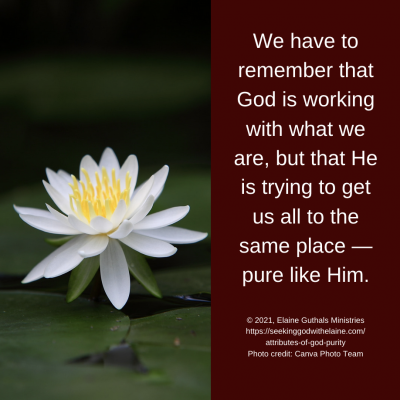
  • Attributes of God: Transcendent

    God is transcendent of time and space. He lives in heaven, where we are not. This daily devotional looks at what that means for our redo for godliness.

    Nuggets

    • God transcends time and space, yet He chooses to live in us when we imitate His character.
    • God’s thoughts and ways are transcendent to ours, but we must try to imitate Him.
    • Our focus should remain on God.

    To read devotions in the Redo for Godliness series, click the appropriate button below.

    Devotions in the Finding Our Center series

    We’ve already looked at God being beyond the limits of time — eternal. We’ve also looked at God being beyond the limits of space — omnipresent. This is also impacted by God’s being immutable — unchanging. We also need to add in that God is self-sufficient.

    So, why are we looking at it again in the form of being transcendent?

    I think this gives us another snapshot of Who God is. He is unlike anyone we’ve ever met.

    I also feel that, sometimes, we tend to try to bring God down to our level. Worldview people do it even more when they try to say they are God’s equal.

    We have to give God the honor that He deserves. God is above us.

    Let’s take a look at some different verses and see what we can add to the our base of knowledge.

    Let’s Put It into Context #1

    Here is a running list of what we’ve discussed previously.

    Let’s Put It into Context #2

    Transcendent means “extending or lying beyond the limits of ordinary experience,” according to the Merriam-Webster Dictionary. This is especially true when it is in relation to space and time.

    Resource

    God the High and Exalted One

    “For the High and Exalted One, who lives forever, whose name is holy, says this: ‘I live in a high and holy place, and with the oppressed and lowly of spirit, to revive the spirit of the lowly and revive the heart of the oppressed’” (Isa. 57: 15 CSB)

    God transcends time and space, yet He chooses to live in us when we imitate His character.

    High and Exalted

    We have to put this into perspective. When Isaiah wrote this, the Israelites were experiencing the Babylonian captivity.

    Here comes their God, saying, “You may be being punished right now, but I am still holy. I am still Sovereign.”

    Macduff noted that many of the Israelites during that time were atheists. God’s Sovereignty is not based on our worship of Him. He is Sovereign without us.

    Resource

    God is holy. Holiness is more than a character trait; it is purity, dedication, and commitment that lead to being set apart. We are not pure. Purity means we are without the stain of sin.

    Sins are actions by humans that disobey God and break one of His reasonable, holy, and righteous laws and commandments, goes against a purpose He has for us, or follows Satan’s promptings.

    Yeah, we are the opposite of God in many ways. Still think we are His equal?

    High and Holy Place

    The King James Version has an interesting translation of this verse. “For thus saith the high and lofty One that inhabiteth eternity, whose name is Holy; I dwell in the high and holy place …” (Isa. 57: 15 KJV).

    It says God inhabits eternity. He occupies eternity, not just lives eternally.

    That makes it more of a space than a time.

    Then add that to “… I dwell in the high and holy place …” (Isa. 57: 15 KJV). Even where God lives is pure and set apart.

    God dwells in Heaven. Rees reminded us that “He tells us that He ‘dwells in the high and holy place;’ that is, in the heaven of heavens, the peculiar residence of the Deity, where His glory is chiefly manifested, and His favour is chiefly enjoyed. Heaven is not only high, but the highest place in the whole creation. There is no other place that can for a moment be compared with it, either in glory or felicity. Nor is there any other place so holy.”

    Resource

    That is some description!

    Oppressed and Lowly

    But look where else God lives. “… with him also that is of a contrite and humble spirit, to revive the spirit of the humble, and to revive the heart of the contrite ones” (Isa. 57: 15 KJV). He lives in our hearts.

    No, God doesn’t dwell with us because of we do the do’s and don’t do the don’ts. He doesn’t pick us because we are the smartest people in the room. He doesn’t pick us because we are the most caring people in the room.

    God picks us because we have chosen to submit to Him. We acknowledge that He is eternal and unchangeable.

    God picks us because we have chosen to submit to Him.

    We may not be God’s equal, but we are beloved of Him. He lives with His children now. Thomas noted that is a permanent condition. When we are “… changed, in a moment, in the twinkling of an eye, at the last trumpet” (I Cor. 15: 51-52 CSB), we will be able to spend eternity with Him.

    Glossary

    Resource

    But only those who have ABCDed will get to live with Him forever. Harris wrote that the only way God will condescend to live with us is if we hold the same character traits and values as He does.

    The ABCDs of Salvation

    If you have not become a believer in Christ, please read through the
    Plan of Salvation and prayerfully consider what God is asking you to do.

    A – admit our sins
    B – believe His Son Jesus is our Redeemer
    C – confess God as Sovereign Lord

    D – demonstrate that commitment by making any changes needed in our lives to
    live the way in which God has called us

    The Disciple’s Job Description

    Resource

    What does that take? “… a contrite and humble spirit …” (Isa. 57: 15 KJV). It takes true repentance. Repentance is acknowledging our separation from God and expressing sorrow for breaking God’s laws and commandments by making the commitment to changing ourselves through obedience so that we no longer do the wrong things.

    God’s whole Plan of Salvation was “… to revive the spirit of the lowly and revive the heart of the oppressed” (Isa. 57: 15 CSB). He wanted to fix us.

    Part of our problem is that we see oppressed only through a worldview lens. We see it as poverty stricken, being marginalized, and various other ways we see us as being held down.

    We have to see things God’s way. Remember, He lives in us when we exhibit His character.

    Can We Think Like God?

    “‘For my thoughts are not your thoughts, and your ways are not my ways.’ This is the Lord’s declaration. ‘For as heaven is higher than earth, so my ways are higher than your ways, and my thoughts than your thoughts’” (Isa. 55: 8-9 CSB)

    God’s thoughts and ways are transcendent to ours, but we must try to imitate Him.

    I know. These are two of my go-to verses. I pull these out a lot.

    We know God is a thinker and a planner. He doesn’t just spontaneously do something.

    It is part of God’s omniscience. He knows all — past, present, and future.

    We are made in God’s image, so we are thinkers and planners, too. But we can be spontaneous, as well.

    No matter how much we are like God, the verses in Isaiah make it clear that we will never be able to think as God does. “For as heaven is higher than earth, so my ways are higher than your ways, and my thoughts than your thoughts’” (Isa. 55: 9 CSB).

    Spurgeon rocked that boat. He wrote, “… if ever man is to dwell with God, he must think as God thinks.”

    Resource

    Whoa, hold the phones!

    God is so much more knowledgeable than we are. He is more loving, and caring, and merciful. He is so much more … everything than we are.

    How can we think like God?

    But look what Wadsworth said. He said it was talking more about a result, not a process.

    Resource

    We are in a redo for godliness this year. We are trying to change to be like God.

    That means we have to try to think like God. Spurgeon argued we have to walk with God and agree with Him to do that.

    If we tie in what Wadsworth said, thought is not about the process on the Sanctification Road. It is about a result – perfection when we get called home.

    Glossary

    The way I read what Spurgeon said was that, if we think after God, He will meet us more than halfway. He will come to meet us. Add Wadsworth’s we have to be sincere in navigating the Sanctification Road.

    Never, ever must we forget about the greatness of God. We don’t have that – even if we are thinking like Him. I love what Spurgeon said in another sermon. He wrote that theology “… is not the revelation of God’s greatness, but of man’s littleness …”

    Resource

    We will never have God’s total knowledge and wisdom in this life and may not in the next.

    But we have to have His mindset. We have to have His attitude and character.

    That is what godliness is all about.

    I think we are going to have to revisit this sometime and look at the rest of the sermons. That is getting too big of a topic for this discussion.

    MindsetAttitudeCharacter

    We Are to Strive to be Like God

    “Who is like the Lord our God — the one enthroned on high, who stoops down to look on the heavens and the earth?” (Ps. 113: 5-6 CSB)

    Our focus should remain on God.

    Remember, when we were talking about God being omnipresent, we cited I Kings 8: 27. “But will God indeed live on earth? Even heaven, the highest heaven, cannot contain you, much less this temple I have built” (I Kgs. 8: 27 CSB).

    Heaven and earth together cannot contain God. Still, the psalmist said that God was “… enthroned on high” (Ps. 113: 5 CSB).

    When we were walking through Ephesians, we talked about the heavenly places.

    To read a related devotion, click the button below.

    God transcends whatever corner we try to stick Him in. He is superior to whatever being we put Him in a line up with – angel, Satan, demon, human.

    We’ve talked before that God made us even though He knew we would disobey Him. He chose to make us anyway.

    Glossary

    We just said God meets us halfway – if not more. In fact, we can’t search for Him until He calls us. Orton wrote, “They cannot by searching find out God, nor have they minds capacious enough to receive Him.”

    Resource

    It is all about God. We are not the focus here.

    Oh, we like to think we are the focus. If nothing else, we like to think God just can’t get along without us.

    He can.

    He doesn’t want to.

    We were created to worship God. He wants us to get back to His original plan.

    TranscendentPin

    Making the Connections

    Trapp described God perfectly. He wrote, “He is a God, saith one, whose nature is majesty, whose place is immensity, whose time is eternity, whose life is sanctity, whose power is omnipotency, whose work is mercy, whose wrath is justice, whose throne is sublimity, whose seat is humility.”

    Resource

    God defies whatever description we try to use to identify Him. He is always so much more.

    How Do We Apply This?

    Our greatness is dependent on God living within us. Robertson put it this way. When talking about the two things of which the nature of greatness in man consists, he wrote, “One is to have God so dwelling in us as to impart His character to us; and the other is to have God so dwelling in us that we recognize His presence, and know that we are His and He is ours.”

    Resource

    Oh, wow.

    1. That we are godly.
    2. That we recognize Him.

    How many times do we say we don’t feel His presence? We don’t see Him working in our lives????

    Yeah, it is more than just ABC. We have to nail the D part, too.

    Think of it this way. Thomas wrote, “During our existence here, He [God] is working out a plan that, like Himself, never had a beginning and will never have an end.”

    Resource

    During our existence here. The plan is for us — individually and corporately. The plan that He had from before the foundation of the world. He will use us individually to expand His kingdom corporately.

    We can’t rely on religious ceremony to secure God living within us. It has to be a redo for godliness — changing our character to be like Him.

    That means:

    • Fixing our minds to acknowledge we are not great.
    • Learning to truly worship God.
    • Getting God to our heart level.
    • Kicking out the doubts through prayer.

    Resource

    Orton said one of the things we should imitate was God’s condescension. We do that by treating others with grace.

    Resource

    Bottom line, God is over all. We are to strive to become godly. We will sometimes fail, but it is about where we are at in the end.

    Father God. We praise You for being the Sovereign God of all. We pray that You are God of every part of us. Amen.

    What do you think?

    Leave me a comment below (about this or anything else) or head over to my Facebook group for some interactive discussion.

    If you don’t understand something and would like further clarification, please contact me.

    If you have not signed up for the email daily or weekly providing the link to the devotions and the newsletter, do so below.

    If God has used this devotion to speak with you, consider sharing it on social media.