Category: Love

  • How Do Believers Love Others?

    Jesus called us to love one another. Specifically, He called us to love our neighbors and our enemies as we do ourselves. This devotion looks at that – because we often don’t love ourselves.

    Nuggets

    • Jesus specifically gave us the command to love others.
    • Others includes our enemies.
    • However, we generally don’t love ourselves, making it difficult to love others as ourselves.

    To read devotions in the What It Means to Be a Believer series, click the appropriate button below.

    Flowers with title How Do Believers Love Others?

    Job duty #5 for believers is to love others. Jesus specifically gave us this command. Additionally, there are many verses that tell us we are to do this.

    Love People

    “This is my commandment, that you love one another as I have loved you” (Jn. 15: 12 ESV)

    First Peter 4: 8 says, “Most important of all, continue to show deep love for each other, for love covers a multitude of sins” (NLT). When we love someone, we are more willing to overlook their faults. However, we are also more apt to hold them accountable when we see they are not living the lives they should be living.

    We’ve talked previously about who Jesus considered the neighbors that we are supposed to love (Lk. 10: 27). Jesus’ response to the lawyer’s question was that we are to love God and others.

    To read a related devotion, click on the button below.

    We show we love God by loving others. These others may be people who are different than those who inhabit our normal sphere. We still need to love them.

    Love Your Enemies

    Jesus also said we are to live our enemies. ““You have heard the law that says, ‘Love your neighbor‘ and hate your enemy. But I say, love your enemies! Pray for those who persecute you! In that way, you will be acting as true children of your Father in heaven. For he gives his sunlight to both the evil and the good, and he sends rain on the just and the unjust alike.” (Mt. 5: 43-45 NLT).

    Luke 6: 27-31 expands on that. “But to you who are willing to listen, I say, love your enemies! Do good to those who hate you. Bless those who curse you. Pray for those who hurt you. If someone slaps you on one cheek, offer the other cheek also. If someone demands your coat, offer your shirt also. Give to anyone who asks; and when things are taken away from you, don’t try to get them back. Do to others as you would like them to do to you.” (NLT).

    It is much easier to love those who love us. If truth were told, we probably are just indifferent to those who are different from us if we really don’t know them and don’t have to interact with them in a significant way.

    Screen Shot 2021-01-05 at 6.35.52 PM

    That is, though, exactly what Jesus calls for us to do.“But love your enemies, do good to them, and lend to them without expecting to get anything back. Then your reward will be great, and you will be children of the Most High, because he is kind to the ungrateful and wicked” (Lk. 6: 35 NIV). We are to show mercy to them.

    We’ve talked before what the definition of mercy is. Mercy is where God doesn’t judge us to the extent He could have.

    God expects us to extend this same mercy to others as He has extended to us. The way Jesus said it was “… forgive us our sins, as we have forgiven those who sin against us” (Mt. 6: 12 NLT). God will judge us as we judge others.

    Love Others as Ourselves

    The kicker is Mark 12: 29-31. “Jesus answered, ‘The most important is, “Hear, O Israel: The Lord our God, the Lord is one. And you shall love the Lord your God with all your heart and with all your soul and with all your mind and with all your strength.” The second is this: “You shall love your neighbor as yourself.” There is no other commandment greater than these’” (Mk. 12 29-31 ESV).

    This ‘love others as yourself’ theme is in other verses, too. Romans 13: 8-10 says, “Owe no one anything, except to love each other, for the one who loves another has fulfilled the law. For the commandments, ‘You shall not commit adultery, You shall not murder, You shall not steal, You shall not covet,’ and any other commandment, are summed up in this word: ‘You shall love your neighbor as yourself.’ Love does no wrong to a neighbor; therefore love is the fulfilling of the law” (ESV).

    The Golden Rule can be interpret to be talking about just that. Matthew 7: 12 says, “Do for others what you want them to do for you: this is the meaning of the Law of Moses and of the teachings of the prophets” (GNT).

    To read a related devotion, click the button below.

    We are told to love our enemies as ourselves. The problem is we don’t love ourselves.

    We are really critical of ourselves. That can be anything from looks to knowledge to skills.

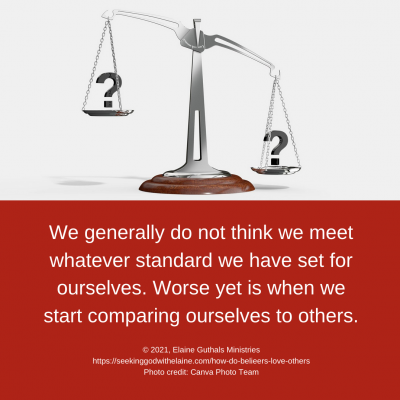
    We generally do not think we meet whatever standard we have set for ourselves. Worse yet is when we start comparing ourselves to others.

    So, when it says this is how we are to love others, that sets the bar low in our estimation. However, Jesus was trying to set a high expectation.
    Screen Shot 2021-01-05 at 6.38.22 PM

    Making the Connections

    Loving someone is a choice. What? You think we just magically fall in love with someone? But we aren’t talking that romantic kind of love.

    We choose to spend time with people. We choose to establish a relationship. We choose to not throw in the towel after the first, and second, and millionth argument.

    We choose to love people unconditionally. We choose to work things out.

    We choose to love those that are different from us. We choose to love those who hurt us. We choose to love ourselves.

    How Do We Apply This?

    I googled self-love quotes. It didn’t attribute this quote to anyone, but I think it is a good one. “Eat like you love yourself. Move like you love yourself. Speak like you love yourself. Act like you love yourself.”

    Ooo, baby! Have you watched either movies or television shows where something goes wrong, and out comes the ice cream? And then the whole gallon is gone. That sure isn’t eating like we love ourselves, no matter how comforting it can be.

    “Speak like you love yourself” — even the thoughts you say in your head. How quickly do we start chewing ourselves up one side and down the other when something either goes wrong or just not he way we planned?

    “Act like you love yourself.” Self care can be way down on the list — especially for women/wives/mothers. But we have to take care of ourselves.

    Take a look at this other quote. “Loving yourself starts with liking yourself, which starts with respecting yourself, which starts with thinking of yourself in positive ways.” Yep, self-talk really affects how we look at ourselves. We’ve got to reign in those negative thoughts.

    Remember I am a fake-it-until-you-make-it girl. Eat, move, speak, and act like you love yourself now until you actually do. That is you choosing to love yourself.

    Screen Shot 2021-01-05 at 6.38.48 PM

    Why should we love those different from us, our enemies, and ourselves? Because God first loved us. He chose to send His Son to die for us (Jn. 3: 16). That makes us all lovable.

    Loving Father. Your love is so amazing. Even when we didn’t deserve it, You sent Your Son to die for us. We cannot fathom that, but that is how deep for us Your love is. Help us to love ourselves. Help us to love all people, especially those different from us and our enemies. In this way, we can show our love for You. Amen.

    What do you think? How do you think your loving (or not loving) yourself affects how you love others?

    Leave me a comment below (about this or anything else) or head over to my Facebook group for some interactive discussion.

    If you don’t understand something and would like further clarification, please contact me.

    If you have not signed up for the email daily or weekly providing the link to the devotions and the newsletter, do so below.

    If God has used this devotion to speak with you, consider sharing it on social media.

  • Out of the Good Samaritan’s Comfort Zone

    But a certain Samaritan, as he journeyed, came where he was. And when he saw him, he had compassion.
    Luke 10: 33 (NKJV)
    Scripture: Luke 10: 30-37

    Jesus told the Parable of the Good Samaritan to show people that we need to love others, regardless of diversity. For some, this takes them out of their comfort zone. The second devotion in the Called Out of Our Comfort Zones series, this devotion looks at which characters stayed in their comfort zones and who went outside of theirs.

    Cliff Notes

    • A lawyer initially asked Jesus how to inherit eternal life.
    • Jesus’ response to the question “Who is my neighbor” was the Parable of the Good Samaritan.
    • Even though the Good Samaritan had to have gone out of his comfort zone, he helped the victim where the religious leaders did not.

    To read devotions in the Called Out of Our Comfort Zones series, click the appropriate button below.

    Flowers with title Out of the Good Saritan prag

    Sometimes, we can have conflict with others because we are dealing with people who are totally different from us. We may have deep-seated reasons why we feel the way we do.

    Jesus said the bottom line is we have to love each other.

    Let’s Put It into Context

    Jesus told the Parable of the Good Samaritan to a lawyer who initially asked how to inherit eternal life. The lawyer did a good job of encapsulating what God expects when Jesus put it back on him.

    “So he answered and said, “‘You shall love the Lord your God with all your heart, with all your soul, with all your strength, and with all your mind,’ and ‘your neighbor as yourself’” (Lk. 10 27 NKJV).

    Whatever points the lawyer made with that answer, he lost with the follow-up question. Okay then, who is my neighbor (Lk. 10: 29)?

    Jesus’ response was the parable. It may or may not have been a made-up story. Most of the time, we focus on the “just love them” aspect.

    I think there is something else we can look at. I think each of the characters had to decide if they were staying in or going out of their comfort zones. I don’t think we always recognize just how hard that can be at times to go out of our comfort zones with other people.

    The victim in the story sure wasn’t comfortable. He got beat up by thieves. He had to have been a Jew. It wouldn’t have made any impact on the lawyer if a Samaritan helped another Jew.

    Three people come upon them, but helping the man means they have to get out of their comfort zones.

    The Priest Stayed In

    “Now by chance a certain priest came down that road. And when he saw him, he passed by on the other side” (Lk. 10 NKJV).

    Since the man was a priest and he was going from Jerusalem to Jericho, we can assume that he was going home from his tour of duty. He may have been overseeing the sacrifices and offerings. Maybe it was his job this time to assist the people, either blessing them (Num. 6: 22-26) or teaching them (Deut. 31: 9-12). Or he might be trying to determine the will of God (Ex. 28: 30).

    If the priest was making the round trip daily from his home to the temple, maybe he didn’t want to take a chance the victim would die. This would have made Him unclean and forced him to not fulfill his duties.

    But we would think that a priest would show compassion to his countryman. This man would have had a direct connection with God. This was a guy who had respect status, and prestige.

    So, the priest not only didn’t stop, but he also stepped all the way around to the other side of the road. He made it blatantly obvious that he didn’t want anything to do with the poor man.

    If his comfort zone was the temple, maybe the priest thought he was off duty from compassion? This wasn’t in his job description?

    But you would expect a priest to know the law better than the average joe. He would know that it was okay to do the “thou shalt nots” when it meant saving a human life.

    The Levite Stayed In

    “Likewise a Levite, when he arrived at the place, came and looked, and passed by on the other side” (Lk. 10: 32 NKJV).

    The Levite did better. He at least checked on the victim. But he didn’t help either.

    Let’s look who the Levite was. The Levites were descendants of Levi, but not necessarily of Aaron. They were not priests; the way I read it is they were more of assistants or administrators. They were the lowest rung in the hierarchy of priests.

    In my research I read where the lawyer might have been a Levite himself. The Levite in the story could have, however, represented the average joe.

    Whoever the Levite was, he choked whatever compassionate urge he had to even check on the victim. He still didn’t want to step out of his comfort zone and actually help the poor guy.

    The Good Samaritan Went Out

    “But a certain Samaritan, as he journeyed, came where he was. And when he saw him, he had compassion. So he went to him and bandaged his wounds, pouring on oil and wine; and he set him on his own animal, brought him to an inn, and took care of him. On the next day, when he departed, he took out two denarii, gave them to the innkeeper, and said to him, ‘Take care of him; and whatever more you spend, when I come again, I will repay you.’ So which of these three do you think was neighbor to him who fell among the thieves?”

    Wow. Did you read all the Samaritan did for this guy he had never met before? This guy that, if he hadn’t been beaten up and half dead, would have looked down on him?

    Can we talk out of our comfort zone? I wonder if it is going through his mind, “Does this dude even want me to touch him? Is he going to snub me when he wakes up?

    Remember, this was one of those yucky Samaritan guys. While it had previous been associated with the Northern Kingdom, in Jesus’ day, Samaritans were the descendants of Jews who had married Gentiles.

    Can we talk how much money the Samaritan spent on someone who may not even be thankful?

    The dude shelled out mega bucks in a situation that could have gone bad quickly.

    Making the Connections

    The lawyer’s question was to determine how we gain eternal life. Jesus’ response was that we are to love God and others. We show we love God by loving others.

    It is easy to say we love somebody. Putting that love into action can be hard. Putting that love into actions we are unfamiliar or uncomfortable with and ministering to people who are different than those who inhabit our normal sphere can be downright difficult for some.

    People

    Diversity and inclusion are the buzzwords today. Diversity can take many forms. There is diversity in culture, values, assumptions, and beliefs (including religious and political). There is diversity in economies, languages, music, and art. That just scratches the surface.

    Jesus was telling us with the parable that we need to set aside all the diversity issues and just love everyone with whom we come in contact. By loving others (the second commandment), we are showing others that we truly love God (the first commandment)”.

    We need to act positively with others, even if that is outside our comfort zones. Yes, it will take a conscious effort, but it has to start within our hearts. It must be genuine.

    How Do We Apply This?

    We step out of our comfort zones when we truly love our neighbors, not just tolerate their opinions and actions. Loving them means helping them to grow into the people God would have them be.

    Loving them means working to establish relationships. It means listening when they need an ear. It means doing what we can to help a hurt they have. It means not judging them, but not condoning their actions that are worldview, not Godview.

    People

    Believers must be ready to love any person to whom God calls us to witness. We must be ready to build a relationship with those who are different than us so that we can expand His kingdom.

    Loving Father. You have called us to work to expand Your kingdom. We can only do this by building relationships with those You put in our path. Help us to lovingly, truthfully reflect Your love to them. Help us to work through our weaknesses. May we always relay on You because it will be You doing the convicting, not us. We pray that we will always do Your will. Amen.

    What do you think?

    Leave me a comment below (about this or anything else) or head over to my Facebook group for some interactive discussion.

    If you have not signed up for the email daily or weekly providing the link to the devotions and the newsletter, do so below.

    If God has used this devotion to speak with you, consider sharing it on social media.

  • Does God Really Delight in Us?

    When we look at God, then look at ourselves, we sometimes question how God can delight in us. But He does. This devotion looks at how that can be.

    Nuggets

    • There are many verses in the Bible that tell us God will never leave us.
    • God’s power ensure victories that will further His kingdom.
    • God delights in us because we praise Him.
    • Because of God’s love for us, He devised the plan of salvation to restore our relationship with Him.
    • God sings a song of joy over us.
    Flowers with title Does God Really De;oght in US?

    When we look at ourselves, it is easy to focus on what we see as negatives. When we look at God, we see His holiness.

    That makes us wonder why God would delight in us. Zephaniah says that He does, though.

    Let’s Put It into Context

    If you are like me, you have no clue who Zephaniah was. Zephaniah was royalty. He was the great-great-grandson of King Hezekiah.

    Zephaniah and Jeremiah prophesied at the same time. Israel had started worshipping Baal and Astarte. Josiah, the king at the time, wanted to turn the nation back to God.

    Still, Zephaniah prophesied destruction because of Israel’s unfaithfulness. Not only that, but Scythian immigrants were coming and overwhelming the Israelites.

    Zephaniah told the Israelites about the “day of the Lord.” They — and the nations around them — would be punished for disobedience. As always, though, God gave them an opportunity to repent. In the end, God would draw the nation back to Himself.

    Since this is a small, three-chapter book, Zephaniah 3: 17 comes almost at the end of the book. What a wonderful way to end this prophecy! Let’s look at each phrase in the verse.

    God, Where Are You?

    “The LORD your God is with you …” (Zeph. 3: 17 NIV).

    Yes, we’ve talked about this before. God will never leave us.

    God must think we are a little hard-headed because He tells us this in several verses. These are just some of them:

    Deuteronomy 31: 8 says, “It is the Lord who goes before you. He will be with you; he will not leave you or forsake you. Do not fear or be dismayed” (ESV).

    Psalm 94: 14 says, “For the Lord will not forsake his people; he will not abandon his heritage” (ESV).

    Isaiah 41: 10 says, “Fear not, for I am with you; be not dismayed, for I am your God; I will strengthen you, I will help you, I will uphold you with my righteous right hand” (ESV).

    Matthew 28: 20 says, “Teaching them to observe all that I have commanded you. And behold, I am with you always, to the end of the age” (ESV).

    Psalm 118: 6 says, “The Lord is on my side; I will not fear. What can man do to me?” (ESV).

    Ps1186

    And that is just some of the verses showing God will never leave us! Let’s get it through our thick skulls (mine included) that God isn’t going anywhere.

    When we think God isn’t around, it is because we are not around. We moved away from God, not the other way around.

    Victory Ensured

    “… the Mighty Warrior who saves …” (Zeph. 3: 17 NIV).

    Since God is always with us and God is all-powerful, victory is secured.

    Deuteronomy 20: 4 says, “For the LORD your God is the one who goes with you to fight for you against your enemies to give you victory (NIV)”

    First Corinthians 10: 13 says, “No temptation has overtaken you except what is common to mankind. And God is faithful; he will not let you be tempted beyond what you can bear. But when you are tempted, he will also provide a way out so that you can endure it” (NIV).

    Psalm 3: 8 says, “From the LORD comes deliverance. May your blessing be on your people” (NIV).

    First John 5: 4 says, “For everyone who has been born of God overcomes the world. And this is the victory that has overcome the world — our faith” (ESV).

    “For everyone who has been born of God overcomes the world. And this is the victory that has overcome the world -- our faith” (I Jn. 5: 4 ESV).

    First Corinthians 15: 57 says, “But thanks be to God! He gives us the victory through our Lord Jesus Christ” (NIV).

    No, this doesn’t mean success as in this world’s definition. It doesn’t mean the nicest car, the biggest house, the prestigious job [keep naming what you can think of]. God’s victory doesn’t give us worldly spoils.

    God’s victory furthers His kingdom. It isn’t about us; its about God.

    God Really Delights in Us?

    “… He will take great delight in you …” (Zeph. 3: 17 GNT)

    Does it amaze us that God can delight in us? I mean, we are so entrenched in this world sometimes. We are still trapped in our sinful bodies — and sin we do.

    We see ourselves as imperfect creatures. How can He possibly delight in us?

    Psalm 18: 19 says, “He brought me out into a broad place; he rescued me, because he delighted in me” (ESV).

    “He brought me out into a broad place; he rescued me, because he delighted in me” (Ps. 18: 19 ESV).

    Okay. He does delight in us. Why?

    Psalm 147:11 says, “But the Lord takes pleasure in those who fear him, in those who hope in his steadfast love” (ESV).

    Psalm 70:4, “May all who seek you rejoice and be glad in you! May those who love your salvation say evermore, ‘God is great!’” (ESV).

    God delights in us because we praise Him. We are doing what we should be doing — genuinely giving Him the glory.

    Love Gives Life

    “… in his love he will no longer rebuke you …” (Zeph. 3:1 7 NIV).

    Since God is love (I Jn. 4: 8), He loves us. He has called us as His people.

    Deuteronomy 33: 3 says, “Yes, He loves the people; All His saints are in Your hand; They sit down at Your feet; Everyone receives Your words” (NKJV).

    Psalms, 63: 3 says, “Your constant love is better than life itself, and so I will praise you” (GNT).

    Because God loves us, He will give us life — this life and everlasting life.

    John 3: 16 says, “For God so loves the world, that He gave His only begotten Son, that whosoever believeth in Him should not perish, but have everlasting life” (KJV).

    Ephesians 2: 4-5 says, “But God, being rich in mercy, because of the great love with which he loved us, even when we were dead in our trespasses, made us alive together with Christ — by grace you have been saved” (ESV).

    “But God, being rich in mercy, because of the great love with which he loved us, even when we were dead in our trespasses, made us alive together with Christ — by grace you have been saved” (Eph 2: 4-5 ESV).

    Romans 5: 8 says, “But God has shown us how much he loves us — it was while we were still sinners that Christ died for us!” (GNT).

    God loves us so much that He would sacrifice His only Son to die a horrible death so He would be the sacrifice to pay for our sins.

    God the Vocalist

    “… but will rejoice over you with singing” (Zeph. 3: 17 NIV).

    Being a singer, you would have thought I would have found this verse long before now. God will sing over us!

    What my research said was this singing was equated to God’s joy. But it isn’t necessarily singing — it is a shout of joy.

    Psalm 42: 8 says, “By day the LORD commands his steadfast love, and at night his song is with me, a prayer to the God of my life” (ESV).

    “By day the LORD commands his steadfast love, and at night his song is with me, a prayer to the God of my life” (Ps. 42: 8 ESV).

    We’ve kind of come full circle. God loves us and will never leave us. He loves us so much, He has given us the gift of eternal life — if we accept it.

    Making the Connections

    Why do we work ourselves up into a tizzy? If anyone has left, it isn’t God. He still loves us.

    Yes, Paul told us in II Corinthians 13: 11 to “… Strive for perfection …” (GNT). God knows we won’t attain that until we hit the pearly gates.

    But we are working toward perfection. If we aren’t working to be more like God, we aren’t trying to cut sin out of our lives. We aren’t trying to turn from Satan.

    We don’t have a license to sin. We have to turn away from the sin.

    We can be assured that, if we ask forgiveness, God will forgive us.

    Think about it. God gave the ultimate sacrifice — His only Son, Jesus — to restore our relationship with Him. He is not going to give up on us that easily.

    If He is not going to leave us, I think God would make us so He would enjoy spending time with us.

    I think God really does delight in us. I think He enjoys our sense of humor and our quirkiness. I think He enjoys seeing us smile and leans extra close when we cry.

    If only we could see ourselves as God sees us! We would see why He delights in us.

    If we think about how God loves us — even with our imperfections — we would praise Him even louder. Let’s commit to doing that today.

    Father. You delight in us. You don’t see our imperfections. You see Jesus’ blood covering the ones we have confessed. Help us to not doubt You when life gets hard. Hold us in the palm of Your hand. Amen

    DoesGodReallyDelightInUs

    What do you think? I didn’t have a How Do We Apply this time because each of us struggle in our own way with this. How has this devotion shown you that God does delight in you? What can you do to help embed that thought in you for when the trials come?

    Leave me a comment below (about this or anything else) or head over to my Facebook group for some interactive discussion.

    If you have not signed up for the email daily or weekly providing the link to the devotions and the newsletter, do so below.

    If God has used this devotion to speak with you, consider sharing it on social media.

  • Does God Love Non-Believers?

    When thinking about God’s unconditional love, some may question whether God loves unbelievers. If we do not follow His establishment of commandments, does that mean He doesn’t love us? This devotion, the second in the God’s Unconditional Love series, looks at whether God loves non-believer and whether that is different than how He loves believers.

    Nuggets

    • God loves all people
    • God will only reward those who have admitted their sins, believed on His Son Jesus as Redeemer, and confessed Him as Sovereign Lord.
    • Admission to heaven is not earned through good works.
    • At the end of the age, Jesus will when judge people and distribute rewards and repayments.

    Devotions in the God’s Unconditional Love series

    Flowers with title Does God Love Non-Believers

    In the last devotion, we started talking about somebody’s response to the question of whether God’s love is unconditional. The person also felt that God loves believers but does not love non-believers. In fact, God punishes non-believers. Let’s look at God’s love for believers and non-believers.

    The person’s viewpoints are in red.

    God Loves Those Who Believe and Do Good

    God Loves Those Who Believe

    “Say to them, As I live, declares the Lord God, I have no pleasure in the death of the wicked, but that the wicked turn from his way and live; turn back, turn back from your evil ways, for why will you die, O house of Israel?” (Ezek. 33: 11 ESV)

    There are a couple of things here. First thing: God does love those who believe. But He loves everyone.

    How can we tell? Non-believers are identified in Scriptures by the terms wicked, dead, cursed, and evil.

    God does not want them to pay the price for their sins. Because of this, He designed the Plan of Salvation. How?

    “But God, being rich in mercy, because of the great love with which he loved us, even when we were dead in our trespasses, made us alive together with Christ — by grace you have been saved — and raised us up with him and seated us with him in the heavenly places in Christ Jesus, so that in the coming ages he might show the immeasurable riches of his grace in kindness toward us in Christ Jesus” (Eph. 2: 4-7 ESV emphasis added). God loved us enough to send His Son while we were still sinners to the the sacrifice to pay for our sins.

    God’s loving act came before the belief. In fact, He designed the plan before He even created us.

    Glossary

    To say our belief had to come before His love would mean His plan wouldn’t be an act of love. It was — pure and simple love.

    God Loves Those Who Do Good

    Second thing: All are sinners, even believers. Believers are just sinners who have been saved by grace. Believers still sin.

    To read Why Do Christians Sin?, click the button below.

    Non-believers all have the opportunity to become believers. They have to make the choice whether they will believe or not.

    You want a specific example of believers who didn’t do good but were still loved by God? “Did not Solomon king of Israel sin on account of such women? Among the many nations there was no king like him, and he was beloved by his God, and God made him king over all Israel. Nevertheless, foreign women made even him to sin (Neh. 13: 26 ESV emphasis added). Solomon did not follow the commandments and was still loved by God.

    Jacob was a cheater. Noah was a drunk. Moses was a murderer. David was a murderer and committed adultery. Do I need to go on???

    God does love those who obey Him, but we can’t earn our way into heaven. “But when the goodness and loving kindness of God our Savior appeared, he saved us, not because of works done by us in righteousness, but according to his own mercy, by the washing of regeneration and renewal of the Holy Spirit, (Ti. 3: 4-5 ESV emphasis added).

    To read What Is a Definition of Works, click the button below.

    If we could get into heaven by doing the do’s and not doing the don’ts, Jesus wouldn’t have had to die. We can’t; He did.

    Clouds

    Unbelievers Receive His Wrath

    This is the only thing this person said with which I agree. We talked in a previous devotion that Jesus, when judging people at the end of the age, will distribute rewards and repayments. Rewards will be given to those who believe. Repayments will be given to non-believers.

    To read Will We Be Rewarded or Repaid?, click the button below.

    Proverbs 15: 9 says, “The LORD hates the ways of evil people, but loves those who do what is right” (GNT emphasis added). It doesn’t say He hates evil people. He hates their actions.

    But think of it this way. “… For he gives his sunlight to both the evil and the good, and he sends rain on the just and the unjust alike” (Mt. 5: 45 NLT). If non-believers only receive God’s wrath, then nothing good would fall on them. That just isn’t true.

    Let me try to figure out what this person wants. This person acknowledges that God has commandments. However, what? This person doesn’t think God should act on them? No punishment regardless of actions? Reward everyone regardless of belief?

    Again, this is Satan inciting people to rebel against God. He got Adam and Eve to bite and disobey God. He convinced them that they would be equal to God.

    To read a related devotion, click the button below.

    He thinks he can work the same con on their great, great, great … great grandchildren. I think he’s backed off the equal part and focuses on the don’t-have-to-listen part.

    DoesGodLoveNonBelieversPin

    Making the Connections

    Just as some confuse love and tolerance, I think this person is confusing love with reward. God is going to love us even if we don’t believe in Him. He will only reward believers.

    God is going to love us. He will not tolerate our actions that are unrighteous.

    We live in a society that believes in entitlement. That is where the tolerance and participation award originated.

    We lost our entitlement when Adam and Eve committed the original sin — if we even had it than. God is Sovereign. He does not have to love us. He does not have to provide for us.

    For some reason, God does love us. He loves us even after we sin against Him.

    Sunset on water

    How Do We Apply This?

    I would suggest this person read the Bible. God’s love has been present all through history.

    The end has already been written. Because God loves us, He is waiting for all who are going to to turn to Him. He doesn’t want to have to punish anyone — but as a good Father, He will.

    What is true about God’s unconditional love is summed up in I John 3: 1: “See what kind of love the Father has given to us, that we should be called children of God; and so we are. The reason why the world does not know us is that it did not know him” (ESV). Non-believers need to learn of the true loving Father. He is waiting for them to turn to Him.

    Glossary

    Loving Heavenly Father. You love us unconditionally. You will offer us salvation until we completely reject You. Lord, we pray that none reject You. It is our prayer that all admit their sins, believe in Jesus as their Redeemer, and confess You as Sovereign Lord. We know that is Your wish, and that is our wish. Use us to be witnesses to all who have not turned their lives over to You. Help us to love them with Your unconditional love. Amen.

    The ABCDs of Salvation

    If you have not become a believer in Christ, please read through the
    Plan of Salvation and prayerfully consider what God is asking you to do.

    A – admit our sins
    B – believe His Son Jesus is our Redeemer
    C – confess God as Sovereign Lord

    D – demonstrate that commitment by making any changes needed in our lives to
    live the way in which God has called us

    The Disciple’s Job Description

    What do you think? If you are a believer, how could you show more love to non-believers? If you are a non-believer, how has God shown His love to you?

    Leave me a comment below (about this or anything else) or head over to my Facebook group for some interactive discussion.

    If you don’t understand something and would like further clarification, please contact me.

    If you have not signed up for the email daily or weekly providing the link to the devotions and the newsletter, do so below.

    If God has used this devotion to speak with you, consider sharing it on social media.

  • Is God’s Love Unconditional?

    How would you answer if someone told you God’s love was not unconditional? Does His establishment of commandments show He does not love us? This devotion, the first in the God’s Unconditional Love series, looks at whether God doesn’t love us because He has established commandments and punishes us for breaking them.

    Nuggets

    • God’s love and love for God is agape love.
    • God established commandments because of His love for us and to help us live orderly lives.
    • God punished us when we break the commandments because of His love for us.

    Devotions in the God’s Unconditional Love series

    Flowers with title Is God's Love Unconditional?

    When I am writing these devotions, depending on the topic, I do a lot of research. A lot of times, I will read something that flips something in my mind that really doesn’t pertain to the topic at hand. I’m interested in it for a future devotion, so I’ll throw the concept on a template and stick it in a drafts folder.

    This is one of them. I was researching God’s love. I read somebody’s response to the question of whether God’s love is unconditional. The person’s response was no.

    That response and their reasoning made me very sad because it is not true. Let’s break it down and see what is true. First, though, let’s look what love is.

    What Is Love?

    But if his descendants forsake my instructions and fail to obey my regulations, if they do not obey my decrees and fail to keep my commands, then I will punish their sin with the rod, and their disobedience with beating. But I will never stop loving him nor fail to keep my promise to him. (Ps. 89: 30-33 NLT)

    These days we love everything from our significant other to our dog. But we also say we love everything from our music to the outfit we are wearing.

    So, if we’ve are not limiting love to just our relationships with people, what does love really mean? Let’s look at some definitions.

    Love is an intense feeling of deep affection. It drives you toward something. Affection is fondness and liking.

    But we aren’t talking about any kind of love. We’re talking unconditional love.

    Unconditional love is intense feelings of deep affection without limits or circumstances. It is believed to be a complete love.

    So, unconditional love is you have strong feelings no matter what.

    But we also need to look at agape love. That is the love that originates from God for man. However, it is reciprocal. It isn’t brotherly love or romantic love that we humans share with each other.

    Agape love not only is unconditional, but it is also selfless and sacrificial. It is God’s covenant love.

    God Loves Us

    There are many verses in the Bible that tell us of God’s love for us. Here are just a couple.

    • “We know how much God loves us, and we have put our trust in his love. God is love, and all who live in love live in God, and God lives in them” (I Jn. 4: 16 NLT).
    • “For God so loved the world, that he gave his only begotten Son, that whosoever believeth in him should not perish, but have everlasting life” (Jn. 3: 16 KJV).
    • “’I have loved you,’ says the LORD. …” (Mal. 1: 2 ESV).
    • “Because you are precious in my eyes, and honored, and I love you, I give men in return for you, peoples in exchange for your life” (Isa. 43: 4 ESV). This verse talks of deliverance for God’s people. God is not only talking about deliverance from Babylon, but also deliverance from sin by Jesus.
    • “Long ago the LORD said to Israel: ‘I have loved you, my people, with an everlasting love. With unfailing love I have drawn you to myself’” (Jer. 31: 3 ESV).

    Now let’s look at the arguments given as to why God doesn’t love us unconditionally.

    God Doesn’t Love You Because He Makes You Follow Commandments

    People today think love means not setting boundaries. They think love condones whatever actions they do. This is a very selfish definition of love. If it were applied to relationships, it strips the other person of their feelings, values, and choices.

    We will have rules to follow our whole life. We start out obeying our parents’ rules. Then there are school rules. There are always laws of the land to follow (stop signs, stop lights, speed limits have minor consequences; murder and stealing have major consequences). We grow up and get jobs — and have to follow our employers’ rules. Do I need to go on?

    The establishment of rules show us how far we can go in something. It builds consensus. It shows what is acceptable and what isn’t.

    Rules are usually made because we are trying to better circumstances, not punish people. Especially in the case of parents, rules are made out of love in order to help children grow up to be their best.

    But as I said, people today balk against rules and boundaries. They don’t want others to tell them what to do — especially God.

    Sovereign God does have the authority to place commandments on us. As He is our Creator, we should follow His commandments. We are His subjects, not His equal. We should follow His Will.

    Really, telling anything different is Satan inciting people to rebel against God. He is stirring up people to turn away from the One true God.

    If God set His commandments in order for us to grow to be our best, rebelling against these commandments would mean we are not going to be the best we could be. Yet Satan is deluding people to think the opposite.

    If God set His commandments in order for us to grow to be our best, rebelling against these commandments would mean we are not going to be the best we could be.

    God Doesn’t Love You If He Punishes You

    To me, thinking God doesn’t love you if He punishes you is an offshoot of the no commandments one. If you don’t have rules, you won’t deserve punishment because nothing is wrong.

    But we do have rules in society. People who break those rules should be punished. When people aren’t — or some are, some aren’t — that creates problems. Just ignoring the rules doesn’t solve anything. Selective enforcement doesn’t solve anything.

    We correct people when they are heading in a wrong way. Parents correct kids. Teachers correct students. Sometimes that correction involves punishment.

    We do this because we love the person. We want them to be able to function well in society.

    God is the same way. “My child, don’t reject the Lord’s discipline, and don’t be upset when he corrects you. For the Lord corrects those he loves, just as a father corrects a child in whom he delights” (Prov. 3: 11-12 NLT).

    God punishes us when we break His commandments. Those are his commandments. He gets to choose the punishment.

    Let’s just stop and think about this a minute. If there were no punishment, was no right or wrong, there would be no grace and mercy.

    What is grace? Even though we don’t deserve good things, God gives them to us anyway.

    What is mercy? Even though we deserve bad things, God doesn’t give them to us.

    If you are doing what is right, there is no need for mercy. If there is no wrong, there is no need for grace.

    If you are doing what is right, there is no need for mercy. If there is no wrong, there is no need for grace.

    If you are doing what is right, there is no need for mercy. If there is no wrong, there is no need for mercy.

    Think of it this way. We don’t generally grow the most when we do things right. We grow more by our mistakes and failures. In an anything-goes world, we wouldn’t grow as much.

    IsGodsLoveUnconditionalPin

    Making the Connections

    God established commandments so that we would have orderly lives. He made these because He does love us.

    Thinking that we should not have boundaries set on us is not showing love to the other, in this case God.

    Does “limitless” mean the depth of the love rather than whether or not conditions are out on it? I think so.

    If unconditional love means it is not based on the circumstances (whether we complete the commandments or not), God has shown that He does love us regardless of circumstances. “But God has shown us how much he loves us — it was while we were still sinners that Christ died for us!” (Rom. 5: 8 GNT). This is where the selfless and sacrificial part of the agape love comes in.

    UnconditionalLove

    If God put conditions on saving us, wouldn’t He make us clean up our acts first? He doesn’t. We come to Him just as we are. We clean up our acts after we become believers. We do this by following His commandments.

    To read Do We Have to Clean Uo Our Acts to Get Salvation?, click the button below.

    The worldview would like to strip God of His ability to enforce the commandments. It would like to undermine His authority and power. It does this by questioning His love. However, from cover to cover, the Bible does show us the depth of His unconditional love.

    How Do We Apply This?

    We need to totally understand God’s love. In order to do that, we have to search for and seek Him.

    Searching for and Seeking God

    Hearing His Word (Rom. 10: 17).
    Reading His Word (Rev. 1: 3).
    Praying to Him (Heb. 4: 16).
    Studying His Word (Ac. 17: 11).
    Meditating on His Word (Ps. 1: 1-2).
    Memorizing His Word (Ps. 119: 11).

    We can’t totally understand Him until we are in communication with Him. If we don’t seek Him in His Word, we will never understand Him.

    Tomorrow we will be discussing whether God loves non-believers.

    Loving Heavenly Father. You do love us unconditionally. You love us so much that You show us the way we should live. You have established commandments to guide us as to how You want us to live. These commandments are in our best interests. We pray that You will help us to grow more in Your image. We long for the day when we see You face to face. Amen.

    If you have not admitted that your relationship is not right with God,

    have not asked Jesus to be your Lord and Savior,

    and have not confessed your sins,

    please read through the Plan of Salvation and prayerfully consider what God is asking you to do.

    What do you think? Does placing boundaries means a person does not love unconditionally? What is the purpose of commandments?

    Leave me a comment below (about this or anything else) or head over to my Facebook group for some interactive discussion.

    If you don’t understand something and would like further clarification, please contact me.

    If you have not signed up for the email daily or weekly providing the link to the devotions and the newsletter, do so below.

    If God has used this devotion to speak with you, consider sharing it on social media.

  • How Did Jesus Reflect God?

    No one has ever seen God. The One and Only Son — the One who is at the Father’s side — He has revealed Him.
    John 1: 18 (HCSB)
    Scripture: Ephesians 2: 14-22

    Over the last few devotions, we have looked at examples of how God Himself appeared to people. He also sent His Representative to earth. While this isn’t theophany, Jesus is our best example of who God is. This devotion will look at how God revealed Himself through Jesus.

    Flowers with title How Did Jess Reflect God?

    God Revealed Himself Through Christ

    The most well-known example of God revealing Himself to us is through Jesus. Jesus took on human flesh. Christ’s deity was linked with His humanity.

    Remember, man is made in God’s image (Gen. 1: 27). That God utilized this in Christ is verified in Colossians 1: 15: “Christ is the visible likeness of the invisible God. He is the first-born Son, superior to all created things” (GNT). God used this visible likeness to show us His nature. Jesus is a reflection of God.

    Jesus came down from heaven to show us Who God is. Hebrews 1:3 says, “He reflects the brightness of God’s glory and is the exact likeness of God’s own being, sustaining the universe with his powerful word …” (GNT). Jesus became the way for us to see God. He verified this in John 18: 9: “… “Have I been with you so long, and you still do not know me, Philip? Whoever has seen me has seen the Father. How can you say, ‘Show us the Father’?” (ESV).

    Whoever has seen me has seen the Father. John 18: 9 (ESV)

    Because He knows God, Jesus can show us who God is (Jn. 10:15). Why does Jesus know God? John 10: 30 says, “I [Jesus] and the Father are one” (NASB).

    Let’s look at it this way. “Let this mind be in you which was also in Christ Jesus, who, being in the form of God, did not consider it robbery to be equal with God, but made Himself of no reputation, taking the form of a bondservant, and coming in the likeness of men. And being found in appearance as a man, He humbled Himself and became obedient to the point of death, even the death of the cross” (Phil. 2: 5-8 NKJV). Jesus was equal to God, but He gave it all up to come down to earth to sacrifice Himself so that we could be reconciled to God. Wow! That is love.

    Church

    Jesus came to earth and paid the ultimate price because that was God’s plan. He allowed the hurt and pain to happen because He submitted Himself to that plan. John 5:30 says, “I can do nothing on my own. As I hear, I judge, and my judgment is just, because I seek not my own will but the will of him who sent me” (ESV). Jesus did whatever God wanted Him to do.

    In fulfilling God’s plan, Jesus showed us God’s character. His words and his actions came from God (Jn. 8:28). Everything Jesus did or didn’t do was to show us how humans should live in God’s will.

    Everything Jesus did or didn’t do was to show us how humans should live in God’s will.

    When you think about who God is and how Jesus revealed that, it can be eye-opening. Think about God as Creator, Ruler, and Judge.

    Matthew 14: 22-33 is the story of Jesus walking on the sea. We usually focus on Jesus walking on the water and Peter trying to. What we don’t fully focus on is Jesus’ command of the environment. Jesus not only walked on the water (Mt. 14: 25), but when He got into the boat, the sea calmed (Mt. 15: 32).

    Next, Matthew 14: 33 says, “Then those who were in the boat came and worshiped Him, saying, ‘Truly You are the Son of God’” (NKJV). They saw that Jesus commanded the elements and, because of this, worshiped Him. Remember, the Jews were only to worship God. They were.

    Jesus rules with God. Hebrews 12: 1-2 says, “Therefore we also, since we are surrounded by so great a cloud of witnesses, let us lay aside every weight, and the sin which so easily ensnares us, and let us run with endurance the race that is set before us, looking unto Jesus, the author and finisher of our faith, who for the joy that was set before Him endured the cross, despising the shame, and has sat down at the right hand of the throne of God” (NKJV). We can take comfort in the fact that the One Who has lived as we live, struggled as we struggle, sits on the throne in authority.

    Jesus will also judge us. Look at Matthew 35: 31-33: “When the Son of Man comes in his glory, and all the angels with him, then he will sit on his glorious throne. Before him will be gathered all the nations, and he will separate people one from another as a shepherd separates the sheep from the goats. And he will place the sheep on his right, but the goats on the left” (ESV). Something as important as the great divide would not be delegated to Someone who is not God.

    Loving Heavenly Father. You sent Your ultimate Representative to show us Who You are. You sent Your Son. But You not only called Jesus to live His life as an example for us to follow, but You also sent Him to die so that we might be reconciled to You. Thank You, Lord. Help us to follow that example and live the lives that glorify You. Amen.

    What do you think? Leave me a comment below (about this or anything else) or head over to my Facebook group for some interactive discussion.

    If you have not signed up for the email providing the link to the daily devotion and the monthly newsletter, do so below.

    If God has used this devotion to speak with you, consider sharing it on social media.

  • How Can God Be Loving and Vengeful?

    This is evidence of the righteous judgment of God, that you may be considered worthy of the kingdom of God, for which you are also suffering — since indeed God considers it just to repay with affliction those who afflict you, and to grant relief to you who are afflicted as well as to us, when the Lord Jesus is revealed from heaven with his mighty angels in flaming fire, inflicting vengeance on those who do not know God and on those who do not obey the gospel of our Lord Jesus.
    II Thessalonians 1: 5-8 (ESV)
    Scripture: Hebrews 10: 19-39

    Have you ever had someone tell you they have trouble reconciling a loving God with a vengeful God? They think that because God is love, everyone will be forgiven everything in the end regardless of the choices they have made. Today’s devotion explores two of the facets of God’s character — love and vengeance — and what that will mean for eternity.

    Flowers with title How Can God Be Loving and Vengeful?

    People really pick up on the notion that God is love. “Anyone who does not love does not know God, because God is love” (I Jn. 4: 8 ESV). However, they kind of turn the “…who does not love …” part around. They think that God cannot do anything but act in love. Translation — bring on the good stuff!

    Also brought up is the fact that a God is merciful and forgiving. “But the Lord our God is merciful and forgiving, even though we have rebelled against him” (Dan. 9: 9 NIV). It does follow, doesn’t it, because if you love someone, you are going to forgive them even if they don’t deserve it, right?

    So, in the end, God will forgive us, right? Even if we haven’t asked forgiveness for sins, He will say, “Come home to paradise.”

    That is not true.

    God is a vengeful God. “The LORD is a jealous and avenging God; the LORD takes vengeance and is fierce in wrath. The LORD takes vengeance against His foes; He is furious with His enemies” (Nah. 1: 2 HCSB). Let’s take a look as some definitions.

    We generally think of jealous as being upset because your significant other is pursuing or being pursued by someone else. We usually don’t think about being jealous as being protective.

    Vengeance is an act of retaliation against someone. Someone did something to hurt you, and you are getting back at them. Wrath is the complete, extreme anger that is fueling that vengeance.

    How does that apply to God? He loves us, but we are pursued by Satan. God wants Satan to just leave us alone, but He knows that isn’t going to happen until all this is over.

    God is protective of us. He wants what is best for us. In fact, He has built our plans around our choices to bring about good for His kingdom and us (Rom. 8: 28).

    One day, God’s wrath will be unleashed, and His vengeance will be evident. This earth will end, and we will all stand before the judgment seat.

    And people think God is going to take our lifetime acts of denying His Lordship and just chuck them out the window? The only way He does that is if we come to Him in complete repentance, asking to have the blood of Jesus redeem us. “In him we have redemption through his blood, the forgiveness of sins, in accordance with the riches of God’s grace” (Eph. 1: 7 NIV). That will be the deciding factor.

    Water

    Do people expect God to say, “Well, I’ve been saying all along that Jesus is the only way (Jn. 14: 6), but I’ve changed my mind.” Do people really expect God to invalidate Jesus’ death by letting in people who have not been redeemed by His blood?

    Not going to happen.

    Doorway

    God doesn’t change His mind. Numbers 23: 19 says, “God is not man, that he should lie, or a son of man, that he should change his mind. Has he said, and will he not do it? Or has he spoken, and will he not fulfill it?” (ESV). God stands firm in His convictions.

    Have you ever been in a relationship where the other person changed their mind constantly? That does not promote a stable relationship.

    Maybe it was your supervisor who waffled all the time. That made it hard for you to do your job because expectations were constantly changing.

    Maybe it was a significant other who’s thoughts and decisions were a moving target. Maybe they didn’t realize they were doing this. Maybe they did this on purpose.

    Let’s look what really is the issue. The underlying issue is usually people don’t want to be judged for their actions and beliefs. They don’t want to suffer the consequences of their choices.

    People want good stuff and no bad stuff.

    Not going to happen, people. “But because of your stubbornness and your unrepentant heart, you are storing up wrath against yourself for the day of God’s wrath, when his righteous judgment will be revealed” (Rom. 2: 5 NIV). The choice — and consequences— are ours.

    And people are really going to give their loyalty to a god who does that? I don’t think so.

    But that is just it, isn’t it? People try to point out all of the inconsistencies that “prove” God is inconsistent. Then people look at those who follow Him and the inconsistent list grows.

    People use this to validate as to why they haven’t asked God to be their Lord and Jesus to be their Savior. Then they can keep on doing what they want to be doing!

    The last chapter has already been written. Revelations gives us an idea about how it is all going to end.

    Jesus also talked about judgment when He was here on earth. Matthew 25 talks about the the dividing that will take place. In verse 46, it ends the description with “And these will go away into eternal punishment, but the righteous into eternal life” (NKJV). That is what is going to happen at the judgment seat.

    That judgment is going to be based on one deciding factor: have we acknowledged God’s lordship and have we asked Jesus to be our Redeemer? It isn’t going to be contingent on how many save the kids, save the animals, save the planet groups we support. It isn’t based on how we treat or mistreat other people. It isn’t based on whether we were at church every time the doors opened.

    When we stand at the judgment seat, only one thing will decide if we go to eternal punishment or eternal life. Have we surrendered our lives to God?

    Father. You saw long before You created man that we would allow Satan to deceive us. In You infinite love, You devised a plan to redeem us. You give us the choice to accept or reject that salvation. Forgive us when we only want to focus on Your love and not Your judgment. Help us to more fully surrender our lives to You. Lord, we wait for the day when we will stand at the judgment seat and hear “Well done, good and faithful servant. … Enter into the joy of your master” (Mt. 25:21 ESV).

    What do you think? How do you reconcile a loving God with a vengeful God? Leave me a comment below (about this or anything else) or head over to my Facebook group for some interactive discussion.

    If you have not signed up for the email providing the link to the daily devotion and the monthly newsletter, do so below.

    If God has used this devotion to speak with you, consider sharing it on social media.

  • What’s So Special About the Lost Sheep?

    What do you think? If a man has a hundred sheep, and one of them goes astray, does he not leave the ninety-nine and go to the mountains to seek the one that is straying? And if he should find it, assuredly, I say to you, he rejoices more over that sheep than over the nine-nine that did not go astray. Even so it is not the will of your Father who is in heaven that one of these little ones should perish.
    Matthew 18: 12-14 (NKJV)
    Scripture: Luke 15: 1-7

    Jesus used many examples to drive home His point when He was teaching about the kingdom of God. One such example was a very short story of a shepherd and his sheep. This devotion will look at the Parable of the Lost Sheep.

    Flowers with title What's So Special About the Lost Sheep?

    One day Jesus was talking to His followers. He said three sentences that we have entitled the Parable of the Lost Sheep. It was one of the times He used things His audience would understand to explain what might be incomprehensible to them.

    Let’s try to reason out why the sheep got lost. In this illustration, there was a shepherd with his flock in fields. We don’t know if it was an action of Shepherd or if Sheep was responsible for getting lost. It may have been a bit of both.

    We don’t know why Shepherd (if he did) wanted the flock to move. Maybe they had eaten all the grass in the area. Maybe there was more water elsewhere. Since they were out in the open, Shepherd could have felt in danger there. It could have been it was just time to go home.

    We don’t know how little Sheep got separated. Maybe he wasn’t paying attention when Flock exited the area. He could have been sick and just wanted to stay put. Maybe he was being rebellious: who was that old Shepherd telling him what to do? Maybe he just started chasing a butterfly and wandered off.

    In any event, Sheep was not with Flock.

    After Shepherd got Flock where they were going, Shepherd eventually does a nose count. Oh, no! He is missing a sheep!!!! Now what do most of us do when we are facing a math problem? Recount. It didn’t work this time, either. He was still missing a sheep.

    Now, Shepherd has some choices. Since they spent so much time out of doors, he would expect to lose some sheep. He could have just written off the loss of Sheep as the consequences of doing business.

    If Shepherd and Flock moved, we don’t know how far they went before the nose count. Shepherd would have to backtrack with no guarantee that a wild animal hadn’t gotten Sheep or that he had wandered off from where they had been. Shepherd might miss him altogether, even though he passed really close.

    Besides, Sheep was just one sheep. There was nothing really special about him. Flock was 99. It doesn’t make business sense to put Flock in jeopardy just for one sheep.

    Shepherd didn’t care. He decided to go back for Sheep. And he finds him!!!!!!

    Can’t you just picture Shepherd running and throwing his arms around Sheep’s neck when he sees him? Can’t you hear him babbling that he missed him, asking him if he is alright. Telling Sheep how scared he was for him.

    If Shepherd is going to go through all this trouble looking for Sheep, he isn’t just going to say, “Oh, there you are.”

    Then picture Shepherd picking Sheep up in his arms to carry him home. He puts Sheep on his shoulders like we do a little kid. Yep, he is probably still talking.

    That whole story was to show how Jesus is Shepherd and we are Sheep. He will come to where we are to get us when we go astray. It doesn’t make business sense for Jesus to come after us, but He does. We are that important to Him.

    Can you imagine Jesus running up to us and throwing His arms around us? Can You imagine Him talking lovingly to us — even when we have willfully wandered off? He will. He loves us that much.

    We probably don’t know as much about sheep herding as Jesus’ audience did. We do know what we feel when we lose a kid in some store [if you are a parent, it is going to happen. If you aren’t, you’ve seen the frantic expressions on parents’ faces when this has happened to them]. We know the sense of relief that even overpowers our sense of wanting to shake some sense into our kids.

    We do know that Jesus loves us. He specifically came to earth to die so that man could reestablish a relationship with the Heavenly Father. He came with open arms – arms that were nailed to the cross because He loved us that much.

    Merciful Heavenly Father. It is hard for us to fathom how much You love us. We are unworthy of Your love – but You love us anyway. We have asked Jesus to be our Savior and You to be our Father, yet we still sin – and You love us anyway. You come to us individually, convicting us each based on who we are and where we are. You come to us and throw Your arms around us – because You love us. We are humbled, Lord. Thank You. Amen.

    What do you think? Do you have an example of how Jesus came looking for you? Leave me a comment below (about this or anything else) or head over to my Facebook group for some interactive discussion.

    If you have not signed up for the email providing the link to the daily devotion and the monthly newsletter, do so below.

    If God has used this devotion to speak with you, consider sharing it on social media.

  • Peace, Mercy, and Love

    Jesus answered him, “If anyone loves me, he will keep my word, and my Father will love him, and we will come to him and make our home with him.
    John 14: 23 (ESV)
    Scripture: 1 Corinthians 3: 1-17

    God talked to me three times today. I wrote to process what He was telling me. This devotion talks about what He told me about His peace, mercy, and love.

    Flowers with titel Peace, Mercy, and Love

    If you have read the About Me page, you know that I started writing these devotions because God was talking to me one night. God kept talking, and I kept writing.

    God is still talking to me (thankfully! I still need a lot of work.) He talked to me a couple of times today through various things. I am going to write this to try to process what He wanted me to get out of all He put before me.

    I like to make connections. I think the three times He was talking to me today was really all variations on the same theme.

    So, walk along with me as I try to figure out what He wanted me to know (and share with you).

    City with John 14: 23

    Today’s Devotion

    My Secret Pal at church gave me a devotional book for Christmas. It is Jesus Calling by Sarah Young. It is written as if Jesus were saying the words directly to us.

    I’ve been underlining what has spoken to me. Then I try to put in my own words what the sentence(s) say to me.

    Today’s devotion talks about God’s peace reigning within us in the deepest core of our being. Here is what I wrote.

    First Corinthians 3:16 says, “Do you not know that you are a temple of God and that the Spirit of God dwells in you?” (NASB). His dwelling place is in the deepest part of us. Yes, we can’t see it, but that is where the peace is buried.

    Does it stay buried, or do we work to have it flow out of us? Yes, it is work. We have to work to focus on it. We have to decide to be joyful and tap into that peace.

    Does peace stay buried within us or does it flow out of us?

    Praise Team

    I am on Praise Team Sunday morning so I went to practice tonight. One of the songs we are singing is At The Cross (Love Ran Red), written by Chris Tomlin, Ed Cash, Jonas Myrin, Matt Armstrong, and Matt Redman. At prayer time, we focused on some of the words. If I were to write how it spoke to me, here is what I would write.

    God provides a place where peace, mercy and love flow in abundance. It is where he bestows forgiveness.

    River

    On My Way Home

    I was listening to the Christian radio station on the way home. They played For King and Country’s new song, God Only Knows.

    The first line caught my attention. It talks about being awake while everyone else is sleeping. Considering I have an Insomnia Buddy, I felt the song was talking to me.

    The song talks about our feelings of loneliness. It talks about trying to move on when everything seems like it is in pieces and haunted by memories.

    Even if no one sees us for who we are, God does. He knows the experiences we’ve had that makes us the person we are.

    God knows us like no one else knows us. The song says He knows the real us. He even knows the real us that we try to hide from others.

    God loves us enough to help us start over. He knows us, loves us, and will never leave us.

    Making the Connections

    God’s peace, mercy and love is at our center. That is our foundation. Those three prongs make a strong foundation.

    We need to focus inward to tap into God’s foundation of peace, mercy, and love. I know that is hard to do, especially for women. We are so programmed to put others first. This is especially true of husbands and children.

    We need to make sure that we don’t let the constant struggles of today’s world, attacks on the family, and personal attacks make us to take our focus off our center. We have to seek God. We do, as a person. Not as a wife/husband. Not as a parent. Not as an employee, student, or any other descriptor we want to tack on us. We need to seek God as a child of the One true God.

    This is not being selfish. This is self-preservation. And it is work. If we don’t work to strengthen the foundation by growing our relationship with our Lord, the foundation will start to crumble.

    Okay, I have been struggling with the loneliness for a while. I told someone a while back that, if God put a new significant other in my path and he asked me what experiences had made me the woman I am today, he would probably think I was 120 because of all the things that have formed who I am now. It makes meeting someone new scary.

    But God knows. God walked with me through all of those experiences.

    God doesn’t need our thoughts in cartoon bubbles over our heads. He knows all about us — and still loves us immensely. He knows our struggles, our insecurities, and our greatest fears.

    God intimately knows us — and provides peace, mercy, and love abundantly. He knows the real us and loves us unconditionally.

    All we have to do is look inside of us and tap into that peace, mercy, and love. We must choose to seek God.

    So, bottom line, what do I think God was telling me through all of this? I may feel that everything is very chaotic now with starting this blog and the upcoming move. I don’t have to worry. He’s got me. He loves me and wants to give me His peace, mercy, and love. I just have to look inward to my core to find them. That will take my focus off the chaos and put it on Him — where it belongs.

    Father. We struggle so much as we live out our lives in today’s world. Unfortunately, at times we take our focus off You and put it on the people and circumstances before us. Help us to look inward to where You are dwelling within us. You are close to us, Lord, and want us to keep our focus on You. Flood us with your peace, mercy, and love. Amen.

    What do you think? Do you see the connections that I made? Leave me a comment below (about this or anything else) or head over to my Facebook group for some interactive discussion.

    If you have not signed up for the email providing the link to the daily devotion and the monthly newsletter, do so below.

    If God has used this devotion to speak with you, consider sharing it on social media.