Author: admin

  • Wisdom and Knowledge Promote Unity

    Two spiritual gifts – wisdom and knowledge – can be used to promote unity. This daily devotional looks at how these two gifts can be used to grow us individually and the unity of the church.

    Nuggets

    • Wisdom and knowledge are spiritual gifts, I think, given to all disciples.
    • All the spiritual gifts are necessary for the administration of the church, and all gifts, regardless of the apportionment, comes from one source.

    Devotions in the Never Alone: The Holy Spirit in Our Lives series

    In the last devotion, we talked about the spiritual gifts God gives us through the Holy Spirit. While these gifts should unify us, they at times cause division within the church.

    Paul went on to stress that, even though there are a variety of spiritual gifts, they all come from one Spirit.

    Let’s Put It into Context #1

    Here is a running list of nuggets for the series.

    Let’s Put It into Context #2

    Spiritual gifts are skills and abilities given to us by God through the Holy Spirit so that we can serve Him.

    There are several lists identifying spiritual gifts. They are found in Romans 12: 6-8, 1 Corinthians 12: 8-10 and 28-30, Ephesians 4: 11, and 1 Peter 4: 11.

    Of course, they are not all the same. Here is a compilation of the lists.

    • Faith
    • Apostle
    • Prophecy
    • Pastor/preaching/speaker
    • Evangelist
    • Teaching
    • Miracles
    • Healer
    • Tongues and interpretation of tongues
    • Serving
    • Encouragement
    • Giving
    • Leadership/administration
    • Mercy
    • Word of wisdom
    • Word of knowledge
    • Distinguishing between spirits

    Wisdom and Knowledge

    “For to one is given through the Spirit the utterance of wisdom, and to another the utterance of knowledge according to the same Spirit, to another faith by the same Spirit, to another gifts of healing by the one Spirit, to another the working of miracles, to another prophecy, to another the ability to distinguish between spirits, to another various kinds of tongues, to another the interpretation of tongues” (I Cor. 12: 8-10 ESV)

    Wisdom and knowledge are spiritual gifts, I think, given to all disciples.

    We said in the last devotion that at least one spiritual gift is given to every disciple. After further study, I would argue that we all have been given the gift of faith. We cannot gain salvation without faith.

    Faith is a gift from God that enhances the conviction that the doctrines revealed in God’s Word are true, even if we do not understand all aspects of them, a belief which impacts our lives and distinguishes us from others.
    Salvation is the gift of life through the deliverance from condemnation and sin to acceptance and holiness and changes us from being spiritually dead to spiritually alive.

    • Sin is not believing that Jesus is our Savior to save us from our actions by humans that disobey God and break one of His reasonable, holy, and righteous laws and commandments, goes against a purpose He has for us, or follows Satan’s promptings.
      • Holy means to be set apart — because of our devotion to God — to become perfect, and morally pure while possessing all virtues.
        • Perfection means we reach a state of maturity because the combination of the spiritual graces form, when all are present, spiritual wholeness or completeness — holy, sanctified, and righteous.
        • Spiritual graces are worldly morals that have been submitted to God to further His kingdom instead of enhancing this world.
        • Sanctified means to be set free from sin.
        • Righteous means we are free from sin because we are following God’s moral laws.
      • Pure means not being sinful or having the stain of sin. 
      • Virtues are standards of moral excellence.
    • Holiness is the transcendent excellence of His nature that includes elements of purity, dedication, and commitment that lead to being set apart.
      • Purity means possessing God’s moral character, having eliminated the stain of sin.
    • Spiritual death is the spiritual separation from God that occurred as a consequence of Adam and Eve’s original sin.
      • The spiritually alive are those who have ABCDed, so they are no longer separated from God.

    The ABCDs of Salvation

    If you have not become a believer in Christ, please read through the
    Plan of Salvation and prayerfully consider what God is asking you to do.

    A – admit our sins
    B – believe His Son Jesus is our Redeemer
    C – confess God as Sovereign Lord

    D – demonstrate that commitment by making any changes needed in our lives to
    live the way in which God has called us

    The Disciple’s Job Description

    Glossary

    I would also argue that we each are called to be encouragers. What better way to show love to each other than to build each other up? This helps us fulfill the second greatest commandment.

    Glossary

    Two other spiritual gifts that I would argue we all have – albeit in varying degrees – are knowledge and wisdom. Those four gifts are basic spiritual gifts of milk babies.

    To me, it is logical that we each gain at least one other gift as we grow to be steak adults. There are many more gifts needed to administer the church.

    All the spiritual gifts have the same end goal. They are to be used to teach the saints to grow them and support the church.

    Yes, that means us, too. We are all saints. Saint means holy one who has been set apart.

    I do not remember reading these verses before, so word of wisdom and word of knowledge are new terms to me. Both wisdom and knowledge are needed to grow in God’s grace. Gaining knowledge is the foundation.

    Knowledge is the intellectual comprehension of a fact or gaining familiarity with something by experiencing it.
    Wisdom is an enlightened acceptance of God’s principles, gained through knowledge, discernment, and good sense, that is put into practice through salvation, increasing our goodness and virtue.

    • Discernment means we can evaluate the situation and recognize right from wrong. 
    • God’s goodness is His holy, pure, and righteous behavior.
      • God’s holiness is the transcendent excellence of His nature that includes elements of purity, dedication, and commitment that lead to being set apart.
      • God’s purity stems from the fact that He cannot sin.
      • God’s righteousness is the result of His being pure.

    We cannot employ our free will if we do not have the basis on which to make the decisions. Free will is the ability within us to make decisions, which determine actions that produce character.

    Clarke reminded us that much of our knowledge comes through our senses. That may make it difficult to gain knowledge of the spiritual world.

    Resource

    But think about it. When we seek God, we utilize several of our senses.

    We use our sight to read. We hear the Word of God preached. We also listen when we study and meditate on His Word.

    Once we possess the knowledge, we utilize the wisdom to make decisions regarding good and evil. Good, in the biblical sense, is the workings of God within His people through His holy, pure, and righteous behavior. Evil is equated with sin because it is that which goes against God and His purposes.

    The wisdom and knowledge are based on the word. This is the Word of God — His Scriptures — that tell us the good news of Jesus Christ.

    Apportionment of Gifts

    “All these are empowered by one and the same Spirit, who apportions to each one individually as he wills” (I Cor. 12: 11 ESV)

    All the spiritual gifts are necessary for the administration of the church, and all gifts, regardless of the apportionment, comes from one source.

    The Holy Spirit empowers disciples so that they can minister to the needs of the church. He distributes the gifts through God’s grace.

    It is God Who decides who gets what gift. Again, each disciple gets gifts.

    It would not be to the church’s advantage for everyone to have the same gift. What if everyone had the gift of healing and no one had the gift of preaching? Yes, our physical bodies may be healed, but our spiritual condition wouldn’t.

    Thompson was right when he said some of those gifts were more showy while others are more useful. That is part of the problem, isn’t it?

    Resource

    Our pride wants our gifts to be seen. We want to be seen doing them. Unfortunately for some, the showy outweighs the gifts being useful.

    That also leads to rivalry. Someone might become envious of the spiritual gifts that we possess.

    God doesn’t want that. This is another area in which we have to be content with what God has given us. Contentment is being satisfied regardless of the circumstances of our lives.

    We can’t gloss over the fact that God “… apportions to each one individually as he wills” (I Cor. 12: 11 ESV). It is God Who decides who gets what gift and to what level.

    wisdom-and-knowledge-promote-unityFB

    Making the Connections

    Paul hammered hard on the idea that the distribution of the gifts are varied. We don’t all get the same gift. Those that do don’t all get the gift with the same skills and abilities.

    The worldview wants everyone to be considered equal. God considered us equal in that we all need salvation.

    After that, no, we are not equal. Why? God knows what we can and will do for Him. He knows the choices we are going to make.

    God knows how faithful we will be to Him. He rewards us accordingly so we can use our gifts to tell others about Him.

    How Do We Apply This?

    • Embrace variety by decreasing intolerant exclusiveness.
    • Pursue diligence earnestly.
    • Use the gifts given to us to glorify God.
    • Seek God

    Resource

    Searching for and Seeking God

    Hearing His Word (Rom. 10: 17).
    Reading His Word (Rev. 1: 3).
    Praying to Him (Heb. 4: 16).
    Studying His Word (Ac. 17: 11).
    Meditating on His Word (Ps. 1: 1-2).
    Memorizing His Word (Ps. 119: 11).

    Father God. Thank You for giving us spiritual gifts upon conversion. You give us knowledge and wisdom to begin learning of You. That leads to faith. You call us to be unified with other disciples through loving them and encouraging them. Thank You that You give us other gifts so we may use them to further Your kingdom. Help us to do this in a unified manner. Amen.

    What do you think?

    Leave me a comment below (about this or anything else) or head over to my Facebook group for some interactive discussion.

    If you don’t understand something and would like further clarification, please contact me.

    If you have not signed up for the email daily or weekly providing the link to the devotions and the newsletter, do so below.

    If God has used this devotion to speak with you, consider sharing it on social media.

  • Unity in the Spirit

    God calls His people to be unified. This daily devotional discusses how Paul explained that unity in the Spirit to the Corinthians.

    Nuggets

    • God made all of us alike, but we are given different spiritual gifts.
    • Just as Paul said unity came in one Spirit, He also wrote that unity came in one Lord and one God with variety of ways to serve Him.
    • One reason why we may have differing levels of abilities when it comes to performing that gift is because we are at different stages of mastering the growth in those gifts.

    Devotions in the Never Alone: The Holy Spirit in Our Lives series

    In several of his letters, Paul stressed the concept of unity within the church. He saw that as a foundation.

    The church was to worship the same Spirit. We are to have one faith in one Christ. “There is one body and one Spirit, just as you were called to one hope when you were called; one Lord, one faith, one baptism; one God and Father of all, who is over all and through all and in all” (Eph. 4: 4-6 NIV).

    Paul also acknowledged the diversity of the disciples. No, he didn’t base it on race or ethnicity.

    What Paul was talking about was what each disciple brought to the church. We are all given different skills and abilities to use to further the gospel of Christ. “But to each one of us grace has been given as Christ apportioned it” (Eph. 4: 7 NIV)

    Paul talked about this in 1st Corinthians. Let’s dig in.

    Let’s Put It into Context #1

    Here is a running list of nuggets for the series.

    Let’s Put It into Context #2

    Spiritual gifts are skills and abilities given to us by God through the Holy Spirit so that we can serve Him.

    There are several lists identifying spiritual gifts. They are found in Romans 12: 6-8, 1 Corinthians 12: 8-10 and 28-30, Ephesians 4: 11, and 1 Peter 4: 11.

    Of course, they are not all the same. Here is a compilation of the lists.

    • Faith
    • Apostle
    • Prophecy
    • Pastor/preaching/speaker
    • Evangelist
    • Teaching
    • Miracles
    • Healer
    • Tongues and interpretation of tongues
    • Serving
    • Exhortation
    • Giving
    • Leadership/administration
    • Mercy
    • Word of wisdom
    • Word of knowledge
    • Distinguishing between spirits

    Unity and Diversity of Gifts

    “Now there are varieties of gifts, but the same Spirit” (I Cor. 12: 4 ESV)

    God made all of us alike, but we are given different spiritual gifts.

    We all are made in God’s image. We all have brains, hearts, ears, eyes, and noses. We have the capacity to gain His character.

    Glossary

    The Holy Spirit works in all our hearts the same way. There is only one salvation.

    But we are all different, too. God doesn’t make everyone the same. We all have different experiences.

    We each have our own strengths and weaknesses. We each have our own knowledge, skills and abilities.

    God uses all of those to grow His church.

    The key is the Holy Spirit. Riddle put it all into perspective. He wrote, “The glory of the Apostolic Church was not merely in her faith, zeal, conversions, or martyrdoms; but above all, and as their source — in the possession of the Holy Spirit.”

    Resource

    The Holy Spirit gives each of us gifts. Yep, some may have more than others, but all of us have at least one.

    God is a God of order, but He believes in natural order. He knows some of the gifts are perceived as higher on the hierarchy ladder.

    Doesn’t matter. All gifts are important.

    Riddell reminded us that even the least gift is useful and valuable. He wrote, “The humblest gifts of grace have a use and a value, surpassing all gifts of genius and wealth, and are not to be despised.”

    Resource

    All gifts are needed to grow the church. That is the profit to which is sometimes referred. In fact, it is through the lower gifts that we can see it is really God working in the church.

    We shouldn’t be envious of other’s gifts. When we start thinking we need that gift that Tom or Sally has, we start splitting the unity of the church.

    Also, we shouldn’t think that our gifts are given to us in its mature form. Some gifts we may have to grow, such as teaching.

    The first time I taught a Sunday school class, I was a horrible teacher. I was barely older than the children I taught, I had no guidance in how to be a Sunday School teacher.

    When I was an adult and was provided with more resources to teach an adult class, I was able to learn how to teach. I became a better teacher.

    So many of the gifts are given and grown.

    One thing we have to remember is that God is more interested in our spiritual condition than our physical condition. That means the unity He is seeking is spiritual unity.

    God is not interested in worldview societal unity.

    Unity and Diversity of Service

    “and there are varieties of service, but the same Lord; and there are varieties of activities, but it is the same God who empowers them all in everyone” (I Cor. 12: 5-6 ESV)

    Just as Paul said unity came in one Spirit, He also wrote that unity came in one Lord and one God with variety of ways to serve Him.

    Thomas gave us a list of different types of service. He listed

    • Bodily
    • Mental
    • Moral
    • Spiritual
    • National.

    Resource

    The call to missions in Acts 1: 8 shows us that we need to share the gospel with all people regardless of what identifier we place on them. “… and you will be my witnesses in Jerusalem and in all Judea and Samaria, and to the end of the earth” (Ac. 1: 8 ESV).

    Just as there is no limits as to the location of those we witness to, there is no limits as to age or socioeconomic status.

    God wants everyone to hear the gospel story. Our motivation for sharing this story with them is love.

    I think we should add here that we can have the same gift but at different levels of ability. There may be several teachers within the church. They may have differing levels of abilities when it comes to performing that gift.

    Gifts Given for Good

    “To each is given the manifestation of the Spirit for the common good” (I Cor. 12: 7 ESV)

    One reason why we may have differing levels of abilities when it comes to performing that gift is because we are at different stages of mastering the growth in those gifts.

    We will not necessarily start growing our gifts at the same time. Nor may we necessarily rise to the next level in the same time frame.

    Cooke had an interesting take on this. He noted that, at times, we are filled with the Holy Spirit, such as Balaam and Samuel were, in special occasions. We should continually be walking in the Spirit and led by Him. Cooke argued that we should grow to be continually filled with the Spirit.

    Resource

    Sanderson reminded us that it doesn’t really matter what gift we have or what level we are on at the current time. He wrote “… that howsoever manifold they are, either for kind or degree, so as they may differ in the material and formal, yet they do all agree both in the same efficient and the same final cause.”

    Resource

    What matters is each disciple is given one, if not more, gifts. Spiritual gifts comes from God through the Holy Spirit to clearly show us God. We are to use them to expand His kingdom.

    Sanderson argued that we do not have reason to complain about the level of the gifts we receive from the Spirit. We owe God much for saving us, not the other way around.

    unity-in-the-spiritFB

    Making the Connections

    Elaine-speak of something Momerie said. We need to cooperate with God. But others need to do the same.

    We aren’t going to all have the same opinion. If we do, we can still have different opinions on how to accomplish something.

    That means we have to follow God‘s lead.

    Momerie made another good observation. He wrote, “It is sometimes imagined that a clergyman, as such, is in a unique degree under the guidance of the Spirit. In spiritual matters there is no exclusive prerogative. I pity the clergyman who has never been ministered unto when he went to minister. Profitableness is the test of spiritual gifts. He is the most highly gifted man who does the most good.”

    Resource

    God uses the Pastor Steve types to be the shepherds of His church. He gives the pastors the directions in which He wants the churches to grow.

    But God gives gifts to everyone. He talks to everyone.

    We are to judge our gifts in the same way — how are they profiting the church? How are we doing the most good? How are we preserving the unity?

    How Do We Apply This?

    • Make sure we use our greater gifts for the welfare of others.
    • Play our part in the function of the church just as the many parts play a part in the function of the body.
    • Be a praying church.

    Resource

    Father God. You give us the skills and abilities we need to complete the service You have decreed that we should do. Thank You for entrusting us with these important assignments. We know the end goal is to win other souls to salvation. Help us to be successful in our work to expand Your kingdom. Amen.

    The ABCDs of Salvation

    If you have not become a believer in Christ, please read through the
    Plan of Salvation and prayerfully consider what God is asking you to do.

    A – admit our sins
    B – believe His Son Jesus is our Redeemer
    C – confess God as Sovereign Lord

    D – demonstrate that commitment by making any changes needed in our lives to
    live the way in which God has called us

    The Disciple’s Job Description

    Searching for and Seeking God

    Hearing His Word (Rom. 10: 17).
    Reading His Word (Rev. 1: 3).
    Praying to Him (Heb. 4: 16).
    Studying His Word (Ac. 17: 11).
    Meditating on His Word (Ps. 1: 1-2).
    Memorizing His Word (Ps. 119: 11).

    What do you think?

    Leave me a comment below (about this or anything else) or head over to my Facebook group for some interactive discussion.

    If you don’t understand something and would like further clarification, please contact me.

    If you have not signed up for the email daily or weekly providing the link to the devotions and the newsletter, do so below.

    If God has used this devotion to speak with you, consider sharing it on social media.

  • Doing What Is Right

    Paul wrote to the Romans about the difficulty of doing what was right. This daily devotional looks at why we can’t do what is right and how God uses that.

    Nuggets

    • Disciples accept the fact that good is not part of our physical nature.
    • Disciples know we want to do good– but can’t.

    To read devotions in the At the Heart Level theme, click the button below.

    Devotions in The Goodness of Grace series

    We tend to think of Paul as someone who never sinned. When he wrote the Romans, he corrected us of thinking that way.

    Let’s took a look at what that means to Paul – and to us.

    Let’s Put It into Context

    Here is a running list of nuggets for the series.

    Nothing Good in Us

    “And I know that nothing good lives in me, that is, in my sinful nature. I want to do what is right, but I can’t” (Rom. 7: 18 NLT)

    Disciples accept the fact that good is not part of our physical nature.

    Look what Paul said. “And I know that nothing good lives in me …” (Rom. 7: 18 NLT). By nature, we do not have any good in us.

    Oh, yes. We can be kind by worldview standards. We can even love people.

    But that isn’t enough. Sin is still there.

    Only when we ask Jesus to be our Savior and Redeemer does the goodness come into our lives.

    That is because the definition of good is different than what worldview people believe. Evil is the opposite of good.

    Good, in the biblical sense, is the workings of God within His people through His holy, pure, and righteous behavior.

    • Holy means to be set apart — because of our devotion to God — to become perfect, and morally pure while possessing all virtues.
      • Perfection means we reach a state of maturity because the combination of the spiritual graces form, when all are present, spiritual wholeness or completeness — holy, sanctified, and righteous.
        • Spiritual graces are worldly morals that have been submitted to God to further His kingdom instead of enhancing this world.
        • Sanctified means to be set free from sin.
        • Righteous means we are free from sin because we are following God’s moral laws.
      • Pure means not being sinful or having the stain of sin. 
      • Virtues are standards of moral excellence.

    Evil is equated with sin because it is that which goes against God and His purposes.

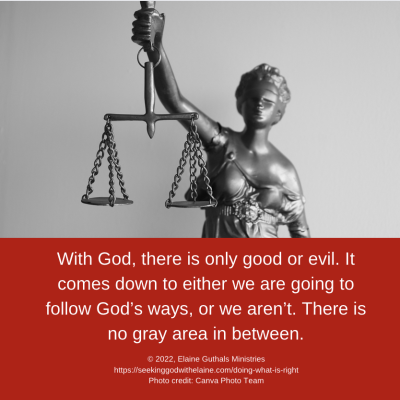
    With God, there is only good or evil. It comes down to either we are going to follow God’s ways, or we aren’t. There is no gray area in between.

    With God, there is only good or evil. It comes down to either we are going to follow God’s ways, or we aren’t. There is no gray area in between.

    The Tug of War in Us

    “… I want to do what is right, but I can’t” (Rom. 7: 18 NLT)

    Disciples know we want to do good– but can’t.

    Disciples want to follow God’s laws and commandments. We know, when we do that, God will be glorified.

    We know we can’t do it on our own. We cannot be blameless and pure without the Holy Spirit guiding and directing us.

    Even then, we still sin. As much as we want to be totally good, we cannot.

    Yes, every Tom, Sally, and Elaine still sin after conversion. Even Paul did — the Energizer Bunny for God. He couldn’t do what was right all the time.

    Part of how we respond is based on the circumstances in which we find ourselves. What we are facing plays a big part in how we react.

    No, we don’t want that to be the case. We want to react the way God wants us to every time.

    Satan loves to blindside us with things. He loves to fan our doubts.

    The whole purpose Satan does what he does is to get us to react without thinking and praying what does God want us to do.

    The way we counter that is to seek God daily. We have to be so strong in our relationship with Him that we discern where Satan is attacking and we stand firm.  Discernment means we can evaluate the situation and recognize right from wrong. 

    Tozer said something with which, I think, many of us struggle. He wrote, “God does not expect more from us than we are capable of being and doing.”

    Resource

    We have a tendency to read that as “God does not expect more from us than we are capable of doing.”

    We skip the being part all together. If it does show up on our radar, we don’t hook it with the “capable of being” part.

    God is in the business of growing us. We wouldn’t grow if the trials were just up to the line of what we could handle or not handle at that time.

    God does not expect more from us than what He can grow us. So, He is going to give us things we don’t think we can handle.

    We know two things.

    1.     God does not give us things to face them on our own.
    2.    God can handle everything.

    When we don’t do what we are supposed to how we are supposed to do it, we only need ask forgiveness. Forgiveness is, when we ask, the act of God pardoning us because we have shown repentance for breaking His laws and commandments, which allows us to become holy as He is.

    • Repentance is acknowledging our separation from God and expressing sorrow for breaking God’s laws and commandments by making the commitment to changing ourselves through obedience so that we no longer do the wrong things.
      • Holy means to be set apart — because of our devotion to God — to become perfect, and morally pure while possessing all virtues.
        • Perfection means we reach a state of maturity because the combination of the spiritual graces form, when all are present, spiritual wholeness or completeness — holy, sanctified, and righteous.
          • Spiritual graces are worldly morals that have been submitted to God to further His kingdom instead of enhancing this world.
          • Sanctified means to be set free from sin.
          • Righteous means we are free from sin because we are following God’s moral laws.
        • Pure means not being sinful or having the stain of sin. 
        • Virtues are standards of moral excellence.

    Glossary

    doing-what-is-rightFB

    Making the Connections

    Chambers talked about it almost looking like disciples had split personalities within us. One of our personalities follows God, and the other doesn’t.

    It can appear that way sometimes, can’t it? When our tendencies are diametrically opposite, people are confused about which one of us is showing up in that current situation.

    How Do We Apply This?

    • Strengthen our relationships with God by seeking Him.
    • Follow God’s laws and commandments.
    • Repent when we sin.

    Searching for and Seeking God

    Hearing His Word (Rom. 10: 17).
    Reading His Word (Rev. 1: 3).
    Praying to Him (Heb. 4: 16).
    Studying His Word (Ac. 17: 11).
    Meditating on His Word (Ps. 1: 1-2).
    Memorizing His Word (Ps. 119: 11).

    Father God. We know, because of our sinful nature, there is no good in us – until we ABCD. Thank You that You designed the Plan of Salvation so that we can confess our sins to You and gain forgiveness. Help us to win the tug of war that occurs almost daily in us. Amen.

    What do you think?

    Leave me a comment below (about this or anything else) or head over to my Facebook group for some interactive discussion.

    If you don’t understand something and would like further clarification, please contact me.

    If you have not signed up for the email daily or weekly providing the link to the devotions and the newsletter, do so below.

    If God has used this devotion to speak with you, consider sharing it on social media.

  • Without God, Endless Conflict

    Though we begin our lives without God, we choose whether or not we want to follow Him. This daily devotional looks at what happens when we choose not to follow God.

    Nuggets

    • Our initial nature is sinful because mankind is born without God.
    • Without God, we give in to our sinful nature.
    • Because all of us possess that sinful nature within us, we will be judged by God if we don’t ABCD.

    To read devotions in the At the Heart Level theme, click the button below.

    Devotions in The Goodness of Grace series

    This series that we are starting with this devotion looks like it is going to be a good follow-up to our last installment in the Sunday Morning Bible Study series. We just got done discussing being walking in the Spirit so that we can mortify the sins of the flesh.

    The only way we can mortify our sins is through the promptings of the Holy Spirit. He comes to dwell in us upon conversion. We only gain salvation through the grace of God.

    For this series, we will be looking at Griffith’s sermon entitled Grace, the Only Source of Goodness. He started out looking at our lives without God.

    Resource

    Let’s Put It into Context

    Here is a running list of nuggets for the series.

    The Body without God

    “Thank God! The answer is in Jesus Christ our Lord. So you see how it is: In my mind I really want to obey God’s law, but because of my sinful nature I am a slave to sin” (Rom. 7: 25 NLT)

    Our initial nature is sinful because mankind is born without God.

    Adam and Eve were created in the image of God. They were given one commandment – obey God.

    Glossary

    They didn’t do that. Their choice to disobey God brought sin into the world. That made mankind a slave to sin.

    Being a slave to sin is the polar opposite of the moral life God for which God made us. Beecher described it this way. He wrote, “Here, then, begins the conflict between man’s physical life and his moral life — the strife of gentleness, purity, joy, peace, and faith, against selfishness, pride, and appetites of various kinds.”

    Resource

    The question is which is going to win the tug of war over us. Is it going to be Satan? Or is it going to be God?

    The answer, hopefully, will be God. For Him to win, we need to return to how we were created.

    The way is belief that Jesus is the only way to salvation.  Salvation is the gift of life through the deliverance from condemnation and sin to acceptance and holiness and changes us from being spiritually dead to spiritually alive.

    • Sin is not believing that Jesus is our Savior to save us from our actions by humans that disobey God and break one of His reasonable, holy, and righteous laws and commandments, goes against a purpose He has for us, or follows Satan’s promptings.
      • Holy means to be set apart — because of our devotion to God — to become perfect, and morally pure while possessing all virtues.
        • Perfection means we reach a state of maturity because the combination of the spiritual graces form, when all are present, spiritual wholeness or completeness — holy, sanctified, and righteous.
          • Spiritual graces are worldly morals that have been submitted to God to further His kingdom instead of enhancing this world.
          • Sanctified means to be set free from sin.
        • Pure means not being sinful or having the stain of sin. 
        • Virtues are standards of moral excellence.
      • Righteous means we are free from sin because we are following God’s moral laws.
    • Holiness is the transcendent excellence of His nature that includes elements of purity, dedication, and commitment that lead to being set apart.
      • Purity means possessing God’s moral character, having eliminated the stain of sin.
    • Spiritual death is the spiritual separation from God that occurred as a consequence of Adam and Eve’s original sin.
      • The spiritually alive are those who have ABCDed, so they are no longer separated from God.

    To read a related devotion, click the button below.

    Glossary

    Since it is a tug of war, whoever is stronger will win. That means we need to grow in our relationship with God to strengthen it.

    That is the only way we have a chance to mortify our sin. Mortify means to place a death penalty on our sins.

    Glossary

    Many like to think that, once we experience conversion and regeneration, the tug of war will end. It won’t

    Salvation doesn’t automatically cut the sin out of us. That is what working through our salvation does.

    The churchy word for that is sanctification. Sanctification is the transformation of mind, body, and soul, which begins with regeneration; gradually changes our nature and morals through the promptings of the Holy Spirit; and ends with perfected state of spiritual wholeness or completeness.

    • Regeneration is being changed from spiritually dead to spiritually alive and the internal new birth and requickening that God brings about through the work of the Holy Spirit to give us new character.

    Glossary

    That is hard and painful.

    But it is worth it.

    Appetites, Passions, and Perversities

    “When you follow the desires of your sinful nature, the results are very clear: sexual immorality, impurity, lustful pleasures, idolatry, sorcery, hostility, quarreling, jealousy, outbursts of anger, selfish ambition, dissension, division” (Gal. 5: 19-20 NLT)

    Without God, we give in to our sinful nature.

    Griffiths talked about our animal appetites, selfish passions, and mental perversities. He pulled out three of the sins to use as examples of what he was discussing. He highlighted fornication, hatred, and idolatry.

    Fornication was the example used for animal appetites. Worldview people would argue that two people in love shouldn’t be a sin. It is because it goes against God’s command.

    • “But because of the temptation to sexual immorality, each man should have his own wife and each woman her own husband” (I Cor. 7: 2 ESV).
    • “Let marriage be held in honor among all, and let the marriage bed be undefiled, for God will judge the sexually immoral and adulterous” (Heb. 13: 4 ESV).

    We must have the greatest commandments as the foundation of our faith. If we are loving God and others, we aren’t hating them.

    Glossary

    Griffith used hatred to explain selfish passions. There is hatred of God and others.

    We may say we love God, but if we don’t follow His commandments, we aren’t really loving Him. Neither are we loving Him when we are following Him but wishing we weren’t.

    Our hatred of others can come out in a variety of ways. Beveridge listed some as anger, envy, lack of mercy, cruelty, pride, desire of revenge, suspicion, and defiant of authority.

    Resource

    Griffiths is more than likely defining hatred as selfish passions because we are putting our wants and needs before God and others. When we are our priority, we do sin against God, and it is easier to sin against others.

    An idol is an object of worship in any form that is below God that takes from God the worship that is His due and is needy and dependent on its worshipers. It is easy for some to slip into the practice of idolatry.

    It should be easy to worship our Creator. He provides daily for our needs.

    However, it isn’t. Satan tries to turn our focus from God back to ourselves. He feeds a line that we don’t need to pledge allegiance to anyone or anything.

    He is wrong.

    Judgment without God

    “All of us used to live that way, following the passionate desires and inclinations of our sinful nature. By our very nature we were subject to God’s anger, just like everyone else” (Eph. 2: 3 NLT)

    Because all of us possess that sinful nature within us, we will be judged by God if we don’t ABCD.

    Disciples once were non-believers. We gave into the same sinful desires.

    The difference now is we have ABCDed. We asked Jesus to be our Savior and Redeemer.

    God’s grace changed us. No, He isn’t finished yet changing us. We have a long way to go before we are perfect such as He is.

    We are made children of God by His mercy and love. He offers us the Plan of Salvation because He does not want us to be found lacking in the final judgment.

    If we refuse God’s gift of salvation, we set ourselves up for God’s wrath. It may look like He is not punishing sinners now, but He is. He will give the ultimate judgment on judgment day.

    without-god-endless-conflictFB

    Making the Connections

    God offers the Plan of Salvation to each and every person.

    Stafford had an interesting sermon. He talked about serving the law of God. He wrote, “For this end the law is written upon his heart, and, therefore, he serves God with his spirit, or with his renewed mind.”

    Resource

    Think about it, and let’s connect some dots.

    • The law is written within us at the heart-level, so that means it has changed our character.
    • Our spirit is our renewed mind.

    What is one question with which we sometimes struggle? How do we worship God in spirit and truth. Jesus said, “But the hour is coming, and is now here, when the true worshipers will worship the Father in spirit and truth, for the Father is seeking such people to worship him. God is spirit, and those who worship him must worship in spirit and truth” (Jn. 4: 23-24 ESV).

    I read that to say we worship in spirit by progressing on the Sanctification Road.

    What is the old saying? The highest form of flattery is imitation. We worship by changing to become more like Him.

    How Do We Apply This?

    The ABCDs of Salvation

    If you have not become a believer in Christ, please read through the
    Plan of Salvation and prayerfully consider what God is asking you to do.

    A – admit our sins
    B – believe His Son Jesus is our Redeemer
    C – confess God as Sovereign Lord

    D – demonstrate that commitment by making any changes needed in our lives to
    live the way in which God has called us

    The Disciple’s Job Description

    Searching for and Seeking God

    Hearing His Word (Rom. 10: 17).
    Reading His Word (Rev. 1: 3).
    Praying to Him (Heb. 4: 16).
    Studying His Word (Ac. 17: 11).
    Meditating on His Word (Ps. 1: 1-2).
    Memorizing His Word (Ps. 119: 11).

    • Don’t attempt to cover up our sin – repent and cut it out.
    • Don’t compromise with the worldview.
    • Realize we can’t be good without Jesus as our Savior and Redeemer.
    • Realize and accept we don’t know it all.

    Resource

    Father God. Lord, You created us knowing that we would disobey You. Because of that – even before You created us – You designed the Plan of Salvation so that our relationship with You could be restored. Change us so that we become more like You. Amen.

    What do you think?

    Leave me a comment below (about this or anything else) or head over to my Facebook group for some interactive discussion.

    If you don’t understand something and would like further clarification, please contact me.

    If you have not signed up for the email daily or weekly providing the link to the devotions and the newsletter, do so below.

    If God has used this devotion to speak with you, consider sharing it on social media.
  • How Do We Bless God? (1.1)

    There are many verses in Scriptures that say God will bless us. But Paul says that we are to bless God. What? This daily devotional looks at how we can and should bless God.

    Nuggets

    • Blessings begin with God, the Father.
    • Spiritual blessings are delivered by the Holy Spirit.
    • The reason we can receive the blessings is because Jesus died for our sins.

    Devotions in the The Letter of Paul to the Ephesians series

    Sometimes, Satan tempts us to take our focus off of God. It seems like we get stuck on the what’s-in-it-for-me cycle. That is quickly followed by what-has-God-done-for-me-lately whine.

    Paul kind of flipped that on its ear, though. (He was good at doing that, wasn’t he?) Paul said that we were to bless God.

    Wait! How is that even possible? I mean, we are talking about Sovereign God here — Creator of the universe. Author of salvation.

    Yes, God would be like a parent. What could you get Him for birthdays and Christmas? He has everything — and made it.

    So, how are we going to bless God?

    This is just a foreign concept for me. Stroll along beside me as I try to figure this one out.

    Let’s Put It into Context #1

    Here is a running list of nuggets for the series.

    Let’s Put It into Context #2

    First things first. What does bless even mean?

    Bless is one of those words that have several meanings. We generally think of it as an act of God that shows His favor toward us.

    If you look at the definition, it does say that it is an act or words that imparts a special favor or mercy. It doesn’t limit it to just God.

    We know that mercy is where God doesn’t judge us to the extent He could. Even though we deserve bad things, God doesn’t give them to us.

    But we also say we bless the meal when we eat. That is a type of praise or worship.

    So, let’s dive into the verse now.

    God the Father

    “Blessed be the God and Father of our Lord Jesus Christ …” (Eph. 1: 3 KJV).

    Blessings begin with God, the Father.

    We know there are many verses saying God blesses. Numbers 6: 24-26 says, “The LORD bless you and keep you; the LORD make his face shine on you and be gracious to you; the LORD turn his face toward you and give you peace” (NIV). The whole Beatitudes is about those who are blessed.

    Then we get to John 1: 16. “Out of his fullness we have all received grace in place of grace already given” (Jn. 1: 16 NIV). The Plan of Salvation that God devised is our greatest blessing.

    But what about “Bless the Lord, O my soul: and all that is within me, bless his holy name” (Ps. 103: 1 KJV)?

    “Bless the Lord, O my soul: and all that is within me, bless his holy name” (Ps. 103: 1 KJV)

    You see, it isn’t a one-sided blessing. No, we will never be able to out-bless God.

    But we are supposed to praise God with every fiber of our being. Praise is our response to God, but it usually involves music.

    We are supposed to continuously praise Him. We are supposed to humble ourselves so that our praise is real.

    I see you jumping up and down over there, saying you are too smart to give your allegiance to an unseen God. If you think about it, we need our intelligence, our will, and our intent to praise God.

    No, we will never understand everything. But we have to process it enough to say, “You know, it may not make sense to some, but it makes sense to me. God is supreme.”

    Paul addressed that in his letter to the Corinthians. “The natural person does not accept the things of the Spirit of God, for they are folly to him, and he is not able to understand them because they are spiritually discerned” (I Cor. 2: 14 ESV).

    We have to give up our will (in other words, control of our lives) in order to do what God is calling us to do. When we do this, we have to go whole hog. We can’t keep some area back for our control.

    We can’t say, “Well, I am going to pretend to follow Him until He convinces me He is real.” We can tell from the Stories About the End Times series that, if you do that, it isn’t going to end well for you.

    To read a related devotion, click the button below.

    We have to really, really want to do what God wants us to do. Remember, God can see the desires of our hearts. The desire to obey Him really has to be there.

    We bless God when things don’t go the way we want, but we are okay with that. When we give up our expectations and desires and truly follow His will, we bless Him.

    How can we bless God even more? We can by witnessing. If we love Him so much that we want others to share in what we have, that blesses God.

    Let’s look at it this way. How did God describe Himself in the Old Testament? He was “… the God of Abraham, the God of Isaac, and the God of Jacob …” (Ex. 3: 15 ESV).

    Now, how did Jesus describe Him? “… I am ascending to my Father and your Father, to my God and your God” (Jn. 20: 17 ESV).

    What does that say about the expectation of a relationship? To me, it went from God way off in heaven to God taking residence in our hearts and lives.

    What Kind of Blessings?

    “… who has blessed us in Christ with every spiritual blessing in the heavenly places” (Eph. 1: 3 ESV).

    Spiritual blessings are delivered by the Holy Spirit.

    What kind of blessings can we expect? Yes, we can expect earthly blessings. God will provide what we need (Phil. 4: 19).

    God is more interested in spiritual, heavenly blessing. What are spiritual blessings? They are blessings that address heavenly things.

    They are about our salvation. They are about our relationship with God.

    We get spiritual blessings through the Holy Spirit. God blesses us as we change to become more like Him.

    Go back to Abraham a second. When God established His covenant with Abraham, Abraham didn’t own any land in Canaan. In fact, when Abraham died, he only owned the land on which he was buried.

    But the blessing wasn’t all about Abraham. The covenant was about Israel. Ultimately, it was about God. That is His singular focus.

    God is going to bless His children in order to expand His kingdom. He will bless those faithful to Him: “A faithful man will abound with blessings” (Prov. 28: 20 ESV).

    Full Circle

    “… in Christ …” (Eph. 1: 3 ESV).

    The reason we can receive the blessings is because Jesus died for our sins.

    It comes back to Christ. Jesus came to earth, lived, died an agonizing death, and rose again so that our relationship with God can be restored.

    To restore that relationship, we have to admit our sins, believe on Jesus as Redeemer, and confess God as Sovereign Lord.

    The ABCDs of Salvation

    If you have not become a believer in Christ, please read through the
    Plan of Salvation and prayerfully consider what God is asking you to do.

    A – admit our sins
    B – believe His Son Jesus is our Redeemer
    C – confess God as Sovereign Lord

    D – demonstrate that commitment by making any changes needed in our lives to
    live the way in which God has called us

    The Disciple’s Job Description

    Once this relationship has been restored, God can bless us — all because of and through Jesus. We can only approach Him through the name of Jesus in prayer and praise.

    how-do-we-bless-god-1.1FB

    Making the Connections

    We have to remember the Paul of old days — back when He was Saul and held the cloaks when Stephen was stoned (Ac. 7: 54-60).

    This, however, is 25 to 30 years after Paul met Jesus on the Damascus Road. That encounter changed Paul’s entire life. He had done a drastic 180 degree turn.

    Paul had learned to be content (Phil. 4: 11), even though he encountered trials and hardships daily.

    How Do We Apply This?

    Jesus wants to change our lives so that God can bless us, also. He wants us to ABCD.

    We need to bless God by praising Him. We don’t do this just when things are going good. We do this all the time. We need to break into praise as Paul did — frequently.

    So, we can bless God. We do every time that we praise Him. We have to become more intentional in our own worship of God and in leading others to accept Him.

    Loving Father. We do praise You. We thank You that You loved us enough to send Jesus as our Savior. Forgive us when we get so caught up in this world that we don’t praise You and thank You as we should. We claim all the blessings that You have in store for us today. Amen.

    What do you think?

    Leave me a comment below (about this or anything else) or head over to my Facebook group for some interactive discussion.

    If you don’t understand something and would like further clarification, please contact me.

    If you have not signed up for the email daily or weekly providing the link to the devotions and the newsletter, do so below.

    If God has used this devotion to speak with you, consider sharing it on social media.

  • Crucifying the Flesh

    Not giving in to sinful desires is hard. Paul called this crucifying the flesh. This daily devotional looks at how the Holy Spirit uses fruits of the Spirit to change and reward us so that we can be totally submitted to God.

    Nuggets

    • The fruits of the Spirit are a measure of our growth.
    • Being crucified with Christ is the evidence of our walking in the Spirit.
    • We must totally submit to God.

    Devotions in the Never Alone: The Holy Spirit in Our Lives series

    We’ve talked about the fruits of the Spirit being the rewards of living godly lives. They are also the elements of that godly life.

    Unfortunately, living a godly life isn’t always easy. Satan wants to try to get us to give into our sinful desires.

    Fortunately, we have the Holy Spirit walking with us to guide us to where God wants us to be. Let’s take a look at what Paul said here.

    Let’s Put It into Context #1

    Here is a running list of nuggets for the series.

    Let’s Put It into Context #2

    We have looked at this passage of verses a couple of times – and in depth.

    To read a related devotion, click the appropriate button below.

    Fruits of the Spirit

    “But the fruit of the Spirit is love, joy, peace, patience, kindness, goodness, faithfulness, gentleness, self-control; against such things there is no law” (Gal. 5: 22-23 ESV)

    The fruits of the Spirit are a measure of our growth.

    Bayley argued that it may not be as easy to see the fruit of the Spirit as it is the works of the flesh. I can see that.

    Remember, we’ve talked about how the Scriptures are just an introduction to God. God doesn’t reveal Himself totally to those who are not His children. He reveals Himself to us after we ABCD.

    Resource

    Glossary

    The fruits of the Spirit come from the Holy Spirit. I know. It is in the name. Duh.

    We usually see the fruits of the Spirit as rewards for being righteous. And they are.

    But also, they are the character traits that we need to work on to be more like God. Why do I say this?

    Bayley told us that these characteristics must be present in every disciple. Yeah, we may differ in what there is within us, but we each have to have love, joy, peace, patience, kindness, goodness, faithfulness, gentleness, and self-control within us.

    How can we be a child of God if we have no faithfulness within us? Or love? Or self-control?

    These fruits are important. Washburn wrote, “He tells us here what a spiritual life in Christ means, a life that has its ripe fruit in these real virtues of the man. It is no exact classification of the religious graces, but we may find an inward harmony, as if he thought of them as following a law of personal growth.”

    Resource

    The fruits of the Spirit show us that God is working within us.

    The fruits of the Spirit show us that God is working within us.

    Crucifying the Flesh

    “And those who belong to Christ Jesus have crucified the flesh with its passions and desires” (Gal. 5: 24 ESV)

    Being crucified with Christ is the evidence of our walking in the Spirit.

    Being crucified with Christ can be difficult for some to understand. Really, it is an easy concept.

    We are crucified with Christ when we are successful at overcoming sinful desires. We commit to that at conversion. We consider ourselves dead to sin.

    No, that isn’t easy. It is only through the grace of God that we can do that.

    Unfortunately, sin isn’t kicked out entirely upon conversion. We still commit internal and external sins.

    The end goal of regeneration is mortify our sins. It is going to be a gradual process to fully accomplish that. This process is called sanctification.

    Regeneration is being changed from spiritually dead to spiritually alive and the internal new birth and requickening that God brings about through the work of the Holy Spirit to give us new character.
    Mortify means to place a death penalty on our sins.
    Sanctification is the transformation of mind, body, and soul, which begins with regeneration; gradually changes our nature and morals through the promptings of the Holy Spirit; and ends with perfected state of spiritual wholeness or completeness. 

    • Spiritual death is the separation from God that occurred as a consequence of Adam and Eve’s original sin.
      • The spiritually alive are those who have ABCDed, so they are no longer separated from God.
    • Perfection means we reach a state of maturity because the combination of the spiritual graces form, when all are present, spiritual wholeness or completeness — holy, sanctified, and righteous.
      • Spiritual graces are worldly morals that have been submitted to God to further His kingdom instead of enhancing this world.
      • Sanctified means to be set free from sin.
      • Righteous means we are free from sin because we are following God’s moral laws.

    The ABCDs of Salvation

    If you have not become a believer in Christ, please read through the
    Plan of Salvation and prayerfully consider what God is asking you to do.

    A – admit our sins
    B – believe His Son Jesus is our Redeemer
    C – confess God as Sovereign Lord

    D – demonstrate that commitment by making any changes needed in our lives to
    live the way in which God has called us

    The Disciple’s Job Description

    Glossary

    Yes, we are to sentence our sins to the death penalty. But not a humane execution like we do these days.

    We are to violently kill them.

    Remember, it says crucify. That was a hard, shameful, painful death.

    Oh, yeah. That will be painful.

    Our motivation should be to live as Christ did. His motivation was to honor His Father.

    So, that should be our motivation, too – to honor God.

    Elaine-speak for something else Gisborne said. Our previous spiritual tests that showed our faith in Jesus have been drawn from whom we follow and our interactions with mankind. Yes, that is the two greatest commandments.

    Glossary

    We must have the greatest commandments as the foundation of our faith. From there, we determine the path of our unguided thoughts. Do we think of God or sinful desires?

    This goes next to what Paul told the Philippians. “And this is my prayer: that your love may abound more and more in knowledge and depth of insight, so that you may be able to discern what is best and may be pure and blameless for the day of Christ, filled with the fruit of righteousness that comes through Jesus Christ — to the glory and praise of God” (Phil. 1: 9-11 NIV).

    • Discernment means we can evaluate the situation and recognize right from wrong. 
    • Pure means not being sinful or having the stain of sin. 
    • Righteousness is the indwelling goodness that is the result of a solid relationship with God built by a sincere life of conscientious obedience to God’s laws and commandments and from which all virtues flow.
    • We glorify God when we use what we learn from seeking Him to change our words and actions in order to obey and praise Him.
    • Praise is our response to God, but it usually involves music.

    This is what the Holy Spirit is promoting when we daily walk with Him. Yep, it is going to be hard for us to crucify the flesh, but we aren’t alone. The only One Who can help us be successful in accomplishing that is right there with us.

    Living and Walking with the Spirit Must Match

    “If we live by the Spirit, let us also keep in step with the Spirit” (Gal. 5: 25 ESV)

    We must totally submit to God.

    Oh, this is a scary thought. We can live by the Spirit but not be in step with the Spirit.

    How can we do this?

    We’ve already talked about becoming new creations by navigating the Sanctification Road.

    Glossary

    But what if we come forward for conversion, but we never start down the Sanctification Road? We don’t try to change our lifestyles. We consistently continue to make choices that do not reflect Christ within us. But yet we love our neighbors, are kind and generous to them, and strive to be a good person.

    In other words, we buy the fire insurance to escape hell, but we think that gives us license to go on sinning.

    That doesn’t work.

    We must have a spiritual change. We must submit our whole lives to God.

    crucifying-the-fleshFB

    Making the Connections

    Gisborne provided a list of all the different titles disciples of Christ are called – and titles used for non-believers. He wrote, “Thus those that are Christ’s are occasionally characterized as born of the Spirit; walking in the Spirit; the children of God; the elect of God; the doers of the law; the heirs of the kingdom of heaven. Those that are not Christ’s are described as walking in the flesh; fulfilling the lusts of the flesh; the children of this world; the unfruitful hearers of the law; the servants of Satan; the heirs of damnation.”

    Resource

    It is up to us to evaluate our walk to determine which title belongs to us.

    If we a child of the flesh, what is the reason we are not a child of God? Gisborne gave us questions to think about here, too.

    • Do we believe Scriptures are not truly the Word of God?
    • Do we think God will not do what He says He will?
    • Do we think God or Jesus will make an exception for us and allow us into Heaven anyway?

    It is, He will, and They won’t.

    How Do We Apply This?

    Gisborne asked the right questions. He wrote, “Have you therefore resolved, through the grace of God, to renounce the indulgence of sinful inclinations and practices? Have you thus taken the first step towards living unto Christ? What then is the second? ‘Cease to do evil’ saith the prophet. What is his next injunction? ‘Learn to do well.’”

    Resource

    • Govern ourselves by adhering to the two greatest commandments.
    • Daily strive to mortify our sins.
    • Seek God daily.
    • Grow in faith in order to mortify our sins.
    • Grow all the spiritual graces.
    • Grow in grace to help us mortify our sins.
    • Avoid temptations.

    Resource

    Searching for and Seeking God

    Hearing His Word (Rom. 10: 17).
    Reading His Word (Rev. 1: 3).
    Praying to Him (Heb. 4: 16).
    Studying His Word (Ac. 17: 11).
    Meditating on His Word (Ps. 1: 1-2).
    Memorizing His Word (Ps. 119: 11).

    Father God. We want to live godly lives. We want to possess Your character. Thank You for sending the Holy Spirit to guide us in crucifying our sins in order to gain godly character. Amen.

    What do you think?

    Leave me a comment below (about this or anything else) or head over to my Facebook group for some interactive discussion.

    If you don’t understand something and would like further clarification, please contact me.

    If you have not signed up for the email daily or weekly providing the link to the devotions and the newsletter, do so below.

    If God has used this devotion to speak with you, consider sharing it on social media.

  • Sinful Desires

    Living our lives controlled by sinful desires is the opposite of walking with the Holy Spirit. This daily devotional looks at a list of sins given to the Galatians by Paul.

    Nuggets

    • God identifies sins as things that go against His character.
    • We can commit murder in many different ways.
    • Sinning rather that walking with the Spirit brings dire consequences.

    Devotions in the Never Alone: The Holy Spirit in Our Lives series

    We’ve looked extensively at each sin listed here in the Walk in the Spirit series. I don’t want to cover the same ground here.

    So, let’s take more of an overview approach. That way we can see exactly where the Holy Spirit fits in.

    Let’s Put It into Context #1

    Here is a running list of nuggets for the series.

    Let’s Put It into Context #2

    We have looked at this passage of verses a couple of times – and in depth.

    To read a related devotion, click the appropriate button below.

    Let’s Put It into Context #3

    Walk is the term used to describe how we live our lives, specifically our habitual state of mind, behavior, and manners. Walking with God means we are humble, reverent, teachable servants of God. Walking in the Spirit is our acceptance of the fact that we cannot win over sin without the ministering of the Holy Spirit because we are weak.

    The flesh is our human, sinful nature that focuses on our own ends.

    A Sampling of Sins

    “Now the works of the flesh are evident: sexual immorality, impurity, sensuality, idolatry, sorcery, enmity, strife, jealousy, fits of anger, rivalries, dissensions, divisions, envy, drunkenness, orgies, and things like these …” (Gal. 5: 19-21 ESV)

    God identifies sins as things that go against His character.

    We are made in God’s image. However, after Adam and Eve chose to sin, mankind has been corrupted by sinful nature.

    Sin is not believing that Jesus is our Savior to save us from our actions by humans that disobey God and break one of His reasonable, holy, and righteous laws and commandments, goes against a purpose He has for us, or follows Satan’s promptings.

    • Holy means to be set apart — because of our devotion to God — to become perfect, and morally pure while possessing all virtues.
      • Perfection means we reach a state of maturity because the combination of the spiritual graces form, when all are present, spiritual wholeness or completeness — holy, sanctified, and righteous.
        • Spiritual graces are worldly morals that have been submitted to God to further His kingdom instead of enhancing this world.
        • Sanctified means to be set free from sin.
      • Pure means not being sinful or having the stain of sin. 
      • Virtues are standards of moral excellence.
    • Righteous means we are free from sin because we are following God’s moral laws.

    Glossary

    Paul included a list of some sins in Galatians 5: 19-21. This list is not exhaustive, but it does give us a rough idea of what displeases God.

    Bayley and Eadie grouped the 17 sins listed into four broad categories. They were similar, but I picked which one I thought was most easily understood.

    • Sensuality
    • Idolatry
    • Malice
    • Personal excess

    Resource

    All sin has a root of displaying disobedience toward God. God has told us to do or not do something — and we do the exact opposite because we do not want to obey Him.

    This sampling shows us that the whole of us is sinful. “For I know that nothing good dwells in me, that is, in my flesh. For I have the desire to do what is right, but not the ability to carry it out” (Rom. 7: 18 ESV).

    Look at the list again. It talks about who we are to how we interact with others. It talks about emotions and actions.

    It implies it is our choice to commit these sins. If we had no choice in the matters why make the list?

    Some sins are committed only in the heart. Our actions stem from who we are.

    Our motivation is determined by what we value in our hearts. If I value others more than myself, my motivations will be totally different than if I value myself or things more than people.

    Some sins are committed only in the mind. That is why we have to corral our thoughts.

    Many times, sin appears as something bright and shiny. This masks it’s destructive capabilities.

    The hardest sins to identify are those that, in some cases, aren’t a sin but, in other cases, are. Maybe our motivation is wrong. We may be obsessed with something that kicks it into being a sin.

    Maybe God has told us to do something a certain way, and we choose not to do it that way. A good example of this is how we are to worship and serve God.

    It is our choice to not listen to what God is saying.

    It is our choice to not listen to what God is saying.

    A Bonus

    We can commit murder in many different ways.

    I didn’t want to get into all of the sins individually. However, I did find a great sermon by Goodheart entitled Murders.

    Goodheart made a great observation. He wrote, “Life is threefold of the body, mind, and spirit; and murder against each may be deliberate or careless, resulting from action or inaction.”

    Resource

    Ooo, baby. We just think of murder as murdering the body. There is so much more we can kill.

    We can kill someone’s reputation — and even their opinion of themselves. We can kill their correct opinion by biting on them because they don’t think like we do — but we are wrong.

    Unfortunately, we can kill their desire to as Jesus to be their Savior and Redeemer. Or we don’t witness to them like we should. That is the worst murder we can commit.

    Parker took the same track. The example that caught my eye was when he wrote, “Anger without cause is murder.” The rest of his examples were more socially oriented.

    Resource

    I know. Murder isn’t on this list. It is a commandment.

    But it means so much more than we realize.

    A Big Warning

    “… I warn you, as I warned you before, that those who do such things will not inherit the kingdom of God” (Gal. 5: 21 ESV)

    Sinning rather that walking with the Spirit brings dire consequences.

    Let’s start at the end and work backwards.

    The kingdom of God is a spiritual kingdom that describes His sovereign reign.

    Only the righteous can enter the kingdom of God, also called the kingdom of Heaven. “For I tell you, unless your righteousness exceeds that of the scribes and Pharisees, you will never enter the kingdom of heaven” (Mt. 5: 20 ESV).

    In other words, we have to be genuine in our relationship with God.

    Person of Interest

    We might look at the list and say we don’t commit all of those sins. It doesn’t matter.

    Starke explained. He wrote, “It is not needful for a man to do all these sins, or many such, to fall under the penalty; it is enough if he lets one single sin rule over him, let it be what it will.”

    Resource

    Until we admit that mankind was separated from God after the original sin, making us sinners; believe Jesus paid the penalty for those sins to become our Savior and Redeemer; confess God as Sovereign God; and demonstrate that commitment by submitting to living our lives following His laws and commandments confessing God as Sovereign Lord, we will be facing the consequences of our sins.

    sinful-desiresFB

    Making the Connections

    Bottom line is sin is being disobedient to God. We don’t want to do that.

    We want to be led by the Holy Spirit to follow His laws and commandments.

    How Do We Apply This?

    • Work to not sin.
    • Repent when we do.
    • Avoid the opportunities that tempt us to sin.
    • Fill our time with doing God’s work.
    • Seek God
    • Put the priority on God, not self.

    Resource

    Searching for and Seeking God

    Hearing His Word (Rom. 10: 17).
    Reading His Word (Rev. 1: 3).
    Praying to Him (Heb. 4: 16).
    Studying His Word (Ac. 17: 11).
    Meditating on His Word (Ps. 1: 1-2).
    Memorizing His Word (Ps. 119: 11).

    Father God. Thank You for showing us what sins are. Only through the help of the Holy Spirit will we gain victory over sin. We long to experience that victory because we long to be like You. Amen.

    The ABCDs of Salvation

    If you have not become a believer in Christ, please read through the
    Plan of Salvation and prayerfully consider what God is asking you to do.

    A – admit our sins
    B – believe His Son Jesus is our Redeemer
    C – confess God as Sovereign Lord

    D – demonstrate that commitment by making any changes needed in our lives to
    live the way in which God has called us

    The Disciple’s Job Description

    What do you think?

    Leave me a comment below (about this or anything else) or head over to my Facebook group for some interactive discussion.

    If you don’t understand something and would like further clarification, please contact me.

    If you have not signed up for the email daily or weekly providing the link to the devotions and the newsletter, do so below.

    If God has used this devotion to speak with you, consider sharing it on social media.

  • The Spirit versus the Flesh

    Our walk with the Spirit is threatened by the desires of the flesh. This daily devotional looks at how the desires of the Spirit is the opposite of the desires of the flesh.

    Nuggets

    • The desires of the flesh are polar opposite to the desires of the Spirit.
    • As difficult as the battle of our spiritual will against our fleshly will, it is beneficial.
    • The Holy Spirit works in our lives to help us grow in grace and knowledge.

    Devotions in the Never Alone: The Holy Spirit in Our Lives series

    As much as we would hope to have an easy road after conversion, it really isn’t. Yes, the Holy Spirit comes to live inside us so that we can walk with Him.

    However, we are still in our physical bodies. We still have the capacity to sin within us.

    But that means we will have a battle on our hands as the desires of the Spirit battle the desires of the flesh.

    Let’s see what Paul had to say about that.

    Let’s Put It into Context #1

    Here is a running list of nuggets for the series.

    Let’s Put It into Context #2

    We have looked at this passage of verses a couple of times – and in depth.

    To read a related devotion, click the appropriate button below.

    Polar Opposites

    “For the desires of the flesh are against the Spirit, and the desires of the Spirit are against the flesh, for these are opposed to each other …” (Gal. 5: 17 ESV)

    The desires of the flesh are polar opposite to the desires of the Spirit.

    Paul said in Galatians 5: 16 that the flesh and the Spirit both battle for control of us. He expands on that in verse 17.

    The flesh and Spirit are polar opposites because the Spirit follows good and flesh follows evil.

    • The flesh is our human, sinful nature.
    • Good, in the biblical sense, is the workings of God within His people through His holy, pure, and righteous behavior.
      • Holy means to be set apart — because of our devotion to God — to become perfect, and morally pure while possessing all virtues.
        • Perfection means we reach a state of maturity because the combination of the spiritual graces form, when all are present, spiritual wholeness or completeness — holy, sanctified, and righteous.
          • Spiritual graces are worldly morals that have been submitted to God to further His kingdom instead of enhancing this world.
          • Sanctified means to be set free from sin.
          • Righteous means we are free from sin because we are following God’s moral laws.
        • Pure means not being sinful or having the stain of sin. 
        • Virtues are standards of moral excellence.
    • Evil is equated with sin because it is that which goes against God and His purposes.

    Glossary

    We cannot compromise what God has decreed are absolutes.

    I know. The worldview teaches we should meet somewhere in the middle. If truth be told, that means we would be going 100% to the fleshly side that wants to say anything goes.

    God will judge us based on His laws and commandments. Those do not contain worldview opinions.

    Manton made an interesting comment. He wrote, “That there is a liberty in a Christian of walking according to each principle, either the spirit or the flesh.”

    Resource

    That comment seems strange when there is a constant struggle between the flesh and the Spirit.

    We know there is freedom in Christ.

    • “So Jesus said to the Jews who had believed him, ‘If you abide in my word, you are truly my disciples, and you will know the truth, and the truth will set you free’” (Jn. 8: 31-32 ESV)
    • “So if the Son sets you free, you will be free indeed” (Jn. 8: 36 ESV)

    Worldview people would argue that God’s laws and commandments places us in bondage. By not adhering to them, they say we are free to do what we want to do.

    They may be true in this life. However, the worldview people do not realizes they will pay the consequences of those actions in the next life.

    But let’s backtrack a little on what Manton said. His contended that Spirit and flesh fostered freedom to support this statement: “When for a continuance we obey the flesh, usually accomplish its motions without let and restraint, and with love, pleasure, and full consent of will; this is proper to the unregenerate.”

    Elaine-speak. When we sin in order to put off something, we can usually do it freely and consciously. But we are acting like the unsaved act.

    But the original statement I quoted said that “… there is a liberty in a Christian of walking according to each principle …” Even after conversion, we have a willful heart.

    I would guess that means we have freedom from our heart’s corrupt ness and the consequences of sin when we repent.

    Repentance is acknowledging our separation from God and expressing sorrow for breaking God’s laws and commandments by making the commitment to change our sinful ways to ways of righteousness through obedience.

    • Sin is not believing that Jesus is our Savior to save us from our actions by humans that disobey God and break one of His reasonable, holy, and righteous laws and commandments, goes against a purpose He has for us, or follows Satan’s promptings.
    • Obedience means submitting ourselves to the will of God as it is presented to us and living our lives accordingly.

    Glossary

    We’ve talked before about working out our salvation. How said that we work it out by making the choices to follow God’s Will.

    Resource

    Yep, there is that word – work. It takes work for the desires of the Spirit to win the battle of wills.

    It takes work for the desires of the Spirit to win the battle of wills.

    The Battle of Wills

    “… to keep you from doing the things you want to do” (Gal. 5: 17 ESV)

    As difficult as the battle of our spiritual will against our fleshly will, it is beneficial.

    We can probably read this two different ways. To keep us from doing the things we want to do or keep us from doing things we would normally have done before conversion.

    Either way, there is a change in perspective. We recognize where we want to follow the flesh and, hopefully, follow the Spirit instead.

    The struggle does have its value, though. We do learn more by the going through the trials.

    When we exercise, it is the resistance that makes us stronger. Same here.

    That, in turn, highlights our true faith. It is easy to be faithful in the calm, easy-going periods in our lives. Our faith is identified when trial shine a spotlight on it.

    Newman made an interesting comment. He wrote, “Sins which rise from a deficiency of practical experience, or from ignorance how to perform duties which we set about.”

    Resource

    Even though we want to not sin, we can’t pull it off. We don’t know how to do it right because it is something that is foreign to us.

    We sin for many reasons. Sometimes, our attitude and motivation is wrong. Something times, we just have it wrong (no one is going to figure out 100% of what and how God wants).

    Sometimes, we just forget.

    What we have to remember is that God is a God of order. Also, He made us as complex individuals.

    Changing us from walking in the flesh to walking in the Spirit — the process of sanctification — is not easy. Sanctification is the transformation of mind, body, and soul, which begins with regeneration; gradually changes our nature and morals through the promptings of the Holy Spirit; and ends with perfected state of spiritual wholeness or completeness.

    • Regeneration is being changed from spiritually dead to spiritually alive and the internal new birth and requickening that God brings about through the work of the Holy Spirit to give us new character.
      • Spiritual death is the separation from God that occurred as a consequence of Adam and Eve’s original sin.
        • The spiritually alive are those who have ABCDed, so they are no longer separated from God.

    The ABCDs of Salvation

    If you have not become a believer in Christ, please read through the
    Plan of Salvation and prayerfully consider what God is asking you to do.

    A – admit our sins
    B – believe His Son Jesus is our Redeemer
    C – confess God as Sovereign Lord

    D – demonstrate that commitment by making any changes needed in our lives to
    live the way in which God has called us

    The Disciple’s Job Description

    Glossary

    We have to get ready for the fight of our lives.

    Led by the Spirit

    “But if you are led by the Spirit, you are not under the law” (Gal. 5: 18 ESV)

    The Holy Spirit works in our lives to help us grow in grace and knowledge.

    Sometimes, it is easy to forget that the Holy Spirit is a Person. Yes, He is a Spirit, but He is also a Person.

    Parkhurst described why it is easy to forget that. He wrote, “The personality of the Spirit is a doctrine freely confessed by us in our creed, but often denied by us in thought, converse, prayers. He comes to have with us only the indefiniteness of an impulse and the impersonalness of an influence, with none of that substantive being, intelligence, and will that constitutes the Holy Spirit a true and complete personality.”

    Resource
    Parkhurst’s The Guidance of the Spirit
    https://biblehub.com/sermons/auth/parkhurst/the_guidance_of_the_spirit.htm

    We also can confuse knowing of Jesus with knowing Jesus. We may have head knowledge of Jesus because we get why there is a Christmas and an Easter.

    But that doesn’t mean we let Jesus into our hearts. That doesn’t mean we are letting the Holy Spirit lead.

    Melvill reminded us that we can do nothing without the Holy Spirit’s leading. God calls us to salvation. We don’t just go looking for Him.

    Resource

    The Holy Spirit shows us how we are to grow. He teaches us what we are to know.

    More importantly, the Holy Spirit facilitates the change of our character to be more like God’s.

    How does the Holy Spirit lead us? He gives us thoughts. “Finally, brothers, whatever is true, whatever is honorable, whatever is just, whatever is pure, whatever is lovely, whatever is commendable, if there is any excellence, if there is anything worthy of praise, think about these things” (Phil. 4: 8 ESV).

    the-spirit-versus-the-fleshFB

    Making the Connections

    I love how Binney reminded us that, when we choose to walk with the Spirit, it makes it two against one. (Actually, it makes it four against one.)

    Resource

    We aren’t alone in facing Satan’s temptations.

    How Do We Apply This?

    • Follow the Holy Spirit’s guidance as to cutting sin out of our lives.
    • Obey the Holy Spirit’s promptings.
    • Keep our focus on God when we go through testings and take heart.
    • Work to repent of our sins.
    • Evaluate ourselves to determine our weakest areas and strengthen them.
    • Utilize prayers, faith, and hope to access the grace needed to win over sin.
    • Pray earnestly.
    • Realize we will fail.
    • Keep on watch.
    • Remember we are saved by grace through faith, not works.

    Resource

    Father God. Thank You so much for giving us the Holy Spirit to live within us. We would be lost without His guidance and teachings. Most of all, we wouldn’t be nearly as far along in the Sanctification Road as we are. Thank You for giving us this piece of You. Amen.

    What do you think?

    Leave me a comment below (about this or anything else) or head over to my Facebook group for some interactive discussion.

    If you don’t understand something and would like further clarification, please contact me.

    If you have not signed up for the email daily or weekly providing the link to the devotions and the newsletter, do so below.

    If God has used this devotion to speak with you, consider sharing it on social media.

  • Walking with the Spirit

    Because He is our Guide, we should walk with Spirit. This daily devotional looks at how we walk to be victorious over our sinful nature.

    Nuggets

    • Walking by the Spirit focuses us on God.
    • The flesh and the Spirit battle for control of us.
    • We strive to have daily and ultimate victory over our sin.

    Devotions in the Never Alone: The Holy Spirit in Our Lives series

    We know that walk is the term used to describe how we live our lives, specifically our habitual state of mind, behavior, and manners. We also know that walking with God means we are humble, reverent, teachable servants of God. 

    Paul advised us that we are to walk with the Spirit. We do this so that the He can lead us to display the fruits of godly character.

    Let’s step through what Paul said.

    Let’s Put It into Context #1

    Here is a running list of nuggets for the series.

    Let’s Put It into Context #2

    We have looked at this passage of verses a couple of times – and in depth.

    To read a related devotion, click the appropriate button below.

    What Does It Mean to Walk by the Spirit?

    “But I say, walk by the Spirit …” (Gal. 5: 16 ESV)

    Walking by the Spirit focuses us on God.

    I know. The definition we use for walk may be a little generic.

    Venn gave us an expanded definition. He wrote, “To walk in the Spirit, therefore, is to acknowledge with the heart our own weakness and inability to serve God; to expect victory over sin only by the gracious operation of His Spirit.”

    Resource

    Think about that. Walking with the Spirit focuses on God and has nothing to do with us because we are weak and unable to serve God.

    Victory over sin comes through the workings of the Holy Spirit. We are not victorious without Him.

    Our walk has to comprise of our efforts to do God’s Will of following His laws and commandments. It is our duty to consistently follow His Will.

    This is talking about direction.

    To read a related devotion, click on the appropriate button below.

    Oh, yes. It is hard. We have to resist falling into a worldview perspective and compromising God’s laws and commandments.

    Our motive for walking in the Spirit should be obedience.

    When we become new creations at conversion, we get God’s saving grace in our hearts. To be obedient, we need to listen to the promptings of the Holy Spirit. He was sent as our Guide and Teacher.

    Glossary

    Once we become new creations, we can begin to renew and grow. We do this, too, through the Holy Spirit’s leadership.

    Venn described the Holy Spirit in more detail. He wrote, “… the Spirit of God is always represented in the New Testament as the Author of all holiness in the hearts of Christians; whence the Christian dispensation is eminently styled “the ministration of the Spirit.”

    Resource

    That is what we are working toward – godliness. As we grow in godliness, we grow toward perfection.

    The Spirit v. the Flesh

    “But I say, walk by the Spirit, and you will not gratify the desires of the flesh” (Gal. 5: 16 ESV)

    The flesh and the Spirit battle for control of us.

    Galatians 5: 16 could be used by worldview people to argue that Christianity is not what it says it is. They want to believe that, when we have experienced conversion and regeneration, we no longer sin.

    Conversion is the product of repentance, when we turn away from our sins and return to God, that secures salvation.

    • Repentance is acknowledging our separation from God and expressing sorrow for breaking God’s laws and commandments by making the commitment to change our sinful ways to ways of righteousness through obedience.
      • Sin is not believing that Jesus is our Savior to save us from our actions by humans that disobey God and break one of His reasonable, holy, and righteous laws and commandments, goes against a purpose He has for us, or follows Satan’s promptings.
        • Holy means to be set apart — because of our devotion to God — to become perfect, and morally pure while possessing all virtues.
        • Perfection means we reach a state of maturity because the combination of the spiritual graces form, when all are present, spiritual wholeness or completeness — holy, sanctified, and righteous.
          • Spiritual graces are worldly morals that have been submitted to God to further His kingdom instead of enhancing this world.
          • Sanctified means to be set free from sin.
          • Righteous means we are free from sin because we are following God’s moral laws.
        • Pure means not being sinful or having the stain of sin. 
        • Virtues are standards of moral excellence.
      • Obedience means submitting ourselves to the will of God as it is presented to us and living our lives accordingly.
    • Salvation is the gift of life through the deliverance from condemnation and sin to acceptance and holiness and changes us from being spiritually dead to spiritually alive.
      • Holiness is the transcendent excellence of His nature that includes elements of purity, dedication, and commitment that lead to being set apart.
        • Purity means possessing God’s moral character, having eliminated the stain of sin.

    Glossary

    Reality is, once we accept Jesus as our Savior and Redeemer and are forgiven of our sins, we still sin. We are still in our fleshly nature.

    That means we have a struggle going on within us. It is up to us to make choices that follow the Holy Spirit’s guiding.

    We are going to sin. “For we all stumble in many ways. And if anyone does not stumble in what he says, he is a perfect man, able also to bridle his whole body” (Jas. 3: 2 ESV).

    What we are striving for is the perfection. But we know the only way we will gain perfection is when God calls us home.

    Victory Over the Flesh

    “… and you will not gratify the desires of the flesh” (Gal. 5: 16 ESV)

    We strive to have daily and ultimate victory over our sin.

    Let’s look at the “… and you will not gratify the desires of the flesh” (Gal. 5: 16 ESV) part of the verse. This verse not only shows us that we will still sin after conversion, but it also shows us that we have victory over sin when we walk in the Spirit.

    When we are gratifying the desires of the flesh – sinning – we aren’t thinking about good and evil. Desires of the flesh are the opposite of walking in the Spirit.

    Becoming disciples mean we don’t want to deliberately sin. Remember, direction.

    We can only follow God’s Will when we have mortified our sins. We can only do this under the direction of the Holy Spirit.

    Unfortunately, we can’t kill all sin.

    We find victory in walking in the Spirit when we make God the priority in our lives. God must rule.

    walking-with-the-spiritFB

    Making the Connections

    Wouldn’t it have been best if God would have simply forbidden what was sinful? Well, in a way He did just that. He tells us not to follow sinful desires.

    But God is loving in that He knows more is needed. He knows that we cannot accomplish a sinless life on our own.

    Carpenter addressed this. He wrote, “If man is to be saved from evil thoughts, habits, passions, he must be given definite and positive duties to fulfil.”

    Resource

    This is talking total salvation. But it is talking total commitment, also.

    Let’s look at it this way. Think of the respect with which we are treated. We disobeyed God, yet He doesn’t force His Will upon us.

    God allows us to choose to come back to Him. The thing is that self-restraint isn’t going to cut it.

    The choice needs to be to submit to God so that He can change our character. Our ability to resist sin’s temptation must come from within from our voluntary obedience to Him.

    The good thing is that our walk in the Spirit has a starting point. Hambleton said that each of us has our own starting point – the place where we are at upon conversion.

    Resource

    God meets us where we are at. That is the starting point because God does not leave us there. He changes us until we become more like Him.

    How Do We Apply This?

    • Follow God’s laws and commandments.
    • Don’t compromise with the worldview.
    • Seek God.
    • Fear the Lord
    • Grow in grace and knowledge to prepare for temptations.
    • Know ourselves.
    • Develop a good conscience.
    • Guard our hearts.
    • Don’t put ourselves into sinful situations.
    • Commit to being sinless.
    • Daily live life to imitate God.

    Resource

    Searching for and Seeking God

    Hearing His Word (Rom. 10: 17).
    Reading His Word (Rev. 1: 3).
    Praying to Him (Heb. 4: 16).
    Studying His Word (Ac. 17: 11).
    Meditating on His Word (Ps. 1: 1-2).
    Memorizing His Word (Ps. 119: 11).

    Glossary

    Father God. We want to walk with the Spirit. When we do that, we live in Your Will and grow closer to You. We become like You – perfect. We long for the day when we will see You face to face so that we can be made perfect. Amen.

    What do you think?

    Leave me a comment below (about this or anything else) or head over to my Facebook group for some interactive discussion.

    If you don’t understand something and would like further clarification, please contact me.

    If you have not signed up for the email daily or weekly providing the link to the devotions and the newsletter, do so below.

    If God has used this devotion to speak with you, consider sharing it on social media.

  • But How Do We See Jesus Today? (1.1)

    Even though God may not appear to us, send His angels or even just flat out talks to us, He speaks to us these days. This daily devotional looks at how God continues to appear to us today.

    Nuggets

    • Jesus told His followers that the Spirit would come as a guide.
    • God reveals Himself to us through His Word.
    • God can put other people in our paths to speak to us through them.
    • God speaks to us through His creation.

    To read devotions in the How Do We See God? series, click the button below.

    Over the past few devotions, we have been looking at how God appears to His people. But we really haven’t talked about how He appears to us today.

    God uses the Holy Spirit, His Word, His people, and His Creation to show us His Will for our lives. Let’s take a look.

    Let’s Put It into Context

    Here is a running list of nuggets for the series.

    Holy Spirit

    “No one has ever seen God; if we love one another, God abides in us and his love is perfected in us” ( I Jn. 4: 12 ESV)

    Jesus told His followers that the Spirit would come as a guide.

    Jesus told the disciples that, though He had to leave them, He was sending a Comforter. The Holy Spirit tells us of Jesus as our Savior and helps us bear witness to others. “But the Helper, the Holy Spirit, whom the Father will send in my name, he will teach you all things and bring to your remembrance all that I have said to you” (Jn. 14: 26 ESV). God will teach us what we need to know and make sure we remember it when we need to remember.

    God gives us His Spirit as a helper. “Likewise the Spirit helps us in our weakness. For we do not know what to pray for as we ought, but the Spirit himself intercedes for us with groanings too deep for words.” (Rom. 8: 26 ESV). Even when we are so stressed and focusing on us — when we are at our lowest — the Spirit helps us.

    To read a related devotion, click the button below.

    His Word

    God reveals Himself to us through His Word.

    Second Timothy 3: 16-17 says, “All Scripture is breathed out by God and profitable for teaching, for reproof, for correction, and for training in righteousness, that the man of God may be complete, equipped for every good work” (ESV). God reveals His Will for us through His Word and disciplines us through it when needed.

    That means we have to read God’s Word – and not just the parts that give us the warm fuzzies. We need to actively seek what His Word tells us about Him.

    We have to read God’s Word – and not just the parts that give us the warm fuzzies.

    His People

    God can put other people in our paths to speak to us through them.

    A perfect example of God using others to speak through is His church. God can use the pastor to speak to us during the message. Or He can use someone when we meet together in a small-group setting. (I know He has used my Ladies many times to speak to me!) He can even use someone in the congregation to say just the thing we need to hear.

    Family is a big one that God can use. Who knows us like our family, right?

    Godly parents help us to form our beliefs and values. In fact, Proverbs 22: 6 says, “Train up a child in the way he should go, Even when he is old he will not depart from it” (ESV). Parents also instruct and correct children.

    Siblings (after we grow out of the sibling rivalry) can be used to show us what God is trying to tell us. I know my sister has been the mouthpiece for God many times!

    And that isn’t even going into aunts, uncles, and cousins. Or Springfield Mom and Dad or other people I have adopted over the years.

    God can even use a chance encounter on the street to talk with us. Have you ever had a complete stranger give you a compliment or encouragement — just when you needed it? God can use other believers — and those who are seeking Him and those who aren’t — to speak just the words we need to hear.

    His Creation

    God speaks to us through His creation.

    Look around. We live on a beautiful planet. It is part of a beautiful universe.

    There has to have been a Creator. This complex connected system could not have happened by chance.

    One of my Ladies shared a profound revelation with us. We are studying in the Book of Mark. She stated that, in Genesis, it reports that God spoke the world into existence. In Mark, He calms the storm. Jesus calmed the storm because it recognized His voice.

    Creation recognizes God as Creator. It recognizes God as the One Who sustains it. His creation can and will praise Him.

    In Luke 19: 40, Jesus said, “…  ‘I tell you, if these [people] were silent, the very stones would cry out.”” (ESV).

    but-how-do-we-see-jesus-1.1

    Making the Connections

    We have covered a lot of territory the past few days. We talked about how He appeared to people in the Scriptures and how He appears to people today. Why is this so important?

    When we have a leader, don’t we want to know who we are following? Don’t we want to know the God that we are following?

    God doesn’t shy away from our trying to see Him. Matthew 6:33 says, “But seek ye first the kingdom of God, and his righteousness; and all these things shall be added unto you” (KJV). He welcomes our searching for Him.

    God wants us to “see” Him and see Him. He wants us to know who He is and what He expects from us.

    We have to seek Him. Yes, He can come after us. He wants us to come looking for Him.

    God will make Himself known to those who are truly seeking Him. What, you say you have been seeking Him and are still getting nothing? What is happening?

    Maybe you are seeking God in the wrong way. Maybe you are looking for a definitive sighting. That is probably not going to happen.

    Maybe you are seeking but with a lot of doubt baggage. Maybe God is waiting for you to really choose to seek Him. You have to seek in faith.

    Maybe you are seeking for the wrong reasons. God wants us to worship Him as the One true God. He doesn’t want us to seek Him just so we can live the easy life.

    Maybe God is just telling you to wait. He will reward our persistence. Maybe He is letting you work out what you really want to ask Him.

    Bottom line is God wants a relationship with us. He wants us to seek Him and see Him. He wants us to worship Him.

    Loving Heavenly Father. You do not play hide and seek with us. You want us to seek You and see You. You will make Yourself known to us. We just have to look and see. Thank You, Lord. Amen.

    What do you think?

    Leave me a comment below (about this or anything else) or head over to my Facebook group for some interactive discussion.

    If you don’t understand something and would like further clarification, please contact me.

    If you have not signed up for the email daily or weekly providing the link to the devotions and the newsletter, do so below.

    If God has used this devotion to speak with you, consider sharing it on social media.