Author: admin

  • The Angels Reveal Their Mission

    Lot and the men of Sodom were outside Lot’s house in a situation that was deescalating. This devotional reading looks at how the angels stepped in to reveal their mission.

    Nuggets

    • There are some who think the primary sin of Sodom was homosexuality while others think it was a lack of hospitality.
    • The men of Sodom didn’t even acknowledge Lot’s offer of his daughter, instead focused on their original intent to rape the visitors.
    • The men of Sodom considered Lot a second-class citizen, one they didn’t have to listen to or respect.
    • The men of Sodom threatened violence against Lot.
    • The anger stemming from Lot’s judgmental ways helped fuel the townsmen to attempt to break down Lot’s door and forcibly remove the visitors.
    • The angels rescued Lot from the townspeople.
    • The men of Sodom were physically blinded, but they were also mentally blinded.
    • Lot was supposed to be in the city of Sodom but not of it, but he really wasn’t.
    • We have to wonder if Abraham stopped at ten righteous people when he was questioning Jehovah because he thought surely there were ten people in Lot’s household that believed in Him.
    • Lot had witnessed to his future sons-in-law but didn’t have any effect.

    the-angels-reveal-their-mission

    The situation outside of Lot’s house deteriorated. So, the angels stepped in,

    Let’s Put It into Context #1

    To read devotions in the Creating Everything theme, click the button below.

    Devotions in the Abraham the Patriarch series

    Let’s Put It into Context #2

    There is some who think the primary sin of Sodom was homosexuality while others think it was a lack of hospitality.

    Let’s look at what God’s Word says about homosexuality.

    • “Do not practice homosexuality, having sex with another man as with a woman. It is a detestable sin” (Lev. 18: 22 NLT).
    • “If a man practices homosexuality, having sex with another man as with a woman, both men have committed a detestable act. They must both be put to death, for they are guilty of a capital offense” (Lev. 20: 13 NLT).
    • “That is why God abandoned them to their shameful desires. Even the women turned against the natural way to have sex and instead indulged in sex with each other. And the men, instead of having normal sexual relations with women, burned with lust for each other. Men did shameful things with other men, and as a result of this sin, they suffered within themselves the penalty they deserved” (Rom. 1: 26-27 NLT).
    • “Don’t you realize that those who do wrong will not inherit the Kingdom of God? Don’t fool yourselves. Those who indulge in sexual sin, or who worship idols, or commit adultery, or are male prostitutes, or practice homosexuality, or are thieves, or greedy people, or drunkards, or are abusive, or cheat people — none of these will inherit the Kingdom of God” (I Cor. 6: 9-10 NLT).
    • “For the law was not intended for people who do what is right. It is for people who are lawless and rebellious, who are ungodly and sinful, who consider nothing sacred and defile what is holy, who kill their father or mother or commit other murders. The law is for people who are sexually immoral, or who practice homosexuality, or are slave traders, liars, promise breakers, or who do anything else that contradicts the wholesome teaching 11 that comes from the glorious Good News entrusted to me by our blessed God” (I Tim. 1: 9-11 NLT).

    Let’s look at what God’s Word says about hospitality.

    • “When God’s people are in need, be ready to help them. Always be eager to practice hospitality” (Rom. 12: 13 NLT).
    • “Don’t forget to show hospitality to strangers, for some who have done this have entertained angels without realizing it!” (Heb. 13: 2 NLT).
    • “Cheerfully share your home with those who need a meal or a place to stay” (I Pet. 4: 9 NLT).
    • “For I was hungry, and you fed me. I was thirsty, and you gave me a drink. I was a stranger, and you invited me into your home” (Mt. 25: 35 NLT).

    We have to look at hospitality from a spiritual perspective. The article from God’s Faithbook does just that. It says, “As we reflect on these lessons [from Abraham and Lot], it becomes clear that hospitality is not merely an act of kindness; it is a fundamental expression of our values and beliefs. By embracing a spirit of hospitality, we can create environments that promote understanding, acceptance, and love.”

    Resource

    For that night, I think it started with homosexuality, making it a sexual immorality sin; but it was directed at visitors, making it a hospitality sin. We see from the verses above, sexual immorality will keep humans from inheriting the kingdom of God, not being hospitalitable doesn’t.

    The primary sin causing the destruction of the cities would not be based on something that would not keep them from inheriting the kingdom of God. So, the primary sin that we know of at this point is homosexuality.

    The Crowd Responded to Lot’s Offer

    “‘Stand back!’ they shouted. ‘This fellow came to town as an outsider, and now he’s acting like our judge! We’ll treat you far worse than those other men!’” (Gen. 19: 9 NLT)

    The men of Sodom didn’t even acknowledge Lot’s offer of his daughter, instead focused on their original intent to rape the visitors.

    Outsider and Judge

    The men of Sodom considered Lot a second-class citizen, one they didn’t have to listen to or respect.

    As a foreigner in the city, the men of Sodom wouldn’t have respected Lot. He wasn’t “one of them.”

    Plus, it sounds like Lot didn’t approve of their lifestyle. Go back to why we said Lot may have been by the gate. He was screening the wickedness of the townspeople.

    Wouldn’t they have been incensed at that? Here is this immigrant, telling them  how to act or not act. This sojourner is condemning their behavior.

    Lot probably appeared to them to be judge, jury, and executioner.

    Our takeaway here is that Lot was not liked because he examined the people and found their actions sinful, and they felt his condemnation.

    If we are living set apart — in the world but not of it — we will experience the same anger directed at us.

    Yes, it says not to judge others, take the mote out of our eye, etc.

    But we are also to stay away from those who can lead us astray. We have to be discerning.

    Treat You Worse

    The men of Sodom threatened violence against Lot.

    Let’s think about it a second. The two men (that we know were angels) showed up and went home with Lot. The men of Sodom demanded the men be handed over so they could rape them.

    So, instead of offering hospitality, the townsmen offered hostility.

    Let’s see what verse 9 says in Hebrew. “And they said, Stand back. And they said again, This one fellow came in to sojourn as a ger (alien), and he will now play the shofet [judge]; now will we deal worse with thee, than with them. And they pressed strongly upon the man, even Lot, and came near to break down the delet” (Gen. 19: 9 OJB).

    Lacey tried to explain it. He wrote, “Simply put, the Sodomites were not promiscuous men looking for intercourse — they sought to violently assault Lot and rape his guests.”

    Resource

    I don’t know. I keep tripping over not promiscuous men looking for intercourse.

    I agree that rape is dominance and humiliation. I agree they were upping it to violence.

    They were looking for a sexual encounter. Look at some of the synonyms for promiscuous: licentious, sexually indiscriminate, debauched.

    If Jehovah created sex to be between a man and a woman — which He did — promiscuous is being unselective. Choosing something that doesn’t keep within Jehovah’s directive makes them unselective.

     “… Bring them out to us so we can have sex with them!’ (Gen. 19: 4-5 NLT).

    They were promiscuous.

    Worse than that, they were talking violence. They were talking about assaulting Lot.

    The Men of Sodom Force the Angels to Step In

    “And they lunged toward Lot to break down the door. But the two angels reached out, pulled Lot into the house, and bolted the door. Then they blinded all the men, young and old, who were at the door of the house, so they gave up trying to get inside” (Gen. 19: 10-11 NLT)

    Break Down the Door

    The anger stemming from Lot’s judgmental ways helped fuel the townsmen to attempt to break down Lot’s door and forcibly remove the visitors.

    Ooo, baby. The mob was not going to be denied.

    We have to give some credit to Lot. There were no other righteous men in the city (the three others led out before the destruction began were women).

    With his selfishness and greed, Lot was probably seen as a hypocrite.

    But still, Lot had the courage to stand up to the crowd. Dods put it this way. He wrote,

    “That he had the courage which lies at the root of strength of character became apparent as the last dark night of Sodom wore on. To go out among a profligate, lawless mob, wild with passion and infuriated by opposition — to go out and shut the door behind him — was an act of true courage.”

    Resource

    All of this for strangers.

    Angels Reached Out

    The angels rescued Lot from the townspeople.

    The angels let the argument go on for a while. Remember, one of their missions was to find out what was actually going on in the region. “I am going down to see if their actions are as wicked as I have heard. If not, I want to know” (Gen. 18: 21 NLT).

    They found out. However, if they hadn’t stepped in when they did, Lot would have become a victim of their violence.

    Blinded Them

    The men of Sodom were physically blinded, but they were also mentally blinded.

    When the visitors had enough, they took over the situation. Their power showed Lot that they really were angels, not human men.

    Godman told how we could know that judgment is near.

    • Jehovah leaves us to our sin.
    • The warnings don’t have the desired effect.
    • The righteous are removed from the situation.
    • Those facing judgment feel secure rather than concerned.

    Resource

    Yeah, I would say that describes the men of Sodom.

    You would have thought the townsmen would have known something was up when everyone of them was blinded. But it sounds like they were slow on the uptake.

    The New Living Translation said the men of Sodom just gave up. The Orthodox Jewish Bible says that they grew weary and stopped.

    “And they struck the men that were at the petach [open] of the bais [house] with blindness, both katan [small] and gadol [big, great]; so that they wearied themselves to find the petach” (Gen. 19: 11 OJB).

    To me, that is a big difference. Yeah, we could say that they gave up after a while. But we could also think they gave up after five minutes.

    The Orthodox Jewish Bible gave us the why the men gave up. They tried their best to get the job done – even blinded – but they couldn’t make it.

    Isn’t it sad that they were so rooted in their sin that, even thought they got a preliminary judgment of blindness, they refused to repent and turn away from their sin? They had to keep banging and banging on sin’s door.

    I wonder if Jehovah did the same thing here as He did to the Arameans.

    “Then Elisha prayed, ‘O Lord, open his eyes and let him see!’ The Lord opened the young man’s eyes, and when he looked up, he saw that the hillside around Elisha was filled with horses and chariots of fire. As the Aramean army advanced toward him, Elisha prayed, ‘O Lord, please make them blind.’ So the Lord struck them with blindness as Elisha had asked” (II Kgs. 6: 17-18 NLT).

    The Mission Revealed to Lot

    “Meanwhile, the angels questioned Lot. ‘Do you have any other relatives here in the city?’ they asked. ‘Get them out of this place — your sons-in-law, sons, daughters, or anyone else. For we are about to destroy this city completely. The outcry against this place is so great it has reached the Lord, and he has sent us to destroy it.’ So Lot rushed out to tell his daughters’ fiancés, ‘Quick, get out of the city! The Lord is about to destroy it.’ But the young men thought he was only joking” (Gen. 19: 12-14 NLT)

    Lot was supposed to be in the city of Sodom but not of it, but he really wasn’t.

    Just as disciples today live among worldview people, so, too, did Lot. This is explained in Yeshua’s Parable of the Tares and Wheat.

    When Abraham and Sarah went down to Egypt and took Lot with them, we talked about how Lot may have been dazzled by the splendor and grandeur of Egypt. That may have conditioned Lot to want sinful things.

    Ker noted Lot’s lack of converts to make up the other six people needed for ten righteous people to save the cities. He points to this as evidence that Lot was more of the city than in it.

    Resource

    Think about it. Lot lost all his possessions back in Genesis 14 when he was taken captive. Now, he was losing them again.

    Disciples are to understand that this life is temporary. We must focus on preparing for eternal life.

    • “So we don’t look at the troubles we can see now; rather, we fix our gaze on things that cannot be seen. For the things we see now will soon be gone, but the things we cannot see will last forever” (II Cor. 4: 18 NLT).
    • “And this world is fading away, along with everything that people crave. But anyone who does what pleases God will live forever” (I Jn. 2: 17 NLT).
    • “For we know that when this earthly tent we live in is taken down (that is, when we die and leave this earthly body), we will have a house in heaven, an eternal body made for us by God himself and not by human hands” (II Cor. 5: 1 NLT).

    Think back to Genesis 13, when the land could not support both Abraham’s and Lot’s herds. Instead of saying, “Oh, no, Uncle – you choose” when they agreed to separate, Lot chose the garden-like area.

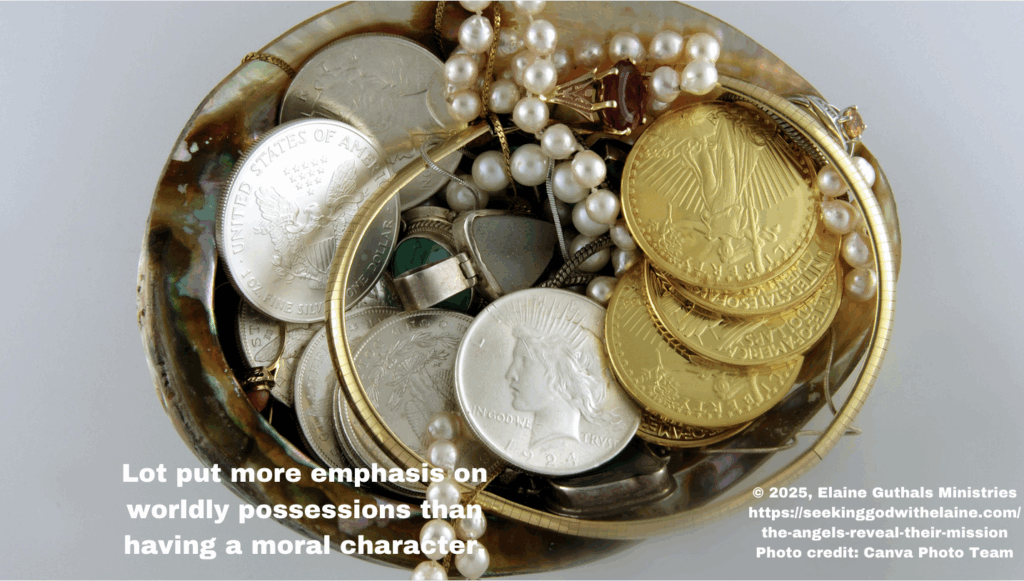
    Lot put more emphasis on worldly possessions than having a moral character.
    Other Relatives

    We have to wonder if Abraham stopped at ten righteous people when he was questioning Jehovah because he thought surely there were ten people in Lot’s household that believed in Him.

    Ooops.

    It is interesting what the angels asked who Lot went to save. The angels said, “… ‘Get them out of this place — your sons-in-law, sons, daughters, or anyone else” (Gen. 19: 12 NLT). “So Lot rushed out to tell his daughters’ fiancés …” (Gen. 19: 14 NLT).

    That tells me Lot didn’t have sons. I don’t think Moses would have told us the fiancés refused to come and not say sons did, too.

    I would use the same reasoning to think Lot and Mrs. Lot only had two daughters.

    Lot’s daughters’ fiancés would have been his sons-in-law eventually. “And Lot went out, and spoke unto his chosonim [chosen], which were pledged to marry his banot [girls] …” (Gen. 19: 14 OJB).

    This tells us that the daughters were in the betrothal stage of the marriage. They were pledged to be married but weren’t yet. They were in the preparation stage.

    Outcry Against this Place

    We talked in Genesis 18 how Jehovah said that He had heard an outcry. The outcry came from the cities themselves. Creation was calling to its Maker for relief.

    Walker took a stab at how creation did that. He wrote, “A cry of blood, like that of Abel’s from the ground, for vengeance against the murderer (Genesis 4:10). Murder, no doubt, was rife in Sodom; and He who had demanded blood for blood, could not overlook it.”

    Resource

    It doesn’t say if Lot’s voice was also heard in the outcry. But he made a silent cry.

    “But God also rescued Lot out of Sodom because he was a righteous man who was sick of the shameful immorality of the wicked people around him. Yes, Lot was a righteous man who was tormented in his soul by the wickedness he saw and heard day after day” (II Pet. 2: 7-8 NLT emphasis added).

    If he was feeling this much anguish about the state of his fellow townspeople, wouldn’t Lot be crying out to Jehovah for relief?

    We can’t gloss over the fact that Lot probably didn’t know the visitors were from Jehovah until verse 13. That is the first time they told him about their mission.

    Let’s go back to the angel’s mission for a second. They were there because Jehovah wanted His messengers to have first-hand knowledge of the extent of the wickedness.

    Oh, yeah. Jehovah knew, but He didn’t make this important judgment until He had all the facts. He knew He could send His trusted messengers to accurately evaluate the situation and report back to Him.

    Jehovah carefully evaluates our relationship with Him before He enacts judgment upon us. I think He looks at our motivations, the situation, the chooses available to us, and our ultimate decision. I would think He takes into consideration what type and degree of punishment we need to get us back on track with Him.

    We are not punished just for punishment’s sake. Jehovah punishes us sanctify us.

    Thought He Was Joking

    Lot had witnessed to his future sons-in-law but didn’t have any effect.

    Lot went to tell the men his daughters were betrothed to that the city was going to be destroyed. The future sons-in-law thought Lot was pulling their legs. They couldn’t see Jehovah destroying one city, let alone all the Cities of the Plains.

    That tells us Lot hadn’t been telling them much about his relationship with Jehovah. He had been planning on yoking his daughters with non-believers.

    Because he hadn’t shown himself set apart from the townspeople, Lot’s warning was dismissed by the two men.

    We can’t ignore or tolerate sin.

    Making the Connections

    “For God made Christ, who never sinned, to be the offering for our sin, so that we could be made right with God through Christ” (II Cor. 5: 21 NLT)

    Jehovah is the Judge Who determines what righteousness is. We don’t.

    Our self-righteousness means nothing to Jehovah. We aren’t saved because we are good people.

    Look what Walker said. He wrote,

    “If this means those whom God shall find naturally righteous, when He comes to take account of such as shall be saved, then the whole human race must be excluded from its benefits, for never since the day of Adam’s fall, was there a man, woman, or child on the earth whom God would or could admit to be righteous in themselves.”

    Resource

    No one is righteous unless Jehovah says we are. Paul said we all have sinned. “For everyone has sinned; we all fall short of God’s glorious standard” (Rom. 3: 23 NLT).

    How Do We Apply This?

    • Live our lives so that worldview people see we are different from them.
    • Don’t discount or disregard a relationship with God.
    • Don’t neglect our relationship with God.

    Resource

    Father God. When we need You, You come to rescue us. Thank You for protecting us and caring for Your children. Amen.

    If you don’t understand something and would like further clarification, please contact me.

    If you have not signed up for the email providing the link to the devotions and the newsletter, do so below.

    If God has used this devotion to speak with you, consider sharing it on social media.
  • Arriving for the Destruction of Sodom and Gomorrah

    God had decided to bring judgment on Sodom and Gomorrah and the cities of the plains. This devotional reading looks at the arrival of the angels and the last chance given to Sodom.

    Nuggets

    • Sodom, as it held the first position in the list of the Cities of the Plains, was the major city of the region.
    • The two angels tasked with checking out Sodom and Gomorrah would have been looking for Abraham’s beloved nephew, Lot.
    • Lot showed the visitors hospitality.
    • Because Lot knew the wickedness of the city, he knew the visitors shouldn’t spend the night in the square.
    • Twice that day, the angels ate because they were in human form.
    • The men of Sodom had wicked plans for the visitors.
    • We tend to think that homosexuality was the sin because of which the cities were destroyed.
    • God doesn’t want us to combat the commission of one sin with another.
    arriving-for-the-destruction-of-sodom-and-gomorrah

    When we left Genesis 18, the angels had left Jehovah so that he could talk to Abraham. They were heading to Sodom to fulfill the mission Jehovah was discussing with Abraham.

    In this chapter, the angels arrive and complete the mission.

    Let’s Put It into Context

    To read devotions in the Creating Everything theme, click the button below.

    Devotions in the Abraham the Patriarch series

    Let’s Put It into Context #2

    Let’s take a look at our timeline.

    1960 BC — Abram born (Gen. 25: 7)
    1890 BC — Terah, Abram, Sarai, and Lot move from Ur to Haran (Gen. 11: 31)
    1885 BC — Abram called at age 75 (Gen. 12: 1-3)
    c. 1880 – 1875 BC — Abram defeats King Chedorkiamer to rescue Lot (Gen. 14)
    1875 BC — God promises an 85-year-old Abram that he will have a son (Gen. 15)
    1874 BC — Ishmael born (Gen. 16: 15)
    1861 BC — God reestablished His covenant with Abram; and Abraham, Ishmael, and males are circumcised (Gen. 17)
1861 BC — Sodom and Gomorrah are destroyed one year before the birth of Isaac (Genesis 18 – 19).

    Resource

    The Visitors Arrived in Sodom

    “That evening the two angels came to the entrance of the city of Sodom. Lot was sitting there, and when he saw them, he stood up to meet them. Then he welcomed them and bowed with his face to the ground” (Gen. 19: 1 NLT)

    Entrance of the City of Sodom

    Sodom, as it held the first position in the list of the Cities of the Plains, was the major city of the region.

    Compared to the garden of the Lord, the plain was well watered. Lot chose it when he separated from Abraham because it was rich in pastureland. It was rich enough to have the four kings in Genesis 13 want it for themselves.

    While we don’t know the city’s exact location, it is believed that Sodom was at the southern end of the Dead Sea. Today, we don’t think of the Dead Sea region as being pastureland.

    The northeastern gate is thought to have been the main entrance to the city. Usually when we hear about the entrance or the gate to a city, we think about it as the place townspeople gathered to govern the city or conduct their business there.

    I like Meyer said was the possible motivation for the angels’ visit.

    • Their love for us
    • Abraham’s prayer
    • Jehovah’s mercy

    Resource

    I like how Meyer contrasted the reasons for Lot and the angels had for being in the city. Lot went for selfish reasons. The angels went for redemptive reasons. That is why the angels were unaffected by the sin while Lot caved to it.

    Meyer also made another great point. The angels were satisfied to complete the mission knowing they would have few that they would be leading out of the cities before its destruction.

    How many times do we feel the success of our ministry means we have led many souls to Christ?

    But look at it this way. How many souls are saved if they don’t have personal engagement with a disciple?

    This one-at-a-time method that Yeshua employs is time consuming and fraught with risks. We are probably going to have a lot more rejections than acceptances.

    Our marching orders are that we are called to spread the message. Acceptance or rejection comes from the work of the Holy Spirit.

    • “And then he told them, ‘Go into all the world and preach the Good News to everyone’” (Mk. 16: 15 NLT).
    • “Therefore, go and make disciples of all the nations, baptizing them in the name of the Father and the Son and the Holy Spirit. Teach these new disciples to obey all the commands I have given you. And be sure of this: I am with you always, even to the end of the age” (Mt. 28: 19-20 NLT).
    • “… And you will be my witnesses, telling people about me everywhere—in Jerusalem, throughout Judea, in Samaria, and to the ends of the earth” (Ac. 1: 8 NLT).

    We can’t forget the fact that the angel’s warning went up the evening before the destruction was set at dawn. They had one night to process their final warning and make their choice to obey or disobey Jehovah.

    Lot Was Sitting There

    The two angels tasked with checking out Sodom and Gomorrah would have been looking for Abraham’s beloved nephew, Lot.

    They found him right away. In fact, they found Lot as they entered the city of Sodom.

    Since it was evening, though, Lot may have just been sitting at the gate to enjoy the evening.

    But Dods had an interesting take. He wrote, “His sitting at the gate in the evening to offer hospitality may fairly be taken as an indication of his desire to screen the wickedness of his townsmen, and also to shield the stranger from their brutality.”

    Resource

    Well, I can see that. Gate police would have been a good indication that Lot was sick about the state of Sodom.

    It would have been a way for Lot to put actions to his feelings. “Yes, Lot was a righteous man who was tormented in his soul by the wickedness he saw and heard day after day” (II Pet. 2: 8 NLT emphasis added).

    We don’t know for sure why Lot was at the gate. All we know is that he was there.

    Lot’s Hospitality

    “‘My lords,’ he said, ‘come to my home to wash your feet, and be my guests for the night. You may then get up early in the morning and be on your way again.’ ‘Oh no,’ they replied. ‘We’ll just spend the night out here in the city square.’ But Lot insisted, so at last they went home with him. Lot prepared a feast for them, complete with fresh bread made without yeast, and they ate” (Gen. 19: 2-3 NLT

    Lot showed the visitors hospitality.

    Be My Guests for the Night

    Lot had lost his father, though we don’t know at what age. It sounds like Abraham had basically raised Lot.

    So, it is logical that Lot would show the same tendencies for hospitality that Abraham did.

    The thing is, if Lot started out with Abraham’s faith in God, he lost some of it along the way. He was tied into the society in Sodom and Gomorrah – and enjoyed it. “When Lot still hesitated, the angels seized his hand and the hands of his wife and two daughters and rushed them to safety outside the city, for the Lord was merciful” (Gen. 19: 16 NLT).

    Lot did provide the visitors with what was needed to wash their feet. Feet washing was an important part of hospitality because sandals were the type of shoes worn. These open shoes allowed the dust – depending on how far they had traveled – to cake on the feet. When they got where they were going, they needed a good wash.

    At a minimum, the host would offer water. If the host had servants or slaves, they would be given the task to perform.

    Lot did show hospitality to the angels. Yes, selfish Lot opened his home to strangers.

    Spend the Night in the Square

    Because Lot knew the wickedness of the city, he knew the visitors shouldn’t spend the night in the square.

    Lot knew they wouldn’t be safe sleeping overnight in the square. In short, he feared for their lives.

    No, Lot probably didn’t see them as angels first off. He just saw them as vulnerable men. His actions should be seen as protection for the defenseless.

    Prepared a Feast

    Twice that day, the angels ate because they were in human form.

    This would have been the second feast the visitors would have had that day. We remember Abraham took out all the stops in preparing his meal.

    When we read verse 3 in the Hebrew, it is interesting. “And he pressed upon them greatly; and they turned in unto him, and entered into his bais [home]; and he made them a mishteh (meal, feast), and did bake matzot, and they did eat” (Gen 19: 3 OJB).

    Matzot is unleavened bread. We know the importance of unleavened bread from the Passover Sadar meal.

    “The bread you eat must be made without yeast from the evening of the fourteenth day of the first month until the evening of the twenty-first day of that month. During those seven days, there must be no trace of yeast in your homes. Anyone who eats anything made with yeast during this week will be cut off from the community of Israel. These regulations apply both to the foreigners living among you and to the native-born Israelites. During those days you must not eat anything made with yeast. Wherever you live, eat only bread made without yeast” (Ex. 12: 18-20 NLT).

    It wasn’t only about the Israelites not having time to have the bread made with yeast rise – although that is a big part. It was also about yeast being a symbol of sin.

    Having the unleavened bread served two purposes. It was a symbol of holy living. It also separated the Israelites from those around them.

    The Song of Israel article showed how the matzah also tied to the Messiah. The bread is striped (as Yeshua was from the whip) and pierced (as He was from the nails).

    Resource

    But of course, that was way after Lot’s time. I just thought it was interesting that this unleavened bread was for the angels.

    Surrounded

    “But before they retired for the night, all the men of Sodom, young and old, came from all over the city and surrounded the house. They shouted to Lot, ‘Where are the men who came to spend the night with you? Bring them out to us so we can have sex with them!’ (Gen. 19: 4-5 NLT)

    All the Men of Sodom

    The men of Sodom had wicked plans for the visitors.

    Poor Lot. He was only trying to provide hospitality for two strangers. He never thought a consequence of that would be every single man from Sodom showing up at his doorstep and surrounding his house.

    That supports Jehovah’s decision to destroy the cities. If every single man in the town was wicked, we can see evidence that Jehovah made the right decision.

    But don’t miss the fact that God gave every man there the final opportunity to repent. How could any repent if they didn’t receive the warning?

    I know. Does that leave out the women and children? Were they just sorry, out of luck?

    I don’t think so. Part of the man’s/husband’s role as spiritual advisor to the family would be to lead his family to Jehovah. Remember, the priestly institution hadn’t been set up yet. The firstborn males were de facto priests.

    The men were to shepherd the women and children to Jehovah.

    That night, they didn’t.

    Let’s look at this in the Hebrew for a second. “But before they lay down, the men of the Ir [city], even the anshei [people] Sodom, surrounded the bais [house], from na’ar [boy] to zeken [beard], all the people from every quarter [of the city]” (Gen. 19: 4 OJB).

    I’d say this was functionally translated. Where the New Living Translation says young and old, the Orthodox Jewish Bible says boy and beard.

    I know. Beard sounds a little funky.

    In Judaism, beards were important. It was more than just an appearance thing.

    Beards represented maturity in Jewish culture. This is not only in wisdom but also in spirituality.

    Moss explained that. He wrote, “It [The beard] is the bridge between mind and heart, thoughts and actions, theory and practice, good intentions and good deeds.”

    Resource

    But think about it. The word translated as perfect really means mature. In other words, the beard expressed – hopefully – a sincere walk with God.

    So We Can Have Sex with Them

    We tend to think that homosexuality was the sin because of which the cities were destroyed.

    I can see how that is thought. The men of Sodom came to Lot’s house interrogate the two visitors at best and rape them at worst.

    But I think it is safe to go with the sexual definition. “And don’t forget Sodom and Gomorrah and their neighboring towns, which were filled with immorality and every kind of sexual perversion. Those cities were destroyed by fire and serve as a warning of the eternal fire of God’s judgment” (Jude 1: 7 NLT).

    It isn’t the only one. “Sodom’s sins were pride, gluttony, and laziness, while the poor and needy suffered outside her door. She was proud and committed detestable sins, so I wiped her out, as you have seen” (Ezek. 16: 49-50 NLT).

    Jehovah will hear the cry of the oppressed. He will see the injustice and lack of compassion. He will not put up with sin.

    Walker reminded us that Jehovah had called the people of The Cities of the Plains to be His children. Remember who we said they were back in Genesis 14.

    Yep, four of the towns contained family. “… The Canaanite clans eventually spread out, and the territory of Canaan extended from Sidon in the north to Gerar and Gaza in the south, and east as far as Sodom, Gomorrah, Admah, and Zeboiim, near Lasha” (Gen. 10: 18-19 NLT emphasis added).

    Just as Jehovah had judged His children in Genesis 11 for building the tower of Babel, He judged the people of the Plains.

    Trying to Deescalate the Situation

    “So Lot stepped outside to talk to them, shutting the door behind him. ‘Please, my brothers,’ he begged, ‘don’t do such a wicked thing. Look, I have two virgin daughters. Let me bring them out to you, and you can do with them as you wish. But please, leave these men alone, for they are my guests and are under my protection’” (Gen. 19: 6-8 NLT)

    God doesn’t want us to combat the commission of one sin with another.

    Lot tried his best to deescalate the situation. He went out to talk with the men and try to reason with them.

    It is interesting that Lot even called them brothers. Remember, in actuality they were cousins. He did that to make a connection with them.

    In today’s society, we question Lot’s decision to offer his two daughters in exchange for protection for two visitors.

    Talk about a moral dilemma! God’s Faithbook brought up a good point. Hospitality in that society seems like it included protection for the visitors. But must the host provide that much protection to his guests at the detriment of his family?

    Resource

    I don’t think Lot believed the men of Sodom only wanted to interrogate the angels, or he wouldn’t have offered his daughters in exchange.

    Look at it this way. The crowd was wanting homosexuality. Lot was offering fornication. Both are sins.

    ·      “Do not practice homosexuality, having sex with another man as with a woman. It is a detestable sin” (Lev. 18: 22 NLT).
    ·      “For out of the heart proceed evil thoughts, murders, adulteries, fornications, thefts, false witness, blasphemies:” (Mt. 15: 19 KJV).

    Still, I can’t see how Jehovah could condone either choice. In the end, the angels provided the protection before it got to that point.

    Lot needed to let Jehovah do His work and not try to take it over or do it on our own.

    Really, Lot put himself into this position. He chose to live in Sodom knowing the moral depravity of the townspeople.

    Do you think that isn’t applicable to today’s society? Think again!

    Don’t we lock our doors? If someone rings the doorbell we don’t know, do we want to answer?

    What if that person asks for money? Asks for a place to stay????

    If you are out driving and see someone broken down on the roadside, and they flag you down, do you stop?

    What do you do?

    Making the Connections #1

    Satan loves to tell us that Jehovah won’t save us because our sin is too great. Or is too engrained in us. Or any other excuse he thinks will manipulate us into not asking Jehovah for forgiveness.

    Satan is wrong. Jehovah knows we are imperfect.

    Jehovah knows our salvation depends on the strength of the cross, not on our strength to do the do’s and don’t do the don’ts.

    Making the Connections #2

    I have to process what Dods said. Let break them down together.

    Dod’s wrote,

    “In the first few hours of his last night in Sodom there is much that is admirable and pathetic in Lot’s conduct. But when we have said that he was bold and that he hated other men’s sins, we have exhausted the more attractive side of his character. The inhuman collectedness of mind with which, in the midst of a tremendous public calamity, he could scheme for his own private [well]-being is the key to his whole character. He had no feeling, lie was cold-blooded, calculating, keenly alive to his own interest, with all his wits about him to reap some gain to himself out of every disaster; …”

    ·      Lot started the evening’s activities by doing the right thing.
    ·      He had a shallow character, even if some part was good.
    ·      He was always working a deal.
    ·      His selfish greed led to him being cold-blooded and calculating.
    ·      He always looked to gain something from every disaster.

    Resource

    I know. That list just doesn’t jive with the two verses in Hebrew.

    “But God also rescued Lot out of Sodom because he was a righteous man who was sick of the shameful immorality of the wicked people around him. Yes, Lot was a righteous man who was tormented in his soul by the wickedness he saw and heard day after day” (II Pet. 2: 7-8 NLT emphasis added).

    It reiterates the fact that salvation isn’t based any anything we do or do not do. It is based on our acceptance of a Savior.

    We have to remember that Lot chose this life himself. He chose to move to Sodom.

    We have to protect our salvation. Living among lowness, wicked people won’t do that.

    How Do We Apply This?

    • Be prepared for judgment even as we go through our daily responsibilities for God.
    • Listen to God when He warns us.
    • Exercise discernment when faced with moral dilemmas.
    • Do not compromise our moral character to fit in with the world.

    Resource

    Father God. Thank You for giving us warning when we have disobeyed You. Unfortunately, some thing we meed more warning than just Your Word. Some think we need angels to come to us. Help us, Lord, to be obedient. Help us to ask forgiveness when we aren’t.

    If you don’t understand something and would like further clarification, please contact me.

    If you have not signed up for the email providing the link to the devotions, do so below.

    If God has used this devotion to speak with you, consider sharing it on social media.
  • Abraham Intercedes for Sodom and Gomorrah

    We finally get to the meat of God’s visit with Abraham. This devotional reading looks at Abraham’s response to God’s plan to judge Sodom and Gomorrah.

    Nuggets

    • Abraham questioned Jehovah about saving the cities until he was down to ten righteous people.
    • Abraham interceded with Jehovah in confidence and doubt.
       
    • Not only was Abraham confident in his relationship with Jehovah, but he also knew Jehovah’s character – and this plan, to Abraham, was out of character.
    abraham-intercedes

    God had told Abraham He had judged Sodom and Gomorrah because of its sinfulness. Abraham had some questions for God.

    Well, really it was a variation of the same question. If You found righteous people there, would you destroy the good with the evil?

    Let’s Put It into Context

    To read devotions in the Creating Everything theme, click the button below.

    Devotions in the Abraham the Patriarch series

    Abraham’s Question

    “Suppose you find fifty righteous people living there in the city — will you still sweep it away and not spare it for their sakes?’” (Gen. 18: 24 NLT) “And the Lord replied, ‘If I find fifty righteous people in Sodom, I will spare the entire city for their sake.’ Then Abraham spoke again. ‘Since I have begun, let me speak further to my Lord, even though I am but dust and ashes. Suppose there are only forty-five righteous people rather than fifty? Will you destroy the whole city for lack of five?’ And the Lord said, ‘I will not destroy it if I find forty-five righteous people there.’ Then Abraham pressed his request further. ‘Suppose there are only forty?’ And the Lord replied, ‘I will not destroy it for the sake of the forty.’ ‘Please don’t be angry, my Lord,’ Abraham pleaded. ‘Let me speak — suppose only thirty righteous people are found?’ And the Lord replied, ‘I will not destroy it if I find thirty.’ Then Abraham said, ‘Since I have dared to speak to the Lord, let me continue — suppose there are only twenty?’ And the Lord replied, ‘Then I will not destroy it for the sake of the twenty.’ Finally, Abraham said, ‘Lord, please don’t be angry with me if I speak one more time. Suppose only ten are found there?’ And the Lord replied, ‘Then I will not destroy it for the sake of the ten.’ When the Lord had finished his conversation with Abraham, he went on his way, and Abraham returned to his tent” (Gen. 18: 26-33 NLT)

    Abraham questioned Jehovah about saving the cities until he was down to ten righteous people.

    Abraham Pressed His Request

    Abraham interceded with Jehovah in confidence and doubt.

    Yeah, Abraham actually had the guts to question Jehovah. But you are probably scratching your heard that I said he approached Him in both confidence and doubt.

    We may wonder that Abraham had the audacity to question Jehovah. But Abraham knew He could confidently approached his Friend. He knew his relationship with Jehovah.

    Abraham approached Jehovah with reverence to His position. He did show confidence in his position with Jehovah. Look how Candlish described the interaction. He wrote,

    “Aspiring to no acquaintance with the secret decrees of God, and standing upon no claim of merit in himself, he has still warrant enough for all the earnestness of this intercessory pleading, in that broad general aspect of the character and moral government of God, to which he expressly refers.”

    Resource

    But Abraham didn’t approach God as an equal friend. He knew he was dealing with Sovereign God. That what the secret decrees is about.

    “The Lord our God has secrets known to no one. We are not accountable for them, but we and our children are accountable forever for all that he has revealed to us, so that we may obey all the terms of these instructions” (Deut. 29: 29 NLT). God is all-knowing – we aren’t.

    Let’s look at how Abraham approached Jehovah.

    • Boldly with reverence.
    • Humbly (verse 27)
    • Acknowledging God’s sovereignty and character.
    • Just between the two of them.
    • Persistently

    Why did Abraham approached God this way?

    • He understand God’s moral government of the world.
    • He understand God’s patience.
    • He acknowledge our position as subordinate.
    • He acknowledge God’s right to determine what is a sin and when and how to judge disobedience.

    Jehovah wants us to boldly approach His throne while we give Him the reverence He deserves as Sovereign God and our Savior.

    We can have confidence in Jehovah’s wisdom and righteousness.

    I Am but Dust and Ashes

    Not only was Abraham confident in his relationship with Jehovah, but he also knew Jehovah’s character – and this plan, to Abraham, was out of character.

    To Abraham, this destruction of the good with the wicked seemed out of character.

    Abraham would have known Noah’s story. Noah would have been Abraham’s great-great-great-great-great-great-great-great-grandfather. He was probably wondering when the equivalent of the ark would be brought up. If Jehovah was willing to save eight people and kill possibly millions, he knew He would save the faithful.

    Plus, Rowlands thought Abraham’s doubt came from the incompatibility of God’s plan with Abraham’s definition of a judge. He wrote, “The position of any judge is one of dignity, authority, and responsibility; he cannot, therefore, maintain his position for a single day unless he do right, and execute justice, and act impartially.”

    Resource

    I know. We look at the condition of Sodom and Gomorrah – and the world today – and question why a righteous Sovereign God allows the lawlessness to go on so long.

    But the doubt also came in, I think, as to how far Abraham wanted to push it.

    Yeah, Abraham was questioning Sovereign God about His plans. That would be scary.

    Again and again, Abraham noted that the lesser was questioning the Greater.

    • “… Since I have begun, … even though I am but dust and ashes” (Gen. 18: 27 NLT).
    • “‘Please don’t be angry, my Lord,’ … (Gen. 18: 30 NLT).
    • “… ‘Since I have dared to speak to the Lord …’ …” (Gen. 18: 31 NLT).
    • “… ‘Lord, please don’t be angry with me if I speak one more time …’…” (Gen. 18: 32 NLT).

    In fact, Dunning thought God brought up His plans so that Abraham could intercede. I wonder if it was a test for Abraham.But Abraham was only a righteous man because he knew he was still a sinful man. He was far from perfect – but he was forgiven.

    Resource

    Abraham could intercede because he was a righteous man. Only those God considers holy can find the power in prayer.

    But Abraham was only a righteous man because he knew he was still a sinful man. He was far from perfect – but he was forgiven.

    Suppose There Are Only

    Thousands of wicked people would have been saved if there had only been ten righteous people.

    We don’t know the actual number of people living in Sodom and Gomorrah when the cities were destroyed. It could have been in the thousands.

    If we really look at the question, we see that it is really just the same question. How many righteous people must You find before You don’t destroy the cities?

    What we can see as the number dwindles that Jehovah was averse to punish the wicked of Sodom and Gomorrah. We can tell because as long as Abraham asked, He answered with they would be saved.

    Jehovah would have much rather they would believe in Him. “I am going down to see if their actions are as wicked as I have heard. If not, I want to know’” (Gen. 18: 21 NLT).

    Jehovah is always open to people repenting from their sins and turning back to Him.

    • “The Lord isn’t really being slow about his promise, as some people think. No, he is being patient for your sake. He does not want anyone to be destroyed, but wants everyone to repent” (II Pet. 3: 9 NLT).
    • “This is good and pleases God our Savior, who wants everyone to be saved and to understand the truth” (I Tim. 2: 3-4 NLT).
    • “For this is how God loved the world: He gave his one and only Son, so that everyone who believes in him will not perish but have eternal life” (Jn. 3: 16 NLT).
    • “As surely as I live, says the Sovereign Lord, I take no pleasure in the death of wicked people. I only want them to turn from their wicked ways so they can live. Turn! Turn from your wickedness, O people of Israel! Why should you die?” (Ezek. 33: 11 NLT).

    But as he got going in the prayer, Abraham asked for more and more. Saving thousands for the sake of 50 is one thing. Saving thousands for the sake of ten is something entirely different. Yeah, that would make him doubt if he should push that far.

    Yet, we’ll find out that, though God didn’t save the cities, He saved three people and tried to save the fourth.

    We think Jehovah is the God of big things, but not the little things. But then, we think He will be offended when we ask for the big things.

    Trench had an interesting comment. Jehovah was more concerned about the absence of good than He was the presence of evil. He wrote,

    “However corrupt any fellowship of men may [be], however far gone in evil, yet so long as there is a sound, healthy kernel in it of righteous men, that is, of men who love and fear God and will witness for God, there is always hope.”

    Resource

    God was concerned that He wouldn’t find ten righteous people. That is one reason why He kept affirming Abraham’s requests.

    Trench likened the ten righteous men to lightning rods. They draw the lightning strikes/Jehovah’s vengeance away.

    I wonder how this conversation strengthened Abraham’s faith. He had to have been comforted that his relationship with Jehovah was at a level where he could ask these questions of Jehovah.

    It probably strengthened Abraham’s resolve to remain obedient to Jehovah.

    Think about it this way. Rowlands said that Sovereign God was really recognizing Abraham’s faith in Him and his selfless concern for others of faith.

    Resource

    Making the Connections #1

    Notice that not once did Abraham ask God to not go to Sodom and Gomorrah to pass judgment on them. He knew the wicked should be punished. He trusted God to judge fairly.

    Instead, Abraham learns about the spiritual condition of the cities from God’s perspective. He sees firsthand God’s patience.

    Did we expect Abraham to go even further and ask salvation of the cites for five righteous people? Maybe even one?

    Dunning had a good handle on this. He wrote, “But the failure of his intercession, if he regarded it as a failure, resulted from his ignorance of the depths of sin, and an inadequate conception of the mercy of God.”

    Resource

    According to Dunning, we shouldn’t try to weasel out of God’s judgment. We should plead for those going against His moral character.

    This also shows us what God values – righteousness. Not self-righteousness, but His righteousness – purity of our character. Not the things we do or don’t do. He only looks at the condition of our hearts.

    Making the Connections #2

    Have you ever looked at Abraham’s intercession as a prayer? Allen called it the first recorded prayer.

    Resource

    Yeah, I’ve long gotten the intercession part. I just wouldn’t call it a prayer.

    God was standing right there in front of Abraham. This wasn’t a get-down-on-your-knees prayer.

    It was a conversation between two beings who were looking at each other in the eyes.

    Making the Connections #3

    We know blessings fall on the just and the unjust. “In that way, you will be acting as true children of your Father in heaven. For he gives his sunlight to both the evil and the good, and he sends rain on the just and the unjust alike” (Mt. 5: 45 NLT).

    Do worldview people understand how many blessings are bestowed upon them because they are around disciples? Do they not get that they would receive judgment if disciples weren’t in their midst? Isn’t that what the concept of The Rapture is all about?

    Fuller gave this warning to worldview people. He wrote,

    “God was willing to spare the worst of cities for the sake of a few righteous characters. This truth is as humiliating to the haughty enemies of religion as it is encouraging to its friends, and furnishes an important lesson to civil governments, to beware of undervaluing, and still more of persecuting, and banishing men whose concern it is to live soberly, righteously, and godly in the world. Except the Lord of Hosts had left us a remnant of such characters, we might ere now have been as Sodom, and made like unto Gomorrah!”

    Resource

    Making the Connections #4

    “Ooo, baby. Mason didn’t mince words about bad prayers. He wrote, “Any other prayer must be a mockery and an abomination in the sight of God. Any other prayer is an insinuation that man is a better being than his Maker.”

    Resource

    We really don’t want to approach God with a better-than-thou attitude. An abomination is a disgrace and a horror.

    We want to approach God with honor and reverence – and above all, love.

    Making the Connections #5

    I love what Jowett said about approaching the throne of grace. He wrote, “He must lie low, and aim high.”

    Resource

    How many times do we get that backwards? We go in high and aim low.

    Making the Connections #6

    Go back to Trench’s comment. Let’s look at it again so that we won’t have to scroll back. He wrote,

    “However corrupt any fellowship of men may [be], however far gone in evil, yet so long as there is a sound, healthy kernel in it of righteous men, that is, of men who love and fear God and will witness for God, there is always hope.”

    Resource

    If the angels would have found ten righteous men in the cities of Sodom and Gomorrah, those cities would have been saved.

    What did Jesus say. “‘…’ Jesus told them. ‘I tell you the truth, if you had faith even as small as a mustard seed, you could say to this mountain, “Move from here to there,” and it would move. Nothing would be impossible” (Mt. 17: 20 NLT).

    If Jesus finds faith the size of a mustard seed in us, we will have salvation. It isn’t about the size of our faith, but it is about Who our faith is in.

    Making the Connections #7

    Let’s face it. We know, while Abraham was praying for the cities, he was mostly praying for Lot. And that is okay.

    Abraham was probably praying for Lot and his family’s safety. But that meant he was praying that God found them righteous. Because it was “if you found 10 righteous people” (Gen. 18: 32 NLT).

    Remember, we don’t know for sure how many were in Lot’s family. Surely, there was a son or two, but that isn’t guaranteed. If he had two married sons, that would be 10 people counting the daughters’ betrothed.

    But back to Abraham. What have we been saying since Ur that his Sanctification Road was built on separation.

    God was isolating Abraham – even from his family – for something bigger.

    When we first met Lot, he was never around for anything but the road trips. We never heard that he helped build the altars.

    Some might call Lot a fake person. If he was around and Moses just didn’t add that tidbit, we might call Lot as masquerading as a goat in sheep’s clothing.

    Let’s be real. Fake people and fake sheep wouldn’t want to around a righteous person. They have little in common with them.

    On top of that, Satan wouldn’t be able to stand it.

    We don’t know for sure. What we do know is that God was separating people from who would take Abraham’s focus off Him.

    God does that to us, too. As painful as it may be, that is God’s plan for us. For as long or as short of a time, God is with us while we are adding bricks to our Road.

    How Do We Apply This?

    Pray and intercede for others, even when we feel it is in vain.
    Don’t shy away from acknowledging and repenting our sin.
    Give God reasons for answering our prayers.
    Approach God in increasing earnestness.
    Humbly approach God with high expectations.

    Resources

    Father God. We are like Abraham at times. We approach You hesitantly. But You want us to approach You boldly. Help us to intercede for other righteous disciples. Amen.

    If you don’t understand something and would like further clarification, please contact me.

    If you have not signed up for the email providing the link to the devotions and the newsletter, do so below.

    If God has used this devotion to speak with you, consider sharing it on social media.
  • God Told Abraham His Plan for Sodom and Gomorrah

    God started a conversation with Abraham after Abraham’s hospitality. This devotional reading looks at how He told him His plans for the cities’ destruction.

    Nuggets

    • Sodom and Gomorrah were wonderful cities.
      Jehovah said that He had heard an outcry.
    • Sin was rampant and horrific in Sodom and Gomorrah.
    • At first read, some may think that Jehovah really doesn’t know what was happening in Sodom and Gomorrah.
    • The angels leave God with Abraham to have their talk.
    • Abraham was afraid that Jehovah would wipe out the righteous as well as the unrighteous, but he knew He wouldn’t.
    god-told-abraham-his-plan-for-sodom-and-gomorrah

    We have been talking about Abraham’s hospitality for and discussion with his Friend, Jehovah. We know that God has plans that He hasn’t shared yet.

    After weighting things out, God chose to share the plan with Abraham. Let’s see how He does it.

    Let’s Put It into Context

    To read devotions in the Creating Everything theme, click the button below.

    Devotions in the Abraham the Patriarch series

    Sodom and Gomorrah’s Judgment

    “So the Lord told Abraham, ‘I have heard a great outcry from Sodom and Gomorrah, because their sin is so flagrant. I am going down to see if their actions are as wicked as I have heard. If not, I want to know’” (Gen. 18: 20-21 NLT)

    Sodom and Gomorrah were wonderful cities.

    Foster described Sodom and Gomorrah as beautiful cities. Its position on the Babylon to Egypt trade route made Sodom prosperous.

    Resources

    The problem, though, was humans. Sin had become rampant again, possibly from the abundance of idleness.

    Dykes, though, didn’t find any evidence of culture or refinement.

    Resource

    Great Outcry

    Jehovah said that He had heard an outcry.

    We know that God can hear us from Heaven. But from whom did the outcry originate?

    No, it wasn’t from Abraham, lamenting that humans had become as sinful as they had been before the flood. We really haven’t been told to this point that he was concerned whether others believed or not.

    Jehovah had personal knowledge that there was evil in Sodom and Gomorrah.

    The outcry came from the cities themselves. Creation was calling to its Maker for relief.

    Think about it. We know that Jesus calmed the storm (Mk. 4: 35-41). Creation obeyed the voice of its Creator.

    When Jesus was entering Jerusalem during the Triumphant Entry, He said the rocks would cry out. “But some of the Pharisees among the crowd said, ‘Teacher, rebuke your followers for saying things like that!’ He replied, ‘If they kept quiet, the stones along the road would burst into cheers!’” (Lk. 19: 39-40 NLT).

    Sin Is Flagrant

    Sin was rampant and horrific in Sodom and Gomorrah.

    We’ll find out one of the sins of the cities was sexual immorality. We can deduct from the fact that there was not ten righteous men in the cities that there were thousands that cursed Jehovah. There was probably a big dose of pride. Gilfillan wondered if there was child sacrifices.

    Gilfillan described the situation in Sodom and Gomorrah. He wrote,

    “Had there been but one prevalent evil practice in Sodom, there is something so disgusting, and at the same time comparatively so rare, in the sin which bears the name of the city, that it might have been as well, perhaps, to have passed it over in silence. But it is evident that the peculiar iniquity of Sodom was only the climax and consummation of the general depravity of the place.”

    Resource

    I Want to Know

    At first read, some may think that Jehovah really doesn’t know what was happening in Sodom and Gomorrah.

    Nothing is further from the truth. Jehovah wasn’t going there to make an initial evaluation. He is going to make a final evaluation.

    The purpose was to pull out the righteous.

    Trench helped us understand this. He wrote,

    “The judgments of God from time to time overtake guilty nations and guilty men; but, huge and overwhelming catastrophes as these often are, there is nothing hasty, blind, precipitate about them. He is evermore the same God who, when the cry of Sodom and Gomorrah waxed great, is described as going down to see and inquire whether they had “done altogether according to the cry of it.”

    Resource

    Jehovah wants us to evaluate our lives. First, we do it to determine if we need salvation. Then, we continue to evaluate ourselves to ensure we are navigating the Sanctification Road. We identify the areas Jehovah is working in our lives to make us more like Him.

    In other words, this evaluation gives us a clear view of our sins.

    Dunning brought up something interesting. Maybe I want to know really meant were they ripe for judgment.

    Resource

    Was God giving them one last chance to turn to Him?

    The Angels Take Their Places

    “The other men turned and headed toward Sodom, but the Lord remained with Abraham” (Gen. 18: 22 NLT)

    The angels leave God with Abraham to have their talk.

    Do we think it is strange that Jehovah came this far but didn’t go any farther? Especially since He said that He wanted to know in verse 21.

    At times, Jehovah does things Himself. He shut door of ark (Gen. 7: 16).  He was in the burning bush to commission Moses (Ex. 3: 4).

    At other times, Jehovah sends His messenger.

    We don’t know that Jehovah didn’t go with the two angels. No, He wasn’t visible, but that doesn’t mean He wasn’t there.

    But look at the two angels. They calmly left the dinner with their Master and friend and walked to Sodom and Gomorrah to carry out their assignment.

    Yes, they were going to mete out vengeance. But they didn’t go to the cities with anger or even fanfare.

    Abraham’s Response to the Plan

    “Abraham approached him and said, ‘Will you sweep away both the righteous and the wicked?’” (Gen. 18: 23 NLT)

    “Surely you wouldn’t do such a thing, destroying the righteous along with the wicked. Why, you would be treating the righteous and the wicked exactly the same! Surely you wouldn’t do that! Should not the Judge of all the earth do what is right?’” (Gen. 18: 25 NLT)

    Abraham was afraid that Jehovah would wipe out the righteous as well as the unrighteous, but he knew He wouldn’t.

    Abraham knew God. He knew that God would not execute the righteous with the unrighteous, but he had to ask.

    In fact, this question probably just came flying out of Abraham’s mouth before the brain engaged. We can see why.

    Dunning wondered if Abraham was blindsided by the judgment on the cities. This is a rather abrupt tone.

    Resource

    As we read on, we’ll find out that God did not call Abraham out on this. Maclaren told us why. He wrote, “The boldest words from a loving heart, jealous of God’s [honor], are not irreverent in His eyes.”

    Resource

    Meyer thought that, beyond his concern for Lot. Abraham was concerned how others would respond to God’s destruction of the cities. He didn’t want others to turn away from God because of this.

    Resource

    Abraham knew Jehovah as a merciful God. He wanted others to know Him as he did.

    I wonder if Abraham kind of felt like Noah stepping off the ark. He had never seen Jehovah’s judgment like this in the almost 25 years of his life as a believer. In fact, he hadn’t seen this level of destruction in his lifetime.

    Abraham now knew Jehovah’s judgment of those who habitually sinned and chose to turn away from Him.

    Think about it. Disciples are called to look different than worldview people. We aren’t supposed to have the same values and social norms they have.

    Why would we expect the same severe judgment?

    Let’s look at the Hebrew here. “And Avraham drew near, and said, Wilt Thou also destroy the tzaddik [righteous] with the rasha [morally wrong]?” (Gen. 18: 23 OJB).

    Remember, morally wrong means that they were deviating from God’s Will, law, and commandments.

    We know that Jehovah does not always save His children from trials and persecution. Disciples are not exempt from suffering the results of sin. Neither are we.

    However, we are not given the judgment of the unrighteousness.

    Think about Noah. Out of the unknown number of people present on earth at that time, eight people were saved.

    “… Noah was a righteous man, the only blameless person living on earth at the time, and he walked in close fellowship with God” (Gen. 6: 9 NLT emphasis added). Seven other people were saved because of the faith of one man.

    Jehovah will not judge the righteous with the unrighteous. Otherwise, why would we choose to submit to Him?

    So, was Abraham asking God to change His mind? Wouldn’t he have known that God is immutable?

    Mason felt it was Abraham telling God that His plan was wonderful – but could He give him a clue as to some details.

    I know. Don’t we wish God would share some plans with us once in a while? And give us a few more details!!!

    Mason said something spot on. He wrote, “The mercy which is prayed for is not an exception from righteousness, but the fruit of it.”

    Resource

    We become righteous only through a greater connection with God. Our concern for other’s salvation comes out of that connection.

    It was that connection that created the surety that God would not destroy the righteous along with the wicked that fostered Abraham’s boldness. He knew God as a Father, not just as Judge.

    Think about this. God is righteous, so that He can do no wrong. If He can’t do wrong, He won’t approve of us doing wrong.

    Making the Connections #1

    We may think Sodom and Gomorrah had no warnings to turn from their sinful ways. But Gilfillan said they did.

    Resource

    There first warning was the arrival of Lot. I know we bit pretty hard on him back in Genesis 13, but by the end we had a different picture of him.

    Remember, we talked about Lot’s Christian worldliness.

    Robinson argued that, however we may judge Lot in Genesis 13, by the time he left Sodom in Genesis 19, he was a righteous man. He was sick of the culture in which he lived.

    “But God also rescued Lot out of Sodom because he was a righteous man who was sick of the shameful immorality of the wicked people around him. Yes, Lot was a righteous man who was tormented in his soul by the wickedness he saw and heard day after day” (II Pet. 2: 7-8 NLT emphasis added).

    Okay, maybe the warning wasn’t with Lot’s arrival. It was obvious to others by Lot’s turning to/turning back to Jehovah. His friends and neighbors would have seen a difference between him and them.

    The second warning was when King Chedorlaomer and the invaders from the east arrived in Genesis 14. Oh, yeah. Defeat is a good warning.

    Surely, they would have known about Abraham, at a minimum. They may even have known about Melchizedek.

    But that didn’t deter them. They kept on sinning anyway.

    Making the Connections #2

    The first question may have come flying out of Abraham’s mouth, but he knew one thing. Jehovah devised the good and orders the evil.

    That is one reason that Jehovah is Judge.

    Another reason is all-seeing, all-knowing Jehovah is the best One for the job. “… For the LORD is a God who knows what you have done; he will judge your actions” (I Sam. 2: 3 NLT).

    Still another reason is Jehovah can do no wrong. “God’s way is perfect. All the Lord’s promises prove true. He is a shield for all who look to him for protection” (Ps. 18: 30 NLT).

    How Do We Apply This?

    • Remain obedient to Jehovah.

    Resource

    Father God. You trusted Abraham because he had faith to believe in You. Thank You when You share Your plans with us. Fortify us to discern Your Will when You do not. Amen.

    If you don’t understand something and would like further clarification, please contact me.

    If you have not signed up for the email providing the link to the devotions, do so below.

    If God has used this devotion to speak with you, consider sharing it on social media.
  • God Didn’t Hide His Plan from Abraham

    God doesn’t always tells us His plans. This devotional reading looks at God’s thought process in whether to tell Abraham about His plans or not.

    Nuggets

    • Abraham walked with them a bit when they started on their way, allowing God to tell Abraham His plans.
    • Sometimes, God shares His plans with us, though not always.
    • God chose to reveal the plan to Abraham because He did honor him.
    • Because God had honored Abraham, he inherited a great responsibility toward his family.
    god-didn’t-hide-his-plan-from-abraham

    Abraham had been host to God and two angels. As they are leaving, God wrestles with Himself whether He should share His plans with him.

    Let’s Put It into Context

    To read devotions in the Creating Everything theme, click the button below.

    Devotions in the Abraham the Patriarch series

    Leaving the Hospitality

    “Then the men got up from their meal and looked out toward Sodom. As they left, Abraham went with them to send them on their way. ‘Should I hide my plan from Abraham?’ the Lord asked. ‘For Abraham will certainly become a great and mighty nation, and all the nations of the earth will be blessed through him’” (Gen. 18: 16-18 NLT)

    Abraham walked with them a bit when they started on their way, allowing God to tell Abraham His plans.

    It looks like God is debating with Himself on whether or not He should say anything to Abraham. No, God isn’t undecided.

    I think God was just allowing us to know why He was starting this conversation.

    Hide my Plan

    Sometimes, God shares His plans with us, though not always.

    Sovereign God has plans for each of us. “For I know the plans I have for you,” says the Lord. “They are plans for good and not for disaster, to give you a future and a hope” (Jer. 29: 11 NLT).

    But God does not always tell us everything. “The LORD our God has secrets known to no one. We are not accountable for them, but we and our children are accountable forever for all that he has revealed to us, so that we may obey all the terms of these instructions” (Deut. 29: 29 NLT).

    We see this affirmed in Revelation. “The LORD our God has secrets known to no one. We are not accountable for them, but we and our children are accountable forever for all that he has revealed to us, so that we may obey all the terms of these instructions” (Rev. 10: 4 NLT).

    Don’t read over this. Abraham had never asked God why He was there. He wasn’t trying to get a glimpse into God’s secret plans.

    True, God had already given Abraham the timeline for his plan. The promised son would come in a year.

    No, I don’t think Abraham didn’t ask because he didn’t care. I think that he knew God would tell him if it was his business to know.

    Look what Candlish said. He wrote,

    “Nor in this pleading does Abraham arrogate anything to himself. He has boldness and access, with confidence, by the faith of Jesus. He has liberty to converse with God as a friend, to give utterance to his feelings and desires before Him, to represent his own case and the case of every one for whom he cares; and not for himself only, but for others, yea, indeed for all, to invoke the name of Him whose memorial to all generations is this: “The Lord, the Lord God merciful and gracious, long-suffering, and abundant in goodness and truth; keeping mercy for thousands, forgiving iniquity, transgression, and sin, and that will by no means clear the guilty” (Exodus 34:6, 7).”

    Resource

    I read that to mean that Abraham knew that anyone who had the faith he did had the same access.

    We know we have this same access. We call it seeking God.

    Searching for and Seeking God

    Non-believers search for God.
    Disciples seek Him.

    Hearing His Word (Rom. 10: 17)
    Reading His Word (Rev. 1: 3)
    Praying to Him (Heb. 4: 16)
    Studying His Word (Ac. 17: 11)
    Meditating on His Word (Ps. 1: 1-2)
    Memorizing His Word (Ps. 119: 11)

    You know, those elements are missing one thing. I don’t talk about the need to worship God.

    We access God through worshiping Him. If we can’t worship Him, are we really truly seeking Him?

    Leale said that this communication with God is a privilege of our friendship with Him. True – if we aren’t His friend, we can’t communicate with Him.

    Resource

    We keep saying that is isn’t about religion. It is about relationship. We have to communicate to have a relationship.

    Honor Already Granted to Abraham

    God chose to reveal the plan to Abraham because He did honor him.

    God didn’t have to revel His plan to Abraham. He chose to do so.

    The reason God chose to tell Abraham His plans was that He had plans for Abraham.

    • Abraham’s descendants will become a strong nation.
    • Through him, all the world will be blessed.
    • He will instruct his children to follow God.

    Fuller reminded us that God had a special interest in the nation of which the Abraham would be the father. That is why He wanted to talk with His friend about His plans.

    Resource

    Everything God has out in His Word is there for a reason – the good, the bad, and the ugly.

    Inclusion doesn’t mean God is approving of the actions. In fact, it is probably the opposite. God can also just be showing us the condition of mankind.

    Another head-scratching verse is when God said He was “… going down to see if their actions are as wicked as I have heard. If not, I want to know” (Gen. 18: 21 NLT).

    God is all-seeing. He knows.

    I read this to say that God was giving them a chance to repent.

    Aren’t we like that? We want to know how far we can go before we can’t get away with it anymore.

    We shade it to make it look like we are trying to stay obedient. Really, we just want to know how much sin we can keep.

    God Had Plans for Abraham

    “I have singled him out so that he will direct his sons and their families to keep the way of the Lord by doing what is right and just. Then I will do for Abraham all that I have promised’” (Gen. 18: 19 NLT)

    Because God had honored Abraham, he inherited a great responsibility toward his family.

    Ooo, baby. Abraham did have a great responsibility. Let’s look at what the Hebrew says.

    “For I know him, that he will command his children and his household after him, and they shall be shomer [guard] over the Derech Hashem [the Way of God], to do tzedakah [charity, righteousness] and mishpat [judgment, justice, ordinance, legal right]; that Hashem may bring upon Avraham that which He hath spoken [promised] of him” (Gen. 18: 9 OJB).

    God knows Abraham. It isn’t about having head-knowledge about Him. God knew Abraham’s heart and that His belief and love of God was at the heart-level.

    Does it seem strange that God said, “For I know him, that he will command his children and his household after him …” (Gen. 18: 9 OJB). It shouldn’t.

    Hastings had a slightly different definition of knew. He argued it wasn’t only Abraham’s knowledge, but it was also God’s approval of his conduct.

    Resource

    God knows Abraham will witness to his descendants. Bedtime stories, celebrations, everyday conversations – this was how he would command/direction his descendants about Who God is and what He wants from us.

    We do know that in some prior cultures, the father was an authoritarian. No, Abraham isn’t taking away his descendants’ free will. He was fulfilling his responsibility as a parent and as a child of God.

    What Abraham was to pass on to his family was the things that qualified him for being the father of nations. Emmons said that Abraham would be expected to dedicate, instruct, and restrain his children.

    • Knowledge
    • Piety
    • Virtue
    • Authority
    • Fidelity
    • Diligence

    Resource

    Why is family government so important? It is one way in which God’s Gospel is spread from generation to generation. Neglecting to do so makes them disobedient to God. 

    • “Direct your children onto the right path, and when they are older, they will not leave it” (Prov. 22: 6 NLT).
    • “Fathers, do not provoke your children to anger by the way you treat them. Rather, bring them up with the discipline and instruction that comes from the Lord” (Eph. 6: 4 NLT).
    • “And you must commit yourselves wholeheartedly to these commands that I am giving you today. Repeat them again and again to your children. Talk about them when you are at home and when you are on the road, when you are going to bed and when you are getting up” (Deut. 6: 6-7 NLT).

    Nothing is more important than keeping the Way of God.

    Melvill told us what this is at stake here. He wrote,

    “Such an expression seems to imply that there is no tendency in children to walk in the right way. They have to be dealt with in the way of command — as though, if left to themselves, the almost certainty is that they will walk in the wrong.”

    Resource

    That brings up an important occurrence more times than not. Grandparents went to church faithfully and took Parents. But Parents rebelled and left the Church. So, they never took Children to introduce them to God.

    Grandparents tried to keep the Way of God.  Parents and Children will be judged on Judgment Day. Their eternity is at risk if not assured.

    Making the Connections #1

    Just as we know there are plans that we need to follow, we also have to know that there are consequences for those that do not follow the plans.

    No, it isn’t every day that suffer rains from the skies and destroys two cities. However, meteorological events do happen — tornadoes, hurricanes, floods.

    How would we know the why behind the destruction of Sodom and Gomorrah if God hadn’t told Abraham?

    Making the Connections #2

    Leale made an interesting comment. He wrote, “Abraham was not only a saint, but also a representative man, through whom God intended to convey great blessings to mankind.”

    Resource

    My first thought was, “Huh.” But then I thought about it.

    “I will make you into a great nation. I will bless you and make you famous, and you will be a blessing to others. I will bless those who bless you and curse those who treat you with contempt. All the families on earth will be blessed through you” (Gen. 12: 2-3 NLT).

    I think I would have used a different word than representative. I would use foundation, instead.

    A representative means that we would look like Abraham. We do physically, but do we all spiritually? Some, yes; some, no.

    I say foundation because we should want to look like Abraham and have a faith like his.

    Thinking through this, maybe both are correct. Abraham is the foundation, but we should want to be like him, making him our representative.

    Making the Connections #3

    The Congregational Pulpit is right. God has revealed to us some of His secrets.

    • We know Jesus will return.
    • We know the world as we know it will end. This planet is scheduled for destruction.
    • We know all will be judged and rewarded or punished accordingly.

    Resource

    Making the Connections #4

    Yes, parents can teach their children the Way of God. Why doesn’t it stick?

    Melvill addressed that. He wrote,

    “When you come to think on what right training is, a system of example as well as of precept, you must assuredly see how likely it is that the best training has been defective — that even parents who have taken most pains have failed in thoroughly educating their children for God; and of course it is vain to urge that the Divine promise has not been accomplished, so long as there could be doubt as to whether the condition on which it is made has been rigidly complied with.”

    Resource

    Pastor Steve and I had this conversation the other day. We are called to witness to people. It is up to God to save them.

    Oh, yeah. We would love to be able to make the decision for them – but we can’t. They must decide on their own to follow God’s Way.

    All we can do is be obedient to the tasks God has for us.

    Making the Connections #5

    We have to remember that, at this point, the chosen son wasn’t born, but the first-born son had been. Ishmael would have just enter his teenage years.

    Abraham would also have servants and slaves to whom to witness. We don’t know how many this entailed, but we do know he was wealthy.

    This could be a significant number of people. They would have been under Abraham’s care.

    That makes it even more important for us to be an example and witness for God.

    Making the Connections #6

    It just hit me that there is only one other altar that Abraham builds after this point. It was the one to sacrifice Isaac.

    But then, Abraham stayed put at Mamre, where he had built his third of the fourth altars.

    • Shechem: Abram built his first altar upon entering the land of Canaan (Gen. 12: 7).
    • Bethel: He constructed an altar between Bethel and Ai as a place of worship (Ge. 13: 3).
    • Hebron: Abram built an altar in the region of Mamre, near Hebron (Gen. 13: 18).
    • Mount Moriah: Abraham prepared an altar for the sacrifice of Isaac, demonstrating his faith (Gen 22: 9).

    In other words, Abraham didn’t have to build more.

    That doesn’t mean Abraham didn’t pray with and intercede for his family. That is one of the main ways he would have introduced his God to his family.

    Abraham wanted his family to have what he had. Benson told us what that was. He wrote,

    “Family-blessings arise from family religion; — temperance, frugality, industry, discretion — peace, quietness, love, harmony — the [favor], protection, and care of God; His direction and aid — all necessaries (Psalm 37:25; Matthew 6:33) — prosperity, as far as will be good for us, and our families.”

    Resource

    How Do We Apply This?

    • Be friends with God so He will open up to us about His plans.
    • Be different from the world.
    • Pray for others to become God’s friends.
    • Always do that which God requires of us.
    • Worship as a family.
    • Ensure our house, habits, associates, pursuits, and recreations show the Way of God.

    Resources

    Father God. Lord, may we have faith like Abraham’s where You would feel confident in sharing Your plans with us. Help us watch and wait when You don’t. Amen.

    What do you think?

    Leave me a comment below (about this or anything else) or head over to my Facebook group for some interactive discussion.

    If you don’t understand something and would like further clarification, please contact me.

    If you have not signed up for the email providing the link to the devotions and the newsletter, do so below.

    If God has used this devotion to speak with you, consider sharing it on social media.
  • A Breakdown of Hospitality

    Sarah’s response was less than favorable to God’s restatement of the promise of a child. This devotional reading examines how Sarah’s response to the proclamation compared to Abraham’s.

    Nuggets

    • Sarah shouldn’t have been in the tent.
    • Sarah shouldn’t have laughed at the promise.
    • Sarah not only laughed, but she also denied that she laughed.
    a-breakdown-of-hospitality

    Sarah played an important role in the covenant between God and Abraham. She was the mother of the promised child.

    Sometimes, we don’t think about how much it probably was Sarah’s covenant, also. Part of that reason is because God never really talks to her.

    Even when God came to talk with Abraham in Genesis 18, Sarah didn’t perform the normal hospitality duties of the wife. When God finally says three words to Sarah, they were a mild rebuke.

    Let’s Put It into Context

    To read devotions in the Creating Everything theme, click the button below.

    Devotions in the Abraham the Patriarch series

    Hiding in the Tent

    “‘Where is Sarah, your wife?’ the visitors asked. ‘She’s inside the tent,’ Abraham replied” (Gen. 18: 9 NLT)

    Sarah shouldn’t have been in the tent.

    I don’t know enough about hospitality practices in Abraham’s time. When I googled it, it said that Sarah would have been expected to welcome and serve guests.

    So, why was she eavesdropping in the tent?

    If we look at the three Visitors as strangers, we might think it off that the One would ask where Sarah was.  Wouldn’t a total stranger who was benefiting from your hospitality ask if all your family was well? Of course, he would ask after the wife.

    Same may think it was strange when we know it was God asking.

    Yes, God is all knowing and all-seeing. But He isn’t a dictator. He asks us to join in the conversation. He allows us to truly converse with Him.

    God knows me well enough to know that talking it through clarifies things for me. Who better to talk it through with than the One in control?

    This shows that God was approaching Abraham as a friend. He didn’t have to stop there that day. He didn’t have to answer the questions Abraham asked when He was leaving.

    God came to visit His friend Abraham — just as He is our friend.

    What? Did you think Jesus was the only One Who is our friend? God and Jesus are both our friends.

    • “Inside the Tent of Meeting, the Lord would speak to Moses face to face, as one speaks to a friend. Afterward Moses would return to the camp, but the young man who assisted him, Joshua son of Nun, would remain behind in the Tent of Meeting” (Ex. 33: 11 NLT).
    • “I no longer call you slaves, because a master doesn’t confide in his slaves. Now you are my friends, since I have told you everything the Father told me” (Jn. 15: 15 NLT).

    We know that God wants to have an intimate relationship with us.

    God knew Sarah better than she knew Him. He knew she was going to doubt His promise. He knew her faith was weaker.

    God used Sarah anyway.

    A Timeline to Fulfill the Promise

    “‘Then one of them said, ‘I will return to you about this time next year, and your wife, Sarah, will have a son!’ Sarah was listening to this conversation from the tent. Abraham and Sarah were both very old by this time, and Sarah was long past the age of having children. So she laughed silently to herself and said, ‘How could a worn-out woman like me enjoy such pleasure, especially when my master — my husband — is also so old?’” (Gen. 18: 10-12 NLT)

    Sarah shouldn’t have laughed at the promise.

    This isn’t the first time God told Abraham that Sarah was going to give him a son. “Then the Lord said to him, “No, your servant will not be your heir, for you will have a son of your own who will be your heir” (Gen. 15: 4 NLT).

    This was the first time God out it on the calendar.

    Why does God tell us when some things are going to happen and other times not? Either way, He is testing our faith.

    Why does God tell us that He will answer our prayers in some impossible way? So that, when it happens in just that way, we can say that it was only God Who did it and did it the way He promised.

    When God doesn’t tell us how or when He will answer our prayers, He is expecting us to see His hand in it when it does happen.

    At first, we think we can’t come down hard on Sarah for laughing. That was Abraham’s response, too. “Then Abraham bowed down to the ground, but he laughed to himself in disbelief” (Gen. 17: 17 NLT).

    Well, yes, we can. Abraham believed when he was called on it. Sarah denied.

    Leale talked about our faith being paralyzed by fear. Abraham wasn’t, but Sarah was. Compare both of their responses.

    • “So Abraham said to God, ‘May Ishmael live under your special blessing!’” (Gen. 17: 18 NLT).
    • “Sarah was afraid, so she denied it, saying, ‘I didn’t laugh.’ But the Lord said, ‘No, you did laugh’” (Gen. 18: 15 NLT).

    Resource

    Yes, Abraham laughed because he knew it was impossible, so he offered Ishmael as a second choice. I don’t think that Abraham thought the rest of the covenant couldn’t happen.

    As Leale said, Abraham’s paralyzation was momentary. Sarah’s was a bit longer.

    I think God expects us to question Him a little — through faith — when He promises to do the impossible. If we didn’t, we may be telling Him that we thought it was possible naturally.

    How can we be worshiping the God of the Impossible if we just go, “Oh, okay,” when he says he is going to have old people become parents, or a virgin become a mother — or untested people like us — regardless of our age — do whatever He is calling us to do?

    We have to acknowledge that something is happening only because God is powerful enough to make it happen. “I have no idea how You are going to pull this off, but then, You know a lot more than I do and can do anything You want.”

    A Sin Leading to Another Sin — Once Again

    “Then the Lord said to Abraham, ‘Why did Sarah laugh? Why did she say, “Can an old woman like me have a baby?” Is anything too hard for the Lord? I will return about this time next year, and Sarah will have a son.’ Sarah was afraid, so she denied it, saying, ‘I didn’t laugh.’ But the Lord said, ‘No, you did laugh’” (Gen. 18: 13-15 NLT)

    Sarah not only laughed, but she also denied that she laughed.

    Maybe it was a knee-jerk reaction. Probably not.

    In essence, Sarah was calling God a liar because He was speaking the truth. God knows what is on our minds, so we can’t hide anything from Him.

    Maybe worse yet, Sarah may not have thought the promise would really come to fruition. Then, here sits God says, “Hey, it’s now on the calendar. There is no way out.”

    Aren’t there times that we think even the promise we asked for is nice and shiny – until it is on the calendar. We are forced to think about all the diapers we will have to change, runny noses we will have to wipe, terrible two tantrums to teenage rebellion that the only way we are going to get through is to just deal.

    Cue incredulity. All the sudden it doesn’t look. So shiny. How do we do a 180o and still save face?

    That may have been a part of Sarah’s response.

    We can’t forget the fact that Abraham and Sarah have been waiting so long. It will be 25 years since God first told Abraham that he would have descendants.

    1885 BC — Abram called at age 75 (Gen. 12: 1-3)
    1875 BC — God promises an 85-year-old Abram that he will have a son (Gen. 15)
    1861 BC — God reestablished His covenant with Abram (Gen. 17)
    1860 BC — Isaac born (Genesis 35: 28)

    Resource

    That’s a long time.

    Aren’t there times when we want some kind of confirmation that God is going to keep His promise regardless of how long it is taking and how impossible it is? Oh, yeah.

    While I was writing this, Honest by Leanne Crawford came on. It seemed to fit here.

    Related Links

    Leanna Crawford

    Look at God’s response. “Yes, you did” lie. That was pretty mild.
     
    I think what this probably tells us is that Sarah’s faith wasn’t as rock solid as Abraham’s, but that doesn’t mean she didn’t have faith.
     
    It was more than that, though, wasn’t it? We talked about Leale saying part of Abraham’s response was adoration and joy. The Homilist said Sarah’s response was incredulity.

    Resources

    In other words, Abraham’s response was worship. Sarah’s was a sin.

    Sarah may have thought she was being sensible in not betting the bank on an impossible promise. God doesn’t want to hear that. He wants obedient acceptance.

    This is another instance of one sin leading to another. We have to be careful.

    Making the Connections #1

    Let’s take a minute to check the score card. Dod’s told us what to look at.

    • Sarah was impulsive in yielding her wifely rights in her plan to get a son.
    • She was even seemingly generous in her conduct towards Hagar – at first.
    • She couldn’t follow through when she got the result she wanted.
    • Sarah isn’t fulfilling her duties as hostess.
    • She thought she knew more than God.
    • She didn’t truly believe in God’s promise.

    Yeah. I doubt we would call Srah blameless. God still used Sarah to be mom to Isaac and great, great … great grammy to Jesus.

    But then, we may see ourselves in Sarah. Dods thought so. He wrote, “Does not our faith, like Sarah’s, vary in proportion as the promise to be believed is unpractical?”

    Resource

    Guilty. We like the idea of the promise. We like the reward of the promise.

    We don’t like the work of the promise. We don’t like what we think we have to give up.

    Making the Connections #2

    “I no longer call you slaves, because a master doesn’t confide in his slaves. Now you are my friends, since I have told you everything the Father told me” (Jn. 15: 15 NLT)

    Okay, we have to chase a rabbit for a second. I have never heard John 15: 15 translated as slaves before. Usually, it is translated as servants.

    I really have problems with Jesus calling the Apostles slaves. They were students in my book. I thought that was what disciple meant.

    “No longer do I call you avadim [slaves], because the eved [slave] does not have da’as [wisdom] of what his Adon [Master] is doing. But you I have called chaverim [friends], because all things which I heard from HaAv [Father] of me, of all these things I gave you da’as. [SHEMOT 33:11]” Jn. 15: 15 OJB).

    We have to dig further. The Jewish Virtual Library had a large explanation. It reads,

    “The Hebrew term for slave, ‘eved (pl. ‘avadim), is a direct derivation from the verb ʿbd, ‘to work’; thus, the slave’ is only a worker or servant. The eved differs from the hired worker (sakhir) in three respects: he receives no wages for his work; he is a member of his master’s household (cf. Gen. 24:2; Lev. 22:11 …); and his master exercises patria potestas over him; for example, the master may choose a wife for the slave and retains ownership of her (Ex. 21:4) and he has proprietary rights in him ….”

    Resource

    Talk about confusion. It says an eved is a slave who is only a servant, but it differs from the hired worker.

    Let’s pull out the Scripture verses first.

    • “One day Abraham said to his oldest servant [eved zekan – old slave], the man in charge of his household, “Take an oath by putting your hand under my thigh” (Gen. 24: 2 NLT).
    • “However, if the priest buys a slave [nefesh with his kesef – soul with his money] for himself, the slave may eat from the sacred offerings. And if his slaves have children, they also may share his food” (Lev. 22: 11 NLT).
    • “If his master gave him [Hebrew slave who was a thief or a pauper – eved Ivri] a wife while he was a slave and they had sons or daughters, then only the man will be free in the seventh year, but his wife and children will still belong to his master” (Ex. 21: 4 NLT).
    • “Inside the Tent of Meeting, the Lord would speak to Moses face to face, as one speaks to a friend. Afterward Moses would return to the camp, but the young man who assisted him, Joshua son of Nun, would remain behind in the Tent of Meeting” (Ex. 33: 11 NLT).

    Okay, At least it got the friend part right. Let’s summarize the rest of what the Jewish Virtual Library said.

    • Only Hebrews who had stolen something and was unable to make restitution could be forced to be a slave.
    • The only other way a Hebrew could become a slave is voluntarily giving himself into bondage, usually to satisfy debts.
    • Slaves who were Hebrew were to be freed in the Year of Jubilee (the seventh year), but this wasn’t implemented into practice.
    • There was to be no difference between a paupers who had been redeemed by a stranger and a hired laborer (Lev. 25: 4- 53).

    When reading the article, it led me to Exodus 21. 8. It didn’t really inform what we were looking for, but I saw one interesting tidbit. In the Orthodox Jewish Bible, it defined redeemed as, “… [i.e., let her freedom be purchased] …” (Ex. 21: 8 OJB).

    We are redeemed from the slavery of sin.

    Well, on second thought, that is the only thing that I read that would make the term slave logical when applied to the Apostles.

    Doesn’t that just turn things around! I have always considered the students – Apostles – were graduating and would be taking over the ministry.

    No, it didn’t have anything about Jesus passing the ministry baton to His followers.

    It had to do with their spiritual condition. They were no longer slaves to sin, so they could be the Messiah’s friends.

    How Do We Apply This?

    • Trust God even when it stretches what we know is possible.
    • Laugh with joy instead of disbelief.
    • Wait for God’s fullness of time to perform His promise.

    Resources

    Father God. So many times, we react wrong when You make or remake a promise to us. We either doubt You or we doubt Your word. Forgive us, Lord. Grow our faith until we react in obedient acceptance. Amen.

    What do you think?

    Leave me a comment below (about this or anything else) or head over to my Facebook group for some interactive discussion.

    If you don’t understand something and would like further clarification, please contact me.

    If you have not signed up for the email providing the link to the devotions and the newsletter, do so below.

    If God has used this devotion to speak with you, consider sharing it on social media.
  • Preparing for Sodom and Gomorrah

    God went to visit Abraham one day. This devotional reading looks at Abraham playing host to His Creator.

    Nuggets

    • Three Heavenly Beings visited Abraham one day.
    • We have to meet God in a quiet place.
    • God frequently reminds us in His Word to be watchful.
    • Middle Eastern culture in Abraham’s time – and God – put great emphasis on hospitality.
    • Abraham showed how deep his faith was by running to God.
    • God gives us perfect rest.
    • When family, friends, neighbors, and travelers came to visit, it was their duty to show hospitality to them.
    • Abraham prepared a feast for his visitors.
    • Yep, God and the angels performed human actions.
    preparing-for-sodom-and-gomorrah

    God has finished setting up the covenant with Abraham. Now, it was growing closer to the time of the sign of the covenant to be given.

    But something had to be cleaned up first. Well, somewhere – Sodom and Gomorrah.

    To start this process, God goes personally to meet with Abraham.

    Let’s Put It into Context

    To read devotions in the Creating Everything theme, click the button below.

    Devotions in the Abraham the Patriarch series

    Let’s Put It into Context #2

    Let’s keep adding to the Biblestudy.org’s timeline.

    1960 BC — Abram born (Gen. 25: 7)
    1890 BC — Terah, Abram, Sarai, and Lot move from Ur to Haran (Gen. 11: 31)
    1885 BC — Abram called at age 75 (Gen. 12: 1-3)
    c. 1880 – 1875 BC — Abram defeats King Chedorkiamer to rescue Lot (Gen. 14)
    1875 BC — God promises an 85-year-old Abram that he will have a son (Gen. 15)
    1874 BC — Ishmael born (Gen. 16: 15)
    1861 BC — God reestablished His covenant with Abram; and Abraham, Ishmael, and males are circumcised (Gen 17)
    1861 BC — Sodom and Gomorrah are destroyed one year before the birth of Isaac (Genesis 18 – 19).
    1860 BC — Isaac born (Genesis 35: 28).

    Resource

    Heavenly Visitors

    “The Lord appeared again to Abraham near the oak grove belonging to Mamre. One day Abraham was sitting at the entrance to his tent during the hottest part of the day. He looked up and noticed three men standing nearby …” (Gen. 18: 1-2 NLT)

    The Lord Appeared/Three Men Standing Nearby

    Three Heavenly Beings visited Abraham one day.

    Let’s take a look at the beginning and ending of this passage. Both are talking about the visitors.

    One of the visitors is initially identified. Our version translate the word as Lord. The Hebrew word is Hashem. The part of speech is a proper masculine name.

    I really wish I could find something that translated the Dead Sea scrolls. Bradford has said somewhere in his lessons that I’ve seen online that God’s name has been changed to the title the Lord.

    Resource

    I wonder if this is one of those instances.

    It is God that appeared as a man. We may scratch our heads on that one. Never in a million years would we even think we would entertain angels, let alone God Himself.

    Some, thought, this was Jesus. Yes, this is before He came down to earth as a baby.

    Meyer had an interesting take. He wrote,

    “It was thus that the Son of God anticipated His Incarnation; and was found in fashion as a man before He became flesh. He loved to come incognito into the homes of those He cherished as His friends, even before He came across the slopes of Olivet to make His home in the [favored] cottage, where His spirit rested from the din of the great city, and girded itself for the cross and the tomb.”

    Resource

    I don’t know if I would go that far. But something just popped into my head.

    We have other verses where it may be attributed to it that the angel was Jesus. One such time is in the fiery furnace.

    “So Shadrach, Meshach, and Abednego, securely tied, fell into the roaring flames. But suddenly, Nebuchadnezzar jumped up in amazement and exclaimed to his advisers, “Didn’t we tie up three men and throw them into the furnace?’ ‘Yes, Your Majesty, we certainly did,’ they replied. ‘Look!’ Nebuchadnezzar shouted. ‘I see four men, unbound, walking around in the fire unharmed! And the fourth looks like a god’!” (Dan. 3: 23-25 NLT).

    We talked about whether the mighty angel in Revelation 10: 1-3 was Jesus.  To me, that one does seem logical.

    “Then I saw another mighty angel coming down from heaven, surrounded by a cloud, with a rainbow over his head. His face shone like the sun, and his feet were like pillars of fire. And in his hand was a small scroll that had been opened. He stood with his right foot on the sea and his left foot on the land. And he gave a great shout like the roar of a lion. And when he shouted, the seven thunders answered” (Rev. 10: 1-3 NLT).

    In Daniel and Revelation, it was Jesus. Here in Genesis, to me, I see this as God. I see God as the One coming down in the burning bush to call Moses and coming to Patmos to give John the Revelation of Jesus.

    In verse 2, it does call them men. The Hebrew is Shloshah (three masculine) Anashim (people). The Heavenly Beings were in human form.

    I can see why some would think it would be three angels/messengers here, and not God/Jesus Himself. I don’t think that. It was God.

    Edwards had an interesting take on this that I don’t remember ever hearing before. What if this was the Trinity?  At a minimum, maybe it was meant to be a foreshadowing of It.

    Resource

    But let’s come back to this discussion in a little bit. Let’s just end this part of the discussion by saying God visits His children. It can be in human form, and it can be we don’t recognize Him.

    God comes to us when we need Him and blesses us.

    The Oak Grove Belonging to Mamre

    We have to meet God in a quiet place.

    Hmmm. The Hebrew word used here was terebinth. When I googled it, it didn’t say oak tree.

    The tree described by the Hebrew word was part of the pistacia tree family. It was known for its resilience and medicinal properties, probably using the resin.

    We’ve heard about Mamre before. Mamre was one of the allies that went with Abram to rescue Lot (Gen. 14: 13).

    A grove of fruit trees is a peaceful place. It would be a wonderful place to meet with God.

    Abraham Was Sitting and Looked

    God frequently reminds us in His Word to be watchful.

    This is interesting. It was the heat of the day. Instead of seeking relief inside the tent, Abraham was sitting at the entrance.

    Go back to verse 1. Here were these three “men” standing near the grove. God was inviting Abraham into the shade with Him.

    But Abraham did more than just sit there. He looked up and saw the visitors.

    I love what Edwards said. He wrote, “… the presence of God cannot be realized, unless the soul of man directs its gaze above the objects of the sensual, earthly life.”

    Resource

    God is right there, calling us to Him. We just have to hear His still, small voice.

    In other words, we can’t focus on our earthly interests. We have to pray to Him and set our minds on this above (Col. 3: 1).

    We, like Abraham, have to get out of our tent and go toward the Heavenly Father. But that is the next section.

    Meeting with God

    “… When he saw them, he ran to meet them and welcomed them, bowing low to the ground.  ‘My lord,’ he said, ‘if it pleases you, stop here for a while. Rest in the shade of this tree while water is brought to wash your feet. And since you’ve honored your servant with this visit, let me prepare some food to refresh you before you continue on your journey.’ ‘All right,’ they said. ‘Do as you have said.’ So Abraham ran back to the tent and said to Sarah, ‘Hurry! Get three large measures of your best flour, knead it into dough, and bake some bread.’ Then Abraham ran out to the herd and chose a tender calf and gave it to his servant, who quickly prepared it. When the food was ready, Abraham took some yogurt and milk and the roasted meat, and he served it to the men. As they ate, Abraham waited on them in the shade of the trees” (Gen. 18: 2-8 NLT)

    Middle Eastern culture in Abraham’s time – and God – put great emphasis on hospitality.

    Ran to Meet and Welcomed Them

    Abraham showed how deep his faith was by running to God.

    I hadn’t put two and two together before. I had heard that Jewish men never ran. That was what made the father in the Prodigal Son parable so interesting, He ran to meet his kid when the son was far off. (Lk. 15: 20).

    But here, Abraham ran to meet God. We know he recognized Him right off because he called Him “‘My lord,’ …” (Gen.. 15: 3 NLT).

    Our faith should be deep enough that we recognize God right off if He pops up before us. We need to want to get into His close presence as soon as we can get there.

    When we are running toward God, we are proactively looking to Him for His help in our spiritual matters. We put that much importance on our relationship with Him.

    It is an act of submission and obedience. It shows our commitment to Him.

    Stop and Rest

    God gives us perfect rest.

    One of the ways we search for and seek God is to meditate on our walk with God. “Oh, the joys of those who do not follow the advice of the wicked, or stand around with sinners, or join in with mockers. But they delight in the law of the Lord, meditating on it day and night” (Ps. 1: 1-2).

    This is where we think about what we have heard and read and apply it to our lives. But it is more than that.

    This is where we just enjoy God’s presence.

    How does Edwards say we do that? He wrote, “The hours taken from the world and spent in Divine worship, in the calm peace of the church; the hours in which the soul enters into the closet, shuts the door, and prays to the Father which is in secret, are the hours in which man rises into the realization of the eternal life.”

    Resource

    We must worship God, listen to Him, talk to Him, and love Him. We have to make Him a large part of our lives.

    We have to abide with Him.

    Normal Hospitality Practices

    When family, friends, neighbors, and travelers came to visit, it was their duty to show hospitality to them.

    There weren’t any inns around. Abraham wasn’t going to take Them out to the nearest Texas Roadhouse restaurant.

    Even if the visitor came from across town, their feet would have been duty in their sandals. Remember, we weren’t talking paved roads here.

    It was up to Abraham to be the host. There were several things that a good host would do in that culture. By doing these action for people – whether they knew them or not – showed kindness, generosity, and reverence for God.

    Feet washing was important because sandals were the type of shoes worn. These open shoes allowed the dust – depending on how far they had traveled – to cake on people’s feet. When they got where they were going, they needed a good wash.

    At a minimum, the host would offer water. If the host had servants or slaves, they would be given the task to perform.

    There are several instances in God’s Word in the Old Testament where it talks about washing of feet.

    • “‘My lords,’ he said, ‘come to my home to wash your feet, and be my guests for the night. You may then get up early in the morning and be on your way again’” (Gen. 19: 2 NLT).
    • “So the man went home with Laban, and Laban unloaded the camels, gave him straw for their bedding, fed them, and provided water for the man and the camel drivers to wash their feet” (Gen. 24: 32 NLT).
    • “The manager then led the men into Joseph’s palace. He gave them water to wash their feet and provided food for their donkeys” (Gen. 43: 24 NLT).
    • “So he [an old man] took them home with him and fed the donkeys. After they washed their feet, they ate and drank together” (Jdgs. 19: 21 NLT).
    • “She [Abigail] bowed low to the ground and responded, ‘I, your servant, would be happy to marry David. I would even be willing to become a slave, washing the feet of his servants!’” (I Sam. 25: 41 NLT).

    Of course, food was involved. This showed Abraham’s generosity and care.

    Also, a host may provide shelter for the night. If the travelers could spend the night there. Like I said, no inns.

    Yeah, Abraham treated them as he would other travelers. He may not have pulled (but probably did pull) out the fatted calf for others, but the rest was standard operating procedure.

    Look how quickly the meal was put together. They had probably done this many times before. This time, they had special visitors.

    But look at verse 8. Abraham didn’t even eat with them!

    It doesn’t say that Abraham went on about his business and let them eat by themselves. It says he was taking the role of a servant, standing ready to refill drink glasses and get Them whatever They would ask.

    The writer of Hebrews spoke to the importance of hospitality, “Don’t forget to show hospitality to strangers, for some who have done this have entertained angels without realizing it!” (Heb. 13: 2 NLT).

    Abraham Said to Sarah

    Abraham prepared a feast for his visitors.

    Ummm. Something isn’t adding up here.

    The New Living Translation says, “… let me prepare some food …” (Gen. 18: 5 NLT). The Orthodox Jewish Bible says, “And I will bring a morsel of bread …” (Gen. 18: 5 OJB).

    Some food is more in line with what Abraham spread before his Visitors than just a morsel of bread. From the list of food in verses 6-8, Abraham had a feast prepared,

    I never caught before that Abraham gave Sarah instructions for the meal. Then, he started the servant on preparing the calf. But put it all together himself.

    It is interesting that, when Abraham gave Sarah the menu, he asked for cakes, not bread (Gen. 18: 6 OJB).

    Rittenbaugh made a fantastic observation. He wrote,

    “How long do you think that it took Abraham to do all of that? How long did it to take him to run, order a calf killed, have someone slaughter the calf, bleed the calf, skin the calf, butcher the calf, roast the meat, and then serve it to Him?”

    Resource

    Here’s God and He’s running the whole universe. Do you ever feel rushed at times because you have too many things to do? I mean, here is the busiest.

    As They Ate

    Yep, God and the angels performed human actions.

    God and the angels ate the meal Abraham prepared. Well, if hospitality was so important to Him, how could He refuse it?

    While He conversed with Abraham, God also spoke to and heard him.

    Making the Connections #1

    Does it seem strange to us that God Himself would have appeared to Abraham? We know Abraham was noted for his righteousness.

    • “And Abram believed the Lord, and the Lord counted him as righteous because of his faith” (Gen. 15: 6 NLT).
    • “For the Scriptures tell us, ‘Abraham believed God, and God counted him as righteous because of his faith’” (Rom. 4: 3 NLT).
    • “In the same way, ‘Abraham believed God, and God counted him as righteous because of his faith’” (Gal. 3: 6 NLT).
    • “And so it happened just as the Scriptures say: ‘Abraham believed God, and God counted him as righteous because of his faith.’ He was even called the friend of God” (Jas. 2: 23 NLT).
    • “It was by faith that Abraham obeyed when God called him to leave home and go to another land that God would give him as his inheritance. He went without knowing where he was going. And even when he reached the land God promised him, he lived there by faith — for he was like a foreigner, living in tents. And so did Isaac and Jacob, who inherited the same promise. Abraham was confidently looking forward to a city with eternal foundations, a city designed and built by God” (Heb. 11: 8-10 NLT).

    We think God can’t even be “in the same room” with sin. We get this from Habakkuk. “But you are pure and cannot stand the sight of evil …” (Hab. 1: 13 NLT).

    Stand the sight of doesn’t necessary mean can’t be in the proximity of.

    We know God takes us residence in our sinful hearts (Jer. 17: 9). But that doesn’t stop God.

    “Jesus replied, ‘All who love me will do what I say. My Father will love them, and we will come and make our home with each of them’” (Jn. 14: 23 NLT).

    Well, that doesn’t necessarily mean They will physically be in our hearts, does it? He was probably thinking They would be with us in spirit and in truth.

    Making the Connections #2

    How did Abraham know that it was God standing out under the trees? The verses imply that Abraham never flinched. He knew that this was God, and he needed Him.

    We need to run to God.

    Edwards said that we are not in control as to when – or if – God appears to us. He wrote,

    “Man cannot by his own will cause God to be either present or absent from His sanctuary and throne of grace. ‘His tabernacle is with men.’ But man can neglect to fulfil those conditions upon which God’s presence can be realized by his own soul. By sloth, prayerlessness, and apathy, he can remain beneath the shadow of his earthly tent, and lose the vision of God, because he will neither lift up his eyes, nor go forth to meet Him.”

    Resource

    We are not in control – God is. We don’t call the shots – God does.

    Abraham was visited by God because he was righteous. No, not self-righteous. He had been given God’s righteousness. He had found favor in God.

    Making the Connections #3

    Hospitality was given to create community. People in Abraham’s day wanted everyone to feel welcome.

    Olitzky said hospitality wasn’t just for the home. It was for the synagogue and community institutions.

    Resource

    I like the remark of Jonathan Roumie’s Jesus in Season 2 Episode 1. You don’t have to have a home to show hospitality. In that episode, hospitality was planting a field. In other episodes, it was making sure firewood was cut for the next traveler.

    Hospitality is about meeting the needs of others. It is about making sure they are satisfied. It’s about a welcoming environment.

    How Do We Apply This?

    • Be kind to strangers.
    • Have faith in what God has promised.
    • Draw aside to meet with God, running to Him.

    Resource

    Father God. We want to be in Your presence. Help us to obediently serve You as we should. Amen.

    If you don’t understand something and would like further clarification, please contact me.

    If you have not signed up for the email providing the link to the devotions and the newsletter, do so below.

    If God has used this devotion to speak with you, consider sharing it on social media.

  • Sarai’s and Isaac’s Parts in the Covenant

    The end of Genesis 17 is the last discussion between God and Abraham about the covenant. devotional reading looks at Sarai’s and Isaac’s parts in the covenant.

    Nuggets

    • Sarai not only got a name change, but she also go the promise of a son.
    • This was the first time Sarah is directly included in the covenant.
    • Abraham’s laughter showed the thought of his heart.
    • Since Abraham didn’t believe deep down to his core that God was the God of the impossible, he offered the son he had.
    • When God tells us to do something, we need to do it.
    sarais-and-isaacs-parts-in-the-covenant

    Abraham had gotten his name change. Now, it was time for Sarai to get hers.

    I wonder which one was harder to deal with. Did they struggle more over their new names or having a son when they were or were about a century old?

    But then, Ishmael was also still around. Abraham didn’t want him to be forgotten.

    Let’s Put It into Context

    To read devotions in the Creating Everything theme, click the button below.

    Devotions in the Abraham the Patriarch series

    Sarah’s Name Change and Role

    “Then God said to Abraham, ‘Regarding Sarai, your wife — her name will no longer be Sarai. From now on her name will be Sarah. And I will bless her and give you a son from her! Yes, I will bless her richly, and she will become the mother of many nations. Kings of nations will be among her descendants’” (Gen. 17: 9 NLT)

    New Name

    Sarai not only got a name change, but she also go the promise of a son.

    I bet Abram wasn’t the only one who was laughing. If he told anyone else other than Sarai, they would have seen it as an unachievable statement.

    We’re getting ahead of ourselves, but we know that Sarah did laugh when Abraham was told this a second time and she overheard. “So she laughed silently to herself and said, ‘How could a worn-out woman like me enjoy such pleasure, especially when my master — my husband — is also so old?’” (Gen. 18: 12 NLT).

    What is the significance of Sarai’s name changes? It means princess. Remember, “… Your descendants will become many nations, and kings will be among them!’” (Gen. 17: 6 NLT).

    When we are called to be God’s children, we become new creations. “So we have stopped evaluating others from a human point of view. At one time we thought of Christ merely from a human point of view. How differently we know him now! This means that anyone who belongs to Christ has become a new person. The old life is gone; a new life has begun!” (II Cor. 5: 16-17 NLT).

    Isn’t a name change logical? Abram’s and Sarai’s names were changed to reflect their new duties in God’s kingdom.

    Give You a Son from Her!

    This was the first time Sarah is directly included in the covenant.

    When God and Abraham had talked covenant dealings before, Abraham hadn’t really talked about Sarah’s part of it. There is no talk of who will be the mother of the descendants.

    • “I will make a covenant with you, by which I will guarantee to give you countless descendants” (Gen. 17: 2 NLT).
    • “This is my covenant with you: I will make you the father of a multitude of nations!” (Gen. 17: 4 NLT).
    • “I will make you extremely fruitful. Your descendants will become many nations, and kings will be among them!” (Gen. 17: 6 NLT).

    We know that God believes in the sanctity of marriage. He constituted this divine institution way back in the Garden of Eden. “This explains why a man leaves his father and mother and is joined to his wife, and the two are united into one” (Gen. 2: 24 NLT).

    God made marriage to be a lifelong commitment between a man and a woman. They are to remain faithful to each other. “You must not commit adultery” (Ex. 20: 24 NLT).

    Jesus confirmed this when He talked about how mankind has perverted marriage. “Jesus replied, ‘Moses permitted divorce only as a concession to your hard hearts, but it was not what God had originally intended’” (Mt. 19: 6 NLT).

    Moses really didn’t say anything about Sarah’s faith. Davidson thought she had a strong and loving affection for God. But we do see her arrogance in the way she treated Hagar.

    Resource

    Still, Sarah had to believe in the promise as much as Abraham did, or I doubt the couple would have been chosen.

    Isaac’s Birth Promised

    “Then Abraham bowed down to the ground, but he laughed to himself in disbelief. ‘How could I become a father at the age of 100?’ he thought. ‘And how can Sarah have a baby when she is ninety years old?’ So Abraham said to God, ‘May Ishmael live under your special blessing!’ But God replied, ‘No — Sarah, your wife, will give birth to a son for you. You will name him Isaac, and I will confirm my covenant with him and his descendants as an everlasting covenant. As for Ishmael, I will bless him also, just as you have asked. I will make him extremely fruitful and multiply his descendants. He will become the father of twelve princes, and I will make him a great nation. But my covenant will be confirmed with Isaac, who will be born to you and Sarah about this time next year.’ When God had finished speaking, he left Abraham” (Gen. 17: 16-22 NLT)

    Laughed to Himself

    Abraham’s laughter showed the thought of his heart.

    Abraham and Sarah were both old. They were way past the childbearing years.

    The men weren’t living the 900 years that Adam did or even the 600 years that Noah and Shem did. Abraham’s grandfather Nahor (Gen. 11: 24-25) lived 148 years, and his father Terah lived 275 years (Gen. 11: 26-32).

    But still, Abraham was well into middle age. More importantly, he and Sarah were both past childbearing age.

    Abraham had a good chuckle over the thought that this old couple was going to have a baby. He couldn’t see it happening.

    Neither could Zechariah when Gabriel told him that he and Elizabeth would be the parents of John the Baptist. They had the same issue. He paid for his unbelief.

    Mary questioned it when Gabriel told her she would be the mother of Jesus. But she believed and accepted God’s plan for her.

    God is the God of the impossible (Lk. 1: 37). We can’t limit Him by our human limitations. We have to let Him work in our lives.

    So, we have to watch our reactions to God’s Will. Abraham laughed.

    Yeah, it was probably a knee-jerk reaction. It probably did, as Leale said, have the elements of adoration and joy in it.

    I remember my reactions when God said that I was going to be a pastor’s wife. My question was, “Do you really think that I would be okay at that?”

    We have to be careful and not let God’s revelations — no matter how far outfield they sound — paralyze us. We shouldn’t let fear or doubt have any part of our reaction. Our reaction should be obedience.

    We can’t have a heart-level doubt of God’s word or His power.

    When we do, we run the risk of asserting our way of doing things. That won’t end well.

    May Ishmael Live under Your Blessing

    Since Abraham didn’t believe deep down to his core that God was the God of the impossible, he offered the son he had.

    The laughter was just the outward expression of Abraham’s lack of faith that he and Sarah would have a child. That is the main reason he offered Ishmael as the covenant son.

    We can’t lose track of the fact that, the last time God and Abraham had a covenant discussion, Abraham was 85 years old. Now, he was 99. In his estimation, time wasn’t only a-wasting, but it was already gone.

    The other reason Ishmael was offered as a substitute was that, regardless of Abraham’s relationship with Hagar — slave, concubine, or wife — he probably saw Ishmael as his firstborn. It was common practice in the culture that the firstborn was the one to inherit. Plus, we know that Abraham probably loved him (Gen. 21: 11).

    In that culture, children whose mother was a slave was also a slave. If Isaac hadn’t been born or died before Abraham, according to Dykes, Ishmael could have inherited. This would be along the same lines as Abraham’s servant inheriting (Gen. 15: 2).

    Resource

    Abraham could have been praying that God not take out his and Sarah’s unbelief on Ishmael. He may have thought that God would end Ishmael’s life when Isaac was born.

    At a minimum, Abraham may have thought Ishmael would be banished as Cain was.

    Fuller didn’t think any of Abraham’s fears for Ishmael’s life or banishment was out of line. In fact, he thought acceptance of the definition of live before thee would mean it was a distinct possibility. God is in the business of separating and dividing — even to what we would consider extreme measures.

    Resource

    But I hadn’t thought off it the way the writer in The Congregational Pulpit’s sermon did. Abraham may have been praying for Ishmael’s spiritual condition. It was written,

    “WHAT THE CHRISTIAN PARENT SEEKS FOR HIS OFFSPRING. What is meant by living before God? It means to enjoy His forgiving grace, that we be not consumed by His wrath; and to receive His fostering protection and blessing, without which life would be a calamity, and existence a burden. We would not have our children go forth through life neglected of God; still less, contending against Him as an enemy.”

    Resource

    At the core, Abraham knew that walking with God was how we needed to live. He was asking that Ishmael walk as God had told Abraham to: “… Walk in my presence and be pure-hearted” (Gen. 17: 1 CJB).

    We know this by going back to the Hebrew. “And Avraham said unto HaElohim, O that Yishmael might live before Thee!” (Gen. 17: 18 OJB emphasis added).

    Abraham wanted Ishmael to have a relationship with God. He not only wanted Ishmael to be living and breathing but also obediently walk with God and worshiping Him.

    But God’s refusal to choose Ishmael most assuredly stemmed from one fact. That fact was Isaac was the chosen son.

    God assured Abraham that Ishmael — even if he was rejected — would be blessed.

    I wonder how much of the blessing came because of Hagar’s obedience. Since Ishmael was to be “… a wild man, as untamed as a wild donkey!” (Gen. 16: 12 NLT), we can see why the covenant wasn’t to come through him.

    Acomb reminded us that God had a plan for Ishmael that, unfortunately, didn’t include his walking with God. God wants His children to be self-controlled.

    Resource

    Leale had a good reminder. When we respond to God’s revelations with patience of faith, we are rewarded with discernment. We get to the knowledge through obedience.

    Resource

    What had Abraham not done? He hadn’t waited for God to work on His timetable. So, Isaac had a half-brother.

    But now, Abraham was waiting for God to work.

    Yeah, Abraham probably had been humbled in the process. That’s okay.

    Abraham couldn’t — just as we can’t — figure everything out. Our reasoning process isn’t on the same level of God’s.

    That is where faith comes in. “Faith shows the reality of what we hope for; it is the evidence of things we cannot see” (Heb. 11: 1 NLT).

    Covenant with Isaac

    The bottom line was God’s covenant was through Isaac, a type of Christ.

    Regardless of what Ishmael was or wasn’t, Isaac was born only through the grace of God in a distinctive action. Without God giving Abraham and Sarah this child by promised, he would not have been born. This is like Jesus.

    Isaac was born free — his mother wasn’t a slave. Biblical Illustrator told us how that compared to Jesus. It was written, “Christ makes men free when they are born into the kingdom of God by His spirit, and thus belong to that holy nation whose children walk in perfect liberty.”

    Resource

    As promised to Abraham, all nations were blessed through Isaac. Jesus does bless us by giving us life.

    Isaac was born within the bounds of matrimony. God is all about working through families.

    Immediate Obedience

    “On that very day Abraham took his son, Ishmael, and every male in his household, including those born there and those he had bought. Then he circumcised them, cutting off their foreskins, just as God had told him. Abraham was ninety-nine years old when he was circumcised, and Ishmael, his son, was thirteen. Both Abraham and his son, Ishmael, were circumcised on that same day, along with all the other men and boys of the household, whether they were born there or bought as servants. All were circumcised with him” (Gen. 17: 23-27 NLT)

    When God tells us to do something, we need to do it.

    Abraham was prompt in getting himself, Ishmael, and all other makes in his household circumcised. He didn’t put it off.

    Think about it. Abraham was diligent and circumcised Ishmael even though he knew Ishmael would not be a Hebrew. Maybe he was keeping him as a spare just in case. Maybe he thought God would change His mind.

    But Abraham took God at His word. “… Each male among you must be circumcised” (Gen. 17: 10 NLT). He was ultra careful and scrupulous.

    Look at it this way. Ishmael was not the chosen son, but he was allowed into the covenant process. He could have chosen to follow God.

    Ishmael chose not to follow God.

    This wasn’t just a works-based faith. Yes, the circumcision was outward, but it had to be fostered by an inward faith.

    No, Abraham didn’t say that he was old, so he wasn’t going to change the way he worshiped God. He didn’t shy away from the pain and blood.

    Abraham circumcised his heart. “Therefore, circumcise your hearts and don’t be stiff-necked any longer” (Deut. 10: 16 CSB).

    Outward circumcision means nothing without the circumcision of the heart.

    Making the Connections #1

    I think we need to delve into Leale’s sermon a little farther. What he really was talking about is discernment.

    Why does God do what He does? Well, He is Sovereign God.

    God doesn’t need us to accomplish His Will. He doesn’t need our advice any more than He needs our help feeble attempts to complete the tasks.

    Remember, God is the One Who can do the impossible, not us. “For nothing will be impossible with God” (Lk. 1: 37 NLT).

    God even hides His purpose from us sometimes. We don’t need to know the why’s until He is ready for us to.

    Leale put it this way. He wrote,

    “This concealment must tend to His glory, for it is rendered necessary by His infinite superiority to us. We who are but of yesterday cannot scan the designs of Him who is from everlasting to everlasting. The great deep of God’s judgments is to us unfathomable.”

    Resource

    God is sovereign and immutable. How can we even think that we know better than Him how things should or shouldn’t happen?


    This dependence on God makes faith necessary. He will deal with us in His Will.

    But that means we have to figure out what His Will for us is. That is called discernment.

    We know that, above all else, God wants salvation for us. “And it shall come to pass that everyone who calls upon the name of the Lord shall be saved” (Ac.. 2: 21 NLT).

    Our walk with God can’t be undermined by us trying to figure everything out for ourselves. Our processing of things has to be done through pondering things in our heart.

    We aren’t trying to figure out the how of things but rather the why of things.

    Making the Connections #2

    James brought up a good point. He wrote, “In the distribution of His [favors] to the human race, God generally connects His bounty with our exertions.”

    Resource

    The way we’d say it is that God’s blessings are proportionate to our obedience.

    God does bless non-believers. He gives them life, a semblance of happiness, and some success (maybe by the worldview standard).

    God blesses believers more.

    Making the Connections #3

    Besides being the chosen son because he came from both Abraham and Sarah, why was Isaac chosen? It had to do with his character.

    We aren’t really told a whole lot about Isaac’s faith. What we are told is that he was a peaceful man.

    • Ishmael wasn’t nice to Isaac (it couldn’t be a one-and-off thing), but we are never told he retaliated (Gen. 21: 9).
    • Isaac submitted to Abraham’s interpretation of God’s Will, even though he was to have been the sacrifice (Gen. 22: 10).
    • Isaac didn’t fight back in the quarrels about the wells. He gave credit to God for the peaceful resolution of the quarrel (Gen. 26).
    • When Abraham said he was going to find Isaac a wife from his homeland, Isaac made no objections (Gen. 24: 10).
    • When the servant returned with Rebekah, she first saw him when he was walking in the field meditating (Gen. 24: 63).
    • When the Philistine king Abimelech offered a peace treaty, Isaac accepted (Gen. 26: 28-29).
    • Isaac didn’t retaliate against either Rebekah or Jacob when he was deceived out of Esau’s blessing (Gen. 27: 6-7).

    Sounds like Isaac had a fairly strong faith.

    Making the Connections #4

    It isn’t always easy to just accept God’s promise as given, as grace would have us do. That is especially true when the promise involves our children.

    But we need to do so.

    Making the Connections #5

    Dix brought up an important point. Ishmael was born after the flesh, but Ishmael was still a gift of God.

    God still had a purpose for him, even if it wasn’t the covenant purpose. Dix took a stab at what that purpose was. He wrote,

    “Ishmael, therefore, stands for the promise of this earth, of the world, and of this present life. I do not mean that he represents our sin, nor those evil passions which haunt and afflict us, nor the low, gross life of carnal men: for Abraham, his father, was a man of faith and a servant of righteousness before Ishmael was born; but he stands for the fair good promise of this earth, before a better thing is born in the soul.”

    Resource

    Yeah, that is our blessings.

    How Do We Apply This?

    • Renew our covenant when we have sinned.
    • Renew our covenant when we’ve been publicly humiliated.
    • Renew our covenant in time of social upheaval.
    • Renew our covenant to give a testimony to God’s mercy.
    • Renew our covenant at the onset of temptation.
    • Renew our covenant before we take the Lord’s Supper.

    Resource

    Father God. Your plan is always what is best for us. Forgive us when we fail to believe that You are the God of the impossible. Help us to walk with You and to teach that to our children. Amen.

    If you don’t understand something and would like further clarification, please contact me.

    If you have not signed up for the email providing the link to the devotions and the newsletter, do so below.

    If God has used this devotion to speak with you, consider sharing it on social media.

  • Lord, Give Me Light

    Today is a music day. 

    Hey guys. I am going to do a music day today. The three of us have all been sick and had issues that we’ve had to deal with.

    On top of that, my other hat as pastor’s wife has taken a little more time than usual. Pastor Steve is really good at listening to God, even if God changes the sermon topic or even just the focus of that topic. I am in charge of music and the bulletin, so that has me switching up things, too.

    Then there is this song. One of the sermon changes meant Pastor Steve was preaching on repentance. I always do a Google search to see what are all the different songs out there that I can choose to include in the service.

    Lord, Give Me Light popped up. Well, the lyrics did. When I goggled it to see if there was a video of it, I fell in love with what I found.

    The music was the same music for the hymn Higher Ground.I found a really neat accompaniment track for it.

    Easy-peasy from there, right?

    Ummmm.

    I am a visual person, so I needed the music in front of me. My wonderful sister had told me about a program that allowed me to do that.

    The first issue I ran into was Higher Ground in the hymnal was three beats to the measure, and the accompaniment was four. So, it took me a while to figure out what was happening for each of the four beats.

    Next, I had to deal with putting the words in, which I hadn’t tried in my other times playing around with it. I finally got it done.

    But then I had to modify the accompaniment track. There were too many choruses on it but not enough verses.

    I recorded this at 4:00 Sunday morning — the day I sang it at church. (Of course, my nocturnal kid wasn’t nocturnal that night.)

    Really listen to these words. It isn’t a check list, but it brings up a lot of areas in our lives where we might need repentance. 

    God wants us to be totally focused on Him. We can’t keep any area of ourselves back from turning it over to Him. This song should make us think about what we need to pray about.

    If you don’t understand something and would like further clarification, please contact me.

    If you have not signed up for the email providing the link to the devotions and the newsletter, do so below.

    If God has used this devotion to speak with you, consider sharing it on social media.

  • The Everlasting Covenant

    We continue our discussion of the last recorded conversation between God and Abraham regarding their covenant. This devotional reading looks at how it is an everlasting covenant and what Abraham’s responsibilities were to fulfill it.

    Nuggets

    • God promises that the covenant with Abram will remain in effect throughout eternity.
    • God’s making a covenant with Abraham was a sure thing, but Abraham had responsibilities that he had to perform.
    the-everlasting-covenant

    In the last devotion, we started talking about the final component of the covenant between God and Abraham. This was when Abram got his name changed to Abraham.

    The bulk of the verses though, in the last devotion and this one, focus on the covenant itself. Let’s see where the conversation went next.

    Let’s Put It into Context

    To read devotions in the Creating Everything theme, click the button below.

    Devotions in the Abraham the Patriarch series

    Everlasting Covenant, Including the Land

    “I will confirm my covenant with you and your descendants after you, from generation to generation. This is the everlasting covenant: I will always be your God and the God of your descendants after you. And I will give the entire land of Canaan, where you now live as a foreigner, to you and your descendants. It will be their possession forever, and I will be their God’” (Gen. 17: 7-8 NLT)

    God promises that the covenant with Abram will remain in effect throughout eternity.

    In this passage, God was confirming the covenant He made with Abram. God promised the land of Canaan to Abram four times.

    • “Then the Lord appeared to Abram and said, ‘I will give this land to your descendants’” (Gen. 12: 7 NLT)
    • “I am giving all this land, as far as you can see, to you and your descendants as a permanent possession” (Gen. 13: 15 NLT)
    • “Then the Lord told him, ‘I am the Lord who brought you out of Ur of the Chaldeans to give you this land as your possession’” (Gen. 15: 7 NLT).
    • “And I will give the entire land of Canaan, where you now live as a foreigner, to you and your descendants. It will be their possession forever, and I will be their God” (Gen. 17: 8 NLT).

    We like to say third time is the charm. God went even one more.

    God told Abram that the covenant would stand the test of time.

    This covenant was for Abraham and his descendants. (Yeah, we get that with it being an everlasting covenant.) But does that mean they have no choice in the matter?

    Abraham’s children still had free will. They had to choose to serve God.

    But it also shows an important fact. “Understand, therefore, that the Lord your God is indeed God. He is the faithful God who keeps his covenant for a thousand generations and lavishes his unfailing love on those who love him and obey his commands” (Deut. 7: 9 NLT emphasis added).

    We can take God’s promises to the bank.

    • “It is God who enables us, along with you, to stand firm for Christ. He has commissioned us, and he has identified us as his own by placing the Holy Spirit in our hearts as the first installment that guarantees everything he has promised us” (II Cor. 1: 21-22 NLT).
    • “God himself has prepared us for this, and as a guarantee he has given us his Holy Spirit” (II Cor. 5: 5 NLT).
    • “The Spirit is God’s guarantee that he will give us the inheritance he promised and that he has purchased us to be his own people. He did this so we would praise and glorify him” (Eph. 1: 14 NLT).

    I see you jumping up and down over there. No, the only land Abraham actually owned was the cave in which he and his family were buried.

    I never thought of it this way before, but Ness was right. It is the same way with us and Heaven. We have the promise, but it is a promise for the future.

    Resource

    • “But don’t rejoice because evil spirits obey you; rejoice because your names are registered in heaven” (Lk. 10: 20 NLT).
    • “Since everything around us is going to be destroyed like this, what holy and godly lives you should live, looking forward to the day of God and hurrying it along. On that day, he will set the heavens on fire, and the elements will melt away in the flames. But we are looking forward to the new heavens and new earth he has promised, a world filled with God’s righteousness” (II Pet. 3: 11-13 NLT).

    If the promise to Abraham that the land would be his someday came true, it will for us, too.

    In the last two verses of this passage, three times God says in three different ways that the covenant with be eternal.

    • generation to generation (Gen. 17: 7)
    • everlasting covenant (Gen. 17: 7)
    • possession forever (Gen. 17: 8)

    Sibbes noted that this was the first covenant of works. I don’t know if I agree with that. Adam and Noah both had to obey if they didn’t eat or did build an ark.

    Okay. I get that. Noah had already built the ark and taken a ride when God made the covenant with him. Plus, God not flooding the earth again didn’t have anything to do with human’s obedience.

    Sibbes made a great observation. He wrote, “… for we cannot fulfil the law that requireth personal obedience, perfect obedience, and exact obedience.”

    Resource

    We can’t fulfill the law. That was the whole reason why Jesus had to be our Savior. Even after we make a profession of faith and become children of God, we still break God’s laws and commandments.

    But all the way from Adam until now – and what will continue until the end of the age – is that we obey God and walk with Him.

    True, some will break the covenant and never return to it. Their fate is eternal punishment and separation from God.

    There will be those who keep the covenant. They will live eternally on the Promised Land – Heaven or wherever we end up.

    The Promised Land is a dwelling place with God. “There is more than enough room in my Father’s home [dwelling place]. If this were not so, would I have told you that I am going to prepare a place for you?” (Jn. 14: 2 NLT).

    The Mark of the Covenant

    “Then God said to Abraham, ‘Your responsibility is to obey the terms of the covenant. You and all your descendants have this continual responsibility. This is the covenant that you and your descendants must keep: Each male among you must be circumcised. You must cut off the flesh of your foreskin as a sign of the covenant between me and you. From generation to generation, every male child must be circumcised on the eighth day after his birth. This applies not only to members of your family but also to the servants born in your household and the foreign-born servants whom you have purchased. All must be circumcised. Your bodies will bear the mark of my everlasting covenant. Any male who fails to be circumcised will be cut off from the covenant family for breaking the covenant’” (Gen. 17: 9-14 NLT)

    God’s making a covenant with Abraham was a sure thing, but Abraham had responsibilities that he had to perform.

    We continue our discussion on Abraham’s part of the covenant. His part was simple.

    • Walk in God’s presence (Gen. 17: 2)
    • Be pure-hearted (Gen. 17: 2)
    • Practice circumcision (Gen. 17: 10)

    Bottom line is we have to be obedient to what God says.

    That is logical. The original sin was all about humans’ disobedience to God. It goes to figure that any other dealings would have to include our willingness to be obedient.

    It also makes sense that our responsibilities would be written out. Abraham is called the father of the faithful. If they weren’t written out, faithful to what?

    Sibbes noted this was an important part of a covenant. He wrote, “A covenant is something to be done.”

    Resource

    It is easy to think that circumcisions began with Abraham, that this was a new and singular practice of the Hebrews/Israelites/Jews. Wrong.

    Kalisch reported that it actually was first used by the Ethiopians and other Southern African nations. They would have used a stone knife.

    Resource

    That circumcision wouldn’t have been a religious ceremony. It probably started as a medical procedure to prevent incurable diseases and disorders. It may have addressed the physical benefits of the practice, one of them being cleanliness.

    It seems a little odd to an outside observer that they would wait until puberty to perform the procedure. But they did.

    The practice spread northward through Egypt. Other people groups performing this practice were the Arabians, Edomites, Ammonites, Moabites, Phoeniians, and Syrians.

    So, did worship of God incorporate another pagan practice?

    Kalisch thought not. He wrote,

    “In no other institution, perhaps, do we see with greater force and distinctness that fundamental principle which pervades the whole legislative part of the Old Testament, and without regard to which it will ever be impossible to comprehend its full spiritual meaning, and to balance its exact historical value…By connecting the rite of circumcision with the purest ideas of resignation and piety, Mosaism laid a sure foundation for moral conduct; licentiousness, stimulated by the fiery temperament of the Oriental, was checked; the passions were restrained; and if sinful ideas or vicious imaginations arose within him, he was reminded by the covenant sealed on his flesh that he had promised holiness of life and innocence of the heart.”

    Resource

    Circumcision was required of all males in Israel. This included those who were born as slaves into the household or bought into it. No, God didn’t make it about a tight knit group.

    “And he that is eight days old shall be circumcised among you, every zachar [male] in your dorot [generations], he that is born in the bais [house], or bought with kesef [money] of any foreigner, which is not of thy zera [descendants]” (Gen. 17: 12 OJB).

    Does it seem strange that everyone connected either socially or domestically to Abraham had to be circumcised? Well, not if we think about it.

    What did God keep telling the Wilderness Wanderers when they were ready to take over the Promised Land? “When the Lord your God hands these nations over to you and you conquer them, you must completely destroy them. Make no treaties with them and show them no mercy. You must not intermarry with them. Do not let your daughters and sons marry their sons and daughters, for they will lead your children away from me to worship other gods. Then the anger of the Lord will burn against you, and he will quickly destroy you” (Deut. 7: 2-4 NLT).

    God knew having worldview people around would lead us to drawing away from Him. He didn’t want to put us in that predicament.

    True, babies don’t have a choice, but their parents did, according to Kalisch. Yeah, circumcision was required but again, humans have free will.

    Anyone who was not circumcised was cut off. “And the arel (uncircumcised) zachar [male] whose basar [meat] of his arelah (foreskin) is not circumcised, that nefesh [soul] shall be cut off from his people; My Brit hefer (he broke)” (Gen. 17: 14 NLT).

    We are accountable for the company that we keep.

    Remember, God is in the business of separating and dividing. He wants His children to have obvious differences from those around them.

    There is another aspect to this. God works through families. This practice was to be handed down through the generations.

    We can’t think the act of circumcision was just about the physical act, even though the stone knife used certainly made it that. We need to know the spiritual meaning of it.

    Leale said this practice was to show the need for purification and its resulting in regeneration. By this act, others would know they were God’s people as they were dedicated to God.

    Resource

    We have to remember that blood is shed in this practice. That made it a personal covenant.

    We know that only through the blood are our sins forgiven. Some may say that Jesus did away with the circumcision requirement. Oh, no.

    Remember, Jesus said He wasn’t abolishing any laws. “Don’t misunderstand why I have come. I did not come to abolish the law of Moses or the writings of the prophets. No, I came to accomplish their purpose” (Mt. 5: 17 NLT).

    Jesus never said that He was the law of Moses, but we can connect the dots to that.

    • The laws reveal God’s character.
    • God and Jesus have the same nature — They are one (Jn. 10: 30).
    • f God is the law, then Jesus is the law.

    Moses included circumcision of the heart. “The Lord your God will change your heart and the hearts of all your descendants, so that you will love him with all your heart and soul and so you may live!” (Deut. 30. 6 NLT).

    Paul expanded on it. “No, a true Jew is one hose heart is right with God. And true circumcision is not merely obeying the letter of the law; rather, it is a change of heart produced by the Spirit. And a person with a changed heart seeks praise from God, not from people” (Rom. 2: 29 NLT).

    Here was the ground of circumcision in the Jewish Church. It does transfer to the Church.

    “Peter replied [to the question, ‘What must we do to be saved?’], ‘Each of you must repent of your sins and turn to God, and be baptized in the name of Jesus Christ for the forgiveness of your sins. Then you will receive the gift of the Holy Spirit. This promise is to you, to your children, and to those far away — all who have been called by the Lord our God’” (Ac. 2: 38-39 NLT).

    Candlish said this because it is a covenant of grace. He wrote, “To a spiritually-minded Jew — to one who was an Israelite indeed — it was still the token of the better covenant, and the seal of the righteousness that is by faith.”

    Resource

    Then, as now, it is all about faith. It acknowledges God as our Creator. It praises Him for the gift of new life. More than this, it consecrates us to a holy life.

    Making the Connections #1

    Strong brought up a great point. If covenants are everlasting, why do they need to be renewed? He said that we need to

    • Identify our unbelief
    • Identify our lack of faith
    • Ensure the sincerity of our hearts regardless of failed duty
    • Exercise falseness in our hearts
    • Grow our commitment to the covenant
    • Combat any forgetfulness we may have
    • Counteract our ignorance and blindness

    Resource

    This is important because we know that we are going to break our covenant with God. Covenant renewal helps us to fix our relationship with God.

    That means we have to be fully versed in the covenant to know how it is broken and how we fix it. It is our decision to do both break and fix.

    Does that mean we bind ourselves to God, as Strong said? You betcha.

    If we can’t bind ourselves to our Creator Who has our best interest in mind, with whom can we bind ourselves?

    Making the Connections #2

    True, some choose not to accept the covenant. What happens to them?

    When Abraham’s descendants choose not to accept the covenant, their sins were more readily identified. That led to being disinherited.

    Those that do choose to accept the covenant form God’s Church. I know. Some today think church isn’t important or relevant.

    They would be wrong.

    Making the Connections #3

    Leale argued that the act of circumcision showed the doctrine of salvation.

    • The need for being restored to God.
    • The controlling of the flesh
    • The need for repentance
    • The need for a Savior.

    Resource

    That is especially true in the circumcision of the heart. Circumcision has to get to the heart level.

    Making the Connections #4

    In some countries, it is now a standard practice for male children to be circumcised regardless of religious belief. Does this mean — today — that every male who is circumcised has his ticket punched for Heaven?

    No. We must each make our own decision to follow Jesus.

    Making the Connections #5

    We do have a different ordnance that we adhere to. It is called baptism.

    “When you came to Christ, you were ‘circumcised’ but not by a physical procedure. Christ performed a spiritual circumcision — the cutting away of your sinful nature. For you were buried with Christ when you were baptized. And with him you were raised to new life because you trusted the mighty power of God, who raised Christ from the dead” (Col. 2: 11-12 NLT).

    Some believe in baptizing babies. Some allow it to be their choice after salvation.

    Either way, instruction is to be given to train them to perform the duties required by the covenant.

    Making the Connections #6

    Candlish reminded us about the timing. In approximately one year, Abraham would become a father to the son of the covenant. The last time (Ishmael) was in a worldly act. This time, God would be exercising His Will.

    Resource

    I wouldn’t call this a redo, as we did with Noah. To me, this looks more like a reset.

    It foresees another birth that occurs solely through God’s Will. It highlights the circumcision of the heart.

    Making the Connections #7

    Did we ever think about why the son wasn’t named until he was circumcised? It may be because that was when Abram’s name was changed to Abraham.

    How Do We Apply This?

    • Renew our covenant when we have sinned.
    • Renew our covenant when we’ve been publicly humiliated.
    • Renew our covenant in time of social upheaval.
    • Renew our covenant to give a testimony to God’s mercy.
    • Renew our covenant at the onset of temptation.
    • Renew our covenant before we take the Lord’s Supper.
    • View circumcision as a hope and encouragement.
    • Allow God to circumcise our hearts.

    Resources

    Father God. We give You our hearts. We know that they are wicked (Jer. 17: 9), but we choose Jesus as our Savior. We choose to walk with You daily and ask you to circumcise our hearts. Amen.

    What do you think?

    Leave me a comment below (about this or anything else) or head over to my Facebook group for some interactive discussion.

    If you don’t understand something and would like further clarification, please contact me.

    If you have not signed up for the email providing the link to the devotions and the newsletter, do so below.

    If God has used this devotion to speak with you, consider sharing it on social media.