Author: admin

  • What Are the Causes and Effects of Evil? (Part 2)

    We are continuing to discuss the fact evil – or sin – is the overarching cause and effect of ungodliness. This daily devotional continues to look deeper into how causes and effects of sin promote ungodliness.

    Nuggets

    • Our moral corruption is both a cause and effect of evil, though it is mainly an effect.
    • God gives us free will, but He wants us to use that free will to choose Him.
    • Sin has caused mankind’s affections to become corrupt.
    • Our conscience is to help guide us to do what is right, but our sinful nature helps to muddy that picture.

    Devotions in In the Days of Noah series

    In the last devotion, we started looking at the causes and effects of evil. I had hoped to finish it up here, but we are going to have to save some of it for the next devotion.

    So, once again, we are going to wait for the connections and applications until we have all the causes and effects.

    Let’s Put It into Context #1

    There are two parts to the definition of ungodliness, according to the Merriam-Webster Dictionary. The second part is that it is “contrary to moral law.” This was qualified by the words sinful and wicked.

    The first definition listed, though, is “denying or disobeying God.” It qualifies this by the words impious or irreligious.

    Resource

    Ungodliness is denial of God and refusal of following His laws and commandments, instead living a life engaged in sinfulness.

    Evil is equated with sin because it is that which goes against God and His purposes. Sins are actions by humans that disobey God and break one of His reasonable, holy, and righteous laws and commandments, goes against a purpose He has for us, or follows Satan’s promptings.

    Let’s Put It into Context #2

    Nuggets from the previous devotion.

    • Because Adam and Eve chose to sin, mankind has a sinful nature.
    • Our sinfulness opens us up to God’s wrath.
    • We may think we understand how God did many things and why, but we really don’t.
    • The foundation of the Christian virtues is faith.

    Mankind’s Depravity Is Great

    “The natural person does not accept the things of the Spirit of God, for they are folly to him, and he is not able to understand them because they are spiritually discerned” (I Cor. 2: 14 ESV).

    Our moral corruption is both a cause and effect of evil, though it is mainly an effect.

    Fuller made an interesting observation. He connected the increased depravity with the population growth.

    Growth is seen as a sign of healthiness, which makes it a blessing. However, it can also be connected to depravity.

    Growth is seen as a sign of healthiness, which makes it a blessing. However, it can also be connected to depravity.

    Fuller wrote, “When men are collected in great numbers they whet one another up to evil, which is the reason why sin commonly grows rankest in populous places. We were made to be helpers; but by sin we are become tempters of one another, drawing and being drawn into innumerable evils.”

    Resource

    I see the moral depravity mainly as a effect. There is an argument at can be made for it being a cause.

    The faith and the godliness wouldn’t have been where it should have been in Adam and Eve. That caused them to bite when Satan pushed.

    Mankind’s Will is Corrupt

    “For the one who sows to his own flesh will from the flesh reap corruption, but the one who sows to the Spirit will from the Spirit reap eternal life” (Gal. 6: 8 ESV)

    God gives us free will, but He wants us to use that free will to choose Him.

    God always intended to give us free will. Free will is the ability within us to make decisions, which determine actions that produce character. He was not going to force salvation on us.

    Think about it. If God had predestined who would be given salvation and who wouldn’t, wouldn’t He have just done that from the get-go? Why make Adam and Eve sin and make it look like their choice?

    If God wanted to flex His Sovereign muscles, He could just proclaim it to be so. But He doesn’t work that way.

    Instead, disciples are called. Morison said that we are not compelled. We are invited.

    Resource

    But that will has become corrupted. Boston wrote, “The will, that commanding faculty, which at first was faithful and ruled with God, is now turned traitor and rules with and for the devil. God planted it in man ‘wholly a right seed,’ but now it is ‘turned into the degenerate plant of a strange vine.’”

    Resource

    Regeneration is the change in us that God brings about through the work of the Holy Spirit when we go from being spiritually dead to spiritually alive. Spiritual death is the separation from God that occurred as a consequence of Adam and Eve’s original sin. The spiritually alive are those who have ABCDed, so they are no longer separated from God.

    The ABCDs of Salvation

    If you have not become a believer in Christ, please read through the
    Plan of Salvation and prayerfully consider what God is asking you to do.

    A – admit our sins
    B – believe His Son Jesus is our Redeemer
    C – confess God as Sovereign Lord

    D – demonstrate that commitment by making any changes needed in our lives to
    live the way in which God has called us

    The Disciple’s Job Description

    Our wills are corrupted when they lead us to put this world and it’s offerings above God and His provision for us. This again was caused by the original sin but exasperated by our continued choice of this world over God.

    Paul put it this way. “The mindset of the flesh is hostile to God because it does not submit to God’s law. Indeed, it is unable to do so” (Rom. 8: 7 CSB)

    There is that word mindset again. It is a choice. We decide. That is what free will is.

    It is an attitude. It is how we think because it reflects our behavior.

    Attitude

    Mankind’s Affections Are Corrupt

    “Set your affection on things above, not on things on the earth” (Col. 3: 2 KJV)

    Sin has caused mankind’s affections to become corrupt.

    Affections are important to us. What we like and what we dislike makes us who we are. We aren’t going to all like and dislike the same things.

    We have to make sure we are letting God lead in choosing our affections. We can’t follow our sinful nature or even the worldview.

    We have talked before that the worldview people think love is based on tolerance. We are to tolerate their sins to show that we love them. That isn’t setting our affections on things above.

    Foster describes the struggle that disciples face. He wrote, “Our nature, composed of two kinds of being, places us in strict relation to two different economies. Therefore there is great difficulty in apportioning the regards towards these in due proportion.”

    Resource

    That, again, is both a cause and effect of evil. Adam and Eve’s desire for wisdom was the affection they put over things above and created our sinful nature. That began our habit of putting earthly things above heavenly things.

    Mankind’s Conscience Is Corrupt

    “To the pure, all things are pure, but to the defiled and unbelieving, nothing is pure; but both their minds and their consciences are defiled” (Ti. 1: 15 ESV)

    Our conscience is to help guide us to do what is right, but our sinful nature helps to muddy that picture.

    Our conscience is the part of our inner nature that makes us us and governs our actions by pointing us to what is right and giving us pain or pleasure when we choose wrong.

    Our consciences grow as we experience situations in which we must decide what is right and what is wrong. We are regenerated and sanctified when we utilize those experiences to grow our character to be like God’s.

    God put our consciences in us. He has a conscience, and we are made in His image.

    Our conscience is the tie between our moral character and our free will.

    • Our moral character tells us what is right and what is wrong.
    • Our free will gives us the opportunity to make the choice.
    • Our conscience prompts us to make the right choice.

    To read a related devotion, click the button below.

    There is just one little problem. Foot wrote, “That the decisions of conscience are not always in accordance with the truth is evident from the fact that sinners are [not] always convinced of sin.”

    Resource

    Reynolds explained what that defilement is. He wrote, “Defilement of “mind” must mean that thoughts, ideas, desires, purposes, activities, are all corrupted and debased. Defilement of “conscience” would mean that the sentinel sent to watch was bribed to hold his peace, or that the guide to loftier standard was eagerly applying some base-born, man-made perilous rule as all-sufficient.”

    That’s right. Worldview people aren’t convinced something is really a sin. Two examples off the top of my head are homosexuality and abortion.

    Our sinful nature corrupts us so we question God and His authority to proclaim something is a sin. We question His proclamations.

    If we are kicking back, how is our conscience supposed to prompt us what is right and wrong? Our conscience is corrupted by the kicks.

    Foot made another interesting observation. He wrote, “This view of the subject is strengthened by the fact that even Christians do not always detect their own sins.”

    Resource

    Yep, even disciples struggle with this. Do you think that is why there is no law or commandment to follow our consciences? (That is a great argument for the Holy Spirit not being our conscience.)

    It also strengthens the argument that we need God as our guide. We can’t depend on ourselves to get it right.

    Taylor had a good definition of mind. He wrote, “By the mind is meant the whole understanding part of the soul, which, being the eye of the soul, carrieth with it reason, judgment, and election.”

    Resource

    So, let me see if I have this right. The mind is a component of the soul that controls our will. Our soul is our spiritual part that is immortal. It is in our minds that we process and make judgments and decisions.

    We’re talking internal here. I keep thinking of the connection this has to have with our hearts, our core.

    I am also thinking of the greatest commandment. “And you shall love the Lord your God with all your heart and with all your soul and with all your mind and with all your strength” (Mk. 12: 30 ESV).

    Glossary

    We are called to submit our all to God. Heart, soul, mind, and strength are all internal. (Yes, strength is external, also.)

    No, Adam and Eve didn’t follow their consciences, causing the evil. We keep the effect going, because we don’t follow ours, either.

    Loving Heavenly Father. We are humbled by the fact that You love us. Even before You created us, You loved us enough to make us — flaws and all. Lord, we will always have to deal with the effects of sin. Help us to resist sin and follow Your Will. Amen.

    WhatAreTheCausesAndEffectsOfEvilPart2Pin

    What do you think?

    Leave me a comment below (about this or anything else) or head over to my Facebook group for some interactive discussion.

    If you don’t understand something and would like further clarification, please contact me.

    If you have not signed up for the email daily or weekly providing the link to the devotions and the newsletter, do so below.

    If God has used this devotion to speak with you, consider sharing it on social media.

  • What Are the Causes and Effects of Evil? (Part 1)

    We know that ungodliness is caused by evil – or sin. That is the overarching cause and effect. This daily devotional looks deeper into how causes of sin and effects of ungodliness.

    Nuggets

    • Because Adam and Eve chose to sin, mankind has a sinful nature.
    • Our sinfulness opens us up to God’s wrath.
    • We may think we understand how God did many things and why, but we really don’t.
    • The foundation of the virtues is faith.

    Devotions in In the Days of Noah series

    I started out working under the title What Are the Causes of Evil? But, then I realized some of these can be considered effects also.

    This got long, so I am breaking it into two devotions. I am going to leave the connections and the applications for the next one.

    The obvious answer to the question is that the cause was the original sin. The effects are ungodliness.

    We are deluding ourselves if we think those are the only ones. In reality, that is the overarching cause and effect. Let’s dig in deeper.

    Let’s Put It into Context #1

    There are two parts to the definition of ungodliness, according to the Merriam-Webster Dictionary. The first part is that it is “contrary to moral law.” This was qualified by the words sinful and wicked.

    That is the definition that is probably thought of first. It is the do-the-do’s-and-don’t-do-the-don’ts aspect.

    The first definition listed, though, is “denying or disobeying God.” It qualifies this by the words impious or irreligious.

    Resource

    Ungodliness is denial of God and refusal of following His laws and commandments, instead living a life engaged in sinfulness.

    Evil is equated with sin because it is that which goes against God and His purposes. Sins are actions by humans that disobey God and break one of His reasonable, holy, and righteous laws and commandments, goes against a purpose He has for us, or follows Satan’s promptings.

    Let’s Put It into Context #2

    God always knew that mankind was going to disobey Him and let sin into the world. He had the Plan of Salvation ready to go before He created the universe.

    Glossary

    God created us anyway. With sin, death, crucifixion, and resurrection all in place, He created us anyway.

    Why would God create a world that is not permanent? We could argue that the world God created was permanent until Adam and Eve committed the original sin.

    Glossary

    God gave man just one restriction. “… You may freely eat of every tree of the garden; but of the tree of the knowledge of good and evil you shall not eat, for in the day that you eat of it you shall die” (Gen. 2: 16-17).

    Satan convinced Eve to not believe and to disobey what God said. Satan said bite; Eve bit; and Adam bit.

    Because of Adam and Eve’s original sin, we all begin as sinners. “For all have sinned and fall short of the glory of God” (Rom. 3: 23 CSB).

    But God created it so that sin would be temporary. His new Heaven and earth — and a new Jerusalem — will be permanent. It will be eternal.

    As soon as Adam and Eve committed the original sin, God said Jesus was coming to be our Savior. “I will put hostility between you and the woman, and between your offspring and her offspring. He will strike your head, and you will strike his heel” (Gen. 3: 15 CSB). God was going to use His power to fix what was destroyed by the original sin.

    To read a related devotion, click on the appropriate button below.

    Mankind Has a Sinful Nature

    “Behold, I was brought forth in iniquity, and in sin did my mother conceive me” (Ps. 51: 5 ESV).

    Because Adam and Eve chose to sin, mankind has a sinful nature. “The heart is deceitful above all things, and desperately sick; who can understand it?” (Jer. 17: 9 ESV).

    The heart is the core of all our lives. What begins in the heart permeates all of us. Gray said, “From the heart outwardly through all the life. The heart includes “conscience and consciousness, will and desire, intellect and emotion, understanding and affection.”

    Glossary

    Resource

    I am sure I have read this before, but I never read it this way. “When Adam had lived 130 years, he fathered a son in his own likeness, after his image, and named him Seth” (Gen. 5: 3 ESV).

    Does that mean we are made in Adam’s image, not God’s? Ooo, baby. That is going to have to go in the drafts folder, or I will chase a rabbit through the extended scenic route.

    So, let’s get back on track with this. “Behold, I was brought forth in iniquity, and in sin did my mother conceive me” (Ps. 51: 5 ESV). Both our bodies and our souls are sinful.

    Paul put it this way. “And you were dead in the trespasses and sins in which you once walked, following the course of this world, following the prince of the power of the air, the spirit that is now at work in the sons of disobedience — among whom we all once lived in the passions of our flesh, carrying out the desires of the body and the mind, and were by nature children of wrath, like the rest of mankind” (Eph. 2: 1-3 ESV).

    Our sinfulness opens us up to God’s wrath. We’ve talked several times about God’s wrath. It is formidable.

    Glossary

    That is why we have laws and commandments. “Now we know that the law is good, if one uses it lawfully, understanding this, that the law is not laid down for the just but for the lawless and disobedient, for the ungodly and sinners, for the unholy and profane, for those who strike their fathers and mothers, for murderers” (I Tim. 1: 8-9 ESV).

    We need to be taught right from wrong. We have to be held accountable for our actions.

    Boston brought up some good points.

    • Don’t we have to be taught things? Boston’s example was we have to be taught to sew our equivalent of fig leaves together. But we also have to be taught to walk and talk. We don’t come out all-knowing.
    • Adam and Eve hid from God in the garden (Gen. 3: 8). Don’t we still hide from God, especially when we have sinned?
    • Oh, we hate to say we are sorry. We don’t want to admit we were wrong.
    • We hate admitting we have sinned, so we deflect. “Eve made me bite” (Gen. 3: 12). “I was scared of You” (Gen. 3: 10).

    Resource

    We can say our sinful nature is both a cause and effect. While it is an effect of the original sin, our nature does cause us to sin. We make the choices whether we are going to sin or obey God.

    SinBothCauseAndEffect

    Mankind’s Understanding Is Corrupt

    “For my thoughts are not your thoughts, neither are your ways my ways, declares the Lord. For as the heavens are higher than the earth, so are my ways higher than your ways and my thoughts than your thoughts” (Isa. 55: 8-9 ESV).

    We may think we understand how God did many things and why, but we really don’t.

    This is especially true of spiritual things. “For whoever lacks these qualities is so nearsighted that he is blind, having forgotten that he was cleansed from his former sins” (II Pet. 1: 9 ESV).

    These qualities? What are “these qualities,” you ask. “For this very reason, make every effort to supplement your faith with virtue, and virtue with knowledge,  and knowledge with self-control, and self-control with steadfastness, and steadfastness with godliness, and godliness with brotherly affection, and brotherly affection with love” (II Pet. 1: 5-7 ESV).

    Oh, yeah. The virtues again.

    Devotions in the Christian Virtues series

    Okay. Let’s connect the verses.

    For whoever lacks the Christian virtues is so nearsighted that s/he is blind, having forgotten that s/he was cleansed from his/her former sins.

    Yes, non-believers can have goodness, knowledge, self-control, patience, kindness, and love.

    But the foundation of the virtues is faith. Faith is the conviction that the doctrines revealed in God’s Word are true, even if we do not understand all aspects of them, a belief which impacts our lives.

    Having faith as the foundation of all the other virtues kick them up to God level. They lead to godliness.

    If godliness is reverence in thought, feeling, and conduct that is promoted by walking in His Spirit and obeying God’s laws and commandments and produces a moral likeness of God, and is the last virtue in the continuum, we aren’t going to even come remotely close to getting up to God’s level if we don’t start out with the faith.

    We are blind if we don’t follow God. We are in the dark.

    We are blind if we don’t follow God. We are in the dark.

    Instead, we want to follow God and have His mindset. “Now the mindset of the flesh is death, but the mindset of the Spirit is life and peace. The mindset of the flesh is hostile to God because it does not submit to God’s law. Indeed, it is unable to do so. Those who are in the flesh cannot please God” (Rom. 8: 6-8 CSB).

    We like to think we are powerful. We aren’t. “For although we live in the flesh, we do not wage war according to the flesh, since the weapons of our warfare are not of the flesh, but are powerful through God for the demolition of strongholds. We demolish arguments and every proud thing that is raised up against the knowledge of God, and we take every thought captive to obey Christ” (II Cor. 10: 3-5 CSB).

    We think we understand things, increasing our pride. This causes us to deny God’s power and His control over us.

    The effect comes into play when our pride increases. We may not see that as what we would normally term evil, but it definitely is sin.

    Gracious Heavenly Father. Lord, we thank You that You love us so much that You designed the Plan of Salvation so that our relationships with You could be restored. Even though our Savior has come and we have submitted ourselves to You, there is still sin in the world. There is still sin in us. Strengthen us so that we can choose You over Satan. Amen.

    WhatAreTheCausesAndEffectsOfEvilPart1Pin

    What do you think?

    Leave me a comment below (about this or anything else) or head over to my Facebook group for some interactive discussion.

    If you don’t understand something and would like further clarification, please contact me.

    If you have not signed up for the email daily or weekly providing the link to the devotions and the newsletter, do so below.

    If God has used this devotion to speak with you, consider sharing it on social media.

  • What Does “In the Days of Noah” Mean?

    In Matthew, Jesus made a reference to the days of Noah when he was talking about the end times. This daily devotional looks at what we could look for in the end times based on what occurred in the days of Noah.

    Nuggets

    • God saw that wickedness was widespread on the earth.
    • Being godly is an individual choice that starts with the heart.
    • Jesus only mentioned two things about the days of Noah: eating and drinking; and marrying and giving in marriage.

    Devotions in In the Days of Noah series

    When we were doing the How Do We Know If We Don’t Know series, I saw a verse and thought, “Oh, that is a series in and of itself.” The verse was Matthew 24: 37. “For as were the days of Noah, so will be the coming of the Son of Man” (Mt. 24: 37 ESV).

    To read a devotion in the How Do We Know If We Don’t Know series, click on the appropriate button below.

    Ooo, baby. That gives us pause. The days of Noah were so ungodly that God destroyed almost everything.

    And we are going to get that way again?

    What are we to look for if this is a sign of the end times?

    Let’s Put It into Context

    There are two parts to the definition of ungodliness, according to the Merriam-Webster Dictionary. The first part is that it is “contrary to moral law.” This was qualified by the words sinful and wicked.

    That is the definition that is probably thought of first. It is the do-the-do’s-and-don’t-do-the-don’ts aspect.

    The first definition listed, though, is “denying or disobeying God.” It qualifies this by the words impious or irreligious.

    Resource

    We have looked at piety before. That is defined as the persistent application of moral virtues to our lives.

    Most of us probably think of being devoid of religious doctrines first. We can be moral without being religious.

    I think ungodliness is all of that wrapped up in one package. The major emphasis is on denying God.

    What were Noah’s contemporaries doing that was considered sinful, wicked, impious, and irreligious?

    What Was the Widespread Evil in Noah’s Day?

    “When the Lord saw that human wickedness was widespread on the earth … (Gen. 6: 5 CSB)

    God saw that wickedness was widespread on the earth. What this is talking of here is people were living corrupt lives.

    I think we can look at this as society fosters the spread of evil. At a minimum, society allows the evil to take hold. At maximum, that hold is encouraged and even fostered.

    Think of it this way. Look at these two definitions of society from the Merriam-Webster Dictionary:

    • a voluntary association of individuals for common ends
    • a community, nation, or broad grouping of people having common traditions, institutions, and collective activities and interests

    Resource

    The members of the group are likeminded. They have pretty much the same outlook on life.

    We gravitate to people who think and act like we do and are comfortable with what we are comfortable. If we don’t like where we are at, we move.

    All that says is that it allows a breeding place for certain ideas to flourish. Good can flourish in some places. Evil can flourish in others.

    We like to think that just the non-believers are corrupt. Unfortunately, this described believers and non-believers alike. Hastings wrote, “But, to bring the matter home to ourselves, for with ourselves the great concern lies, are not men still full of envy, murder, debate, deceit? Is not the state of society lamentably corrupted and depraved?”

    Resource

    Job put it this way. “What are mortals, that they could be pure, or those born of woman, that they could be righteous?” (Job 15: 14 NIV).

    You really think that question can be answered yes?

    Think again. Light wrote, “When a question is asked in argument and left unanswered, it is the strongest possible form of denial. It is more than saying no man is clean or righteous. It represents such a supposition as man’s priority or holiness to be preposterous and absurd.”

    Resource

    Believers are still part of mankind. We are still in our sinful bodies.

    We are navigating the Sanctification Road, trying to become godly. We aren’t perfect yet.

    Glossary

    How Were Hearts Corrupt in Noah’s Day?

    “… and that every inclination of the human mind was nothing but evil all the time” (Gen. 6: 5 CSB)

    Being godly is an individual choice that starts with the heart.

    We’ve talked about the heart so many times over the last two years. But that is because the heart is so important.

    Glossary

    In the days of Noah, people’s hearts were corrupt. Boston noted that “every imagination of the thoughts of his heart was only evil continually.”

    Resource

    Really, though, if we think about it, Simeon is right. It was their hearts, thoughts, and imaginations that were evil. It was the whole package.

    Resource

    That brings up a couple of points. That makes the wickedness an individual thing. We can’t blame our ungodliness on society. It is our own choice.

    If it starts at the heart, it must be the whole package. Gray wrote that “the heart includes ‘conscience and consciousness, will and desire, intellect and emotion, understanding and affection.’”

    Resource

    So, when God says He want our hearts, He means all of us. We can’t say we are His child and then not live that way.

    Let’s stop a second. When a thought flies into our minds that we know is evil, we have not sinned just by having the thought pop in. It is more likely than not Satan tempting us to sin.

    It is what we do with that thought that counts. Remember, temptation is not only a suggestion in our mind that would lead us to sin rather than following God’s Will, but it is also that period of time between conception and execution of doing what is sinful.

    Charnock put it this way. He wrote, “A simple apprehension of sin is not sinful. Thoughts receive not a sinfulness barely from the object. That may be unlawful to be acted which is not unlawful to be thought of.”

    Resource

    We have to make the choice to allow that temptation to become a sin.

    The people in the days of Noah had made that choice. It was a continual happening.

    The people in the days of Noah were not trying to please God and simply failing. They had chosen to not please Him.

    Well, Scriptures do acknowledge this. “The heart is deceitful above all things, and desperately wicked: who can know it?” (Jer. 17: 9 KJV).

    What Did Jesus Say about the Days of Noah?

    “For as in those days before the flood they were eating and drinking, marrying and giving in marriage, until the day when Noah entered the ark, and they were unaware until the flood came and swept them all away, so will be the coming of the Son of Man” (Mt. 24: 38-39 ESV)

    Jesus only mentioned two things about the days of Noah: eating and drinking; and marrying and giving in marriage. How we read verse 38 depends on whether we hook it to verse 37 or verse 39.

    If we read in through the lens of verse 39, it would sound like it was business as usually. The world continued to spin as it did until the flood came along.

    This seems to be the gist of it — especially if we hook on verses 40 and 41. “Then two men will be in the field; one will be taken and one left. Two women will be grinding at the mill; one will be taken and one left” (Mt. 24: 40-41 ESV).

    This described standard operating procedure. We are going to work right up to the time Jesus comes. There is not going to be any warning.

    WorkUntilJesusComes

    But what if we hook verse 38 to verse 37? “As it was in the days of Noah, so it will be at the coming of the Son of Man. For in the days before the flood, people were eating and drinking, marrying and giving in marriage, up to the day Noah entered the ark” (Mt. 24: 37-38 NIV).

    What was wrong with the “… eating and drinking, marrying and giving in marriage …” (Mt. 24: 37-38 NIV)? If we look at this through the lens of the days of Noah were filled with ungodliness, what were they doing wrong?

    Exell pointed out that “… marriage was commenced on a wrong principle.” “When human beings began to increase in number on the earth and daughters were born to them, the sons of God saw that the daughters of humans were beautiful, and they married any of them they chose” (Gen. 6: 1-2 NIV).

    Resource

    Who in the world are sons of God? The Holman Bible Dictionary gave us this: “Divine beings associated with God in the heavens in what can be called the ‘divine council’ (Psalm 82:1 NRSV) or the ‘council of the holy ones’ (Psalm 89:7 NAS). In Job, the earliest Greek translation translated ‘sons of God’ as ‘angels of God’ (Job 1:6;  Job 2:1) and ‘my angels’ (Job 38:7).”

    I don’t think the issue is they were marrying. I think the issue was they were marrying someone they should not have been.

    God has very specific laws and commandments about who we shouldn’t marry. These laws are found in Leviticus 18.

    We talked about these in a previous devotion. There is a whole list of unlawful sexual practices. This includes unlawful practices with family member as well as same-sex marriages.

    To read a related devotion, click the button below.

    Exell contended that the purpose of marriage was to be supporting in our navigation of the Sanctification Road. It should not be a marriage that leads to ungodliness.

    Instead of looking to God, mankind was proud at their growth outside of the garden. They were proud of their increased number and the life that they had made.

    That is what eating and drinking could mean. They are absorbed in the life they have made that does not include God. Lewis contended that this meant they were not keeping the Sabbath holy.

    Resource

    Bottom like was as Exell wrote. He said, “The degenerate world rejected the holy influences of heaven.”

    Resource

    WhatDoesInTheDaysOfNoahMeanPin

    Making the Connections

    I wonder if it is a combination of both? Jesus will come without warning because the world has slid back into the wickedness known in the days of Noah.

    JesusComeAgain

    How Do We Apply This?

    • We have to search for and seek God.
    • We have to live pure, godly lives.
    • We need to be obsessed with God, not absorbed in this world.
    • We have to humbly submit ourselves to God and show Him gratitude for giving us life and eternal life.
    • We have to walk in the Spirit.

    We know the days of Noah had much wickedness. Wickedness in Scriptures is equated to sin.

    We know there is much wickedness in the world today. Wickedness is still equated to sin.

    While these verses may not detail exactly what the wickedness was in Noah’s day, we do have the Scriptures. They tell us exactly what God’s expectations are for our behavior.

    It is up to us to choose to be like Him.

    Father God. We do choose You. We want to imitate You by living pure lives. We know that, because we are in these sinful bodies, we will occasionally fail. Only You can change us to be like You. We pray that we continue to navigate the Sanctification Road to reach that end. Amen.

    The ABCDs of Salvation

    If you have not become a believer in Christ, please read through the
    Plan of Salvation and prayerfully consider what God is asking you to do.

    A – admit our sins
    B – believe His Son Jesus is our Redeemer
    C – confess God as Sovereign Lord

    D – demonstrate that commitment by making any changes needed in our lives to
    live the way in which God has called us

    The Disciple’s Job Description

    Searching for and Seeking God

    Hearing His Word (Rom. 10: 17).
    Reading His Word (Rev. 1: 3).
    Praying to Him (Heb. 4: 16).
    Studying His Word (Ac. 17: 11).
    Meditating on His Word (Ps. 1: 1-2).
    Memorizing His Word (Ps. 119: 11).

    What do you think?

    Leave me a comment below (about this or anything else) or head over to my Facebook group for some interactive discussion.

    If you don’t understand something and would like further clarification, please contact me.

    If you have not signed up for the email daily or weekly providing the link to the devotions and the newsletter, do so below.

    If God has used this devotion to speak with you, consider sharing it on social media.

  • How Does God’s Expectations for Us Lead to Godliness?

    God has given us what His expectations for us are. We’ve look at that several times. This daily devotional reviews and synthesizes those to give us a foundation for future devotions.

    Devotions in the Review 101: Godliness series

    We’ve talked several times about what God expects from us. We’ve called it our job description. We’ve called it characteristics and expectations.

    The foundation of all of them is they tell us how we are to be godly.

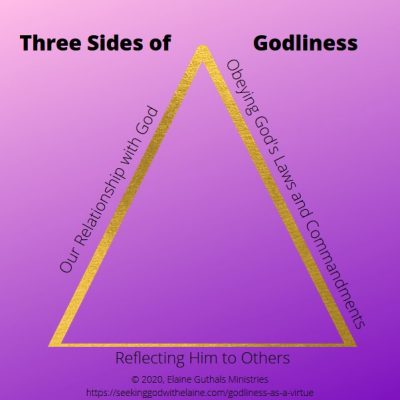
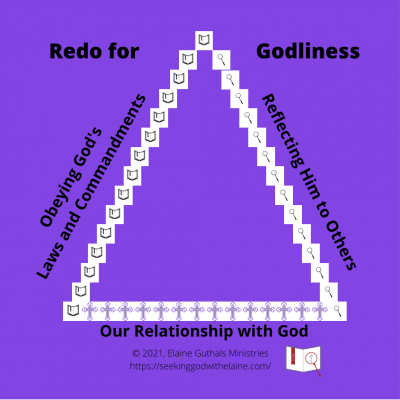
    So, I thought that the last review would be what we’ve said before. This time, we are going to shuffle it through our three sides of godliness.

    • Our Relationship with God
    • Obeying God’s Laws and Commandments
    • Reflecting Him to Others

    It will give us a foundation on which to build this year.

    Our Relationship with God

    • The defining aspect of being God’s elect is we are all to be holy (What Is Expected of Disciples?).
    • It is only through faith that disciples attempt to imitate Jesus and exhibit true compassion, pity, and love (What Is Expected of Disciples?).
    • God loves those who love and submit to Him (What Is Expected of Disciples?).
    • We follow God’s opinions, not our own (What Else Is Expected of Disciples?).
    • We have to work on every characteristic as a package deal. So, on the Sanctification Road, we should run everything we do through the greatest commandments. Is what we are going to say going to keep those commandments or break them? Does our attitudes foster patience, forbearance, gentleness, etc.? If we don’t love, we don’t have the right attitudes (What Else Is Expected of Disciples?).
    • What I think the “… don’t sound a trumpet before you, …” (Mt. 6: 2 CSB) means is religion isn’t to be show (Disciples and Charitableness).
    • Religion and its rituals are not what God wants. God didn’t want the circumcision without the holiness. He doesn’t want baptism without the holiness. There is no purity in the artificial or that which is designed to impress the worldview people (The Nominal Disciple).
    • God doesn’t want this to just be an outward religion. He wants it to be an inward transformation (The Nominal Disciple).
    • What Jesus was about was true religion — how it should be. We were created to worship the Father. We were made to be like Him (Disciples and Charitableness).
    • What Paul was trying to get across was that circumcision is surface. God is looking for obedience, submission, and service. God is looking for a change in heart (The Nominal Disciple).
    • Jesus warned us about motivation. His would have been a radical viewpoint in that day and age. The norm those days was to show you were religious by advertising how you were giving alms, praying, and fasting. Prayer and fasting are personal. Jesus told us that almsgiving should be, too (Disciples and Charitableness).
    • God wants to see evidence that we have chosen Him. That evidence is our obedience. We have to live like we were converted. We have to do the progression. We have to undergo the sanctification. We have to submit (The Nominal Disciple).
    • Humility means we have a real perspective about ourselves. But we have to realize that we should focus on our character, not our intelligence. We have to change our character to imitate God (What Is Expected of Disciples?).
    • While we are in the process of being sanctified, we use charity to become more like God. We are to conduct our charitable activities for His honor and glory (Disciples and Charitableness).
    • We have to be consistent. If we say we are disciples of God, we have to live obediently and not have double standards (The Nominal Disciple).
    • We have to be genuine when we ABCD. We have to truly submit to God. We have to obey His laws and commandments (The Nominal Disciple).

    The ABCDs of Salvation

    If you have not become a believer in Christ, please read through the
    Plan of Salvation and prayerfully consider what God is asking you to do.

    A – admit our sins
    B – believe His Son Jesus is our Redeemer
    C – confess God as Sovereign Lord

    D – demonstrate that commitment by making any changes needed in our lives to
    live the way in which God has called us

    The Disciple’s Job Description

    • We need to build our relationship with God by working out our salvation (How Do We Work Out Our Salvation?).
    • We have to determine what we believe so that we can answer questions when asked what we believe (How Do We Work Out Our Salvation?).
    • Being a living sacrifice means that we offer God our everyday lives, which He can use as a witness to non-believers (How Do Non-Preachers Proclaim the Gospel?).

    Obeying Laws and Commandments

    • If we are righteous, we are imitating God. That would mean we are judging the situation as He would judge it (Disciples’ Duty to the Poor).
    • Bag the pride (A To Do List for Life).
    • Pick friends that are humble (A To Do List for Life).
    • Don’t be a smart alack (A To Do List for Life).
    • Think about what you are doing, and do what is right (A To Do List for Life).
    • No matter how loving we are, we have to change to imitate God’s loving. That means we have to get to heart level (What Else Is Expected of Disciples).
    • Some think disciples have to be doormats. That isn’t true. God knows we will encounter spiritual warfare — especially as we do more for Him. He is looking for boldness with humility (What Else Is Expected of Disciples?).
    • We are to do the charitable acts through mercy (Disciples and Charitableness).
    • We like to think that we are successful because of our knowledge and skills. Paul told us that the only thing we should boast about is God (The Lenient Judgment of Others).
    • John 7: 24 tells us we are to judge based on righteous judgment. What if it is how we live our lives? What if this means we are not supposed to judge surface, but we are supposed to judge deep down? We are not to pass judgment on people, but we are supposed to determine if they are following God’s laws and commandments. No, no one is going to be 100% perfect. We have to determine if we need to witness to them (The Lenient Judgment of Others).
    JudgeOnRighteousJudgment
    • We are not to let other lead us astray (The Lenient Judgment of Others).
    • Most importantly, our job is to preach the gospel and make disciples. How can we do that if we don’t determine if they have admitted their sins, believed on Jesus, and confessed God as Sovereign Lord? (The Lenient Judgment of Others).
    • We have to judge situations. We have to judge intent of people’s actions. If we don’t, we may be headed off the straight and narrow (The Lenient Judgment of Others).
    • Our actions do not depend on what other’s actions are (A To Do List for Life).

    Reflecting Him to Others

    • Help the needy saints (A To Do List for Life).
    • Be hospitable (A To Do List for Life).
    • Don’t be enemies with your enemies (A To Do List for Life).
    • Whatever emotions someone is experiencing, experience those, too (A To Do List for Life).
    • Get along with one another (A To Do List for Life).
    • Don’t hold back on love. Don’t pick and choose who you are going to love. Just do it (A To Do List for Life).
    • God expects us to have a heartfelt sympathy for others (What Is Expected of Disciples?).
    • To be a true disciple, pity and love must follow repentance (What Is Expected of Disciples?).
    • Love is expressed through kindness. Kindness is the action (What Is Expected of Disciples?).
    • We don’t argue — if we answer at all (What Else Is Expected of Disciples).
We don’t pay back evil with evil (What Else Is Expected of Disciples?).
    • Not only do we have a modest demeanor, but we also elevate others (What Is Expected of Disciples?).
    • We’ve got to stand firm patiently (What Else Is Expected of Disciples).
    • We shouldn’t participate in the quarrel in the first place (What Else Is Expected of Disciples?).
    • Forbearance is not only forgiving another, but it is also going the extra distance to meet them halfway (What Else Is Expected of Disciples?).
    • We not only give up the right to retaliate, but we also initiate the forgiveness. Plus, we give up the hurt feelings (What Else Is Expected of Disciples?).
    • We need to forgive for our sake, not necessarily theirs (What Else Is Expected of Disciples?).
    • Why can’t everyone just love everyone else? Sin bashed that (What Else Is Expected of Disciples?).
    • But worldview people don’t want disciples to love them enough to warn them about their future (What Else Is Expected of Disciples?).
    • We have to be concerned enough about the poor for action (Disciples’ Duty to the Poor).
    • Family was to take care of family. God has a plan for our help for others. First, we are to help our biological family (Disciples’ Duty to the Poor).
    • Instead of a brother being reduced to an alien, we have an alien elevated to the status of brother (Disciples’ Duty to the Poor).
    • God calls His children to support each other. No, not everyone is a child of God (Disciples’ Duty to the Poor).
    • Jesus called charity work the way we practice our righteousness (Disciples and Charitableness).
    • Jesus told His disciple to not be judgmental of private individuals. It is not talking about public individuals (The Lenient Judgment of Others).
    • Jesus knew we so often jump to conclusions. We see things as we are, not necessarily as the situation is. We can’t just make snap judgments (The Lenient Judgment of Others).
    • We’ve got to lead with love and compassion, not judgment (The Lenient Judgment of Others).
    • People believing the worldview equate disciples saying “sin no more” as judging. Isn’t it more that we are concerned for the spiritual condition of your hearts and lives? Telling someone to “sin no more” is not judging them. It is the ultimate expression of love (The Lenient Judgment of Others).
    • We are to use our experiences when we witness. If I say this is something that happened to me or helped me in my walk as a disciple (it’s proved itself), you would be more open to trying it for yourself (The Nominal Disciple).
    • Jesus explicitly tells His disciples – of which we are one – they are to witness to non-believers (How Do Non-Preachers Proclaim the Gospel?).
    • We have to be prepared to defend what we believe and why we believe it (How Do Non-Preachers Proclaim the Gospel?).
    HowDoesGodsExpectationsForUsLeadToGodlinessPin

    Making the Connections

    That is a lot of bullet points. If you are like me, you need it synthesized. So, let’s try this.

    1. Submit to God and follow God’s opinions, not our own, by exhibiting obedience, submission, and service (What Is Expected of Disciples?; What Else Is Expected of Disciples; The Nominal Disciple).
    2. Be holy because of a sincere, inward transformation (What Is Expected of Disciples?; The Nominal Disciple).
    3. Imitate Jesus through faith and righteousness by exhibiting true compassion, pity, and love (What Is Expected of Disciples?; What Else Is Expected of Disciples; Disciples and Charitableness; Disciples’ Duty to the Poor).
    4. Build our relationship with God by genuinely ABCDing and working out our salvation by navigating the Sanctification Road (What Else Is Expected of Disciples; How Do We Work Out Our Salvation?).
    5. Expand God’s kingdom by witnessing to by preaching His gospel and making disciples (The Lenient Judgment of Others)
    6. Follow God’s laws and commandments and use them to judge situations (A To Do List for Life; The Lenient Judgment of Others).
    7. Perform charitable acts to fellow disciples and non-believers alike with love, forgiveness, and forbearance (Disciples and Charitableness; What Else Is Expected of Disciples?).

    Okay, that is a start. We’ll be adding to it and modifying it as we go this year.

    Father God. We want to be holy and righteous like You. We want to be godly. Help us with our redo so that we can become what You want us to be – like You. Amen.

    What do you think?

    Leave me a comment below (about this or anything else) or head over to my Facebook group for some interactive discussion.

    If you don’t understand something and would like further clarification, please contact me.

    If you have not signed up for the email daily or weekly providing the link to the devotions and the newsletter, do so below.

    If God has used this devotion to speak with you, consider sharing it on social media.

  • Why and How Are We to Live Godly Lives?

    What is the payoff for living godly lives, and how do we get there? This daily devotional looks at things we can do while we are waiting for Jesus to return to take us home.

    Nuggets

    • If we know the end of this Heaven and earth is coming, we want to live godly lives to prepare us for eternity.
    • We need to be godly because God will not change His laws and commandments and expectations for us.
    • We have to be ready for the day of the Lord by ABCDing.
    • We have to live godly lives until the day of the Lord arrives.

    Devotions in the Review 101: Godliness series

    Being human, we ask ourselves what is in it for us when we live godly lives. That is an easy question to answer.

    How do we live godly lives? That takes a little more to answer it.

    Let’s Put It into Context #1

    Godliness, equated with the Old Testament term fear of the Lord, is reverence in thought, feeling, and conduct that is promoted by walking in His Spirit and obeying God’s laws and commandments and produces a moral likeness of God. The fear of the Lord means awe, reverence and love, not terror.

    Let’s Put It into Context #2

    “But the day of the Lord will come like a thief, and then the heavens will pass away with a roar, and the heavenly bodies will be burned up and dissolved, and the earth and the works that are done on it will be exposed” (II Pet. 3: 10 ESV)

    I don’t want to chase a rabbit. (New year’s resolution? Don’t worry. It won’t last.).

    But I need to explain what all is being dissolved in verse 11. Then we can get to the good stuff.

    Verse 11 refers back to what Peter had discussed in previous verses. It is commonly referred to as the day of the Lord.

    The day of the Lord is when we will be called home. Yep, we are talking end times here.

    • Christ’s reign will have been completed.
    • God’s mercy for sinners will end.
    • Jesus will come again.
    • All that God said would happen will come true.
    • We are going to get to see God for Who He is.
    • God’s glory, power, and wrath will clearly be on display.
    • We will see God really is in control.
    • We will be judged according to our sheep and goat nature.

    Resource

    Glossary

    This Heaven and earth is going to pass away. This verse says it will burn and dissolve. However that takes place, all of the sin of this world will be exposed.

    Until that time, we have to put the correct emphasis on the earth, then. It is a temporary thing.

    Are you still tripping over the fact that this world is going to go away? It is doctrine.

    TheEarthWillPassAway

    The earth will pass away. We won’t. Spaulding wrote, “Dissolution is not annihilation, it is simply transformation.”

    Resource

    If we don’t put our emphasis on the temporary earth, we need to put it on what is eternal. We have to put our emphasis on being godly when Jesus returns.

    Being Godly Because the End Is Coming

    “Since all these things are thus to be dissolved, what sort of people ought you to be in lives of holiness and godliness” (II Pet. 3: 11 ESV)

    If we know the end of this Heaven and earth is coming, we want to live godly lives to prepare us for eternity. Peter is contrasting “… lives of holiness and godliness” (II Pet. 3: 11 ESV) with the “… the works that are done on … ” the earth (II Pet. 3: 10 ESV).

    I know. We think the works that are done on the earth are pretty special. We consider ourselves knowledgeable and caring.

    We don’t hold a candle to God. “For as the heavens are higher than the earth, so are my ways higher than your ways and my thoughts than your thoughts.” (Isa. 55: 9 ESV).

    Let’s look at the arguments posed here for godly living. Spalding gave us several.

    • The day of the Lord is a direct result of man’s sins.
    • Man will be restored to the relationship God intended when the day of the Lord occurs.

    The thing is — we know the end is coming. We just don’t know when. “But the day of the Lord will come like a thief …” (II Pet. 3: 10 ESV).

    We aren’t going to get any more warning than the end time signs.

    To read a related devotion, click the appropriate button below.

    To read devotions in the How Do We Know If We Don’t Know series, click the appropriate button below.

    If we don’t know when Jesus is coming back, that means we have to prepare like it could be today — this minute. “Be watchful, stand firm in the faith, act like men, be strong” (I Cor. 16: 13 ESV).

    What does standing firm in our faith mean? “Only let your manner of life be worthy of the gospel of Christ, so that whether I come and see you or am absent, I may hear of you that you are standing firm in one spirit, with one mind striving side by side for the faith of the gospel” (Phil. 1: 27 ESV).

    We need to live like the gospel tells us to live. We need to live godly lives.

    LiveLikeGospelTells

    Being Godly Because God Never Changes

    “For I the Lord do not change; therefore you, O children of Jacob, are not consumed” (Mal. 3: 6 ESV)

    We need to be godly because God will not change His laws and commandments and expectations for us.

    Melvill pointed out something that is easy to overlook. In essence, we’ve been talking about the changes we will encounter with this earth passing away.

    Resource

    God will never change. “God is not man, that he should lie, or a son of man, that he should change his mind. Has he said, and will he not do it? Or has he spoken, and will he not fulfill it?” (Num. 23: 19 ESV).

    Things are really going to happen just as God says they are. He doesn’t lie. He is not going to reconsider. He isn’t going to be talked out of it.

    Living Godly Lives Start with ABCD

    “Repent therefore, and turn again, that your sins may be blotted out” (Ac. 3: 19 ESV).

    So, we have to be ready for the day of the Lord by ABCDing.

    How do you do that? Let’s start with repent.

    Repentance is acknowledging our separation from God and expressing sorrow for breaking God‘s laws and commandments by making the commitment to changing ourselves through obedience so that we no longer do the wrong things. We need to repent of the sins we’ve committed by doing something that is wrong or not don’t something that is right. Sins our actions by humans that disobey God and break one of his reasonable, holy, and righteous laws and commandments, goes against a purpose he has for us, or follows Satan‘s promptings.

    God designed a Plan of Salvation so that we could be delivered from the consequences of sin. The consequences of sin are spiritual death and separation from God.

    This was accomplished through His grace. Grace is a free and unmerited gift from the Heavenly Father given through His Son, Jesus Christ that enables salvation and spiritual healing to believers by the work of the Holy Spirit. Because of God’s infinite grace, Jesus our Redeemer in order to forgive us of our sins.

    Redemption is where something is used in exchange for something else to gain or regain something. Jesus is our Redeemer because He was born of a virgin, making Him 100% God and 100% man; gave His life on the cross for us so that His blood could pay the price for our sins; and because of God’s great might and power, rose from the grave, conquering death and paying the price for our sins. 

    We access this grace through faith. Faith is the conviction that the doctrines revealed in God’s Word are true, even if we do not understand all aspects of them, a belief which impacts our lives. Because we have faith and believe, we gain the forgiveness of our sins. Forgiveness is, when we ask, God pardons us because we have broken His laws and commandments.

    We accept the pardon by letting go of the guilt and remorse that we feel because we have done something wrong. It is a conscious decision to accept His forgiveness. We also commit to changing ourselves so that we no longer do the wrong things.

    By doing this we gain eternal life in heaven. Heaven is the opposite of hell. It is a perfect existence.

    The ABCDs of Salvation

    If you have not become a believer in Christ, please read through the
    Plan of Salvation and prayerfully consider what God is asking you to do.

    A – admit our sins
    B – believe His Son Jesus is our Redeemer
    C – confess God as Sovereign Lord

    D – demonstrate that commitment by making any changes needed in our lives to
    live the way in which God has called us

    The Disciple’s Job Description

    What Type of Person Should We Be?

    “Do not be conformed to this world, but be transformed by the renewal of your mind, that by testing you may discern what is the will of God, what is good and acceptable and perfect” (Rom. 12: 2 ESV)

    We have to live godly lives until the day of the Lord arrives. What does that mean?

    • We use our intelligence to discern what God wants us to know and good from evil.
    • We are to love as God loves.
    • We are to preach His gospel and make disciples.
    • We are to do whatever God asks us to do.
    • We need to grow in faith and grace.
    • We need to repent of the sins we continue to commit and omit and broken-hearted because we still commit the sins.
    • We need to watch and waiting expectantly for Jesus’ coming.
    • We must be sincere and diligent in living for God.
    • We are to be patient.
    • We need to live lives full of charity

    To read a related devotion, click on the appropriate button below.

    Devotions in the How to Discern the Voice of God series

    Devotions in the Consistency Needed for Spiritual Growth series

    Devotions in the What Is Charity? series

    WhyAndHowAreWeToLiveGodlyLivesPin

    Making the Connections

    I think the bottom line is we need to want it. We need to want godly lives.

    It is going to be hard. Satan is going to throw everything he has at us to try to derail us off the narrow path.

    Glossary

    Wilson told us how we should do this. He wrote, “Christians should live and walk as on the borders of eternity, dying daily.”

    Resource

    Remember when I said if we don’t know when Jesus is coming back, that means we have to prepare like it could be today — this minute.

    This is what Wilson is talking about. Start each day thinking today is going to be the day.

    Vaughan took that a step further. He said we should hasten the day. “In every age Christians are to be praying and labouring for the extension of the gospel over the whole earth.”

    Resource

    I know what you are thinking. How can we do that?

    We do that by spreading and praying for the spread of the gospel. “And this gospel of the kingdom will be proclaimed throughout the whole world as a testimony to all nations, and then the end will come” (Mt. 24: 14 ESV).

    How Do We Apply This?

    Well, we already gave a list of what we are to be doing. Now we have to do it.

    Gracious Heavenly Father. We want to start living as if You are coming today. We want You to find us watching. We want to be living as we should. Help us to live godly lives. Amen.

    What do you think?

    Leave me a comment below (about this or anything else) or head over to my Facebook group for some interactive discussion.

    If you don’t understand something and would like further clarification, please contact me.

    If you have not signed up for the email daily or weekly providing the link to the devotions and the newsletter, do so below.

    If God has used this devotion to speak with you, consider sharing it on social media.

  • The Form of Godliness

    Godliness has two forms: inward and outward. This daily devotion looks at how godliness needs to have an aspect of spontaneity.

    Nuggets

    • Godliness has a dual form as it should be both an inwardly and outwardly expression.
    • The quest for godliness is to be spontaneous, not calculated for our gain.
    • Unfortunately, some can have a false form of godliness because they are not committed to Sovereign God.

    Devotions in the Review 101: Godliness series

    Godliness is a huge term. It may be difficult for some to wrap their heads around.

    Maybe it will be easier for us to understand if we look at how it is expressed. Let’s see if we can quantify it some.

    Let’s Put It into Context

    Godliness, equated with the Old Testament term fear of the Lord, is an attitude of reverence that is promoted by walking in His Spirit and obeying God’s laws and commandments and produces a moral likeness of God. The fear of the Lord means awe, reverence and love, not terror.

    The Dual Form of Godliness

    “For this very reason, make every effort to supplement your faith with virtue, and virtue with knowledge, and knowledge with self-control, and self-control with steadfastness, and steadfastness with godliness, and godliness with brotherly affection, and brotherly affection with love. For if these qualities are yours and are increasing, they keep you from being ineffective or unfruitful in the knowledge of our Lord Jesus Christ” (II Pet. 1: 5-8)

    Godliness has a dual form as it should be both an inward and outward expression.

    I know we talked about these verses in the last devotion — and a whole series a couple of months ago. We talked about how these elements help us grow.

    Let’s look at now from the lens of what these tell us about godliness itself.

    Maclaren argued that it is appropriate for us to list godliness both with virtues and graces. He reminded us that “the fundamental idea is reverence toward God.”

    Resource

    Then Maclaren said something interesting. He said that the reverence should be all-encompassing: inward and outward.

    The inward expression of godliness is communion with God. Prayer is a two-way communication with God. Even if we are praying with our mouths, we are praying with our hearts. Our inward expression of godliness also manifests itself in confession, praise, and worship.

    The outward expression is our acts of service for God. Service is an act based on belief in God that comes from a response of worship by acknowledging His power through our submission. The Homilist noted this was directed toward mankind.

    Resource

    The way I read Maclaren’s sermon is that godliness is made up of the communication and the acts of service.

    Maclaren felt that we go from faith to godliness by the following:

    • Strength to resist temptations
    • Duty to tell the difference between good and evil
    • Self-control to discipline ourselves
    • Perseverance to increase patience

    Thompson noted that we possess that reverence of God because we love His holiness. Holiness is more than a character trait; it is purity, dedication, and commitment that lead to being set apart.

    This respect, according to Thompson, is “… a reverence for dignity, station, greatness, power, which is cold and formal and distant.”

    Resource

    The outward expression implies a love for God’s laws and commandments. We acknowledge His control in our lives.

    The Spontaneity of Godliness

    “And without faith it is impossible to please him, for whoever would draw near to God must believe that he exists and that he rewards those who seek him” (Heb. 11: 6 ESV)

    The quest for godliness is to be spontaneous, not calculated for our gain.

    Thompson’s definition of godliness had an interesting twist. He cited Robinson, saying that godliness is a “… reverence toward God which is a spontaneous feeling of the heart in view of His character (see in Robinson).”

    Resource

    I don’t see Thompson as meaning we should get a wild hair and jump on the godliness bandwagon. I am think he is meaning that it shouldn’t exclusively have an external stimulus.

    An external stimulus would take on the form described by the Homilist. There, “… respect for the right, compassion for the miseries, and a loving desire for the happiness of all” would cause us to act.

    Resource

    We have to pursue godliness because of an internal stimulus. Thompson said we are pursuing godliness because of Who God is and because it leads us to blessedness. Blessedness means we have been perfected.

    Abernethy described the inward stimuli. He wrote they must constitute a reverence for God’s majesty, a recognition of His glory, and love, gratitude, and respect.

    Resource

    We are pursuing godliness because it leads to eternal life. Eternal life is the promise of living eternally – even if we have died in this life – because we have admitted our sins, believed Jesus as Savior and Redeemer, and confessed God as Sovereign Lord.

    One day, we will see God face to face. We need to be ready for that by ABCDing. We need to have being going from faith to God-likeness.

    One day, we will see God face to face.

    A False Form of Godliness

    “These people always cause trouble. Their minds are corrupt, and they have turned their backs on the truth. To them, a show of godliness is just a way to become wealthy” (I Tim. 6: 5 ESV)

    Unfortunately, some can have a false form of godliness because they are not committed to Sovereign God.

    Paul told us point blank that pursuit of godliness will bring persecution. That makes us wonder why people pursue godliness for gain.

    No, the road to godliness is not easy. “Indeed, all who desire to live a godly life in Christ Jesus will be persecuted” (II Tim. 3: 12 ESV).

    RoadToGodlinessNotEasy

    One would think that verse would scare away anyone who is not fully committed to the Sovereign God. But it doesn’t.

    There are some that are pursuing godliness for some external gain. This is more like Paul was taking about in First Timothy 6: 5. “To them, a show of godliness is just a way to become wealthy” (I Tim. 6: 5 NLT). They are using it to be a means to an end.

    They may have an outward appearance of being righteous. Righteous means we are free from sin because we are following God’s moral laws.

    But inwardly, they have not submitted to the Sovereign God. Not. Going. To. Fly.

    We are commanded to become godly. Kollock wrote, “We are unequivocally commanded to assume the form of godliness; to testify by external acts our allegiance to the Lord; and to attend on those ordinances and sacraments which He surely did not appoint that we might with impunity neglect them.”

    Resource

    See what that says? Testify. Witness. Witnessing means we tell non-believers that Jesus can be their personal Savior, even though that may be considered our perspectives and opinions.

    We have to tell others what Sovereign God has done in our lives. That is in our job descriptions.

    The Disciple’s Job Description

    Complete Job Description

    Individual Descriptions

    Job Duty #4
    Proclaim the Gospel (Mark 16: 15)

    Job Duty #6
    Make Disciples (Matthew 28: 19-20)

    We can’t hide the fact that we have submitted our lives to the Sovereign God. Kollock wrote that we can’t just worship Him in our hearts. Why?

    The inward expression of godliness has to bubble out to be an outward expression of godliness. “For with the heart one believes and is justified, and with the mouth one confesses and is saved” (Rom. 10: 10 ESV).

    See. In, then out.

    The flip side of that is that it cannot be an out without the in. We cannot believe being a good person will gain admission to Heaven. A person who has not changed to possess the nature of God and follow the commands of God is not godly.

    To read a related devotion, click the button below.

    There is another form of false godliness. The Homilist wrote, “There is often a great deal of external worship where there is no godly devotion.” We’ve called this being a nominal disciple. Nominal disciples are those boasting they loved God without even trying to imitate Him — those who dig on religion and its rituals without having a change in heart.

    Resource

    TheFormOfGodlinessPin

    Making the Connections

    Abernethy contended that godliness is a support of the virtues. Our ability to become godly and to obtain those virtues all stem from obeying God’s laws and commandments.

    Resource

    Hamer must have agreed. He wrote, “It is no easy thing, under all circumstances, to look calmly and trustfully up to the throne of the living God, and cheerfully commit all our life to His fashioning and to His keeping: it is no easy thing at all times to trace the gentleness of His grace in the ways of providence.

    Resource

    When we become disciples of Christ, we have to consider godliness our duty. We no longer have the choice of whether we will or will not become godly.

    That is part of the package for which we signed up.

    How Do We Apply This?

    Now that we know the form, we know how to get there. Paul told us to “But you, man of God, flee from these things, and pursue righteousness, godliness, faith, love, endurance, and gentleness” (I Tim. 6: 11 CBS).

    Yes, this sounds like the Sanctification Road. “But sanctify the Lord God in your hearts …” (I Pet. 3: 15 KJV).

    Looking back over this, the two forms make sense to me. We have to be totally committed. Not just doing lip service to God (at best) while doing wonderful social work. We can’t be praising God at the top of our lungs, and be doing nothing to tell of His love to others.

    We have to be totally committed to being like God.

    Loving Father. We don’t want to be just giving You lip service. We don’t want our worship to be praise only. We want inward and outward forms of godliness. We want to totally be like You. Amen.

    What do you think?

    Leave me a comment below (about this or anything else) or head over to my Facebook group for some interactive discussion.

    If you don’t understand something and would like further clarification, please contact me.

    If you have not signed up for the email daily or weekly providing the link to the devotions and the newsletter, do so below.

    If God has used this devotion to speak with you, consider sharing it on social media.

  • Growing in Godliness

    Our goal on the Sanctification Road should be to grow in godliness. This daily devotional looks at how we can train ourselves to grown in godliness and faith.

    Nuggets

    • We want to grow in godliness because God and His Word are real.
    • Growing in godliness means becoming more virtuous.
    • Growing in godliness means we are growing in faith.
    • As we grow, we learn the value of godliness and we gain value in God’s eyes.

    Devotions in the Review 101: Godliness series

    Even though we may feel we have a long way to go on the Sanctification Road, we can take comfort in the fact that we can grow closer to being godly.

    Yes, we can grow to be more God-like. Let’s check it out.

    Let’s Put It into Context

    Godliness, equated with the Old Testament term fear of the Lord, is an attitude of reverence that is promoted by walking in His Spirit. The fear of the Lord means awe, reverence and love, not terror.

    Beecher extended that definition. He said that godliness means “… having a wise view of all the laws of our being and condition, and living in conformity to them.”

    Resource

    Godliness Is a Matter of Training

    “Have nothing to do with irreverent, silly myths. Rather train yourself for godliness” (I Tim. 4: 7 ESV)

    We want to grow in godliness because God and His Word are real.

    Nothing in Scriptures is fiction. The multiple authors did not make up some interesting story to manipulate us.

    God is real. He created the universe. He created mankind.

    All of this was done because God loves us. When we think about I Corinthians 13, we think that is how our marriages should be run.

    Have we ever looked at that as that describes Who God is?

    “Love is patient and kind; love does not envy or boast; it is not arrogant 5 or rude. It does not insist on its own way; it is not irritable or resentful; 6 it does not rejoice at wrongdoing, but rejoices with the truth. 7 Love bears all things, believes all things, hopes all things, endures all things. 8 Love never ends” (I Cor. 13: 4-8 ESV).

    Yep, the only place that breaks down is in verse 5. “… It does not insist on its own way …” (I Cor. 13: 5 ESV).

    God can insist that we do things His way. He is all-powerful, all-knowing, and all-present.

    To read a related devotion, click on the appropriate button below.

    But look what it says. We get to “… train yourself for godliness” (I Tim. 4: 7 ESV).

    Yes, we can change. Yes, it is going to take work.

    Also, it will be a process. Essex Congregational Remembrancer wrote, “This duty includes a strict and impartial inquiry into our own hearts, as to what may be therein likely to prevent our advancement in godliness.”

    Resource

    When we train, that means we have to be committed to the process. We can’t just work on obtaining God’s character once a week.

    It has to become a habit. It has to be engrained in us.

    That also means that we have to look deep inside us. We aren’t talking about a surface change. We are taking about one at the heart level.

    This is also where the watching comes into play. Watchfulness is a continual conscious examination of ourselves and all events so that we may follow God in all things.

    Glossary

    But we have to go through this training. This is the only way we become godly.

    Growing in Godliness

    “For this very reason, make every effort to supplement your faith with goodness, goodness with knowledge, knowledge with self-control, self-control with endurance, endurance with godliness, godliness with brotherly affection, and brotherly affection with love” (I Pet. 1: 5-7 CSB)

    Growing in godliness means becoming more virtuous.

    Ooo, baby. Do these verses sound familiar?

    These are the verses that we used when we talked about the virtues that disciples should possess. We said it was a continuum that culminated in godliness, kindness, and love.

    Devotions in the Christian Virtues series

    These verses are also truly appropriate. They show that we do grow our character.

    We said in Faith as a Virtue that these were not all the virtues on the sit that I found. Sometime this year, we will look at some more of them.

    God will show us where we need to grow to be like Him. However, He wants us to make sure we are always looking for those growth areas.

    So, how do we get to godliness? Perfection, right?

    Well, no. The perfected state indicates the combination of the graces which, when all are present, form spiritual wholeness or completeness. It means we have become as Jesus is. — holy, sanctified, and righteous. That will only happen in Heaven.

    Glossary

    Emmons said we need to be intentional. Do we see a pattern here?

    • Word for 2019: Intentional
    • Word for 2020: Self-discipline
    • Word for 2021: Godliness

    Resource

    It is more than just striving for godliness, though. We have to get it to heart level. We have to make sure our work in finding out what godliness is makes us more like God. We can’t just have head knowledge.

    Gaining the character of God begins with our choice. Yeah, it is going to take work. But if we are diligent, our character does become like His.

    But it has to be more than a new years’ resolution that we forget before we get out of January. It can’t be something we give up in July because it takes so much work. It isn’t one that we will be able to accomplish by December so we will never have to work at it again.

    This is going to be a life-long process. Yeah, we are talking sanctification here.

    ChoiceLifeLongProcess

    Sanctification is the transformation of mind, body, and soul, which begins with regeneration, gradually changes our nature through the promptings of the Holy Spirit, and ends with perfected state of spiritual wholeness or completeness. Regeneration is the change in us that God brings about when we go from being spiritually dead to spiritually alive.

    Glossary

    Champney gave us a real big caution. We can’t let the evaluation process lead to pride or conceit. Instead, the process needs to humble us.

    Resource

    Growing in Faith

    “For everyone who has been born of God overcomes the world. And this is the victory that has overcome the world — our faith” (I Jn. 5: 4 ESV)

    Growing in godliness means we are growing in faith.

    If we really get down to the meat and potatoes of it, when we are growing in godliness, we are really growing in faith. We are strengthening our belief in God.

    Blencowe put it this way. He wrote godliness is “… a real belief in God, the Father, the Son, and the Holy Ghost; our Maker, our Redeemer, and our Sanctifier. It is believing in Him, as He is made known to us in the Bible, in the gospel of Jesus Christ.”

    Resource

    Isn’t that what it is all about? It isn’t that we do the does and don’t do the don’ts. It is our belief in what God has done for us.

    Yes, obedience to God’s laws and commandments is a huge way that we show that belief. Obedience alone is not going to get our ticket to Heaven punched.

    Instead, we have to have faith. We have to be growing in that faith.

    What Do We Gain as We Grow?

    As we grow in godliness, we gain many valuable things and gain in value in God’s eyes.

    We gain temporal blessings when we grow in godliness. We know that “every good gift and every perfect gift is from above, coming down from the Father of lights, with whom there is no variation or shadow due to change” (Jas. 1: 17 ESV).

    We gain a good reputation. Griffith was correct when he wrote that “the discipline of godliness does make a man better inwardly.”

    Resource

    But it also manifests itself into what what the world sees. Our inward godliness informs our actions.

    We’ve talked about how godliness is the parent of contentment. That is because we gain peace as we are living as a God wants us to live. This comes because we start believing that we have been forgiven.

    GrowingInGodlinessPin

    Making the Connections

    Stevens had a great take on our pursuit of godliness. He wrote, “No aim can so call out all the powers of the human mind, and soul, as the aim after God-likeness. For what is godliness? Is it not God-likeness? a seeking to be like God? Yet the question at once arises, How can man be like God? God is infinite, man is finite. Yet with all this disparity, the Bible exhorts us to set the Lord always before us, and to grow up into His likeness.”

    Resource

    That’s right. How are we going to accomplish the impossible?

    Let’s face it. To most of us, it seems like becoming godly isn’t going to happen.

    But Scriptures say, “… With man this is impossible, but with God all things are possible” (Mt. 19: 26 ESV).

    No, we will never be creators, all-knowing and all-seeing.

    But we can imitate God’s moral characteristics. That means we can be holy.

    How Do We Apply This?

    First off, we have to be children of God’s to have a shot at being godly. Boston wrote, “That professor or minister that is not godly can never exercise himself to godliness. It is impossible to act without a principle of acting, and exercise doth naturally require a power of it. He can never exercise himself to running, that wants feet to run with; or to wrestling, who wants arms; nor the ungodly exercise themselves to godliness; on the contrary, ‘an heart they have exercised with covetous practices.’” Just being a good person will never make us godly.

    Resource

    To read a related devotion, click the button below.

    Let’s look at it this way. One of the files in my drafts folder for this year is on the topic of sin being a disease.

    We need a healthy, viable relationship with God.

    The Essex Congregational Remembrancer gave us some really good advice. They wrote, “It is of importance to consider that unless we exercise ourselves unto godliness, so far from making further advances in the Divine life, we shall go backward, not forward.”

    Resource

    We have to grow in our relationships with God. We’ve got to become more like Him.

    Yes, there are days we will go backwards. We always have to try to move forward.

    Gracious Heavenly Father. It brings us great joy to think that we can grow to be like You. Yes, we know from the world’s viewpoint we have a long way to go. You, however, do not look at what we do or do not do. You look at our hearts — our love for You. Help us to grow our faith in You. Amen.

    What do you think?

    Leave me a comment below (about this or anything else) or head over to my Facebook group for some interactive discussion.

    If you don’t understand something and would like further clarification, please contact me.

    If you have not signed up for the email daily or weekly providing the link to the devotions and the newsletter, do so below.

    If God has used this devotion to speak with you, consider sharing it on social media.

  • Godliness: The Parent of Contentment

    There is a benefit of becoming godly. We gain contentment. This daily devotional looks at how giving God priority in our lives and following His laws and commandments makes us godly, which brings contentment.

    Nuggets

    • When we become godly and gain contentment because we have the character we were intended to have.
    • In order to accomplish our redo, we have to give God the priority in every area of our lives.
    • Godliness, along with contentment, comes from being obedient to God’s laws and commandments.

    Devotions in the Review 101: Godliness series

    We are executing a redo this year because we want a better result. We want to be more like God, which will bring us contentment.

    Ooo, baby! The year has just begun, and we already know we will need lots of contentment this year!!!

    Let’s Put It into Context

    Godliness, equated with the Old Testament term fear of the Lord, is an attitude of reverence that is promoted by walking in His Spirit. The fear of the Lord means awe, reverence and love, not terror.

    We spent a whole series looking at contentment. Some of the things were learned were the following:

    • God has commanded all disciples be content in our situations.
    • Knowing God and being like God will be us contentment.
    • We like to think that godliness and holiness are synonymous, but sometimes, we like to think those are just a short distance from sin.
    • We know what makes us content and what doesn’t.
    • It matters whether we are content or not.
    • We have to look at our employment as it — whatever we are doing — is ordained by God.
    • God wants us to be working toward what He wants us to be working toward.

    To read a devotion in the Contentment Leads to Tranquility series, click on the appropriate button below.

    How Is Godliness Related to Contentment?

    “Now there is great gain in godliness with contentment” (I Tim. 6: 6 ESV)

    When we become godly, we gain contentment. This is because we have the character we were intended to have.

    Godliness fosters contentment because we become like God. When God originally created us, He made us this way. However, we changed after Adam and Eve committed the original sin.

    Becoming godly takes us back to the way we were originally created. It means we possess spiritual life, not spiritual death. Spiritual death is the separation from God that occurred as a consequence of Adam and Eve’s original sin. The spiritually alive are those who have ABCDed, so they are no longer separated from God.

    However, godliness can produce contentment in this life. Sibthorp listed one of the benefits as “… the improvement of his judgment, his discrimination, his mental faculties.” Our lives have more contentment because of this improvement.

    Resource

    Beattie explained how that can be. Leading godly lives eliminates sorrows in life. Yes, there will be sorrow, but godliness brings joy to life. “Restore to me the joy of your salvation, and uphold me with a willing spirit” (Ps. 51: 12 ESV).

    Resource

    Godliness Obtained through the Gospel

    In order to accomplish our redo, we have to give God the priority in every area of our lives. It also means growing in the three sides of godliness.

    We want to be like God. In order to do that, we follow the gospel, “… because the object of the revelation of Christ in the gospel is to show us the character of God in the person of a man, and thereby set us a pattern for us to copy — and by offering grace to all, by which they may be able to copy that pattern, to make them Godlike by making them like Christ.” That means we have to seek God

    Resource

    It will take hearing His Word, reading it, studying it, meditating on it, and memorizing it. All through that, we need to be in prayer, asking God to provide the meaning.

    Searching for and Seeking God

    Hearing His Word (Rom. 10: 17).
    Reading His Word (Rev. 1: 3).
    Praying to Him (Heb. 4: 16).
    Studying His Word (Ac. 17: 11).
    Meditating on His Word (Ps. 1: 1-2).
    Memorizing His Word (Ps. 119: 11).

    Godliness Obtained through Obedience to the Laws and Commandments

    Godliness, along with contentment, comes from being obedient to God’s laws and commandments. That is because the laws and commandments show us God’s character.

    As we follow them, our character changes to be like Him. It becomes second nature to us.

    Look at it this way. Our three sides of godliness follow the greatest commandments.

    “‘Teacher, which is the great commandment in the Law?” And he said to him, ‘You shall love the Lord your God with all your heart and with all your soul and with all your mind. This is the great and first commandment. And a second is like it: You shall love your neighbor as yourself’” (Mt. 22: 36-39 ESV).

    • If we love God, we will build our relationships with Him.
    • If we love God, we will obey His laws and commandments.
    • If we love others, we will reflect Him to others
    GodlinessFollowsGreatestCommandments

    In How Does Dedication Help Consistency?, we said that this is how Christian perfection is achieved. Our character is changed to be like His.

    Godliness breeds contentment because our relationships with God is where they should be. Becoming more like God brings us peace that allows us to be satisfied.

    Newton must have thought the same way because he had an interesting definition of godliness. He said godliness is “… real, vital, experimental, practical religion — genuine Christianity — a religion concerning God, the great, the wise, the blessed God.”

    Resource

    We can understand the vital part. It has to be a 24/7/365 relationship.

    Experimental? When something is experimental, it is untested. That means it isn’t the final product.

    Well, doesn’t that fit? We are still a work in progress. We are being tested.

    No, we won’t be a finished product until we are perfected. The perfected state indicates the combination of the graces which, when all are present, form spiritual wholeness or completeness.

    Glossary

    We are not going to be perfect until we are called home. Until then, we will get things right sometimes.

    Sometimes, we will not. That’s why it is experimental.

    GodlinessTheParentOfGodlinessPin

    Making the Connections

    “But he said to me, ‘My grace is sufficient for you, for my power is made perfect in weakness.’ Therefore I will boast all the more gladly of my weaknesses, so that the power of Christ may rest upon me” (II Cor. 12: 9 ESV)

    Smith had an interesting sermon. Its title was Enough. He wrote, “The godly man hath found that which all the world doth seek, that is, enough.”

    Resource

    We are content with what God has given us. Why?

    It isn’t about what He has given us. It is about being in a relationship with Him.

    Some of us may find perfection in the next year. One thing brought home to Adam and I this year — as with so many others — we aren’t guaranteed next year — or even tomorrow.

    Unless Jesus comes to call us home, the majority will still be here this time next year. We have to find enough.

    Enough is going to be different this year, just like it was the year before — and every year before that.

    Each year has its own enough. We have to see what God’s plan says enough is for us this year.

    How Do We Apply This?

    We work to know God as Maclaren said: “… His character, His heart, His relations to us, His thoughts of good concerning us sufficiently for all intellectual and for all practical purposes.”

    Resource

    Berry said that we have to do this by being in Christ. Our evaluations of ourselves need the framework of God is calling us to be saints. Saint means holy one who has been set apart.

    Resource

    So, if we are in a redo year, what is God going to think about that?

    Lewis gave us an idea. He wrote, “The Saviour sees, not merely what we are, but what we may become, and as fidelity is the highest element of moral worth, He estimates the value of men, not by what they do, but by their fidelity — by the proportion which exists between their power and their performance. The lisping prayer of a little child may thus be of greater value in God’s estimation, than the highest song which ever rose from an angel’s heart.”

    Resource

    Oh, don’t get me wrong. God is not delusional about us. He sees us exactly as we are.

    But what isn’t all. God sees us bought by the blood and changed into someone like His Son.

    So, this year we are not going to focus on how we have messed up in the past. (He has forgiven us of those sins when we asked.)

    We aren’t going to focus on what is wrong with us now.

    We are going to focus on what God wants us to be. Like Him.

    Father God. We are humbled that You give us second chances. In fact, You forgive us again and again when we ask. Lord, we want to grow to be more like You. We want to follow Your laws and commandments because we have Your character. We can only do that through You changing us. Amen.

    What do you think?

    Leave me a comment below (about this or anything else) or head over to my Facebook group for some interactive discussion.

    If you don’t understand something and would like further clarification, please contact me.

    If you have not signed up for the email daily or weekly providing the link to the devotions and the newsletter, do so below.

    If God has used this devotion to speak with you, consider sharing it on social media.

  • Starting Anew: Redo for Godliness

    When we sin, we need a redo to get back to godliness. Luckily, God allows that. This daily devotional looks at the fear of the Lord as the foundation of godliness and how we will be looking at that throughout the year.

    Nuggets

    • After we start getting better at disciplining ourselves, we need to put godliness into practice.
    • God makes us new creatures so we can have a redo.
    • We shouldn’t focus on the sin; instead, our focus needs to be on our Redeemer and His call for us.
    • Fear of the Lord, the Old Testament term is the same concept called godliness in the New Testament.
      • We begin to put the fear of the Lord into correct perspective when we realize what God has done for us.

    Devotions in the Review 101: Godliness series

    A couple of months ago, we looked at how we are to be children of God. That can be a difficult concept — ask Nicodemus.

    Glossary

    We said that Paul really didn’t explain it much better to some peoples’ estimation. “Therefore, if anyone is in Christ, he is a new creation. The old has passed away; behold, the new has come” (II Cor. 5: 17 ESV).

    I found a really great quote by Vaughan helped me understand. He wrote, “This image does not convey the idea of a perfectly new being, but of an old being begun again, that it may do better.”

    Resource

    God makes us new creatures, so we get to have a redo.

    Most of us are probably jumping up and down with joy because we didn’t get it right the first time. Well, we begin a new year today. This is our opportunity for a redo.

    I told you last year when we were looking at self-discipline, I thought God would be saying, “You need to work on this sin, that sin, and the other sin.”

    God didn’t. He told me I needed to mature my faith. I feel like I did mature last year. I hope you did, too.

    So, new year — new word.

    When we did Godliness as a Virtue, I did (what I thought was) a really neat graphic on the three sides of godliness.

    • Our Relationship with God
    • Obeying God’s Laws and Commandments
    • Reflecting Him to Others

    To read a related devotion, click the button below.

    Triangle

    What better place to go next?! After we start getting better at disciplining ourselves, we need to put that into practice.

    The thing is, I still don’t see God as saying, “So now we are going to get around to work on this sin, that sin, and the other sin.” Oh, yes. That is going to be the how.

    The what, though, is how do I become more like Him? That is the focus.

    Our goal is to have God’s character — to be godly.

    We talked in How Are God’s Messengers Supposed to Respond, that a lot of times, we focus solely on our relationship and what we have to do to get back into obedience. I want to reshare this nugget.

    To read a related devotion, click the button below.

    Robinson wrote, “It never helps anyone to begin desperately to study his wickednesses with a view to outroot them. It is better for him to keep looking at God. The objective study of Christ, His life, character, etc., is far safer and more profitable for growth in grace than any painful act of self-examination.”

    Resource

    We shouldn’t focus on the sin. Our focus needs to be on our Redeemer and His call for us.

    This has been rummaging around in my mind since August, so I have a little better head start this year for where I think God is leading me — and you since you have chosen to come along for the ride.

    In all honesty, I can’t say I am any better organized. I have a lot of things in the drafts folder, but there is no real schedule — yet.

    Let’s start out with what we know about godliness. Our discussions started out calling it fear of the Lord, the Old Testament term. The same concept is called godliness in the New Testament.

    Let’s Put It into Context

    Godliness, equated with the Old Testament term fear of the Lord, is an attitude of reverence that is promoted by walking in His Spirit. The fear of the Lord means awe, reverence and love, not terror.

    The glossary page is a little lacking.

    • The fear of the Lord means reverence and love, not terror (What Does Fear of the Lord Mean?).
      • Our following God’s laws and commandments shows that we fear God (Finding Favor by Acknowledging God).
      • When we fear God and give honor to Him, we want to serve Him (What Constitutes an Obedient Disciple?).
      • Walking in the Spirit should promote the fear of the Lord (What Does It Mean to Walk in the Spirit?).
      • The New Testament term godliness is equated with the Old Testament term fear of the Lord (Godliness as a Virtue).
      • God’s intent is us loving Him, and we show that love by obeying Him. Obedience means we not only hear God’s Word but also follow His instructions (Can We Change the Scriptures?).

    We have a whole year to rectify that. So, let’s start by working on the foundation.

    Fear of the Lord: The Foundation of Godliness

    “Fear of the Lord is the foundation of true wisdom. All who obey his commandments will grow in wisdom” (Ps. 111: 10 NLT)

    Let’s start with fear of the Lord. That is the Old Testament term, which is the foundation for the New Testament. So, let’s build the foundation.

    Maccolloch expanded our definition. He wrote fear of the Lord denotes “… affection of reverence, which arises in the mind by means of the contemplation of the grandeur and dominion, the power and righteousness, with the other Divine excellences of Jehovah. It adores His greatness; it venerates His purity; it respects His omniscience; it does homage to His goodness; it stands in awe of His power; it honours His justice, and is solicitous to avoid His displeasure.”

    Resource

    Hmmm. I don’t know if I would have used the word affection to describe it. A fondness seems shallower than what I would associate with reverence.

    The grandeur, dominion, power, and righteousness fit with God.

    • “Splendor and majesty are before him; strength and joy are in his place” (I Chron. 16: 27 CSB).
    • “Now we have this treasure in clay jars, so that this extraordinary power may be from God and not from us” (II Cor. 4: 7 CSB).
    • “Now he is far above any ruler or authority or power or leader or anything else—not only in this world but also in the world to come” (Eph. 1: 21 NLT).
    • “And be found in him, not having a righteousness of my own that comes from the law, but that which comes through faith in Christ, the righteousness from God that depends on faith” (Phil. 3: 9 ESV).

    It also speaks of some other words about which we’ve talked: purity, omniscience, goodness, justice.

    • “Create in me a clean heart, O God, and renew a right spirit within me” (Ps. 51: 10 ESV).
    • “For whenever our heart condemns us, God is greater than our heart, and he knows everything” (I Jn. 3: 20 ESV)
    • “The LORD passed before him and proclaimed, “The LORD, the LORD, a God merciful and gracious, slow to anger, and abounding in steadfast love and faithfulness” (Ex. 34: 6 ESV).
    • “Therefore the Lord waits to be gracious to you, and therefore he exalts himself to show mercy to you. For the Lord is a God of justice; blessed are all those who wait for him” (Isa. 30: 18 ESV).

    That means the fear of the Lord is an awe and reverence to which God is due. We should want to always possess this toward Him.

    So, what does that mean for us? “What then shall we say to these things? If God is for us, who can be against us?” (Rom. 8: 31 ESV).

    Spurgeon said that this fear “… dwells with it [love] in harmony.” He doesn’t want us to keep our distance. He wants communion.

    Resource

    We begin to put the fear of the Lord into correct perspective when we realize what God has done for us. “For God so loved the world that he gave his one and only Son, that whoever believes in him shall not perish but have eternal life” (Jn. 3: 16 NIV).

    God actually had His Son be born as a human being so that He would be the Sacrifice to pay the penalty for our sins. Sins are actions by humans that disobey God and break one of His reasonable, holy, and righteous laws and commandments, goes against a purpose He has for us, or follows Satan’s promptings.

    Wow.

    RedoForGodliness

    So, Where Is Our Road Taking Us This Year?

    • I think I am going to start out looking at all the verses that talk about godliness.
    • Then we will talk about ungodliness. I want to look at the term days of Noah as it applies to the end days. This would fall under Obeying God’s Laws and Commandments.
    • We also need to look again/further into Who God and Jesus are. How can we imitate them if we don’t really know Who They are? This addresses Our Relationship with God.
    • Transitioning from being ungodly to being godly could straddle Obeying God’s Laws and Commandments and Our Relationship with God.
    • Working on being godly could straddles all three categories.

    As usual, things may change as I dig into the topics. We’ll just have to see where this takes us.

    Father God. It is our prayer and desire to become more like You. That is Your Will for us, and You have made us so that we can grow. Help us this year as we do a redo. Grow us in the areas You know we need. Amen.

    StartingAnewPin

    What do you think?

    Leave me a comment below (about this or anything else) or head over to my Facebook group for some interactive discussion.

    If you don’t understand something and would like further clarification, please contact me.

    If you have not signed up for the email daily or weekly providing the link to the devotions and the newsletter, do so below.

    If God has used this devotion to speak with you, consider sharing it on social media.

  • Finding Jesus

    When Mary and Joseph found Jesus in Jerusalem, He was in the temple asking questions of the teachers. This daily devotional looks at why Jesus was where God wanted Him to be and why He went back to Nazareth with His family.

    Nuggets

    • While Mary and Joseph were on the way home to Nazareth, Jesus was in the Bible school at the temple.
    • Jesus was exactly where God wanted Him to be.
    • Jesus went back to Nazareth and submitted Himself to obeying Mary and Joseph.

    Devotions in the Passover Trip to Jerusalem series

    Finding Jesus

    Why in the world would Jesus stay in Jerusalem when He knew that Mary and Joseph were leaving? Well, He had his reasonings. Let’s look.

    Let’s Put It into Context

    “After those days were over, as they were returning, the boy Jesus stayed behind in Jerusalem, but his parents did not know it” (Lk. 2: 43 CSB)

    Mary and Joseph had gone to the Passover Festival and taken the 12-year-old Jesus. Everything went smoothly until the trip home.

    The caravan left without Jesus. They went up to 20 miles without missing Him.

    Mary and Joseph returned to Jerusalem to look for Jesus.

    Reunited with Jesus

    “After three days, they found him in the temple sitting among the teachers, listening to them and asking them questions. And all those who heard him were astounded at his understanding and his answers” (Lk 2: 46-47 CSB)

    While Mary and Joseph were on the way home to Nazareth, Jesus was in the Bible school at the temple.

    I am sure Mary and Joseph were looking in perfectly acceptable places. They probably started with the place they stayed. They would have gone to other friends and family members’ homes.

    It is easy to armchair coach and say, “Well, why didn’t You start there?” I doubt I would have started at the temple.

    However, it is logical that Jesus would have been at the temple. He would have been home there. We don’t know how much He remembered of Heaven, but He did know He was God’s Son. If nothing else, Mary would have told Him that.

    But look at what Jesus was doing. He wasn’t praying. He wasn’t singing and worshiping.

    Jesus was at the Bible school. He was there to learn.

    What?! The Son of God having to learn????

    Trumbull addressed that. He wrote, “Although He was the Son of God, He felt the need of Bible study; and, feeling that need, He went into the Bible school, where the need could be met. If there is a man nowadays who thinks that he doesn’t need Bible study, or that it is beneath his dignity to be in the Bible school, he either seems to suppose that he knows more than Jesus knew, or he seems to count it hardly safe to be on the same plane with the Son of God.”

    Resource

    In a way it amazes me that the teachers would have put up with three days of questions from Someone Who was not their student. Wouldn’t they have questioned any child being there for three days? I am sure it wasn’t a common occurrence — someone wanting to go to school that wasn’t supposed to be there.

    It probably went on for such an extended time because Jesus fascinated them. “And all those who heard him were astounded at his understanding and his answers” (Lk 2: 41-47 CSB). I bet this was especially true if this was the first time Jesus would have been considered old enough to attend Passover.

    It makes us wonder if the teachers were questioning how Someone so knowledgeable could have come out of Nazareth. I mean, they were the teachers in THE temple. How would other teachers know more than they did?

    But they were teachers. We are instructed to grow. “Rather, you must grow in the grace and knowledge of our Lord and Savior Jesus Christ …” (II Pet. 3: 18 NLT).

    Even Jesus was expected to grow. We do know from our recent study of Isaiah that it was prophesied that the Christ Child would grow.

    • “Then a shoot will grow from the stump of Jesse, and a branch from his roots will bear fruit” (Isa. 11: 1 CSB).
    • “For he grew up before him like a young plant, and like a root out of dry ground; he had no form or majesty that we should look at him, and no beauty that we should desire him” (Isa. 53: 2 ESV)
.

    To read a related devotion, click the appropriate button below.

    Growing takes place inside and outside of our homes. Outside growth means we are also to make sure they are engaged in corporate worship. Trumbull wrote, “Prayer and praise and reverence and devotion, and obedience and right being and right doing in all things at home, and worship and attentive hearing in the House of God, are duties which parents ought to see that their children attend to.”

    Resource

    Trumbull’s brief words give us a good snapshot of Jesus’ character. He does have a holy disposition. William of Auvergne wrote, “A holy disposition is the source and fountain of all goodness: the soft wax out of which is moulded the image of love, purity, obedience (James 3:17).”

    Resource

    I know. How can Jesus Who is also God grow to know Himself better? I think the obvious answer is that He had to be the example for us. We had to show us how we are to grow.

    I think the other part is that things were not as they were. Jesus is no longer in Heaven with God.

    Jesus still wanted to communicate with God. He could no longer do it “face to face” — whatever that entailed.

    That brings up a great point. How do we grow closer to God when we don’t feel as close to God?

    We do what Trumbull said.

    • Prayer
    • Praise
    • Reverence
    • Devotion
    • Obedience
    • Right being and right doing in all things at home
    • Worship and attentive hearing in the House of God

    Resource

    We will always learn something. One of my Ladies explained it perfectly once. She said that, yes, we may be reading the same words for the umpteenth time. But we are different people this time. They mean something different to us.

    Clark brought up a good point. Jesus was showing humility, allowing the recognized teachers of this world to teach Him.

    Resource

    I am sure, though, that it was a two-way street. He was teaching them in His answers.

    Why Was It Necessary for Jesus to be in His Father’s House?

    “When his parents saw him, they were astonished, and his mother said to him, ‘Son, why have you treated us like this? Your father and I have been anxiously searching for you.’ ‘Why were you searching for me?’ he asked them. ‘Didn’t you know that it was necessary for me to be in my Father’s house?’ But they did not understand what he said to them” (Lk 2: 48-50 CSB)

    Jesus was exactly where God wanted Him to be.

    I don’t know what I would say to Adam if he had been missing three days when he was 12. It might have been some version of “How could you do this to us?”

    Longwill reminded us that just because our kids may be mini me’s, it doesn’t mean they don’t have different interests. They are their own persons.

    Resource

    Some of us might question why this whole incident wasn’t considered a sin. The fifth commandment says, “Honor your father and your mother so that you may have a long life in the land that the Lord your God is giving you” (Ex. 20: 12 CSB).

    I think this falls under the two greatest commandments. “‘Teacher, which is the great commandment in the Law?’ And he said to him, ‘You shall love the Lord your God with all your heart and with all your soul and with all your mind.  This is the great and first commandment.  And a second is like it: You shall love your neighbor as yourself. On these two commandments depend all the Law and the Prophets’” (Mt. 22: 36-40 ESV).

    In Elaine speak, what this is telling us is that, whenever we come across a dilemma, we should resolve it by loving God and doing His Will. That does not give us a license to sin, but neither does that allow us to not do what He is telling us.

    It is easy to start biting on Mary. Shouldn’t she have remembered that Jesus was just on loan to her from Sovereign God?

    Brooks thought Mary’s response was typical of someone who had been entrusted a great responsibility. The response is especially expected when the person is as conscientious as Mary appeared.

    Some of us get lost in the jobs we are supposed to do, don’t we? We can’t separate ourselves from it.

    Brooks explained it this way. He wrote, “Such people are people who have realized responsibility more than they have realized God.” Ouch.

    Resource

    We put more emphasis on our actions and our abilities than for Whom we are performing the tasks. Simply, we take our focus off God.

    We can get where Mary was coming from at that point. Yes, Jesus was right where He should be in His Father’s house. No, He shouldn’t have stayed without telling them.

    All Mary saw was it wasn’t Jesus’ time – yet. He was only 12. Ministry started when you were 30. He had 18 to continue to grow — under her tutelage.

    We have to realize God is Sovereign Lord of the kids, too. He doesn’t ignore them until they are 30 and ministry age. He can — and will — use them if it furthers His kingdom.

    I think we had to have been there to see if Jesus was talking back to Mary or trying to ease her mind. “‘Why were you searching for me?’ he asked them. ‘Didn’t you know that it was necessary for me to be in my Father’s house?’” (Lk. 2: 49 CSB).

    This just popped into my head. I wonder if, up until this time, Jesus was basically being a normal kid. He wasn’t focused on His future.

    But on this trip, by seeing and being in the temple, Jesus really committed to completing the Plan of Salvation. Everything He did from here on out was preparation for His ministry.

    I wonder if that is why this is included in the Scriptures. Jesus had a choice. Was He going to complete the Plan of Salvation or not?

    God wanted us to see where Jesus chose His plan. Yeah, starting His ministry at 30 was the act of starting His ministry.

    But God wanted us to see that, right before Jesus reached adulthood, He chose to be the Suffering Savior.

    JesusChose

    Still, Jesus Went Back Home

    “Then he went down with them and came to Nazareth and was obedient to them …” (Lk 2: 51 CSB)

    Jesus went back to Nazareth. He submitted Himself to obeying Mary and Joseph.

    It seems a little strange that in one verse Jesus is saying He is right where He is supposed to be and the next verse He goes back to where He was.

    I think this is where obey Your parents comes into play. I think Jesus also realized He needed to finish growing.

    Probably, what is meant here is much deeper than the simple words. Jesus was going home to learn more about what human domestic life was all about.

    Let’s face it. When we are kids in single digits, we don’t look around us and evaluate what is happening except how it impacts us.

    We have to grow up to see how the home runs. We can then start really looking at family relationships. Then we start learning about relationships outside of the family structure.

    I love what Brooke said. He wrote, “He gives no sanction to the error of those who think that in separation from all domestic and social ties they can live more purely and worship God with a more entire devotion; that a systematic contempt for all the bonds which bind mother to son, and wife to husband, is a proof of the highest spirituality; whose spiritual religion consists in a denial of the natural piety of the heart, and whose efforts for a reformation of human nature are founded on a denial of human nature.”

    Resource

    We can’t separate ourselves totally from the world. We are to be in the world but not of the world. That means we are to grow to have the human nature that God has given us while giving up the human nature Satan wants us to have.

    Wordsworth brought up a good point. He wrote, “The only acts recorded of Christ’s childhood are acts of obedience — to God His heavenly Father, also to His earthly parents.”

    Resource

    That is what Jesus’ life was all about. He submitted to His parents and fulfilled the laws and commandments.

    Jesus submitted to His Father and saved us from being separated from God.

    FindingJesusPin

    Making the Connections

    Trumbull said it best. He wrote, “Jesus won the favour of man by seeking the favour of God.”

    Resource

    Jesus couldn’t have been the Messiah aligned with the religious machine of the day. He was here to right what was wrong.

    All His life, Jesus showed how God wants us to be. We are to be obedient and submissive — always to God, sometimes to others.

    How Do We Apply This?

    It is easy to lose Jesus. When we start focusing on this world, we let Him slip away.

    We find Jesus by searching for Him and seeking Him.

    Searching for and Seeking God

    Hearing His Word (Rom. 10: 17).
    Reading His Word (Rev. 1: 3).
    Praying to Him (Heb. 4: 16).
    Studying His Word (Ac. 17: 11).
    Meditating on His Word (Ps. 1: 1-2).
    Memorizing His Word (Ps. 119: 11).

    We always know where we are going to find Jesus — in the temple. We find Him by repenting.

    Loving Father. Forgive us when we take our eyes off of You. Forgive us when we value this world over our relationships with Jesus. Lead us back to You. Amen.

    What do you think?

    Leave me a comment below (about this or anything else) or head over to my Facebook group for some interactive discussion.

    If you don’t understand something and would like further clarification, please contact me.

    If you have not signed up for the email daily or weekly providing the link to the devotions and the newsletter, do so below.

    If God has used this devotion to speak with you, consider sharing it on social media.