The rest of Genesis 22 and all of Genesis 23 focus on Abraham’s family relationships. This devotional reading looks at a letter from Nahor’s family and the death of Sarah.
Nuggets
- Abraham got an update from his family.
- Abraham was separated from his wife of many years.
- Sarah died near Hebron.
- Since Jehovah called Abraham to move to Canaan, He had not given him land to call his own.
God has put us in family units. The remainder of our time studying Abraham is going to focus on his relationships with that family.
We have a few verses at the end of Genesis 22 to look at. This is going to be an unexpected correspondence from family he left in Ur.
Genesis 23 is a sad chapter. It focuses on the death of Sarah.
Programming note: I was hoping this would make one devotion, but it ran long. We are going to begin talking about her death but leave the purchase of the burial ground for the next devotion. We’ll leave the connections and applications until then also.
Let's Put It into Context
To read devotions in the Creating Everything theme, click the button below.
Devotions in the Abraham the Patriarch series
An Update on Terah’s Family
“Soon after this, Abraham heard that Milcah, his brother Nahor’s wife, had borne Nahor eight sons. The oldest was named Uz, the next oldest was Buz, followed by Kemuel (the ancestor of the Arameans), Kesed, Hazo, Pildash, Jidlaph, and Bethuel. (Bethuel became the father of Rebekah.) In addition to these eight sons from Milcah, Nahor had four other children from his concubine Reumah. Their names were Tebah, Gaham, Tahash, and Maacah” (Gen. 22: 20-24 NLT)
Abraham got an update from his family.
Abraham then got an update from his family. Remember, Terah was the father of Abram, Nahor, and Haran (Gen. 11: 27). Nahor had married Milcah, the daughter of Haran (Gen. 11: 29).
Most societies in today’s world have passed laws that make an uncle marrying his niece illegal. That was not the case in Abraham’s day.
The Bible Hub gives us a little insight as to what it was okay in Abraham’s age but is usually illegal now. It says,
“In the cultural context of the ancient Near East, Milcah’s marriage to Nahor and her role as a mother would have been seen as vital for the continuation of family lines and the inheritance of property and blessings. Her account reflects the importance of kinship and familial loyalty, themes that are prevalent throughout the biblical narrative.”
Resource
Think about it. Terah was the father of Abraham, Sarah, Nahor, and Haran. Since Milcah was Haran’s daughter, Nahor kept it in the family also.
Nahor and Milcah had raised a large family. The most important to Abraham’s future was Bethuel. Bethuel would become the father of Rebecca, Isaac’s future wife, and Laban, Jacob’s father-in-law.
Okay. We need a visual.
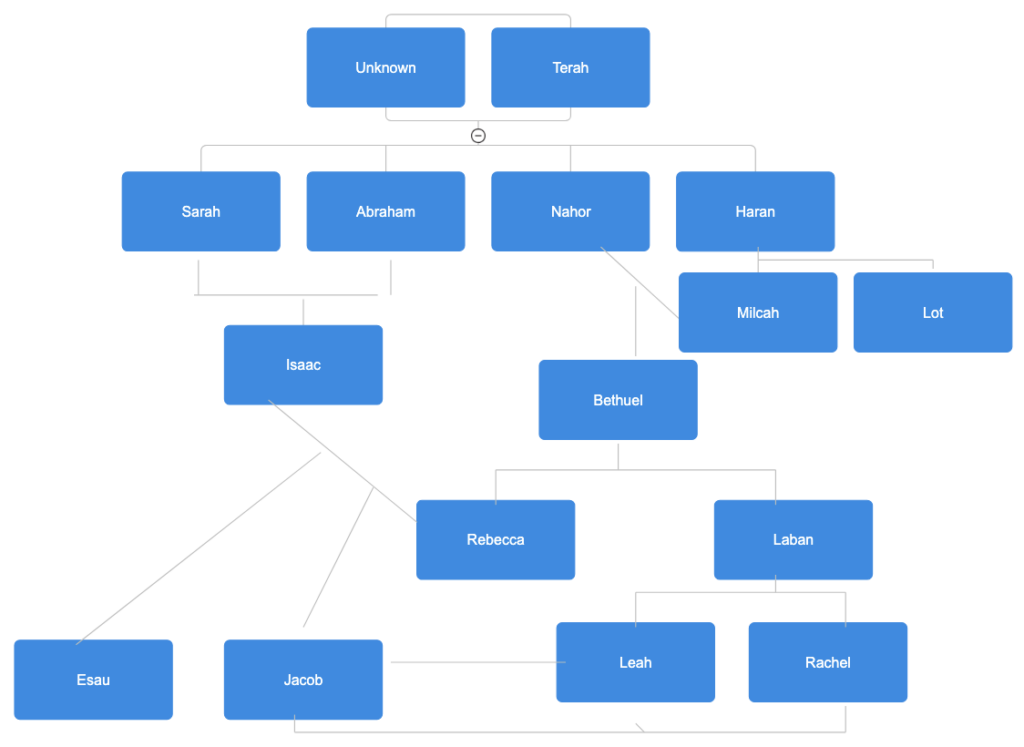
That is several diagonal lines that aren’t usually there.
Way back in Genesis 12, we talked about whether Terah or Abraham was called. If Terah was not, he was chosen to have the chosen family to descend from him.
This is going to be important to keep this in mind for the next couple of chapters.
Let’s connect all of this. In Chapter 24, Abraham looked for a wife for Isaac. Would he thought to look at his family for a wife for his son? Probably.
But Abraham may or may not have had contact with them since he moved out of Ur. If he didn’t, this brought it back to his mind.
Truthfully, I am sure that Jehovah put it in his mind.
The Death of Sarah
“When Sarah was 127 years old, she died at Kiriath-arba (now called Hebron) in the land of Canaan. There Abraham mourned and wept for her” (Gen. 23: 1-2 NLT)
Sarah Died
Abraham was separated from his wife of many years.
To me, Sarah is portrayed in Scriptures as a difficult woman. She devised a plan to hurry Jehovah along in His promise and then didn’t like how it turned out. She could be seen as being mean to Hagar and Ishmael — even though they brought some of that upon themselves.
The thing is, Abraham loved her. He didn’t take another wife while she was alive. (Remember, Hagar wasn’t described as an isha [wife] but a shifchah [female slave of the lowers rank]).
Yeah, Abraham did try to pass Sarah off as just his sister – which she was. But he had to have loved her when he could have taken another wife when it was evident she was barren.
Dykes noted that, because the duties of being a shepherd were straightforward, it would of left Abraham and Sarah plenty of time to interact. It allowed them at establish and grow their life together.
Although Dykes did make an interesting observation. Sarah was Abraham’s last link to Ur. She wasn’t just his wife, she was the last family member (sister) — person altogether — to have seen the complete transformation from idol worshiper to child of Jehovah.
Resource
They had a long life, full together; and in the end, he mourned for her.
It may have thrown Abraham for a loop. Sarah was ten years younger than him. Yet she died first.
If we go back to the Hebrew, it says something interesting. “And Sarah was an hundred and seven and twenty shanah old: these were the shnei chayyai [two lives] Sarah” (Gen. 23: 1 OJB).
What does two lives mean? There are a couple of ways this is interpreted.
The first way is that Sarah had a full significant life. In other words, it was a she-had-a-good-life statement.
The other way to interpret it is that there were two distinct phases in Sarah’s life. It is easy to see the dividing line.
She was born Sarai and lived most of her life as that person. In fact, she lived 89 years under this name. She went from a child to an adult, from being single to being a wife.
The second phase, she became Sarah — a mother with a spiritual transformation. She was a princess who became princess, mother of nations.
But this is something Jehovah’s children would understand.
- “This means that anyone who belongs to Christ has become a new person. The old life is gone; a new life has begun!” (II Cor. 5: 17 NLT).
- “It doesn’t matter whether we have been circumcised or not. What counts is whether we have been transformed into a new creation” (Gal. 6: 15 NLT).
- “For you have been born again, but not to a life that will quickly end. Your new life will last forever because it comes from the eternal, living word of God” (1 Pet. 1: 23 NLT).
- “Jesus replied, “I tell you the truth, unless you are born again, you cannot see the Kingdom of God’” (Jn. 3: 3 NLT).
We call it changing from a physical life to eternal life.
Robinson had an insight into Abraham’s grief. He wrote, “Had he not had to arouse himself and procure a grave for Sarah, he would have brooded over his grief.
Resource
Oh, yeah. The busyness of the funeral and the first couple of weeks help focus us and get us through. Then about week 3, it hits us. They are gone and not coming back.
But then Robertson also wondered if Abraham’s tears indicated he felt some remorse. He may have been thinking back to his deception in Egypt and to Abimelech.
Resource
It is correct, though, when Robertson says, Abraham treated Sarah with mostly tenderness, concession, and dignity.
Sarah lived 127 years. She was 65 when Abraham received the call to go to Canaan. She stayed with him up until now.
This had to have been one of the biggest separations Jehovah required of Abraham. We have talked about how He had a lifetime of these separations. Abraham’s Sanctification Road being built on bricks formed by separations.
- Left his country and kin (Gen. 11: 31)
- Father died (Gen. 11: 32)
- Left Haran (Gen. 12: 1)
- Left Canaan for Egypt (Gen. 12: 10)
- Left Egypt (Gen. 12: 20)
- Separated from Lot (Gen. 13: 13)
- Separated from Ishmael (Gen. 21: 14)
- Almost separated from Isaac (Gen. 22: 10)
- Separated from Sarah (Gen. 23: 1-2)
- Separated from worldly possessions (Gen. 25: 5)
- Separated from life (Gen. 25: 7-8)
Abraham had already experienced the death of a loved one. His brother Haran died before they left Ur. His father Terah died in Haran.
But this was Abraham’s mate – the mother of the covenant son.
Kiriath-arba (now called Hebron)
Sarah died near Hebron.
Wait! What????
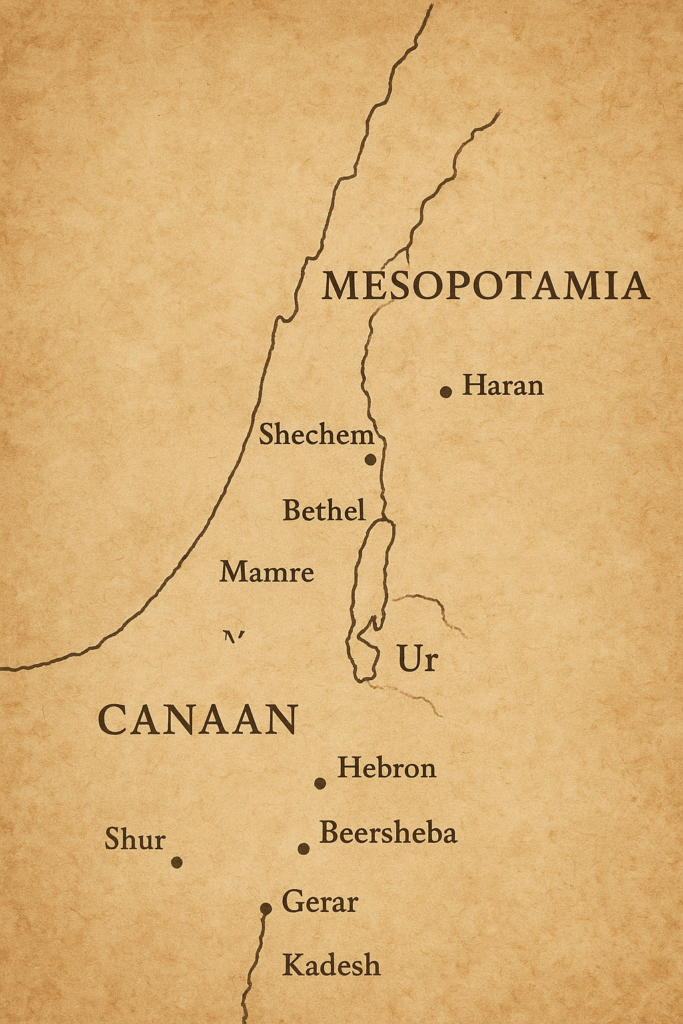
When did they move from Mamre? And why does verse 17 say they were near Mamre?
Well, Mamre was both a town and an oak grove. “The Lord appeared again to Abraham near the oak grove belonging to Mamre. One day Abraham was sitting at the entrance to his tent during the hottest part of the day” (Gen. 18: 1 NLT).
The oak groves and the altar Abraham built eventually became identified with Hebron.
The city of Hebron was in the vicinity of the oak grove of Mamre. Remember, Mamre was one of the allies who helped rescue Lot and the owner of the oak grove.
“But one of Lot’s men escaped and reported everything to Abram the Hebrew, who was living near the oak grove belonging to Mamre the Amorite. Mamre and his relatives, Eshcol and Aner, were Abram’s allies” (Gen. 14: 13 NLT).
Beginning to Secure a Burial Place
“Then, leaving her body, he said to the Hittite elders, ‘Here I am, a stranger and a foreigner among you. Please sell me a piece of land so I can give my wife a proper burial.’ The Hittites replied to Abraham, ‘Listen, my lord, you are an honored prince among us. Choose the finest of our tombs and bury her there. No one here will refuse to help you in this way’” (Gen. 23: 3-6 NLT)
A Stranger and Foreigner
Since Jehovah called Abraham to move to Canaan, He had not given him land to call his own.
Abraham and Sarah had basically been nomads up to that point. Yes, Jehovah had promised that He would give the land to his descendants.
Jehovah just hadn’t given Abraham any of it yet.
Because of this, Abraham knew that he was a stranger in the land. “And even when he reached the land God promised him, he lived there by faith — for he was like a foreigner, living in tents …” (Heb. 11: 9 NLT emphasis added).
This is the Old Testament way of also saying we are in the world but not of the world. Look how Breed described Abraham’s relationship with those around him. He wrote,
“We shall attempt the task of [analyzing] the relations which Abraham sustained to his heathen [neighbors]. We perceive at once that they were those of entire friendliness, but of absolute separation. We shall follow, therefore, this simple division of the subject of this chapter.”
Resource
Friendly but separate. The lifestyle of those around him would have been repugnant and offensive to Abraham. He did not condone their cruel, covetous, and licentious lifestyle.
Breed gave us a list of how Abraham was separate.
- Food
- Dwelling in a tent
- His covenant relations with Jehovah.
- His slow acquisition of his wealth.
- His display of power when needed (rescuing Lot).
We also read of the term sojourner in God’s Word. That highlights our temporary status here in this life. Abraham was experiencing that first-hand here.
Abraham went to negotiate the purchase of land of which he could use as a burial ground. This is the only land that Abraham would ever own.
In a way, that is sad. He was promised all this land for his descendants. None of it was given to him until he needed a burial plot.
But it allowed Abraham to keep his focus on Jehovah.
Hittites (Khitti)
Hebron was populated by the Hittites.
One nation living in Canaan during Abraham’s time was the Hittites. Little is known about the Hittites, also known as Hethites. They were a mighty nation in the 15th and 16th centuries, the size of their empire rivaling that of the Roman Empire.
The Hittites were descendants of Canaan, the grandson of Noah (Gen. 10: 15). Their territory was (currently) part of northern Syria and eastern Turkey.
- “Canaan fathered Sidon his firstborn and Heth” (Gen. 10: 15 ESV).
- “Canaan’s oldest son was Sidon, the ancestor of the Sidonians. Canaan was also the ancestor of the Hittites” (Gen. 10: 15 NLT).
During Abraham’s lifetime, the Hittites settled in the Hill Country around Hebron.
Father God. You have put us in families to love us and support us. We grieve when we lose a loved one to death. Help us keep our eyes on You, as Abraham did, when our hearts are breaking. Amen
If you don’t understand something and would like further clarification, please contact me.
If you have not signed up for the email providing the link to the devotions and the newsletter, do so below.
If God has used this devotion to speak with you, consider sharing it on social media.