
Abraham and His Disobedience
A Famine in Canaan
Abram probably had some of the doubts we have, too. We get really good at questioning God after the fact when things don’t turn out the way we think they should.
That has the potential of making us take our focus off God. Makes it a good test, doesn’t it? Can we focus on God over and above the chaos?
The onset of these trials doesn’t mean that God has forsaken us. It means He is sanctifying us.
We say we take what we have learned from past experiences, evaluate what we are going through now, and grow. But if our perception of the past is flawed, the growth is flawed, isn’t it?
I can just see Satan using that to ensure that we are thinking we’re good to go — but we aren’t.
Egypt
The famine in Genesis 12 must have been really bad for Abram to even consider moving. It must have been widespread for him to consider moving to another country.
There is one tidbit on which this section that is glaringly silent. Did God tell Abram to go to Egypt? Maybe. Maybe not.
Did Abram have any business being in Egypt? Not if God didn’t tell him to go.
We aren’t told how long Abram and Sarai stayed in Egypt, but we are given only half of one chapter of their story there – and it isn’t a flattering one.
Since it said Abram lived as a foreigner in Egypt, I would think he took his whole household.
Abram probably didn’t know how long the famine was going to last. He didn’t have a Joseph-type down in Egypt prophesying there was even going to be a famine.

Abram wasn’t given the land in Canaan. He wasn’t even given possession of any of it until later in life.
That may have caused Abram to still have the urge to wander. If he doesn’t own the land, how can he put down roots?
But surely, Abram considered God’s provision getting him from Ur to Shechem. Whether obedient or not, Abram and Sarai headed down to Egypt.
As obedient as Abram had been, he succumbed to the temptation of sin by not believing God could handle what his new circumstances were.
Abram thought he would run into trouble in Egypt. He was concerned for his life. He thought the men of Egypt would kill him to take Sarai.
Moses doesn’t tell us how much of a struggle Abram had making this decision. We have no way of knowing if Abram immediately thought God wouldn’t be able to take care of them or if he had to talk himself into it.
Abram decided to tell, and Sarai agreed to go along with, a lie. He forfeited truth for safety.
True, Sarai was Abram’s sister. But she was more – she was his wife.
But Abram wasn’t really worried about Sarai in this instance. He was worried for himself! He was asking Sarai to lie for him for his benefit.
Faith opposes false practicality. We can’t conceal the truth because a lie would be easier or more rewarding.
Abram may not have liked confrontation. He was a peaceful man.
Don’t we hate it when Hall of Famers disobey God? If they mess up, how will we not?
But Abram — like us — probably thought this was a small thing. It was just a lie. We don’t like to bother God with the small things.
God says, “Nothing you go through is a small thing to me. You must decide in every situation whether nor not you are going to trust me and obey me.”
God knows we are not going to be 100% fruit-of-the-Spirit perfect. He knows He will forgive us when we ask.
Arrival in Egypt
God didn’t like how things were going down and stepped in.
When we tell a lie, we tell ourselves that no one will know. Well, maybe no human will know.
God always knows. God is all-seeing and all-present.
God stepped in the situation to put things back to right.
Yes, Abram had sinned. He didn’t trust God.
That didn’t stop God.
The Pharaoh found out that God is all-powerful. Pharaoh may have thought he was, but he was no match for God.
We aren’t told what the plagues were and how many (since it is plural). I doubt that they were to the level of the plagues Moses saw God do.
This time God didn’t send a Moses-type to warn the Pharaoh the plagues were coming. We aren’t told how Pharaoh figured out that it was because he was messing with Abram’s wife.
Yeah, this may be Moses picking and choosing what to tell of the story. What is important to know is God instigated the tell-all, and Abram’s secret was made known.
Abram was concerned for his life. Instead, his integrity took a hit. He probably would have used the word dishonored instead of integrity.
What the Egyptians saw was Abram was not, in God’s terms, pure and righteous. They probably would have just said he was a liar and untrustworthy.
The Egyptians were quick to point out that Abram caused the problem by not telling them Sarai was his wife. And they would be right.
Yes, Abram told a lie. That lie did not force them to take Sarai into the palace. That was their choice alone.
This is just another example of deflection of sin. “I did it, but it isn’t my fault.”
But the Egyptians were done with Abram. In fact, he and his family were being escorted out of the country of Egypt.
Abraham Deceived Abimelech
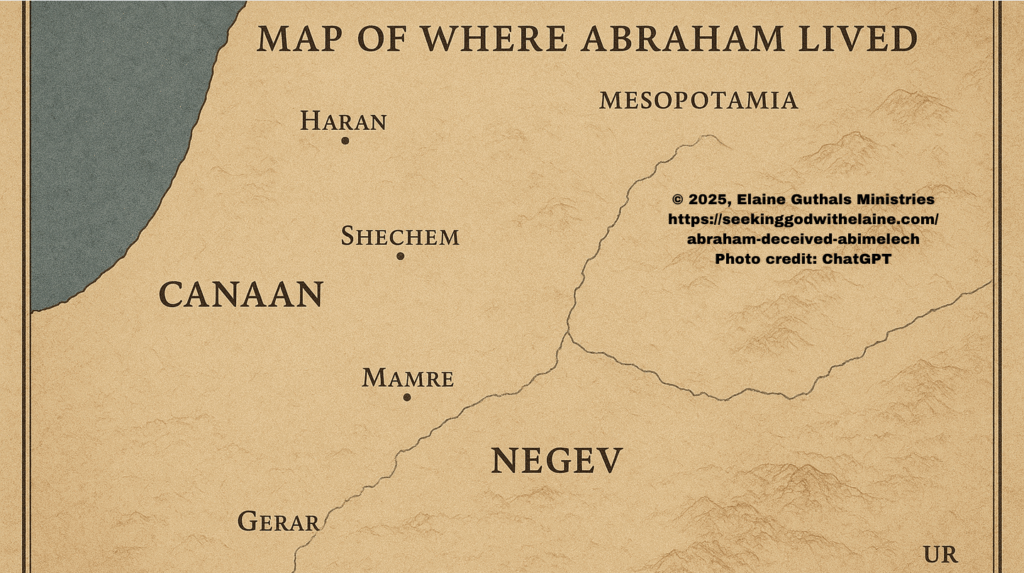
God’s Word does not tell us why Abraham moved again. We have to remember that Abraham was a shepherd. In other words, he was a nomad.
More than likely, at Mamre, Abraham had used up its resources. He had to move on to find grazing lands and water for his flocks and herds.
Was it a famine as it was when Abraham and Sarah moved to Egypt? Maybe it was a famine that wasn’t as severe as the earlier one.
When Abraham went to Egypt, we weren’t told that God moved him. We aren’t told that He initiated this move, either.
We don’t know that for sure. Again, Moses didn’t reference God here.
Gerar was in the land that – in the future – would be the land of Philistia, aka the Gaza Strip. Yes, the Philistines are the modern-day Palestinians – the Greek translation of Philistine.
Gerar was on the eastern border.
She Is My Sister
Abraham didn’t learn the first time in claiming Sarah was his sister. He did it again. He said that Sarah was his sister, not his wife.
Isn’t it easy to forget about what went wrong when it ended up okay? I mean, it had been 24 years since the last deception. Memories fade.
Doesn’t that also show us that, when we think we have learned from one temptation, it will probably come up again to make sure we have learned it?
But since Abraham had been tempted once – and caved – and was being tempted again and caved, wouldn’t that make this sin worse in our way of thinking?
Abraham was more concerned about his life in the lawless region – again – than his wife’s safety.
Does Jehovah allow us to throw out His laws and commandments just because we live in the world? A big emphatic NO!
The opposite is true. Jehovah doesn’t want us to compromise His laws and commandments, let alone throw them out altogether. He wants us to be the example in a lawless society.
I think many disciples have done compromised today. We want to be very careful doing that. When we find we have, we need to repent and turn from those actions and thoughts.

King Abimelech
Abimelech wasn’t only a name. It was also a title that meant my father is king. So, we don’t know if this Abimelech was king or prince. I think the way we should look at it is that this Abimelech’s father the king died making him, the prince, king.
Sarah was taken again. Yep, a 90-year-old woman was taken for her beauty.
Since the visit was mostly peaceful, it wasn’t the kidnapping the Egypt situation may have been.
But if – going into this – knowing it was all about an alliance – a marriage – was Abraham going to give up his wife????
Didn’t Abraham think about his covenant with Jehovah (Gen. 18: 10 NLT)?
Jehovah Came to Abimelech
Once again Jehovah came to deal with the situation. Abraham appears to have been okay with it going on. God wasn’t.
Abraham had agreed to put his faith and trust in God. He was to rely on Jehovah’s provision. That went out the window again.
It may be interesting to some that Jehovah came to Abimelech. He came to a Gentile.
What? Do we think Jehovah only comes to His children?
In Elaine-speak, God will use believers and non—believers to further His plan.

Since Abimelech was a Gentile, we may question how he knew it was Jehovah.
I don’t think we are going to know. It has to go in our UNR book – understanding not required.
Jehovah came out playing hardball. Abimelech was a dead man because of what he had done.
I’m sorry. I’m tripping over Abimelech taking a pregnant woman for an alliance. If she was showing – as much as children, especially sons, were valued – I don’t see him taking someone else’s son if this was a peaceful alliance.
Abimelech Defends Himself
We can see Abimelech’s outrage. He was just acting on the information he had been given. There was no way he would know if it was truth or a lie.
Isn’t that how we comfort ourselves? We make the best decision we can with the information that we have at that time. What else can we do?
Besides, Abimelech hadn’t slept with Sarah yet.
It doesn’t seem that Abimelech had any trouble understanding what the dream meant. A God was talking to Him, albeit one he didn’t know.
But as a pagan, Abimelech may have believed that there were many gods. Some believed each region had their own gods. As Abraham was from a different region, Abimelech may have thought that this was Abraham’s God – which it was.
Still, that would have been something foreign to Abimelech. Yes, they believed there were gods over regions, but they didn’t believe that those gods could function outside of those regions. To have one to come with Abraham all this way would have been unnormal.
Whatever Abimelech thought, he knew he was talking to a god. He gave Jehovah the title Adonoi – Lord.
God’s Response
Jehovah acknowledged that Abimelech had not done nothing wrong – but only because He hadn’t allowed it.
So, what Jehovah was saying was, if Abimelech would have bedded Sarah, he would have suffered the death penalty. Not knowing Sarah’s status wasn’t enough to commute the sentence.
In this instance, Jehovah accepted Abimelech’s ignorance in the situation. That is not always the case.
But the ball was in Abimelech’s court. If he would have pursued the path that led to bedding Sarah, he would have been put to death by Jehovah.
It is interesting that God would call Abraham a prophet. We think of him as Patriarch, not a seer.
God gave Abimelech the opportunity to do what was right.
Even if Abimelech didn’t acknowledge God as Sovereign Lord, he listened to Him when he came to him in the dream. He did what God said – and immediately.
Plus, Jehovah recognized his intentions. We can’t judge someone else’s relationship with Jehovah. We don’t know their hearts or intentions.
Abimelech probably knew Jehovah meant business. If he didn’t immediately return Sarah to Abraham, He would make good His word and make Abimelech a dead man.
We have to give Abimelech his due. It quickly set up getting Sarah back.
Called Out
Abimelech didn’t mince words with Abraham. He said that people just don’t do this to others.
Abraham was allowed to defend himself. The problem was that it showcased his doubt that God would protect them.
The fact that Sarah really was Abraham’s sister caused him to believe he really wasn’t telling a lie. She was his sister, but it was a lie because she was his wife, also.
But Abraham’s insecurities all stemmed from him believing Abimelech was a godless man. Instead of fearing for his life this time, Abraham said that he was afraid Abimelech didn’t reverence God.
No amount of whining from Abraham was going to make it less a lie. He should have just left it at, “I lied.”
Abraham blamed this on God (Gen. 20: 13 NLT). That isn’t a smart thing to do.
The choice was Abraham’s. He could have chosen to tell the truth, but he chose to lie.
Restitution
Once again, Abraham was rewarded handsomely for lying. Abimelech gave him everything the Pharaoh gave him except donkeys and camels.
Instead, Abimelech gave Abraham 1,000 pieces of silver. That wasn’t too shabby.
Well, at least Abraham wasn’t kicked out of the country this time. He just got loot again – making him even more wealthy.
But don’t we question when Jehovah rewards sinful behavior? We question why Abraham should have – again – increased his wealth for telling a lie.
Another Intercessory Prayer
God had Abraham intercede for Abimelech. What he was interceding for was for the ability of Abimelech’s wives and concubines to become pregnant.
If the consequence was done in a night, it wouldn’t be much of a consequence. It had to be felt.
God had Abraham pray for Abimelech for a couple of reasons. We build that faith by spending time with God in prayer. Even though Abraham was righteous, there was more work needed to be done in him.
Abraham had to be gracious and truthful in praying for Abimelech. If he rebelled about what Jehovah would have him do, He wouldn’t answer the prayer.
But remember. Jehovah called Abraham a prophet. This after calling him His friend.
I wonder if part of the reason was because the last time Abraham tried to intercede – for Sodom and Gomorrah – it didn’t go so well.
Remember, the 20 questions that Abraham asked Jehovah about finding the righteous in Sodom and Gomorrah. That was him interceding with Him.
In reality, Abraham was interceding for Lot. That was accomplished. But his prayer was also for the whole cities of the plains. That didn’t succeed.
But as he stood looking at the smoke across the plain (Gen. 19: 28), Abraham’s heart had to be breaking.
Did Abraham think Jehovah hadn’t answered his prayer? Did He ignore his intercession?
At that point, Abraham didn’t know Lot’s fate. He probably felt his intercessory prayers wouldn’t be answered.
God wanted to prove differently to Abraham.
A Visit from Abimelech
Abraham and Abimelech’s relationship had been built on shaky ground.
It has been a minute since we discussed Abraham and Abimelech. Their relationship didn’t start off on a good note. Abraham lied to Abimelech.
Abraham had moved to Gerar, probably in search of pastureland. Abimelech, probably a Philistine, was the king of Gerar.
Abraham was more concerned about his life in the lawless region – again – than his wife’s safety. He tried to pass Sarah off as his sister.
Just as the Pharaoh had done in Egypt, Abimelech “… brought [Sarah] to him at his palace” (Gen. 20: 2 NLT). He may have done this in order to form an alliance through marriage with Abraham.
Whatever the reason for Abimelech taking Sarah, Jehovah intervened. He came to Abimelech in a dream.
This had to have occurred sometime between the destruction of Sodom and Gomorrah in 1861 BC and the birth of Isaac in 1860 BC. Abraham was living in Mamre when Sodom and Gomorrah was destroyed.
At the time of this story, it was at least 1858. According to its placement — which may or may not be chronological, it was after Isaac was weaned.
Abimelech didn’t come alone. He brought his army commander, Phicol. This was probably due to the perilousness of the journey. If Abimelech thought he would need military support when talking to Abraham, I think Phicol would have been mentioned more than just at the arrival and departure.
A Treaty with Abimelech
Since a good relationship wasn’t really established, Abimelech wanted to establish a treaty with Abraham.
I doubt Abimelech knew of Jehovah’s blessing. “I will bless those who bless you and curse those who treat you with contempt. All the families on earth will be blessed through you” (Gen. 12: 3 NLT).
What Abimelech did know was that Abraham’s success came from Jehovah.
We talked about Sarah may or may not have been pregnant when the fiasco happened with Abimelech. Either way, Abimelech would have acknowledged the miracle needed for this old couple to have conceived a child.
But Abimelech’s view would also be a worldview. Don’t we like to have successful, influential friends?
It may have been that — after they got Abraham’s deception straightened out — Abimelech saw Abraham as he really was. He would have seen a goodness in Abraham.
Still, Abimelech prefaced the treaty with one condition — don’t deceive me or mine again. He was telling Abraham that for however long it had been since Abraham had been living in the country as a foreigner, he had been loyal to him despite the initial deception.
Abimelech was wanting a little reassurance that that loyalty would not be returned with more deception n the future.
Abraham’s answer was immediate. “Yes, let’s make a treaty.”
Remember, Abraham’s reason for the deception was that he thought the land was lawless. He would have been told, I am sure, that Jehovah came to speak to Abimelech.
Working Out a Problem
This is the first time we are told that Abraham dug wells. It is logical that he would. He needed water for his flocks.
This will be confirmed when we get to Genesis 26. “So the Philistines filled up all of Isaac’s wells with dirt. These were the wells that had been dug by the servants of his father, Abraham” (Gen. 26: 15 NLT).
When I googled it, it said these wells were a source of water for his family, servants, and livestock.
So, go back to Hagar and Ishmael. When Abraham told them they had to leave, they would probably have been traveling from well to well. If Abraham built them for family use, and not just livestock use, they would have been depending on these wells.
If the wells had been commandeered by the pre-Philistines, they may not have let travelers use them. That is especially true for travelers association with the man who dug them in the first place and from whom they commandeered them.

To read devotions in the Creating Everything theme, click the button below.
Devotions in the Abraham the Patriarch series