Abraham and Isaac arrived at Moriah to worship Jehovah through sacrificing Isaac. This devotional reading look at whether Abraham could come through on the testing or not.
Nuggets
- Abraham and Isaac made it to where they could see the mountain in the distance.
- Abraham and Isaac journey on without the servants.
- Abraham and Isaac carried what they needed to make the sacrifice.
- The first thing that Abraham did when they arrived at the place for the sacrifice was to build an altar.
Abraham and Isaac arrived at Moriah to worship Jehovah through sacrificing Isaac. That was the gut-wrenching test Jehovah was putting Abraham through.
Let see if Abraham passed or failed.
Let's Put It into Context
To read devotions in the Creating Everything theme, click the button below.
Devotions in the Abraham the Patriarch series
Journey to the Mountain
“On the third day of their journey, Abraham looked up and saw the place in the distance. ‘Stay here with the donkey,’ Abraham told the servants. ‘The boy and I will travel a little farther. We will worship there, and then we will come right back’” (Gen. 22: 4-5 NLT)
On the Third Day
Abraham and Isaac made it to where they could see the mountain in the distance.
We have to clear up something. The New Living Translation says, “On the third day of their journey, Abraham looked up and saw the place in the distance” (Gen. 22: 4 NLT).
If we go back to the Hebrew, it says, “Then on Yom HaShlishi Avraham lifted up his eyes, and saw the place afar off. [1C 15:3]” (Gen. 22: 7 OJB).
Yom HaShlishi does mean the third day. But it means the third day of the week — our Tuesday – not the number of days in the journey.
Only Shabbat is the only day of the week given a name. Sunday is the first day, Monday is the second day, and Tuesday is the third day.
In other words, we don’t know how long the journey took.
All we know is that Abraham took the journey to worship Jehovah. “… We will worship there, and then we will come right back” (Gen. 22: 5 NLT).
Stay Here with the Donkey
Abraham and Isaac journey on without the servants.
Abraham asked his servants to stay back, partially because he didn’t want them to try and stop him. He probably didn’t want any of the three to know yet who the sacrifice was going to be.
But I can also see this as being a very private act of worship for Jehovah’s glory. It was a between Abraham and his God.
I think another reason is that Abraham wanted that time alone with Isaac.
Lannon talked about this was the only time in which we read Abraham traveled with servants. Maybe, but it wasn’t the only time he traveled with servants.
When he went to Egypt and Gerar, Abraham moved his whole household with him – flocks and all. That includes servants. They didn’t need to be singled out.
Let’s look at the Hebrew for a second on verse 5. “And Avraham said unto his servants, Abide ye here with the donkey; and I and the young man will go over there and nishtachaveh (we will worship) and we will come back again to you” (Gen. 22: 5 OJB emphasis added).
Hmmm. Young man or boy? Kennedy thought Isaac was a man. Lannon said that Isaac could have been up to 30 years old based on the word Na’ar used (1830 BC). Gray thought he was 25 (1835 BC). The Old Testament Timeline we’ve been using says it was 1845 BC, making him 15.
Resources
A teenager isn’t necessarily a young man but a youth. To me that is more a young adult.
I don’t know. Fifteen seems too young to me and thirty too old to me.
Abraham was convinced that it would turn out okay. “… We will worship there, and then we will come right back’” (Gen. 22: 4-5 NLT).
Heading toward the Altar
“So Abraham placed the wood for the burnt offering on Isaac’s shoulders, while he himself carried the fire and the knife. As the two of them walked on together, Isaac turned to Abraham and said, ‘Father?’ ‘Yes, my son?’ Abraham replied. ‘We have the fire and the wood,’ the boy said, ‘but where is the sheep for the burnt offering?’ ‘God will provide a sheep for the burnt offering, my son,’ Abraham answered. And they both walked on together” (Gen. 22: 6-8 NLT)
Abraham and Isaac carried what they needed to make the sacrifice.
The servants weren’t the only thing left behind. The donkey was, too. Abraham and Isaac went on alone.
Isaac carried the wood, and Abraham carried the fire and knife. But that made something very obvious to Isaac.
Where was the animal to be sacrificed?
Did Abraham not answer Isaac’s question fully because he didn’t want to scare the boy? Or was he wanting to help grow Isaac’s faith? Probably a bit of both.
Because of Abraham’s strong faith, he knew that God would provide a sacrifice, or His promise would be null and void.
What has always amazed me is how calm on the outside Abraham was. His thoughts had to be racing because Satan had to be working on him.
What would have been our first response? Far too many, I am afraid, would have been railing against Jehovah. We would scream at Him for breaking His covenant promises. We would be furious for the anguish the testing was causing.
Our response would be wrong.
Remember, this was “Some time later …” (Gen. 22: 1 NLT) after Abraham had sent Ishmael away. Talk about insult to injury.
Not one time did Abraham so much as even murmur against Jehovah. He always said, “Sir, yes Sir.”
How was Abraham able to keep his conduct in line? Fuller told us how. He wrote, “We have here a surprising instance of the efficacy of Divine grace, in rendering every power, passion, and thought of the mind subordinate to the will of God.”
Resource
Abraham’s obedience — and his faith — never wavered because of grace.
The Sacrifice of Isaac
“When they arrived at the place where God had told him to go, Abraham built an altar and arranged the wood on it. Then he tied his son, Isaac, and laid him on the altar on top of the wood. And Abraham picked up the knife to kill his son as a sacrifice” (Gen. 22: 9-10 NLT)
Built an Altar
The first thing that Abraham did when they arrived at the place for the sacrifice was to build an altar.
Building altars was Abraham’s way to worship God. It wasn’t something novel for God to ask Abraham to make a sacrifice. In fact, Abraham had sacrificed enough that Isaac knew something was missing.
It was a novel experience that God asked Abraham to sacrifice Isaac, the son for whom he had waited so long.
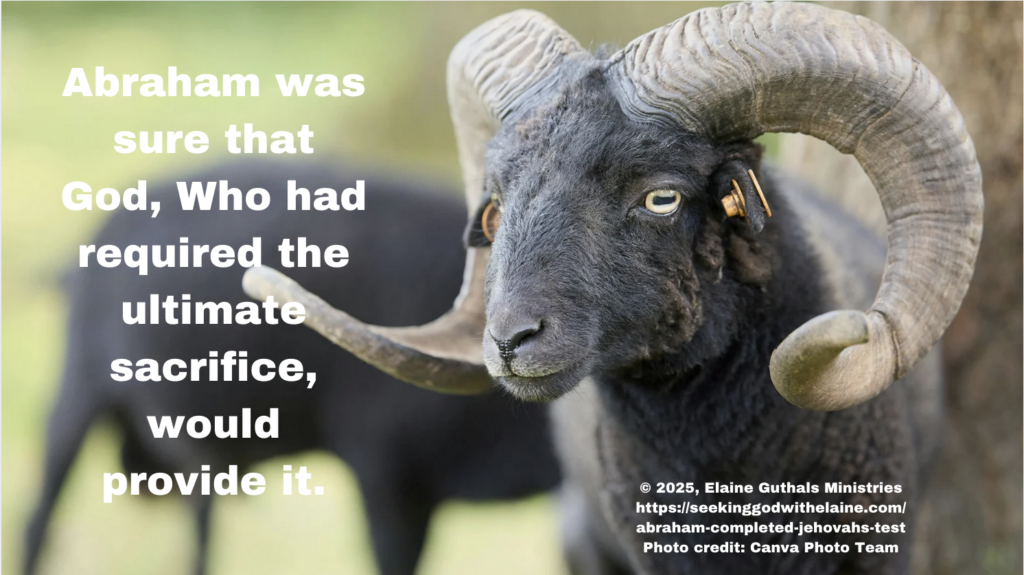
Abraham was sure that God, Who had required the ultimate sacrifice, would provide it.
Picked Up the Knife
Obedience isn’t complete without an inward transformation.
I bet there were tears running down his face as he bound Isaac. He had to be feeling a variety of thoughts.
The faith shown was that Abraham believed — even if he had to go through with the sacrifice — Jehovah was Sovereign God above all. The covenant promise would be kept in some way.
Abraham didn’t have to understand how that would play out. He just had to believe it would.
But Abraham also had to be willing to go the entire way if it didn’t play out the way he thought it should.
Robertson made a great point. We like to think that Abraham knew, even if he had to go through with the sacrifice, Jehovah would raise his Isaac back to life and return him to his loving father.
Wrong. Robertson said, “If you make a sacrifice, expecting that God will return you your Isaac, that is a sham sacrifice, not a real one. Therefore, if you make sacrifices, let them be real.”
Resource
If we worship Jehovah with an expectation of some blessing, it really isn’t the kind of worship He requires.
It isn’t we worship because of. It is we worship because.
If we worship because of receiving something in return, that isn’t true worship. We must worship Jehovah because He is Sovereign God.
Some of us are probably asking why Jehovah had to let it go this far. That is easy.
It didn’t mean anything until Abraham showed Jehovah that he would go all the way. Saying he would and not meaning anything proved nothing. It was just a lie.
Abraham had to pick up the knife. He more than likely had to lift it over his head.
I loved how Maclaren explained that. He wrote, “The outward deed is only the coarse medium through which it is made visible for men. God looks on purpose as performance.”
Resource
Performance equals action. But not just any action — it has to be what Jehovah requires and performed through faith.
If we are good at the second greatest commandment — loving others as ourselves (Mk. 12: 31) — but do not surrender ourselves to the first greatest commandment — love God with heart, soul, mind, and strength (Mk. 12: 30) — we haven’t performed either to Jehovah’s satisfaction.
Kill His Son for a Sacrifice
The purpose of the burnt offering was not to wipe clean the person’s sin but is a gift of ransom to alter Jehovah’s attuned toward that person.
We don’t know what Abraham’s understanding of the coming Messiah was. This is a perfect example of what was coming.
Bradford explained how. He wrote,
“The elements are that Isaac was to be killed and burned up on an altar. And, we can see from the story that this also was not about some sin or another that either Isaac or Abraham had committed. So what was it about? As a burnt offering, an ‘olah, it was about total surrender and obedience to God on the part of the worshipper…..Abraham. It also demonstrated the principle of substitution when Isaac was replaced by a Ram that had been caught by his horns in some nearby thorn bushes. And the sacrifice displayed the idea of ransom…… that Isaac was to be a price paid, voluntarily, in order that mankind could be at peace with God.”
Resource
When Jehovah gave the Levitical Sacrificial System to Moses, he would have understood the concepts behind it better because of this sacrifice. We better understand the concept of Yeshua being the sacrifice because of the substitution of the ram for Isaac.
Making the Connections #1
When we started talking about Abraham in Genesis 12, we talked about how Abraham’s Sanctification Road being built on bricks formed by separations.
- Left his country and kin (Gen. 11: 31).
- Father died (Gen. 11: 32).
- Left Haran (Gen. 12: 1)
- Left Canaan for Egypt (Gen. 12: 10).
- Left Egypt (Gen. 12: 20).
- Separated from Lot (Gen. 13: 13).
- Separated from Ishmael (Gen. 21: 14).
- Almost separated from Isaac (Gen. 22: 10).
- Separated from Sarah (Gen. 23: 1-2).
- Separated from worldly possessions (Gen. 25: 5).
- Separated from life (Gen. 25: 7-8).
Because Abraham was marked for a great purpose, he needed to be separated from worldly things. That usually means being separated from some people in our past.
Making the Connections #2
Many of us probably have thought, “Oh, no. I couldn’t do that.” Maybe. Maybe not.
Taylor had an interesting take. He wrote,
“The significance of the transaction is rooted in the fact that Abraham was not a mere private individual, but in a very special sense a representative man. … I would say that the whole story was meant to reveal the universal law to this effect, that what is born of God must be consecrated to God; that the children of promise are at the same time the children of consecration, and so there is no more difficulty in the command to sacrifice Isaac than there is in the injunction to cast out Ishmael.”
Resource
But look what Taylor was saying.
- What is Jehovah’s is Jehovah’s — He can do what He wants with it.
- This is even true with what He has promised. It isn’t that He changed His mind. It is about Him giving us what we need to know when we need to know it.
- We aren’t told that Abraham ever saw Ishmael again. Sending him away would have been sending him to his death even if it wasn’t physical. He may have just been dead to Abraham.
Making the Connections #3
Taylor made a great observation. He wrote, “Tribulation by itself will not improve our characters.”
Resource
The point isn’t that we go through the hard times. The point is we go through it depending on Jehovah.
Just like Abraham, we don’t need to know the end plan — or even the end destination.
We only need to have a heart-knowledge of the Sovereign God calling us to walk with Him through the testing.
Making the Connections #4
Yeah, this was a really hard testing. One thing we tend to forget is that Abraham had a lot on the line – either way he went.
Through it all, Jehovah was right there. Like we said, He wasn’t going for the sin in Abraham’s life. He was going for the faith.
Of course, Jehovah is going to watch over us and help us with this trial.
Making the Connections #5
Okay. My mind is a little mushy tonight. I have to process Rowsell’s statement. He wrote, “In every age and in every station faith is expressed in simple dutifulness, and this faith of Abraham is, indeed, of the mind of Christ.”
Resource
In Elaine-speak, wherever we are at on our Sanctification Road, we just have to obey. Abraham’s faith allowed him to be willing to do the hard thing, what he deep down really didn’t want to do.
But Abraham did it anyway.
How Do We Apply This?
- Walk with Sovereign God.
- Do everything that He asks of us the way He asks of us and the first time He asks.
Father God. Thank You for the example of Abraham completing the hard thing You asked him to do. Help us to obey You perfectly the first time. Amen.
If you don’t understand something and would like further clarification, please contact me.
If you have not signed up for the email providing the link to the devotions and the newsletter, do so below.
If God has used this devotion to speak with you, consider sharing it on social media.