Even though John the Immerser faithfully taught about Yeshua, some of his disciples still had a question. This devotional reading looks at their concern regarding the people following Jesus instead of John.
Nuggets
- There appears to be a contradiction as to whether Yeshua actually baptized people.
- John was still baptizing near the Jordan River.
- Ceremonial cleansing was an important aspect of the first-century Jewish faith.
- John had previously identified Yeshua as the Messiah.
- If John’s disciples had accepted Yeshua as the Messiah, they would have understood why He drew the crowds, not John.
- John acknowledged his ministry came from God.
- John acknowledged that he fulfilled his mission.
- Yeshua is referred to as the Bridegroom in Scripture.
- John was proud of the success that Yeshua was experiencing.
- John knew the focus had to be on the Messiah.
- John reinforced that Yeshua is divine.
We don’t know how long John’s disciples had been following him. Scripture tells us of a question they asked John about Yeshua’s growing ministry. They questioned why people weren’t coming to see John instead.
John showed his deep understanding of his mission and Who Yeshua was.
Let's Put It into Context
To read devotions in The Battle for the Heart theme
Devotions in the The Early Ministry of the Messiah series
Baptizing People
“Then Jesus and his disciples left Jerusalem and went into the Judean countryside. Jesus spent some time with them there, baptizing people” (Jn. 3: 22)
There appears to be a contradiction as to whether Yeshua actually baptized people.
Blow me over with a feather, I’ve read this verse before, but ooo baby, I don’t remember it. “… Jesus spent some time with them there, baptizing people” (Jn. 3: 22 NLT).
But is this right? There seems to be a slight contradiction between John 3: 22 and John 4: 2. “Jesus knew the Pharisees had heard that he was baptizing and making more disciples than John (though Jesus himself didn’t baptize them — his disciples did)” (Jn. 4: 1-2 NLT).
Maybe. Maybe not. John would have known whether Jesus baptized anyone. So why the switch?
There could be a logical explanation. It was Jesus’ ministry, not the disciples’ ministry.
When Yeshua was preaching, maybe the disciples were doing the actual baptizing. They would have been doing the baptizing in His name.
So, maybe that is what John meant in John 3: 22. Maybe John 4: 2 is just a clarification.
Bottom line, Scripture really doesn’t tell us what is meant by the two verses and their being seemingly contradictory.
John’s Location
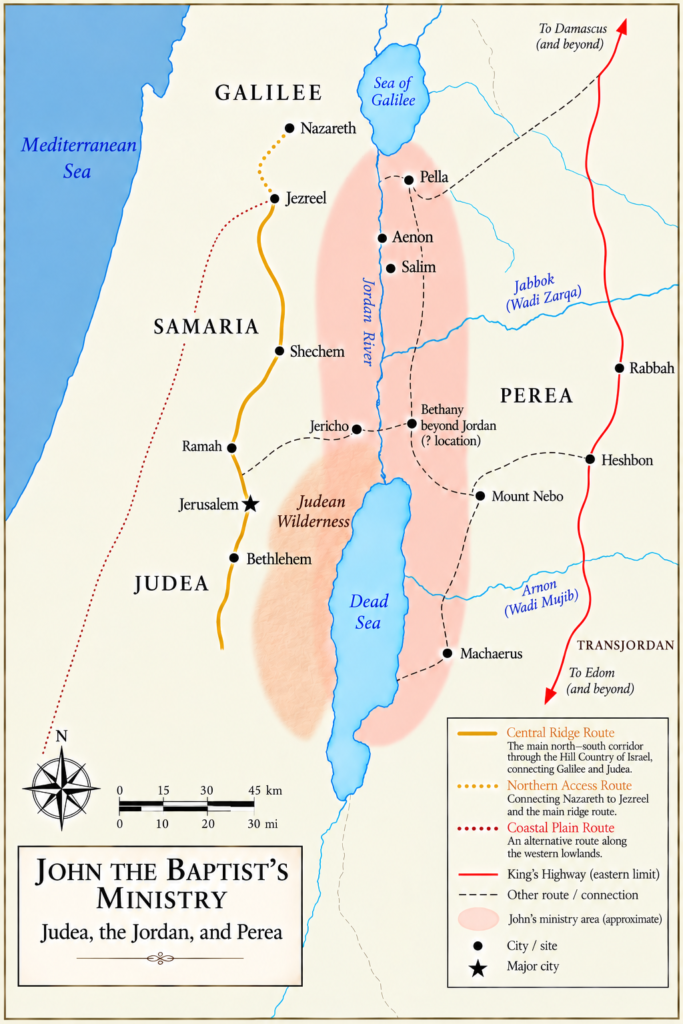
“At this time John the Baptist was baptizing at Aenon, near Salim, because there was plenty of water there; and people kept coming to him for baptism. (This was before John was thrown into prison.) ” (Jn. 3: 23-24)
John was still baptizing near the Jordan River.
Aenon is an interesting place. Its name is generally understood to come from a Semitic word related to springs or fountains.
We think of springs feeding a larger body of water. These springs would have fed the Jordan River.
John wouldn’t have been looking for anywhere beside the Jordan River. He was looking for an abundance of water. We have to remember this was immersion baptism.
While we aren’t for sure where Aenon was looking, it seems to me that the best choice is in the northern Jordan Valley. (The other choice is in Samaria, which at that time wasn’t Israel.)
Ceremonial Cleansing
“A debate broke out between John’s disciples and a certain Jew over ceremonial cleansing” (Jn. 3: 25 NLT).
Ceremonial cleansing was an important aspect of the first-century Jewish faith.
Wait! What????
Why are we talking ceremonial cleansing? What does that have to do with baptism????
We know ceremonial cleansing was a way to remove ritual impurity. This allowed the person to participate in certain aspects of Jewish religious life. This had to be done after:
- Contact with a dead body.
- Certain bodily discharges occurred.
- Menstruation and childbirth.
- Contact with other sources of ritual impurity.
It didn’t necessarily mean someone had sinned, contrary to what some might think. It meant that the person temporarily had a condition that restricted them from participating in sacred activities.
Between Leviticus 15 and first-century Israel, Jewish interpretations had been added to explain how the purification should be practiced.
What may have started as a ritual handwashing turned into ritual immersion by the Second Temple period. Archaeological finds have uncovered stepped immersion pools from first-century Judea and other Jewish settlements.
Ceremonial cleansing was important. It was connected to holiness, obedience, Temple worship, and the people’s relationship with Jehovah.
So, how was this different from John’s baptism – and Yeshua’s? Their immersion baptism included another very important condition.
It was tied to repentance. Remember, John’s and Yeshua’s messages were the same.
- “This messenger was John the Baptist. He was in the wilderness and preached that people should be baptized to show that they had repented of their sins and turned to God to be forgiven” (Mk. 1: 4 NLT).
- “From then on Jesus began to preach, ‘Repent of your sins and turn to God, for the Kingdom of Heaven is near’” (Mt. 4: 17 NLT).
That is an important distinction.
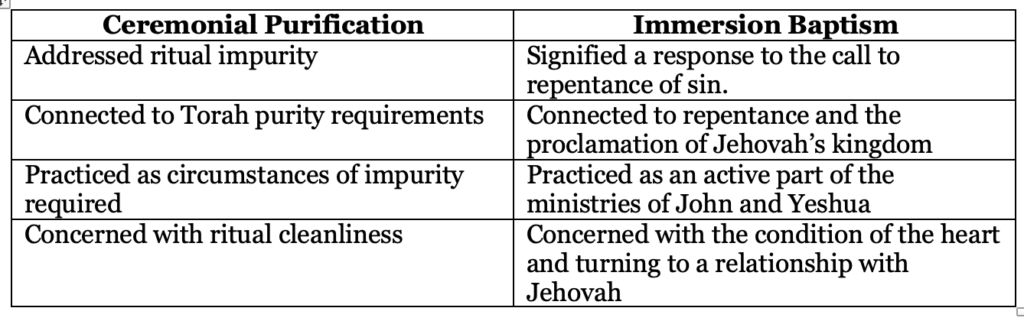
So, what was the debate about? If we stopped reading here, we might think it was whether baptism was replacing, supplementing, or serving a different purpose from that with which they were familiar.
And that could have been the reason for the debate. We know how we don’t like to change things – especially those associated with rituals.
But would John’s disciples’ question and his response have been what it was if that was all they were asking? I don’t think so.
One word is missing from the New Living Translation that is in other versions. It is the word then, which can also be translated as the word therefore. That connects it to the abundant water rather than to the next question.
And the question is much more important than ceremonial cleansing.
The Real Issue
“So John’s disciples came to him and said, ‘Rabbi, the man you met on the other side of the Jordan River, the one you identified as the Messiah, is also baptizing people. And everybody is going to him instead of coming to us’” (Jn. 3: 26 NLT)
The One You Identified as the Messiah
John had previously identified Yeshua as the Messiah.
This reference calls us back to a passage we’ve discussed before. It was what John was proclaiming in his testimony to the priests and Temple assistants.
- “John testified about him when he shouted to the crowds, ‘This is the one I was talking about when I said, “Someone is coming after me who is far greater than I am, for he existed long before me”’” (Jn. 1: 15 NLT).
- “The next day John saw Jesus coming toward him and said, ‘Look! The Lamb of God who takes away the sin of the world! He is the one I was talking about when I said, “A man is coming after me who is far greater than I am, for he existed long before me”’” (Jn. 1: 29-30 NLT).
They knew Who Yeshua was.
They would also have known John’s purpose. He was very vocal about his job: to prepare the way for the Messiah.
So, what was the problem?
They knew who He was in their heads. But it hadn’t gotten down to their hearts yet.
How can we tell? “… the one you identified as the Messiah …” (Jn. 3: 26 NLT). Your Messiah, not our Messiah – or even He is the Messiah.
Everybody Is Going to Him
If John’s disciples had accepted Yeshua as the Messiah, they would have understood why He drew the crowds, not John.
It seems like John’s disciples were looking at John’s ministry as John’s ministry, not as preparation for Yeshua’s ministry. To them, it was two distinct ministries running parallel to each other.
No, we see nothing in Scripture to say John put that thought in their minds. Every mention we have of John confirmed that he knew his assignment – prepare the way for the Messiah.
And that was just what John did.
That doesn’t mean all of John’s disciples got his message. Face it, Yeshua’s disciples struggled with knowing Yeshua was Messiah, too – and Judas never got it.
Even if John’s disciples didn’t understand how Yeshua fit, they should have known that the ministry was Jehovah’s ministry. John didn’t own it.
Let’s think about it a second. We read about all the crowds that John was attracting. “People from Jerusalem and from all of Judea and all over the Jordan Valley went out to see and hear John” (Mt. 3: 5 NLT).
Those crowds didn’t corrupt John’s understanding of his mission. He was to be the voice in the wilderness – the Elijah of the New Testament.
John the Baptizer didn’t head down that road. He kept the focus on Yeshua.
We don’t like to give up what we are used to doing – especially if we think Jehovah has called us to that ministry. We really don’t like giving up the recognition that ministry affords us.
We shouldn’t look for the world’s applause when we are doing Jehovah’s work.
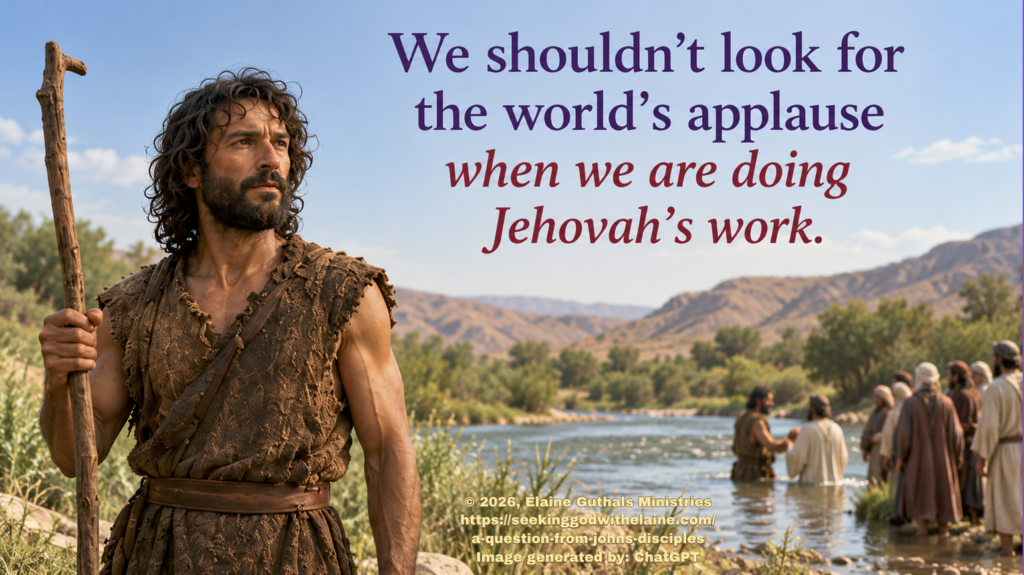
John didn’t, but it sounds like his disciples were thinking that for him.
All Is from Jehovah
“John replied, ‘No one can receive anything unless God gives it from heaven. You yourselves know how plainly I told you, “I am not the Messiah. I am only here to prepare the way for him.” It is the bridegroom who marries the bride, and the bridegroom’s friend is simply glad to stand with him and hear his vows. Therefore, I am filled with joy at his success. He must become greater and greater, and I must become less and less” (Jn. 3: 27-30 NLT)
Unless God Gives It
John acknowledged his ministry came from God.
True, John’s father was told about John’s purpose in life before he was even conceived. He grew up knowing what he would do with his life.
But John wasn’t talking merely about the ministry Jehovah gave him. He said God gives everything – our purpose, our knowledge, our skills, our resources – life itself.
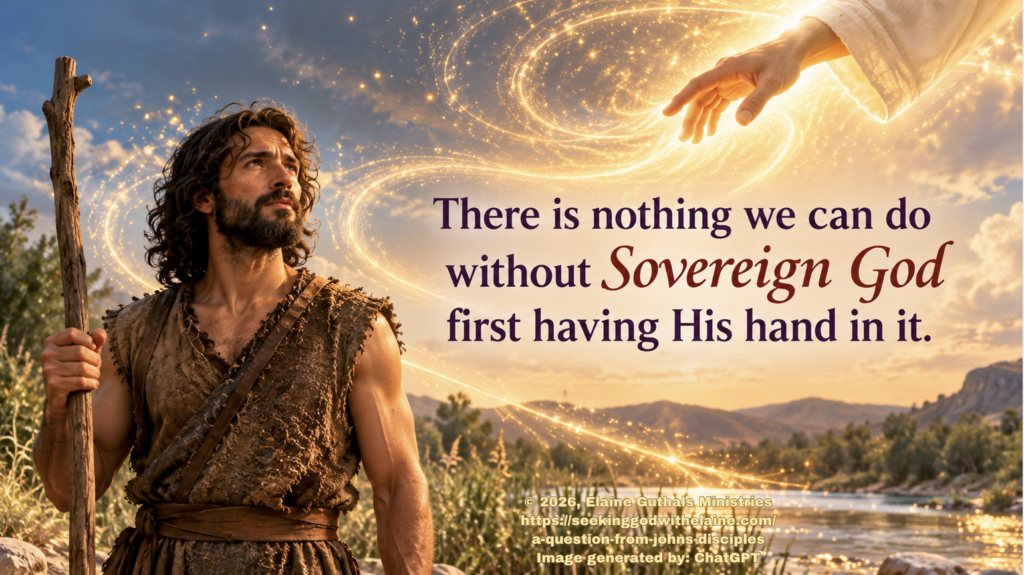
There is nothing we can do without Sovereign God first having His hand in it.
Know How Plainly I Told You
John acknowledged that he fulfilled his mission.
John was sent to tell people that the Messiah was coming, and John told the people the Messiah was coming. That was all he could do.
John couldn’t make his disciples believe in the Messiah. Even Yeshua didn’t make people believe in Him.
We each have to make our own choice to believe Yeshua or not and accept Him to be our Savior. We each have to choose daily to walk with Him.
Our job – like John’s – is to witness to people. The Holy Spirit does the rest. He convicts those we tell about Yeshua and guides us to Yeshua.

Bridegroom
Yeshua is referred to as the Bridegroom in Scripture.
There are other passages that identify Yeshua the Bridegroom. Yeshua refers to Himself as the Bridegroom whose presence makes fasting inappropriate for His companions.
- “One day the disciples of John the Baptist came to Jesus and asked him, ‘Why don’t your disciples fast like we do and the Pharisees do?’ Jesus replied, ‘Do wedding guests mourn while celebrating with the groom? Of course not. But someday the groom will be taken away from them, and then they will fast”’ (Mt. 9: 14–15 NLT).
- “Once when John’s disciples and the Pharisees were fasting, some people came to Jesus and asked, ‘Why don’t your disciples fast like John’s disciples and the Pharisees do?’ Jesus replied, ‘Do wedding guests fast while celebrating with the groom? Of course not. They can’t fast while the groom is with them. But someday the groom will be taken away from them, and then they will fast’” (Mk. 2: 18–20 NLT).
- “One day some people said to Jesus, ‘John the Baptist’s disciples fast and pray regularly, and so do the disciples of the Pharisees. Why are your disciples always eating and drinking?’ Jesus responded, ‘Do wedding guests fast while celebrating with the groom? Of course not. But someday the groom will be taken away from them, and then they will fast’” (Lk. 5: 33–35 NLT).
The Old Testament gave the foundation for this.
- “For your Creator will be your husband; the Lord of Heaven’s Armies is his name! He is your Redeemer, the Holy One of Israel, the God of all the earth” (Isa. 54: 5 NLT).
- “Never again will you be called ‘The Forsaken City’ or ‘The Desolate Land.’ Your new name will be ‘The City of God’s Delight’ and ‘The Bride of God,’ for the Lord delights in you and will claim you as his bride. Your children will commit themselves to you, O Jerusalem, just as a young man commits himself to his bride. Then God will rejoice over you as a bridegroom rejoices over his bride” (Isa. 62: 4-5 NLT).
- “I will make you my wife forever, showing you righteousness and justice, unfailing love and compassion” (Hos. 2: 19 NLT).
- “Go and shout this message to Jerusalem. This is what the Lord says: ‘I remember how eager you were to please me as a young bride long ago, how you loved me and followed me even through the barren wilderness’” (Jer. 2: 2 NLT).
Paul also talked about Yeshua being the husband of the Church. “For I am jealous for you with the jealousy of God himself. I promised you as a pure bride to one husband — Christ” (II Cor. 11: 2 NLT).
We do know Yeshua as the Bridegroom from Revelation. “Let us be glad and rejoice, and let us give honor to him. For the time has come for the wedding feast of the Lamb, and his bride has prepared herself” (Rev. 19: 7 NLT). Yeshua will be the Bridegroom, and the Church will be the bride.
John was more than happy to be a groomsman. (No, it doesn’t say he was the best man. He was just a groomsman.)
Filled with Joy at His Success
John was proud of the success that Yeshua was experiencing.
John got it. If Yeshua – or he – were to be considered a success that meant people were repenting and returning to Jehovah. They were turning away from sin and turning to follow Jehovah.
It wasn’t about the number of dunks. It was about the souls being redeemed.
Greater and Less
John knew the focus had to be on the Messiah.
John was very clear. Ever since John 1: 20, he said, “Nope, the Messiah is coming. I’m not Him.”
The Messiah was the main character of this story. John was a supporting character – a very important supporting character – but a supporting role, nonetheless.
So, that is what John had to become – less – less of a draw.
John knew that he wasn’t competing against Yeshua. Yeshua definitely wasn’t competing against him.
To me, all this means that John knew that his ministry was coming to an end. Could he have kept preaching and baptizing? Sure.
But we have to meet Yeshua, spend time with Him, and develop a personal relationship with Him. It really wasn’t any different in first-century Israel – except it was face to face.
John was good with that.
Yeshua’s Divinity
“He has come from above and is greater than anyone else. We are of the earth, and we speak of earthly things, but he has come from heaven and is greater than anyone else. He testifies about what he has seen and heard, but how few believe what he tells them! Anyone who accepts his testimony can affirm that God is true. For he is sent by God. He speaks God’s words, for God gives him the Spirit without limit. The Father loves his Son and has put everything into his hands. And anyone who believes in God’s Son has eternal life. Anyone who doesn’t obey the Son will never experience eternal life but remains under God’s angry judgment” (Jn. 3: 31-36)
John reinforced that Yeshua is divine.
One thing John was perfectly sure of was that Yeshua was divine. John knew He was an actual witness to Jehovah.
Yeah, John figured that out when Zechariah told him about Gabriel announcing his birth (Lk. 1:5–25). It isn’t every pregnancy that gets announced by an angel!
More than that, Jehovah sent Yeshua to earth. He not only had His Father’s words, but He also had His Spirit.
Remember, during the Old Testament, the Holy Spirit didn’t indwell people. He rested on them, usually for a specific purpose.
John the Immerser said that eternal life is gained by believing in Yeshua. John, the author of the Gospel, first mentioned it in the conversation between Yeshua and Nicodemus (Jn. 3: 15-16). John 3: 36 returns to the subject of eternal life.
The other three gospels mention accounts of people asking about eternal life. The passage is about the rich man asking what he should do to gain eternal life (Mt. 19: 16; Mk. 10: 17; Lk. 18: 18-23).
Another passage asking about eternal life is the lead into the Parable of the Good Samaritan. It is found in Luke 10: 25-37.
Making the Connections
We can’t expect to understand everything in God’s Word. We aren’t Jehovah. We can’t understand at His level.
We may say that there shouldn’t be contradictory passages. Maybe. Maybe not. Maybe we think the passages in the different books are explaining the same event – but maybe they aren’t.
We can’t let that get in the way of believing in Yeshua as our Savior as Jehovah as Sovereign God.
Heart Check
Think about the battle Yeshua is engaged in for your heart. Ask yourself the following questions.
- Do I rejoice when others receive recognition for serving Jehovah, or do I feel overlooked when I don’t receive recognition?
- Do I see ministry as something Jehovah has entrusted to me, or something that belongs to me?
- Am I willing to step back when Jehovah’s work requires someone else to take the lead, or do I struggle to give up my position?
- Do I focus on bringing people to Yeshua, or on getting people to follow me?
- Can I accept that my responsibility is to witness while trusting the Holy Spirit to convict and guide people, or do I try to control their response?
How Do We Apply This?
- Recognize that everything we have and do comes from Jehovah.
- Remember that ministry belongs to Jehovah, not to us.
- Be willing to let others receive recognition for their service.
- Keep Yeshua as the focus rather than ourselves.
- Witness to others without trying to force them to believe.
- Trust the Holy Spirit to convict people and guide them to Yeshua.
- Rejoice when people turn to Jehovah, regardless of who led them there.
- Remember that our purpose is to serve faithfully, not to collect applause.
Father God. Thank You that You have called all of us to be workers in Your kingdom. Forgive us when we get envious of other workers. Help us to serve You faithfully in all we’ve been called to do. Amen.
If you don’t understand something and would like further clarification, please contact me.
If you have not signed up for the email providing the link to the devotions and the newsletter, do so below.
If God has used this devotion to speak with you, consider sharing it on social media.