Early in His ministry, Yeshua attended the Passover celebration. This devotional reading looks at Him clearing the Temple of merchants.
Nuggets
- The Temple area was huge.
- Commercial activity was being conducted on Temple grounds.
- Jewish pilgrims came from all over the known world.
- Yeshua wanted to return His Father’s house to its original purpose – worship.
- Yeshua’s disciples were good Jewish men and women who remembered Scripture.
- The Jewish leaders questioned who would allow Yeshua to do this.
- When asked, Yeshua offered the sign of Jonah.
- The Temple expansion Herod had begun had been going on for 46 years – and it wasn’t complete yet.
- Yeshua knows His followers.

In the last devotion, we looked at when Yeshua went to Jerusalem to attend the Passover celebration. We talked about what that may have meant for someone in first-century Jerusalem.
We don’t know when the next chain of events took place. Some think it is so out of character for Yeshua to do this. But is it?
Let’s Put It into Context
To read devotions in The Battle for the Heart theme
Devotions in the The Early Ministry of the Messiah series
My Father’s House
“In the Temple area he saw merchants selling cattle, sheep, and doves for sacrifices; he also saw dealers at tables exchanging foreign money” (Jn. 2: 14 NLT)
In the Temple Area
The Temple area was huge.
In order to accommodate the millions of worshipers, the Temple complex had to have been massive. And it was!
Herod’s Temple, as the Second Temple came to be known after Herod the Great’s renovation project, sat on approximately 36 acres of land. While the Temple stood at the heart of Jerusalem’s religious and national life, its geographical location occupied a prominent elevated position on the east-central portion of the ancient city.
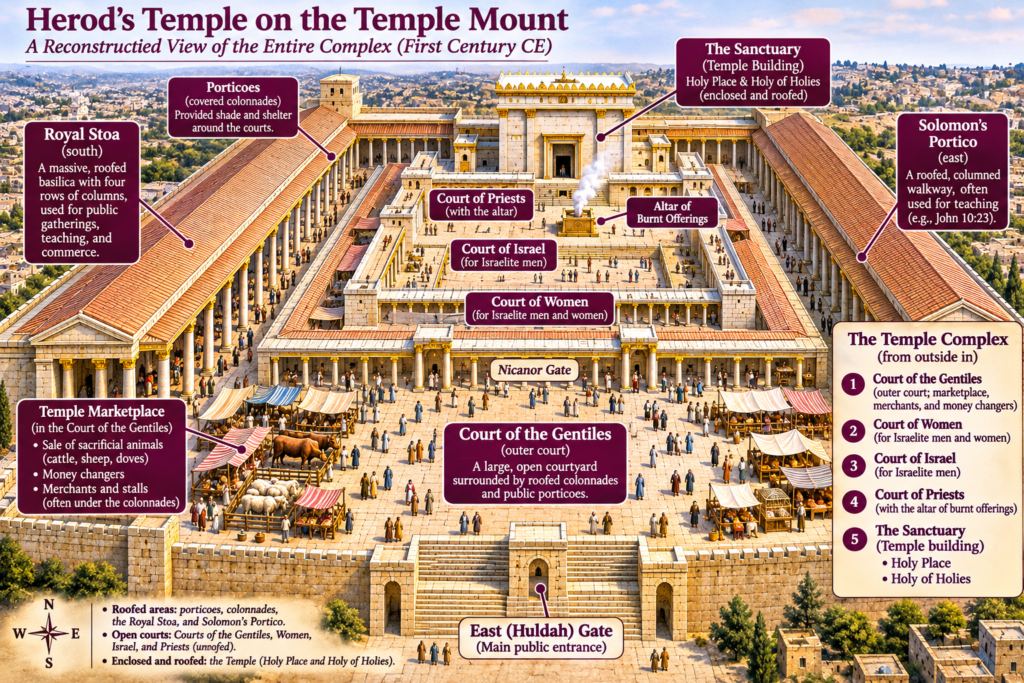
To put it into our perspective, we’re talking 27 football fields – including the end zones. However, it wasn’t a perfect rectangle as a football field is.
It was more of an irregular, trapezoidal platform.
Merchants
Commercial activity was being conducted on Temple grounds.
John listed three groups: sellers of oxen, sellers of sheep, and sellers of doves. That means to me that there were multiple merchants of each category.
The three types of animals were indicative of the types of sacrifices to be given. The Paschal Lamb was the foundation of the Passover observance. However, sheep as well as the oxen were used for burnt offerings and peace offerings. (Those offerings wouldn’t have stopped for Passover.) The doves – and pigeons – were for those who couldn’t afford the other animals.
We aren’t talking a few sellers and a few animals here. If Josephus’ numbers during a time shortly before the Jewish revolt of AD 66 are to be believed – and many don’t – we are talking of a couple of hundred thousand sacrifices being offered. Most of the celebrants were from out of town and probably didn’t bring their sacrifices with them in order to ensure the purity of the animal offered.
Resource
Hence, the need for merchants. The reasons we discussed may be the defining factors – or there may have been reasons we don’t know about.
Moneychangers
Jewish pilgrims came from all over the known world.
Jewish people didn’t only live in Israel in the first century. By then, Jews were spread out – some in well-documented areas, others not so much.
That is a lot of different currency to exchange!
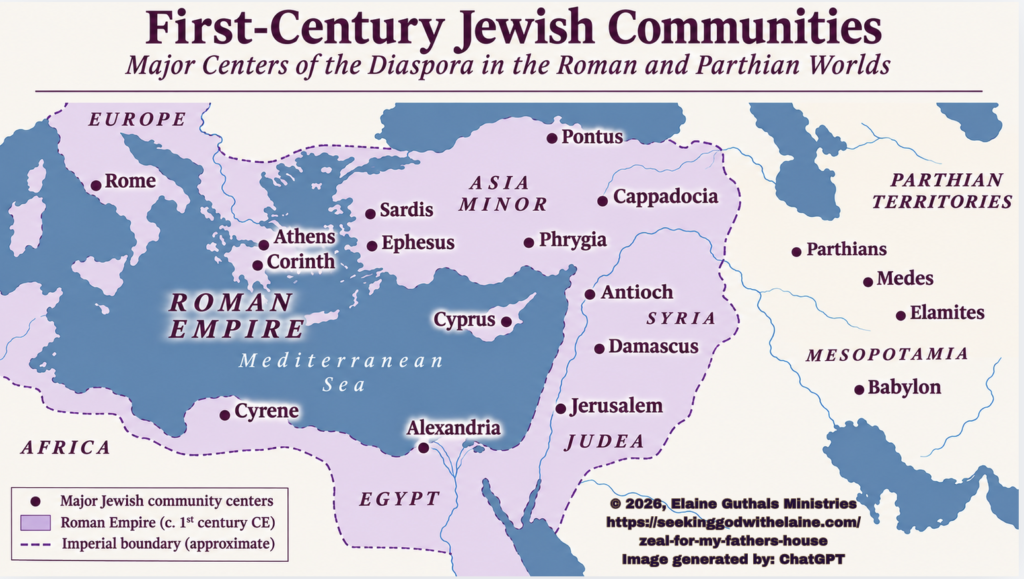
Those pilgrims would have had Roman coins, Greek coins, and other regional currencies. Those coins, however, did the pilgrims no good – only the Tyrian silver shekel could be used to pay the Temple tax.
The Temple tax was established in Exodus 30: 11-16. It was a way to take a census of the men of Israel who were over 20 years old. It was also considered “… a ransom for himself to the Lord. Then no plague will strike the people as you count them” (Ex. 30: 12 NLT).
The amount paid was standardized for all. “… (This payment is half a shekel, based on the sanctuary shekel, which equals twenty gerahs.)” (Ex. 30: 13 NLT).
Eventually, this morphed into an annual Temple contribution.
Back to first-century Jerusalem. All of this converged onto the Temple area:
- Worshipers from large distances.
- Worshipers from diverse territories, each with their own currency.
- Worshipers in need of pure sacrifices.
- Worshipers from multiple socioeconomic statuses
What is the common denominator? They needed what they needed when they needed it to worship Jehovah in the way He required.
No, we aren’t blaming this mess on Jehovah. People made their own decisions – as well intentioned as some of them might have been.
But that also made the Temple something it was never intended to be. Instead of being a place for people to pray and worship, it became the center of Israel’s sacrificial economy and a major financial institution.
While Jehovah intended the sacrifices to be made, He didn’t set up a merchant system so those sacrifices could be obtained.
Think about it. They couldn’t just assign a priest to take care of this. It wasn’t even what was intended for the Levites.
Selling cattle, sheep, and doves and exchanging foreign currency, while occurring on Temple grounds, was not part of the prescribed Temple responsibility.
The commercial environment wasn’t factored into the picture.
Moving out the Merchants and Merchandise
“Jesus made a whip from some ropes and chased them all out of the Temple. He drove out the sheep and cattle, scattered the money changers’ coins over the floor, and turned over their tables. Then, going over to the people who sold doves, he told them, ‘Get these things out of here. Stop turning my Father’s house into a marketplace!’” (Jn. 2: 15-16 NLT)
Yeshua wanted to return His Father’s house to its original purpose – worship.
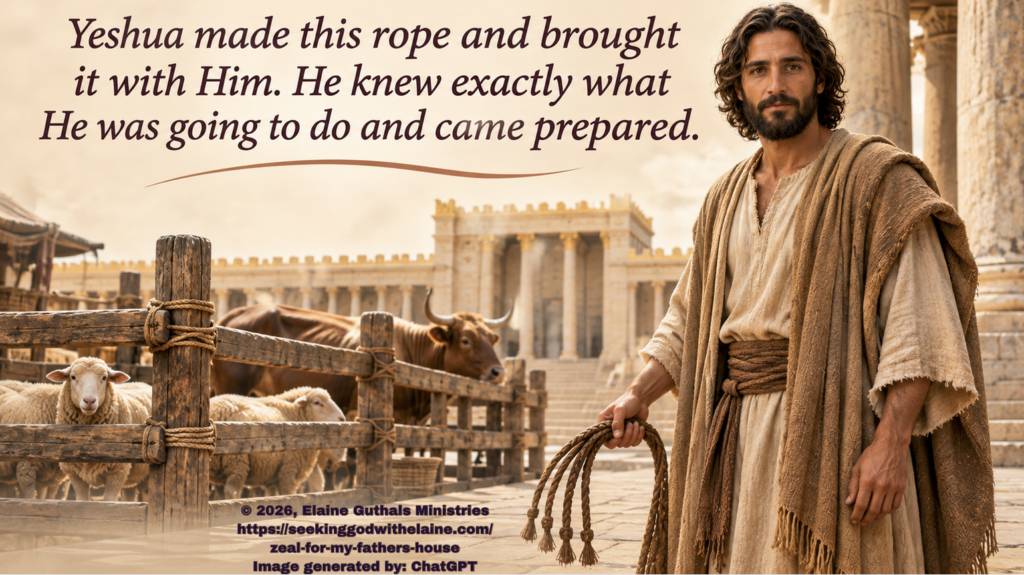
The rope Yeshua used to clear the Temple wasn’t special in any way. It was an ordinary rope made out of other rope or cords.
What we need to take from this verse is that it was a deliberate act. It wasn’t one Yeshua picked up from next to a stall.
Yeshua made this rope and brought it with Him. He knew exactly what He was going to do and came prepared.
Yeshua was going to help people to think in ways more aligned with Jehovah.
- “Don’t be fooled into thinking that you will never suffer because the Temple is here. It’s a lie!” (Jer. 7: 8 NLT).
- “‘Look! I am sending my messenger, and he will prepare the way before me. Then the Lord you are seeking will suddenly come to his Temple. The messenger of the covenant, whom you look for so eagerly, is surely coming,’ says the Lord of Heaven’s Armies. ‘But who will be able to endure it when he comes? Who will be able to stand and face him when he appears? For he will be like a blazing fire that refines metal, or like a strong soap that bleaches clothes’” (Mal. 3: 1-2 NLT).
My Father’s house. The Jewish leaders would have seen that as a bold claim. They would also see it as a non-factual claim.
Fulfilling Prophecy
“Then his disciples remembered this prophecy from the Scriptures: ‘Passion for God’s house will consume me’” (Jn. 2: 17 NLT)
Yeshua’s disciples were good Jewish men and women who remembered Scripture.
In this case, they remembered a specific Scripture from the Psalms. “Passion for your house has consumed me …” (Ps. 69: 9 NLT).
Let’s break that down.
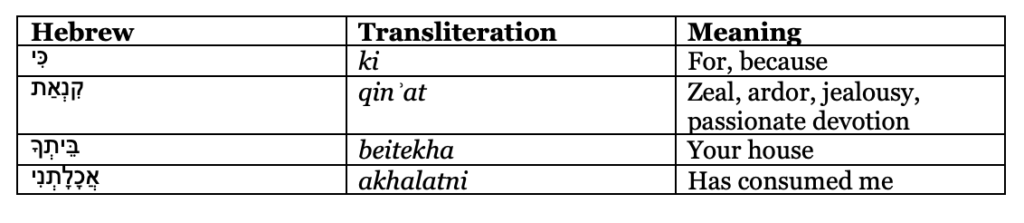
The focal point of the sentence is the word we know as passion. It can mean different things in different contexts.
It can describe Jehovah’s own jealousy for His covenant relationship with Israel, as well as human jealousy or passionate devotion.
Think about it. Jealousy is an attribute of Jehovah. It describes a refusal to accept unfaithfulness.
That describes Jehovah to a T.
Jehovah will not accept sin. True, He hasn’t punished that sin yet, and sin remains until this day.
But Jehovah is pure where sin is not.
We often equate a passionate response with emotions running high. While that can be the case, it can also identify a person who is totally committed to the action.
John didn’t record all of Psalm 69: 9 here. Remember, only part of it was said to trigger those listening to remember the rest of it.
So, what was the rest? “… and the insults of those who insult you have fallen on me” (Ps. 69: 9 NLT).
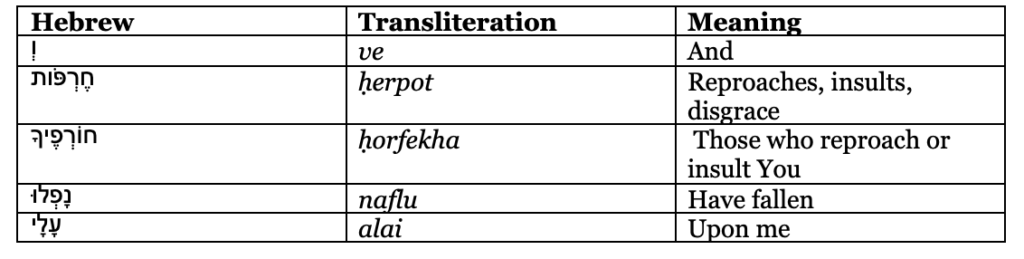
When David spoke those words, he was identifying as a person under rebuke because of identifying with Jehovah’s honor.
I see an even greater connection between Yeshua and Jehovah. Yeshua was more than David in every way. He was more involved in the mission itself. He had a greater tie to the planning, execution, and outcome of the mission.
Because Yeshua agreed to carry out the Plan of Salvation, He was rebuked, ridiculed, and put to death for its accomplishment.
Who Gave You Authority?
“But the Jewish leaders demanded, ‘What are you doing? If God gave you authority to do this, show us a miraculous sign to prove it’” (Jn. 2: 18 NLT)
The Jewish leaders questioned who would allow Yeshua to do this.
I bet the Jewish leaders were upset that Yeshua had cleared the marketplace. The bigger picture would be that they probably didn’t like things happening that upset the normal operation.
More than likely, they didn’t think someone not associated with the Temple complex should have more of a say with what occurred than they did. But that wasn’t the only focus of this question.
When the leaders asked under whose authority Yeshua was operating, they were asking who His teacher was. In first-century Israel, there were several schools of thought. Priests and Pharisees were taught to interpret Torah the way their teacher believed.
So, what they were really asking about was Yeshua’s rabbinic standing or authorization.
Ooo, baby. They didn’t know of ANY teacher that would teach this.
And sure enough. Here came this upstart – in their eyes – who was teaching and commanding without invoking another teacher’s name or relying on that person’s authority.
Proof of Authority
“‘All right,’ Jesus replied. ‘Destroy this temple, and in three days I will raise it up’” (Jn. 2: 19 NLT)
When asked, Yeshua offered the sign of Jonah.
If Jehovah gave Yeshua this authority, they believed that He would have given Him the ability to do signs and wonders. In fact, they expected that of Messiah. This wasn’t something new.
In Israelite history, promised deliverers, anointed ones, and prophets were given the ability by Jehovah to perform extraordinary works to demonstrate His authority. In fact, signs and wonders became a part of Israel’s scriptural vocabulary for recognizing His intervention.
- “But I will make Pharaoh’s heart stubborn so I can multiply my miraculous signs and wonders in the land of Egypt” (Ex. 7: 3 NLT).
- “I will raise up a prophet like you from among their fellow Israelites. I will put my words in his mouth, and he will tell the people everything I command him. I will personally deal with anyone who will not listen to the messages the prophet proclaims on my behalf” (Deut. 18: 18-19 NLT).
- “And when he comes, he will open the eyes of the blind and unplug the ears of the deaf. The lame will leap like a deer, and those who cannot speak will sing for joy! Springs will gush forth in the wilderness, and streams will water the wasteland” (Isa. 35: 5-6 NLT).
The Hebrew word for sign was ʾot (אוֹת). The Hebrew word for wonder was mofet (מוֹפֵת).
Isn’t it interesting that the Pharisees didn’t ask why – as in the purpose – Yeshua did this. They didn’t give Him a sob story about the needs of the worshipers. They didn’t bring up the lost review the merchants depended on to fed their families.
The Pharisees wanted to know who sanctioned this destruction of the marketplace on the Temple grounds. Who besides Jehovah had a say over His house?
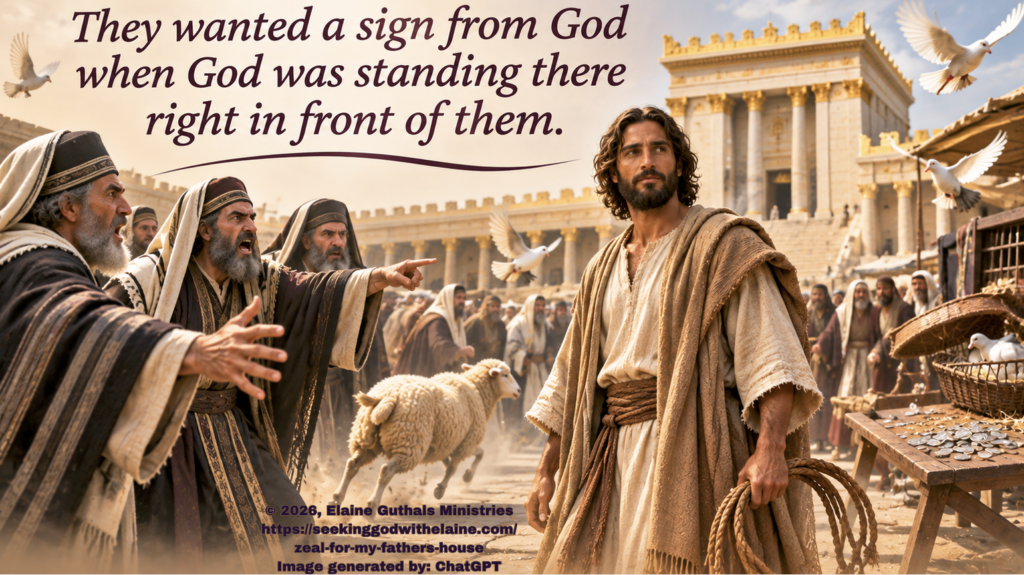
They wanted a sign from God when God was standing there right in front of them.
I am sure the sign Yeshua gave confused them. It was the sign of Jonah. “Now the Lord had arranged for a great fish to swallow Jonah. And Jonah was inside the fish for three days and three nights” (Jnh. 1: 17 NLT).
I’m pretty sure the Pharisees didn’t expect Jonah to end up as fish food. They didn’t even recognize it as a prophecy of His death. They definitely wouldn’t have seen it as a foreshadowing of His resurrection.
They didn’t equate Yeshua’s body with the Temple. They were focused on the physical Temple – the one which they, no doubt, had just thought He violated.
The Second Temple
“‘What!’ they exclaimed. ‘It has taken forty-six years to build this Temple, and you can rebuild it in three days?’ But when Jesus said ‘this temple,’ he meant his own body. After he was raised from the dead, his disciples remembered he had said this, and they believed both the Scriptures and what Jesus had said” (Jn. 2: 20-22 NLT)
The Temple expansion Herod had begun had been going on for 46 years – and it wasn’t complete yet.
Solomon’s Temple – Israel’s pride and joy – was destroyed in 586 BC when Babylon conquered Judah and Jerusalem. Seventy years later, when the exiles returned home, they built the Second Temple under Zerubbabel, the governor, and Joshua, the High Priest. It was completed in 516/515 BC (Ezra 6: 15).
Around 20/19 BC, Herod the Great began a renovation and expansion project.
- Expanded and reshaped the Temple Mount platform.
- Constructed the massive retaining walls and surrounding colonnades.
- Rebuilt the sanctuary.
- Created the magnificent architectural complex familiar from the Gospel accounts.
While the renovations for the Temple itself had been completed, renovations for the courts, surrounding walls, and porticoes went on for many years. There is question, though, whether the number of 46 refers to the age of the Temple sanctuary or the duration of the construction.
As much as the first-century Jews had against Herod the Great, this was still their Temple. They could appreciate it.
But think of it. Right there. Jehovah’s presence was right there in front of them.
Did they trust Him? No. Did they trust a building? Yes.
Yeshua’s Following
“Because of the miraculous signs Jesus did in Jerusalem at the Passover celebration, many began to trust in him. But Jesus didn’t trust them, because he knew all about people. No one needed to tell him about human nature, for he knew what was in each person’s heart” (Jn. 2: 23-25 NLT)
Yeshua knows His followers.
It was wonderful that people believed in Yeshua because of what they had seen. But that wasn’t the only thing.
Yeshua wasn’t there just to do great signs and wonders. He didn’t call them to His side periodically to show them something new and different.
Yeshua wanted them to hear and believe His message. He wanted them to know why He was there. They needed to believe that He was Who He said He was.
If they believed only because of the signs and wonders, they had a superficial belief. They believed in His abilities, not His identity.
It says that the people believed (πιστεύω) in Him, but He didn’t believe in them. What does that sound like?
“Not everyone who calls out to me, ‘Lord! Lord!’ will enter the Kingdom of Heaven. Only those who actually do the will of my Father in heaven will enter. On judgment day many will say to me, ‘Lord! Lord! We prophesied in your name and cast out demons in your name and performed many miracles in your name.’ But I will reply, ‘I never knew you. Get away from me, you who break God’s laws’” (Mt. 7: 21-23 NLT).
Making the Connections #1
There is a more familiar occurrence of Yeshua clearing the Temple than this account in John 2. It also occurred during Holy Week – only that Holy Week led up to the crucifixion of the Messiah.
Why cover this now?
This account is different than the other accounts in Matthew, Mark and Luke – and we will cover it again when we get to their accounts of the Holy Week. Can there be two accounts?
I don’t see Yeshua ignoring it. But does that mean He did it at Passover Year 2? Or did He clear the Temple another time, and it just wasn’t recorded?
Bottom line is we just don’t know. We aren’t given enough information to figure it out. So, it is just one more thing for the UNR book – understanding not required.
Making the Connections #2
This is a great example of us thinking we are doing God’s Will in following the call for our ministries – and the world gets in the way.
True, coordination is important. Ensuring worshipers have the needed sacrifices is essential.
But it shouldn’t take our focus off Jehovah.
Heart Check
Think about the battle Yeshua is engaged in for your heart. Ask yourself the following questions.
- When I serve Jehovah, am I focused on worshiping Him or managing the activity surrounding worship?
- Do I recognize when good intentions and practical arrangements begin to distract me from Jehovah, or do I allow them to become the priority?
- Am I more concerned with who has given someone authority or with whether that person is acting according to Jehovah’s will?
- Do I look for signs that Jehovah is working, or do I recognize His presence and work even when they are standing right in front of me?
- Is my faith grounded in what Yeshua can do, or in who He is and why He came?
- Do I trust the things associated with my faith—my church, traditions, and religious activities—or do I trust Jehovah Himself?
How Do We Apply This?
- Keep worshiping Jehovah at the center of everything we do in His name.
- Examine whether our good intentions and practical arrangements are distracting us from our purpose.
- Be willing to recognize Jehovah’s authority even when it doesn’t come through familiar channels.
- Look beyond the signs and wonders to understand the identity and mission of Yeshua.
- Build our faith on who Yeshua is, not merely on what we hope He will do for us.
- Remember that religious activity is not a substitute for a genuine relationship with Jehovah.
Father God. Forgive us when we focus more on the program and ritual of the service than we do focusing on You. Help us to turn our backs on the worldly pulls and turn back to You. Most of all, help us to always see You standing in front of us when You are there. Amen.
If you don’t understand something and would like further clarification, please contact me.
If you have not signed up for the email providing the link to the devotions and the newsletter, do so below.
If God has used this devotion to speak with you, consider sharing it on social media.