Yeshua traveled to Capernaum and then Jerusalem. This devotional reading looks at why He took this trip and who His travel companions were.
Nuggets
- We can’t be sure of the timeline.
- Even if Yeshua’s brothers did not believe in Him, they were still faithful Jewish men.
- We still don’t know how many disciples were traveling with Yeshua at this point.
- Observance of the Passover celebration was an important event.
- Jerusalem was an important city to the nation of Israel.
John is the only one to record Yeshua’s trip to Jerusalem for Passover at the beginning of His ministry. To me, this is an important trip.
At the beginning of His ministry, Yeshua went to His Father’s house.
Let’s Put It into Context
To read devotions in The Battle for the Heart theme
Devotions in the The Early Ministry of the Messiah series
Leaving Where He Was
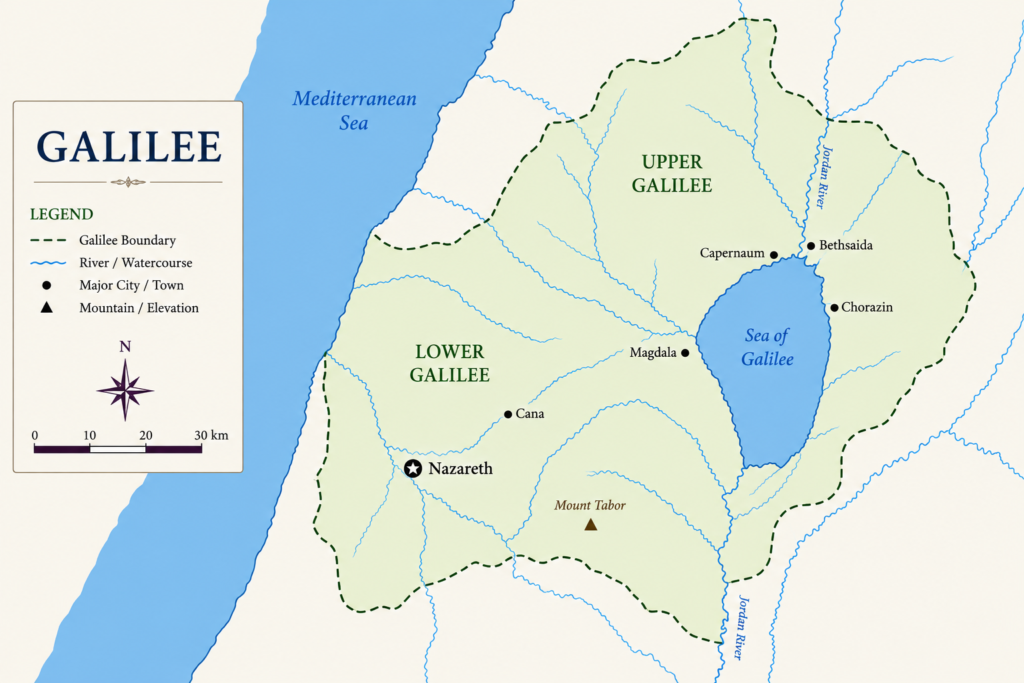
”After the wedding he went to Capernaum for a few days with his mother, his brothers, and his disciples” (Jn. 2: 12 NLT)
After the Wedding
We can’t be sure of the timeline.
John did help us with the chronology on this one – well, he tried. If we look at the wedding at Cana where Yeshua turned the water into wine – His first miracle – we see that the wedding happened the day after He talked with Nethanael.
The uncertainty comes in two places. We don’t know if Philip found Nathanael on the day Yeshua called Him. Nor do we know how long after the wedding was.
But then, we also don’t know what John actually wrote. Most other versions translate this differently.
- “On the third day there was a wedding at Cana in Galilee, and the mother of Jesus was there” (Jn. 2: 1 ESV).
- “Three days later Mary, the mother of Jesus, was at a wedding feast in the village of Cana in Galilee” (Jn. 2: 1 CEV).
- “Two days later there was a wedding in the town of Cana in Galilee. Jesus’ mother was there” (Jn. 2: 1 GNT).
- “The third day, there was a wedding in Cana of Galilee. Jesus’ mother was there” (Jn. 2: 1 WEB).
- “And [on] the third day a wedding happened in Cana of Galilee, and the mother of Jesus was there” (Jn. 2: 1 LSV).
We have no clue as to what the third day is referring. Is it the third day of the wedding festival? Is it three days after Yeshua’s talk with Nathanael? Or is it the third day of the week (since Shabbat is the only day name – the rest are identified as first day, second day, third day, etc.).
I know. That was verse 1. We are talking verse 12 now. But how can we make an informed decision on verse 12 if we can’t make an informed decision on verse 1?
With His Mother and Brothers
Even if Yeshua’s brothers did not believe in Him, they were still faithful Jewish men.
What we do know is that it signals Yeshua’s travel with Mary and his brothers and disciples to Capernaum. Remember, He was living there now. “He went first to Nazareth, then left there and moved to Capernaum, beside the Sea of Galilee, in the region of Zebulun and Naphtali” (Mt. 4: 13 NLT).
The other uncertainty is that we don’t know exactly who was included in His brothers and His disciples. Oh, we know names.
We got an idea of Joseph and Mary’s family when Yeshua preached in the Nazareth synagogue. “Then they scoffed, ‘He’s just the carpenter’s son, and we know Mary, his mother, and his brothers — James, Joseph, Simon, and Judas. All his sisters live right here among us. Where did he learn all these things?’” (Mt. 13: 55-56 NLT).
For this trip to Capernaum, it doesn’t say the sisters were in the group. It doesn’t say how many of the brothers came – but at least two did.
We are told elsewhere that Yeshua’s brothers didn’t believe He was the Messiah. “For even his brothers didn’t believe in him” (Jn. 7: 5 NLT). We know that changed for at least two.
Paul recorded that Yeshua appeared to James (Ya‘aqov – יַעֲקֹב) after the resurrection. “Then he was seen by James and later by all the apostles” (I Cor. 15: 7 NLT).
It is important that Yeshua had this time with James. James was going to become a prominent leader in the Jerusalem assembly. “In fact, James, Peter, and John, who were known as pillars of the church, recognized the gift God had given me, and they accepted Barnabas and me as their co-workers” (Gal. 2: 9 NLT).
We have a glimpse into James’ transformation. He went from unbelief to prominent leader to traditionally be identified as the author of the Book of James.
James wasn’t the only one to write one of the books that has become our Bible. Jude (Yehudah– יְהוּדָה) also acknowledged his relationship with Yeshua in the opening verse of his book – albeit in a roundabout way. “This letter is from Jude, a slave of Jesus Christ and a brother of James” (Jude 1: 1).
His Disciples
We still don’t know how many disciples were traveling with Yeshua at this point.
We discussed in the last devotion that the uncertainty in timing leads to uncertainty in which disciples were included in this verse. We tend to read the disciples as either being limited to the Twelve or, at a minimum, including all of them.
However, the unnamed disciples here couldn’t have included Peter, Andrew, James, and John. Remember, Andrew brought Simon to meet Yeshua, but that isn’t where their call to follow Him took place.
We left it in the UNR book – understanding not required – because we can’t be sure of whether Yeshua’s calling the four fishermen were before He met with Nathanael. If the seashore stroll was after Nathanael, the four fishermen probably weren’t included here.
But maybe not.
Remember, Yeshua was walking along the seashore when He called Peter, Andrew, James, and John to be His disciples (Mt. 4: 18-22; Mk. 1: 16-20). What if He was on His way to Jerusalem?
Immediately following the passages of the calling, Matthew listed Yeshua spreading His Gospel throughout the region. It reads more like a summary statement than a travel itinerary.
The next verse after Mark’s recording of the call says that Yeshua entered Capernaum (Mk. 1: 21). He may have. He may not have.
The Gospels aren’t always written chronologically. It isn’t a step-by-step account. John himself gives the disclaimer that a record like that is impossible (Jn. 20: 30; Jn. 21: 25).
I, personally, like that idea. I want the four to have joined Yeshua as quickly as possible. To me – and I may be wrong – this is plausible.
The Jewish Passover Celebration
“It was nearly time for the Jewish Passover celebration, so Jesus went to Jerusalem” (Jn. 2: 13 NLT)
Passover
Observance of the Passover celebration was an important event.
If we were questioning why Yeshua’s brothers traveled to Capernaum with Him, this verse may provide the answer. While it doesn’t say Mary and His brothers made the trip to Jerusalem, Passover included the whole family in the celebration.
Passover was a pilgrimage festival. This meant all Israelite/Jewish males – even those who were victims of the Diaspora, when possible – should appear (Ex. 23: 17; Ex.34: 23; Deut. 16: 16). This didn’t mean that wife and children couldn’t – and didn’t – come.
The festivals were to occur at the place that Jehovah chose. That meant the Temple once Jerusalem became the established place of worship.
They were called to celebrate before Jehovah – and not be empty-handed (Deut. 16: 17).
One purpose of the Passover celebration is to instruct the children in their history. This is shown in Exodus 12: 26-27, Exodus 13: 8, and Exodus 13: 14. It became – but we’re not sure if it was in the first century – part of the celebration itself when the youngest person asks four questions.
The first Passover was celebrated in Egypt. It occurred the night before Pharaoh agreed to release the Israelites from slavery. The annual celebrations were a reenactment of the defining act that gave Israel her identity – Jehovah’s deliverance of His people.
Everything about the Passover celebration served to remind the first-century Jews of this deliverance. They kept appointed days, removed leaven, ate unleavened bread, participated in the sacrifice, and – most importantly – gathered in the Temple in the Promised Land.
Yes, Jehovah delivered them from a bad situation. Ultimately, He gave them an identity, obligations, and hope.
The focus of Passover wasn’t on the meal. It was on the Temple where the lamb was sacrificed. The Hallel – the Psalms of praise associated with the festival – was being sung. Trumpets were sounding.
The daily offering was sacrificed earlier in order for the Paschal Lamb (or goat) to be sacrificed. After that, the first group – the assembly – brought their sacrifice in the afternoon. The remaining two groups – the congregation and Israel – made their sacrifices after that.
Each group entered the Temple courtyard until all in that group was inside. When the court was filled, the doors were closed, and the sacrifice began.
Each group would remain until all members concluded their sacrifices. All of the priests would be on duty that day, forming an assembly line to pass the blood of the sacrifice from the place of sacrifice to the altar.
The lamb would be flayed until the sacrificial parts could be removed. These would be placed in a basin (magis– מַגִּיס) and burned on the altar.
At nightfall, they would return to wherever they were staying and roast their Paschal Lamb. The people who had been registered for that particular sacrifice would eat it together with the unleavened bread and bitter herbs.
Went to Jerusalem
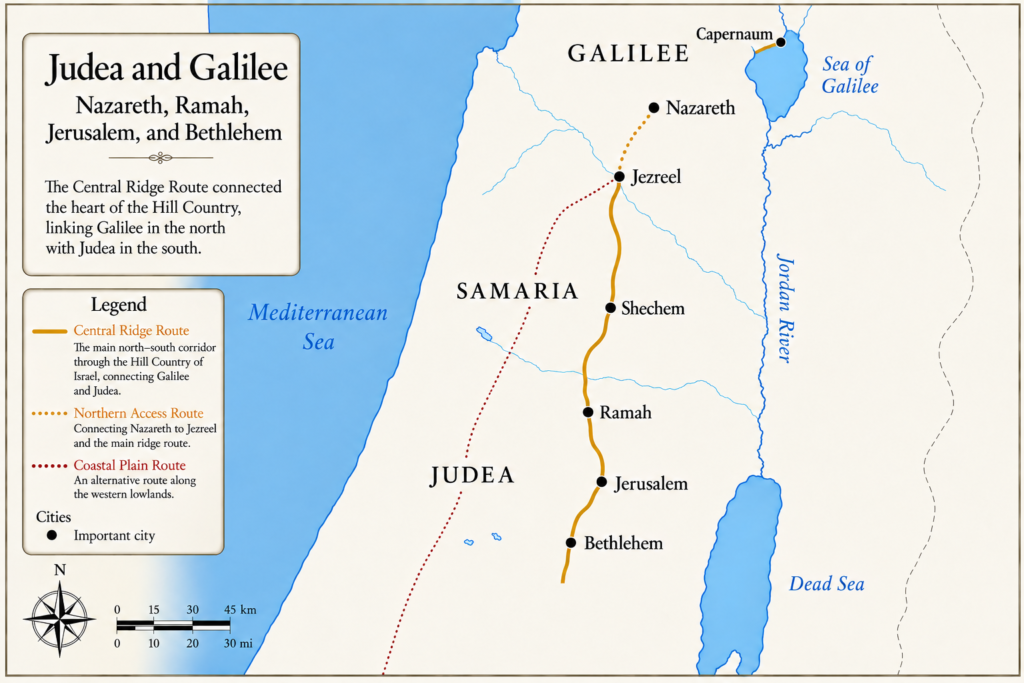
It was approximately a 100-mile trip from Capernaum to Jerusalem.
The normal trip would take four to six days when traveling on foot. Of course, that would depend on the route, pace, and whether the travelers stopped overnight along the way.
They could have cut the trip down to three days if they were willing to go through Samaria. Many Jews, though, opted for the longer trip.
Jerusalem
Jerusalem was an important city to the nation of Israel.
Before the city was called Jerusalem (Yerushalayim– יְרוּשָׁלַיִם), it was named Salem (Shalem – שָׁלֵם). We’ve encountered it in Genesis. “And Melchizedek, the king of Salem and a priest of God Most High, brought Abram some bread and wine” (Gen. 14: 18 NLT).
Some think that Melchizedek was really Adam’s son Seth. He could have been and taken a new name when he became king.
Maybe. Maybe not. That goes in the UNR book – understanding not required.
What we do know is Melchizedek was described as both the king of Salem and a priest of God Most High (El Elyon – אֵל עֶלְיוֹן).
But was Salem really Jerusalem? Asaph, in his psalm, told us it was – sorta. “God is honored in Judah; his name is great in Israel. Jerusalem is where he lives; Mount Zion is his home” (Ps. 76: 2 NLT).
There are several clues in this passage, but we have to put them together with other knowledge and information.
- Jerusalem is within the nation of Israel.
- Jerusalem is located in the territory allotted to the tribe of Judah.
- Jehovah lives in Jerusalem
- Jerusalem is associated with Mount Zion.
Let’s do a quick rundown on Zion. Zion was a stronghold that David conquered. It later became another name for Jerusalem. So, while Zion could mean Jerusalem itself, it could also represent the covenant community and the center of Israel’s national and religious identity.
The earliest urban settlement to be developed on the eastern ridge, Jerusalem sat near the Gihon Spring. It does appear in Egyptian records dating back to the fourteenth century BC.
The city had several natural advantages:
- It was situated in the central hill country.
- The surrounding valleys provided natural defensive protection.
- The Gihon Spring provided a dependable water source.
- Its location offered access to routes connecting the hill country with other parts of Canaan.
The long-established city was ruled by the Jebusites when the Israelites entered the Promised Land. “But the tribe of Judah could not drive out the Jebusites, who lived in the city of Jerusalem, so the Jebusites live there among the people of Judah to this day” (Josh. 15: 63 NLT).
David captured the stronghold of Zion in II Samuel 5: 6-9. The Jebusites were so convinced that the city of Jerusalem was uncapturable that they taunted David.
But capture it David did. He made it the capital city after the tribes united under him. This was an excellent choice as it was not the already-established capital of either Judah or the northern tribes.
By the first century, Jerusalem was:
- The religious center of Jewish life.
- The location of the Second Temple.
- The seat of the high priestly establishment.
- The destination of Jewish pilgrims coming for the three pilgrimage festivals.
- A city under Roman political domination, with considerable local authority exercised through the high priesthood and other Jewish governing institutions.
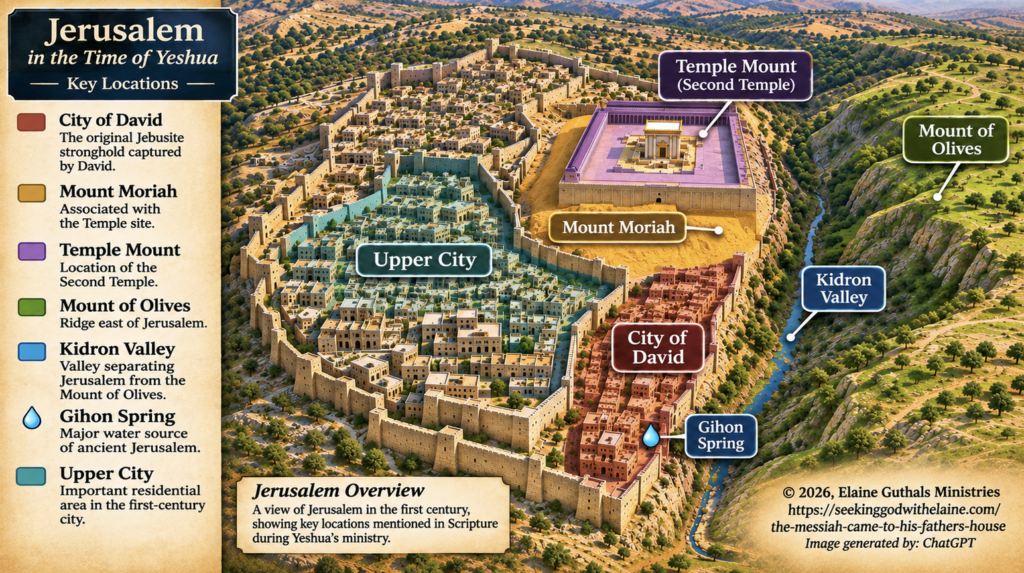
Jerusalem – when Yeshua arrived – had a lot of things swirling around at that time. The sacrificial service, purity concerns, crowds, priestly labor, Roman political oversight, and heightened national memory converged in the same place.
But think about it. This is the first time since Yeshua began His ministry that the Messiah came to His Father’s house.
Making the Connections #1
After Passover was over, the Festival of Unleavened Bread began on the fifteenth day of the first month and lasted for seven days.
In time, the two became known as Passover.
Making the Connections #2
Think about it. The Paschal Lamb was sacrificed at the Temple and then was eaten by the people.
“And as they were eating, Jesus took bread, blessed and broke it, and gave it to the disciples and said, ‘Take, eat; this is My body’” (Mt. 26: 26 NLT).
Just as the Jews at the Paschal Lamb at Passover, we eat the Paschal Lamb every time we take the Lord’s Supper. We are remembering and worshiping the same way.
Heart Check
Think about the battle Yeshua is engaged in for your heart. Ask yourself the following questions.
- Am I open to the possibility that Jehovah can transform someone who once rejected or misunderstood Yeshua, as He did with James?
- Am I willing to follow Yeshua without knowing every detail of where He is going, or do I need to understand the whole plan before I move?
- When I gather to worship, am I mindful that I am coming before Jehovah, or has worship become more about the activity than the One being worshiped?
- Do I recognize that Yeshua’s identity and mission are rooted in Israel’s story of redemption, or do I separate His ministry from the history and promises that came before Him?
How Do We Apply This?
- Follow Yeshua even when the whole journey isn’t clear.
- Give Yeshua the opportunity to transform your understanding and your heart.
- Don’t assume that someone’s present unbelief determines their future.
- Continue praying for family members who have not yet recognized Yeshua as Messiah.
- Remember the deliverance and redemption Jehovah has provided.
- Let your identity be shaped by Jehovah’s faithfulness rather than your circumstances.
- Approach worship with an awareness of whose presence we are entering.
- Learn to see Yeshua’s ministry within the larger story of Jehovah’s covenant faithfulness.
Father God. Thank You for letting us walk beside You each day. Thank You for the days that mark our spiritual journey with You – the days where growth has occurred. May we remember and celebrate what You have done for us. Amen.
If you don’t understand something and would like further clarification, please contact me.
If you have not signed up for the email providing the link to the devotions and the newsletter, do so below.
If God has used this devotion to speak with you, consider sharing it on social media.