Yeshua didn’t stay at one place and preach. This devotional reading looks at how He took His message to Judea, Samaria, Galilee, and beyond.
Nuggets
- Yeshua’s discussion with Nathanael was the day before the wedding at Cana; and after the wedding, He went to Jerusalem for Passover.
- According to where this event is placed, it occurred the day after calling Peter, Andrew, James, and John.
- Yeshua kept His eye on His purpose.
- These two passages are not the same occurrence; however, they bookend the same event.
- Once Yeshua finished preaching to the Samaritans, He returned to Galilee.
Let’s just stop a second. We need to take another look at the timeline. In this series, at least, we are trying to do things chronologically.
The last time we looked at the timetable, it was around the time Yeshua was making some of His disciples His Apostles.
Up to this point, we’ve been working on the assumption that events occurred in this order:
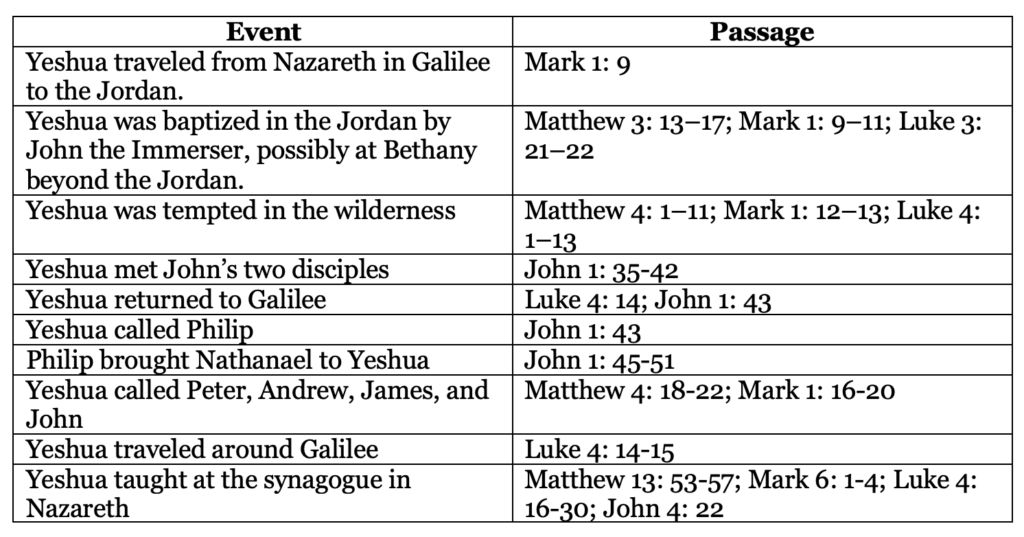
When I was putting together my devotion chart, I wasn’t sure how I was going to handle passages of one, two, or three verses that described Yeshua-traveled-around-healing-people events. When I could, I left them with the event.
But some didn’t seem like they fit with any specific event. Those are the ones we are going to look at in this devotion.
There are some things we need to remember when reviewing these.
- The Gospels are a snapshot of Yeshua’s time here on earth. It is said to be a record of one year of Yeshuah’s three-year ministry. That isn’t much.
- It is no more a diary than it is a travel itinerary. I am sure there are holes galore all over the place.
- The Gospel books don’t necessarily give events in chronological order. Only Matthew and John – if they were written by the Apostles – would be eyewitness accounts. Mark is supposed to be the memories and sermons of Peter, but that would still be a second-hand account.
- It may seem like passage in different Gospels are talking about the same event, regardless of where the passage is placed in the different books. Each individual Gospel book doesn’t necessarily present the material in a chronological order.
- Some travel passages may be leading us to the next event recorded. Or they may be independent passages.
Is it totally important that we know the chronology? Obviously, because we weren’t given it, the answer would be no.
But we can gain insight when we pull up a chair and think about where things go and what they mean when taken together. Would we look at Nicodemus and the woman at the well differently if we thought that the woman at the well came before Nicodemus?
So, let’s walk through this.
Let’s Put It into Context
To read devotions in The Battle for the Heart theme
Devotions in the The Early Ministry of the Messiah series
Travel to Passover
“After the wedding he went to Capernaum for a few days with his mother, his brothers, and his disciples. It was nearly time for the Jewish Passover celebration, so Jesus went to Jerusalem” (Jn. 2: 12-13 NLT)
Yeshua’s discussion with Nathanael was the day before the wedding at Cana; and after the wedding, He went to Jerusalem for Passover.
I never realized exactly where the miracle in Cana took place. John put a timestamp on the travel to Passover saying that it occurred after the wedding in Cana where Yeshua turned water into wine. True, we don’t know how long after the wedding the travel took place.
That is important because it is Yeshua’s first miracle. It sounds like Yeshua has been preaching but not performing miracles.
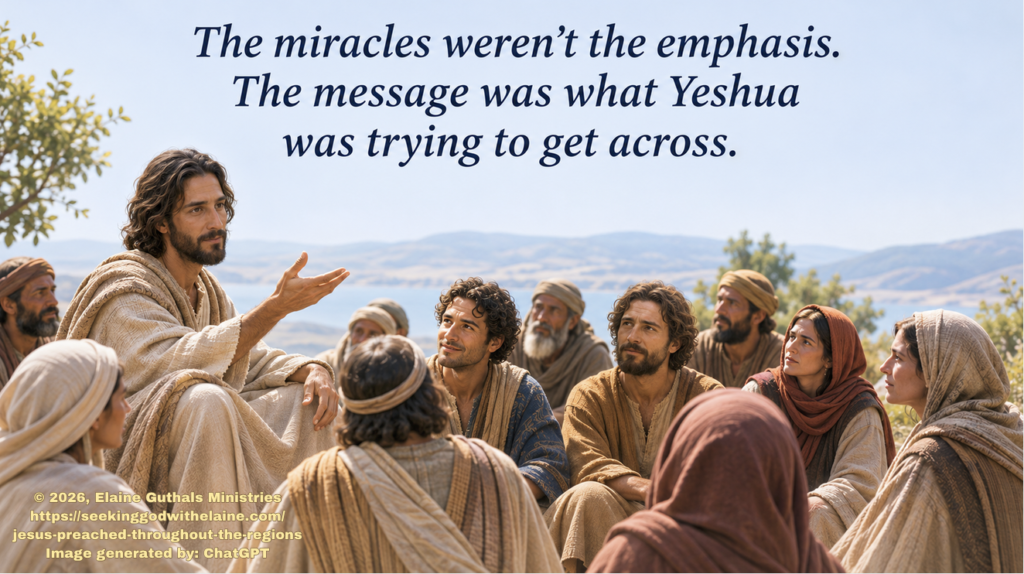
That is logical to me. The miracles weren’t the emphasis. They only showed the power of Jehovah and Yeshua.
The message was what Yeshua was trying to get across.
Another important issue is Yeshua’s traveling companions. He went with His family and his disciples. What stands out to me is that Mary knew exactly Who He was.
We believe Mary and Joseph told Yeshua’s siblings He was the Son of God. At the very least, they found out during His ministry. We are told they didn’t believe in Him (Jn. 7: 5).
But Yeshua’s disciples went with Him. The problem is that we don’t know who they are. We know Philip had been called (Jn. 1: 43).
We know Nathanael had already met Yeshua. Philip brought him to see Him in John 1: 47-51. John 2 starts, “The next day there was a wedding celebration in the village of Cana in Galilee. Jesus’ mother was there, and Jesus and his disciples were also invited to the celebration” (Jn. 2: 1-2 NLT).
We tend to read the disciples as either being limited to the Twelve or, at a minimum, including all of them. We know that the Apostles were called out of a larger group of disciples (Mt. 10: 2-4; Mk. 3: 13-19; Lk. 6: 12-16).
However, the unnamed disciples here couldn’t have included Peter, Andrew, James, and John. Remember, Andrew brought Simon to meet Yeshua, but that isn’t where their call to follow Him took place.
The day after Yeshua met Andrew and Simon, He went to Galilee to call Philip. “The next day Jesus decided to go to Galilee. He found Philip and said to him, ‘Come, follow me’” (Jn. 1: 43 NLT).
The only question about timing is how long it took Philip to bring Nathanael to Yeshua. Did he go immediately to find his friend as Andrew did to find his brother? Or are we talking a day or two? All we are told is that Philip went to look for Nathanael and was successful in finding him (Jn. 1: 45).
Did Yeshua meet Peter, Andrew, James, and John by the seashore before Philip introduced Yeshua to Nathanael? We can’t make an informed decision from the information given. It will have to remain in the UNR book – understanding not required.
Throughout the Region and Beyond
“Jesus traveled throughout the region of Galilee, teaching in the synagogues and announcing the Good News about the Kingdom. And he healed every kind of disease and illness. News about him spread as far as Syria, and people soon began bringing to him all who were sick. And whatever their sickness or disease, or if they were demon possessed or epileptic or paralyzed — he healed them all. Large crowds followed him wherever he went — people from Galilee, the Ten Towns, Jerusalem, from all over Judea, and from east of the Jordan River” (Mt. 4: 23-25 NLT)
According to where this event is placed, it occurred the day after calling Peter, Andrew, James, and John.
Matthew 4: 22 talks about James and John leaving Zebedee on the boat. Peter and Andrew had already followed Him in verse 20.
I would take this as the next step in the timeline. We know that Peter, Andrew, James, John, Philip, and probably Nathanael have already been called. It is during this walkabout that Matthew probably received his call.
What we get from this passage is Yeshua is actively working to expand His mission field. He is getting His message out to the people. He was performing miracles – but the passage does limit them to healing.
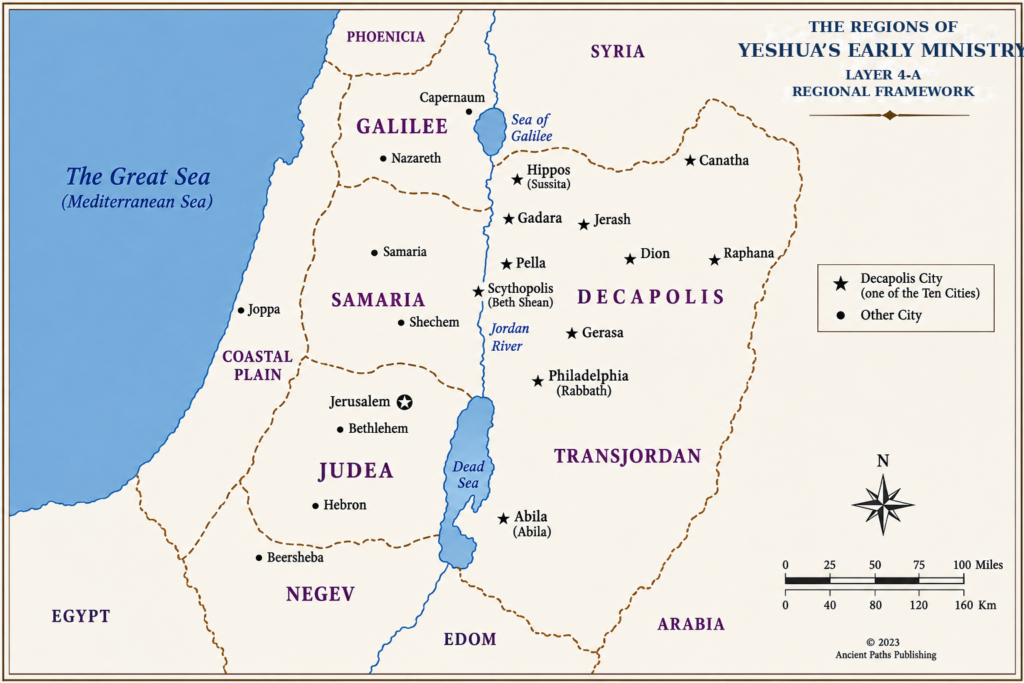
The Ten Towns refers to the Decapolis. These cities were mostly on the east side of the Jordan River in Transjordan and were heavily influenced by the Greek culture.
Resource
Demon-possessed people, according to the Complete Jewish Study Bible, showed this possession by physical illnesses, mental abnormalities, emotional illness, and moral temptation.
Resource
The physical and mental illnesses included many which we count as Yeshua’s miracles, including healing blindness, muteness, and aggression. We read about the erratic behavior, such as living in tombs. Also included in this list that we don’t read about are superhuman strength, seizures, and self-harm.
The moral and spiritual temptations included temptations to lie, betray, doubt, embrace selfishness, or spread false teachings.
Those sound a lot like run-of-the-mill temptations, don’t they? The difference is that a demonic spirit actually indwells within someone so that it has control over us.
One thing we don’t want to lose sight of is people came from all over to hear Yeshua. Many followed Him wherever He went. It wasn’t merely thirteen men walking around the countryside.
The multitudes following Yeshua wherever He went puts walking daily with the Messiah in a whole different perspective.
This is talking about physical walking. Does this mean we are to give up our homes and day jobs and become itinerant preachers? Not necessarily.
It means we leave Illinois and move to Missouri when we are called to do so. It means – on days I don’t even leave the house – He is leading me.
The Purpose of the Travel
“Before daybreak the next morning, Jesus got up and went out to an isolated place to pray. Later Simon and the others went out to find him. When they found him, they said, ‘Everyone is looking for you.’ But Jesus replied, ‘We must go on to other towns as well, and I will preach to them, too. That is why I came.’ So he traveled throughout the region of Galilee, preaching in the synagogues and casting out demons” (Mk. 1: 35-39)
“Early the next morning Jesus went out to an isolated place. The crowds searched everywhere for him, and when they finally found him, they begged him not to leave them. But he replied, ‘I must preach the Good News of the Kingdom of God in other towns, too, because that is why I was sent.’ So he continued to travel around, preaching in synagogues throughout Judea” (Lk. 4: 42-44 NLT)
Yeshua kept His eye on His purpose.
These two passages aren’t describing the same event. Still, there are a lot of similarities between the two.
Let’s set the scene in Mark. Yeshua needed a little Me-time with His Father. The disciples were growing concerned because the crowd was looking for Him. It implies the crowd wanted Him to stay. But Yeshua said, “This message isn’t just for you. It is for everyone.”
Now, look at what Luke said. Yeshua needed a little Me-time with His Father. The crowd wanted Him to stay. But Yeshua said, “This message isn’t just for you. It is for everyone.”
- Both describe Yeshua going out early to an isolated place.
- Both describe people searching for Him.
- Both show that the crowds wanted Him to stay.
- Both record His response that He needed to preach in other towns.
- Both emphasize that proclaiming the Good News was His purpose.
I bet this happened more times than we think. The crowd wanted Yeshua to supply their immediate needs – food, healing, confirmation that they were living for Jehovah.
No, it doesn’t help us in our search for the timeline. It does emphasize Yeshua’s purpose – proclaim the Gospel.
Preaching in Judea
“Then Jesus and his disciples left Jerusalem and went into the Judean countryside. Jesus spent some time with them there, baptizing people” (Jn. 3: 22 NLT)
“Jesus knew the Pharisees had heard that he was baptizing and making more disciples than John (though Jesus himself didn’t baptize them — his disciples did). So he left Judea and returned to Galilee. He had to go through Samaria on the way” (Jn. 4: 1-4 NLT)
These two passages are not the same occurrence; however, they bookend the same event.
After leaving the Passover and Nicodemus, Yeshua continued to preach in Judea. He just moved from Jerusalem to the countryside.
We aren’t told how long was allotted to that preaching.
I am not really sure how to read John 4: 3. In verse 1, John talked about the Pharisees becoming more aware of Yeshua’s ministry. Verse 3 talks about Him leaving the area.
Did Yeshua leave to not antagonize the Pharisees yet, or did He leave because it was time to leave?
It could be a little bit of both. Yeshua was on a mission to Samaria.
Once again, we aren’t told the timeline on that teaching.
We are told that Yeshua was heading back to Galilee.
Preached throughout Samaria and Galilee
“At the end of the two days, Jesus went on to Galilee. He himself had said that a prophet is not honored in his own hometown. Yet the Galileans welcomed him, for they had been in Jerusalem at the Passover celebration and had seen everything he did there. As he traveled through Galilee, he came to Cana, where he had turned the water into wine. There was a government official in nearby Capernaum whose son was very sick” (Jn. 4: 43-46 NLT)
Once Yeshua finished preaching to the Samaritans, He returned to Galilee.
We do get a little timeline help in this passage. Yeshua spent two days preaching in Samaria.
We aren’t told exactly where Yeshua went in the beginning of His travels, but we are given a hint. “He himself had said that a prophet is not honored in his own hometown” (Jn. 4: 44 NLT).
That could be John’s way of saying the teaching at the Nazareth synagogue occurred after Samaria. No, John doesn’t explicitly say that.
But why would he even mention it if it didn’t occur then? What benefit would there be in mentioning something that had happened even earlier in His ministry?
Yes, it was a rejection – and from those who knew Yeshua the longest.
We have to think about John’s Gospel. It is entirely different from the other three Gospels. While it does have some of the same teaching, miracles, and parables, it is totally different.
I read somewhere that John’s Gospel was written last. It could be structured as it is to address faulty beliefs in what happened and what it meant. He goes into theology much more than the other three.
Making the Connections
Let’s take a look at how the timeline works out.
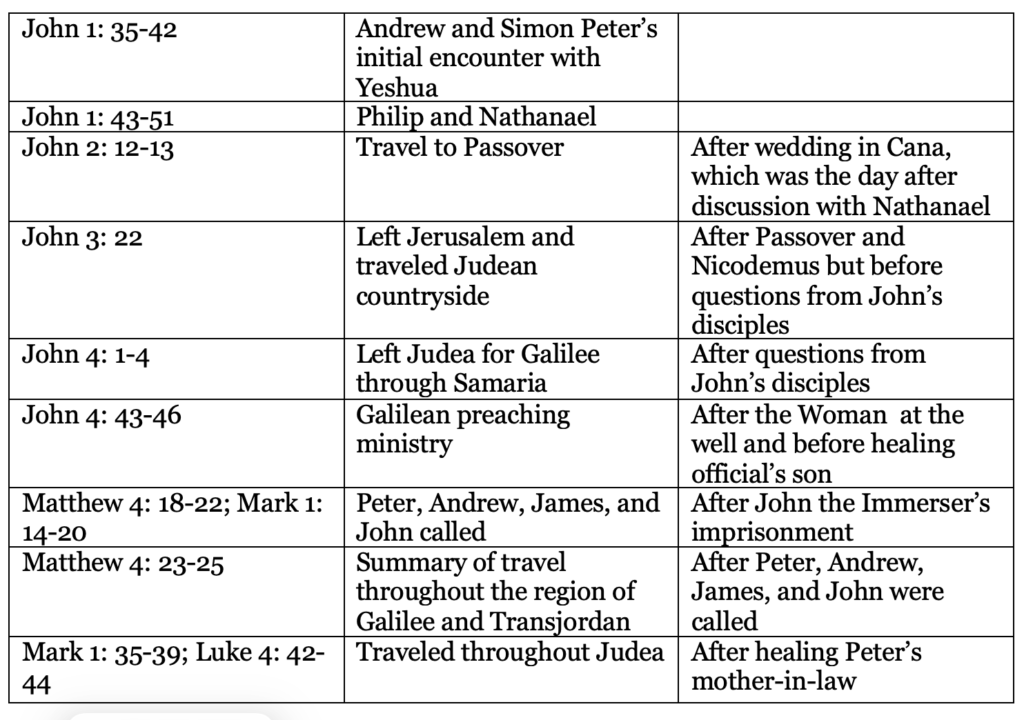
Yeah, that puts the four fishermen’s call back a lot farther than we normally think.
Heart Check
Think about the battle Yeshua is engaged in for your heart. Ask yourself the following questions.
- ·Am I more interested in what Yeshua can do for me, or in what He wants me to learn from Him?
- Do I want Yeshua to stay where I am comfortable, or am I willing to follow when He leads me somewhere new?
- Am I looking for a dramatic way to serve Him, or am I recognizing the ways He leads me in my everyday life?
- Am I listening for His message, or am I distracted by the things I want Him to do for me?
How Do We Apply This?
- Keep Yeshua’s message at the center of your walk with Him.
- Make time to be alone with the Father.
- Be willing to follow when He leads you beyond familiar surroundings.
- Recognize that following Yeshua isn’t limited to traveling or preaching.
- Look for opportunities to share the Good News wherever He has placed you.
- Remember that His leading matters even on the days you never leave home.
Father God. Thank You for the reminder that You come to us. Help us to remember that, at times, it means You come through us. Help us to look for opportunities to spread the Gospel to those in need. May we be willing to do whatever You ask to get Your Word out. Amen.
If you don’t understand something and would like further clarification, please contact me.
If you have not signed up for the email providing the link to the devotions and the newsletter, do so below.
If God has used this devotion to speak with you, consider sharing it on social media.