Yeshua chose twelve men from his group of disciples to become His Apostles. This devotion reading looks at the three lists and continue our introduction to each one individually.
Nuggets
- The event that occurred immediately prior to the calling of the disciples was the healing of a man’s deformed hand in the synagogue on the Sabbath.
- Yeshua frequently withdrew to pray.
- Yeshua had specific tasks for the Apostles.
- The list of the disciple’s names are similar, but not the same.
- It is believed that Thomas was a Galilean Jew, but we aren’t told that in Scripture.
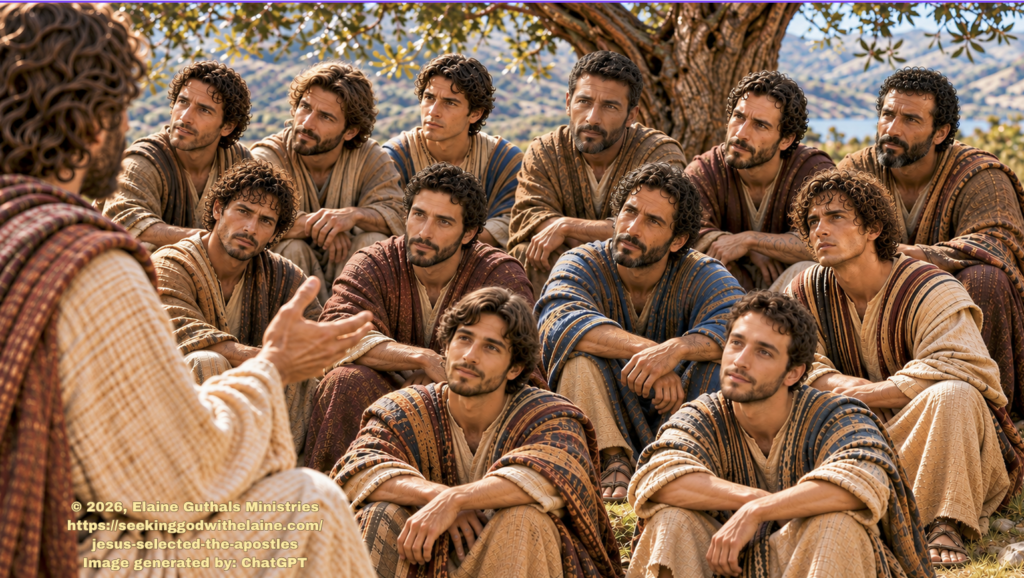
Not much is known about the twelve men Yeshua called as disciples who became apostles. Some we only know them as a name on a list.
That is to be expected that we don’t know much. They weren’t the main character.
However, they are very important characters. The Gospels – in fact, Christianity as a whole – wouldn’t be what it is if they hadn’t been the ones entrusted with spreading His Gospel.
Individually, none would have been considered a powerhouse in their day. Many were fishermen. One was a dreaded tax collector. Many we aren’t even told of their previous occupation.
Together, eleven of these twelve spearheaded taking Yeshua’s salvation to the known world at that time.
It didn’t stop there. Because of their faithfulness, we today know the mission of Yeshua. More importantly, we know Him as our Savior and Redeemer.
We’ve been looking at Yeshua calling those disciples whose call was recorded. As we’ve met them, we’ve been digging a little deeper to look at them individually.
In this devotion, we are going to look at the list of apostles. Then we’ll go back to individually try to figure out what is known about them and what tradition says about them.
Let's Put It into Context
To read devotions in The Battle for the Heart theme
Devotions in the The Early Ministry of the Messiah series
Bathed in Prayer
“Afterward Jesus went up on a mountain and called out the ones he wanted to go with him. And they came to him” (Mk. 3: 13 NLT)
“One day soon afterward Jesus went up on a mountain to pray, and he prayed to God all night” (Lk. 6: 12 NLT)
Afterward
The event that occurred immediately prior to the calling of the disciples was the healing of a man’s deformed hand in the synagogue on the Sabbath.
The Torah-teachers and the Pharisees were hoping to accuse Yeshua of working on the Sabbath. When He did, they began to discuss how they could stop Him.
Prayed to God All Night
Yeshua frequently withdrew to pray.
We see in Scripture that Yeshua had a frequent habit of prayer. Especially for important decisions He withdrew to communicate with His Father.
- “Before daybreak the next morning, Jesus got up and went out to an isolated place to pray (Mk. 1: 35 NLT).
- “But Jesus often withdrew to the wilderness for prayer” (Lk. 5: 16 NLT).
- “He went on a little farther and bowed with his face to the ground, praying, ‘My Father! If it is possible, let this cup of suffering be taken away from me. Yet I want your will to be done, not mine’” (Mt. 26: 39 NLT).
Yeshua kept frequent, significant contact with Jehovah. This is one of His examples that we should follow.
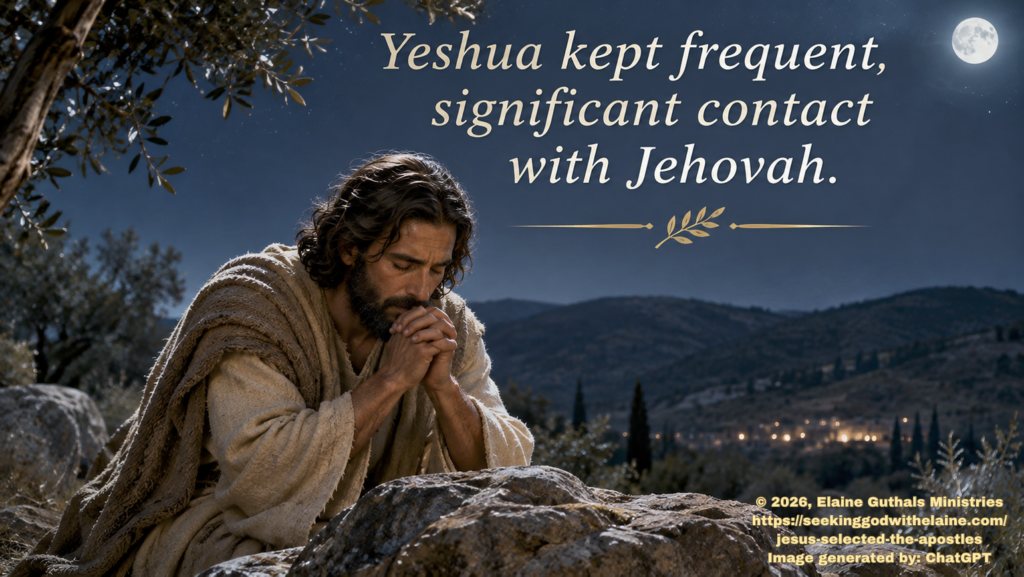
It was a given in Yeshua’s mind that His mission would fail if it was not rooted in Jehovah and His plan every step of the way. Especially important was the men who would carry on the mission long after He had ascended to Heaven.
Appointing the Apostles
“Jesus called his twelve disciples together and gave them authority to cast out evil spirits and to heal every kind of disease and illness …” (Mt. 10: 2 NLT)
“Then he appointed twelve of them and called them his apostles. They were to accompany him, and he would send them out to preach, giving them authority to cast out demons” (Mk. 3: 14-15 NLT)
“At daybreak he called together all of his disciples and chose twelve of them to be apostles …” (Lk. 6: 13 NLT)
Yeshua had specific tasks for the Apostles.
Either I didn’t know or I had totally forgotten, but I got things backwards. I thought the Twelve was chosen first, then the other disciples joined.
Luke 6: 13 makes it very clear. The Twelve were culled out of the larger group.
Yes, I know however they were chosen, Yeshua would choose the ones who best fit His needs. Yet the order in which it happened is intriguing.
Yeshua knew who He was going to choose. He knew their abilities.
Most of all, Yeshua knew the availability of their hearts.
Yeshua chose twelve men. They would have the following responsibilities:
- Follow Him.
- Preach the Gospel that they would hear.
- Heal illnesses.
- Perform exorcisms.
That may surprise some of us. We may think the only time they actually had the authority to cast out demons is when they are sent out.
- Sending out the Twelve: Matthew 10: 1, 7-8; Mark 6: 7-8; and Luke 9: 1-2
- Sending out the Seventy (or Seventy-Two): Luke 10: 1, 17-20
We aren’t told how many times that they attempted this. However, we are told of a time when the disciples failed to cast out a demon (Mt. 17: 14-20, Mk. 9: 14-29, and Lk. 9: 37-43).
I think it is mentioned here because those exorcisms were also evidence of the greater spiritual authority Yeshua possessed over Satan’s kingdom. From the beginning of His ministry, Yeshua would show His authority over Satan.
The Lists
“… Here are the names of the twelve apostles: first, Simon (also called Peter) [Shim’on Kefa], then Andrew (Peter’s brother), James [Ya’akov] (son of Zebedee [Zavdai]), John [Yachanan] (James’s brother), Philip [Philippos], Bartholomew, [Bar-Talmai] Thomas [T’oma], Matthew [Mattityahu] (the tax collector), James (son of Alphaeus) [Ya’akov Bar-Halfai], Thaddaeus [Taddai], Simon (the zealot) [Shim’on], Judas Iscariot (who later betrayed him) [Y’Hudah from K’riot]” (Mt. 10: 2-4 NLT)
“These are the twelve he chose: Simon (whom he named Peter), James and John (the sons of Zebedee, but Jesus nicknamed them ‘Sons of Thunder’), Andrew, Philip, Bartholomew, Matthew, Thomas, James (son of Alphaeus), Thaddaeus, Simon (the zealot), Judas Iscariot (who later betrayed him)” (Mk. 3: 16-19 NLT)
“… Here are their names: Simon (whom he named Peter), Andrew (Peter’s brother), James, John, Philip, Bartholomew, Matthew, Thomas, James (son of Alphaeus), Simon (who was called the zealot), Judas (son of James), Judas Iscariot (who later betrayed him)” (Lk. 6: 13-16 NLT)
The list of the disciple’s names are similar, but not the same.
Simon is always listed by both Simon and Peter. Bartholomew is always named instead of Nathanael. Matthew is always named instead of Levi.
There is only one disciple that is listed by different names in the list of Twelve. Thaddaeus is also listed as Judas, the son of James.
Judas is always listed as the betrayer.
Thomas
It is believed that Thomas was a Galilean Jew, but we aren’t told that in Scripture.
We are told very little about Thomas, but we can gain a lot by the questions that he asked and the times he was mentioned in the Gospels.
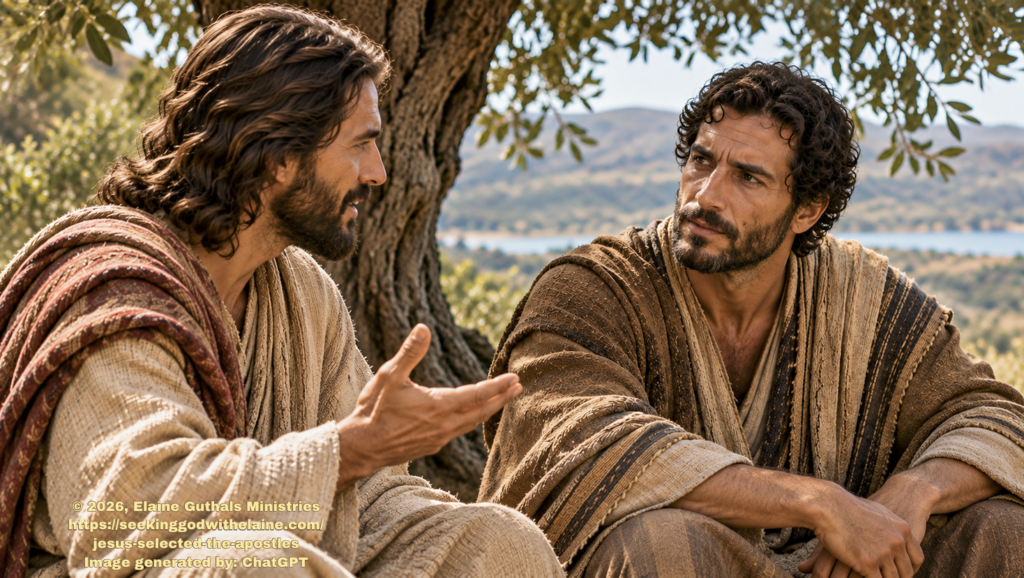
Thomas was loyal to Yeshua and courageous. “Thomas, nicknamed the Twin, said to his fellow disciples, ‘Let’s go, too — and die with Jesus’” (Jn. 11: 16 NLT). He saw the danger of returning to Judea but agreed to follow Him regardless of the outcome.
Thomas was bluntly honest. He was not too proud to let his confusion be known. He needed clarification – and wasn’t shy in asking for it.
The question Thomas asked at the Last Supper allowed one of the most beloved verses in the Gospels. “And you know the way to where I am going. ‘No, we don’t know, Lord,’ Thomas said. ‘We have no idea where you are going, so how can we know the way?’ Jesus told him, ‘I am the way, the truth, and the life. No one can come to the Father except through me’” (Jn. 14: 4-6 NLT).
One event that really showcased Thomas’ character occurred because of Yeshua’s first appearance to the Apostles after the resurrection. Thomas wasn’t there at the moment when Yeshua appeared.
We see Thomas as being cautious when told about it but totally convinced when he does see Him later. But we should also see him as not relying on second-hand testimony. Each of us has to know a risen Messiah for ourselves.
The most important words Thomas spoke was his response to seeing his risen Savior. “‘My Lord and my God!’ Thomas exclaimed” (Jn. 20: 28 NLT).
Thomas’ original doubts gave way to a deeper personal faith.
All this shows us that Thomas was a thinker. He processed what he did and didn’t know and wasn’t timid in finding the answers to make informed decisions.
We also see Thomas as one of the disciples listed who went fishing in John 21: 2. No, that doesn’t necessarily make him a fisherman. (I’ve been fishing before, but that has never been my profession.)
One of the books that may have been written by the Apostles didn’t make it into our version of God’s Word was written by Thomas. It dates from the second century; but just because that is the oldest translation that survived, that doesn’t mean it was the original manuscript.
A possible reason for this is because it is different than the four gospels. Rather than be a collection of miracles and parables and account of Jesus’ life, death, and resurrection, it gives a list of 114 sayings of Jesus.
The problem is some of these are way out there. The Theologist called them strange and cryptic.
Resource
It did get it right that the kingdom of God is within us and salvation is needed to enter it. It just doesn’t say how that salvation is achieved.
This book was rejected from our version of God’s Word because it seemed to follow the gnostic beliefs. Gnostics believe salvation didn’t come through belief in Jesus’ death and resurrection. It came through possessing some secret knowledge.
While it does contain some similarities to Gnostic thought, scholars disagree with how it should be classified. That was, however, the reason given its exclusion in the resource I found.
Not much is known about Thomas at the early start of the early Church. According to tradition, his mission field was Parthia and India, the furthest of any of the Apostles. It was in India that tradition says he was killed around 72 AD by a spear and buried in Mylapore, India.
Making the Connections
How do we apply Thomas’ desire to see the evidence of Yeshua’s resurrection for himself when that isn’t possible for us? Yeshua Himself told us.
“Then Jesus told him, ‘You believe because you have seen me. Blessed are those who believe without seeing me’” (Jn. 20: 29 NLT).
If John only gave us the short version of Yeshua’s answer, I could imagine what the long version would be. In my mind, I hear Him saying, “I’m glad that you search for Me for yourself. You learn about Me and then make your decision on what you know of Me. That is the only way people can find me.
“But people down through the centuries aren’t going to have that opportunity. I am going to have returned to Heaven long before then.
“Think about it. They will have no opportunity to see me standing in the same room as you do. Yet they will believe in Me anyway! That is what true faith is also about.”
Paul echoed that. “Faith shows the reality of what we hope for; it is the evidence of things we cannot see” (Heb. 11: 1 NLT).
Heart Check
Think about the battle Yeshua is engaged in for your heart. Ask yourself the following questions.
- Do I follow Yeshua’s example of seeking Jehovah’s will through prayer, or do I tend to make important decisions on my own?
- Am I making my heart available for Yeshua to use, or am I holding back when He asks something of me?
- Am I faithful in carrying out the responsibilities Jehovah has given me, or am I waiting for something more significant to do?
- Am I developing a personal faith based on knowing the risen Messiah through Scripture, or am I relying primarily on what others tell me about Him?
How Do We Apply This?
- Make prayer an essential part of your daily relationship with Jehovah.
- Keep your heart available for Yeshua’s purposes.
- Be faithful in the responsibilities Yeshua has entrusted to you.
- Build your faith by knowing the risen Messiah through Scripture.
Father God. Because of the men Yeshua chose to surround Himself with, we know of Your Plan of Salvation and our need for it. Help us to boldly carry Your Gospel to the mission field You have for us. Amen.
If you don’t understand something and would like further clarification, please contact me.
If you have not signed up for the email providing the link to the devotions and the newsletter, do so below.
If God has used this devotion to speak with you, consider sharing it on social media.