Matthew was so happy to be called as a disciple that he began witnessing to his friends. This devotional reading looks at the dinner he served at his house and how it affected Jesus’ relationship with the Pharisees.
Nuggets
- Matthew invited his new friends to share a meal with his old friends.
- We’ve established why tax collectors were considered sinners.
- In some ways, Pharisees were very flexible in their beliefs, and in some ways, they were very rigid.
- Yeshua explained that this was His mission.
- Yeshua answered the Pharisees by quoting Scripture, a frequent habit of His.
- Ever since before Cain killed Abel, humans were offering sacrifices to Jehovah.
- Some Jews thought the Messiah would come when the nation was righteous – had repented of their sins.

Matthew may have been considered an outcast by many first-century Jews, but that didn’t mean he didn’t have friends, associates, and acquaintances. We know he did because he invited them to meet Yeshua.
Let's Put It into Context
To read devotions in The Battle for the Heart theme
Devotions in the The Early Ministry of the Messiah series
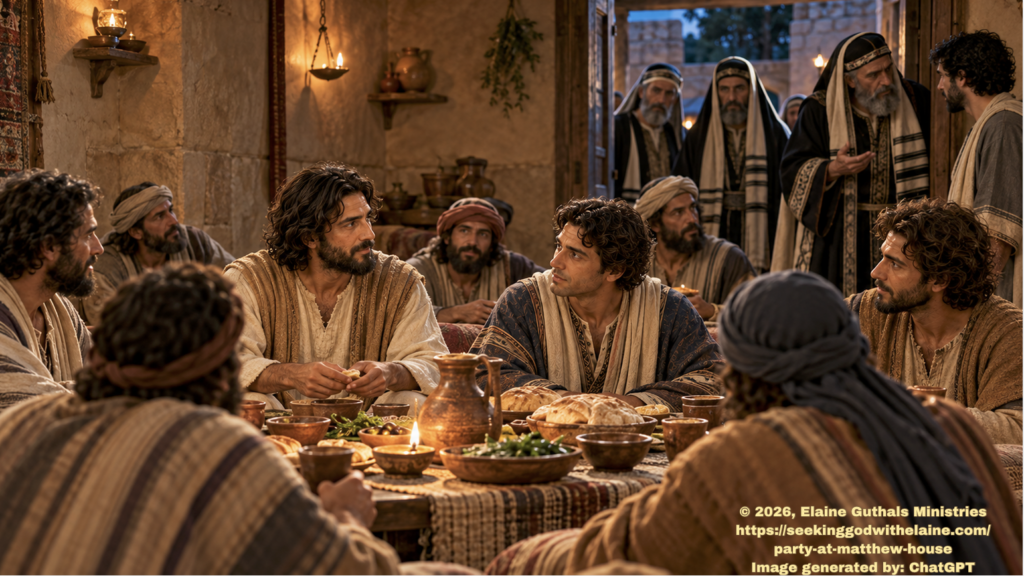
Dinner at Matthew’s Home
“Later, Matthew invited Jesus and his disciples to his home as dinner guests, along with many tax collectors and other disreputable sinners. But when the Pharisees saw this, they asked his disciples, ‘Why does your teacher eat with such scum?’” (Mt. 9: 10-11 NLT)
“Later, Levi invited Jesus and his disciples to his home as dinner guests, along with many tax collectors and other disreputable sinners. (There were many people of this kind among Jesus’ followers.) But when the teachers of religious law who were Pharisees saw him eating with tax collectors and other sinners, they asked his disciples, ‘Why does he eat with such scum?’” (Mk. 2: 15-16 NLT)
“Later, Levi held a banquet in his home with Jesus as the guest of honor. Many of Levi’s fellow tax collectors and other guests also ate with them. But the Pharisees and their teachers of religious law complained bitterly to Jesus’ disciples, “Why do you eat and drink with such scum?” (Lk. 5: 29-30 NLT)
Invited Jesus and His Disciples
Matthew invited his new friends to share a meal with his old friends.
We should have no doubt about the sincerity of Matthew’s faith.
We need to understand the importance of sharing a meal in first-century Israel. Meals could express welcome, friendship, acceptance, and fellowship. Having a meal together was also part of establishing a covenant.
When Matthew decided to host a dinner party at his home, he didn’t only invite Yeshua and the other disciples. He invited others. He wanted to share the Savior with others.
Think about it. We don’t know if it was the same day as Matthew was called, later that week, or later that year.
One of the excuses we use to not witness about Yeshua is that we don’t know enough Scripture in order to tell about Him. That shouldn’t stop us.
Others can read Scripture for themselves. Yes, it is merely an introduction to Yeshua and Jehovah. They may need someone to interpret it for them.
But our relationship with Jehovah doesn’t end in the pages of the Bible. It permeates our lives.
Scripture may be the foundation or the core of our relationship with Him. But our transformation has to come from our hearts and flow out into our lives.
It is this change in us that opens some doors for witnessing. We know what Jehovah has done in our lives.
Along with Many Tax Collectors and Other Disreputable Sinners
We’ve established why tax collectors were considered sinners.
It was generally felt that they had been disloyal to Israel and Jehovah by working for the foreign oppressors and those who aligned themselves with them.
But who were the other disreputable sinners?
Don’t you just love it when writers don’t come out and expressly tell you what they mean with the terms they use?
No, Matthew doesn’t tell us point blank what is meant here. We can, however, piece it together by other things said in Scripture and by the wording used here.
The Greek word used in this passage is hamartōloi (ἁμαρτωλοί), the plural of hamartōlos. It refers to people characterized as sinners—those who sin or are regarded as sinful.
Nope, circular definitions are not helpful at all.
So, we have to look at how it was used back in the day. In first-century Jewish society, the word could refer to people who actually practiced wickedness. Wickedness, in biblical terms, meant something that violated God’s commandments.
Generally, when this term is used, it encompasses several overlapping groups. While there is overlap, they were not identical.
- Tax collectors
- People who openly violated the Torah
- People who didn’t live according to the Pharisees’ understanding of faithful observance
- People regarded as religious or social outsiders
Those who openly violated Torah were liars, oppressors, and those who were sexually immoral, to name a few. That carried a serious moral meaning.
But it was more than merely not following what was written in Torah. The Pharisees felt those who didn’t follow their interpretation of Scripture were religiously deficient. Later, these people were described as a’aretz (עַם הָאָרֶץ), literally people of the land.
Being considered an outsider meant those people were placed outside the religious community because of their behavior or way of life. Shepherds were one group considered outsiders. Being a broad label meant this term could communicate disapproval and distance without specifying one particular offense.
When the Pharisees Saw This
In some ways, Pharisees were very flexible in their beliefs; and in some ways, they were very rigid.
Pharisees were very lenient in their interpretation of Torah. They believed the oral tradition superseded the written law.
But most refused to change their beliefs when confronted by the Messiah.
When the Pharisees saw the other participants in the meal, they saw a Rabbi accepting the condition of known sinners. No faithful teacher – in their mind – would cross these boundaries.
It was obvious that Pharisees were not interested in redeeming their Jewish brothers who had become tax collectors. Then there was no way, in my opinion, they would want to see Gentiles converted to Judaism.
Why did they feel this way?
We tend to see this as – in their eyes – being an issue of clean/unclean. We aren’t told that in this passage, but there are other passages where we do see this issue.
We also may think that the Pharisees operated under a belief that someone must remain in a state of spiritual purity every moment. This doesn’t say that either.
We would say, “Good thing.” They would have become unclean because they broke one of the laws or commandments – we would call that sin. We know that, even after conversion, we continue to sin.
So, it is good to know that perfection wasn’t required.
One way we can read this is that the Pharisees were more interested in their own relationship with Jehovah than someone else’s. The unspoken conclusion made by the Pharisees was, “Interaction with someone who is unclean makes us unclean.”
By Yeshua’s response, that may be getting more toward His take.
Healthy or Sick People
“When Jesus heard this, he said, ‘Healthy people don’t need a doctor — sick people do’ Then he added, ‘Now go and learn the meaning of this Scripture: “I want you to show mercy, not offer sacrifices.” For I have come to call not those who think they are righteous, but those who know they are sinners’” (Mt. 9: 12-13 NLT)
“When Jesus heard this, he told them, ‘Healthy people don’t need a doctor — sick people do ...’” (Mk. 2: 17 NLT)
“Jesus answered them, ‘Healthy people don’t need a doctor — sick people do’” (Lk. 5: 31 NLT)
Healthy People Don’t Need a Doctor
Yeshua explained that this was His mission.
I can see Yeshua mentally shaking His head, wondering, “Do they really think a doctor is going to stay away from a sick person because s/he is sick?”
No, precisely because they were sick, they needed a Physician. And Yeshua is the Great Physician.
Learn the Meaning
Yeshua answered the Pharisees by quoting Scripture, a frequent habit of His.
When we read the Scripture used, we might be a little taken aback. That is especially true when it says something we didn’t expect it to say.
“I want you to show love, not offer sacrifices. I want you to know me more than I want burnt offerings” (Hos. 6: 6 NLT).
That is no more than we usually get. But remember, they memorized everything, so they had a shorthand when referring to a passage. They only said the beginning even though they were talking about the whole passage.
But wait a second. Should it be translated as mercy or love? Let’s check out the Hebrew Scripture.
The terms used there are hesed (or chesed depending on the transliteration) and zevach. Hesed (חֶסֶד) is related to grace conceptually, but it should not simply be treated as another Hebrew word for grace. It emphasizes steadfast kindness, covenant loyalty, faithful love, and lovingkindness.
These weren’t just warm, fuzzy emotions. They affected how they treated others.
Let’s look at loyalty, kindness, and faithfulness.
- Loyalty: A person does not abandon a relationship simply because circumstances become inconvenient.
- Kindness: Loyalty is demonstrated through actions that benefit the other person.
- Faithfulness: The person acts consistently with the relationship and the obligations it entails.
Loyalty talks about commitment to others even if the cost of that commitment is high. That overlaps with steadfast kindness.
Kindness is more than being pleasant to someone or doing them a favor. It talks about wanting better for the other person. That overlaps with our choice to be faithful.
Faithfulness involves the responsibilities needed to protect the relationship.
Not Offer Sacrifices
Ever since before Cain killed Abel, humans were offering sacrifices to Jehovah.
Zevach (זֶבַח) means sacrifice or sacrificial offering. It refers to an offering made by slaughtering an animal, often as part of worship or covenant observance. Jehovah isn’t saying that sacrifice has no purpose. He’s emphasizing that sacrificial observance must not replace the covenant loyalty and faithful love He desires from His people.
Once humans sinned, we lost God’s presence. The blood of the sacrifices covers the sin so we can come into Jehovah’s presence again.
We can pray, repent, and try to get ourselves back into Jehovah’s good graces. But if we don’t do it through the blood of Yeshua, we can’t come before His throne.
We might think it strange that this passage downplayed the Old Testament provision for sacrifices. When we think of sacrifices, we may think first of burnt offerings.
Those sacrifices were offered for a variety of important reasons. Some were for the purpose of atoning for sin. Others expressed gratitude and worship. They solidified and reinforced the covenant between Jehovah and His people. They signified obedience and commitment.
We know now that Yeshua was saying that a relationship with Jehovah is more important than killing animals. That relationship can only happen because of Yeshua’s blood.
Before, those sacrifices were the only way humans could interact with Sovereign God. Once sin entered into humans, we couldn’t approach Him.
But that still didn’t diminish Jehovah’s desire to have a covenant relationship with us. He provided a way to make that relationship possible – He sent His Son to die for us.
We know now what the Pharisees didn’t know then. In AD 70, the Temple would be destroyed. The practice of sacrifices would cease.
Calling Sinners
"For I have come to call not those who think they are righteous, but those who know they are sinners” (Mt. 9: 13 NLT
“... I have come to call not those who think they are righteous, but those who know they are sinners” (Mk. 2: 17 NLT)
“I have come to call not those who think they are righteous, but those who know they are sinners and need to repent” (Lk. 5: 32 NLT)
Some Jews thought the Messiah would come when the nation was righteous – had repented of their sins.
Some first-century Jews thought that the Messiah would come when the nation was obedient to Jehovah. The Qumran community particularly emphasized that strict observance of the law was essential to the Messiah’s coming and expected two messianic figures — one royal and one priestly.
Some find being righteous a difficult concept to understand. They want to whittle it down to being right.
The Hebrew word that we translate as righteous is tzaddik (צַדִּיק). It is another word with a circular definition, meaning righteous or a righteous person.
The meaning that helps us is one who conforms to God’s standards. This is more than merely doing the do’s and not doing the don’ts.
Only Jehovah can declare someone righteous. One is only righteous when the outer character matches the inner person.
Making the Connections #1
I can see why the Pharisees considered were religiously deficient were later called people of the land. It harkens back to the past.
Ever since they were waiting on the bank of Jordan River to cross into the Promised Land, the Israelites were told to not associate with the citizens of the countries they were to overthrow. They were told to be separate.
“When the Lord your God hands these nations over to you and you conquer them, you must completely destroy them. Make no treaties with them and show them no mercy. You must not intermarry with them. Do not let your daughters and sons marry their sons and daughters, for they will lead your children away from me to worship other gods. Then the anger of the Lord will burn against you, and he will quickly destroy you” (Deut. 7: 2-4 NLT).
I can see that they would begin to see the Canaanites as the people of the land – the land that they were promised.
This may be a connection that only I see. To me, however, I see them transferring Jehovah’s condemnation of those not His own – the people who owned the land – to those in Yeshua’s time who were not Jehovah’s people.
Making the Connections #2
One of Jesus’ responses to the Pharisees and Torah-teachers was that healthy people don’t need a doctor — sick people do. He was confirming that sin is a disease.
However, we can take that too far sometimes. We tend to want to believe that we have no choice in getting sick.
Well, technically, that is the case. “When Adam sinned, sin entered the world. Adam’s sin brought death, so death spread to everyone, for everyone sinned” (Rom. 5: 12 NLT).
That is why Yeshua said, “There is no judgment against anyone who believes in him. But anyone who does not believe in him has already been judged for not believing in God’s one and only Son” (Jn. 3: 18 NLT).
Believing is a choice. “But to all who believed him and accepted him, he gave the right to become children of God. They are reborn — not with a physical birth resulting from human passion or plan, but a birth that comes from God” (Jn. 1: 12-13 NLT).
Making the Connections #3
Look what Yeshua didn’t say.
- He did not say, “There is no such thing as sin.”
- He did not say, “It does not matter how people live.”
- And He did not say, “The Torah no longer matters.”
In the Sermon on the Mount, Yeshua told us exactly what He came to do.
“Don’t misunderstand why I have come. I did not come to abolish the law of Moses or the writings of the prophets. No, I came to accomplish their purpose. I tell you the truth, until heaven and earth disappear, not even the smallest detail of God’s law will disappear until its purpose is achieved. So if you ignore the least commandment and teach others to do the same, you will be called the least in the Kingdom of Heaven. But anyone who obeys God’s laws and teaches them will be called great in the Kingdom of Heaven” (Mt. 5: 17-19 NLT).
Salvation in Yeshua doesn’t take away our need to understand and follow the Old Testament.
Heart Check
Think about the battle Yeshua is engaged in for your heart. Ask yourself the following questions.
- Do I show mercy to sinners, or do I avoid them?
- Do I help others understand Scripture, or do I judge them for not understanding?
- Do I examine my heart, or am I satisfied with outward obedience?
- Do I share what Yeshua has done for me, or do I hold back because I don’t know enough Scripture?
How Do We Apply This?
- Look beyond a person’s reputation and see someone who needs Yeshua.
- Show hesed through kindness, loyalty, and faithfulness.
- Examine our hearts, not just our outward behavior.
- Share what Yeshua has done in our lives, even when we don’t have all the answers.
- Practice mercy without dismissing sin or abandoning Jehovah’s standards.
Father God. We see the Pharisees’ reaction to Yeshua associating with sinners. Sometimes, we see Your children associating with those we consider sinners and react the same way. Help us to look at others through Your eyes and recognize their need to have a relationship with You. Amen.
If you don’t understand something and would like further clarification, please contact me.
If you have not signed up for the email providing the link to the devotions, do so below.
If God has used this devotion to speak with you, consider sharing it on social media.