Many of us have grown up believing the miraculous catch of fish happened when Peter, Andrew, James, and John were called to be Yeshua’s disciples. This devotional reading looks to see if that were the case.
Nuggets
- Yeshua would have been fulfilling His mission to bring first-century Jews to a better understanding of Jehovah.
- Luke went on to say that Yeshua was preaching, one of the first indications that His ministry had started.
- It looks like Yeshua just commandeered the boat.
- The Craftsman told the fisherman how to fish.
- Simon probably had every reason not to do what Yeshua asked, but he was obedient.
- Through this encounter, Simon acknowledged his awareness of sin.

Many place this miracle to have occurred at the calling of Peter, Andrew, James, and John’s to follow Yeshua. While it does have the reference of fishing for men and following Him, it doesn’t actually have Him saying, “Follow me.”
In the last devotion, we saw the two passages in Matthew 4 and Mark 1 that – almost verbatim – issue the call.
How do we reconcile the three passages? Let’s see what Luke has to say before we get there. Then what happens when we add John 1 into the mix????
Let's Put It into Context
To read devotions in The Battle for the Heart theme
Devotions in the The Early Ministry of the Messiah series
Yeshua Teaching
“One day as Jesus was preaching on the shore of the Sea of Galilee, great crowds pressed in on him to listen to the word of God. He noticed two empty boats at the water’s edge, for the fishermen had left them and were washing their nets. Stepping into one of the boats, Jesus asked Simon, its owner, to push it out into the water. So he sat in the boat and taught the crowds from there” (Lk. 5: 1-3 NLT)
One Day as Jesus Was Preaching
Yeshua would have been fulfilling His mission to bring first-century Jews to a better understanding of Jehovah.
Luke began his passage by identifying Yeshua’s actions. It wasn’t that He was walking by the shore of the Sea of Galilee, which were His actions in Matthew 4: 18 and Mark 1: 16.
It was that Yeshua had already arrived. And He was fulfilling His mission – He was preaching.
Well, we could say Yeshua had to walk to preach. He may have been walking, the crowds gathered around, and He stopped so they could hear better.
Yeah, that seems like a lot more detail than we usually get in any Gospel passage. Many explain that by Luke being a Greek writing to a Gentile audience. More than that, it is detail we really don’t need to focus on in the story.
So, why discuss it now? It trips up some people when there are seemingly two differing accounts of what is purported to be the same event. We may be fine with brevity; someone else may not.
One goal in writing these devotions is to see things as Peter, Andrew, James, and John saw it. When we do a surface read, we – from a different culture and time – may miss a lot of things. Besides, my Springfield Mom may not want to get bogged down in the minutia while my cousin Willi is looking for those details.
Since I think this is very important, we look.
Noticed Two Empty Boats at the Water’s Edge
Luke went on to say that Yeshua was preaching, one of the first indications that His ministry had started.
A great crowd had gathered around Yeshua to hear His preaching. This crowd would have consisted of fishermen. Yeshua had come to their workplace.
It may have consisted of vendors selling fish. If that was the case, then possibly customers would have been present. It is possible that there was someone just walking along the shore.
In any case, the crowd was pressing in on Yeshua. That not only would have made it more difficult for Him, but it also would have made it more difficult for them.
Yeshua’s solution was to borrow one of the two empty boats right there. He probably thought that, by being in the boat, He would put a little distance between Him and the crowd so they could hear Him better.
What exactly was Yeshua borrowing? Simon’s place of business – his workplace.
Simon, Its Owner
It looks like Yeshua just commandeered the boat.
Yeshua just walked on the boat and told the owner of the boat to push off. The owner was Simon.
Simon – and probably Andrew as they were partners – were a little distance away washing nets. This tells us the point that they were at in the day. Well, actually, night. Fishing was generally done at night as the fish were closer to the surface. It also helped that temperatures were cooler.
Fish wasn’t the only thing that was caught in the net when it was cast. Debris – including aquatic vegetation, mud, and other material – needed to be cleaned from the nets before they could be reused. This also allowed them to be dried, checked, and repaired if needed.
The Greek verb used is plynō (πλύνω). It means to wash or cleanse and describes the ordinary physical task of washing objects. He wasn’t talking purification or being ceremonially unclean.
The important thing to remember is that this had to be done every time they docked from a period of fishing. It had nothing to do with whether fish were caught or not. They ended their period of work by taking care of the nets.
Think about it. If they were net fishing, the nets wouldn’t have been as strong as the more durable nets used on the boats. They may have needed more repair.
Either way, the fishermen would have taken care of them. Even though they were linen, they weren’t disposable, one-use nets.
This parallels Matthew 4: 21 and Mark 1: 19. Simon and Andrew were only washing their nets. James and John had to mend their nets.
Bottom line, fishing at night was normal. The fishermen were finishing their work.
But we have to stop right here and address the timeline. Did Yeshua already know Simon and Andrew?
Maybe. If John 1 happened before Luke 5, they would have spent at least some of the late afternoon/early evening hours with the Messiah. But if it had, Yeshua would have already renamed Simon to Peter.
To me, John 1 couldn’t have happened after Luke 5. John wouldn’t have had to point Yeshua out to Andrew. They probably would have already known He was the Messiah. But Simon’s name would have been correct.
Go Fish
“When he had finished speaking, he said to Simon, ‘Now go out where it is deeper, and let down your nets to catch some fish.’ ‘Master,’ Simon replied, ‘we worked hard all last night and didn’t catch a thing. But if you say so, I’ll let the nets down again.’ And this time their nets were so full of fish they began to tear! A shout for help brought their partners in the other boat, and soon both boats were filled with fish and on the verge of sinking” (Lk. 5: 4-7 NLT)
Now Go Out
The Craftsman told the fisherman how to fish.
When Yeshua was done preaching, He wanted the fishermen to go fishing again. Think about what might have been going through Simon’s mind.
- We’ve been out all night.
- We didn’t have anything to show for our labors.
- We’ve already cleaned the nets.
Simon was done.
We can see Simon had every reason to feel this way. His experience wasn’t wrong. He was stating facts.
But it was even more than that. Yeshua was asking him to do the wrong thing at the wrong time in the wrong place.
Ooo, baby. Don’t we do that? We know so much more than our Savior and Creator knows – at least we think we do.
We don’t.
Yeshua shows us time and time again that we need to trust in Him and Jehovah’s plan for our lives.
And worse luck, Yeshua told Simon to put out in deeper water. Depth or deep water.
That is what the Greek word – bathos (βάθος) – means. Its practical application means going from control to uncertainty, from skill to trust.
Simon had a measure of control because he had knowledge and experience of fishing. He had always picked the times he and Andrew took the boat out – and when they didn’t.
Now, Yeshua was asking Simon to go out in the daytime when the temperature was warmer. Some of the fish could have been at the bottom of the lake instead of closer to the top.
Simon was going from the controllable to the uncertain.
Ooo, baby. Yeshua calls us to go from the comfy, cozy life we have in sin to follow Him into the unknown for us – but known to Him.
Would Simon rely on his experience, or would he say Yeshua was the final authority when given a different instruction?
But If You Say So
Simon probably had every reason not to do what Yeshua asked, but he was obedient.
Simon was tired. He was probably hungry. He more than likely just wanted to get home to his wife.
But Simon was game. If the Man said so, he’d do it.
This is the perfect picture of obedience. It goes against what we want. It doesn’t take into account what we know. What we can do or not do has no bearing on it.
Simon’s obedience wasn’t unquestioning compliance. It was a decision.
Obedience steps up and says, “But if You say so, I’ll do it.”
That is one element of faith: trusting Yeshua’s word over our experience. Trusting His word, even when we think it impossible.
Faith doesn’t require that we pretend we know nothing. It requires us to recognize that our knowledge and experience have limits.
Trust isn’t the absence of questions or the inability to recognize difficulties. Trust is choosing how to respond when we recognize those difficulties.

Nets Were So Full
Simon’s obedience was immediately rewarded.
Ooo, baby. Was Simon in for a surprise. They caught so many fish that the nets began to tear.
Now, Simon not only had to rewash them, but he also had to mend them.
I would guess that Simon wasn’t focusing on that.
Yeshua provided so many fish, Simon and Andrew had to call James and John. They needed their partners to help.
Jehovah’s blessing often exceeds individual capacity.
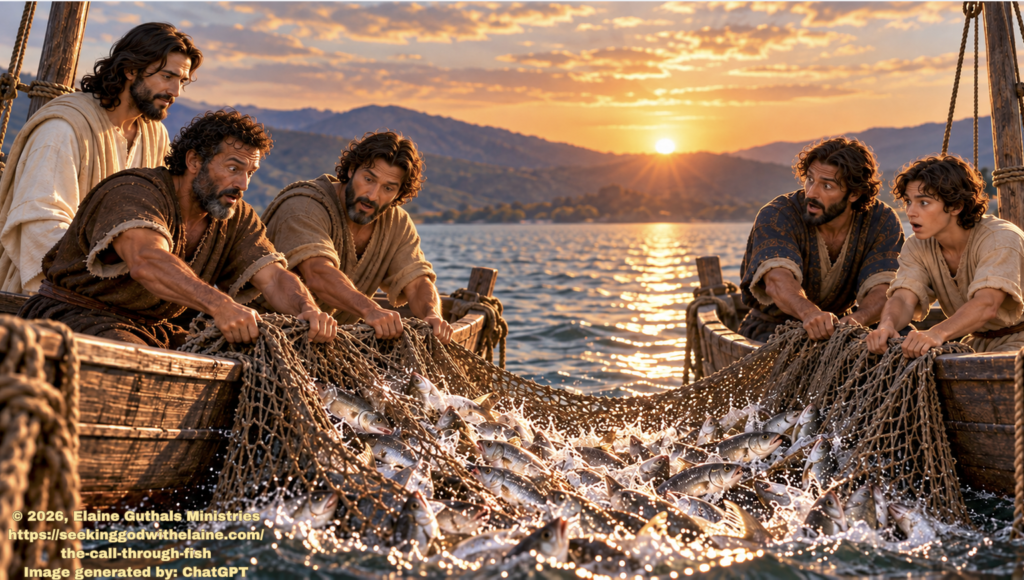
But it had an element we probably think shouldn’t have been a part of the catch. The boat started to sink.
How can something bad be a part of something good? That is what we think, don’t we? When we are doing the Lord’s work, nothing bad should happen.
It doesn’t work that way.
I’m a Sinful Man
“When Simon Peter realized what had happened, he fell to his knees before Jesus and said, ‘Oh, Lord, please leave me — I’m such a sinful man.’ For he was awestruck by the number of fish they had caught, as were the others with him” (Lk. 5: 8-9 NLT)
Through this encounter, Simon acknowledged his awareness of sin.
Remember when we said Simon was going from the controllable to the uncertain? The uncertain became the unbelievable.
But more than that, it became a display of Yeshua’s power and authority. It drove home the point that Simon wasn’t in control. Yeshua was.
Simon had his eyes opened. He saw the Messiah in front of him.
But what Simon saw was his own unworthiness. Instead of looking for salvation, Simon told the Messiah to depart from him. Why?
We have to go back to first-century Messianic expectations. Remember John the Immerser’s message. Repent of your sins.
Many people of the day thought they had to become righteous and then the Messiah would come. Simon acknowledged he wasn’t righteous, so he may have felt he was not worthy to be addressing the Messiah.
Fishers of Men
“His partners, James and John, the sons of Zebedee, were also amazed. Jesus replied to Simon, ‘Don’t be afraid! From now on you’ll be fishing for people!’ 11 And as soon as they landed, they left everything and followed Jesus” (Lk. 5: 10-11 NLT)
The promise in Luke is the same as that in Matthew and Mark.
Yeshua told Simon, Andrew, James, and John that they would catch men. The Greek word there is zōgreō (ζωγρέω). It means capture alive.
Jehovah calls people after exposing their inadequacy – not before.
The disciples’ response? They left everything and followed the Messiah.
Reconciling These Passages with John 1: 35-42, Matthew 4: 18-22, and Mark 1: 16-20
Reconciling These Passages with John 1: 35-42, Matthew 4: 18-22, and Mark 1: 16-20
So, let’s look at all of this and see if we can piece it together.

|
Event |
Gospel |
Supports |
Contradicts |
|
Yeshua walking along the shore |
Matthew 4: 18; Mark 1: 16 |
At first glance they do contradict. Could be the walking announced His arrival at the shore, then He started preaching. |
|
|
Yeshua preaching on the shore |
Luke 5: 1 |
||
|
Simon, also called Peter, and Andrew |
Matthew 4: 18 |
Calling him Simon may indicate that his name hadn’t be changed yet. |
|
|
Simon and Andrew |
Mark 1: 16 |
||
|
Simon |
Luke 5: 3 |
||
|
Two boats belonging to Simon |
Luke 5: 3 |
Neither supports nor denies this. As Simon was a fisherman, it would be expected that several of the boats could have been his. If he were partners with Zebedee, who we know had hired men, maybe Simon did, too. |
|
|
Throwing out a net |
Matthew 4: 18; Mark 1: 16 |
These verses indicate different places Peter and Andrew were in the fishing day. Casting nets meant they were still in the act of fishing; washing nets meant they were done fishing. |
|
|
Washing their nets |
Luke 5: 2 |
||
|
Push out to deeper water |
Luke 5: 4-5 |
This event only appears in Luke’s Gospel. |
|
|
Enough fish came to begin to tear the nets |
Luke 5: 4-5 |
The Craftsman told the fisherman how, where, and when to fish. A large catch was netted. |
|
|
Simon and Andrew call for James and John to help. |
Luke 5: 7 |
This event only appears in Luke’s Gospel. |
|
|
Simon’s declaration of sin. |
Luke 5: 8-9 |
This event only appears in Luke’s Gospel. |
|
|
James and John were amazed. |
Luke 5: 10 |
Matthew and Mark don’t include that interpretation. |
|
|
Come, follow me |
Matthew 4: 19; Mark 1: 17 |
Luke does not contain a call for the two disciples. |
|
|
Fish for people |
Matthew 4: 19; Mark 1: 17; Luke 5: 10 |
All three Gospels include the same declaration. |
|
|
Simon and Andrew left their nets at once |
Matthew 4: 20; Mark 1: 18 |
||
|
James and John a little further up shore |
Matthew 4: 21; Mark 1: 19 |
Luke 5 doesn’t tell us James and John’s activities when they answered Simon and Andrew’s shout for help. So, he neither confirms nor denies what the other two accounts agree upon. |
|
|
Sitting in a boat with Zebedee |
Matthew 4: 21 |
||
|
Repairing their nets |
Matthew 4: 21; Mark 1: 19 |
||
|
He called them, too |
Matthew 4: 21; Mark 1: 19 |
Luke 5: 11 should be coupled with these verses. Luke summarizes all were obedient while Matthew and Mark show how each family of brothers was obedient. |
|
|
Immediately left boat and father |
Matthew 4: 22; Mark 1: 20 |
While Luke summarized what the four gave up, Matthew and Mark explain what they left behind. This does not necessarily mean the accounts are different. It could be the men merely focused on different aspects of what was given up. |
|
|
They left everything |
Luke 5: 11 |
||
|
Left boat with hired hands |
Mark 1: 20 |

Event | Gospel | Supports | Contradicts |
Two of John’s disciples spend time with Yeshua | John 1: 35-39 | For Andrew to be introduced to Yeshua as he was in John’s account, the meeting between Yeshua and the two disciples (one of which was Andrew) had to happen before the encounter on the seashore. |
|
Andrew, of the two disciples, brought his brother Simon to Yeshua | John 1: 40-43 |
| We may or may not be able to make our decisions on timeline because of the name Andrew’s brother is called. While he may have been Simon before the call occurred, we know that names of people and towns are given as the name most commonly recognized by the readers of the account. |
Yeshua goes to Galilee to call Philip | John 1: 43 | If Yeshua traveled to Galilee to call Philip, that meant Andrew and Simon didn’t meet with Yeshua in Galilee in John 1. Matthew 4/Mark 1 would have occurred at a least a minimum of a couple of days earlier after the encounter with Yeshua in John 1. |
|
Yeshua met Simon, Andrew, James, and John on the seashore. | Matthew 4: 18; Mark 1: 16 | An earlier meeting wouldn’t make a meeting at the seashore unlikely. |
|
Yeshua called them and/or told them they would be fishers of men. | Matthew 4: 19; Mark 1: 17; Luke 5: 10 | Regardless of Yeshua actually said the words, “Come, follow me,” He did tell them what their job would become – witnessing to others. He didn’t call Simon, Andrew, and John in John 1, and James was not present there. |
|
Yeshua caused a miraculous catch of fish. | Luke 5: 4-7 |
| I really don’t see that occurring during Simon, Andrew, James, and John’s call. |
It always amazes me that Luke was the only Gospel writer to include the miraculous catch of fish. Wouldn’t Mark, who supposedly transcribed Peter’s memories, have included it and Peter’s wonderful answer?
That tells me the miraculous catch didn’t happen at Peter, Andrew, James, and John’s call.
Making the Connections #1
We could have put this miracle in the next series, The Miracles of Christ. The overflowing catch of fish was miraculous.
But it was more than that.
This miracle was a direct challenge to Simon. It challenged his identity, expertise, and control.
How did Simon respond? “At Your word.”
Making the Connections #2
Who really was the first disciple called? I would say that the first one we are told of the calling is Philip.
I really don’t see Luke 5 telling the same story as Matthew 4 and Mark 1. True, some elements are the same – especially all three using the fishers of men terminology.
But there are too many other elements, in my mind, that make the miraculous catch occur at a different time.
Making the Connections #3
So, the question becomes what are we going to do with this? Are we going to be an ostrich and say tradition/what we’ve been taught stands? Or are we going to allow the Holy Spirit to guide us to a different interpretation?
True, we may not have all the evidence needed to make an informed – or correct – decision. We may need to leave this in the UNR book – understanding not required.
But it brings up a much more important point. How teachable are we? Do we make what we read fit into our understanding and beliefs, or do we let Jehovah reveal Himself to us through the Holy Spirit?
We each have to decide that for ourselves.
Heart Check
Think about the battle Yeshua is engaged in for your heart. Ask yourself the following questions.
- When Yeshua challenges what I know, do I trust my experience and understanding more than His word, or am I willing to obey even when I recognize the difficulties?
- When I encounter something in Scripture that challenges our assumptions, do I dismiss it because it doesn’t fit what I’ve always believed, or do I examine it and allow Jehovah to teach me?
- When we recognize my own sinfulness in the presence of Yeshua, do I draw away because we feel unworthy, or do I turn to Him in repentance?
- When Scripture raises questions I can’t fully answer, do I pretend the difficulties don’t exist, or do I remain teachable while seeking to understand what Jehovah has revealed?
How Do We Apply This?
- Trust Yeshua’s word even when our experience gives us reasons to hesitate
- Recognize the limits of our own knowledge and expertise
- Examine our assumptions in light of Scripture
- Acknowledge our sinfulness and respond to Jehovah in repentance
- Remain teachable when Scripture challenges our understanding
- Trust Jehovah without pretending we have all the answers
Father God. Let us be like Simon. When we stand in front of Yeshua, let us see what that encounter reveals in us. But let us not push Him – or You – away. Let us repent of our sins and respond to You. Amen.
If you don’t understand something and would like further clarification, please contact me.
If you have not signed up for the email providing the link to the devotions and the newsletter, do so below.
If God has used this devotion to speak with you, consider sharing it on social media.