Yeshua called disciples individually, as he did Philip; but He also called several together. This devotional reading looks at the call of Simon, Andrew, James, and John.
Nuggets
- The Sea of Galilee is in northern Israel.
- We’ve already met Simon Peter and Andrew.
- Several tasks make up a fisherman’s work.
- The jury is out as to whether Peter – and Andrew as his partner – were successful or not in their fishing occupation.
- Peter and Andrew’s call to follow Yeshua demanded a very different kind of commitment from what we usually mean when we talk about following Him.
- Yeshua gave them an idea of what they would be doing, just not a travel itinerary.
- There were a lot of things Yeshua didn’t tell them right then – but they were immediately obedient.
- James was the first Apostle who lost his life because of his belief in Yeshua.
- Yeshua emphasized that we should put Him before all other relationships.
- The Book of Mark gave us a clue as to the size of Zebedee’s fishing operation.
I have to admit. I started arranging verses into headings. And I had to just stop.
You know that this study started out being a chronology study. That is one reason we have been looking so closely at the next day and following day designations.
But what happens when today’s study calls into question yesterday’s teaching? Well, not just yesterday – but lifelong!
What if Peter, Andrew, James, and John weren’t the first four disciples called? What if the miraculous catch of fish didn’t occur when the four were called?
I know. That is hard to wrap our heads around since some of us have been taught that our entire lives. But before you write me off as a crazy chick, let’s look at the passages.
PROGRAMMING NOTE: This devotion ran long, so if you want all the answers to both questions I asked, you’ll have to come back for the next devotion.
Let's Put It into Context
To read devotions in The Battle for the Heart theme
Devotions in the The Early Ministry of the Messiah series
Peter and Andrew Working
“One day as Jesus was walking along the shore of the Sea of Galilee, he saw two brothers — Simon, also called Peter, and Andrew — throwing a net into the water, for they fished for a living” (Mt. 4: 18 NLT)
“One day as Jesus was walking along the shore of the Sea of Galilee, he saw Simon and his brother Andrew throwing a net into the water, for they fished for a living” (Mk. 1: 16 NLT)
One Day
We aren’t given any clue as to the timing of this event.
Many of us are taught that this is the first time Yeshua called disciples to follow Him. We also believe that this is very early on during His ministry.
One problem is we don’t know when one day was. It is totally different than either the next day or the following day. It isn’t connected to another event.
No, that doesn’t make it unimportant. It just means that we aren’t given context surrounding this event.
That is important to our lining up events in our minds.
The Shore of the Sea of Galilee
The Sea of Galilee is in northern Israel.
It is interesting to know that the Sea of Galilee was also known by other names. It was also called the Sea of Tiberias and the Lake of Gennesaret. In the Old Testament, it was associated with the region of Kinneret (Num 34: 11; Josh. 13: 27).
Okay, Sea. Lake. Which is it? Well, geographically it is a freshwater lake. I wonder if it was considered a sea because the Jordan River flows into and out of it. That does make it a moving body of water.
A medium-sized lake (13 miles long by 8 miles wide at its widest point), it is a substantial body of water. However, it wasn’t an obstacle to first-century Jews to moving around among the surrounding working settlements.
Its size made the lake substantial enough to host a thriving commercial fishing industry. It was also large enough to accommodate a number of boats at once.
The lake sits in a deep basin surrounded by hills. But this position also allows for dangerous storms to form. In fact, it resulted in sudden, violent storms.
Still, to the people of the region, the Sea of Galilee represented life. It was a source of food and the backbone of their economy.
Simon Peter and Andrew
We’ve already met Simon Peter and Andrew.
Andrew was a disciple of John the Immerser (Jn. 1: 35-42). He and another disciple followed Yeshua after John pointed Him out to them.
Sometime that day, Andrew brought Simon to meet Yeshua. Some Gospel writers say that was when He changed Simon’s name to Peter.
Now, if your mind is going like mine, you are remembering the table that I included to keep our timeline straight.
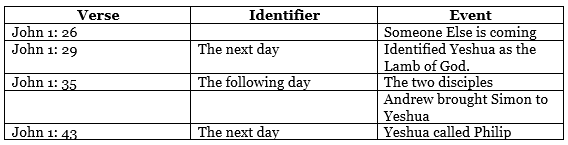
One thing we have to keep in mind is that – if we read it as written – Yeshua didn’t call either Peter or Andrew to be His disciple that day. It was only their initial encounter with the Messiah.
Throwing a Net into the Water
Several tasks make up a fisherman’s work.
Going out on the Sea and catching the fish is an important part of a fisherman’s work. That can happen either during the day or at night.
But it isn’t the only part.
Sometimes, the fishermen fished from the shore, called net fishing. They did this by casting their net into the water. Archaeological research supports the use of several net-fishing techniques in first-century Galilee, including cast nets and heavier nets used from boats.
Resource
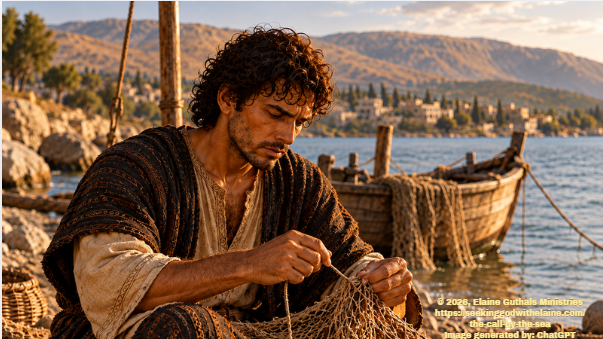
All that fishing – hopefully netting large amounts of fish – was hard on the nets. They would have to take time to repair them. Daily maintenance included washing the nets.
For They Fished for a Living
The jury is out as to whether Peter – and Andrew as his partner – were successful or not in their fishing occupation.
We don’t know how successful Peter and Andrew were at fishing. Scripture doesn’t tell us.
Grey said that Peter is seen as having had a modest existence. This lifestyle was accompanied by Aramaic speech, little formal education, and the lack of knowledge of the Greek language. This would have made Peter a conservative Jew.
Others, according to Grey, believe Peter prospered and was sophisticated enough to have a good grasp of Greek to write the books of Scripture attributed to him.
Resource
Where they came from is interesting knowledge. Where they were going is more relevant to the story.
Peter and Andrew Called
“Jesus called out to them, ‘Come, follow me, and I will show you how to fish for people!’ And they left their nets at once and followed him” (Mt. 4: 19-20 NLT)
“Jesus called out to them, ‘Come, follow me, and I will show you how to fish for people!’ And they left their nets at once and followed him” (Mk. 1: 17-18 NLT)
Come, Follow Me
Peter and Andrew’s call to follow Yeshua demanded a very different kind of commitment from what we usually mean when we talk about following Him.
Our mission statement is to follow Yeshua’s instructions to “… give up your own way, take up your cross daily, and follow me”’” (Lk. 9: 23 NLT). But it looks different from what Yeshua had in store for Peter and Andrew – and James, John, Philip, Nathanael, and the rest.
- They left their nets (Mt. 4: 20; Mk. 1: 18).
- They left family (Mk. 1: 20)
- They left everything (Lk. 5: 11).
Think about it. They weren’t signing up to attend church regularly (if they weren’t already doing that). They weren’t going to fit in a Bible study session after a hard day of fishing.
They were being asked to give up their jobs – their means of making a living. We know Peter was married. Others may have been, too – they just didn’t have a mother-in-law in need of healing.
At a minimum, some were more than likely being asked to leave parents. James and John surely weren’t the only ones there, either.
No, this doesn’t mean they sold everything and closed up shop. This doesn’t mean they dissolved every relationship.
I am sure they came back home at times.
Show You How to Fish for People!
Yeshua gave them an idea of what they would be doing, just not a travel itinerary.
Yeshua told them that they would be interacting with others. He just didn’t say what that interaction would look like.
Yes, it would be nice to get a data dump upon responding to Yeshua’s call. We want to know the obstacles we’ll face, have assurance the job we do will be successful, and what time frame we’re talking about.
Yeshua didn’t give them any of that. They didn’t really know what experience they were signing up for.
Talk about trust out of the starter’s box.
But think about it. From the passages in Matthew and Mark, we haven’t been told they have even heard Yeshua preach. They didn’t know much – if anything – about His message.
The Apostles didn’t know what their reward would be. Three years later when the Messiah was being crucified, they still didn’t understand everything.
All they knew was that they were going to build a relationship with Yeshua. They were called to follow the Savior, not a movement. They weren’t signing up for a religious organization.
They were responding to the One Who called them – the One they would come to understand more fully as they walked with Him.
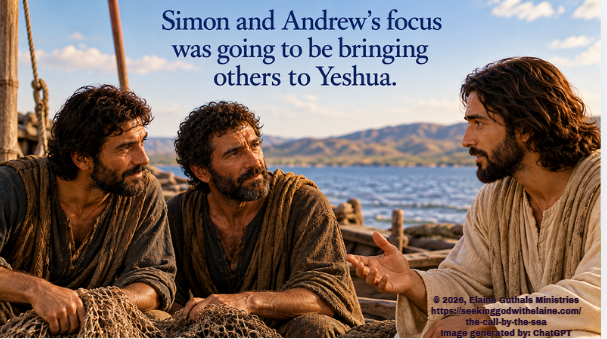
What Simon and Andrew did know was that their focus was going to be other people. We can say now that their focus was bringing others to Yeshua.
They Left Their Nets at Once
There were a lot of things Yeshua didn’t tell them right then – but they were immediately obedient.
Peter and Andrew didn’t worry about the unknown. They didn’t ask what they really knew about this Man.
They followed their heart and followed their Savior.
The best part is they made a split-second decision to follow their Savior for the rest of their lives. True, they didn’t understand, and they were going to fail – but they were also going to grow.
James and John Called
“A little farther up the shore he saw two other brothers, James and John, sitting in a boat with their father, Zebedee, repairing their nets. And he called them to come, too. They immediately followed him, leaving the boat and their father behind” (Mt. 4: 21-22 NLT)
“A little farther up the shore Jesus saw Zebedee’s sons, James and John, in a boat repairing their nets. He called them at once, and they also followed him, leaving their father, Zebedee, in the boat with the hired men” (Mk. 1: 19-20 NLT)
James (Ya ’acov)
James was the first Apostle who lost his life because of his ministry.
We know a little more about James than we know of most of the Apostles. Most of what we know about him mirrors what we know about his brother John – at least until after the crucifixion and resurrection.
James was called to follow Jesus at the same time as John was. His father was Zebedee; and his mother was Salome, possibly the sister of Mary.
We do know Zebedee operated a fishing business on the Sea of Galilee with his sons. It sounds extensive because they did have hired workers (Mk. 1: 20). They appear to have been partners with Simon Peter and Andrew (Lk. 5: 7).
James was known for having a temper. Yeshua called him and John the sons of thunder. This nickname came from their reaction to the Samaritan village (Lk. 9: 51-56).
They both seemed to develop characters more like Yeshua wanted.
Still, he, along with Peter and John, made up Yeshua’s inner circle. They got to witness events the others didn’t, such as on the mount of transfiguration and His agony in Gethsemane.
After the ascension, James’ mission field was Jerusalem. Tradition also associates him with Spain.
We aren’t told how most of the Apostles died – not so with James. We are told about his death in Acts 12: 2.
King Herod Agrippa targeted the leadership of Yeshua’s followers. He had Peter arrested and James beheaded around AD 44.
Bradford said that Agrippa would have been looking at the situation as a political one, not a religious one. The growing number of believers would have – in his mind – posed a threat to his rule. It had grown to include zealots, who were committed to resistance to the Roman occupation and eventually became an organized movement that was more of a revolutionary group. These groups stressed covenant faithfulness.
Resource
Agrippa’s hope may have been to stop the growth of the early church, but it wasn’t totally successful. Tradition says that one of the Roman officers guarding James was won over by James’ defense of his faith, professed faith, and was executed beside James.
Leaving Their Father, Zebedee
Yeshua emphasized that we should put Him before all other relationships.
Some might be a little disturbed by the fact that James and John left their father to follow Yeshua. We shouldn’t be.
Yeshua has told us that we shouldn’t put our family above Him.
- “If you want to be my disciple, you must, by comparison, hate everyone else — your father and mother, wife and children, brothers and sisters — yes, even your own life. Otherwise, you cannot be my disciple” (Lk. 14: 26 NLT).
- “If you love your father or mother more than you love me, you are not worthy of being mine; or if you love your son or daughter more than me, you are not worthy of being mine. If you refuse to take up your cross and follow me, you are not worthy of being mine. If you cling to your life, you will lose it; but if you give up your life for me, you will find it” (Mt. 10: 37-39 NLT).
- “And everyone who has given up houses or brothers or sisters or father or mother or children or property, for my sake, will receive a hundred times as much in return and will inherit eternal life” (Mt. 19: 29 NLT).
Now, don’t get upset that Luke 14: 26 says that we are to hate everyone else. It just means that we are to love Yeshua more than them. That doesn’t contradict the love-one-another commandment.
With the Hired Men
The Book of Mark gave us a clue as to the size of Zebedee’s fishing operation.
Mark listed that hired hands were present with James, John, and Zebedee where Matthew did not. Does that mean the passages contradict each other?
I don’t think so. If the operation was big enough to have hired hands, I would bet some were there.
In my way of thinking, it would seem that Matthew’s focus was not on the size of the operation. Rather, he was trying to emphasize the fact that the brothers left their father.
Making the Connections #1
How does the Apostles’ calling differ from ours?
Their Circumstances | The Continuing Principle |
They physically traveled with Yeshua from place to place. | Discipleship means following His teachings and making them the focus of our lives. |
Some left fishing businesses and family work. | Following Him may require an occupation change, but it may not. It does mean that we will have to change priorities to make Him #1 since He wasn’t before. |
Some left family. | Following Him may mean we have to surrender competing loyalties. |
They learned directly from Him during His earthly ministry. | We learn His teaching from His Word and the guidance of the Holy Spirit. |
They didn’t receive a complete itinerary at the initial call. | We aren’t given a complete itinerary at our initial call. Even as a disciple of His, we are called to obey without knowing every detail of what lies ahead. |
Yeshua was calling them out of the familiar into a world they couldn’t yet fully comprehend. Yeah, that is hard and scary.
Still today, we are called from the familiar into the unknown.
We just have to trust Him.
Making the Connections #2
One thing that hasn’t changed since that day by the Sea of Galilee is that just knowing Yeshua doesn’t make Him our Savior.
Peter and Andrew had spent time with Yeshua on the day that John pointed Him out. That makes them acquaintances.
We can be acquainted with Yeshua. We have head knowledge of Him.
Until we ask Him to be our Savior and Redeemer and commit to allow Him to win the battle for our hearts, we don’t become His disciples and gain salvation.
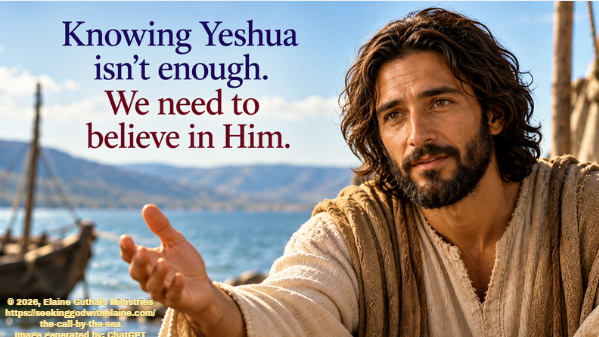
Knowing Yeshua isn’t enough. We need to believe in Him.
Making the Connections #3
Yes, the Apostles ended up establishing the early Church. That isn’t what they started out to do. They were bringing people to the Messiah.
We can get so focused on church activities, programs, and institutions that we forget the reason it exists in the first place. We are to follow Yeshua. Everything else must flower from that.
Heart Check
Think about the battle Yeshua is engaged in for your heart. Ask yourself the following questions.
- Am I willing to follow Yeshua immediately, even when I don’t know what lies ahead, or do I want to know the whole plan before I commit to it?
- Am I following the Savior, or have I become more focused on religion and everything surrounding it?
How Do We Apply This?
- Trust Yeshua with the unknown
- Put the Savior before competing loyalties
- Follow Yeshua rather than merely knowing about Him
- Allow Yeshua to shape our lives as we grow in Him
- Keep the Messiah at the center of everything we do
Father God. Thank You for calling men who became strong in their faith and were obedient to Your mission of sending Your message to others. Thank You for Your children who told us about You or provided us with the resources needed to study Your Word. May we always listen to Your call. Amen.
If you don’t understand something and would like further clarification, please contact me.
If you have not signed up for the email providing the link to the devotions and the newsletter, do so below.
If God has used this devotion to speak with you, consider sharing it on social media.