Andrew wasn’t the only disciple who brought someone to Jesus. This devotional reading looks at how Philip brought Nathaniel to Jesus and their interactions.
Nuggets
The events of this day took place the day after Yeshua met with Andrew, Simon, and the other disciple.
Yeshua left where He was and traveled to Galilee to meet Philip.
Following Yeshua has to be more than just words.
Bethsaida was located near the northern end of the Sea of Galilee.
Philip shared a hometown association with Andrew and Peter, but that doesn’t fit cleanly with what we know about the brothers.
Recently, we talked about John the Immerser pointing Yeshua out to two of his disciples. One was identified as Andrew. Most tradition identifies the other as John.
Some, however, believe that disciple was Philip. I know, most tradition says it was John – and Scripture itself doesn’t tell us, so we don’t really know.
But humor me.
If the other disciple was Philip, they were two for two. Both went to someone else and brought them to Yeshua.
Let's Put It into Context
To read devotions in The Battle for the Heart theme
Devotions in the The Early Ministry of the Messiah series
Let's Put It into Context #2
#dailydevotionalreading #harmonyofthegospelstudy
The Calling of Philip
“The next day Jesus decided to go to Galilee. He found Philip and said to him, ‘Come, follow me’” (Jn. 1: 43 NLT)
The Next Day
The events of this day took place the day after Yeshua met with Andrew, Simon, and the other disciple.
We’ve been slowing down to make sure we have the time transitions correct. Even though the next/following day can be straight forward, those little nuggets are easy to overlook.
To me, that is important. Let’s put it into context to determine why that is so.
Andrew, Philip – if the second disciple in John 1: 35-40 was Philip – and later Simon would have just spent time with Yeshua the previous day. It could have been several hours (4 pm to sundown).
Yet, Yeshua didn’t call any of them to follow Him during that initial meeting.
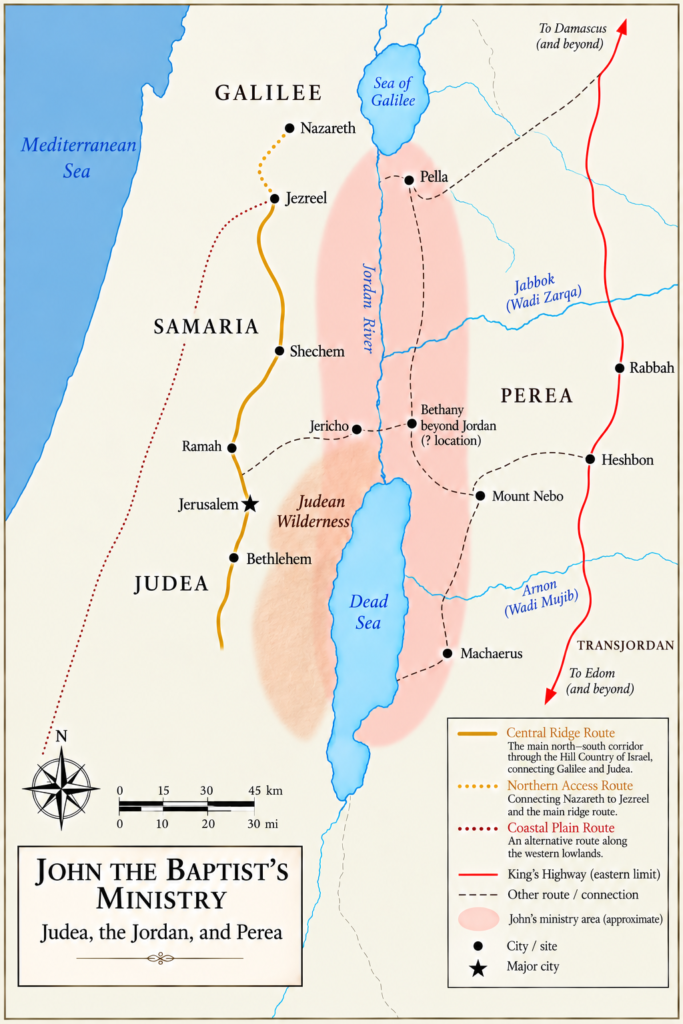
We’ve also spent some ink trying to figure out where these events took place. Post-Yeshua’s baptism, John was baptizing people around Bethany across the Jordan (Jn. 1: 29).
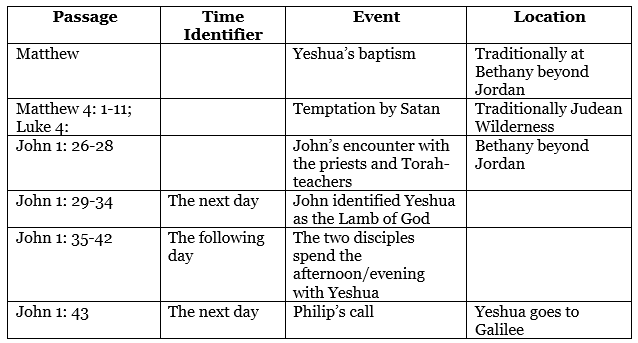
It may be safe to assume that John the Immerser stayed put for three days. Yeshua was there for at least two.
Andrew and the other disciple were considered disciples of John – even if they were there only part of the time. We know Andrew had a day job.
Hold that thought.
Galilee
Yeshua left where He was and traveled to Galilee to meet Philip.
If we assume John the Immerser was still at Bethany beyond Jordan – as there is no indication that he moved – that means Andrew, Simon, and Philip had to come from Bethsaida and/or Capernaum to Bethany.
John doesn’t tell us what Philip did for a living. He may have been a fisherman like Simon and Andrew, but we aren’t told that.
I would think it was safe to assume that Yeshua, Andrew, Simon, and the other disciple were not in Galilee on the day of their meeting. Otherwise, Yeshua didn’t have to go to Galilee.
You know, I think this is a good argument for Philip not being the other disciple.
Yes, for this devotion, it would have been nice to have Philip as the other disciple with Andrew. We may not know his occupation but do know what Philip became after he encountered the Messiah.
Come, Follow Me
Following Yeshua has to be more than just words.
Wait! What?? Yeshua found Philip and told him to follow Him. What did Philip know about Yeshua at this point?
Since we now believe that Philip wasn’t the other of John’s disciple to spend the afternoon with Yeshua, we don’t know whether they had interacted before. Had Philip heard about Him from the Immerser? Was he just going into this blind?
John doesn’t tell us everything that happened between them. We cannot fill in the conversation with things Scripture doesn’t give us. But we do know that Yeshua called Philip to follow Him.
The Greek word translated follow is akoloutheō (ἀκολουθέω). It means to follow or accompany someone. In the context of discipleship, it means more than walking behind someone from one place to another. A disciple follows a teacher, learning from him and becoming his student.
Philip was invited to become a student of Yeshua.
Think about that for a minute. Yeshua didn’t tell Philip to go home and study for another year. He didn’t tell him to get his life straightened out first. He called him to follow.
But that doesn’t mean Philip could just sit around listening to the lecture.
Following Yeshua would mean learning from Him, listening to His teaching, and discovering who He was.
Philip would have much to learn. He didn’t have all the answers yet. But he could begin by responding to the One who called him.
We sometimes think we must understand everything before we can follow Yeshua. We want every question answered, every uncertainty removed, and every detail explained. But learning to follow a teacher means becoming his student. We learn as we walk with him.
Then we think we are no longer the student when we gain salvation. But we have to watch.
Salvation isn’t the finish line. It just begins the sanctification process – the second part of salvation that will take the remainder of our lives.
We can learn about Yeshua without actually following Him. We can know the stories, recognize the names of the disciples, and even explain what the Bible teaches about the Messiah. But knowing facts about Him is not the same as becoming His genuine disciple.
It is more than just spending time with Yeshua. We actively become involved in the relationship we are building with Him. We allow that to change us.
When we begin to understand who Yeshua is, that knowledge should affect how we live. Following Him changes more than we know. It changes on whom we trust, whose teaching we receive, and the direction in which we walk.
Bethsaida
“Philip was from Bethsaida, Andrew and Peter’s hometown” (Jn. 1: 44 NLT)
Bethsaida
Bethsaida was located near the northern end of the Sea of Galilee.
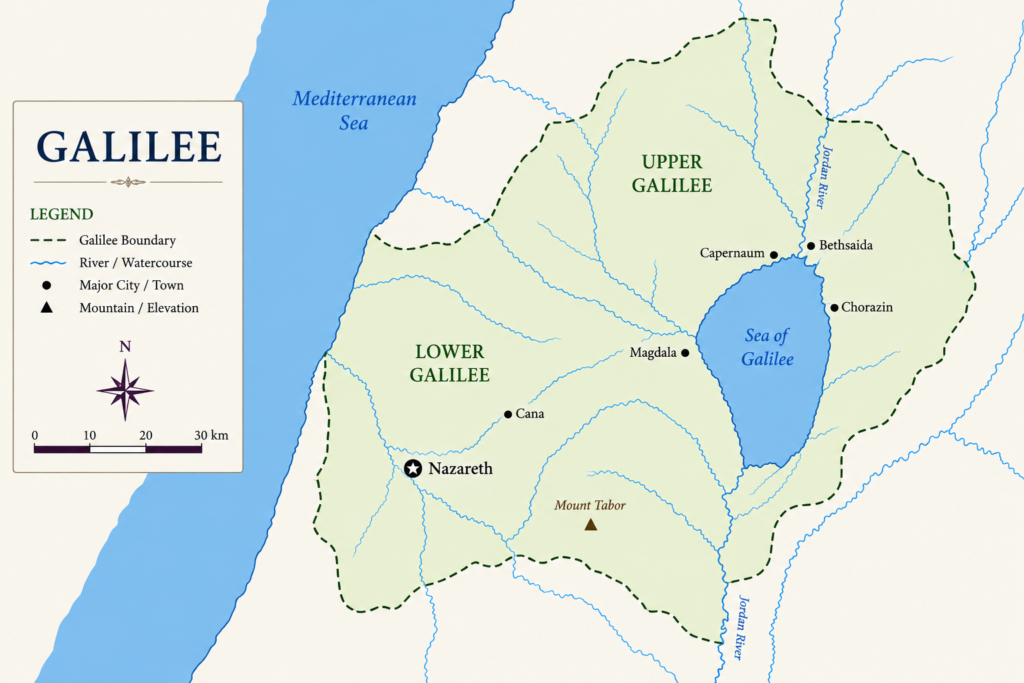
Bethsaida is commonly understood to mean house of fishing or house of the fisherman. Given its location, fishing would have been an important part of life in the surrounding region. People also supported themselves through farming, trade, and related work.
Does that mean Philip was a fisherman? Not necessarily. Scripture identifies Peter and Andrew with fishing, but it never tells us what Philip did for a living. He may have worked in the fishing trade, but we cannot state that as a fact.
Bethsaida also had an interesting political history. Herod Philip, one of the sons of Herod the Great, developed the settlement into a city and renamed it Julias in honor of Julia, a member of the Roman imperial family. This gives us a glimpse into the changing world in which Philip lived. The region was under Roman influence, and local rulers were developing their territories.
There is some uncertainty about the exact location of biblical Bethsaida. Two archaeological sites, et-Tell and el-Araj, have been proposed, and scholars continue to debate which one corresponds to the town mentioned in the Gospels. We can identify the general region without claiming that its precise location has been settled.
Bethsaida appears in several accounts of Yeshua’s ministry. He performed mighty works in the region, and the Gospels associate the town with the healing of a blind man and the feeding of the five thousand. Yet Yeshua also rebuked Bethsaida because the mighty works performed there had not produced the response they should have (Matthew 11:21–22).
Think about that for a minute. Living near where Yeshua ministered didn’t automatically make someone His disciple. Witnessing His works didn’t guarantee that a person would respond to Him in faith.
Philip’s hometown tells us something about where he came from. His response to Yeshua tells us something about the direction his life was taking.
We may not know about Philip’s occupation before he became a disciple, but we know that he became a witness to the Messiah. His story reminds us that following Yeshua is more than knowing where He lived, knowing what He taught, or knowing the stories about Him. It means responding to Him and allowing that relationship to change the direction of our lives.
Andrew and Peter’s Hometown
Philip shared a hometown association with Andrew and Peter, but that doesn’t fit cleanly with what we know about the brothers.
Peter and Andrew are associated with both the villages of Bethsaida and Capernaum (the modern site of Tel Hum). John identified Bethsaida as the city of the brothers.
However, Gospel accounts also associate the brothers with Capernaum (Mk. 1: 21, 29-31; Mt. 8: 14). So, how do we account for both places?
One possibility is that Bethsaida was where the brothers originated, while Capernaum was where they lived when Yeshua began His ministry. A person’s hometown and place of residence don’t always have to be the same.
However, Scripture doesn’t tell us when or why a move from Bethsaida to Capernaum occurred. We should be careful not to turn a possible explanation into a biblical fact.
What we can establish is that John associates Philip, Andrew, and Peter with Bethsaida, while the other Gospel accounts place the brothers in Capernaum. The accounts give us both pieces of information without explaining the circumstances that connect them.
This also reminds us that knowing someone’s hometown doesn’t necessarily tell us everything about where that person lives or works. We have to allow each passage to tell us what it actually says, connect it with other passages, and not add details the biblical writers haven’t provided.
Heart Check
Think about the battle Yeshua is engaged in for your heart. Ask yourself the following questions.
- Am I following Yeshua, or am I mainly learning facts about Him?
- Do I believe I have to understand everything before I can respond to what Yeshua is asking of me?
- Am I allowing my relationship with Yeshua to change how I live, whom I trust, and whose teaching I follow?
- Do I distinguish between what Scripture actually says and what I assume or believe might have happened?
- Am I willing to examine what I believe, even when doing so means reconsidering an assumption I’ve held for a long time?
How Do We Apply This?
- Follow Yeshua even when you don’t have all the answers.
- Allow your relationship with Yeshua to change how you live.
- Study Scripture in context rather than relying on assumptions.
- Distinguish what Scripture says from what you think might have happened.
- Help someone else take a step toward Yeshua.
Father God. Thank You that You personally call us to be Your children. May we all accept Your gift of salvation. Help us to learn to walk with You. May we keep learning until You call us home. Amen.
If you don’t understand something and would like further clarification, please contact me.
If you have not signed up for the email providing the link to the devotions and the newsletter, do so below.
If God has used this devotion to speak with you, consider sharing it on social media.