It was time for John the Baptist’s ministry to draw to a close.. This devotional reading looks at his imprisonment and death.
Nuggets
- Herod Antipas was one of the sons of Herod the Great who received part of his divided kingdom.
- Some in John’s audience thought he was the prophet Elijah.
- The only other named prophet John was compared to was Jeremiah, though John was also compared to unnamed prophets.
- Herod thought Yeshua was John because He could perform miracles.
- Herod must have had a guilty conscience if he thought Yeshua was John.
- Herodias was the daughter of Herod the Great’s son Aristobulus and Berenice.
- John had a specific reason for calling out Herod Antipas and Herodias – their marriage was against Jehovah’s laws.
- Herod had conflicting feelings about John.
- Herodias took matters into her own hands.
- The vow was important because of the audience.
- Once the reward was established, Herod had to follow through.
John the Baptist had a very important role to play in Jehovah’s Plan of Salvation. However, it was time for Yeshua to take center stage.
That meant John’s ministry was over.
Let's Put It into Context
To read devotions in The Battle for the Heart theme
Devotions in the The Ministry of John the Baptist series
Herod’s Uncertainty as to the Identity of Yeshua
“When Herod Antipas, the ruler of Galilee, heard about Jesus, he said to his advisers, ‘This must be John the Baptist raised from the dead! That is why he can do such miracles.’” (Mt. 14: 1-2 NLT)
“Herod Antipas, the king, soon heard about Jesus, because everyone was talking about him. Some were saying, ‘This must be John the Baptist raised from the dead. That is why he can do such miracles.’ Others said, ‘He’s the prophet Elijah.’ Still others said, ‘He’s a prophet like the other great prophets of the past.’ When Herod heard about Jesus, he said, ‘John, the man I beheaded, has come back from the dead’” (Mk. 6: 14-16 NLT)
“When Herod Antipas, the ruler of Galilee, heard about everything Jesus was doing, he was puzzled. Some were saying that John the Baptist had been raised from the dead. Others thought Jesus was Elijah or one of the other prophets risen from the dead. ‘I beheaded John,’ Herod said, ‘so who is this man about whom I hear such stories?’ And he kept trying to see him” (Lk. 9: 7-9 NLT)
Herod Antipas
Herod Antipas was one of the sons of Herod the Great who received part of his divided kingdom.
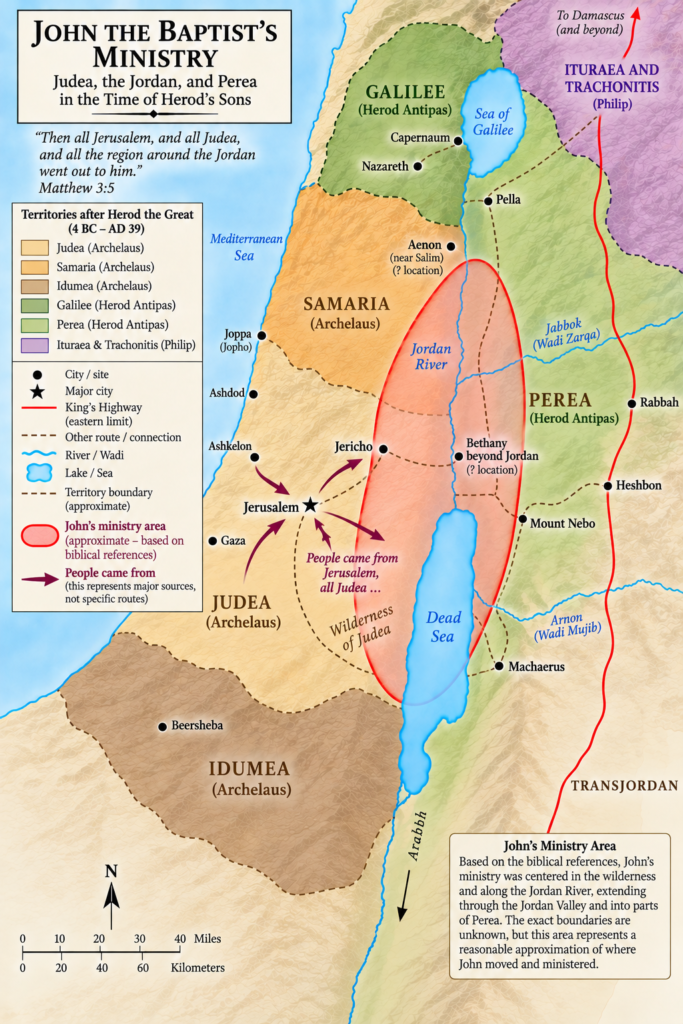
Herod Antipas became tetrarch of Galilee and Perea, including the area where John conducted his ministry. His reign lasted from 4 BC to AD 39.
The capital of Herod’s territory was Tiberias. There was also a fortress and royal palace in Machaerus.
Thomas noted that Herod was a Sadducee. He listed him as an “… avowed patron and protector of the sect …”
Resource
Herod didn’t know what to think about Yeshua. Everyone was talking about Him, so it didn’t take long for Herod to hear about Him, too.
But Herod had no clue as to Who Yeshua was. He had to go on who others said that He was.
Elijah
Some in John’s audience thought he was the prophet Elijah.
“Look, I am sending you the prophet Elijah before the great and dreadful day of the Lord arrives. His preaching will turn the hearts of fathers to their children, and the hearts of children to their fathers. Otherwise I will come and strike the land with a curse” (Mal. 4: 5-6 NLT).
John’s and Elijah’s messages were pretty much the same: repent and turn back to Jehovah. The two men wore similar attire (II Kgs. 1: 8; Mt. 3: 4). They carried out their mission in the wilderness (Mt. 3: 1).
What John had done was to come in the spirit of Elijah. “He will be a man with the spirit and power of Elijah. He will prepare the people for the coming of the Lord. He will turn the hearts of the fathers to their children, and he will cause those who are rebellious to accept the wisdom of the godly” (Lk. 1: 17 NLT emphasis added).
I know. That isn’t exactly what Jesus said.
- “And from the time John the Baptist began preaching until now, the Kingdom of Heaven has been forcefully advancing, and violent people are attacking it. For before John came, all the prophets and the law of Moses looked forward to this present time. And if you are willing to accept what I say, he is Elijah, the one the prophets said would come” (Mt. 11: 12-14 NLT).
- “‘But I tell you, Elijah has already come, but he wasn’t recognized, and they chose to abuse him. And in the same way they will also make the Son of Man suffer.’ Then the disciples realized he was talking about John the Baptist” (Mt. 17: 12-13 NLT).
No, Yeshua did not lie. John was a type of Elijah; however, the audience probably wouldn’t have accepted a no, but because that wasn’t the answer they wanted.
A Prophet
The only other named prophet John was compared to was Jeremiah, though John was also compared to unnamed prophets.
“‘Well,” they replied, “some say John the Baptist, some say Elijah, and others say Jeremiah or one of the other prophets” (Mt. 16: 14 NLT).
Both John and Jeremiah called for Israel to return to covenant faithfulness. Their messages were of repentance and moral change.
Both were deeply concerned with the spiritual condition of Israel. They knew that Israel could not only rely on Abraham being their ancestor. Instead, they confronted religious hypocrisy.
Both endured persecution. That was understandable since both confronted kings and political leaders about their behaviors.
Both were looking forward to the new covenant that Yeshua ushered in. “‘But this is the new covenant I will make with the people of Israel after those days,’ says the Lord. ‘will put my instructions deep within them, and I will write them on their hearts. I will be their God, and they will be my people’” (Jer. 31: 33 NLT).
John, though, was also compared to some unnamed prophets. “… other great prophets of the past’” (Mk. 6: 15 NLT).
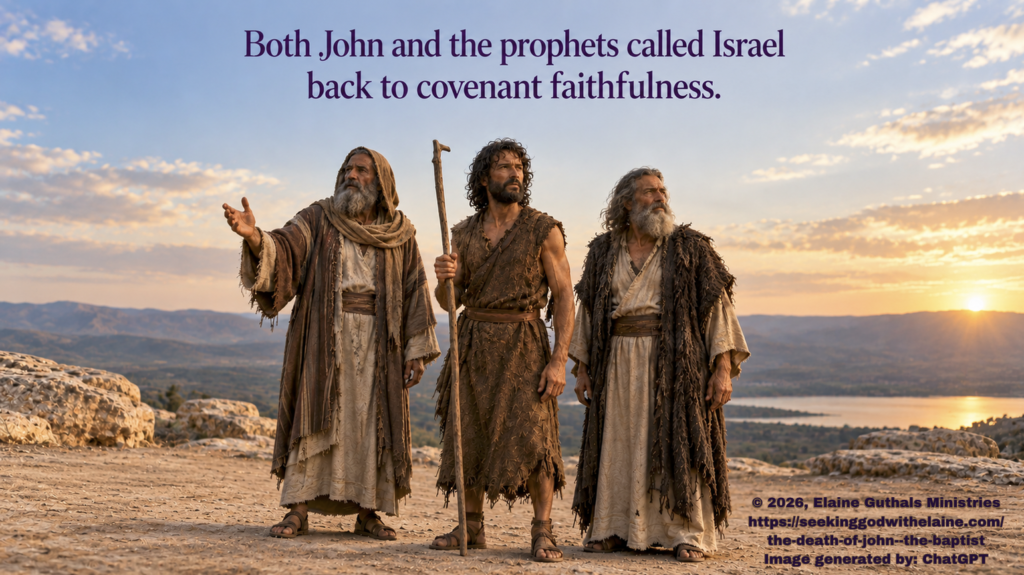
It is understandable that John was compared to the prophets. Both John and the prophets called Israel back to covenant faithfulness.
Why He Can Do Such Miracles
Herod thought Yeshua was John because He could perform miracles.
This always puzzles me. I can’t see why Herod would think Yeshua was John because of miracles.
We aren’t told that John performed miracles. So, why would the ability to perform miracles identify Yeshua as John?
Maybe none of the Gospels report the miracles John performed. They couldn’t report everything he did. Besides, John wasn’t the main character of the Gospels.
I Beheaded John
Herod must have had a guilty conscience if he thought Yeshua was John.
Herod thought Yeshua was John raised from the dead. John had been beheaded at Herod’s direction.
What! What???? John was dead???????
This is one of those oh-by-the-way moments in the Gospels. We’re told after the fact.
John’s Imprisonment
“For Herod had arrested and imprisoned John as a favor to his wife Herodias (the former wife of Herod’s brother Philip). John had been telling Herod, ‘It is against God’s law for you to marry her.’ Herod wanted to kill John, but he was afraid of a riot, because all the people believed John was a prophet” (Mt. 14: 3-5 NLT)
“For Herod had sent soldiers to arrest and imprison John as a favor to Herodias. She had been his brother Philip’s wife, but Herod had married her. John had been telling Herod, ‘It is against God’s law for you to marry your brother’s wife.’ So Herodias bore a grudge against John and wanted to kill him. But without Herod’s approval she was powerless, for Herod respected John; and knowing that he was a good and holy man, he protected him. Herod was greatly disturbed whenever he talked with John, but even so, he liked to listen to him” (Mk. 6: 17-20 NLT)
John also publicly criticized Herod Antipas, the ruler of Galilee, for marrying Herodias, his brother’s wife, and for many other wrongs he had done. So Herod put John in prison, adding this sin to his many others” (Lk. 3: 19-20 NLT)
Herodias (the former wife of Herod’s brother Philip)
Herodias was the daughter of Herod the Great’s son Aristobulus and Berenice.
Herodias’ first husband is commonly identified as Herod II. He was also known as Herod Philip (not Philip the Tetrarch). It is through this union that Salome was born.
We aren’t told why Herodias left her marriage with Herod Philip. We just know that she did.
Herod Antipas also had a prior marriage. He had been married to the daughter of Aretas IV, the king of Nabataea. (Nabataea was a kingdom centered at Petra.) That marriage ended in divorce.
So, in other words, Herod married his niece.
It Is Against God’s Law
John had a specific reason for calling out Herod Antipas and Herodias – their marriage was against Jehovah’s laws.
When given the laws, specifics were given concerning family members. Punishment for breaking these laws was also given.
- “Do not have sexual relations with your brother’s wife, for this would violate your brother” (Lev. 18: 16 NLT).
- “You must keep all my decrees and regulations by putting them into practice; otherwise the land to which I am bringing you as your new home will vomit you out” (Lev. 20: 22 NLT).
Of course, John called Herod on this. He was to call Israel back to repentance and covenant faithfulness.
Herod was Jewish although he was not an Israelite. He was from Idumea.
John was calling all Jews to covenant faithfulness. If Herod truly considered himself a Jew, John knew that Herod should walk with Jehovah and obey His laws.
Herod Wanted to Kill John but Was Afraid
Herod had conflicting feelings about John.
So, was Herod afraid of John or fascinated by him? In one verse – Mark 6: 20 – we get the whole gamut of feelings.
- knew he was a good and holy man
- protected him
- greatly disturbed
- liked to listen to him
Herod knew John possessed a moral authority. He wasn’t just being a troublemaker.
John was a common Jew. Yes, both of his parents had come from a priestly line. Herod knew he was a holy man.
But compared to the king, John was a common man. He was the common man who made Herod afraid.
This really came out when Herod was listening to John. He didn’t want to hear what John had to say, but he knew John was a righteous man with authority.
But Herod didn’t want to hear what John was saying. He was comfortable in his marriage with Herodias.
Herod was protecting John from Herodias. While he had arrested John as a favor to her, it doesn’t sound like he did any other than put him in jail in Machaerus – at least at first.
Machaerus was a heavily fortified Herodian royal complex in Perea, containing both a fortress and a magnificent palace. It was one of Herod Antipas’ important residences as it strategically sat on the frontier.
The Greek word is aporeō (ἀπορέω), carrying the sense of being perplexed, troubled, or at a loss about what to do.
Isn’t that a human response? We are called to Jehovah and His Word – but we just aren’t comfortable with it. We feel His call, but we resist it.
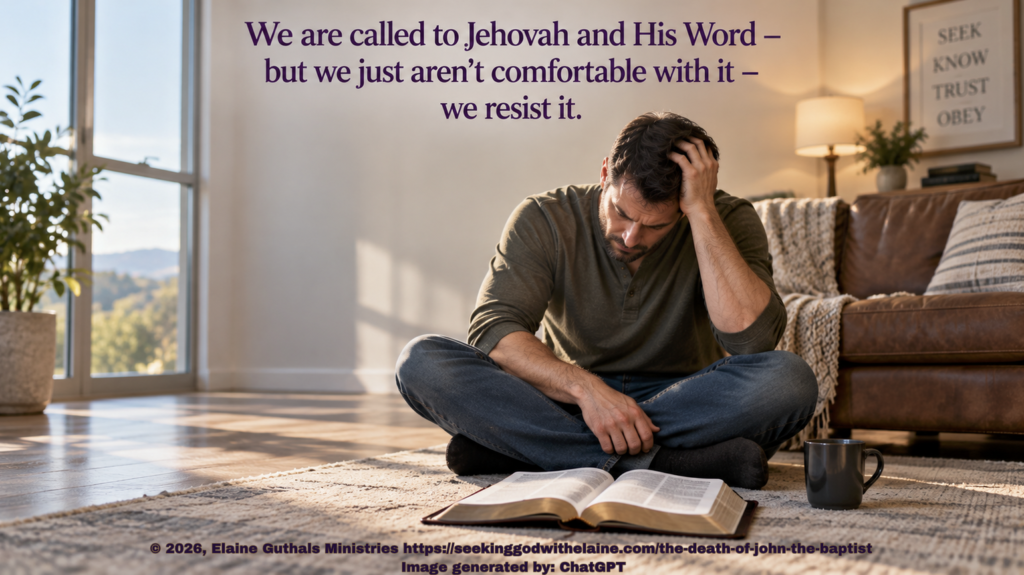
What was Herod going to do with a man he knew was right but didn’t want him to be right?
Herod’s Birthday Party
“But at a birthday party for Herod, Herodias’s daughter performed a dance that greatly pleased him, so he promised with a vow to give her anything she wanted. At her mother’s urging, the girl said, ‘I want the head of John the Baptist on a tray!’ Then the king regretted what he had said; but because of the vow he had made in front of his guests, he issued the necessary orders. So John was beheaded in the prison, and his head was brought on a tray and given to the girl, who took it to her mother. Later, John’s disciples came for his body and buried it. Then they went and told Jesus what had happened” (Mt. 14: 6-12 NLT)
“Herodias’s chance finally came on Herod’s birthday. He gave a party for his high government officials, army officers, and the leading citizens of Galilee. Then his daughter, also named Herodias, came in and performed a dance that greatly pleased Herod and his guests. ‘Ask me for anything you like,’ the king said to the girl, ‘and I will give it to you.’ He even vowed, ‘I will give you whatever you ask, up to half my kingdom!’ She went out and asked her mother, ‘What should I ask for?’ Her mother told her, ‘Ask for the head of John the Baptist!’ So the girl hurried back to the king and told him, “I want the head of John the Baptist, right now, on a tray!” Then the king deeply regretted what he had said; but because of the vows he had made in front of his guests, he couldn’t refuse her. So he immediately sent an executioner to the prison to cut off John’s head and bring it to him. The soldier beheaded John in the prison, brought his head on a tray, and gave it to the girl, who took it to her mother. When John’s disciples heard what had happened, they came to get his body and buried it in a tomb” (Mk. 6: 21-29 NLT)
Salome Danced
Herodias took matters into her own hands.
Herodias must have gotten tired of Herod protecting John. I’m sure she felt it an affront to her that John was saying Herod and Herodias’ marriage was wrong.
The perfect opportunity presented itself at Herod’s birthday party. But she had to enlist help.
That help came from Salome, Herodias’ daughter. This same Salome was the wife of Philip the Tetrarch – but probably not at this precise moment.
The Greek word is korasion (κοράσιον), which means young girl or young woman. What we do know is that she was old enough to participate in the banquet.
Salome danced for Herod. We are told nothing of this dance, but many jump to the conclusion that it was erotic, provocative, or seductive.
Maybe. Maybe not. By this time, sexually provocative dances by professional dancers – the role which Salome took for this party – were frowned on in some Jewish circles.
I can see two holes in that. Some circles do not mean all circles. Herod was Jewish, but it doesn’t sound like he was a practicing Jew.
But the thought that Salome danced a provocative dance in order to get Herod to reward her kind of falls apart.
If Herodias enlisted Salome to dance to secure a reward, wouldn’t she have told her what to ask for when she asked her to dance? But she didn’t. Salome had to go back to Herodias and ask what the reward should be.
That says nothing as to why a wife would have her daughter dance a sexual dance for her husband.
Promised with a Vow
The vow was important because of the audience.
Herod obviously liked the dance. He said that Salome could ask for a reward that was up to half of his kingdom.
Just stop right there. No, nowhere do the Gospels say it was a seductive dance. What else could it be to get this type of reward?
What would make Herod willingly give up half his kingdom? It wasn’t because Herod was thinking of retiring and divesting himself of land. Besides, would he really give the rule to a young woman?
But that is what Herod stipulated. The reward could be up to half his kingdom.
Whatever triggered Herod’s response was something significant. He wouldn’t have made this offer to just any professional dancer. There had to be something in his stepdaughter’s dance that struck a chord.
Was Herod so sure that Salome wouldn’t take his kingdom? Was he thinking jewels or money?
Herod obviously didn’t expect the answer he got from Salome. But he couldn’t back out of it. He couldn’t lose face in front of all the dignitaries that were in attendance.
This wasn’t just a family birthday party. The birthday of the king would have been a political and social affair. His advisors would be there. The ruling elite were present. Wealthy citizens from the area would have been there.
Herod couldn’t say, “I know what I promised you, but this request isn’t acceptable.” He had laid no parameters around the reward – except it couldn’t be more than half his kingdom.
His Head Was Brought on a Tray
Once the reward was established, Herod had to follow through.
We aren’t sure how long John was imprisoned in Herod’s fortified palace. However long it was, it wouldn’t have been comfortable for him.
Herod followed through on his vow. He rewarded Salome for her dance by killing John the Baptist.
We think it was gory bringing John’s head to Salome on a silver platter. There was no mistaking that John was dead.
Herodias was given visible proof.
Making the Connections #1
We could say that Herod made a foolish promise. He opened the door wide open for any reward.
Herod had to have known Herodias’ feelings against John. He had to know the pull she had over Salome.
Look at the progression.
- Herod was afraid of John because he spoke God’s truth.
- Herod protected John because of John’s righteousness.
- Herod was affected by John’s words, so he listened to him.
- Herod put more store in his social standing and being seen as a decisive ruler than he feared disobeying Jehovah.
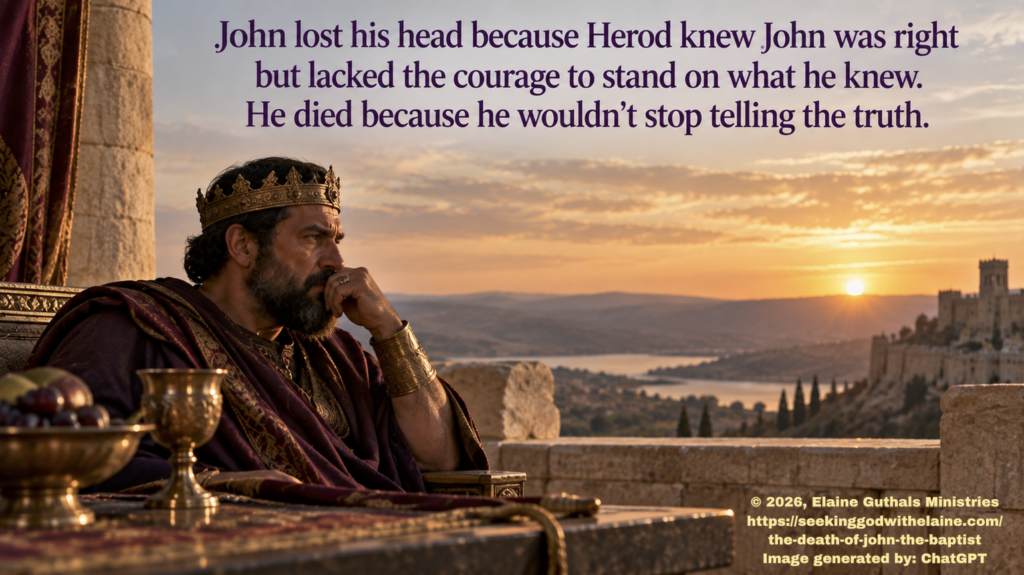
John lost his head because Herod knew John was right but lacked the courage to stand on what he knew. He died because he wouldn’t stop telling the truth.
Making the Connections #2
We talked about Herod having a conscience. We can’t mistake the Holy Spirit for our conscience. Everyone has one.
Not everyone has the Holy Spirit living inside them.
Atterbury helped us understand the difference. He wrote “That the reprehensions of conscience are not a continued, but intermitting, disease.”
Resource
In other words, sometimes we may be affected by our consciences. Sometimes, we may not be.
If we are not being led by the Holy Spirit, our human consciences may sometimes be influenced by our outward actions.
Heart Check
Think about the battle Yeshua is engaged in for your heart. Ask yourself the following questions.
- Do I accept something Jehovah has already shown me through His Word that I know is true, or am I resisting it?
- Am I listening to and applying Jehovah’s Word, or an I refusing to let it change me?
- Do I care more about what other people think of me, or do I care more about obeying Jehovah?
- Am I protecting my reputation, my relationships, my comfort, or my position, or am I standing on what I know Jehovah has said?
- If I know what is right, what is keeping me from doing what is right?
How Do We Apply This?
- Listen even more carefully when Jehovah’s Word makes us uncomfortable.
- Don’t confuse knowing with obeying.
- Don’t let other people determine our obedience.
- Stand on truth before the pressure comes.
- Remember that truth doesn’t become less true because it makes us uncomfortable.
Father God. Thank You that You allow us to work for Your kingdom. Help us to see when You are calling us to move on. May we be faithful and obedient to You until You call us home. Amen.
If you don’t understand something and would like further clarification, please contact me.
If you have not signed up for the email providing the link to the devotions and the newsletter, do so below.
If God has used this devotion to speak with you, consider sharing it on social media.