John’s ministry was to prepare the way for the Messiah. He did this by baptizing those who repented and returned to covenant faithfulness. This devotion looks at what happened when the Messiah showed up for baptism.
Nuggets
- The day for the event we are studying in this devotion was when John was being questioned by Pharisees.
- By calling Yeshua the Lamb of God, John was pointing toward His eventual sacrifice.
- Unlike the Paschal Lamb, the sacrifice of the Lamb of God did something about sin.
- John verified that what he had told them the day before was true because the One he spoke of was there.
- Jesus’ baptism occurred at the beginning of His ministry.
- John couldn’t see the need to baptize Yeshua because it was a baptism of repentance.
- Yeshua set the example because baptism is required – but required for what?
- The Plan of Salvation was designed to reestablish our access to Jehovah.
- The Voice was present to show that Jehovah was the One doing the sending, and the dove was present to identify the work of the Holy Spirit.
- The Jews would have known Israel as Jehovah’s son.
- John’s account of the baptism was a little different from the other Gospels because it was a testimony, not a first-hand description of the event.
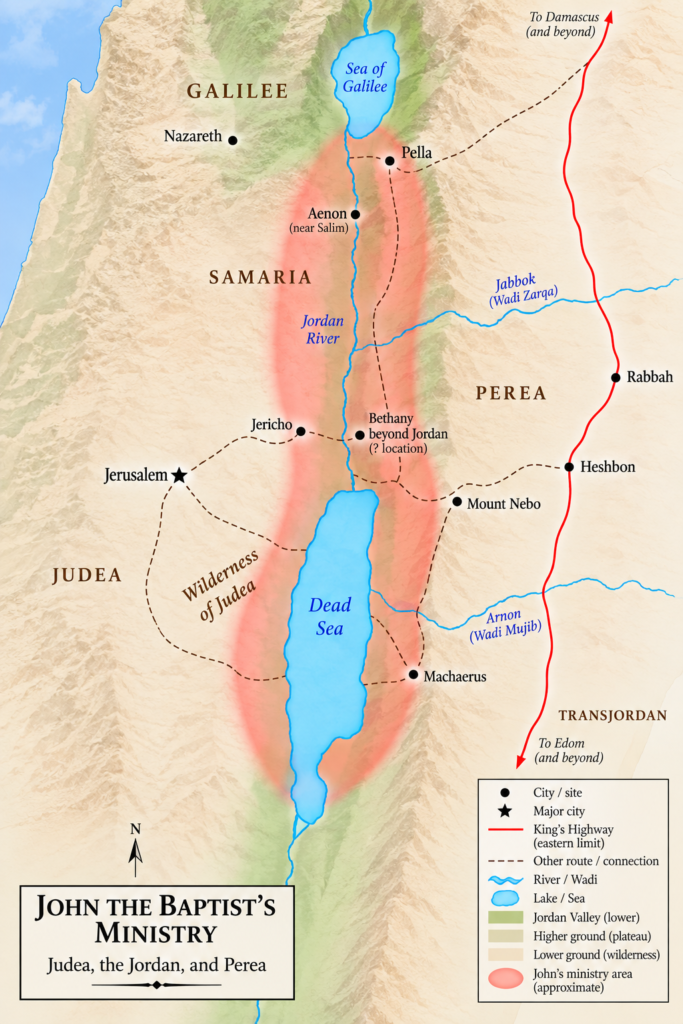
John’s ministry of preparing Israel for the coming of the Messiah occurred along the Jordan River. He used the river when baptizing those who repented and returned to covenant obedience.
Imagine John’s surprise when the Messiah came to him for baptism.
Let's Put It into Context #1
To read devotions in The Battle for the Heart theme
Devotions in the The Ministry of John the Baptist series
Let's Put It into Context #2
Some denominations believe that we must be baptized in order to be saved. Others believe it is among the first acts of obedience of a new believer – important but not essential for salvation.
In first-century Israel, it was not seen as a requirement to become a Jew. People who were not Jewish by birth became Jewish another way.
Strugnell helped us understand the meaning of baptism in first-century Israel. He wrote,
“It was a rite (immersion in running water) that symbolized repentance in preparation for the coming world judgment and was to be accompanied, before and afterward, by a righteous life. It was hardly conceived as a sacrament, in the Christian sense, conveying forgiveness, or as superseding Judaism and marking off a new people, including both Jews and Gentiles, prepared for God’s final kingdom.”
Resource
First-century Jews would have seen it as an act of covenant faithfulness.
John Introduced Jesus
“John testified about him when he shouted to the crowds, ‘This is the one I was talking about when I said, “Someone is coming after me who is far greater than I am, for he existed long before me”’” (Jn. 1: 15 NLT).
“The next day John saw Jesus coming toward him and said, ‘Look! The Lamb of God who takes away the sin of the world! He is the one I was talking about when I said, ‘A man is coming after me who is far greater than I am, for he existed long before me” (Jn. 1: 29-30 NLT)
The Next Day
The day for the event we are studying in this devotion was when John was being questioned by Pharisees.
“John told them, ‘I baptize with water, but right here in the crowd is someone you do not recognize. Though his ministry follows mine, I’m not even worthy to be his slave and untie the straps of his sandal’” (Jn. 1: 26-27 NLT).
We can assume that John hadn’t known that Yeshua would show up for baptism the next day. If he had, he probably would have said something to the effect, “Someone is coming after me – and He is coming tomorrow.”
But John didn’t say that.
That leads us to believe that John knew his mission. He just didn’t know the timing of the plan.
The Lamb of God
By calling Yeshua the Lamb of God, John was pointing toward His eventual sacrifice.
The Complete Jewish Study Bible explained the significance of Lamb of God. It says, “When Yochanan the Immerser speaks of Yeshua as the ‘Lamb of God’ (John 1: 29), he is invoking both the Temple and Pesach [Passover] imagery.”
Resource
The Greek word used was amnos (ἀμνός) — lamb, particularly in sacrificial contexts. This was crucial to the sacrificial system Jehovah had instituted.
The Temple was built around the sacrificial system. It communicated concepts of sin, guilt, holiness, substitution, cleansing, and approaching Jehovah.
John was very specific about the Lamb. He didn’t say ,kk lamb. He said the Lamb.
What is the distinction? Many times, when first-century Jews offered a sacrifice, they provided a lamb.
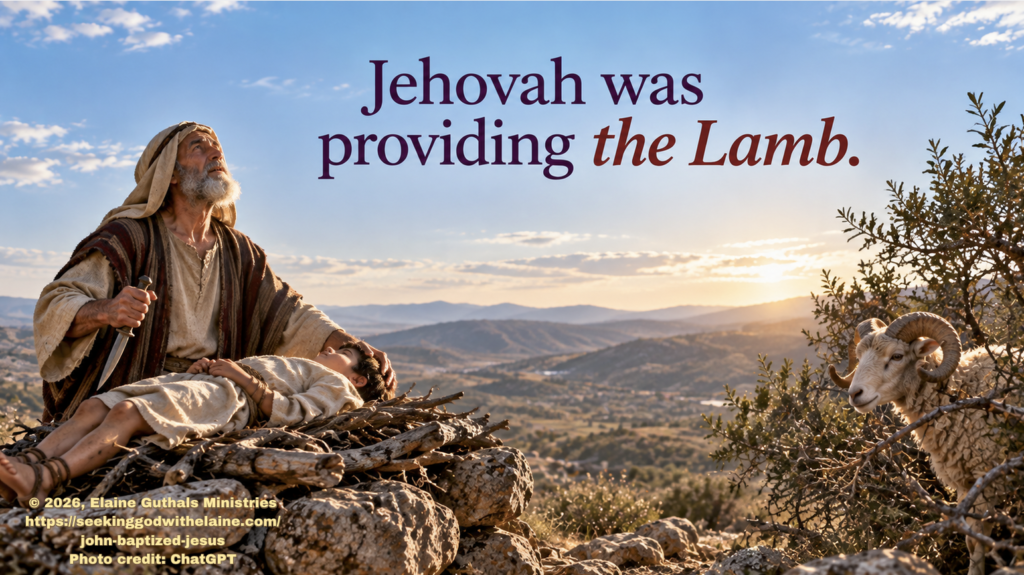
That wasn’t happening here. Jehovah was providing the Lamb.
Jehovah had done that before. When He tested Abraham by telling him to sacrifice his son Isaac, He provided the lamb when Abraham had passed the test (Gen. 22: 12-14).
Jehovah was doing the same thing here – providing the Lamb for sacrifice.
The Passover lamb was a special lamb, called the Paschal Lamb. It represented deliverance. Its blood was associated with protection from judgment
The Paschal Lamb was to be without defect, according to Exodus 12.
Who Takes Away the Sin of the World!
Unlike the Paschal Lamb, the sacrifice of the Lamb of God did something about sin.
The Greek word used was airō (αἴρω) — to take up, remove, or carry away. The sacrificial lamb was to provide a way for them to deal with sin and restore the covenant relationship.
By calling Yeshua the Lamb of God, John was putting Yeshua smack-dab in the middle of the sacrificial framework.
He Is the One
John verified that what he had told them the day before was true because the One he spoke of was there.
There are times when we have to wait for Jehovah’s promises to come true. That day wasn’t one of those times.
John told his listeners that the Messiah was coming soon. The next day was soon.
John Baptized Jesus
“Then Jesus went from Galilee to the Jordan River to be baptized by John. But John tried to talk him out of it. ‘I am the one who needs to be baptized by you,’ he said, ‘so why are you coming to me?’ But Jesus said, ‘It should be done, for we must carry out all that God requires.’ So John agreed to baptize him. After his baptism, as Jesus came up out of the water, the heavens were opened and he saw the Spirit of God descending like a dove and settling on him. And a voice from heaven said, ‘This is my dearly loved Son, who brings me great joy’” (Mt. 3: 13-17 NLT)
“One day Jesus came from Nazareth in Galilee, and John baptized him in the Jordan River. As Jesus came up out of the water, he saw the heavens splitting apart and the Holy Spirit descending on him like a dove. And a voice from heaven said, “You are my dearly loved Son, and you bring me great joy” (Mk. 1: 9-11 NLT)
“One day when the crowds were being baptized, Jesus himself was baptized. As he was praying, the heavens opened, and the Holy Spirit, in bodily form, descended on him like a dove. And a voice from heaven said, ‘You are my dearly loved Son, and you bring me great joy’” (Lk. 3: 21-22 NLT)
Went from Nazareth in Galilee to the Jordan River
Jesus’ baptism occurred at the beginning of His ministry.
Mark was a little more specific in his details than Matthew was. He gave us more information as to where Yeshua had been and where he was going
- “Then Jesus went from Galilee to the Jordan River …” (Mt. 3: 13 NLT).
- “One day Jesus came from Nazareth in Galilee … baptized in the Jordan River” (Mk. 1: 10 NLT).
Why is it important to know specifics? Sometimes, it helps put things into context.
“When Jesus heard that John had been arrested, he left Judea and returned to Galilee. He went first to Nazareth, then left there and moved to Capernaum, beside the Sea of Galilee, in the region of Zebulun and Naphtali” (Mt. 4: 12-13 NLT).
We know that the baptism was before the temptation (Mt. 4: 1-11). We also know that it was before Yeshua moved His base of operations to Capernaum.
Why is that important? It reads that the first thing Yeshua did before anything else was to be obedient in baptism.
John Tried to Talk Him Out of It
John couldn’t see the need to baptize Yeshua because it was a baptism of repentance.
Matthew told us that John pushed back against the need of his baptizing Yeshua. He could not see where Someone Who hadn’t sinned needed the baptism of repentance.
Well, John wasn’t wrong. Yeshua hadn’t sinned.
But remember, John wasn’t offering a baptism tied to salvation. He was baptizing people to restore covenant faithfulness.
That is two different things.
But Yeshua said it emphasized the need to fulfill all righteousness.
Think about it. Yes, Yeshua came to fulfill covenant promises – but that wasn’t all.
Yeshua came to be the sacrifice for our sins. He paid the penalty for what happened in the Garden of Eden on down.
Yeshua didn’t sin, but He took on the capacity to sin when He took human form. If He hadn’t, His sacrifice would have meant nothing.
John saw Yeshua as the spotless Lamb of God. To him, that meant no baptism was necessary.
To Yeshua, He was setting the example.
What God Requires
Yeshua set the example because baptism is required – but required for what?
Yeshua told John that baptism is required by Jehovah. But what did He mean?
This was a way in which Yeshua identified with those He came to save. This was another way in which prophecy was fulfilled.
“He was counted among the rebels. He bore the sins of many and interceded for rebels” (Isa. 53: 12 NLT).
We’ve already talked about how Yeshua came in obedience. Yeshua didn’t come down here with a plan of His own.
The plan being worked was the Plan of Salvation. It was designed totally by Jehovah. He figured out a way to reconcile us to Himself.
Yeshua agreed to implement the plan.
But look at it this way. John’s mission was to prepare the way by calling Israel back to obedience to Jehovah.
Yeshua deliberately submitted to John’s baptism because John was carrying out his assignment from Jehovah.
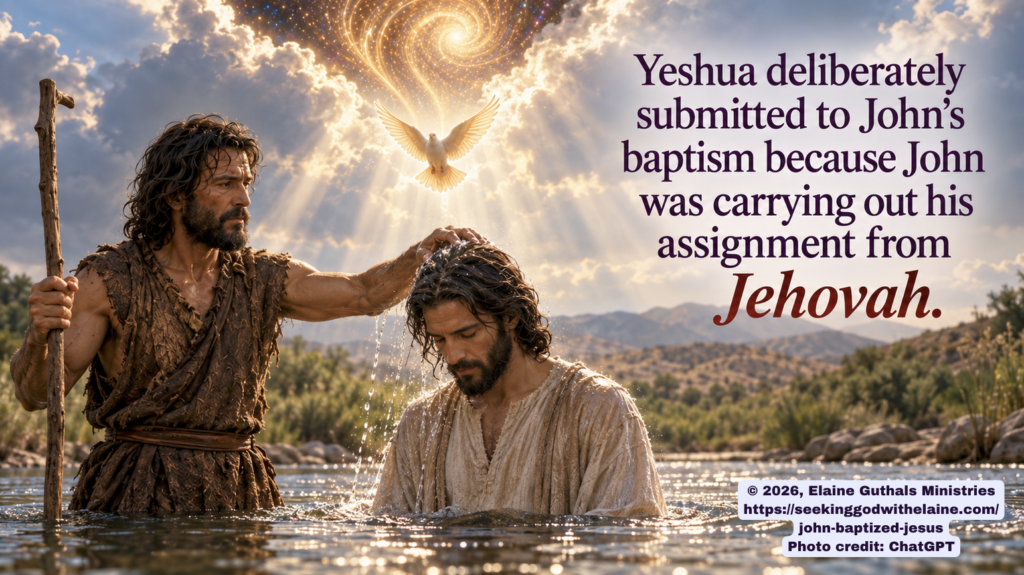
Nowhere else in Scripture are we told that John and Yeshua got together for anything. There was no family get-together – remember they were cousins. They didn’t strike out together for Yeshua to preach and John to baptize.
This was the one time that their ministries collided. Yeshua wasn’t going to bypass Jehovah’s appointed way at the beginning of His ministry.
Besides, remember what John got to say? “Here is the Guy I was talking about yesterday.”
Up until this time, there had been no public announcement of Who Yeshua was. Now, He was identified by the man most if not all knew was on a mission from Jehovah.
But isn’t it more than that? Yeshua said so Himself.
“Don’t misunderstand why I have come. I did not come to abolish the law of Moses or the writings of the prophets. No, I came to accomplish their purpose:” (Mt. 5: 17 NLT).
Yeshua wasn’t saying it was about the act. He was saying it was about the submission.
Isn’t that true? It isn’t about us doing the do’s and not doing the don’ts. It is about our relationship with Jehovah – which is characterized by our submission to Him.
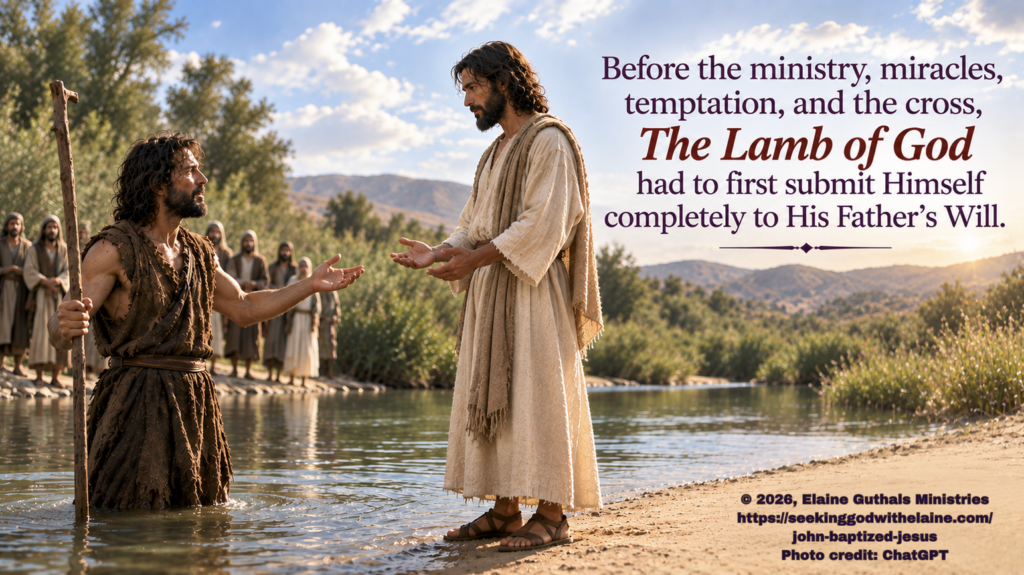
Before the ministry, miracles, temptation, and the cross, The Lamb of God had to first submit Himself completely to His Father’s Will.
Heavens Splitting Apart
The Plan of Salvation was designed to reestablish our access with Jehovah.
Matthew and Luke said that the heavens opened. The Greek word used was the verb is related to anoigō (ἀνοίγω) – to open, to unlock, or to make accessible.
Yeshua’s mission was exactly that – to make Jehovah accessible again to His children. It also allowed those who were not yet His children an opportunity to become so.
Mark gave more of a violent description — “… he saw the heavens splitting apart …” (Mk. 1: 10 NLT). At a minimum, it sounds dramatic.
The Greek word here was schizō (σχίζω). It means to split, tear, or rend apart.
But The Complete Jewish Study Bible said it was just that. The being torn apart harkend back to the creation of the universe.
Resource
The Hebrew thought behind this was baqaʿ (בָּקַע) – to split, cleave, break open, or tear apart. It is simply more than the opening of something.
Baqaʿ paints the imagery that something that was closed or separated was forcefully broken open.
What first jumped into my mind was the splitting of the veil. “Then Jesus shouted out again, and he released his spirit. At that moment the curtain in the sanctuary of the Temple was torn in two, from top to bottom. The earth shook, rocks split apart, and tombs opened. The bodies of many godly men and women who had died were raised from the dead” (Mt. 27: 50-52 NLT).
Put all that together. At the beginning of Yeshua’s ministry, Jehovah opened up the opportunity for people to come to believe in Yeshua. It was only at the end of His ministry – when the Lamb had been sacrificed – that the then-current sacrificial system was no longer needed because the Lamb had been sacrificed.
Jehovah was answering Israel’s prayer. “Oh, that you would burst from the heavens and come down! How the mountains would quake in your presence!” (Isa. 64: 1 NLT).
More importantly, Jehovah was opening up something that had been closed since the Garden of Eden. He was finally allowing access again to Himself.
Voice and a Dove
The Voice was present to show that Jehovah was the One doing the sending, and the dove was present to identify the work of the Holy Spirit.
A Voice was heard, and a dove descended, meaning all Three of the Trinity were present.
Matthew presents the words of the voice in the third person. Mark and Luke use the second person. Was it a public declaration or a direct address?
But it was more than that.
The Voice from Heaven would have been considered by first-century Jews as divine testimony. Jehovah Himself was weighing in on Who this Person was.
They would have seen the dove as anointing imagery.
Think about it. Yeshua submits Himself to Jehovah’s Will, and Jehovah immediately responds.
And the message was very important.
This Is My Son
The Jews would have known Israel as Jehovah’s son.
“The king proclaims the Lord’s decree: ‘The Lord said to me, “You are my son. Today I have become your Father”’” (Ps. 2: 7 NLT).
The Israelites were His children. But they missed verse 6. “For the Lord declares, ‘I have placed my chosen king on the throne in Jerusalem, on my holy mountain’” (Ps. 2: 6 NLT).
They thought this referred to David. In reality, it also referred to David’s Descendant. This was one of the Messianic expectation verses.
Jehovah made a specific proclamation here – and He was doing it in covenant language.
In Matthew, Jehovah introduced Yeshua to Israel. In Mark and Luke, He spoke directly to Him.
In Whom I Delight
The Complete Jewish Bible has the wording a little different. “then a voice came from heaven, ‘You are my Son, whom I love; I am well pleased with you’” (Mk. 1: 11 CJB).
This is closer to the Hebrew, in my opinion. This reminds us of what Jehovah said to Abraham. “Take your son, your only son — yes, Isaac, whom you love so much …” (Gen. 22: 2 NLT).
Your son, your only son, whom you love. My Son, whom I love, with Whom I am pleased.
“Look at my servant, whom I strengthen. He is my chosen one, who pleases me. I have put my Spirit upon him. He will bring justice to the nations” (Isa. 42: 1 NLT).
The Holy Spirit came down in the form of a dove and landed upon Him. He was empowering Yeshua for His mission.
John Recognized Jesus
“‘I did not recognize him as the Messiah, but I have been baptizing with water so that he might be revealed to Israel.’ Then John testified, ‘I saw the Holy Spirit descending like a dove from heaven and resting upon him. I didn’t know he was the one, but when God sent me to baptize with water, he told me, “The one on whom you see the Spirit descend and rest is the one who will baptize with the Holy Spirit.” I saw this happen to Jesus, so I testify that he is the Chosen One of God’” (Jn. 1: 31-34 NLT)
John’s account of the baptism was a little different from the other Gospels because it was a testimony, not a first-hand description of the event.
Okay. These guys were cousins. Both moms knew from before conception who they would turn out to be.
Elizabeth didn’t say anything to John?????? Did Yeshua know?
John was looking to Jehovah to give him a sign. Ooo baby, did He ever!
Remember, the dove settled on Yeshua. It didn’t just touch down and fly away.
It came to roost on Him.
“And the Spirit of the Lord will rest on him — the Spirit of wisdom and understanding, the Spirit of counsel and might, the Spirit of knowledge and the fear of the Lord” (Isa. 11: 2 NLT).
Even if Mary and Elizabeth had told John what was what, he still needed to hear it from Jehovah. Jehovah had to call him personally to the ministry.
John could have said, “Sorry. Don’t like the wilderness. Allergic to locust. Who would be caught dead in camel hair?”
John was human – he could have come up with any number of excuses. He didn’t.
Making the Connections
We see Jehovah, Yeshua, and the Holy Spirit working together. Jehovah speaks. The Spirit descends. Yeshua stands.
Jehovah created the Plan of Salvation. Yeshua implemented it and carried it out. The Holy Spirit works within us to convict us to accept the gift of salvation.
Heart Check
Think about the battle Yeshua is engaged in for your heart. Ask yourself the following questions.
- Am I willing to submit to Jehovah even when I don’t fully understand what He is doing?
- Do I sometimes focus more on doing the right things than on having a heart that is submitted to Jehovah?
- When Jehovah asks me to do something, do I look for reasons why I shouldn’t—or do I trust Him enough to obey?
- Am I willing to follow Jehovah’s appointed way, even when it isn’t the way I would have chosen?
- What is Jehovah asking me to surrender to Him right now?
How Do We Apply This?
- Submit before we understand.
- Don’t confuse obedience with relationship.
- Respect the assignment Jehovah has given others.
- Remember that obedience may be preparation for what comes next.
- Look for Jehovah’s work in the obedience.
Father God. Above all, You ask us to be obedient to You and submit ourselves to Your Will. Give us clarity so that we may do that. Amen.
If you don’t understand something and would like further clarification, please contact me.
If you have not signed up for the email providing the link to the devotions and the newsletter, do so below.
If God has used this devotion to speak with you, consider sharing it on social media.