In the last devotion, we discussed the atmosphere of first-century Israel. This devotional reading looks at the expectations they had for a Messiah.
Nuggets
- Many first-century Jews were looking for Mashiach (מָשִׁיחַ) – the Anointed One.
- Jehovah promised One Who would defeat the oppressors and deliver His people.
- Restoration theology dominated Jewish Messianic expectation.
- Overall, first-century Jews were looking for the establishment of Jehovah’s reign by the Messiah, including His dwelling among His people again.

We tend to look at the Gospels from the end view. We know the stories – some have heard them many times – and we know how it ends.
First-century Jews didn’t. They were waiting for the Messiah.
They didn’t know Messiah’s name, face, or even how Jehovah would fulfill His promises – they just knew that He would.
In the last devotion, we talked about the oppressors that had occupied Irael from around 198 BC until they won their independence in 142 BC. Rome captured Jerusalem in 63 BC.
Many first-century Jews considered themselves still in exile because, though they worshiped in a rebuilt Temple and lived in their ancestral land, they remained subject to Gentile authority.
So, what did Israel expect in a Messiah?
Let's Put It into Context
To read devotions in The Battle for the Heart theme
Devotions in the The Ministry of John the Baptist series
“Rejoice, O people of Zion! Shout in triumph, O people of Jerusalem! Look, your king is coming to you. He is righteous and victorious, yet he is humble, riding on a donkey — riding on a donkey’s colt. I will remove the battle chariots from Israel and the warhorses from Jerusalem. I will destroy all the weapons used in battle, and your king will bring peace to the nations. His realm will stretch from sea to sea and from the Euphrates River to the ends of the earth” (Zech. 9: 9-10 NLT).
Many first-century Jews were looking for Mashiach (מָשִׁיחַ) – the Anointed One.
While some spiritual teachers could be anointed first-century Israel was looking for David’s descendant to take over the physical throne. He was to become their earthly leader.
They wanted their national identity back. They were so done with foreign occupation and foreign domination. Many of those oppressors tried to get them to give up that which made them Jewish.
That is why they were looking for the Son of David. We’ve talked a little about this.
- ·Gabriel told Mary that her Son would inherit David’s throne. “… The Lord God will give him the throne of his ancestor David. And he will reign over Israel forever; his Kingdom will never end!” (Lk. 1: 32-33 NLT).
- The angel in Joseph’s dream call him, “… Joseph, son of David …” (Mt. 1: 20 NLT).
This wasn’t something the Jews had come up with. These were expectations based on Scripture known to many. The Davidic covenant transformed David’s royal line into a Messianic hope.
- “All kings will bow before him, and all nations will serve him” (Ps. 72: 11 NLT).
- “… And my servant David will be their prince forever. And I will make a covenant of peace with them, an everlasting covenant. I will give them their land and increase their numbers, and I will put my Temple among them forever” (Ezek. 37: 25-26 NLT).
- “Jesus was in the center of the procession, and the people all around him were shouting, ‘Praise God for the Son of David! Blessings on the one who comes in the name of the Lord! Praise God in highest heaven!’” (Mt. 21: 9 NLT).
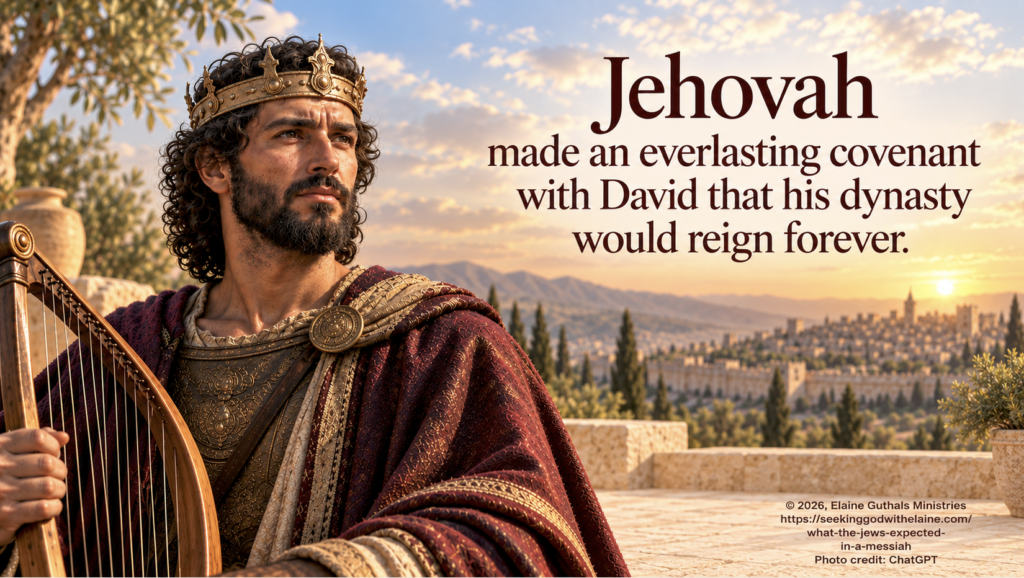
Jehovah made an everlasting covenant with David that his dynasty would reign forever.
Israel Expected a Deliver
“For to us a child is born, to us a son is given; and the government shall be upon his shoulder, and his name shall be called Wonderful Counselor, Mighty God, Everlasting Father, Prince of Peace” (Isa. 9: 6 NLT)
Jehovah promised One Who would defeat the oppressors and deliver His people.
Go back to Israel being under foreign domination. They wanted the Messiah to deliver them from their oppressors.
Think about it. If we had been under 100 years of foreign domination, we would want the same thing. We would want our freedom to worship as Jehovah had commanded.
Remember, the Seleucids especially promoted Hellenization, pressuring Israel to abandon its traditional Jewish practices. This would have gone against the Jewish expectation many had that they had to return to Jehovah before the Messiah would come.
Israel had long been rescued from their oppressors by a strong leader. Moses delivered the Hebrews from Egyptian oppression. Joshua led them on the conquest of the Promised Land.
David was a strong protector of the nation. It was the son of this mighty warrior that they were looking to deliver them from Roman occupation.
Of course, many thought this deliverance will be accompanied by the judgment of their oppressors. They would have loved to see Jehovah show them His superiority – especially if there were payback included for their treatment of the Jews.
Israel Expected a Restorer
“‘The day is coming,’ says the Lord, ‘when I will make a new covenant with the people of Israel and Judah. This covenant will not be like the one I made with their ancestors when I took them by the hand and brought them out of the land of Egypt. They broke that covenant, though I loved them as a husband loves his wife,’ says the Lord. ‘But this is the new covenant I will make with the people of Israel after those days,’ says the Lord. ‘I will put my instructions deep within them, and I will write them on their hearts. I will be their God, and they will be my people. And they will not need to teach their neighbors, nor will they need to teach their relatives, saying, “You should know the Lord.” For everyone, from the least to the greatest, will know me already,’ says the Lord. ‘And I will forgive their wickedness, and I will never again remember their sins’” (Jer. 31: 31-34 NLT)
Restoration theology dominated Jewish Messianic expectation.
The people are restored to the covenant relationship and blessings Jehovah promised. When first-century Jews thought of redemption, they thought Ga’al (גָּאַל). This meant to redeem, to reclaim, or to act as a kinsmen-redeemer.
It was more than restoration of the land. They were looking for purification of the people and renewed covenant faithfulness to Jehovah.
First-century Jews were looking for the covenant to be restored. Jehovah had made covenant promises to Israel, and they were waiting for Messiah to bring those promises to their promised fulfillment….

They were looking for the rebuilding of Jerusalem, which first necessitated the defeat of hostile nations. Again, they were looking for the restoration of the Davidic kingship.
Included in restoring the Davidic kingship was bringing home the Lost Tribes – the ones that had either stayed in Babylon or had scattered elsewhere. They wanted a complete rebuilding of the Northern and Southern Kingdom.
Again, the first-century Jews were looking for the restoration of their Davidic king and national identity. Upon defeating the foreign powers, they looked for worldwide acknowledgment of Jehovah.
This theology was tied to the belief that exile never ended. They were back in their land, but they were still under foreign – Gentile – rule.
To many, something was still missing. The restoration promised by the prophets had not yet arrived in its fullness.
First-century Jews were looking for the complete restoration promised.
Israel Expected God’s Kingdom
“And I will make a covenant of peace with them, an everlasting covenant. I will give them their land and increase their numbers, and I will put my Temple among them forever. I will make my home among them. I will be their God, and they will be my people. And when my Temple is among them forever, the nations will know that I am the Lord, who makes Israel holy” (Ezek. 37: 27-28 NLT)
Overall, first-century Jews were looking for the establishment of Jehovah’s reign by the Messiah, including His dwelling among His people again.
They didn’t think of this as, “Hey, we’re going to go to Heaven.” It was definitely more than a warm, fuzzy feeling.
To them, they wanted Jehovah’s presence to be as His glory was in the Temple.
“When Solomon had finished praying, fire came down from heaven and consumed the burnt offering and the sacrifices; and the glory of the Lord filled the temple. And the priests could not enter the house of the Lord, because the glory of the Lord had filled the Lord’s house” (II Chron. 7: 1-2 NLT).
Jehovah had been living among His people from the beginning. He met face to face with Adam and Eve. His presence filled the Tabernacle. Later it field the Temple.
Before the Babylonian exile, that presence left the Temple. While they had the Second Temple, Jehovah’s presence hadn’t returned.
The first-century Jews were eagerly awaiting the return of Jehovah’s presence to live among them.
The Jews thought of Jehovah’s kingdom in very concrete concepts. They expected restoration of Israel, vindication of covenant promises, defeat of oppressors, and visible rule under Jehovah’s appointed king.
First-century Jews had increased hopes of the Messiah coming.
Making the Connections #1
The first-century Jews were waiting for Jehovah to deal with someone who has wronged us can contain both faith in His justice and very human desires about what that justice ought to look like.
This is what they were expecting. And honestly, given what they had experienced, you can understand why.
One thing we can’t expect, though, is for Jehovah to right every wrong that has been done to us. I don’t think that is in His plan.
Jehovah will judge the person who has wronged us by how that wronged Him – not us.
Making the Connections #2
If we look back at the four sections, they are related. There is some overlap between sections.
- Jehovah would send His anointed King.
- His King would deliver His people.
- His King would restore what had been broken.
- Through His King, Jehovah’s righteous reign would be established.
No, things didn’t happen exactly the way the first-century Jews expected it to happen. But that is okay.
It isn’t going to happen the way we expect it to, either. No one is going to get everything right.
Even people who sincerely believe God’s promises and understand much of Scripture correctly can still misunderstand how Jehovah will fulfill those promises.
Heart Check
Think about the battle Yeshua is engaged in for your heart. Ask yourself the following questions.
- Have I decided what Jehovah must do before I am willing to recognize what He is doing?
- When someone has wronged me, am I trusting Jehovah with justice — or am I telling Him what I think justice should look like?
- Do I trust Jehovah enough to believe that His fulfillment of a promise may look different from what I expected?
- Am I willing to let Jehovah fulfill His promises His way and in His timing?
How Do We Apply This?
- Trust Jehovah with what you cannot see yet.
- Don’t confuse your expectation with Jehovah’s promise.
- Give your hurts to Jehovah.
- Stay open to Jehovah’s way.
- Remember that understanding can grow.
Father God. You told us that You would send a Messiah to redeem us. You did – even when their expectations didn’t turn out as they thought. Lord, Yeshua is coming again. Help us to expect Him and show us how and when we are to watch. Amen.
If you don’t understand something and would like further clarification, please contact me.
If you have not signed up for the email providing the link to the devotions and the newsletter, do so below.
If God has used this devotion to speak with you, consider sharing it on social media.