In anticipation of Yeshua’s ministry, John was called to prepare the way for Him. This devotional reading looks at the world in which John began his ministry.
Nuggets
- Luke used the timestamp of the ministry of John the Immerser beginning during the fifteenth year of Tiberius as Roman emperor, around AD 28-29.
- Tiberius was the second Roman Emperor, who was born in 42 BC.
- Pontius Pilate was the prefect of Judea under Rome from approximately AD 26 to AD 36.
Herod Antipas was the son of Herod the Great. - Philip the Tetrarch was the son of Herod the Great and the brother of Herod Antipas.
- Annas was the Jewish High Priest from around AD 6 to AD 15.
- Caiaphas served as High Priest from around AD 18 to AD 36.
John’s diet was based on what he found in the wilderness. - We don’t know how the message came to John – we just know it did.
Yeshua was now among Jehovah’s people, but it wasn’t time for Him to start His ministry. Someone else had to come first.
That someone was John the Immerser.
John the Immerser was born six months before Yeshua in the hill country (har Yehudah – הַר יְהוּדָה), possibly in Ein Kerem for Juttah, near Jerusalem. His birth was foretold to his father by an angel (Lk. 1: 11). It was a miracle because Zechariah, a Levitical priest of the order of Abijah, and Elizabeth were both elderly, and Elizabeth was barren.
Elizabeth was a relative of Mary, the mother of Yeshua. While we aren’t sure how they were related, many think they were sisters. This made Yeshua and John cousins.
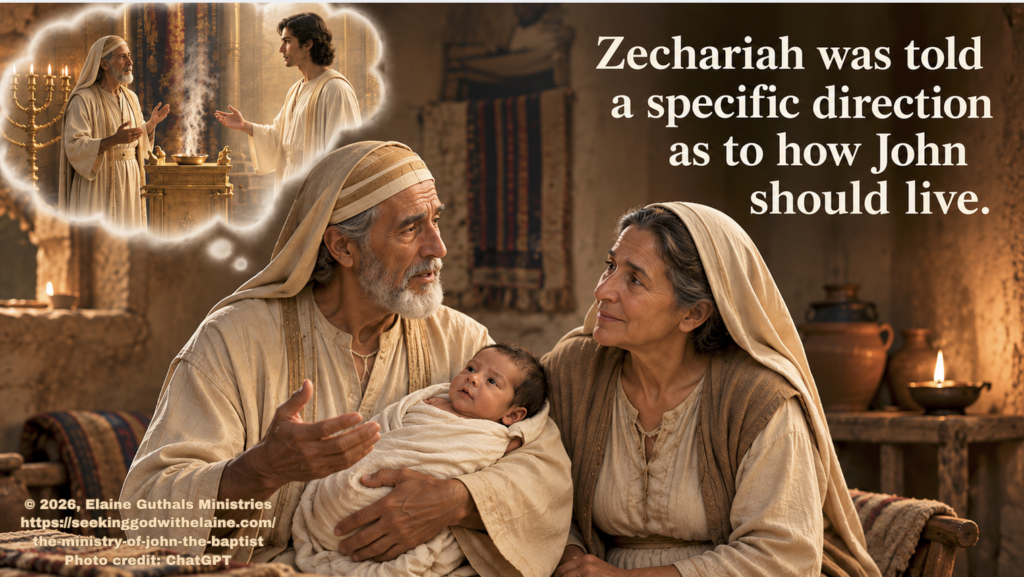
Zechariah was told a specific direction as to how John should live. He was not to drink alcohol (Lk. 1: 15). This is in line with the Nazarite vows.
John the Immerser ministered in the lower valley around the Jordan River.
In a way – to me – it is sad that John has been labeled as the Baptizer. He is so much more than just dunking people in the Jordan.
That leads us away from John the Immerser’s devoutness and submission to Yeshua as Messiah and God as Sovereign Lord.
Jehovah had a very important plan for John’s life. He was to be the forerunner of the Messiah (Lk. 1: 16-17 NLT). This preparation of the way for the Messiah fulfills the prophesy we find in Isaiah.
John knew his place as forerunner. “He must become greater and greater, and I must become less and less” (Jn. 3: 30 NLT).
Let's Put It into Context
To read devotions in The Battle for the Heart theme
Devotions in the The Ministry of John the Baptist series
What is a Nazarite vow (found in Numbers 6)?
- It is a vow that can be taken by a man or a woman.
- It is voluntary.
- It signifies a complete dedication to God in certain areas of life.
- It is a temporary vow.
- It has specific requirements and restrictions.
- A sacrifice is offered at the conclusion of the vow, including burning the person’s hair.
Although not specifically identified as a Nazarite vow, three prominent figures are often associated with the vow. They are Sampson (Jdg. 13: 5 NLT), Samuel (1 Sam 1: 11 NLT), and John the Immerser (Lk. 1: 15 NLT).
The difference was John’s and Samson’s vows was that vow was to be lifelong. Jehovah Himself had commanded it of John.
The Nazarite vows consecrate the person to Jehovah or separate that person for Him.
Setting the Stage
“It was now the fifteenth year of the reign of Tiberius, the Roman emperor. Pontius Pilate was governor over Judea; Herod Antipas was ruler over Galilee; his brother Philip was ruler over Iturea and Traconitis; Lysanias was ruler over Abilene. Annas and Caiaphas were the high priests ...” (Lk. 3: 1-2 NLT)
Fifteenth Year
Luke used the timestamp of the ministry of John the Immerser beginning during the fifteenth year of Tiberius as Roman emperor, around AD 28-29.
What was the nation of Israel like in the first century? It had had a long line of occupation.
The Seleucids ruled Judea from around 198 to 167 BC. They aggressively promoted Hellenization, pressuring Israel to abandon its traditional Jewish practices.
These actions transformed political domination into a direct attack on covenant identity. Because of this, many Jews still considered themselves to be under exile.
The Seleucid rule led to the Maccabean Revolt that occurred began in 167 BC. The successful revolt resulted in the rededication of the Temple and was a powerful symbol of covenant faithfulness and resistance to foreign oppression. It also demonstrated that zealous loyalty to Jehovah could bring national deliverance.
This independence lasted from 142 to 63 BC. Though it was close to national restoration, it still fell short because there was no descendant of David on the throne. Still, internal corruption developed, and many promises of the prophets remained unfulfilled.
Roman occupation began when Pompey captured Jerusalem in 63 BC during a Roman civil conflict in the region. By the first century, Rome controlled Judea through governors, client kings, taxation, and military force.
Many first-century Jews considered themselves still in exile because, though they worshiped in a rebuilt Temple and lived in their ancestral land, they remained subject to Gentile authority.
This environment fueled widespread expectation that Jehovah would send His Messiah to restore Israel, defeat her oppressors, and establish His kingdom.
Tiberius, the Roman Emperor
Tiberius was the second Roman Emperor, who was born in 42 BC.
The adopted son and stepson of Augustus, Tiberius ruled from AD 14 until AD 37. He was said to be reserved, suspicious, and increasingly withdrawn. Even though he was described to be relatively competent and financially conservative, he was also paranoid.
Tiberius’ reign as emperor encompassed the whole time of John’s and Yeshua’s ministry. He died in AD 37, not too many years after Yeshua was crucified.
Pontius Pilate
Pontius Pilate was the prefect of Judea under Rome from approximately AD 26 to AD 36.
As prefect, Pilate was responsible for maintaining Roman order and collecting revenue. His administrative center was in Caesarea Maritima, but he would have been in Jerusalem as required. One time that presence was required was during Jewish festivals.
Pilate, as Rome’s representative, had the Roman authority to impose the Roman death penalty. This was the authority needed to order Yeshua’s crucifixion.
The relationship between Pilate and the Jewish population was strained at best. There were several instances in which Pilate’s actions provoked serious Jewish opposition. One such instance is documented in Luke 13: 1.
Ultimately, Pilate was a Roman official, using deeply offensive symbols and authority, who was governing a nation with a strong religious identity.
Pilate was relieved of his position around AD 36. Though he was taken to Rome to answer accusations of how he handled a confrontation with the Samaritans, he arrived after Tiberius’ death. His fate is uncertain.
Herod Antipas
Herod Antipas was the son of Herod the Great.
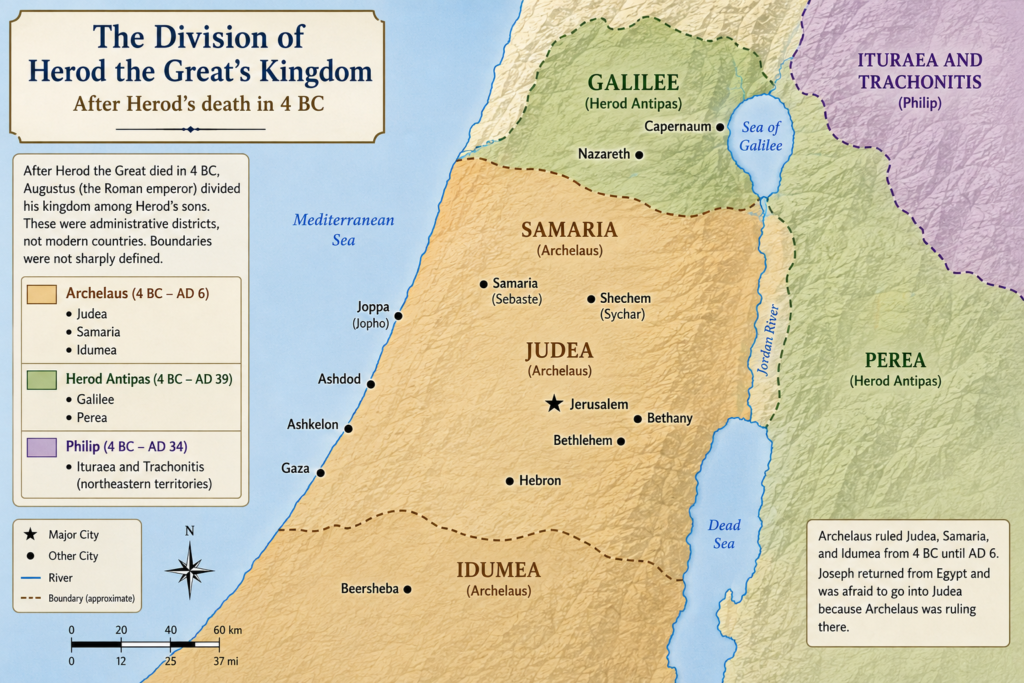
Upon Herod the Great’s death, Herod Antipas was one of his sons who received part of his divided kingdom. Antipas became tetrarch of Galilee and Perea, including where John conducted his ministry. His reign lasted from 4 BC to AD 39.
Philip
Philip the Tetrarch was the son of Herod the Great and the brother of Herod Antipas.
It is important to note that he was not the husband of Herodias. Herodias was married to another of Herod the Great’s sons, also named Herod Philip. Philip the Tetrarch was married to Herodias’ daughter, Salome.
Philip ruled the territories northeast and east of Galilee. He ruled there from approximately 4 BC until AD 34.
Philip was known as a relatively capable and peaceful ruler. He was the founder of Caesarea Philippi.
Annas
Annas was the Jewish High Priest from around AD 6 to AD 15.
Annas was appointed to be the Jewish High Priest by Roman Governor Quirinius. Even though the Roman authorities removed him from office, he retained influence as several family members served as High Priest, including Caiaphas.
Caiaphas
Caiaphas served as High Priest from around AD 18 to AD 36.
This was an unusually long tenure as High Priest. He was removed from the office around the same time Pontius Pilate, in AD 36.
Caiaphas was also the son-in-law of Annas.
John Was Unique
“John’s clothes were woven from coarse camel hair, and he wore a leather belt around his waist. For food he ate locusts and wild honey.” (Mt. 3: 4 NLT)
“His clothes were woven from coarse camel hair, and he wore a leather belt around his waist. For food he ate locusts and wild honey” (Mk. 1: 6 NLT)
John’s diet was based on what he found in the wilderness.
We think John was an interesting dude who made interesting choices in his wardrobe and diet. He wore a camel’s hair garment and ate wild honey and locusts.
This was understandable when we consider the region in which John the Immerser lived. Strugnell explained what that meant. He wrote,
“His formative years were spent in the Judaean desert, where monastic communities, such as the Essenes (a strict Jewish sect that existed from about the 2nd century BCE to the end of the 1st century CE), and individual hermits often educated the young in their own ideals.”
Resource
Because of this, he was often compared to Elijah. The two men wore similar attire (II Kgs. 1: 8; Mt. 3: 4). They both carried out their mission in the wilderness (Mt. 3: 1).
We may cringe when we read John ate locust. People in John’s day knew the nutritional value of this reliable wilderness food source — and it was kosher (Lev. 11: 22).
John’s Call
“... At this time a message from God came to John son of Zechariah, who was living in the wilderness” (Lk. 3: 2 NLT)
We don’t know how the message came to John – we just know it did.
In Jewish thought, John was called an ish haElohim (אִישׁ הָאֱלֹהִים), a man of God.
Think about it. “God sent a man, John the Baptist” (Jn. 1: 6 NLT). That doesn’t really sound like much.
In the Hebrew, it says Jehovah shalach (שָׁלַח) ish (אִישׁ). John wasn’t the only man sent. This was the way Jehovah introduced Moses, Samuel, Elijah, and Isaiah. Great company!
John was sent to be a witness. His call was to prepare the way for the Messiah.
Think about Zechariah. When Gabriel came to tell him that he and Elizabeth would have a son, he probably thought John would become a priest, as he was.
In the end, Zechariah may have thought of John as a radical. He probably saw John as being outside the religious system.
John wasn’t a priest. He wasn’t even in the temple.
John was in the wilderness.
The wilderness was important in John’s day. He was in the Judean Wilderness, a harsh and rocky region east of Jerusalem. It stretched toward the Jordan River and the Dead Sea.
The Hebrew term for it is midbar (מִדְבָּר). It wasn’t considered just an empty land. It was where God spoke and revealed Himself to people. It taught dependence on Jehovah.
When we think wilderness, we think trees – lots and lots of trees. This wilderness boasted jagged limestone hills, steep ravines known as wadis, and dry, chalky soil. The vegetation was limited to thorn bushes and scattered scrub growth.
The extreme climate ran from intense daytime heat to cold nights. Rain was limited, which limited food sources. Those living in the wilderness had to gather what the wilderness provided – locusts and wild honey.
We may scratch our heads. Into this dry, arid place, John brought baptism.
John didn’t bring it into the Temple, where first-century Jews would go to worship. He brought it to the wilderness, where people had to make an effort to go hear Jehovah.
It put feet to John’s message.
- We have to deliberately seek Jehovah.
- We have to enter into testing in our wilderness.
- We have to leave the comfort behind and migrate toward change.
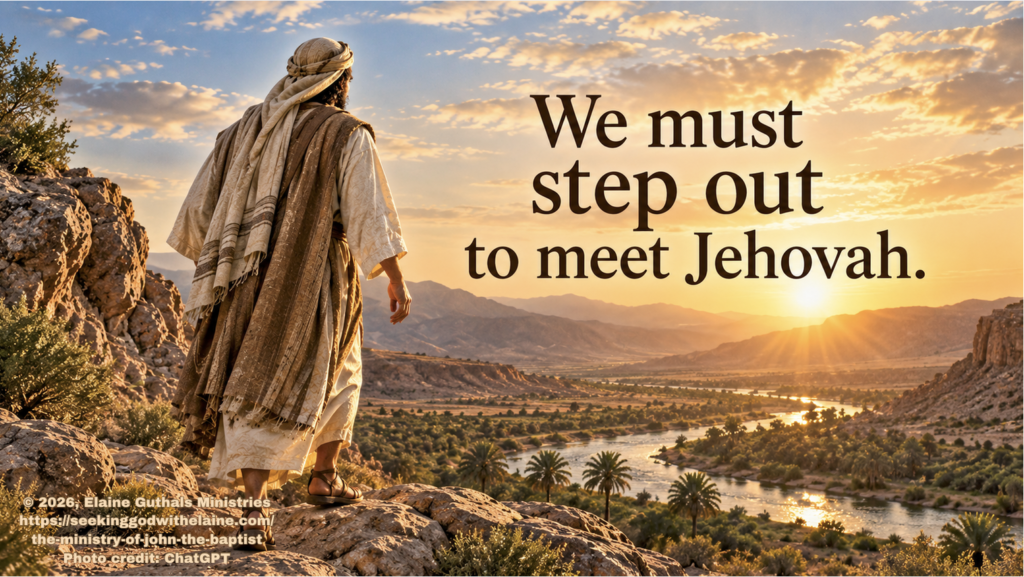
We must step out to meet Jehovah.
Making the Connections #1
Why would we want to start this series reading about all these dead guys? Simple.
Luke proved to us that this was a true account of what happened in a specific period of time. Historical accounts back up the fact that these people existed during this period.
Not only that, but it is giving us the background of where the nation of Israel was during that time. This political oppression has to be understood to order to understand the Messianic expectations. Jewish leadership has to be understood for the same reason.
Making the Connections #2
Pastor Steve made a good connection in his A Voice Crying in the Wilderness blog. He reminded us that there are so many voices in the wilderness right now.
We have to watch who we listen to. Pastor Steve said that “We MUST seek the Lord at all times for the truth.”
Resource
We have to listen to men and women sent by Jehovah to hear the truth. We must do our own due diligence and determine that what was said really is the truth.
Heart Check
Think about the battle Yeshua is engaged in for your heart. Ask yourself the following questions.
- Am I listening to the voices around me, or am I seeking Jehovah for His truth?
- Have I allowed the circumstances around me to shape what I believe Jehovah is doing?
- Am I willing to leave my comfort behind when Jehovah calls me toward change?
- Am I deliberately seeking Jehovah, even when doing so requires me to step into my wilderness?
- Am I willing to listen when Jehovah speaks truth that challenges me?
How Do We Apply This?
- Seek Jehovah deliberately.
- Seek Him and determine whether what you hear is truly His truth.
- Don’t run from the place where He is calling you to grow.
- Leave comfort behind.
- Listen to the people Jehovah sends.
- Prepare your heart for what Jehovah wants to do.
Father God. Since before the creation of the universe, you knew Yeshua would be our Savior and Redeemer. You called John to prepare His way. Lord, help us to step out to seek You. Amen.
If you don’t understand something and would like further clarification, please contact me.
If you have not signed up for the email providing the link to the devotions and the newsletter, do so below.
If God has used this devotion to speak with you, consider sharing it on social media.