Mary and Joseph raised Yeshua in the Jewish faith. This devotional reading looks at the events during Passover when He was twelve.
Nuggets
- Yeshua grew up in obscurity in Nazareth.
- Joseph had been called a righteous man (Mt. 1: 19), and Mary was obedient.
- It was significant that this event took place when Yeshua was 12 years old.
- The return home from Passover didn’t go as planned.
- Yeshua was in the Temple.
- Yeshua spent His time with the rabbis productively.
- Yeshua was mission-driven from early on.
- Luke summarized Yeshua’s life after age 12.

Luke utilized a writing technique called compressed narrative. He did this to jump from the time Yeshua was an infant to when He was 12 years old.
Although Joseph chose — under Jehovah’s guidance — not to live in Jerusalem or Bethlehem, that didn’t mean Yeshua didn’t grow up around the Jewish faith, This included trips to Jerusalem.
Let's Put It into Context
To read devotions in The Battle for the Heart theme
Devotions in the The Birth and Early Childhood of Christ series
Yeshua Grew
“There the child grew up healthy and strong. He was filled with wisdom, and God’s favor was on him” (Lk. 2: 40 NLT)
Yeshua grew up in obscurity in Nazareth.
Once the family returned to Nazareth, we hear little about Yeshua and His childhood. All we are told is that He grew both in wisdom and in God’s favor.
While it might seem strange to us that Yeshua didn’t grow up in Jerusalem around the Temple, this allowed Him to have a normal childhood.
Think about it. There had already been one assassination attempt on Yeshua’s life. And that was before He was a year old.
Because of His being away from the religious and political places of power, Yeshua was raised as any first-century Jewish boy would have been raised. I think this was to His advantage.
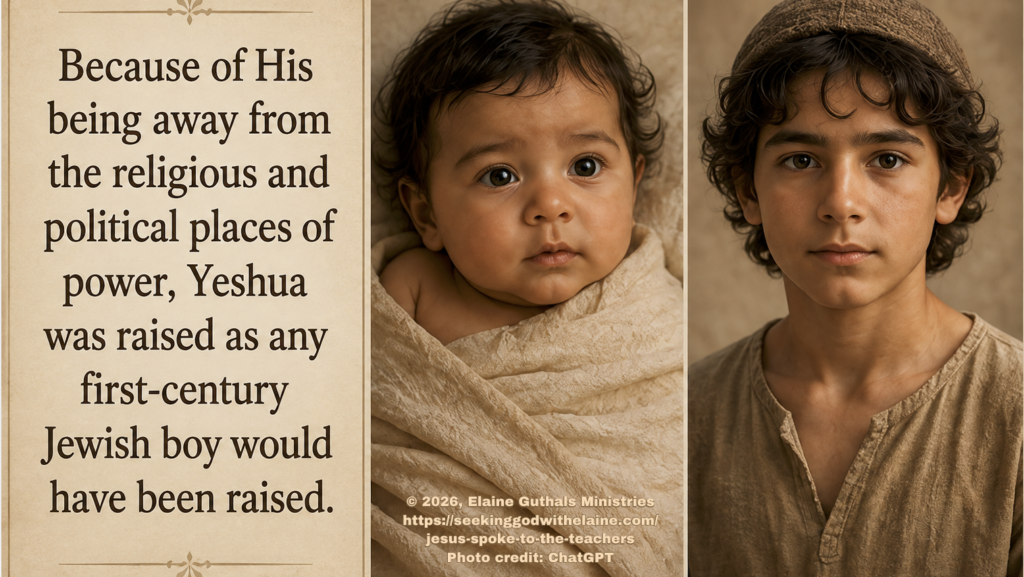
Yeshua came to earth to be one of us. This upbringing gave Him a good foundation of what it meant to be human. He saw the everyday struggles of good Jewish people trying to retain covenant faithfulness.
On Their Way to Passover
“Every year Jesus’ parents went to Jerusalem for the Passover festival. When Jesus was twelve years old, they attended the festival as usual” (Lk. 2: 41-42 NLT)
Passover
Joseph had been called a righteous man (Mt. 1: 19), and Mary was obedient.
Because of that, they went every year to the Passover festival.
Passover (Pesach – פֶּסַח) is a festival celebrating Israel’s redemption from Egypt.
Many of us know about Passover. But few of us probably know what that entails.
In Genesis, Joseph was sold by his brothers because of their jealousy and anger. However, that is the means by which Jehovah got Joseph to Egypt so that he could lead the country in preparing for a famine.
After the famine was over and Joseph and the Pharaoh at the time had died, the Hebrews became slaves to the Egyptians.
Jehovah sent Moses to lead the people out of Egypt and to the Promised Land. They spent the last night of captivity celebrating the Passover meal.
When the Israelites and later the Jews celebrated this festival, they were to remember the time when Jehovah freed them from slavery. More importantly, they were to remember how He redeemed and delivered them.
The festival centered around the lamb that was sacrificed – the Paschal Lamb. This lamb was essential to the story of redemption.
Passover was one of the pilgrimage festivals. That means all males were to appear before Jehovah. True, women and children could accompany them – and we can read from the text that every year Mary and Yeshua did accompany Joseph.
It is in this remembrance that Yeshua grew. He participated in one of the most significant acts of Jewish worship of the entire year.
Did you see what it said in verse 42? Jesus attended the festival when he was 12 as usual. This wasn’t His first Passover – and it wouldn’t be His last.
It means it was what the family did to participate in the worship life of Israel.
Connect some dots here. Every year, Yeshua went to the festival to view the Paschal Lamb – the lamb who – like Him – focused on the imagery of sacrifice. He saw the blood, deliverance, covenant, slavery, redemption and peace all transpiring within the Temple grounds.
Later, Yeshua would become the Paschal Lamb. “… Christ, our Passover Lamb, has been sacrificed for us” (I Cor. 5: 7 NLT).
Twelve Years Old
It was significant that this event took place when Yeshua was 12 years old.
We think of young Jewish boys participating in their bar mitzvah ceremony at age 13. That wasn’t the practice in first-century Israel. That ceremony didn’t exist then.
Still, the age traditionally associated with a Jewish boy coming of age was thirteen.
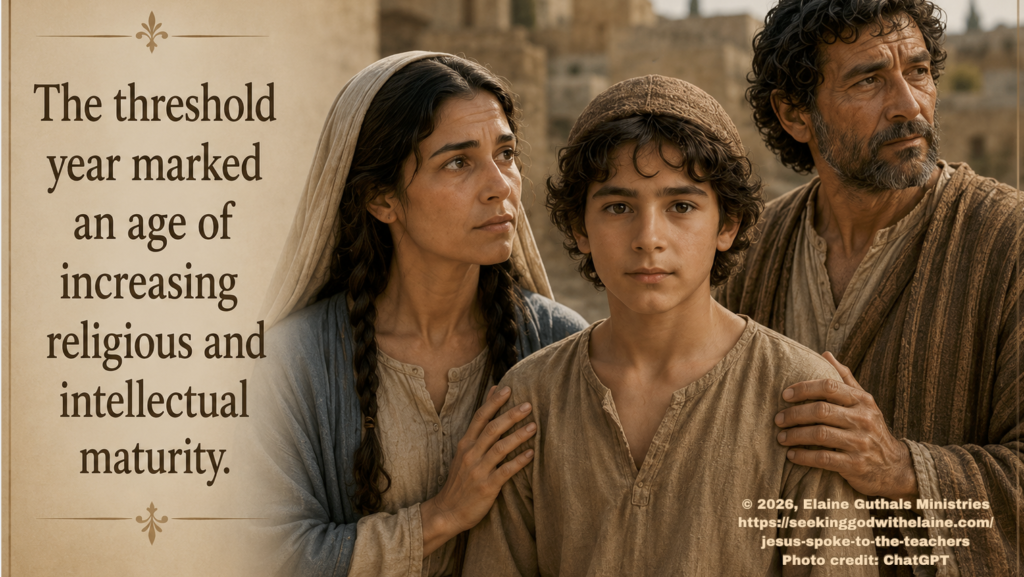
That would make this a threshold year for Yeshua. It marked an age of increasing religious and intellectual maturity.
Returning Home
“After the celebration was over, they started home to Nazareth, but Jesus stayed behind in Jerusalem. His parents didn’t miss him at first, because they assumed he was among the other travelers. But when he didn’t show up that evening, they started looking for him among their relatives and friends” (Lk. 2: 43-44 NLT)
The return home from Passover didn’t go as planned.
We may question how Mary and Joseph started home without Yeshua. That probably isn’t that difficult to see when we really look at it.
It wasn’t like they were going to jump on their donkeys and start home by themselves. We are talking a multi-day trip here. More than likely, they went on foot.
Probably for pilgrimage festivals, it felt like the village was clearing out. They would have been in a caravan.
Caravans from other villages may have been passing through or close by. That would have been especially true when they got on the Central Ridge Route. Their caravan may have joined with other caravans.
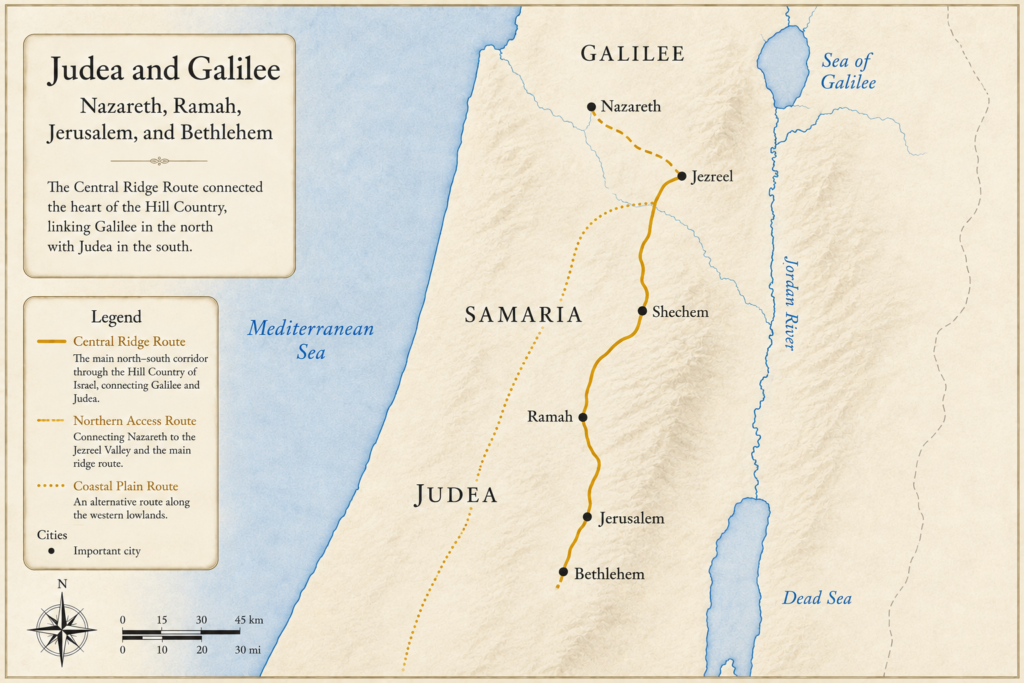
When they were leaving Jerusalem, that would mean the large caravan they left with would probably have been made up of strangers and other people from Nazareth – including family.
However it happened, Mary and Joseph didn’t miss Yeshua until the caravan stopped for the night.
Even if they didn’t know anyone else in the caravan, they would have believed that Yeshua found someone else His age to travel with. Kids do tend to group together, even if they just met.
Finding Yeshua
“When they couldn’t find him, they went back to Jerusalem to search for him there. Three days later they finally discovered him in the Temple, sitting among the religious teachers, listening to them and asking questions. All who heard him were amazed at his understanding and his answers” (Lk. 2: 45-47 NLT).
Three Days Later
Yeshua was in the Temple.
Luke said that Mary and Joseph didn’t realize that Yeshua was missing until evening. They wouldn’t have started back in the dark to return to Jerusalem.
They might have gotten to move faster once they left the caravan and started back. However, they had travel time up to the amount of time they had traveled the day before. More than likely, it was still substantial.
By the time they found Him in the Temple, they had been separated from Him for all or parts of three days. That means Mary and Joseph could have spent as much as roughly two days searching Jerusalem.
We have to realize that there were probably still a lot of people in Jerusalem. As a pilgrimage festival, Jews came from all over Judea and Galilee to worship. They even came from Jewish communities outside the land as well. Josephus called it an innumerable multitude.
Resource
In another place, Josephus described one Passover in the first century. There had been 256,500 Passover sacrifices, associated with more than 2.7 million participants.
Resource
So, it was crowded. Probably not everyone left the day after Passover concluded. Some may have stayed to visit family before returning to their homes.
Listening, Asking, and Answering
Yeshua spent His time with the rabbis productively.
Rabbis taught a little differently than what happens in classrooms today. It was much more interactive than what we are accustomed to.
The rabbi would sit with his students gathered around him. They would read or recite Scripture. The rabbi would explain its meaning. Students were allowed to ask questions, and he would question them to ensure their understanding.
The questions the rabbi asked were also geared to determine what their interpretation was. They could also have applied it to particular situations and debated that application and the results.
Look at how Yeshua interacted with the rabbis. He listened to what they had to say. He asked questions. He apparently answered questions that they had.
Luke says that Yeshua sat with teachers – plural. It doesn’t sound like a regular teaching session. Still, we don’t know whether they were conducting a formal lesson, discussing Torah, answering questions from pilgrims, or engaged in some other Temple teaching setting.
All we know is that it appears that Yeshua was making an impression on them.
That also raises the question as to how much Yeshua remembered. Philippians 2: 7 says “Instead, he gave up his divine privileges; he took the humble position of a slave and was born as a human being” (Phil. 2: 7 NLT).
We know Yeshua divested Himself of those divine privileges and became human. He did not divest Himself of His divinity.
What Yeshua was showing was wisdom beyond His years. Luke had already said that Yeshua was growing in wisdom (Lk. 2: 40).
That is understandable considering He was wisdom.
- “In him lie hidden all the treasures of wisdom and knowledge” (Col. 2: 3 NLT).
- “God has united you with Christ Jesus. For our benefit God made him to be wisdom itself. Christ made us right with God; he made us pure and holy, and he freed us from sin” (I Cor. 1: 30 NLT).
Yeshua’s wisdom was part of His nature – a part of His divine identity. He becomes our wisdom.
Yeshua’s Mission
“His parents didn’t know what to think. ‘Son,’ his mother said to him, ‘why have you done this to us? Your father and I have been frantic, searching for you everywhere.’ ‘But why did you need to search?’ he asked. ‘Didn’t you know that I must be in my Father’s house?’ But they didn’t understand what he meant” (Lk 2: 48-50 NLT)
Yeshua was mission-driven from early on.
Think about it. Mary, Joseph, and Yeshua came to Jerusalem to remember Jehovah’s redemption of Israel. They found the Redeemer Himself in His Father’s house.
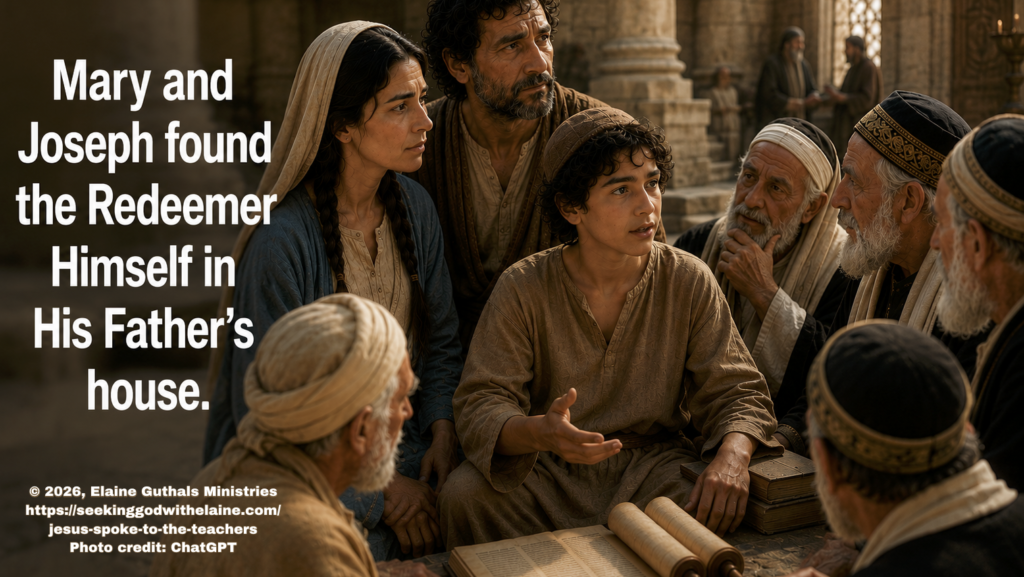
But right now, they were probably in Momma Bear and Poppa Bear mode. They more than likely couldn’t see past the pain and anxiety.
It was no accident that Yeshua was in the Temple – even at 12 years old. He was growing up inside the story of redemption that ultimately pointed to Him.
Take a look at how Yeshua got to that point. Passover → Temple → sacrifice → Father’s house → Yeshua.
And the first words that we hear that Yeshua spoke were, “… ‘Didn’t you know that I must be in my Father’s house?’” (Lk. 2: 49 NLT).
Does that mean Yeshua understood at 12 that HE would one day be the Paschal Lamb? Maybe. Maybe not.
We have hindsight, however. We can see what Yeshua may not have been able to at that time.
What we do see is that Yeshua was mission-driven from early on. He was always building to the point of Him being the sacrifice (I Cor. 5: 7 NT).
Yeshua Grew
“Then he returned to Nazareth with them and was obedient to them. And his mother stored all these things in her heart. Jesus grew in wisdom and in stature and in favor with God and all the people.” (Lk. 2: 51-52 NLT)
Luke summarized Yeshua’s life after age 12.
In the end, Yeshua went back to Nazareth. He lived there until He started His ministry.
We were told one other time that Mary pondered things in her heart. She meditated on what happened here. She probably remembered what Gabriel told her. She remembered prophecy.
Mary was growing in her faith just as Yeshua grew physically and mentally.
Why didn’t we get any more insight into Yeshua’s life as He was growing up? That wasn’t the focus.
The focus should always remain on Yeshua as Savior and Redeemer.
Making the Connections
We may think of Passover as just a meal. That meal was always important to the Jews.
The sacrifices were more important. They were the heart of Passover.
Passover was part of a seven-day celebration, the Feast of the Unleavened Bread (Deut. 16: 1-8).
Think about it. Remember, Josephus had recorded 2.7 million participants. True, the lamb covered the family, so the number of lambs was a somewhat lower number.
Still, it was thousands upon thousands of families. That means thousands upon thousands of lambs.
All were moving toward the Temple, because that was where the lamb was sacrificed. The Hallel – the Psalms of praise associated with the festival – was being sung. The lambs were joining in, but it was probably a baa of fear. Trumpets were sounding.
The sacrifice wasn’t a day-long event. Timing was reported in the Mishnah. “On the eves of Passover, when the Paschal lamb must be offered after the daily offering, the daily offering is sacrificed earlier … “
Resource
However, later it says that those bringing sacrifices were split into groups: the assembly, congregation, and Israel. The assembly was able to bring their sacrifices in the afternoon.
Each group entered the Temple courtyard until all in that group were inside. When the court was filled, the doors were closed, and the sacrifice began.
Rows of priests were described in what appears to be an assembly line. Their job was to pass the blood of the sacrifice from the place of sacrifice to the altar.
The lamb would be flayed until the sacrificial parts could be removed. These would be placed in a basin (mageis– מַגִּיס) and burned on the altar.
Each group would remain until all groups concluded their sacrifices. “Then the whole assembly of the community of Israel must slaughter their lamb or young goat at twilight” (Ex. 12: 6 NLT).
At nightfall, they would return to wherever they were staying and roast their Paschal lamb. The people who had been registered for that particular sacrifice would eat it together with the unleavened bread and bitter herbs.
I know. Think about getting that many people organized.
They accomplished it. Year after year after year.
This was just part of being Israel. It was a celebration of being redeemed.
Heart Check
Think about the battle Yeshua is engaged in for your heart. Ask yourself the following questions.
- Am I growing in wisdom and understanding, or have I become satisfied with what I already know?
- When circumstances become frightening or overwhelming, do I lose sight of Jehovah’s purposes?
- Am I willing to put Jehovah’s purposes ahead of my own plans, expectations, and comfort?
How Do We Apply This?
- Remember that our lives have a purpose beyond what we can see right now.
- Stay rooted in Scripture so we recognize truth when we encounter it.
- Make time to listen, ask questions, and grow in wisdom rather than assuming we already know enough.
- When life becomes stressful, stop and ask whether we are focused on Jehovah’s purposes or only on our immediate circumstances.
Father God. Help us to seek You in Your Word. Show us where we have things wrong. Grow us so that we become more and more like You. Amen.
If you don’t understand something and would like further clarification, please contact me.
If you have not signed up for the email providing the link to the devotions and the newsletter, do so below.
If God has used this devotion to speak with you, consider sharing it on social media.