The time that Yeshua spent in Egypt is a mystery to us, but it raises many questions. This devotional reading looks at Joseph’s dreams instructing him to go to Egypt and to return.
Nuggets
- From a cursory glance, it appears that the timeline in Matthew 2 is different than Luke 2.
- If we just read Luke 2: 39, grammar alone doesn’t necessarily mean Nazareth was the next stop after the Temple.
- Matthew was more specific in his timeline telling us about events that Luke didn’t.
- Does Matthew 2 contradict Luke 2?
- To me, a more logical explanation is that the Magi arrived at Joseph’s family’s house within a few days of Yeshua’s birth.
- Joseph immediately acted when told of a threat.
- Hosea prophesied the escape to Egypt.
- Because Herod was egotistical and self-centered, he ordered the execution of all boys two years old and younger in Bethlehem when the Magi didn’t return.
- Prophecy was once again fulfilled with the Massacre of the Innocents.
- Joseph had another dream.
- It appears that Joseph wasn’t going back to Nazareth at first.
- Matthew said the family returned to Nazareth to fulfill prophecy.
When we last left Mary, Joseph, and Baby Yeshua, they were at the Temple. Mary was completing her purification. Baby Yeshua was presented and redeemed as the firstborn.
There seems to be a conflict between Matthew 2 and Luke 2. When and how did Mary, Joseph, and Baby Yeshua leave Jerusalem/Bethlehem?
We have already covered the Magi. Since we believe that the birth occurred in the animal section of Joseph’s family’s home, the house that the Magi came to could have been theirs.
But Luke was very specific in where the family went after it left Jerusalem.
Stop. Let’s look at what it says.
Let's Put It into Context
To read devotions in The Battle for the Heart theme
Devotions in the The Birth and Early Childhood of Christ series
Let's Put It into Context #2
Herod the Great was religious but ruthless, powerful but fearful, and magnificent yet miserable.
Born around 73 BC, Herod was not of Israelite descent but of Edomite descent. In other words, he ruled the Jews but was not of the Davidic line. To make matters worse, he was chosen to be King of the Jews by Octavian Augustus and the Roman Senate around 40 BC.
Herod’s reign lasted from 37 to 4 BC. While he did maintain stability in the region, his fear of losing power made him a brutal ruler.
The Temple that stood in Yeshua’s day had undergone a massive expansion under Herod’s rule. He tried to curry the favor of his subjects by rebuilding the Temple and funding public works.
Yes, Herod built the stage on which Yeshua’s ministry would unfold.
Leaving
“When Jesus’ parents had fulfilled all the requirements of the law of the Lord, they returned home to Nazareth in Galilee. There the child grew up healthy and strong. He was filled with wisdom, and God’s favor was on him” (Lk. 2: 39-40 NLT)
“After the wise men were gone, an angel of the Lord appeared to Joseph in a dream. ‘Get up! Flee to Egypt with the child and his mother,’ the angel said …” (Mt. 2: 13 NLT)
From a cursory glance, it appears that the timeline in Matthew 2 is different than Luke 2.
Matthew had Mary, Joseph, and Baby Yeshua leaving Bethlehem to go to Egypt. Luke had them going to the Temple then leaving for Nazareth.
Review of Luke’s Passage
If we just read Luke 2: 39, grammar alone doesn’t necessarily mean Nazareth was the next stop after the Temple.
The Greek says this: Καὶ ὡς ἐτέλεσαν πάντα τὰ κατὰ τὸν νόμον Κυρίου, ἐπέστρεψαν εἰς τὴν Γαλιλαίαν εἰς πόλιν ἑαυτῶν Ναζαρέθ.
The word we need to focus on is hōs (ὡς). This means when, after, or as.
Luke’s statement can serve as a summary statement. It links the completion of the required observances to the family’s return to Galilee.
The one word missing here is immediately. It doesn’t say they went straight back to Nazareth. In fact, it doesn’t give us a clue about any timing.
What it is saying is, when everything they were required to do was done, they returned.
To look at Matthew 2 in that light, Mary, Joseph, and Baby Yeshua were required to go to Egypt. They were called back and allowed to return to Nazareth, their own city – their hometown.
The next verse in Luke’s passage is that Baby Yeshua grew strong. He did that in Egypt as well as in Nazareth. This included wisdom and grace.
Luke’s account is not strictly chronological, as shown by his transition to the next story in the passage. Yeshua is no longer a baby – He is 12 years old. In fact, Luke uses this compressed narrative in more places than just here (Lk. 3: 19–21; Ac. 5: 42).
This idea could be strengthened by the use of the word returned. The Greek word used is ἐπέστρεψαν.
Luke’s goal may have been to show the return of the family to Nazareth – the place they started from before Yeshua’s birth.
Review of Matthew’s Passage
Matthew was more specific in his timeline telling us about events that Luke didn’t.
However, Matthew didn’t give us any time references. It has long been assumed that Mary and Joseph stayed in Bethlehem for up to two years after Yeshua’s birth.
The age of Yeshua at the Magi’s visit is estimated by the age of the male children killed by Herod. There would have been no need to kill Jewish sons that had reached that age if it was believed Yeshua had just been born.
However, Herod didn’t ask about the age of the child. He asked when the Magi had seen the star appear (Mt. 2: 7).
We aren’t given that information, either. We aren’t told that the Magi first saw the star on the night of Yeshua’s birth. They could have seen the star long enough before His birth to allow for travel time so they would arrive right around His birth.
Some think that Matthew’s use of the Greek word paidion (παιδίον) indicates Yeshua’s age. This word means child. It does not differentiate between infant and toddler.
It is possible they thought the Messiah should be raised in Bethlehem. Returning to Nazareth before the Magi’s arrival would have entailed a move back to Bethlehem.
Reconciling the Two Passages
Does Matthew 2 contradict Luke 2?
Not necessarily. Luke doesn’t identify the return to Nazareth from Jerusalem as a permanent residence.
Matthew was more explicit in his language. He noted the family settled in Nazareth permanently after their return from Egypt.
There is one little hole in Matthew’s passage that could make it sync with Luke. We are not told the location of the house in which the Magi find Baby Yeshua. We assume it was in Bethlehem because that is where the Magi were sent and where the Massacre of the Innocents happened.
I don’t see Mary and Joseph staying in Bethlehem 40 days, let alone two years. The Magi could have visited Baby Yeshua before they left Bethlehem.
The house referred to in Matthew could have been Joseph’s family’s house. The word Luke used was kataluma (κατάλυμα). That can mean guest room.
If we go with Mary and Joseph staying in the animal housing of Joseph’s family’s home because there was no room in the guest room at Yeshua’s birth, they could have still been at the house a couple of days after His birth. Mary and Joseph may have been able to move into the main house after a couple of days.
The family could have returned to Nazareth. It may have taken Mary a day or two before she felt up to traveling. There was no restriction on her traveling either during her seven days of being unclean or her days of purification.
Conclusion
To me, a more logical explanation is that the Magi arrived at Joseph’s family’s house within a few days of Yeshua’s birth.
The family possibly returned to Nazareth, probably after the circumcision ceremony, but came back to Jerusalem for Mary’s purification offering – the only place that could be performed. Then on the way back to Nazareth, Joseph received the dream to flee to Egypt. Upon returning from there, they again settled in Nazareth.
We cannot prove that. But we also cannot dismiss it from Scripture. It allows Matthew and Luke to be read in their natural sequence without requiring either writer to have omitted or rearranged something they explicitly said.
Though it seems like Matthew and Luke are telling different stories, we can believe that all the information given by both is accurate. We don’t have to know exactly what happened. We just have to believe it did.
Directions to Joseph
“After the wise men were gone, an angel of the Lord appeared to Joseph in a dream. ‘Get up! Flee to Egypt with the child and his mother,’ the angel said. Stay there until I tell you to return, because Herod is going to search for the child to kill him.’ That night Joseph left for Egypt with the child and Mary, his mother, and they stayed there until Herod’s death. This fulfilled what the Lord had spoken through the prophet: ‘I called my Son out of Egypt’” (Mt. 2: 13-15 NLT)
Get up!
Joseph immediately acted when told of a threat.
Once again, Joseph had a dream from Jehovah. Once again, he was told the actions he should take.
Once again, Joseph immediately obeyed. Verse 14 says, “That night Joseph left for Egypt with the child and Mary, his mother” (Mt. 2: 14 NLT).
This shows Joseph’s commitment to raising the Son of God. He wasn’t taking any chances with the Baby’s life.
Out of Egypt
Hosea prophesied the escape to Egypt.
We find a place in God’s Word that prophesied this trip to Egypt. “When Israel was a child, I loved him, and I called my son out of Egypt” (Hos. 11: 1 NLT).
Yeah, I know. The Jews interpreted this to mean Jehovah calling the nation out of their Egyptian captivity. Matthew, however, applied it to Yeshua.
Was Matthew wrong to do that? No, many Old Testament prophecies had current application and future application.
Let’s back up a second — all the way to when Israel was in captivity in Egypt. They thought the nation was Jehovah’s child. “Then you will tell him, ‘This is what the Lord says: Israel is my firstborn son” (Ex. 4: 22 NLT).
Now come back to Yeshua’s time. “But to all who believed him and accepted him, he gave the right to become children of God. They are reborn — not with a physical birth resulting from human passion or plan, but a birth that comes from God” (Jn. 1: 12-13 NLT).
The idea that Jehovah sets apart His children runs through all of God’s Word. That is the defining part to being a saint because that is a defining part of being holy.
Yeshua is the True Israel, the faithful Son, and the One Who succeeded where Israel failed.
Massacre of the Innocents
“Herod was furious when he realized that the wise men had outwitted him. He sent soldiers to kill all the boys in and around Bethlehem who were two years old and under, based on the wise men’s report of the star’s first appearance.” (Mt. 2: 16 NLT)
Because Herod was egotistical and self-centered, he ordered the execution of all boys two years old and younger in Bethlehem when the Magi didn’t return.
Now we come to a passage that is highly debated — the Massacre of the Innocents.
Why is the story questioned? There is no other independent evidence that it occurred. Josephus and other historians of that era are silent on this matter.
If something this big and this atrocious happened, they argue, wouldn’t there be more than one record of it? Or is it folklore based on some other similar incident?
Some believe the massacre occurred in 5 BC. One reason that timeframe doesn’t work is that Herod died in 4 BC.
Herod was incensed when the Magi didn’t report back to him Yeshua’s location. Did that stop his murderous plan?
No. It got worse.
Herod ordered the execution of all males two years old and under living in the city of Bethlehem and its vicinity. He set the time by when the Magi said the star appeared.
How could Herod do something so awful? Moore helped explain. He wrote,
“Herod never thought of our Lord as a human opponent, but as the Messiah. He did not disbelieve the star or the prophecies interpreted by the priests and scribes. He was fighting against God; He thought the prophecies might fail at the last.”
Resource
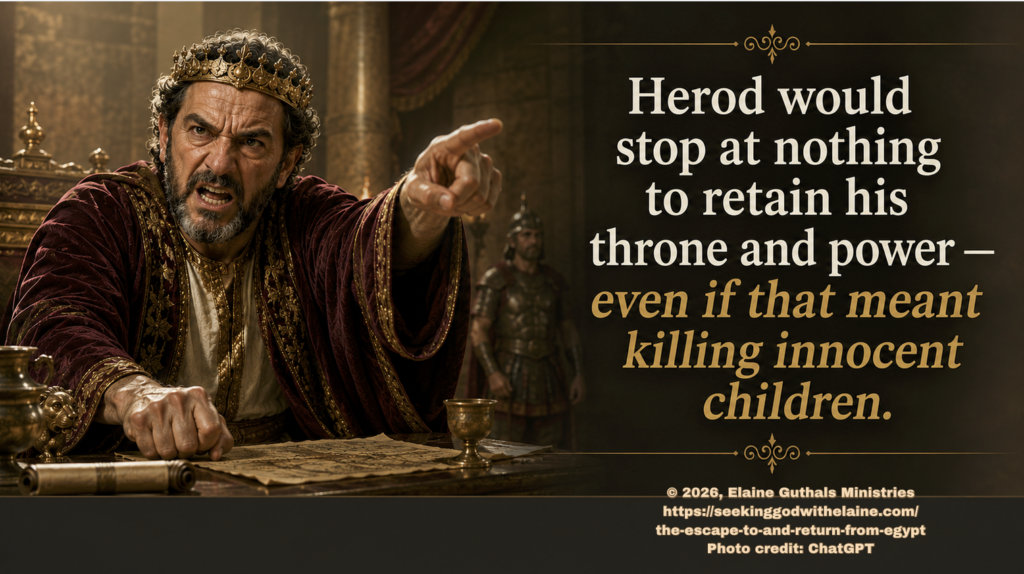
Herod would stop at nothing to retain his throne and power — even if that meant killing innocent children.
We think about the horror of the babies being slaughtered. But have we ever thought how many fathers and mothers were killed along with the little ones?
Think about it. They loved their little ones. Their first instinct would be to protect them. Momma Bear and Poppa Bear mode would kick in big time – with no thought to their own safety.
They would fight tooth and nail to protect their young one. People with no guilt in killing babies would have no guilt in killing moms and dads.
Atrocity Foretold
“Herod’s brutal action fulfilled what God had spoken through the prophet Jeremiah. ‘A cry was heard in Ramah — weeping and great mourning. Rachel weeps for her children, refusing to be comforted, for they are dead’” (Mt. 2: 17-18 NLT)
Prophecy was once again fulfilled.
Matthew 2: 18 basically says what Jeremiah 31: 15 says. “This is what the Lord says: ‘A cry is heard in Ramah — deep anguish and bitter weeping. Rachel weeps for her children, refusing to be comforted — for her children are gone’” (Jer. 31: 15 NLT).
Mourning does cause anguish. The anguish manifests itself as weeping. But mourning called it for what it was: dead instead of gone.
This is another two-for-one prophecy. Jeremiah was talking about Assyrians and nothing about the Messiah.
I hear you. We thought this was Bethlehem, not Ramah.
Well, this goes back to the Babylonian exile. Biblestudy.org tells us the city of Ramah was used as the gathering place for all the exiles who would be taken to Babylon (Jer. 40: 1). It was five miles north of Jerusalem.
Resource
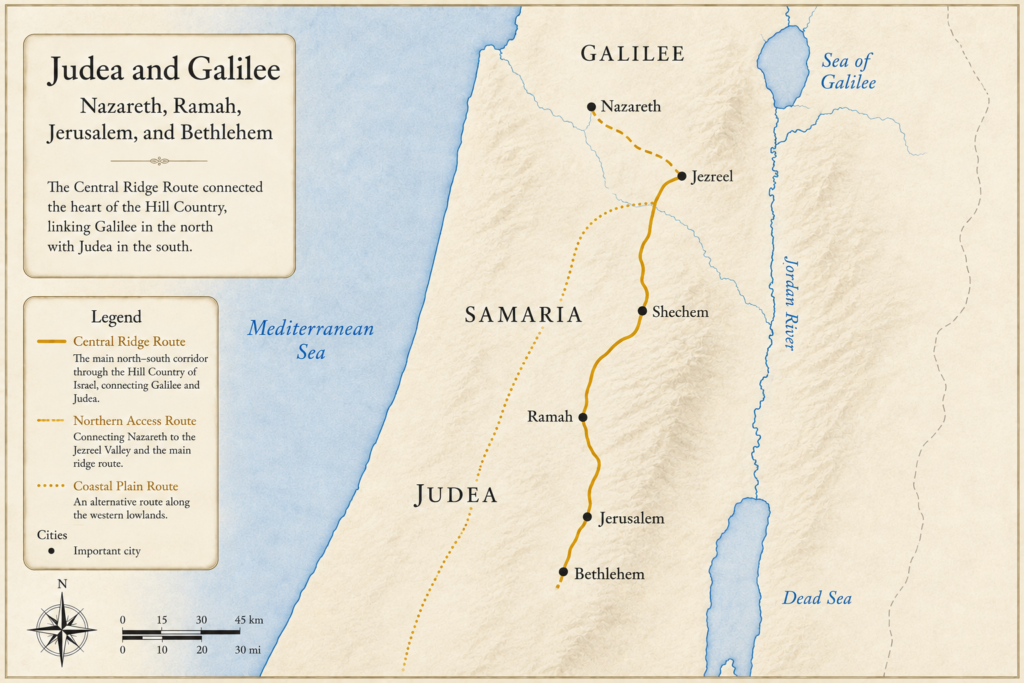
But what does this have to do with Rachel? For one thing, Rachel died in childbirth. Another, she was buried in Bethlehem.
“So Rachel died and was buried on the way to Ephrath (that is, Bethlehem). Jacob set up a stone monument over Rachel’s grave, and it can be seen there to this day” (Gen. 35: 19-20 NLT).
Another reason is Rachel is seen as the primary mother of Israel. Her grandsons, Ephraim and Manasseh, were the leaders of Israel’s leading tribes.
Matthew used this to remind his readers something we don’t catch. He was equating the present sorrow to a past sorrow. This showed first-century Jews that the exile wasn’t truly over. The Messiah was entering into that suffering.
Being Called Back
“When Herod died, an angel of the Lord appeared in a dream to Joseph in Egypt. ‘Get up!’ the angel said. ‘Take the child and his mother back to the land of Israel, because those who were trying to kill the child are dead’ So Joseph got up and returned to the land of Israel with Jesus and his mother. But when he learned that the new ruler of Judea was Herod’s son Archelaus, he was afraid to go there. Then, after being warned in a dream, he left for the region of Galilee. So the family went and lived in a town called Nazareth. This fulfilled what the prophets had said: “He will be called a Nazarene” (Mt. 2: 19-23 NLT)
Called through a Dream
Joseph had another dream.
Once again, Joseph had a dream. Once again, he obeyed immediately. Joseph was given the all-clear to return home.
The problem was Archelaus was now ruler. Joseph would have known him as one of Herod the Great’s sons.
Upon the death of Herod the Great, his kingdom was divided among his sons. Archelaus’ portion included Judea, Samaria, and Idumea. His rule lasted from 4 BC to AD 6.
Unlike his father, Archelaus was not a king. However, he was cruel and ruthless – as Herod was.
It was probably because of this, Joseph’s fear in Matthew 2: 22 is understandable.
Look at that. When told to go, Joseph went. But when he found out who was ruling, he changed plans.
Nazareth
It appears that Joseph wasn’t going back to Nazareth at first.
Let’s put it together. Joseph was going back there, but he was afraid because Archelaus ruled there. Where did Archelaus rule? Judea, Samaria, and Idumea.
Idumea wasn’t part of Israel, so they weren’t headed there. They wouldn’t have gone to Samaria, either.
That means they were headed to Judea.
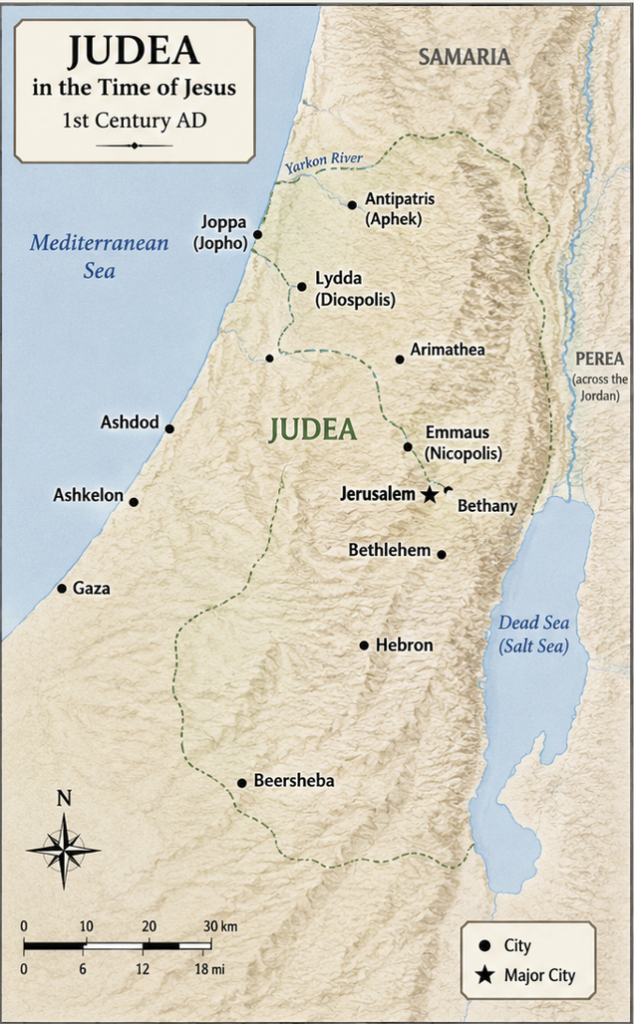
That meant – to me – that Joseph was taking his family to Bethlehem or Jerusalem.
Think about it. Mary and Joseph knew they were parents to the Messiah. They probably thought they needed to be in Bethlehem or Jerusalem.
How does that change our thoughts about the perceived Matthew and Luke discrepancy? Maybe they didn’t go back to Nazareth after Yeshua’s birth. Maybe it was always their intent to stay in Bethlehem or Jerusalem.
Jehovah, however, makes sure that thing go according to His plan.
He Will be Called a Nazarene
Matthew said the family returned to Nazareth to fulfill prophecy.
We may think Joseph chose to take his family to Nazareth because that was their hometown, as Luke said. However, Joseph had another dream, telling him to go to Galilee.
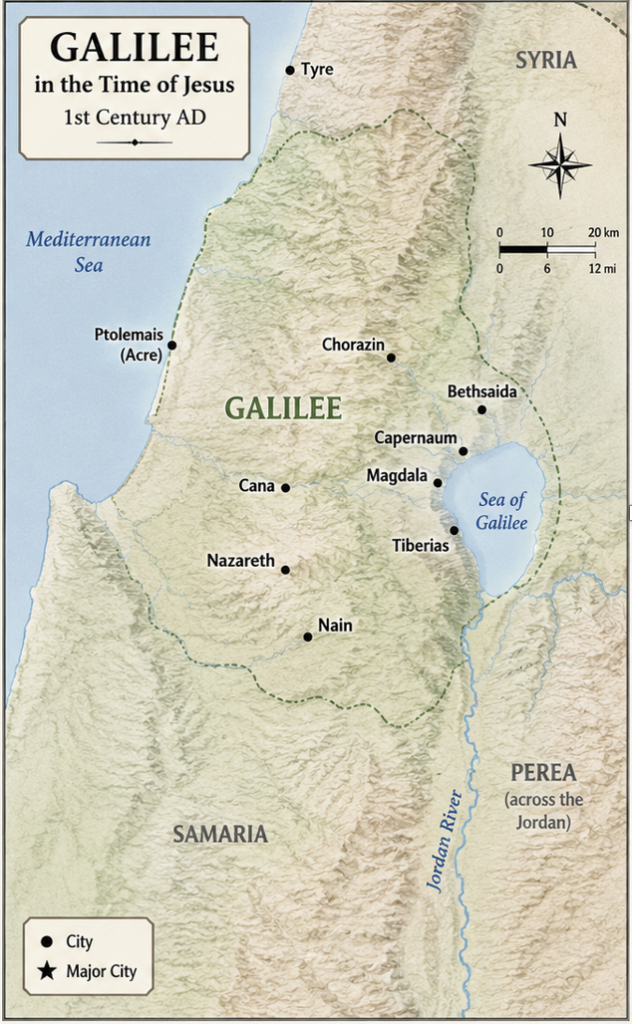
The way “… He will be called a Nazarene” (Mt. 2: 23 NLT) is written, it looks like it should be a quote. It isn’t a direct quote.
But Matthew did use prophets — plural — describing who said it. That means we have to make the connections.
What Matthew may have been getting at was that Yeshua fulfilled the Branch prophecy.
- “Out of the stump of David’s family will grow a shoot — yes, a new Branch bearing fruit from the old root” (Isa. 11: 1 NLT).
- “‘For the time is coming,’ says the Lord, ‘when I will raise up a righteous descendant from King David’s line. He will be a King who rules with wisdom. He will do what is just and right throughout the land” (Jer. 23: 5 NLT)
- “Tell him, ‘This is what the Lord of Heaven’s Armies says: Here is the man called the Branch. He will branch out from where he is and build the Temple of the Lord’” (Zech. 6: 12 NLT).
Melville made an interesting comment. He wrote, “This murder would enable Jesus to live in obscurity until thirty years of age. Brought up at Nazareth, He was regarded as a Nazarite. The slaughter of the innocents would prove His birth at Bethlehem.”
Resource
Hmmmm. Did Melvill believe that Mary and Joseph would have chosen to live in Jerusalem – maybe even Bethlehem? If they didn’t have to go through the abject terror of fleeing for Yeshua’s life, they might have chosen to live somewhere else than this obscure village.
However, it was Nazareth where Jehovah wanted His Son to live. Well, after He got home from Egypt.
Heart Check
Think about the battle Yeshua is engaged in for your heart. Ask yourself the following questions.
- When Jehovah changes my plans, am I willing to trust Him and obey, or do I struggle when I don’t understand what He is doing?
- When I don’t have all the answers, do I trust what Jehovah has revealed, or do unanswered questions make me doubt His Word?
- Am I looking for Jehovah to show me the whole path, or am I willing to obey the next step He gives me?
How Do We Apply This?
- Obey promptly when Jehovah makes the next step clear, even when I don’t know what comes next.
- Trust Jehovah with what I cannot understand.
- Remember that Jehovah is working even when circumstances look chaotic.
- Don’t let unanswered questions about Scripture shake my confidence in Scripture.
- Look for the next step, not the whole map.
Father God. You control everything. You protect us so that Your Will can be accomplished. Thank You that You protected Yeshua so that He could become our Savior. Amen.
If you don’t understand something and would like further clarification, please contact me.
If you have not signed up for the email providing the link to the devotions and the newsletter, do so below.
If God has used this devotion to speak with you, consider sharing it on social media.