While Mary and Joseph were fulfilling Jehovah’s laws in the Temple, two people recognized Baby Yeshua for Who He was. This devotional reading looks at Simeon and Anna’s interaction with the Messiah.
Nuggets
- Mary and Joseph met Simeon in the Temple.
- Simeon entered the story because he walked with Jehovah.
- Like so many in Israel, Simeon was waiting for the coming of the Messiah.
- Simeon was led by the Holy Spirit to go to the Temple that day.
- Jehovah pressed upon Simeon’s heart that he would not die before he had seen the Messiah.
- Simeon not only got to see the Messiah, but he also got to hold him.
- Simeon was highlighting more than just his promise.
- Yeshua is the Savior of Jews and Gentiles.
- Simeon was pointing us back to Jehovah’s glory.
- Simeon had some prophetic words for Mary, but they weren’t necessarily a comfort.
- Covenants usually require signs.
- The deepest thoughts of hearts are whether they choose Yeshua or not.
- Simeon prophesied how Mary would be affected by Yeshua’s rejection.
- A woman who was also in the Temple that day recognized the Messiah.
We are told to watch and wait for the return of the Messiah. In first-century Israel, they were waiting for Him to make His first appearance.
Two such people were Simeon and Anna. Mary and Joseph encountered them when they presented Yeshua in the Temple.
More importantly, they encountered Him.
Let's Put It into Context
To read devotions in The Battle for the Heart theme
Devotions in the The Birth and Early Childhood of Christ series
The Prophecy of Simeon (Shim‘on)
“At that time there was a man in Jerusalem named Simeon. He was righteous and devout and was eagerly waiting for the Messiah to come and rescue Israel. The Holy Spirit was upon him and had revealed to him that he would not die until he had seen the Lord’s Messiah. That day the Spirit led him to the Temple. So when Mary and Joseph came to present the baby Jesus to the Lord as the law required, Simeon was there. He took the child in his arms and praised God, saying, ‘Sovereign Lord, now let your servant die in peace, as you have promised. I have seen your salvation, which you have prepared for all people. He is a light to reveal God to the nations, and he is the glory of your people Israel!’” (Lk. 2: 25-32 NLT)
Simeon
Mary and Joseph met Simeon in the Temple.
We aren’t told anything about who Simeon was. We don’t know if he lived in Jerusalem or was visiting. We don’t know his age – other than assuming he was old. We don’t know his family status: never married, married, widower.
What we do know is what Simeon was in Jehovah’s eyes.
Righteous and Devout
Simeon entered the story because he walked with Jehovah.
Simeon was described as righteous and devout. To be a tzaddik (צַדִּיק) – or a righteous person – is to faithfully walk according to Jehovah’s covenant. That is the Abrahamic covenant.
In other words, Simeon’s condition and character were right.
It isn’t talking about sinless perfection here. Instead, it shows someone whose life is spent in covenant faithfulness. This standing is based on Jehovah’s gracious acceptance.
Devout — chasid (חָסִיד) – is the attitude of holding Jehovah in reverence and treating Him, His holiness, His worship, and His revealed Will with careful respect and faithful obedience.
Devoutness is, therefore, an attitude toward Jehovah that affects conduct. Simeon felt His presence and performed all his acts and thoughts for Him.
Holy Spirit Was upon Him
Simeon was led by the Holy Spirit to go to the Temple that day.
In the Old Testament, the Holy Spirit didn’t dwell in people as He did after Pentecost. The Holy Spirit is the One Who brought Simeon to the Temple that day.
Could Simeon have been a priest? He may have been – it just wasn’t his rotation that day.
But nothing leads us to believe that. All we are told is that Simeon lived in Jerusalem.
What we are told is that this was a prophetic moment. Simeon was there because of divine timing.
He Would not Die
Jehovah pressed upon Simeon’s heart that he would not die before he had seen the Messiah.
There are times Jehovah lets us know what He has in store for us. This was one of them.
You have to think that the promise was given because Simeon was so righteous and devout. Probably.
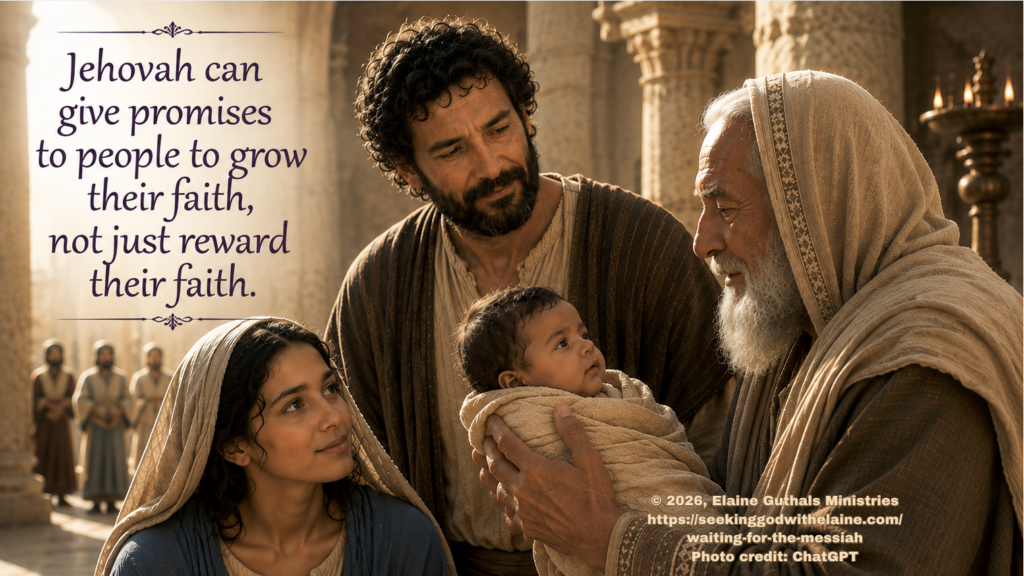
But Jehovah can give promises to the righteous and devout – who don’t feel they are so righteous and devout. He can give promises to people to grow their faith, not just reward their faith.
Took the Child in His Arms
Simeon not only got to see the Messiah, but he also got to hold Him.
We aren’t told anything about the moment of recognition. Yeah, it would have been great to know the joy and wonderment Simeon was feeling.
It seems like Simeon immediately knows. The Holy Spirit didn’t make him wait.
There was no waiting on Simeon’s part. No hesitation. No sign needed.
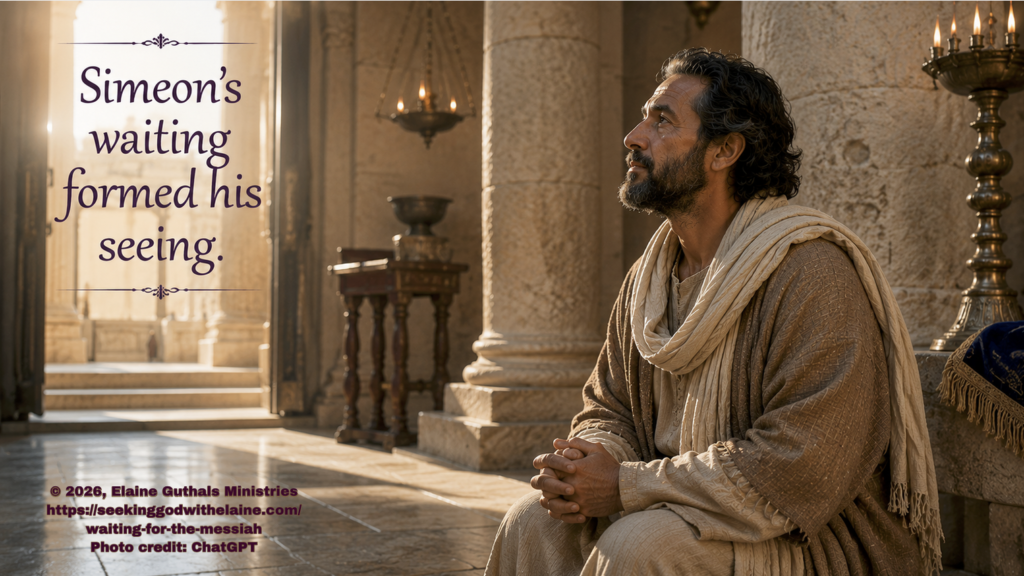
Simeon’s waiting formed his seeing.
That is where Simeon’s faith is displayed most strongly. Waiting is one thing, but what if we refuse to believe when the promise is fulfilled? We have to exercise faith then, too.
Seen your Salvation
Simeon was highlighting more than just his promise.
Yes, Simeon used I-type statements. Your servant (Lk. 2: 29). I have seen (Lk. 2: 30).
But Simeon quickly transitions to Your salvation (Lk. 2: 30) and prepared for all people (Lk. 2: 31).
Simeon wasn’t only celebrating that he had seen the Messiah. He was also celebrating that the Messiah had come – and brought the promised salvation.
- “He says, ‘You will do more than restore the people of Israel to me. I will make you a light to the Gentiles, and you will bring my salvation to the ends of the earth” (Isa. 49: 6 NLT).
- “‘The Redeemer will come to Jerusalem to buy back those in Israel who have turned from their sins,’ says the Lord” (Isa. 59: 20 NLT).
That is for which Simeon was waiting. That makes him saying “I’ve been waiting for the consolation” and I’ve seen your salvation” so powerful.
Consolation – nechamah (נֶחָמָה) – talks about restoration. Salvation – Yeshuah (יְשׁוּעָה) – means deliverance and rescue.
What Simeon was saying was, “I have seen your Yeshuah (יְשׁוּעָה).
We say that salvation is a process. It is more than that. It is a Person.
Prepared for All People
Yeshua is the Savior of Jews and Gentiles.
Was Simeon like so many other first-century Jews looking for a military messiah? I don’t think so.
Simeon’s expectation clearly transcended a merely political salvation.
All people would have included the Gentiles. Many first-century Jews wouldn’t have seen Messiah coming for Gentiles.
Simeon connected the light — or (אוֹר) – for the nations phrase from prophecy. Go back and reread Isaiah 49: 6 in the last section.
- “The people who walk in darkness will see a great light. For those who live in a land of deep darkness, a light will shine” (Isa. 9: 2 NLT).
- “I, the Lord, have called you to demonstrate my righteousness. I will take you by the hand and guard you, and I will give you to my people, Israel, as a symbol of my covenant with them. And you will be a light to guide the nations” (Isa. 42: 6 NLT).
- “Arise, Jerusalem! Let your light shine for all to see. For the glory of the Lord rises to shine on you. Darkness as black as night covers all the nations of the earth, but the glory of the Lord rises and appears over you. All nations will come to your light; mighty kings will come to see your radiance” (Isa. 60: 1-3 NLT).
Remember, this is the same light as used in Genesis 1: 3. “Then God said, ‘Let there be light,’ and there was light” (Gen. 1: 3 NLT).
This is Jehovah’s shekinah – His presence.
Think about it, Yeshua was born and raised in obscurity. His death was anything but hidden. His coming is going to be not only world-wide but for everyone past and present at that time.
The Glory of Your People Israel!
Simeon was pointing us back to Jehovah’s glory.
So, what does the glory (kavod – כָּבוֹד) of Jehovah’s people mean? Does it mean He is bringing them status?
No.
- “For I am ready to set things right, not in the distant future, but right now! I am ready to save Jerusalem and show my glory to Israel” (Isa. 46: 13 NLT).
- “Arise, Jerusalem! Let your light shine for all to see. For the glory of the Lord rises to shine on you” (Isa. 60: 1 NLT).
Jehovah’s glory is associated specifically with Jerusalem/Israel and God’s saving action toward His covenant people. Israel has its role in His redemptive plan.
Notice, Simeon says the Child is the glory of Israel. That ties back into Messianic prophecy and expectations.
Blessing Mary and Joseph
Jesus’ parents were amazed at what was being said about him. Then Simeon blessed them, and he said to Mary, the baby’s mother, ‘This child is destined to cause many in Israel to fall, and many others to rise. He has been sent as a sign from God, but many will oppose him. As a result, the deepest thoughts of many hearts will be revealed. And a sword will pierce your very soul’” (Lk. 2: 33-35 NLT)
Destined to Cause Many in Israel to Fall and Rise
Simeon had some prophetic words for Mary, but they weren’t necessarily a comfort.
First, Simeon reminded Mary that the Messiah would be rejected. Walk through this with me.
From the Suffering Servant passage in Isaiah, “He was despised and rejected — a man of sorrows, acquainted with deepest grief. We turned our backs on him and looked the other way. He was despised, and we did not care” (Isa. 53: 3 NLT).
No, most first-century Messianic expectations didn’t connect the Messiah with suffering. We really don’t read that they felt the Messiah would be rejected.
But from the very first prophecy, Jehovah clearly stated that the Messiah would suffer. “And I will cause hostility between you and the woman, and between your offspring and her offspring. He will strike your head, and you will strike his heel” (Gen. 3: 15 NLT).
We may read this to mean all humans are going to become victims of Satan. If this is a messianic prophecy – and it is – wouldn’t that also mean attacks on the Messiah?
The wording just guarantees attacks. To me, it doesn’t guarantee Satan is successful.
But attacks can be painful. Satan thought he was attacking Yeshua by sending Him to the cross.
That was painful.
Satan found out too late that it was Yeshua’s plan all along that He end up there. He found out it was Jehovah controlling the plan.
Let’s go back to something we just bowled over. Messiah could be rejected.
The salvation Yeshua secured with His death and resurrection is offered to us as a gift. It is up to us to accept or reject it.
Rejecting Yeshua means the falling (naphal – נָפַל). Accepting Him means the rising (qum – קוּם)
Oh, yeah. Accepting salvation is much more beneficial than rejecting it. Still, we are offered a choice.
This brings division. “Do you think I have come to bring peace to the earth? No, I have come to divide people against each other! From now on families will be split apart, three in favor of me, and two against—or two in favor and three against. ‘Father will be divided against son and son against father; mother against daughter and daughter against mother; and mother-in-law against daughter-in-law and daughter-in-law against mother-in-law’” (Lk. 12: 51-53 NLT).
That definitely didn’t jibe with first-century Messianic expectation.
Sent as a Sign from God
Covenants usually require signs.
Don’t misread this. It isn’t saying that Yeshua would perform signs – miracles – so people would know who He was. Yes, He did do that.
This said that Yeshua WAS the sign – ot (אוֹת).
Wait! How does a sign fit into light and division?
Yeshua is Jehovah’s sign that His promised salvation has arrived.
Let’s look at it this way. A covenant almost always included a sign.
Yeshua’s coming was as fulfillment of the promises of the Abrahamic covenant. More importantly, He was bringing a new covenant.
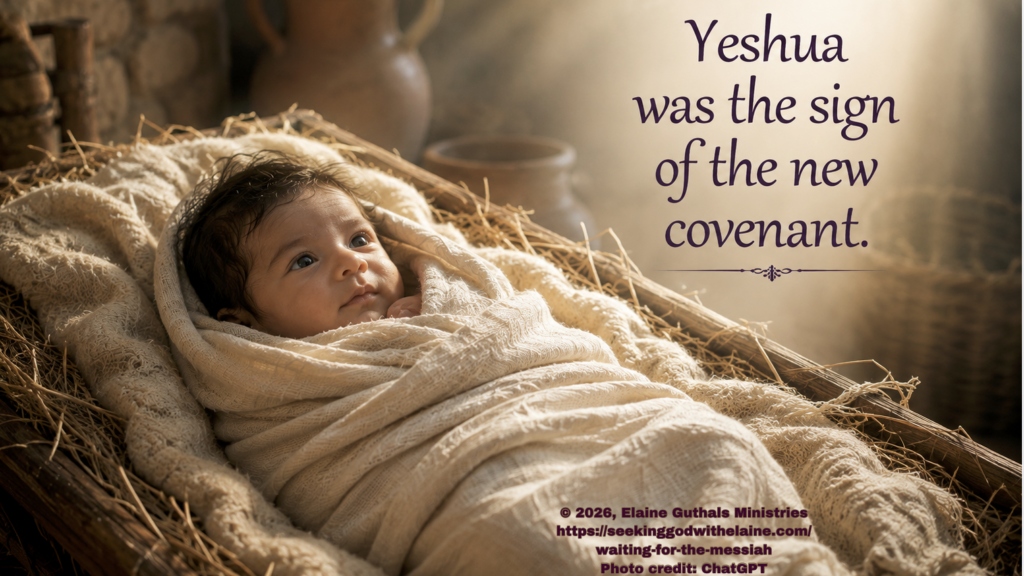
Yeshua was the sign of the new covenant. This new covenant focused on the battle of the heart.
We have to choose if we are going to submit our lives to Yeshua and Jehovah or not. The choice is ours.
That choice follows a pattern that Jehovah established way back in Genesis. Going back to Cain and Abel, Jehovah separated those who followed Him from those who didn’t.
Division? That can happen on our end.
The Deepest Thoughts of Many Hearts Revealed
The deepest thoughts of hearts are whether they choose Yeshua or not.
At the end of the age, Yeshua will separate believers from unbelievers. “He will place the sheep at his right hand and the goats at his left” (Mt. 25: 33 NLT).
The separation into believer and nonbelievers is based on the condition of the heart – where the thoughts rest.
Wait! How would Yeshua know what we think? Well, He does.
- “Jesus knew what they were thinking, so he asked them, ‘Why do you have such evil thoughts in your hearts?’” (Mt. 9: 4 NLT; Lk. 5: 22 NLT).
- “But Jesus didn’t trust them, because he knew all about people. No one needed to tell him about human nature, for he knew what was in each person’s heart” (Jn. 2: 24-25 NLT).
- “‘But some of you do not believe me.’ (For Jesus knew from the beginning which ones didn’t believe, and he knew who would betray him.)” (Jn. 6: 64 NLT).
Yeshua knows our thoughts, especially when they apply to our relationship with Him.
A Sword Will Pierce Your Soul
Simeon prophesied how Mary would be affected by Yeshua’s rejection.
When Gabriel told Mary that she would be a mother, he didn’t tell her about the hard part of the job. But then a mother always feels for their child.
The sword (cherev – חֶרֶב) was figurative. Simeon warned Mary about the rejection and suffering. He didn’t say that it was ultimately fulfilled in the cross.
Still, Mary knew from Yeshua being a month old that it would be hard for her.
The Prophecy of Anna (Chanah)
“Anna, a prophet, was also there in the Temple. She was the daughter of Phanuel from the tribe of Asher, and she was very old. Her husband died when they had been married only seven years. Then she lived as a widow to the age of eighty-four. She never left the Temple but stayed there day and night, worshiping God with fasting and prayer. She came along just as Simeon was talking with Mary and Joseph, and she began praising God. She talked about the child to everyone who had been waiting expectantly for God to rescue Jerusalem” (Lk. 2: 36-38 NLT)
A woman who was also in the Temple that day recognized the Messiah.
Luke gave us more information regarding Anna. She was a widow for around 60 years, making her elderly.
Being of the tribe of Asher, Anna was Galilean.
Like Simeon, she was devout. We are told that she never left the Temple.
Also, like Simeon, Anna recognized the Messiah.
Luke said that Anna witnessed to anyone who would listen. “… and spoke of Him to all those who looked for redemption in Jerusalem” (Lk. 2: 38 ESV).
Isn’t that a little strange? First-century Jewish women weren’t considered reliable witnesses.
Where Simeon prayed, Anna praised. She worshiped.
Making the Connections #1
Why was it important for us to meet Simeon and Anna? They were bridge figures between the Old Testament and the New Testament.
Simeon was a prophet who followed the lead of the Holy Spirit. He spoke the divine truth.
Anna was a prophet who worshiped and speaks about Him to those who were already waiting for redemption in Jerusalem.
Making the Connections #2
We don’t want to miss the theology flow.
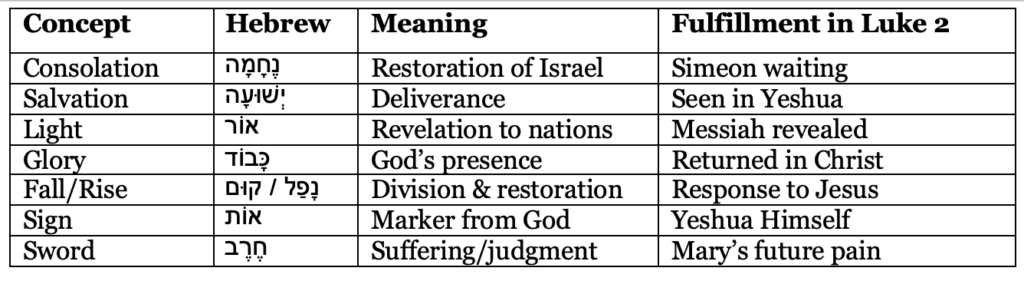
Simeon recognizes in Yeshua the long-awaited נֶחָמָה (consolation) of Israel and declares Him to be יְשׁוּעָה (salvation), אוֹר (light) to the nations, and כָּבוֹד (glory) to Israel — while foretelling that He will become an אוֹת (sign) that brings both נָפַל (fall) and קוּם (rising), and a חֶרֶב (sword) of suffering.
Making the Connections #3
Jehovah was making the rounds. Already He had brought a childless elderly couple into the plan. His plan hinged on the obedience of a faithful teenager and a righteous man.
The birth announcement was given to lowly shepherds and foreign astronomers (who may also have been priests).
Now, within the walls of His Temple, Jehovah fulfilled His promises to faithful servants.
While He was doing this, Yeshua was fulfilling everything required of Him as a human. Everything a common first-century Jewish boy experienced, He experienced.
Yeshua was fulfilling the law and prophecy. All that transpired fulfilled the prophecy in Micah. “‘In that coming day,’ says the Lord, ‘I will gather together those who are lame, those who have been exiles, and those whom I have filled with grief. Those who are weak will survive as a remnant; those who were exiles will become a strong nation. Then I, the Lord, will rule from Jerusalem as their king forever.” (Mic. 4: 6-7 NLT).
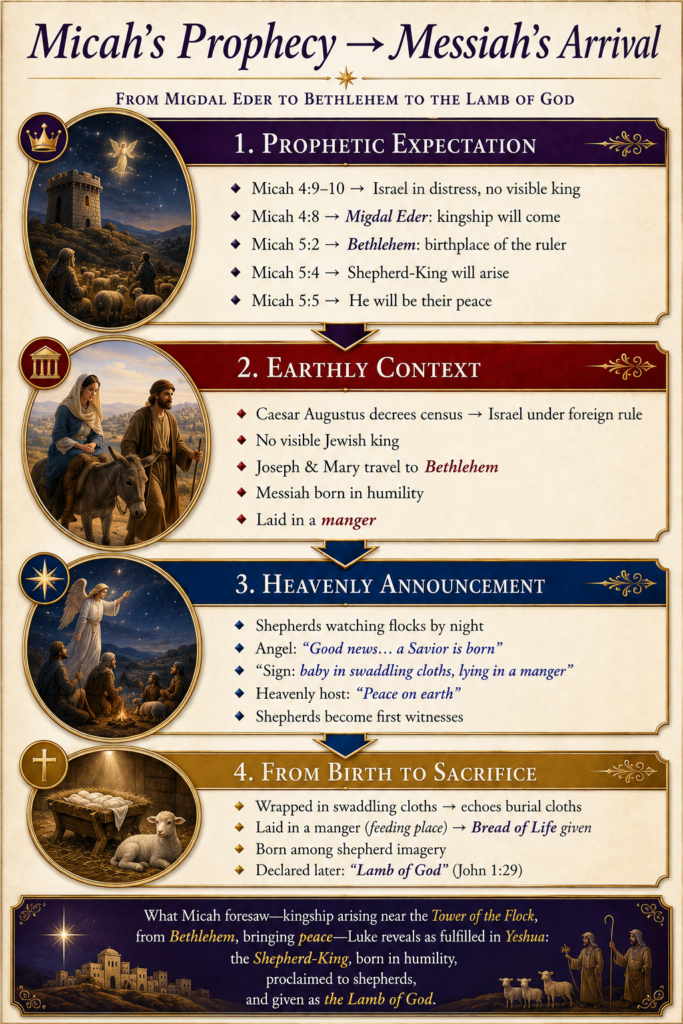
Micah’s prophecy had followed a progression.
- Distress under foreign rule
- No visible king in Israel
- Promise of restoration begins
- Migdal Elder: watching the flock
- Kingship will return
- Bethlehem named
- Ruler will be born
- Shepherd-King
- He will bring peace
Heart Check
Think about the battle Yeshua is engaged in for your heart. Ask yourself the following questions.
- Am I willing to wait on Jehovah, even when I cannot yet see how He will fulfill His promise?
- When Jehovah fulfills a promise differently than I expected, will I recognize what He is doing?
- Does my heart truly belong to Yeshua, or am I still trying to decide whether I will submit to Him?
- What do my thoughts, choices, and responses reveal about the condition of my heart?
- Am I willing to let Yeshua reveal what is really in my heart, or will I resist what He shows me?
How Do We Apply This?
- Wait faithfully when Jehovah gives you a promise but not the timetable.
- Let His Word shape what you expect from Him rather than allowing your expectations to shape His Word.
- When Jehovah fulfills a promise, look for His hand—even when the fulfillment does not look the way you imagined.
- Choose Yeshua every day, knowing that following Him may bring division or rejection.
- Let Yeshua examine your heart and bring anything that needs to change into His light.
Father God. Help us to wait as Simeon and Anna did for Yeshua’s first coming. Let us be watching for His second coming. Not only let us recognize Him, but let Him also recognize us. Amen.
If you don’t understand something and would like further clarification, please contact me.
If you have not signed up for the email providing the link to the devotions and the newsletter, do so below.
If God has used this devotion to speak with you, consider sharing it on social media.