Yeshua had some important visitors. This devotional reading looks at who the Magi may have been and how they got where they needed to be.
Nuggets
- Herod the Great was egotistical and self-centered.
- Men from a far-off country were led to worship Yeshua.
- The wise men – who had given up a lot to get there – arrived in Jerusalem because that was where the palace was.
- The Magi asked the king about the birth of the King of the Jews.
- The Magi were guided by a star.
- We tend to think that Herod was disturbed about the question the Magi were asking.
- King Herod went to those that would be in the know to find the answer to the Magi’s question.
- The religious leaders Herod contacted found the prophecy in Micah.
- Herod set up a chance to talk with the men privately.
- The Magi not only saw the star but also followed it to Jerusalem.
- We don’t know when the Magi made their journey.
- The Magi obeyed Jehovah.
The birth of Yeshua was not hidden from everyone. From the east came men who had seen His star and traveled a great distance to find the newborn King. But when they arrived in Jerusalem, they discovered that knowing where to look would require more than following a star.
Let's Put It into Context
To read devotions in The Battle for the Heart theme
Devotions in the The Birth and Early Childhood of Christ series
Jesus Was Born in Bethlehem
“Jesus was born in Bethlehem in Judea, during the reign of King Herod. About that time some wise men from eastern lands arrived in Jerusalem, asking, ‘Where is the newborn king of the Jews? We saw his star as it rose, and we have come to worship him’” (Mt. 2: 1-2 NLT)
Reign of King Herod
Herod the Great was egotistical and self-centered.
Herod ruled the Jews but was not of the Davidic line. To make matters worse, he was chosen to be King of the Jews by Octavian Augustus and the Roman Senate around 40 BC.
Herod tried to curry the favor of his subjects by rebuilding the Temple and funding public works. However, he alienated many by his close ties with Rome and his violent and unpredictable behavior.
In 4 BC, Herod died. It is believed John the Immerser and Yeshia were both born in the last year of his life.
A good summary of Herod’s reign would be that he was a false king. He reigned through power, fear, and death. Yet he set the stage for the Messiah, who reigned in humility and divine authority.
Wise Men from Eastern Lands
Men from a far-off country were led to worship Yeshua.
Some versions translate it as wise men. Other use the word Magi.
So, who were these people? We don’t know for sure. Some of that uncertainty can be attributed to how words are translated.
Wise men were astronomers. They interpreted celestial signs.
While Magi were also astronomers, they were likely priests from Persia/Babylonia. They also interpreted dreams.
The problem is that the Greek word can mean magician or sorcerer. That would be someone who dealt in occult knowledge.
Nowhere does it say the Magi were kings. Instead, they were highly educated scholars or priests.
Nowhere does it say there was just three. We assume that because there was three gifts.
I am sure there was a whole contingent from the far east, as that would have been an 800-900 mile treacherous and dangerous trip. Got Questions said that there would have been servants and soldiers along.
Resource
Most people have come to see them as non-Jews. But why would Jehovah summon Gentiles before summoning the Jews?
I can see that they were Gentiles. The star was shown to those from the far east. Jews were expected to be living only in Israel at that time.
But were they Gentiles? The Complete Jewish Study Bible offered archeological evidence that the Magi were neither Gentile nor astronomers. Benner agreed with this.
Resource
What if they were, in fact, Jews linked to Daniel’s time during the exile to Babylon? No, I’d never thought of it this way, so let’s dig in a second.
Jerusalem was captured by the Babylonians in 597 BC. The Jews were defeated by them in 586 BC. They were in exile 70 years.
But when they were allowed to go back to Israel, all of them didn’t just pick up and go back. They came in three waves.
- 538 BC under Zerubbabel
- About 458 BC under Ezra
- 445/444 BC under Nehemiah
Some second- or third-generation Jewish Babylonians didn’t want to leave. Gutknecht estimated that, of the 15,000 men that were exiled (II Kgs. 24: 14-16; Jer. 52: 28-30). It is estimated that 42,360 returned — meaning 80% of the Jewish population living in Babylon after 70 years remained there.
Resource
All they knew was their lives in Babylon, lives in which they had become productive members of society.
It makes sense that they would have been descendants from exiled Jews who chose to stay. They would have had access to Daniel’s prophesy.
“Now listen and understand! Seven sets of seven plus sixty-two sets of seven will pass from the time the command is given to rebuild Jerusalem until a ruler—the Anointed One — comes. Jerusalem will be rebuilt with streets and strong defenses, despite the perilous times” (Dan. 9: 25 NLT).
Remember, Daniel was chief of the court seers in Persia in his time (Dan. 2: 48). Seers was another name for prophets.
Daniel may also have turned them on to Numbers 24: 17 as it was prophecy. We’ll talk about that one in a minute.
Arrived in Jerusalem
The wise men – who had given up a lot to get there – arrived in Jerusalem because that was where the palace was.
Bethlehem was David’s hometown and the place where he was anointed, but Jerusalem became his capital. Only six miles north of Bethlehem, Jerusalem became his capital after upon his capture of it from the Jebusites, traditionally dated around 1003 BC.
There was reasons for making Jerusalem the capital. Jerusalem was strategically located between the northern and southern tribal territories and wasn’t identified as the possession of one Israelite tribe. That made the capital politically neutral.
King of the Jews
The Magi asked the king about the birth of the King of the Jews.
The Greek phrase is basileus tōn Ioudaiōn (βασιλεὺς τῶν Ἰουδαίων) — King of the Jews. In Hebrew, this is Melech HaYehudim. Melech means king, while Yehudim is the Hebrew word for Jews.
Yehudim comes from Yehudah – Judah – but by the first century it had become the normal designation for the Jewish people. Remember, when the kingdom divided, the Southern Kingdom comprised of Judah and Benjamin. They became known as the Jews.
His Star
The Magi were guided by a star.
When I was younger, I questioned how the Magi would know there would be a star to mark the Messiah’s birth. Answer, it was prophesied.
“I see him [Jehovah], but not here and now. I perceive him, but far in the distant future. A star will rise from Jacob; a scepter will emerge from Israel. It will crush the heads of Moab’s people, cracking the skulls of the people of Sheth” (Num. 24: 17 NLT emphasis added).
In God’s Word, stars symbolize glory and triumph. Both were on full display that night for the magi and shepherds.
Herod Questioned the Priests and Teachers
“King Herod was deeply disturbed when he heard this, as was everyone in Jerusalem. He called a meeting of the leading priests and teachers of religious law and asked, ‘Where is the Messiah supposed to be born?’ ‘In Bethlehem in Judea,’ they said, ‘for this is what the prophet wrote: “And you, O Bethlehem in the land of Judah, are not least among the ruling cities of Judah, for a ruler will come from you who will be the shepherd for my people Israel.” Then Herod called for a private meeting with the wise men, and he learned from them the time when the star first appeared. Then he told them, ‘Go to Bethlehem and search carefully for the child. And when you find him, come back and tell me so that I can go and worship him, too!’” (Mt. 2: 3-8 NLT)
Deeply Disturbed
We tend to think that Herod was disturbed about the question the Magi were asking.
As paranoid as Herod was, I am sure that he didn’t want to hear that a new king had been born. He would have known of their distrust of a king who was not a Jew.
Yeah, Herod would have been upset by the question. We know he saw this baby as a threat to his rule.
I wonder if Herod was also disturbed because a large contingent of foreigners showed up unannounced. That also seems logical to me.
But would that have upset everyone in Jerusalem? Herod was not especially liked as a king. They probably wouldn’t have been upset about a threat to him.
They would, however, been upset if they thought the Magi were there to make war on the city of Jerusalem. That would have put them in danger.
I can see that response to anywhere from a couple of dozen to a couple of hundred people showing up.
Leading Priests and Teachers of Religious Law
King Herod went to those that would be in the know to find the answer to the Magi’s question.
Of course, Herod went to the priests and scribes. The priests were representatives of Jehovah.
Don’t think of the word scribe as just a glorified robot copying word for word what the scrolls said. When there was a question, they were the ones to research God’s Word to determine the answer. Then they were to teach the Torah.
We might think that the religious leaders, upon knowing the prophecy had been fulfilled, would be asking the Magi if they would mind them tagging along. Why didn’t they speed to Bethlehem and find the Christ Child?
It sounds like they just gave Herod the answer he wanted – and dropped it.
This is just another example of what happens when you have knowledge but no response. Nothing happened. They didn’t meet their Savior.
Was it because they considered the Magi Gentiles – even if they were part of the Lost Tribes of Israel? Did they think Jehovah wouldn’t announce the birth of the Messiah to anyone but them?
Bethlehem
The religious leaders Herod contacted found the prophecy in Micah.
“But you, O Bethlehem Ephrathah, are only a small village among all the people of Judah. Yet a ruler of Israel, whose origins are in the distant past, will come from you on my behalf” (Mic. 5: 2 NLT).
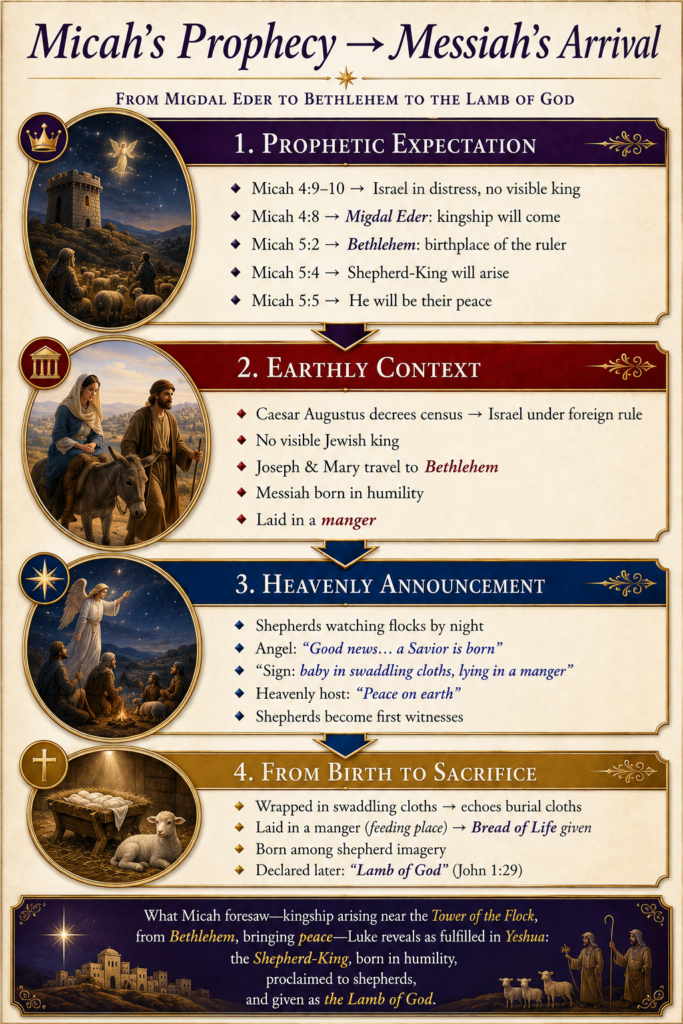
What is the significance of this? This allowed Matthew to tie Matthew to Messianic prophecy.
But it is also important that the religious leaders identified Messiah. The religious leaders had to learn that Messiah was in the world.
Why does Micah emphasize that Bethlehem is “too little” or insignificant among Judah’s clans? We talked about how Nazareth and Bethlehem were both smaller villages.
Bethlehem, unlike Nazzareth, had history, identity, and prophetic weight.
Private Meeting
Herod set up a chance to talk with the men privately.
Does that seem strange to you?
If his real purpose was to worship the King of the Jews, why would Herod want to keep that from his court? Wouldn’t he think they would be wanting to do the same thing?
But no. Herod goes into stealth mode. He spoke with the Magi privately.
Because we have hindsight, we know that worship of the King was not Herod’s intent. Worship was not the objective.
Headed to Bethlehem
“After this interview the wise men went their way. And the star they had seen in the east guided them to Bethlehem. It went ahead of them and stopped over the place where the child was. When they saw the star, they were filled with joy! They entered the house and saw the child with his mother, Mary, and they bowed down and worshiped him. Then they opened their treasure chests and gave him gifts of gold, frankincense, and myrrh” (Mt. 2: 9-11 NLT)
When They Saw the Star
The Magi not only saw the star but also followed it to Jerusalem.
When I was younger, I wondered how the Magi would know that a star would mark the Messiah’s birth. The answer may be found in prophecy.
“‘I see him, but not here and now. I perceive him, but far in the distant future. A star will rise from Jacob; a scepter will emerge from Israel. It will crush the heads of Moab’s people, cracking the skulls of the people of Sheth’” (Num. 24: 17 NLT).
Balaam wasn’t speaking about a star in the sky in isolation. He was prophesying about a ruler who would arise from Israel. The star and the scepter appear together — a sign of kingship.
That makes the Magi’s statement interesting. They didn’t simply say they had seen a star. They said, “We saw his star as it rose.” They understood the celestial sign as connected to a particular King.
And where did that star lead them? To Jerusalem.
That makes sense. They were looking for a king, and Jerusalem was the capital. They had come a tremendous distance because they believed the sign meant that a King had been born.
But the star didn’t give them everything they needed to know.
They still had to ask.
They came to Jerusalem asking, “Where is the newborn King of the Jews?” Their observation of the heavens had gotten them to the right country and the right city, but they needed God’s written Word to tell them where the King would be found.
That matters.
Creation can point us toward Jehovah. Signs can awaken our attention. But we need His Word to understand what we are seeing.
The Magi followed the light they had been given. Then, when they needed more direction, they asked.
And Jehovah gave them the answer through Scripture.
Entered the House
We don’t know when the Magi made their journey.
What we do know is they didn’t show up at the stable. Where, then, did they go?
But remember our discussion on Luke 2: 7? While there were inns in first-century Israel, it is more likely that there was no room in the guest room at Joseph’s family’s house. They were given shelter where his family kept their animals – which was probably an addition to the house.
Look at the Greek here. It is oikia (οἰκία) – house. Luke 2: 7 uses the Greek katalyma (κατάλυμα) – which can mean guest room.
Bottom line, though. We don’t know whose house it was. It may have been a family home or another dwelling where Joseph’s family could stay. Matthew didn’t tell us any more than Luke did. Matthew simply told us that the Magi entered “the house” and found the child with Mary.
Here is another wrinkle. Luke told us about the place where Yeshua was laid after His birth. Matthew told us where the Magi found Him later. We don’t know if that is the same location or a different one.
We don’t know how long it was between those two events. If I were to guess, I would say the Magi got to Bethlehem before Yeshua was presented in the Temple. Luke told us the Holy Family went back to Nazareth after that.
True, we tend to think Yeshua was older when the Magi got there. This is due to all the sons two years and younger being killed by Herod.
But we don’t know for sure. Why would Mary and Joseph remain in Bethlehem when their home was in Nazareth?
The Return Home
“When it was time to leave, they returned to their own country by another route, for God had warned them in a dream not to return to Herod” (Mt. 2: 12 NLT)
The Magi obeyed Jehovah.
The Magi had gone to Jerusalem because they were looking for a King. Herod told them to return and tell him where the child was. Herod claimed that he wanted to go worship Him, too.
But Jehovah knew Herod’s heart. So, He warned the Magi in a dream not to go back to him.
And they obeyed.
Think about that for a minute. They had traveled hundreds of miles following a sign they believed came from Jehovah. They had asked questions when they needed answers. They had listened to Scripture. They had found the child. They had bowed down and worshiped Him. And now they were given one more instruction.
Don’t go back to Herod.
Matthew doesn’t tell us that they argued with the warning, questioned why they couldn’t simply take the familiar route, or worried about what Herod might think. They simply returned to their own country by another route.
Their journey had changed them.
They had come looking for a King. They found Him. And once they had encountered Him, they obeyed Jehovah rather than the earthly king who had commanded them to return.
That is part of being wise.
Wisdom isn’t simply knowing things. It is knowing Whom to obey.
The Magi came from far away to worship the King. Then they left by another route because Jehovah told them to.
Sometimes following Jehovah means taking a different route than the one we originally intended.
The question is whether we will recognize His direction — and obey.
Making the Connections
Coming after the chapter of genealogy and an angelic visitation to the legal father, first-century Jews wouldn’t just see this as some Baby being born. They would have heard a number of things.
- “This child is restarting Israel’s story.”
- “This is the true Son God called out of Egypt.”
- “A new Moses has arrived”
- “The exile may finally be ending”
Some may have been concerned when they heard this. They would have seen their religious leaders missed this. They would also have thought the end of the age was coming before they were righteous.
Matthew was laying out his Gospel to remind them of the prophecy, history, and identity. But he was also showing them the patterns used throughout Scripture.
Heart Check
Think about the battle Yeshua is engaged in for your heart. Ask yourself the following questions.
- Am I genuinely seeking Yeshua, or am I satisfied with knowing about Him?
- When Scripture reveals something I didn’t understand before, am I willing to follow where it leads?
- Do I worship Yeshua for who He is, or only for what I hope He will do for me?
- When Jehovah redirects me, am I willing to take a different route?
- Am I more concerned about obeying Jehovah than about pleasing people?
- Do I allow knowing Scripture to substitute for obeying Scripture?
How Do We Apply This?
- Intentionally seek Yeshua.
- Let Scripture direct your search.
- Respond when Jehovah reveals truth.
- Worship Yeshua for who He is.
- Obey when Jehovah changes your route.
- Don’t let people outrank Jehovah.
Father God. You always deserve praise. Yeshua always deserves praise. Thank You for the Magi who came to worship Him. Let us worship Him, too. Amen.
If you don’t understand something and would like further clarification, please contact me.
If you have not signed up for the email providing the link to the devotions and the newsletter, do so below.
If God has used this devotion to speak with you, consider sharing it on social media.