Now that Messiah had been born, Jehovah was ready announce the birth of His Son. This devotional reading looks at how the good news was told and to whom.
Nuggets
- News of Messiah’s birth was shared first with hard-working shepherds.
- Sometimes, suddenly can be relative.
- When Jehovah called Abram (later known as Abraham) to follow Him, He knew that He was not going to stop with Israel in the restoration from the consequences of the Fall.
- The little Baby had three major titles associated with Him.
- The Anointed One was born in the city the king had been anointed.
- The sign given to the shepherds was very specific and easily recognized and verified.
Things just were not turning out as the Pharisees and Torah-teachers thought it would. The Sadducees would never have picked this way for Messiah to appear.
Messiah didn’t show up at the Temple and start the restoration process – which included kicking Rome out.
Messiah stayed in the manger. Jehovah orchestrated all other events.
Let's Put It into Context
To read devotions in The Battle for the Heart theme
Devotions in the The Birth and Early Childhood of Christ series
The Shepherds
“That night there were shepherds staying in the fields nearby, guarding their flocks of sheep” (Lk. 2: 8 NLT)
News of Messiah’s birth was shared first with hard-working shepherds.
First off, Jehovah wanted the news taken to shepherds in the fields around Bethlehem. We don’t know who owned the fields, what the sheep were being raised for – or anything other than the fact that they were shepherds.
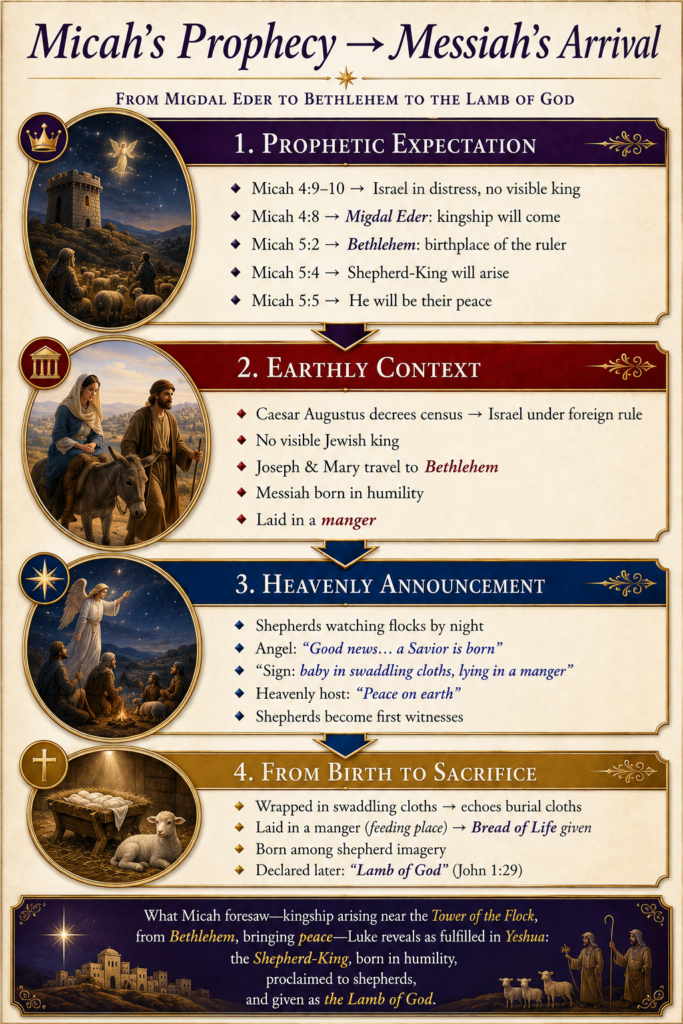
Micah gave us a clue. “And you, O Migdal-eder, Outpost of Fair Zion, It shall come to you: The former monarchy shall return — The kingship of Fair Jerusalem” (Mic. 4: 8 JPS).
Let’s piece together what we can
Migdal Eder (מִגְדַּל־עֵדֶר) – the Tower of the Flock – was a watchtower constructed to the east of Bethlehem. The tower, according to Mishna Shekalim 7:4, was part of a system for preparing and inspecting lambs for Temple sacrifice.
No, this does not mean all sheep in the fields of Bethlehem were destined for sacrifice. It does connect the Midgal Eder, which was in the Bethlehem area, with those sacrifices.
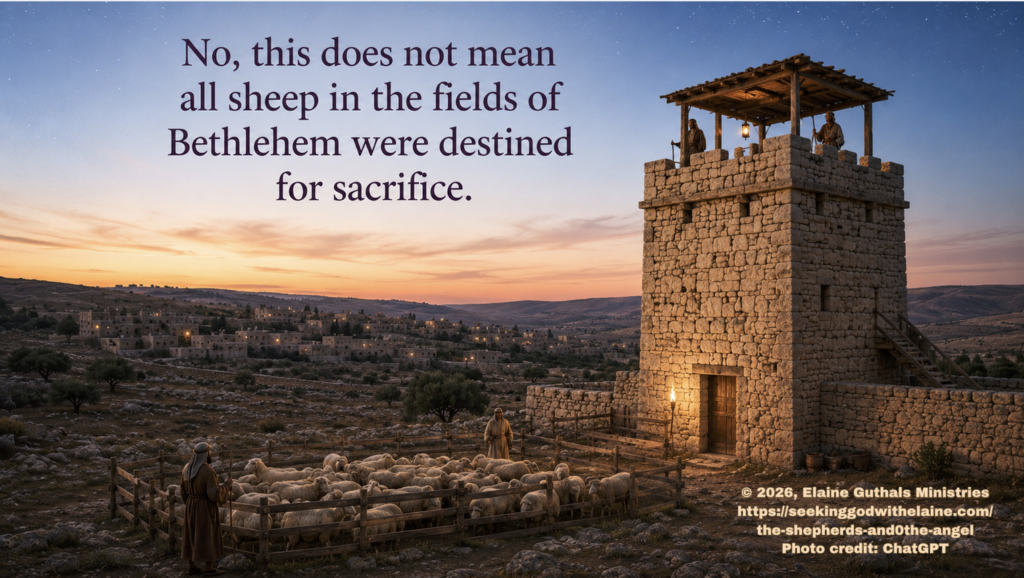
Think about the implication if they were. Jehovah chose societal outcasts who were performing an important task for the Temple – ensuring the purity of the sacrifices – to announce the birth of the Lamb of God – the Pascal Lamb.
That sounds like – to me – a connection Jehovah would make.
What Luke does tell us is important because of its specificity. They were in the Bethlehem region – Bethlehem being the city of David. It was night – an interesting nugget we really didn’t need to know but Luke told us anyway – when the shepherds were watching their flocks.
Society thought they were outcasts. Jehovah didn’t. They still had an important task to perform – and they were performing it. They were protecting the system that excluded them.
Look at the Greek a second. Luke uses ἀγραυλοῦντες (agraulountes), meaning they were staying/living in the open fields, and then φυλάσσοντες φυλακὰς τῆς νυκτός (phylassontes phylakas tēs nyktos), literally something like guarding the watches of the night.
The night was divided into watches. As watch here is plural, to me that mean all the watches were covered. They were looking and waiting for whatever to happen. They were active in their duties.
Jehovah calls us to be active in watching for Messiah’s return.
The Angel
“Suddenly, an angel of the Lord appeared among them, and the radiance of the Lord’s glory surrounded them. They were terrified, but the angel reassured them. ‘Don’t be afraid!’ he said. ‘I bring you good news that will bring great joy to all people. The Savior — yes, the Messiah, the Lord — has been born today in Bethlehem, the city of David! And you will recognize him by this sign: You will find a baby wrapped snugly in strips of cloth, lying in a manger’” (Lk. 2: 9-12 NLT)
Suddenly
Sometimes, suddenly can be relative.
Usually, we think of suddenly meaning that one minute something is true, the next something totally different is now true. That may, however, be contingent on when we notice something.
Still, what happened here was unexpected. The shepherds didn’t anticipate the angels appearing.
The angels did just that because this was where Jehovah sent them to be.
Good News of Joy to All People
When Jehovah called Abram (later known as Abraham) to follow Him, He knew that He was not going to stop with Israel in the restoration from the consequences of the Fall.
Yes, Abraham was going to have enough descendants to form a nation. But even people not his descendants were going to be blessed through him.“… All the families on earth will be blessed through you.” (Gen. 12: 3 NLT).
This blessing was going to be in the Person and mission of Yeshua – the promised Messiah in Genesis 3: 15. Through Him, sin and its originator would be defeated.
It was going to be for everyone.
- “I will give you to Israel as my personal covenant, and you will be a light to the nations.” (Isa. 42: 6 NLT).
- “The LORD has demonstrated his holy power before the eyes of all the nations. All the ends of the earth will see the salvation of our God.” (Isa. 52: 10 NLT)
- “I will also make you a light to the Gentiles, and you will bring my salvation to the ends of the earth.” (Isa. 49: 6 NLT).
Savior, Messiah, and Lord
The little Baby had three major titles associated with Him.
Savior means in Hebrew – moshiaʿ (מֹושִׁיעַ) – savior, deliverer, and one who saves/rescues. The Greek is sōtēr (σωτήρ) and means savior, deliverer, or rescuer.
This calls back to Luke’s previous discussion of salvation in Zechariah’s Benedictus. “He has sent us a mighty Savior from the royal line of his servant David” (Lk. 1: 69 NLT).
Zechariah also stated Yeshua’s mission. “And you, my little son, will be called the prophet of the Most High, because you will prepare the way for the Lord. You will tell his people how to find salvation through forgiveness of their sins” (Lk. 1: 76-77 NLT).
Fast forward to the night Yeshua was born. The same language was used.
What the angel was telling the shepherds was that Jehovah’s salvation promised under the covenant was being fulfilled in Bethlehem that night.
The title of Messiah – Mashiach (מָשִׁיחַ) – in Greek is Christos (Χριστός). Both mean anointed one.
Kings and priests were anointed. As both, Messiah would be anointed.
- “He will be very great and will be called the Son of the Most High. The Lord God will give him the throne of his ancestor David” (Lk. 1: 32 NLT).
- “and he will reign over the house of Jacob forever, and of his kingdom there will be no end.” (Lk. 1: 33 ESV).
The promised Anointed King had arrived.
Then the Baby the shepherds were being told about was called Lord – Kyrios (κύριος) in Greek and Adonai (אֲדֹנָי) in Hebrew. Luke has already set up his readers to understand that He is discussing Jehovah.
- “Then the angel said, ‘I am Gabriel! I stand in the very presence of God. It was he who sent me to bring you this good news!’” (Lk. 1: 19 NLT).
- “He will be a man with the spirit and power of Elijah. He will prepare the people for the coming of the Lord. He will turn the hearts of the fathers to their children, and he will cause those who are rebellious to accept the wisdom of the godly” (Lk. 1: 17 NLT).
- “And you, my little son, will be called the prophet of the Most High, because you will prepare the way for the Lord” (Lk. 1: 76 NLT).
The same Gospel that is preparing us for the coming of the Lord now announces that the Lord has arrived.
This is extremely telling when we read Isaiah.
- “I, yes I, am the Lord, and there is no other Savior.” (Isa. 43: 11 NLT).
- “… Was it not I, the Lord? For there is no other God but me, a righteous God and Savior. There is none but me” (Isa. 45: 21 NLT).
In Bethlehem, the city of David!
The Anointed One was born in the city the king had been anointed.
We’ve talked about Bethlehem being the city of David. That was because he was born there.
Bethlehem was also where David was anointed. Take a look.
- “Now the Lord said to Samuel, ‘You have mourned long enough for Saul. I have rejected him as king of Israel, so fill your flask with olive oil and go to Bethlehem. Find a man named Jesse who lives there, for I have selected one of his sons to be my king’” (I Sam. 16: 1 NLT).
- “So Jesse sent for him. He was dark and handsome, with beautiful eyes. And the Lord said, ‘This is the one; anoint him.’ So as David stood there among his brothers, Samuel took the flask of olive oil he had brought and anointed David with the oil. And the Spirit of the Lord came powerfully upon David from that day on. Then Samuel returned to Ramah” (I Sam. 16: 12-13 NLT).
What had David been doing when he was called in from the field to be anointed? He was being a shepherd watching a sheep.
That makes a great segue into Messiah as a Shepherd King.
Scripture is filled with men and women who were shepherds and shepherdesses. Abel, Abraham, Isaac, Jacob, Rachel, Moses, and David are the most familiar.
David saw the qualities shepherd possess with those of the Lord, Who was the Good Shepherd. “The LORD is my shepherd; I have all that I need” (Ps. 23: 1 NLT).
Shepherds – ro’eh (רֹעֶה) – protected and fed their flock. They guided them and even risked their lives for them.
The title of shepherd was given to the kings. It was their responsibility to ra’ah (רָעָה) – to pasture, to tend and to shepherd – Jehovah’s covenant people. To be more specific, the image became the symbol for covenant care, righteous leadership, and faithful guidance.
Messianic expectation saw Messiah being a Shepherd of His people. This shines through the promises given through David and the prophets while revealing the heart of Jehovah’s Kingdom.
Many saw Messiah being the One to fulfill Jehovah’s covenant promises to judge the false shepherds, gather His scattered sheep, and personally shepherd His people through David’s descendant.
Micah 5 – along with Jeremiah 23 – anticipate a righteous Shepherd-King who restores Israel and rules in peace. “And he will stand to lead his flock with the Lord’s strength, in the majesty of the name of the Lord his God. Then his people will live there undisturbed, for he will be highly honored around the world” (Mic. 5: 4 NLT).
Recognize Him by This Sign
The sign given to the shepherds was very specific and easily recognized and verified.
The angel told the shepherds three very concrete signs – semeion (σημεῖον) meaning a sign, mark, token, or identifying indication through which they could identify the Christ Child. We’ve already been told what the signs are, but Luke repeated them in the angel’s explanation of why they showed up on the hillside that night.
The first sign we may miss. The angel said that the Baby was born that day. Jehovah didn’t waste time in revealing His beloved Son’s birth to those who needed to know.
The Babe would be wrapped in swaddling clothes. That wasn’t unusual. That didn’t even indicate lack of wealth on the parents’ part.
What it did say was that the Baby was taken care of and loved.
The unusual identifying marker was that the Baby was lying in an animal feeding trough. Probably even more astounding to the shepherds was the fact that this Baby was identified as the Savior.
The enormous titles did not fit the setting.
We tend to focus on our perception that being a King in a manger makes Yeshua humble. It does show His humility.
To me, it shows from the first seconds after His arrival on earth, Yeshua was destined to be the Lamb of God, the Sacrifice Who takes away the sins of the world.
Ordinary shepherds would have been affected by the sign. Migdal Eder shepherds wouldn’t be able to miss that even with their eyes closed.
These shepherds would have known how to protect a lamb meant for sacrifice. They would have seen the Baby as entering the world the same way the other lambs did.
The Messiah existed with a Jewish sacrificial-animal framework. Because of that, the Davidic kingship would be restored. He would be the ruler who would shepherd Israel.
Making the Connections #1
The angel told the shepherds that they were being provided a sign. That is covenant language.
The most recognizable covenant sign to all is the rainbow. “Then God said, ‘I am giving you a sign of my covenant with you and with all living creatures, for all generations to come. I have placed my rainbow in the clouds. It is the sign of my covenant with you and with all the earth’” (Gen. 9: 12-13 NLT).
We are also familiar with the sign for the Abrahamic covenant. “You must cut off the flesh of your foreskin as a sign of the covenant between me and you” (Gen. 17: 11 NLT).
So, the angel starts it out by using the same language – this will be a sign to you. But then it took a turn.
Yeshua wasn’t just pointing toward Jehovah’s covenant promise. He was the covenant promise.
- “I, the Lord, have called you to demonstrate my righteousness. I will take you by the hand and guard you, and I will give you to my people, Israel, as a symbol of my covenant with them. And you will be a light to guide the nations” (Isa. 42: 6 NLT).
- “At just the right time, I will respond to you. On the day of salvation I will help you. I will protect you and give you to the people as my covenant with them. Through you I will reestablish the land of Israel and assign it to its own people again” (Isa. 49: 8 NLT).
Yeshua was the covenant. He especially showed this at the Last Supper. “After supper he took another cup of wine and said, ‘This cup is the new covenant between God and his people — an agreement confirmed with my blood, which is poured out as a sacrifice for you” (Lk. 22: 20 NLT).
Making the Connections #2
Luke is quietly foreshadowing what will happen when Yeshua finished His mission.

Making the Connections #3
What does the scene surrounding Yeshua’s birth tell us? Jehovah wasn’t interested in the way the world did things. He certainly didn’t need to ask anyone’s permission to do things His way.
Jehovah didn’t let the focus of the moment to be taken off the incarnation. Here He came to earth as flesh in the form of His Son.
Yeshua came where He needed to be.
Making the Connections #4
When we started this devotion, the shepherds were afraid. Well, that is the first thing we read in any angel encounter.
It really isn’t said here, but by the end of the devotion, they weren’t afraid anymore.
When we are open to what Jehovah is telling us, we shouldn’t be afraid. True, some things we have to experience is hard and hurts.
Experiences are meant to grow our understanding of Jehovah, bringing us closer to Him.
Heart Check
Think about the battle Yeshua is engaged in for your heart. Ask yourself the following questions.
- Am I watching for Yeshua, or am I spiritually asleep?
- Am I willing to receive what God reveals, even when it doesn’t look like what I expected?
- Do I understand that Yeshua came as Savior for all people, rather than restricting God’s grace to the people I think deserve it?
How Do We Apply This?
- Where does Yeshua need you to be?
Father God. So many times You show us that Your ways are not our ways. Thank You for using those times to show us Your love for us. Amen.
If you don’t understand something and would like further clarification, please contact me.
If you have not signed up for the email providing the link to the devotions and the newsletter, do so below.
If God has used this devotion to speak with you, consider sharing it on social media.