More happened at the circumcision ceremony than just the circumcision and the naming of the baby. This devotion looks at Zechariah’s prophecy called the Benedictus.
Nuggets
- When Zechariah got his voice back, he immediately praised Jehovah.
- Prayers and blessings always began with the Berakhah.
- The nation of Israel had long known that redemption was part of the Messianic expectations.
- Rescue and deliverance was on its way.
- First-century Jews believed they were still under the Abrahamic and Davidic covenants, even though they had not experienced full restoration after the Babylonian exile.
- Many first-century Jews correctly longed for deliverance, but they misunderstood the enemy from whom the Messiah had primarily come to save them.
- While many believed full exile restoration hadn’t happened yet, they believed that Jehovah had not abandoned them.
- We are rescued from the condemnation of the Law, the power of sin, and the fear of death.
- We talk of salvation as a free gift from Jehovah.
- Zechariah and his audience would have seen these verses as renewal of the covenant instead of a new covenant with Yeshua.
The setting was the ceremony for John the Immerser’s circumcision. In the last devotion, we talked about the confusion of his name and how Zechariah blessed him.
But before he did, Zechariah broke out into praise about Yeshua. He prophesied as to the coming Messiah.
Let's Put It into Context
To read devotions in The Battle for the Heart theme
Devotions in the Preparing for the Christ Child series
Zechariah’s Prophecy
“Then his father, Zechariah, was filled with the Holy Spirit and gave this prophecy” (Lk. 1: 67 NLT)
When Zechariah got his voice back, he immediately praised Jehovah.
Zechariah’s blessing of John is beautiful, but it is also inspirational. We can’t gloss over the fact that Zechariah was being more than just a proud papa. He was filled with the Holy Spirit and prophesying (Lk. 1: 67).
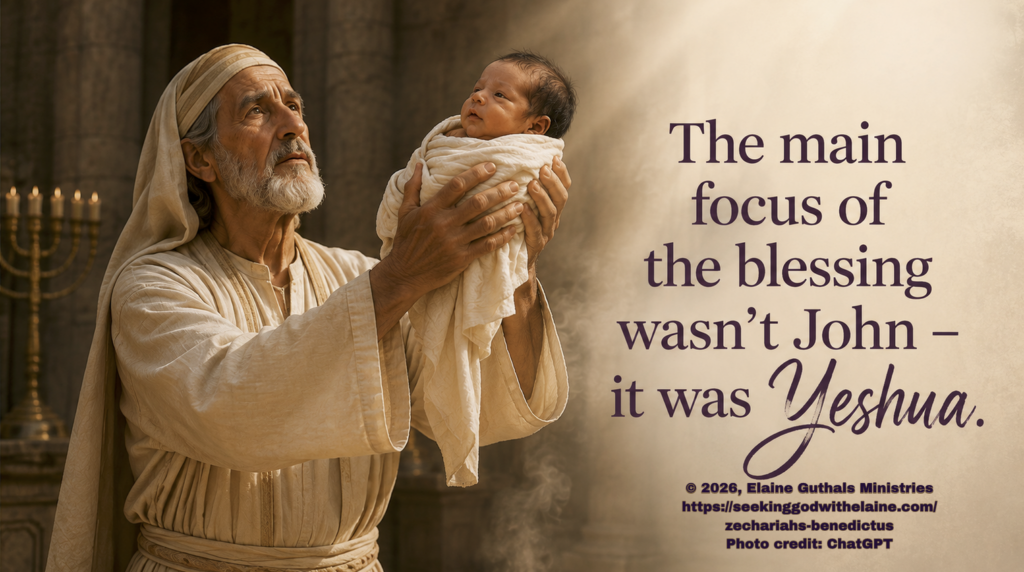
The main focus of the blessing wasn’t John – it was Yeshua.
Zechariah could have just focused on his returned voice and his miracle baby. He didn’t.
Covenant faithfulness focused on national redemption.
But some can’t have to resist going down the path that it seems Parker’s first sentence took. He then seems to straighten it out.
Parker wrote,
“The inspiration of Zacharias recognized most emphatically the preceding inspiration with which God had [favored] His Church. Zacharias seems to be standing in the midst of that summer of which Old Testament times were but the spring. And as, on the one hand, his inspiration seemed to contract the past until Abraham lived but yesterday; so, on the other, it contracts the future, and makes John already the full-grown messenger and herald of the Messiah.”
Resource
Jehovah hasn’t replaced Israel with the church.
Zechariah’s blessing was not focused on the early church. It was a covenant blessing from start to finish.
Parker was right that Zechariah and John were on the threshold between Zechariah’s priests and John’s Holy Spirit-filled life.
We have to remember this was before the Temple was destroyed in 70 AD. Messianic expectation was high.
Those that believed in the Messiah who fulfilled those expectations wouldn’t – in one aspect – see themselves as much different as they had been. They were still Torah-observant, Temple-attending covenant believers.
In other words, they did not see the Messiah as forming a new religion. He was fulfilling the covenant promises.
Enter Zechariah with what is called the Benedictus. It would have been seen as a live covenant proclamation.
Praise to the Covenant Maker
“Praise the Lord, the God of Israel, because he has visited and redeemed his people” (Lk. 1: 68 NLT)
Praise the Lord
Prayers and blessings always began with the Berakhah.
If we go back to the Hebrew, Zechariah’s blessing would have started as many of the first-century Jewish prayers did. He started with the Berakhah. “Blessed are You, Lord our God, King of the universe.”
Because it was a standard opening formula for prayers, first-century Jews would have seen continuity. They would have immediately associated this blessing with the covenant.
Remember who Zechariah was. He was a righteous priest who ministered through ordained ritual.
He Has Visited and Redeemed His People
The nation of Israel had long known that redemption was part of the Messianic expectations.
Ever since the Garden of Eden, the story of redemption has been unfolding. But most first-century Jews didn’t go back that far.
Israel’s identity was rooted in faithful Abrahamic covenant relationship with God, who called, redeemed, and set them apart for His purposes. First-century Jews believed that the covenant relationship would be renewed through renewed holiness and purified worship.
The Babylonian exile rocked their covenant identity. They knew they had broken the covenant, but they wondered if Jehovah would abandon them forever.
Many first-century Jews believed that although they had returned geographically from Babylon, the promised restoration had not yet fully arrived. The prophets had talked of restoration – restoration that hadn’t happened yet.
Messiah, therefore, was expected to accomplish national redemption.
Zechariah was there to tell them that the Messiah had come. Yeshua had visited them. True, He was still growing in His mother’s womb, but He was here.
Unfortunately, many saw this as a new Exodus intervention. They saw it as liberation from Rome.
The Savior Was Sent
“He has sent us a mighty Savior from the royal line of his servant David” (Lk. 1: 69 NLT)
Rescue and deliverance was on its way.
Luke was probably writing in Greek. Verse 69 in the Greek was, “Kai ēgeiren keras sōtērias hemin en oikō Dauid paidos autou (καὶ ἤγειρεν κέρας σωτηρίας ἡμῖν ἐν οἴκῳ Δαυὶδ παιδὸς αὐτοῦ).” Literally, that reads, “He has raised up for us a horn of salvation in the house of David His servant.”
If Luke would have written it in Hebrew, it would probably have been, “Hēqîm lanu qeren yeshu’ah b’veit David avdo (הֵקִים לָנוּ קֶרֶן יְשׁוּעָה בְּבֵית דָּוִד עַבְדּוֹ).
The Hebrew literally says the same thing as the Greek. So, let’s look at the words.
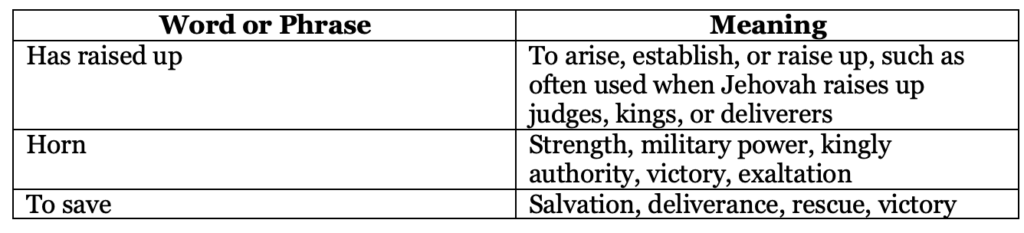
Fun fact. Yeshua comes from the same root as to save. So, Zechariah is proclaiming that Jehovah has raised up a qeren yeshu’ah – a horn of salvation – that is embodied in Yeshua Himself.
So, the horn would have been seen as strong and powerful.
This verse ties together the Davidic Covenant, royal hope, and Zechariah’s prophecy in one thread. That would have conveyed first-century Jews the understanding that the royal covenant promise was alive.
While first-century Jews would have seen this as salvation from Rome, Yeshua pointed them in the way of restoration from sin, death, and spiritual bondage.
Promised Long Ago
“just as he promised through his holy prophets long ago” (Lk. 1: 70 NLT)
First-century Jews believed they were still under the Abrahamic and Davidic covenants, even though they had not experienced full restoration after the Babylonian exile.
At the beginning of the Babylonian exile, the Israelites questioned whether Jehovah had abandoned them. They believed He still intended to fulfill His promises.
They saw the Messiah as the one to fulfill those promises. Way back in the Garden of Eden, Jehovah had promised that one of human’s seed would crush one of the serpent’s seed.
I know. Wouldn’t that have made them realize that faith in Yeshua was covenant continuity, not covenant departure?
From Abraham’s covenant, through David’s royal promises, through the pain of exile, Jehovah had never abandoned His covenant purposes. Zechariah’s prophecy announces that the long-awaited fulfillment had finally begun.
Rescue at Hand
“Now we will be saved from our enemies and from all who hate us” (Lk. 1: 71 NLT)
Many first-century Jews correctly longed for deliverance, but they misunderstood the enemy from whom the Messiah had primarily come to save them.
Remember, many were looking for a Messiah to overthrow Rome. They interpreted Scripture to say this because Jehovah had sent military saviors before.
Yeshua did save them – and us – from our worst enemy – Satan. He came to defeat sin, Satan, and death — the enemies from which humanity most desperately needed rescue.
Satan and the demons hate us. Also, those who are Satan’s hate us.
While the Messianic expectations believed by first-century Jews included renewed holiness and purified worship, they felt it was covenant renewal. They didn’t believe it was Eden renewal.
They believed that being Abraham’s descendants was the entryway to the salvation offered by the Messiah. If they would have heard “… I am the way, the truth, and the life …” (Jn. 14: 6 NLT), they would have thought their beliefs were already there.
Covenant Mercy
“He has been merciful to our ancestors by remembering his sacred covenant — the covenant he swore with an oath to our ancestor Abraham” (Lk. 1: 72-73 NLT)
While many believed full exile restoration hadn’t happened yet, they believed that Jehovah had not abandoned them.
The exile to Babylon had occurred because Israel broke its covenant with Jehovah. The consequences of that disobedience were expulsion from the Promised Land for most of the Israelites and loss of the Davidic throne.
While first-century Jews were back home in the Promised Land, the throne hadn’t been restored. Many still considered themselves under exile.
The appearance of the Messiah would have verified that Jehovah remembered the covenant that He not only made with Abraham but also with David.
“For when you die and are buried with your ancestors, I will raise up one of your descendants, your own offspring, and I will make his kingdom strong. He is the one who will build a house — a temple — for my name. And I will secure his royal throne forever. I will be his father, and he will be my son …” (II Sam 7: 12-14 NLT).
Holiness and Righteousness Restored
“We have been rescued from our enemies so we can serve God without fear, in holiness and righteousness for as long as we live” (Lk. 1:74- 75 NLT)
Rescued
We are rescued from the condemnation of the Law, the power of sin, and the fear of death.
Some might consider it strange that we are rescued from God’s law. He gave it to us, didn’t He? The law shows us His character, doesn’t it?
True, but many first-century Jews – and those still today – believe those laws can save us. They can’t.
God’s laws show us our need for a Savior.

The rescue we got was redemption. It came because of the tender heart of Jehovah.
Serve Him
We talk of salvation as a free gift from Jehovah.
While salvation might be to us a free gift, Boston reminded us it wasn’t to Yeshua. He wrote, “All the benefits of the covenant, to be bestowed on His spiritual seed, are made over to Him on a valuable consideration. God gives us to serve our Redeemer, because Christ served Him perfectly in our room and stead.”
Resource
We are called to serve Jehovah. That is a covenant responsibility.
Does that mean there are strings attached to the gift? No. Boston called it a privilege and a benefit to serve Jehovah.
We accept the responsibilities of the covenant when we put our faith in Yeshua as our Savior.
That doesn’t make us slaves to Jehovah. It doesn’t even make us hired hands.
It is our honor to serve Jehovah. We are ministers – a priesthood – for Him.
The Temple was still functioning and would for a couple more decades. They would have seen holiness and righteousness prophesied in Jeremiah 31 and Ezekiel 36 as being tied with Israel’s priestly vocation.
- “‘But this is the new covenant I will make with the people of Israel after those days,’ says the Lord. ‘I will put my instructions deep within them, and I will write them on their hearts. I will be their God, and they will be my people’” (Jer. 31: 33 NLT).
- “And I will give you a new heart, and I will put a new spirit in you. I will take out your stony, stubborn heart and give you a tender, responsive heart” (Ezek. 36: 26 NLT).
Hey, new covenant, New Testament, right? Abrahamic covenant, Davidic covenant, and Messianic covenant all interconnected.
Yes, but not in the way they thought.
We have to go back to the Hebrew to understand this. What Jeremiah was talking about – and what they would have connected to Ezekiel – was berit chadashah (בְּרִית חֲדָשָׁה).
Yes, it could mean new, but it also could mean renewed or restored. That is what many first-century Jews heard – restored.
But it was only a covenant with the House of Israel and the House of Judah. “See, a time is coming — declares GOD — when I will make a new covenant with the House of Israel and the House of Judah” (Jer. 31: 31 JPS).
First-century Jews generally expected the new covenant to renew Israel, not expand her to include Gentiles; to transform hearts, not abolish Torah; and to restore covenant faithfulness, not establish a different faith. What they didn’t anticipate was that this renewal would be inaugurated through the atoning death and resurrection of the Messiah Himself.
Holiness and Righteousness
Zechariah and his audience would have seen these verses as renewal of the covenant instead of a new covenant with Yeshua.
We’ve heard about holiness and righteousness many times. Those can be confusing terms, though, to some.
- Holiness is the state of being set apart to God, increasingly reflecting His character through a life devoted to Him. As we grow in holiness, holiness produces a clean heart, a steadfast will, and a life wholly dedicated to God.
- Righteousness is the inward reign of Christ that reshapes our desires before it reshapes our behavior.
The service we are called to perform is to continue the rest of our lives. We serve Jehovah because we are set apart to do it. This is a lifelong act because it is part of our Sanctification Road – which is a lifelong process.
Making the Connections #1
How many times can Satan convince us that we have gone one sin too far? He loves to tell us that we crossed the line, and Jehovah will never forgive us.
Since it was probably around 3 or 4 AD, the friends and family that came to the B’rit Milah (בְּרִית מִילָה) would have seen Zechariah’s prophecy as hopeful and anticipatory. They wouldn’t have seen Zechariah’s prophecies as a departure from Judaism.
Making the Connections #2
Look at what Boston said. He wrote,
“The first covenant required a lasting service, but secured not man from breaking the service. But the second covenant secures the perpetuity of the service, that, however fickle the believer is, yet he shall serve the Lord all the days of his life. It imports that he shall serve the Lord for ever and ever, in heaven, after death.”
Resource
Satan is wrong. There is only one sin that Jehovah won’t forgive. It is called the unpardonable sin. In my opinion, it has to do with unbelief and refusal to surrender to Him even if we do believe.
That should comfort us. Once we are Jehovah’s, only we can choose to turn our back on Him. He never will turn away from us.
Making the Connections #3
Zechariah praised Jehovah because He remembered His covenant. Jehovah has never failed to keep His promises. The better question for us is whether we are faithfully walking with Him each day. Have we allowed distractions, sin, or complacency to pull us away from the relationship He has graciously established through Yeshua? Covenant faithfulness begins with the daily choice to follow Him.
Heart Check
Think about the battle Yeshua is engaged in for your heart. Ask yourself the following questions.
- Am I choosing to follow Yeshua daily, or am I slowly turning away from Him?
How Do We Apply This?
- Praise Him for keeping every promise.
- Remember what He has rescued you from.
- Walk faithfully with Him daily.
- Serve Him without fear, in holiness and righteousness.
Father God. We choose You daily. Help us to grow closer to You as we walk with You. May we praise You as Zechariah did for the covenant that we have with Yeshua. Amen.
If you don’t understand something and would like further clarification, please contact me.
If you have not signed up for the email providing the link to the devotions and the newsletter, do so below.
If God has used this devotion to speak with you, consider sharing it on social media.
Lorem ipsum dolor sit amet, consectetur adipiscing elit. Ut elit tellus, luctus nec ullamcorper mattis, pulvinar dapibus leo.