Zechariah and Elizabeth were promised a son who would have a special mission. This devotional reading looks at the birth of the one who would prepare the way for the Messiah.
Nuggets
- Elizabeth had carried the baby that she never thought she would have for nine months.
- The circumcision ceremony was where the newborn son entered into the covenant community.
- John almost got another name.
- Jehovah was with John from conception.
- Zechariah blessed his son and acknowledged the mission Jehovah had for him.
- Second Temple Judaism saw the imagery of the light.
- John grew physically and spiritually.
We discussed in several devotions that two sons were prophesied to be born under unusual circumstances to two women who were relatives. The first couple had been praying for years for a baby – until age made that an impossibility.
Now, they were going to get their son. Jehovah Himself had sent word that it would happen.
We are going to take the verses in a little order. We are going to pull out Zechariah’s Benedtictus for the next devotion. That will leave the last couple of verses to be discussed here.
Let's Put It into Context
To read devotions in The Battle for the Heart theme
Devotions in the Preparing for the Christ Child series
John Is Born
“When it was time for Elizabeth’s baby to be born, she gave birth to a son. And when her neighbors and relatives heard that the Lord had been very merciful to her, everyone rejoiced with her. When the baby was eight days old, they all came for the circumcision ceremony. They wanted to name him Zechariah, after his father. But Elizabeth said, ‘No! His name is John!’ ‘What?’ they exclaimed. ‘There is no one in all your family by that name.’ So they used gestures to ask the baby’s father what he wanted to name him. He motioned for a writing tablet, and to everyone’s surprise he wrote, ‘His name is John.’ Instantly Zechariah could speak again, and he began praising God. Awe fell upon the whole neighborhood, and the news of what had happened spread throughout the Judean hills. Everyone who heard about it reflected on these events and asked, ‘What will this child turn out to be?’ For the hand of the Lord was surely upon him in a special way” (Luke 1: 57-66 NLT)
When It Was Time
Elizabeth had carried the baby that she never thought she would have for nine months.
Now, it was time for the baby to be born. I wonder what was going through her head.
Logic would say that nothing would go wrong in the birth of the forerunner of the Messiah. He had a specific, special plan for His life. It was time for him to start his life.
But we aren’t guaranteed an easy road – even when we are doing Jehovah’s Will. We still feel pain and heartache. Plans fall through – especially if we are doing His Will our way.
At her age, Elizabeth must have had some trepidation for the birthing process. There was no hospital with many machines to address any problem that went wrong.
Jehovah knows we will feel anxious and experience fear and uncertainty. Those feelings are not automatically unbelief.
Some would say that anxiety is really doubt. If done the right way, doubt is really just questions so that we may know more of Jehovah and His will. We just have to question in belief – as Mary did (Lk. 1: 34).
Circumcision
The circumcision ceremony was where the newborn son entered into the covenant community.
The important circumcision ceremony is called B’rit Milah (בְּרִית מִילָה). It probably took place in the modest village in which Zechariah and Elizabeth lived in the Hill Country.
It was a religious ceremony – not just a medical procedure – that was performed on a son’s eighth day after birth. It was a covenant ceremony, a family celebration, a public declaration of identity, and the official welcoming of a son into God’s covenant people all rolled into one celebration.
Covenant celebrations such as this were celebrated by the community. That included family and friends. Many would have wanted to celebrate with the elderly couple because of their covenant blessing.
This is part of God’s covenant with Abraham. It is the part of the Jew’s responsibility to show agreement with the covenant. It was the physical sign of the covenant that showed the child belonged to Jehovah.
“Then God said to Abraham, ‘Your responsibility is to obey the terms of the covenant. You and all your descendants have this continual responsibility. This is the covenant that you and your descendants must keep: Each male among you must be circumcised. You must cut off the flesh of your foreskin as a sign of the covenant between me and you. From generation to generation, every male child must be circumcised on the eighth day after his birth. This applies not only to members of your family but also to the servants born in your household and the foreign-born servants whom you have purchased. All must be circumcised. Your bodies will bear the mark of my everlasting covenant. Any male who fails to be circumcised will be cut off from the covenant family for breaking the covenant’” (Gen. 17: 9-14 NLT).
Since the number seven represents completion, the number eight represents a new beginning. The child is entering into covenant life and God’s promises.
Jehovah created the male body to anticipate this procedure. It produces Vitamin K and clotting factors that peak around the eighth day.
This was a celebration that included family and friends. Covenant life was seen as communal.
John’s circumcision might have been different in one aspect. As it was usually performed by the father – but Zechariah couldn’t speak – another man probably carried out the circumcision ceremony, Zechariah would have directed this, remaining John’s legal father.
His Name Is John!
John almost got another name.
We don’t know if Elizabeth and Zechariah had shared the baby’s name with friends and family prior to his birth. We know they didn’t have gender reveal parties, but people may have questioned them about possible baby names.
Either way, when it got to the part where the baby was named, it reads like the crowd thought they knew what it should be. “… They wanted to name him Zechariah, after his father” (Lk. 1: 59 NLT).
Then, as now, it was common to name a child after an ancestor. It was both a way to preserve and honor the name. In first-century Israel, those names would only be taken from the father’s family.
I bet it was easy to imagine John growing up and being like Zechariah in many ways. We already know, from our study of Gabriel’s visit to Zechariah, that John wouldn’t continue his father’s priestly ministry that Zechariah had given his whole life to serve in faith and obedience.
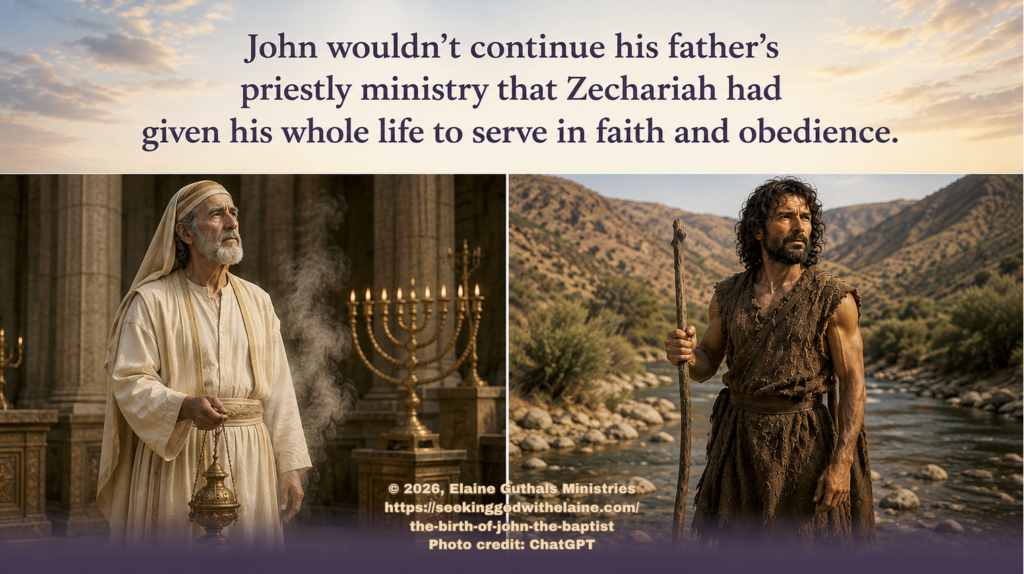
Instead of serving as a priest, John would become a prophet calling the people back to God. He would be preparing them for something new.
Parker had a great comment on what the crowd was doing. He wrote, “They would have dragged down the miraculous to the ordinary, and surrounded this speciality of Divine [favor] with all that was ancient and traditional in the family.”
Resource
We get the obedience behind calling the son John. ‘That was the name the angel Gabriel told Zechariah he was to have.
Elizabeth didn’t equivocate. She flat out said, “His name is John.”
I thought it was funny that the crowd gestured to Zechariah to see his answer. The man couldn’t speak – he wasn’t deaf.
Doubting Zechariah didn’t doubt anymore. He wrote, “His name is John.” He was publicly submitting to Jehovah’s Will.
Zechariah’s obedience was rewarded. His ability to speak returned to him right when Jehovah’s promise, John’s identity, and Zechariah’s obedience merged.
We need to do what Jehovah tells us to do what He has decided.
But there is another aspect to that. “But now, O Jacob, listen to the Lord who created you. O Israel, the one who formed you says, ‘Do not be afraid, for I have ransomed you. I have called you by name; you are mine’” (Isa. 43: 1 NLT).
Part of the reason for the name is the meaning of the names. Zechariah means Yahweh remembers. John (Yôḥānān – יוֹחָנָן) means Yahweh has shown favor.
Let’s stop right there a second to make sure this sinks in.
John was a gift from Jehovah because he was sent for a specific mission. The whole mission was Jehovah’s gift to us. It was all about Jehovah remembering His covenant promise.
Think divine providence. Jehovah provides for His children, whom He knows by name.
But if Zechariah and Elizabeth would have let the worldview hijack Jehovah’s plan before John even said a word and took a step, would His plan have been able to go ahead.
It feels like we sometimes operate on the assumption that Jehovah will forgive us when we go off plan, but He will continue to use us if we just repent. And all-knowing Jehovah may have worked that into some of our plans.
But what if He doesn’t? What if He needs total obedience and surrender for that plan?
The Hand of the Lord Was upon Him
Jehovah was with John from conception.
We know that John was filled with the Holy Spirit from conception (Lk. 1: 15). That would mean Jehovah would be protecting him throughout his life.
Fox reminded us that growth includes not only physical growth but also spiritual growth and growth of the soul.
Resource
John did grow as Jehovah required.
Zechariah’s Prophesy to His Son
“And you, my little son, will be called the prophet of the Most High, because you will prepare the way for the Lord. You will tell his people how to find salvation through forgiveness of their sins. Because of God’s tender mercy, the morning light from heaven is about to break upon us, to give light to those who sit in darkness and in the shadow of death, and to guide us to the path of peace” (Lk. 1: 76-79 NLT)
Prophet of the Most High
Zechariah blessed his son and acknowledged the mission Jehovah had for him.
Oh, what a difference nine months make!
Zechariah understood when John was born what he couldn’t understand when Gabriel gave him the message. He was going to be the forerunner of the Messiah.
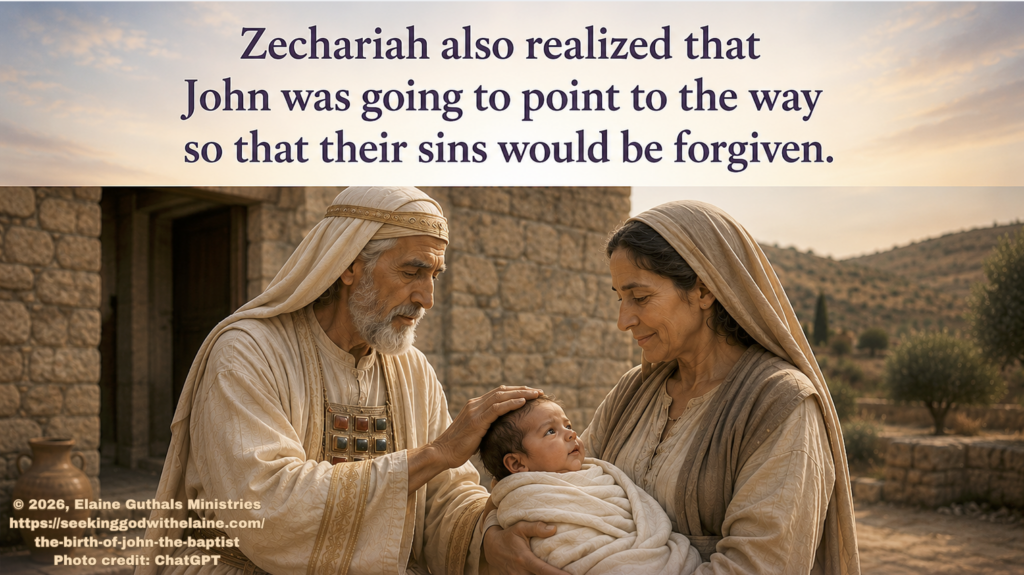
Zechariah also realized that John was going to point to the way that their sins would be forgiven. He said one of John’s duties would be to “… tell his people how to find salvation through forgiveness of their sins” (Lk. 1: 77 NLT).
With sacrifices still being offered in the Temple, the first-century Jews either have seen Yeshua’s way as a renewal or a replacement. I am sure there were some in both camps.
The New Living Translation expresses John’s ministry as showing people how to find salvation. He was to impart the knowledge of salvation that points the people to salvation – to Yeshua.
They have to choose to be obedient to Jehovah.
That is all any Pastor Steve-type or even Elaine-type teacher can do. Those searching for Jehovah must make up their own minds to accept the gift of salvation – and all the responsibilities that goes with Yeshua’s covenant.
But then first-century Jews probably equated this with the sin that occurred that triggered the Babylonian exile. They didn’t see it as the sin that occurred in the Garden of Eden.
Morning Light from Heaven
Second Temple Judaism saw the imagery of the light.
The Greek expression translated “morning light” carries the idea of the sunrise after a long night. For generations Israel had waited through what often felt like spiritual darkness.
Prophets had spoken. The people had hoped. Yet centuries had passed without another prophetic voice.
Now Zechariah announces that the dawn is finally breaking — not because Rome is about to be defeated, but because Jehovah Himself is acting to rescue His people from their greatest enemy: sin.
This light reaches all the way back to Creation. The first recorded words of Jehovah in Scripture were, “Let there be light” (Gen. 1: 3). Before the sun, moon, and stars were created, Jehovah’s Light – Yeshua – pushed back the darkness.
Now, in Yeshua in human form, Jehovah again shines light into a world darkened by sin. John’s ministry would not be the light itself; he would point people to the Light.
That is why John later wrote, “God sent a man, John the Baptist, to tell about the light so that everyone might believe because of his testimony. John himself was not the light; he was simply a witness to tell about the light. The one who is the true light, who gives light to everyone, was coming into the world” (Jn. 1: 6-9 NLT).
John’s mission was to prepare people’s hearts so they would recognize the true Light when He appeared. John was never the destination. He was the signpost pointing everyone to Yeshua.
The prophets had also looked forward to this day. Isaiah spoke of a people walking in darkness who would see a great light (Isa. 9: 2), and Malachi described the coming Messiah as the Sun of Righteousness who would rise with healing in His wings (Mal. 4: 2). Zechariah now realized those promises were no longer distant hopes.
The dawn had begun. The Light was coming.
John in the Wilderness
“John grew up and became strong in spirit. And he lived in the wilderness until he began his public ministry to Israel” (Lk. 1: 80 NLT)
John grew physically and spiritually.
When I think of wilderness, I think of a place with lot of trees. It is a wild and natural place.
Really, a wilderness is an uncultivated and uninhabited region. Its main characteristics is being inhospitable.
Where John would have gone when it says he went to the wilderness was a harsh rocky region east of Jerusalem. It stretched from there toward the Jordan River and the Dead Sea.
Geographically, this region was defined by jagged limestone hills, steep ravines known as wadis, and dry, chalky soil. Vegetation was sparse, limited to thorn bushes and scattered scrub growth. It was not a soft desert, but a severe, broken landscape that stripped away comfort and exposed the heart.
The climate in the wilderness went from one extreme to another. The daytime heat contrasted with the cold nights.
Yet there was hope In this arid land. The wilderness was called the midbar (מִדְבָּר). This wild land was, according to the Hebrew, where God spoke and revealed Himself.
Although we are not told why, we can guess at the reasons John the Immerser chose to minister the wilderness. Instead of going to the Temple, he went to a solitary place that was unfamiliar and called people to repentance and preparation. He took people away from the distractions of their lives so that they could focus on Yeshua.
Making the Connections #1
I agree with one thing Parker said. He wrote, “We shall be better prophets as we become better students. In the silent time we are gathering elements, consolidating character, and undergoing discipline, all of which will be wanted when the trumpet calls us to the battle.”
Resource
We do need to be students of God’s Word. (That is what disciple means.)
Jehovah doesn’t do a data dump into us when we trust Yeshua as our Savior. Instead, He reveals Himself to us over time – over the rest of our lives, in fact.
If we don’t study what God’s Word really says, we may not be getting it right.
More importantly, we aren’t allow Jehovah to transform our hearts if we don’t dig into His way.
Making the Connections #2
John entered into the covenant community through circumcision. But as he grew, he would learn that more than just a physical sign was needed for salvation.
“Prove by the way you live that you have repented of your sins and turned to God. Don’t just say to each other, ‘We’re safe, for we are descendants of Abraham.’ That means nothing, for I tell you, God can create children of Abraham from these very stones” (Lk. 3: 8 NLT).
This followed what both Moses and Jeremiah said.
- “Therefore, change your hearts and stop being stubborn” (Duet. 10: 16 NLT).
- “O people of Judah and Jerusalem, surrender your pride and power. Change your hearts before the Lord, or my anger will burn like an unquenchable fire because of all your sins” (Jer. 4: 4 NLT).
Heart Check
Think about the battle Yeshua is engaged in for your heart. Ask yourself the following questions.
- Am I preparing my heart daily to hear and obey Jehovah, or have I become spiritually complacent?
- Is there an area of my life where I know Jehovah’s will but am resisting it?
- Am I more concerned with following family traditions, culture, or people’s expectations than following Jehovah’s direction?
- Am I walking in the Light Yeshua has given me, or am I holding on to areas of darkness?
- If someone looked at my life, would it point them to me—or to Yeshua?
How Do We Apply This?
- Ask Jehovah to prepare your heart to recognize His work, even when it doesn’t happen the way you expect.
- Spend time in God’s Word each day so your heart stays sensitive to His voice.
- Thank Yeshua for bringing His light into the darkness of your life and revealing the areas that still need His transforming work.
- Surrender any area of resistance where you have been holding on to your own plans instead of trusting Jehovah’s.
- Ask the Holy Spirit to make your life a faithful witness that points others to Yeshua rather than to yourself.
Father God. Thank You for the fact that You call each of us to expand Your Kingdom. You don’t rely on only a few to do the work for You. Each and every one of us has tasks to do for You. These are to grow our faith and grow us closer to You. Amen.
If you don’t understand something and would like further clarification, please contact me.
If you have not signed up for the email providing the link to the devotions and the newsletter, do so below.
If God has used this devotion to speak with you, consider sharing it on social media.