We start Yesha’s story by relating His cousin’s story. This devotional reading begins looking at John the Baptist’s story.
Nuggets
- Jehovah had a plan for reconciling us to Him and sent a man to prepare the way.
- Herod the Great was religious but ruthless, powerful but fearful, and magnificent yet miserable.
- The priestly order of Abijah was created by David in I Chronicles 24.
- Zechariah was an ordinary priest who had been chosen for an extraordinary task, and Elizabeth was a blameless person who was barren.
- Even if we think Zechariah’s service was random, Jehovah didn’t.
This is the first account of two miraculous birth. They mothers were from the same family – descendants of Aaron.
The prophesied son would have an important role in the coming events to restore the nation to Jehovah.
Let's Put It into Context
To read devotions in The Battle for the Heart theme
Devotions in the Preparing for the Christ Child series
John the Baptist (Yochanan) Introduced
“God sent a man, John the Baptist, to tell about the light so that everyone might believe because of his testimony. John himself was not the light; he was simply a witness to tell about the light” (Jn. 1: 6-8 NLT)
Jehovah had a plan for reconciling us to Him and sent a man to prepare the way.
From the beginning, it was evident that John the Immerser was going to be a great man. In fact, he was considered a great prophet.
John’s role was foretold by Isaiah. The total passage is Isaiah 40: 1 to Isaiah 45: 25. We are more familiar with Isaiah 40: 3.
“Listen! It’s the voice of someone shouting, ‘Clear the way through the wilderness for the Lord! Make a straight highway through the wasteland for our God! Fill in the valleys, and level the mountains and hills. Straighten the curves, and smooth out the rough places. Then the glory of the Lord will be revealed, and all people will see it together. The Lord has spoken!’” (Isa. 40: 3-5 NLT).
This is an important passage for two connected reasons. First, the first is John was to clear the way, calling Israel to repentance. This is critical because the second is that Someone was coming – the Messiah.
Second, John called Israel to repentance before they encountered the Messiah. Just as worshipers prepared themselves before entering God’s presence in the Temple, John called the nation to prepare their hearts for the coming King.
John the author made sure his audience knew that John the Immerser was not the Light (or – אוֹר). He was a witness (ed – עֵד) for the light, but he was more than just that. John came in Jehovah’s authority.
This is huge. John not only had the knowledge of Jehovah, but he also testified to the truth, established facts, and upheld covenant realities.
John the Immerser was tasked with increasing their faith – their emunah (אֱמוּנָה), a steadfast trust that comes from the Hebrew root ʾāman (אָמַן), meaning to believe, to trust, or to be faithful. We are to establish a firm trust in Jehovah and Yeshua.
John’s Birth Announced to Zacharias (Zecharyah)
“When Herod was king of Judea, there was a Jewish priest named Zechariah. He was a member of the priestly order of Abijah, and his wife, Elizabeth, was also from the priestly line of Aaron. Zechariah and Elizabeth were righteous in God’s eyes, careful to obey all of the Lord’s commandments and regulations. They had no children because Elizabeth was unable to conceive, and they were both very old” (Lk. 1: 5-7 NLT)
Herod
Herod the Great was religious but ruthless, powerful but fearful, and magnificent yet miserable.
Luke put a timestamp on his gospel by acknowledging that Herod the Great was king in Jerusalem at the time. At one time, Israelites had wanted a king – they did not want this one.
Born around 73 BC, Herod was not of Israelite descent but of Edomite descent. His family was forced to convert to Jewish years before his birth.
In other words, he ruled the Jews but was not of the Davidic line. To make matters worse, he was chosen to be King of the Jews by Octavian Augustus and the Roman Senate around 40 BC.
That wouldn’t have gone over well.
Herod’s reign lasted from 37 to 4 BC. While he did maintain stability in the region, his fear of losing power made him a brutal ruler.
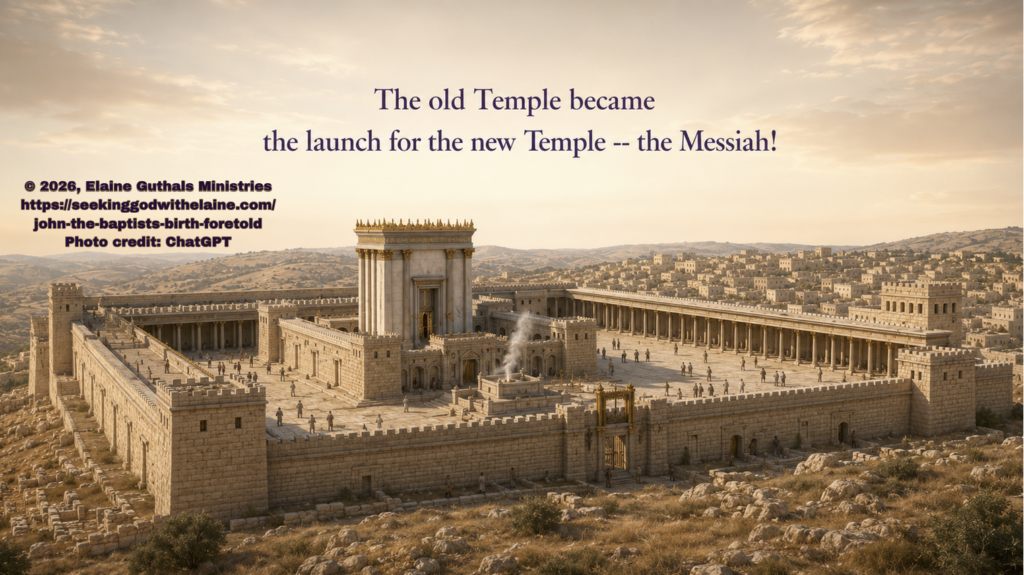
The Temple that stood in Yeshua’s day had undergone a massive expansion under Herod’s rule. Yes, Herod built the stage on which Yeshua’s ministry would exist, but he entered the story only briefly — ordering the murder of the innocents when Yeshua was born. (Herod died shortly after the births of John the Immerser and Yeshua.)
Herod tried to curry the favor of his subjects by rebuilding the Temple and funding public works. However, he alienated many by his close ties with Rome and his violent and unpredictable behavior.
While Herod passed before Yeshua’s ministry began, he helped create the environment that had many expecting the Messiah’s arrival. He did this through political tension and religious compromise.
Upon his death in 4 BC, Herod’s kingdom was divided between his sons. It is one of them that will take a prominent role in the life of John the Immerser and the events of Holy Week.
Luke used a shorthand to set the stage in letting us know what the situation was that was the backdrop of the story. Rome occupied Israel, and Herod represented a compromised leader. This brought a spiritual longing to the people, increasing their Messianic expectations.
It was in this atmosphere that Jehovah started to move.
Priestly Order of Abijah (Aviyah)
The priestly order of Abijah was created by David in I Chronicles 24.
Jehovah choose Aaron’s (Aharon) line to serve Him as priests. Only his descendants could serve in this capacity.
David (Dovid) separated Aaron’s descendants, the priests, into 24 divisions – mishmarot (מִשְׁמָרוֹת) meaning daily ministry – because the priests had become so numerous. Farrar noted that only four of the divisions returned from Babylonian exile. But Geikie reported that, in the first century, around 24,000 priests lived in Jerusalem and approximately 12,000 lived in Jericho.
Resource
Each division served in rotation at the Temple. They ensured order and efficiency in conducting Temple services. This rotation ensured all priestly families were allowed to serve.
This order identity was very important. Abijah was listed as the eighth division. It had a long history of service to Jehovah.
When the division served twice each year, their rotation lasted one week. They rotated according to the list. All divisions, however, served during the major festivals: Pesach – פֶּסַח (Passover), Shavuot – שָׁבוּעוֹת (the Feast of Weeks), and Sukkot – סֻכּוֹת (the Feast of Tabernacles).
True, Temple rotations were disrupted by exile and later history. But this priest was where he was scheduled to be.
Why is it important to know the division this priest in question served? We learn that the timing of this announcement wasn’t left to random chance. It was steeped in history, structure, and legitimacy.
That history and structure was an established covenant structure. Core responsibilities hadn’t changed since the days of Moses (Moshe) when the office of priest was set up.
The angelic visit occurred inside the established rhythm of Temple worship. Daily temple worship had a rhythm to it, which included:
- Offering sacrifices on behalf of the people
- Maintaining ritual purity
- Caring for sacred objects
- Safeguarding the sanctity of the Temple
- Administering the Priestly Blessing
- Incense offering and prayer
They were charged with distinguishing between what was holy and common, clean and unclean, and with teaching the people God’s instructions.
The most coveted of the duties was to enter the Holy Place and offer incense on the golden altar. Many never received it even once.
The priest offering the prayer would pray for the nation. He would additionally pray for those congregated at that time.
What better place to announce the start of fulfilling the Messianic expectations! The old Temple became the launch for the new Temple — the Messiah.
The Parents
Zechariah was an ordinary priest who had been chosen for an extraordinary task, and Elizabeth was a blameless person who was barren.
As a descendant of Aaron, Zechariah became a priest. As such, he served in the Temple only when it was time for his division to serve.
Zachariah and Elizabeth (Elisheva) were faithful to Jehovah. Both were counted as righteous – tzaddik (צַדִּיק). They followed all of the commandments of the Sovereign God.
Names are important. Zachariah’s name means Yahweh remembers. Elizabeth’s name means My God is faithful to His oath.
Many versions translate this tzaddik as blameless. Paul told us how we could be blameless. “… Live clean, innocent lives as children of God, shining like bright lights in a world full of crooked and perverse people” (Phil. 2: 15 NLT).
Both were descendants of Aaron. The marriage was easier because like-minded people married.
It sounds like they were unified in all things. It sounds like they had a good life.
The only disappointment was Zachariah and Elizabeth didn’t have any children. Now that they had gotten on in years, they had probably given up hope of ever becoming parents.
That must have weighed on Elizabeth, because Jewish women were expected to produce children. By the first century, barrenness still carried much of the same social stigma it had in the days of Sarah and Rachel.
Although the Law never taught that childlessness was a punishment for sin, many people viewed it as a sign that God had withheld His blessing. When no children came, Elizabeth was probably very ashamed. She may have even gotten laughed at.
Elizabeth’s joyful declaration that the Lord had “… taken away my disgrace among the people …” (Lk. 1: 25 NLT) shows that this painful assumption still lingered in Israel.
But they weren’t alone. Think Sarah and Isaac. Think Rebekah, Esau, and Jacob. Think Jacob, Rachel, and Joseph. Think Hannah and Samuel.
Do we think when we are walking with Jehovah that the bad things shouldn’t happen to us? It doesn’t work that way.
Zechariah was exactly where Jehovah wanted him to be. He was coming to Him, serving Him. Jehovah had another way Zechariah could be of service.
A Priest Went into the Temple
“One day Zechariah was serving God in the Temple, for his order was on duty that week. As was the custom of the priests, he was chosen by lot to enter the sanctuary of the Lord and burn incense. While the incense was being burned, a great crowd stood outside, praying” (Lk. 1: 8-10 NLT)
Even if we think Zechariah’s service was random, Jehovah didn’t.
Zechariah was serving in the Temple. He had been assigned to burn the incense, the most sacred daily task in the Holy Place. He was assigned that task by casting lots.
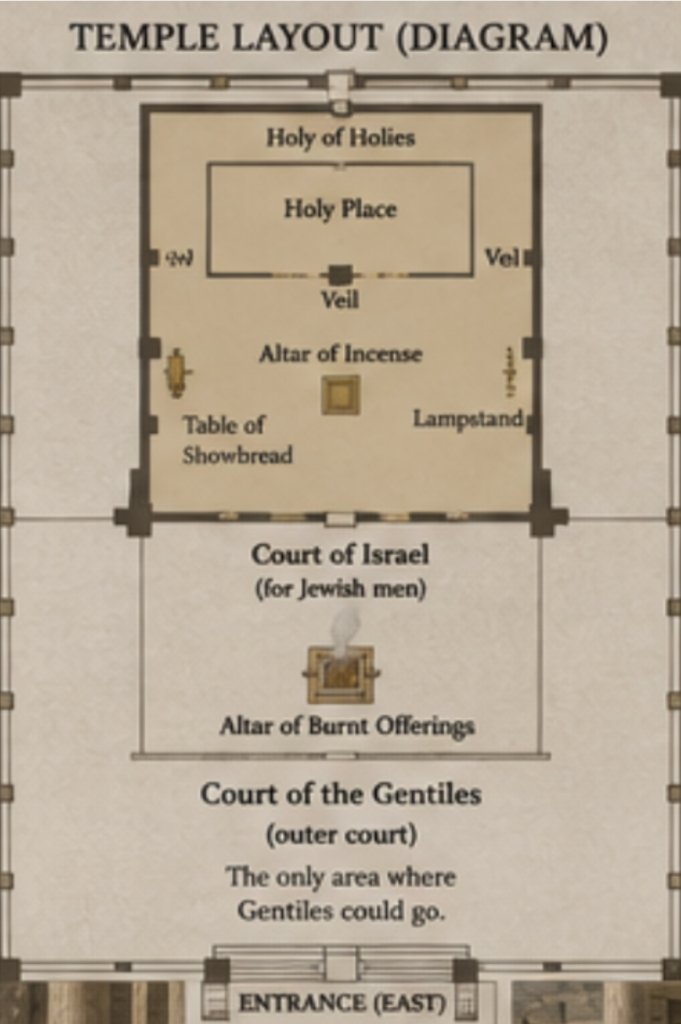
People were in the outer courts. Priests ministered daily in the Holy Place. The Holy of Holies could only be entered by the high priest on Yōm Kippūr (יוֹם כִּפּוּר) – the Day of Atonement.
When it was the division’s time to serve, the duties were assigned by lot. We aren’t sure what the process was for casting lots in the first century. The Mishnah does discuss how it was done later.
It was believed that casting lots would both be fair and be a way to determine Jehovah’s Will. “We may throw the dice, but the LORD determines how they fall” (Prov. 16:33 NLT).
- The priests would gather in a chamber in the Temple.
- An official would choose a number larger than the number of priests present.
- The priests would stand in a circle and each extend one or more fingers.
- The official would then count around the circle until reaching the selected number.
- The priest on whom the count landed received the assignment.
- Several lots were conducted each day to assign different responsibilities.
Zechariah drew the task with the highest honor and extraordinarily rare privilege – perform the daily incense offering. Other tasks included removing ashes from the altar, preparing sacrifices, and tending the menorah.
The daily incense offering was a carefully prescribed ritual. First, Zechariah and assistant priests would have taken the hot coals brought in by other priests from the great altar outside (where sacrifices were made) and placed them on the golden altar.
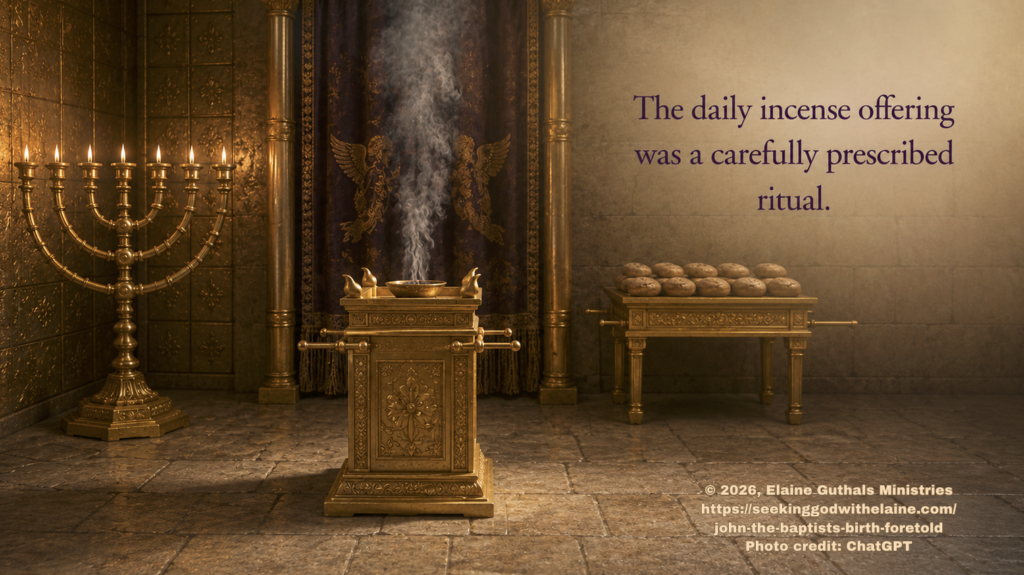
After the assistant priests withdrew, Zechariah would have poured the incense on the hot coals. This would cause the incense to rise heavenward.
This connected prayer and incense in Jewish symbolism. Burning incense represented the prayers of Israel. “Accept my prayer as incense offered to you, and my upraised hands as an evening offering” (Ps. 141: 2 NLT).
At that point, Zechariah stood alone before the veil.
Let’s just stop a second. There were some priests who never were assigned this task. And Zechariah was chosen.
Zechariah was chosen that day.
No, there was no luck of the draw about it. Jehovah had Zechariah right where He could use him.
God interrupted normal ritual with a new act of redemption. Ritual isn’t enough for us to worship Him. Going through the motions can turn into lip service real quick.
I thought it was very important that the congregation was praying while Zachariah was performing his duties. Jehovah was initiating His most important plan, and it was being bathed in prayer.
This shows us that, even though God knows the outcomes of our efforts, He wants us to pray for guidance, strength, and His blessing. He wants us to let Him have His way. He will bless us beyond measure if we ask.
Making the Connections #1
It is easy to forget that Christianity offers various perspectives to different individuals, meaning I can’t always offer a single explanation on a given topic. That is on top of the fact that nothing I say can fully capture its intellectual and spiritual depth.
We also forget the complexity of the message of the Gospels. Parker helped remind us. He wrote, “The facts of Christianity are few and simple, but the truths arising out of them are innumerable and profound.”
Resource
Each disciple creates our own interpretation of Christ’s life. Does that mean there is more than one way to salvation? No. It means that we are different people with differing life experiences and lifestyles.
Jehovah meets us where we are at. That allows for our individual differences.
But Jehovah sanctifies us with one goal in mind — making us as He is. Though our Sanctification Roads may take different routes, the destination is still the same.

We have to seek the meaning of the Word for ourselves. Even listening to the Pastor Steve-types doesn’t negate the fact that we have to be students of the Word for ourselves.
Making the Connections #2
I have to think about this. Essex Remembrancer wrote,
“Religion, wherever it exists, will leave its own entire impression upon the character; not one feature, but every feature of the ‘new man’ will be developed; the duties to man, as well as those we owe to God, will be conscientiously regarded.”
Resource
Jehovah isn’t interested in half of us. He is interested in all of us.
Jehovah will make all of us a new creation. We will have a new character.
That character is built through the tasks that we do for Jehovah.
But we can’t equate blameless with sinless. We will still sin – even after we become disciples of Christ.
Heart Check
Think about the battle Yeshua is engaged in for your heart. Ask yourself the following questions.
Have I invited Jehovah to transform my entire life, or am I asking Him to change only the parts I’m willing to surrender?
Like Zechariah, am I faithfully serving Jehovah in the ordinary moments of life, allowing Him to shape my character while I wait on His timing?
How Do We Apply This?
- Thank Jehovah for the ordinary places where He has placed you today.
- Ask Him to help you trust His timing, even when you cannot see His purpose.
- Look for ways God may be preparing you through today’s ordinary responsibilities.
- Choose faithfulness over recognition.
- Spend time in confession, asking Jehovah to prepare your heart to hear His voice.
- Pray that your heart would be ready whenever God chooses to work.
- Remember that God often answers prayers in ways we never expect.
- Before attending church this week, ask God to keep your worship from becoming routine.
- Ask yourself whether your worship is flowing from your heart or simply from habit.
- Trust that Jehovah is working even when your life feels ordinary.
- Prepare your heart daily so you are ready when God chooses to move.
- Serve faithfully today, knowing that no act of obedience is insignificant in God’s plan.
Father God. You have a plan for all our lives. In those plans, you call us to certain tasks for Your benefit and ours. Thank you that You use us to expand Your kingdom. Amen.
If you don’t understand something and would like further clarification, please contact me.
If you have not signed up for the email providing the link to the devotions and the newsletter, do so below.
If God has used this devotion to speak with you, consider sharing it on social media.