Since the Garden of Eden, Jehovah had not dwelt with humans. This devotional reading sets the stage for His return through Yeshua.
Nuggets
- When God said, “Let there be light,” He was revealing Yeshua as the Light who would enter the darkness and begin the battle for our hearts.
- This Light is available to everyone.
- The Architect of the universe entered that world.
- Even though Yeshua’s coming was prophesied, first-century Jews did not recognize Him as Messiah.

We’ve seen how Yeshua was present at the creation of the universe. In fact, He had an integral part in creation.
Yeshua knew His part in the Plan of Salvation before anything was even created. Before the first sin had been committed – before humans had even been created – the plan for redemption was set in place.
That plan required Yeshua to come to earth as a human being. Let’s see what that entailed.
Let's Put It into Context
To read devotions in The Battle for the Heart theme
Devotions in the Preparing for the Christ Child series
Why Jesus Came
“The one who is the true light, who gives light to everyone, was coming into the world. He came into the very world he created, but the world didn’t recognize him” (Jn. 1: 9-13 NLT)
The True Light
When God said, “Let there be light,” He was revealing Yeshua as the Light. He would enter the darkness and begin the battle for our hearts.
John has talked a lot about light so far in his first chapter. The true Light is Yeshua, who is also the Word.
The true Light was present in this world from creation. When Jehovah said, “Let there be light,” this wasn’t merely physical illumination but the first revelation of Yeshua in spiritual form entering creation as the true Light. Light, therefore, becomes tied to salvation from the very beginning.
The Light Yeshua brings is not merely knowledge but spiritual life itself. Without the Word giving life, humanity remains spiritually dead. The Light enters darkness to illuminate hearts and lead people toward salvation.
Who Gives Light to Everyone
This Light is available to everyone.
Throughout God’s Word, it tells how the Messiah’s mission was to be a mission of inclusion. He was first to go to Israel, the chosen people, and then go to the Gentiles — everyone who wasn’t Jewish.
By giving all the opportunity to believe in Yeshua, the covenant promise made to Abraham would be fulfilled. “All the families on earth will be blessed through you” (Gen. 12: 3 NLT).
While Yeshua’s mission was to go to the cross to become our Savior, He acknowledged His Gentile sheep. “I have other sheep, too, that are not in this sheepfold. I must bring them also” (Jn. 10: 16 NLT).
Going to the Gentiles is part of our marching orders. “Therefore, go and make disciples of all the nations” (Mt. 28: 19 NLT).
Yeshua fulfilled all of God’s promises. He came as Messiah to Israel and then all the world.
Coming into the World
The Architect of the universe entered that world.
What John wrote about in the past tense, we are preparing for it to happen in this series. We are looking forward to the birth of Yeshua in the flesh.
Yeshua’s coming was prophesied many times in the Old Testament.
- “Abraham said, ‘God will provide for himself the lamb for a burnt offering, my son’…” (Gen. 22: 8 ESV).
- “The scepter shall not depart from Judah, nor the ruler’s staff from between his feet, until tribute comes to him; and to him shall be the obedience of the peoples” (Gen. 49: 10 ESV).
- “So Moses made a bronze serpent and set it on a pole. And if a serpent bit anyone, he would look at the bronze serpent and live” (Num. 21: 9 ESV).
- “I will raise up for them a prophet like you from among their brothers. And I will put my words in his mouth, and he shall speak to them all that I command him” (Deut. 18: 18 ESV).
- “When your days are fulfilled and you lie down with your fathers, I will raise up your offspring after you, who shall come from your body, and I will establish his kingdom. He shall build a house for my name, and I will establish the throne of his kingdom forever. I will be to him a father, and he shall be to me a son. When he commits iniquity, I will discipline him with the rod of men, with the stripes of the sons of men, but my steadfast love will not depart from him, as I took it from Saul, whom I put away from before you. And your house and your kingdom shall be made sure forever before me. Your throne shall be established forever” (II Sam. 7: 12-16 NLT).
- “For to us a child is born, to us a son is given; and the government shall be upon his shoulder, and his name shall be called Wonderful Counselor, Mighty God, Everlasting Father, Prince of Peace. Of the increase of his government and of peace there will be no end, on the throne of David and over his kingdom, to establish it and to uphold it with justice and with righteousness from this time forth and forevermore. The zeal of the Lord of hosts will do this” (Isa. 9: 6-7 ESV).
- “Behold, God is my salvation; I will trust, and will not be afraid; for the Lord God is my strength and my song, and he has become my salvation” (Isa. 12: 2 ESV).
We have to watch when we want to bite on the first-century Jews for not recognizing the Messiah. We see Him through hindsight – the cross, the resurrection, justification by faith, and the theological development of the Church.
First-century Jews didn’t possess that framework because it hadn’t been completed yet.
Oh, first-century Jews knew the prophesy about a Messiah – in Hebrew, māšaḥ (מָשַׁח) — to anoint and, in Greek, Christos (Χριστός). But they were looking at those Scriptures through a lens of exile, covenant longing, Roman oppression, Temple expectation, and prophetic hope. They may have been back in Israel and Jerusalem, but they were still under oppression.
They saw Rome and thought they were no better off than when they were in Babylon. The Temple stood, but Jehovah’s Shekina (שְׁכִינָה) – His visible glory – hadn’t returned as of yet.
However, many first-century Jews were expecting the Messiah to come. But, when Yeshua arrived, they didn’t recognize Him.
Why? They were expecting a different type of Messiah. They saw that He was David’s son, so they saw Him as a warrior king. They believed that is what Scriptures told them. The Messiah would be Someone Who
• Defeated Israel’s enemies
• Restored righteous rule
• Judged the nations
• Purified worship
• Gathered the dispersed tribes
• Reigned from Jerusalem
Look at these passages and see if you see that yourself.
- “I will tell of the decree: The Lord said to me, ‘You are my Son; today I have begotten you. Ask of me, and I will make the nations your heritage, and the ends of the earth your possession. You shall break them with a rod of iron and dash them in pieces like a potter’s vessel’” (Ps. 2: 7-9 ESV).
- “There shall come forth a shoot from the stump of Jesse, and a branch from his roots shall bear fruit. And his delight shall be in the fear of the Lord. He shall not judge by what his eyes see, or decide disputes by what his ears hear, but with righteousness he shall judge the poor, and decide with equity for the meek of the earth; and he shall strike the earth with the rod of his mouth, and with the breath of his lips he shall kill the wicked” (Isa. 11: 1, 3-4 ESV).
- “I saw in the night visions, and behold, with the clouds of heaven there came one like a son of man, and he came to the Ancient of Days and was presented before him. And to him was given dominion and glory and a kingdom, that all peoples, nations, and languages should serve him; his dominion is an everlasting dominion, which shall not pass away, and his kingdom one that shall not be destroyed” (Dan. 7: 13-14 ESV).
Do those passages indicate that there would be an immediate defeat of Israel’s oppressors? Well, no, but this was an agent of Sovereign God’s that was being described. Who would think that the Messiah would come under someone else’s – especially an earthly – authority?
Beyond that, first-century Jews didn’t think they as a nation were where they were supposed to be before the Messiah was to come. They thought they had to repent and become righteous before His arrival.
They got that out of Scriptures, also.
- “And when all these things come upon you, the blessing and the curse, which I have set before you, and you call them to mind among all the nations where the Lord your God has driven you, and return to the Lord your God, you and your children, and obey his voice in all that I command you today, with all your heart and with all your soul, then the Lord your God will restore your fortunes and have mercy on you, and he will gather you again from all the peoples where the Lord your God has scattered you” (Deut. 30: 1-4 ESV).
- “And a Redeemer will come to Zion, to those in Jacob who turn from transgression,” declares the Lord” (Isa. 59: 20 ESV).
- “Seventy weeks are decreed about your people and your holy city, to finish the transgression, to put an end to sin, and to atone for iniquity, to bring in everlasting righteousness, to seal both vision and prophet, and to anoint a most holy place” (Dan. 9: 24 ESV).
This was why John the Immerser’s message landed so hard for them. They saw that he was calling them to this repentance and coming judgment. He was calling them to covenant preparation.
Then Yeshua came and, in their eyes, things weren’t anything like that.
- Rome was still there.
- He didn’t follow God’s laws because He associated with sinners.
- He publicly forgave sins.
- He allowed forgiveness before visible moral reform.
In other words, Yeshua didn’t uphold covenant purity.
What Yeshua was doing was redefining the source of that righteousness. He came to heal Israel because they couldn’t heal themselves.
Came to His Own People
“He came to his own people, and even they rejected him. But to all who believed him and accepted him, he gave the right to become children of God. They are reborn — not with a physical birth resulting from human passion or plan, but a birth that comes from God” (Jn. 1: 10-11 NLT)
Even though Yeshua’s coming was prophesied, first-century Jews did not recognize Him as Messiah.
How did all those expectations about the coming of the Messiah relate to Yeshua? They relate because the first-century Jews couldn’t look past expectations to see reality. The Messiah had come!!!!!
And they rejected Him.
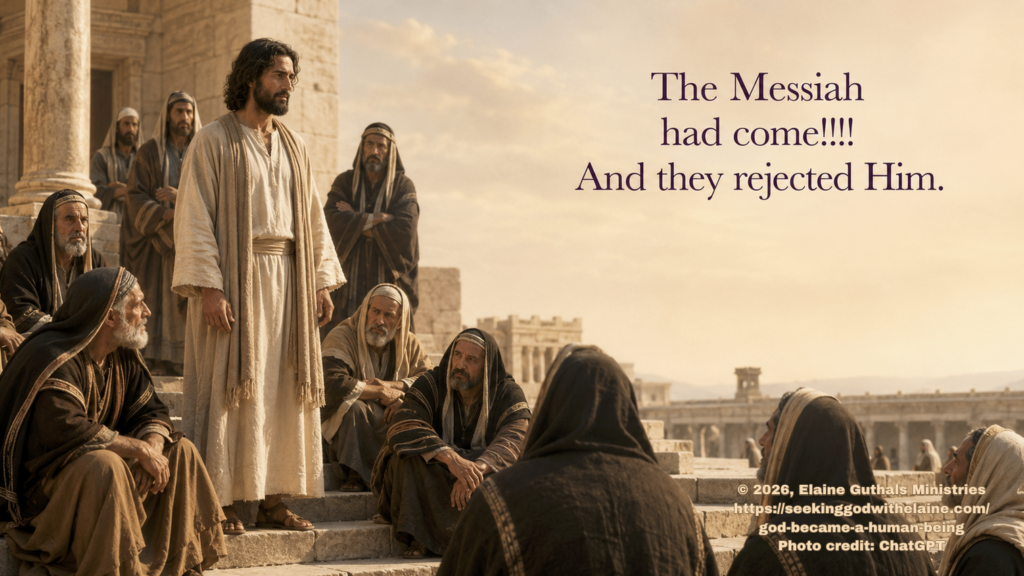
The religious leaders said He wasn’t the Messiah because He challenged religious norms of his time. His miracles and claims of divinity provoked skepticism and disbelief, and His focus on people’s spiritual condition wasn’t welcome.
Ultimately, his rejection fulfilled prophecies about the Messiah’s suffering.
Doesn’t it feel like John is setting us up for something much more positive? Creator of the world. Giver of life and light. The Word.
Expected. Longed for.
Rejected.
No, not totally rejected. Yeshua wasn’t rejected by the Twelve Apostles. There were also women who were traveling with them that didn’t reject Him. Surely, there were some believers in the towns and villages that He went to – like Sychar.
It wasn’t total rejection.
But it was enough to kill Him.
Who was His own? This was covenant language. Remember, Yeshua’s coming was promised to David as his descendant. That tied Him to a rich history – and a covenant line dating back to Abraham.
How did Yeshua come to His own? “Though he was God, he did not think of equality with God as something to cling to. Instead, he gave up his divine privileges; he took the humble position of a slave and was born as a human being. When he appeared in human form, he humbled himself in obedience to God and died a criminal’s death on a cross” (Phil. 2: 6-8 NLT).
Think of it this way, though. Yeshua was instrumental in creation. Without Hi, nothing would have been created. He received authority then.
Now, Yeshua was entering His creation – in a physical form, not a spiritual one. He was coming to His own.
Why did the Pharisees, Sadducees, and Torah-teachers reject Yeshua as the Messiah. He was shaking their rabbinical traditions. As we would say today, “We’ve never done it that way!”
The name Jesus derives from the Hebrew Yēshûaʿ (יֵשׁוּעַ), meaning Jehovah saves. Yet the angel specifically defines the salvation mission in terms of sin.
That makes Matthew 1: 21 land a little differently. “You shall call His name Jesus, for He will save His people from their sins.” (Matt. 1: 21 ESV).
Yeshua came bearing a spiritual liberation, exposing internal corruption.
Yeshua came first to battle for our hearts.
And His own rejected Him.
Making the Connections #1
While first-century Jews had the Scriptures detailing the victories the Messiah would enjoy, they also had the Scriptures spelling out the suffering, rejection, piercing, and being “cut off” that He would experience.
We see this most graphically in Isaiah’s Suffering Servant passage in Isaiah 53.
Under Roman domination, it was so much easier to look for the victorious Messiah than the suffering Messiah.
That is why the cross became a stumbling block for them. A crucified Messiah appeared contradictory to Messianic victory because crucifixion represented shame, defeat, and Roman domination.
Don’t we do that? We focus so much on the circumstances of our trials that we take our eyes off Jehovah.
We want things the way we want them, not the way that is in Jehovah’s plan for us.
Making the Connections #2
We bite on the Pharisees and make them into villains, but they weren’t. They were just like us – trying to understand the words that were written.
They had it harder than we do – at least in Scriptures. They weren’t working on the completed plan. They were seeing it unfold before their eyes.
Only after the resurrection could the Pharisees – even the disciples – finally understand how the suffering servant and conquering King prophecies belonged to the same Messiah.
We don’t know how many Pharisees worked through all the events in their hearts and minds and chose to accept Yeshua as their Savior. We would hope all but know that wasn’t the case. So, we can hope the majority.
Doesn’t it take time for us to understand the trials in our own lives and how Jehovah is using those for our sanctification? It has taken years for me to understand what He was trying to teach me with Mom and Dad dying six weeks apart. Even now – over thirty years later – He can nudge my heart and say, “See why now?”
Making the Connections #3
What track do we want Yeshua as Messiah to take today? Do we just want Him to be a social savior? Some may want a political savior.
Otherwise, we may place Yeshua anywhere on a continuum. Do we want a life/coach/therapist who is on speed dial when we need Him? Or do we want Him just on Sunday?
Or do we surrender our hearts and lives to Him in submissive obedience knowing He is the only one Who can save us?
Heart Check
Think about the battle Yeshua is engaged in for your heart. Ask yourself the following questions.
- Am I following the real Yeshua revealed in Scripture, or a version shaped by my own expectations?
- If Yeshua walked into my life today in a way I wasn’t expecting, would I recognize Him — or would my expectations keep me from seeing what He is doing?
How Do We Apply This?
- Compare and align your expectations with Scripture.
- Welcome Yeshua’s work in your heart.
- Let Him expose areas needing repentance.
- Trust Jehovah’s plan over your own.
- Follow the Messiah He is — not the one you wish He were.
Father God. Thank You that You sent Yeshua to become a human to pay the penalty for our sins. We are humbled that He would agree to go through what He did for us. Help us to open our hearts to Him and allow Him in. Amen.
If you don’t understand something and would like further clarification, please contact me.
If you have not signed up for the email providing the link to the devotions and the newsletter, do so below.
If God has used this devotion to speak with you, consider sharing it on social media.