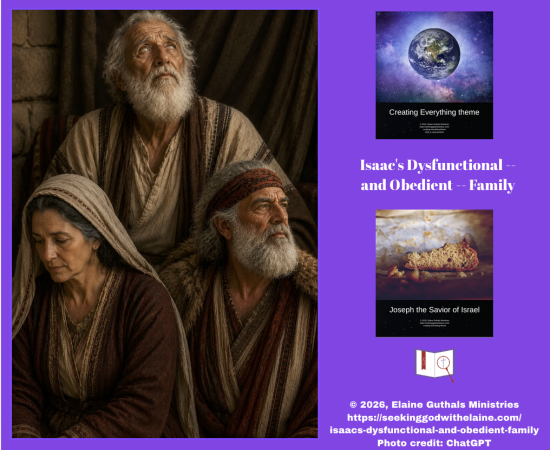
We continue our wrapup on Genesis by looking at Isaac’s family. He, Rebekah, and Esau also had their choices to make.
We will talk about Jacob as he pertains to their stories, but we are going to wait until the next devotion to look at him and his family.
Again, these are excerpts from the book Abraham’s Dysfunctional — and Obedient — Family. It will be coming out soon.
Isaac: A Quiet Faith in Jewish Interpretations
For the patriarch who lived the longest, we get the least information about Isaac. His story seems to be buried within his father’s story and his son’s story.
Between Abraham’s acts of faith and covenant relationship and Jacob’s tumultuous life and transformation, we find Isaac. He was described as meditative — which we would equate to quiet. Jewish interpreters saw him as a model of restraint, endurance, and steady covenant faithfulness.
Isaac was the long-awaited covenant child. His miraculous birth was a testimony to Jehovah’s faithfulness.
A testing of Abraham was a significant event in the Book of Genesis: the Akedah ( עֲקֵדָה) — the binding. We don’t know Isaac’s age when this occurred. We do know of his obedience as he willingly submitted to his father’s actions.
Isaac took Rebekah as his wife. They became the father of Esau and Jacob.
Isaac’s role in the covenant was inheritance and preservation. Unlike Abraham, he did not leave Mesopotamia. Unlike Jacob, he did not spend years in exile. Isaac’s life is rooted in the land God promised to his descendants.
What Isaac Did Right
Isaac Submitted to Jehovah on Mt. Moriah
It is easy to allow Abraham to overshadow Isaac in Genesis 22. It is Abraham’s story. It was his testing.
But it was also Isaac’s story. He was being tested, too.
Would Isaac submit?
Yes, Isaac did. According to Jewish interpreters, he was an active participant, not just a passive person. His willingness to be bound and placed on the altar showed his surrender to God’s Will.
Isaac showed faith and trust not only in Abraham, but also in Jehovah Isaac’s story tells us about the blessings in the obedience.
Isaac Trusted Jehovah Rather than Forced Outcomes
Genesis 26 tells the story of wells. We — who have water at the touch of a faucet — may not understand the importance of having a well.
Access to water in a well would have meant the difference between survival and death. Herds and flocks frequently migrated based on the availability of water.
Yet time and time again, Isaac yielded contested wells to others. Did he — like Abraham — just not want the confrontation?
Isaac seemed content to move on until he found an area where Jehovah had made room for him — thus the name of the well — Rehoboth. He didn’t follow the worldview where he had to fight for every opportunity.
Instead, Isaac relied on Jehovah. As he had learned on Mt. Moriah, Jehovah would provide.
Isaac Preserved Abraham’s Legacy
Some of the wells in question in the last section weren’t built by Isaac. He preserved Abraham’s legacy by reopening his father’s wells that the Philistines had closed in envy and restoring their names (Gen. 26: 15).
Yet Isaac was not merely a caretaker of another man’s accomplishments. His servants dug new wells (Gen. 26: 17). God renewed the covenant directly with him, and through him the covenant promises passed to the next generation.
Isaac preserved Abraham’s legacy as well as established one of his own.
Isaac Cultivated a Life of Prayer
We saw Isaac walking in the field, meditating, when Rebekah’s caravan arrived at Abraham’s place.
Jehovah wants us to meditate on His Word, reflect honestly on our lives, and apply it to draw us closer to his ways. “Blessed is the man who walks not in the counsel of the wicked, nor stands in the way of sinners, nor sits in the seat of scoffers; but his delight is in the law of the Lord, and on his law he meditates day and night” (Ps. 1: 1-2 NLT).
Meditation is the thoughtful contemplation of what the Holy Spirit has put on our hearts. We have to listen to what He tells us and decide what we are going to do about it.
Are we going to be obedient and submit to His Will or be disobedient and do things our own way?
Submitting to Jehovah builds our character. Our reliance on Him takes the focus off us and puts it where it belongs — on Him. We agree to follow God’s plan for our lives because it is better for us.
More importantly, we show the condition of our hearts. When we pray, meditate, and reflect, we open our hearts to the changes the Holy Spirit is proposing.
Isaac Demonstrated Marital Faithfulness
Jehovah wants us to be married to one spouse at a time. Isaac and Rebekah’s marriage may have been arranged; but from the start, Isaac’s love for Rebekah was obvious (Gen. 24: 67 NLT).
We aren’t told that Isaac took another wife or concubine. He remained faithful to Rebekah.
Isaac knew when Abraham was choosing a wife for him, his father did so to advance the covenant responsibilities. He knew that the decision of who his wife would be ultimately rested with Jehovah. He showed submission, trust, and contentment in waiting on Jehovah to provide the chosen wife in His timing.
Isaac Endured Rather than Retaliated
Isaac showed unusual patience. We see this during the conflict over the wells.
We also see this in dealing with his family. Esau, as the firstborn, was not acting as a covenant son when he married two Canaanite women (Gen. 26: 34-35). We are not told that Isaac responded to Esau selling his birthright to Jacob.
What Isaac Did Wrong
Isaac Repeated Abraham’s Deception
You would have thought Isaac would have learned from Abraham. Abraham did the same thing as Isaac was trying to do — both tried to pass their wives off as their sister (Gen. 12: 11-13; Gen. 26: 7).
Fear of circumstances led Isaac to not trust Jehovah. He didn’t believe that He would keep him safe from harm.
Lack of trust in Jehovah to keep His promises of protecting and providing for us undermine our relationship with Him. We need to cultivate a full and unwavering trust in Him.
Isaac Showed Favoritism toward Esau
Isaac’s family was dysfunctional because Isaac favored Esau and Rebekah favored Jacob (Gen. 25: 28). That divided the family and caused conflict between the brothers.
Isaac’s favoritism stemmed from Esau’s outdoorsman activities. He loved the game that Esau hunted and provided.
Isaac Failed to Resolve the Family Conflict
From the time we first heard of the brothers after their birth, we see how the brothers are opposites (Gen. 25: 27 NLT). Scripture records no attempt by Isaac to resolve the conflict. This led to Jacob stealing the birthright and the blessing.
Instead of easing tensions, Isaac allowed for them to grow.
The division of Isaac and Rebekah fostered division between Esau and Jacob. The unhealthy environment created consequences that would echo into future generations.
Isaac’s Patience at Times Became Passivity
Our strengths can become our weaknesses. Isaac may not have been diligent in reading the situations. Maybe he inherited Abraham avoidance of causing a conflict.
Whatever the reason, the patriarch didn’t judge the family. He didn’t directly address his sons’ problems.
Isaac Tried to Give the Covenant Blessing to Esau
From the time the twins were in Rebekah’s womb, Isaac and Rebekah knew the covenant was to pass to Jacob (Gen. 25: 23 NLT). Yet, Isaac still tried to give the covenant blessing to Esau. At minimum, Isaac appears determined to advance Esau despite God’s choice of Jacob.
What Isaac Teaches Us
Isaac teachers us that faithfulness can be quiet and contemplative. It must be a deliberate choice.
Isaac teaches us that Jehovah is God of the little things as well as the big things. He is looking for our obedience in our everyday lives.
Isaac teaches us about self-control and waiting for Jehovah’s perfect timing. Pain and division comes when we try to take things into our own hands.
Isaac teaches us to avoid passivity. Patience must not become neglect.
Perhaps most importantly, Isaac teaches us the importance of generational faithfulness. Abraham passed down the covenant promises to him. Though he tried to pass those promises on to Esau, he did pass them on to Jacob.
We must raise our children in the faith. They must make their own choices to be obedient or disobedient to Jehovah; but as parents, we are called to teach our children His ways (Deut. 6: 7 ESV).
Isaac occupies a unique place among the patriarchs. He was neither called as Abraham was nor transformed as Jacob was. Instead, he quietly endured, prayed, and submitted to God’s Will.
Still, Isaac showed favoritism, passivity, and moments of fear. Jehovah still remained faithful.
Jewish interpretation often celebrates Isaac’s quiet strength. Scripture itself presents him as a man of genuine faith whose life helped preserve the covenant line through which the Messiah would eventually come.
Isaac’s story reminds believers that steady obedience, patient trust, and enduring faithfulness are not lesser forms of spirituality. They are often the very means by which God accomplishes His greatest purposes.
Rebekah: The Quiet Tragedy of Never Seeing Her Son Again
When we look at Rebekah, we see a woman who was deeply committed to Jehovah’s covenant. But we also see a woman who took things into her own hands to ensure the covenant was kept.
This makes Rebekah both influential and complex.
Rebekah entered the covenant story as the wife chosen for Isaac. Early on we see her intelligence, decisiveness, and spiritual perception. She faced the future by accepting Jehovah’s plan even when she knew nothing about it until the day before.
Because she agreed to be Isaac’s wife, Rebekah became the covenant matriarch. Still, she experienced decades of infertility. The difficult pregnancy had her turning to God for explanation. This interchange with Jehovah provides knowledge that will affect the whole family.
But then we see a tragic ending for her story. It is tragic because she just disappears from the narrative. We learn nothing about her death or burial or how she was mourned. It isn’t until her son dies that we learn where she was buried.
Possibly most tragic is that, when Rebekah sent her son away to save him, she didn’t know that she would never see him again. In ensuring the covenant line progressed as Jehovah had decreed, she gave up the son she loved most.
Rebekah’s life shows us both the power of faith and the danger of taking our lives into our own hands instead of relying on Jehovah to work through us.
What Rebekah Did Right
Rebekah Demonstrated Hospitality
We meet Rebekah at the well where she went to fill her jug (Gen. 24: 15). When Eliezer asked for a drink of water, she not only gave him some to drink but she also drew water for his camels to drink.
This gives us a window into her character. She was generous, hardworking, and attentive to others.
The code of hospitality would have only addressed her conduct with Eliezer. It was through her generosity that she drew water for his camels.
Some may have trouble relating to this. We tend to not interact with strangers. In that day, however, hospitality was important. There were no restaurants or motels in which travelers could take a break from the road.
Rebekah also took time out from her original reason for coming to the well to help someone in need. Eliezer wouldn’t have had a jar through which he could draw water from the well.
Pulling water for ten camels probably took several trips. Rebekah willingly did what was needed until the job was completed.
Jehovah didn’t make us to not interact with others. We are to love them as ourselves (Mt. 22: 39).
We are not only to work to support ourselves, but we are also to work to learn more of Him and to expanding Jehovah’s kingdom.
- “Even while we were with you, we gave you this command: ‘Those unwilling to work will not get to eat’” (II Thess. 2: 10 NLT).
- “… Work hard to show the results of your salvation, obeying God with deep reverence and fear. For God is working in you, giving you the desire and the power to do what pleases him” (Phil. 2: 12-13 NLT).
- “Therefore, go and make disciples of all the nations, baptizing them in the name of the Father and the Son and the Holy Spirit. Teach these new disciples to obey all the commands I have given you …” (Mt. 28: 19-20 NLT).
- “And then he told them, ‘Go into all the world and preach the Good News to everyone’” (Mk. 16: 15 NLT).
Rebekah had a caring heart that allowed her to serve others.
Rebekah Responded Willingly to Jehovah’s Leading
In the Ancient Near East, marriages were arranged by the father or patriarch of the family. Rebekah’s acceptance or rejection of the union would not be something in which she would have a say.
Eliezer, however, wanted to return to Canaan the next morning. In this, Rebekah’s wishes were consulted (Gen. 24: 58).
What Eliezer was asking was that Rebekah step boldly into the unknown. She wasn’t alive when Abraham still lived in Haran, so she wouldn’t have known him. More than likely, she would have heard stories about him from her grandfather, Abraham’s brother Nahor.
Rebekah would have known little about Canaan. We know Abraham had received a news from Nahor’s wife Milcah, so they knew where he was (Gen. 22: 20). While we aren’t told if or when he responded, we can assume he had sent at least one letter to Nahor to tell him where they lived.
Rebekah’s answer showed faith, trust, and obedience to Jehovah. Old Testament faith was a gift from God that produced conviction that the truths revealed by Jehovah were true, even when they do not fully understand them, and that continually grew into increasing trust, obedience, and conformity to Gods will.
Rebekah Sought Jehovah During Her Pregnancy
Rebekah is the only matriarch that we are told had a personal encounter with Jehovah. All of the patriarchs received encounters with Him, but we are never told that they initiated it.
Rebekah had enough faith to approach Him. Jehovah will gladly answer our petitions in His Will.
Rebekah Correctly Understood Jehovah’s Choice
The revelation Jehovah gave Rebekah when she asked was that the older son would serve the younger (Gen. 25: 23). The Ancient Near East custom was that the firstborn son became the leader of the clan.
Jehovah doesn’t always follow earthly customs. He looks at hearts and determines the amount of submission and obedience to Him. Based on that, He chooses – in this instance who would become the covenant son.
Rebekah believed what Jehovah had revealed. She didn’t argue that the oldest should become the covenant son. She just accepted God’s Will.
Rebekah accepted God’s declaration of who the covenant son would be.
Jehovah Used Rebekah to Preserve the Covenant Line
Knowing this choice by Jehovah, Rebekah worked to move the covenant story toward His intended outcomes. Though her actions were not what Jehovah wanted, He used them to do just that – ensure the covenant son received the blessing.
Jehovah uses our faithful and sinful responses to move His kingdom along. He knows our sinful responses do much to grow us closer to Him.
Jehovah invites and uses imperfect people in His kingdom.
What Rebekah Did Wrong
Rebekah Allowed Favoritism to Divide Her Family
The divide in Isaac’s family started innocently (Gen. 25: 28 NLT). We aren’t told the contributing factors causing Rebekah to love Jacob more as we are with Isaac. But the why doesn’t really matter all that much.
The important thing is that Isaac and Rebekah both allowed this division to occur. As seen in this story, the consequences can be far reaching.
Rebekah Chose Manipulation Instead of Trust
Instead of trying to encourage Isaac not to sin, Rebekah herself committed a sin. She did not trust Jehovah to work circumstances out according to His plan.
Rebekah knew the outcome – Jacob was to be the covenant son. She was wrong about Jehovah’s method – He had not planned for the blessing to be received through deception.
Another thing she didn’t know was Jehovah’s timetable. Instead of trusting Him to working it out in His time, she took matters into her own hands. She didn’t trust Him to do what He said.
Rebekah’s deceptive plan succeeded in securing the covenant blessing for Jacob – but at a price for both.
Rebekah Encouraged Jacob to Deceive His Father
Rebekah’s lack of trust caused her to not only act to manipulate events, but she also drug Jacob into the deception.
Yes, Jacob chose to deceive his father. But his mother planned for and encouraged him to do that.
Rebekah Underestimated the Consequences
When Esau realized that Jacob had stolen the blessing, he vowed to kill him. To ensure that didn’t happen, Rebekah encouraged Issac to send Jacob to Haran to find a wife.
Rebekah probably anticipated the trip would take a couple of months. That would include one month’s travel time each way plus however long it took for Jacob to find a wife.
Never in Rebekah’s wildest dreams did she anticipate it to be a 20-year trip.
Never in her wildest dreams did Rebekah realize she would never see her beloved son Jacob again.
Rebekah’s Actions Contributed to Lasting Family Pain
It is safe to say that Rebekah’s – and Isaac’s – favoritism tore the family apart. When returning home 20 years later, Jacob was still afraid of Esau and didn’t trust him (Gen. 33: 1).
Jacob and Isaac’s relationship appears to have remain strained. If Scripture is presented chronologically – which we know isn’t always the case – Jacob did not reconnect with Isaac until after Rachel had died (Gen. 35: 37). That means for 17 years that he had been in Canaan, Jacob didn’t see Isaac.
Jacob would probably have been devastated that he had not seen his mother again before she died.
What Rebekah Teaches Us
Rebekah teaches us that faith and fear can exist side by side. We, like Rebekah, struggle with Jehovah’s timetable.
Rebekah teaches us that Jehovah doesn’t need our help in completing His plan. Yes, His plan is accomplished through us, but He controls situations and circumstances.
We don’t have to manipulate situations to force outcomes. Our manipulations cause consequences because it doesn’t show our trust in Jehovah’s ability to keep promises.
Rebekah teaches us not to show favoritism. In doing so, we imitate Jehovah.
Perhaps the most sobering lesson is her abrupt disappearance from the covenant story.
There was no record of either a reunion or death. Rebekah just wasn’t mentioned again.
That is sad. Rebekah began her covenant journey with such faith and obedience. She ended that journey in silence and heartbreak.
Still, Rebekah is a fascinating member of the covenant family. She was courageous, perceptive, generous, and influential. Her faith in Jehovah and her belief in His covenant promises are evident.
Esau: A Man Who Chose the Near over the Eternal
Esau is probably one of the Bible characters that we want to make into the villain. If Jacob wears the white hat, doesn’t that automatically make Esau’s hat black?
We really only see Esau three times in Scripture. However, since the first one is him selling his birthright for a meal, his estimation in our eyes tanks. Big time.
But that is the beginning of Esau’s story, not the entirety of it. Should we just go on first impressions?
Scripture paints Esau as a capable, emotional, generous, and deeply human figure. Even though he had these good qualities, he had no regard for the covenant.
Don’t get me wrong. Esau didn’t openly rebel.
Esau repeatedly chose what was immediate and visible rather than over what was eternal and promised by Jehovah. That is obvious in Esau’s actions.
As firstborn, it would have usually been to Esau that the birthright would have come. However, Jehovah had already spoken as to which twin He had chosen. Much of Esau’s story centers around his response to the privileges he already possessed but didn’t fully appreciate.
What Esau Did Right
Esau Sought to Honor His Father
It was obvious that Esau desired Isaac’s approval. Isaac requested he prepare a meal of game that he caught (Gen. 27: 3). This meal would be part of the covenant process.
Esau immediately obeyed.
Esau Was a Hardworking Provider
Esau became the founder of the Edomite nation. That showed leadership, not laziness.
It also show responsibility. Being a leader of other people takes specific skills.
By worldview standards, Esau was a success. He was the leader of his tribe. He had acquired wealth and influence.
From a worldly perspective, Esau became everything the birthright appeared to promise. He became wealthy, influential, and the founder of a nation. Yet he did so apart from the covenant.
Esau Demonstrated Remarkable Forgiveness
When Jacob deceived Isaac and received the covenant blessing instead of Esau, Esau promised to kill Jacob (Gen. 27: 41). The family had been splintered before.
It was now torn in two.
Jacob fled in exile.
Twenty years later, Jacob was on his way home. Jacob sent a message to Esau,
informing him of his return (Gen. 32: 3).
Esau surprised Jacob. He offered him forgiveness. He embraced him and wept.
When we look at this story, we see one of the most moving reconciliations in Genesis.
Esau Moved Forward Rather than Lived in Bitterness
One reason Esau was able to forgive Jacob was that he had moved forward.
Some people would have focused on what was lost — the birthright and the blessing. They would work to regain what they lost.
Esau didn’t become bitter. He didn’t try to get them back.
Instead, Esau went and built him a life — a successful life.
What Esau Did Wrong
Esau Despised His Birthright
Being firstborn in a family carried many privileges. The firstborn son would receive the blessing, inheritance, status, and prosperity.
How did Esau despise his birthright? The selling of it was wrong.
But the covenant birthright is more than just worldly custom. The spiritual aspect didn’t necessarily fit the oldest son. We’ve seen many cases where the firstborn didn’t get it.
It was based on the condition of the heart, not birth order.
Even if Esau wouldn’t have sold the birthright, he wouldn’t have been the covenant son. Jehovah had decreed that before.
Esau Lived by Appetite Rather than Faith
When Esau got back from hunting, he was hungry.
But the issue goes beyond that. He was too focused on his today to consider what was best for his tomorrow.
Esau valued and chose immediate satisfaction over unseen future promises. He went by sight and feelings.
Esau Showed Little Spiritual Discernment in Marriage
A fifteen-year-old may act impulsively. But by age forty Esau deliberately chose wives outside the covenant family. Those choices reveal that the disregard shown in his youth had become a settled pattern.
Esau Wanted the Blessing without Valuing the Covenant
The blessing was the formal pronouncement that confirmed the heir’s future by conveying authority and leadership.
Esau seemed to be conflicted. By the time Isaac prepared to bestow the patriarchal blessing, Esau had already sold his birthright and chosen wives outside the covenant.
Yet he still desired the blessing. His actions suggest that he wanted the privileges of the covenant without embracing the covenant life those privileges required.
In other words, Esau wanted the advantages of being firstborn without what the firstborn’s covenant role actually was.
Esau had ample opportunity to demonstrate that he valued the covenant. He showed it was not a priority.
What Esau Taught Us
Esau teaches us that our choices do not have to appear as great acts of rebellion. That should make disciples pause.
We tend to forget that salvation is a three-step process. We get the justification part of the process.
Some tend to forget the sanctification process or misunderstand it. Paul called it working through our salvation (Phil. 2: 12-13).
This is where we walk daily with Jehovah. We are not saved because we are Isaac’s son or Abraham’s grandson.
Esau teaches us that we have to value what Jehovah does. We submit our will to Him. He guides our desires for the things in which He approves.
Esau teaches us that being a good person isn’t good enough. Sincere emotions isn’t the same thing as spiritual discernment.
Esau’s story overall is tragic. He was raised to make the choices Jehovah wanted him to make. He obviously had leadership qualities.
Yet in Scripture, Esau is shown to have made the wrong choices. He chose the
temporary over the eternal, the seen near over the unseen far.
Esau’s story warns us about the consequences when we choose the worldview over the Godview. We lose what promises Jehovah has given us. We are not to treat holy things lightly.
Yet, Esau’s story is an invitation. It invites us to a faith that values Jehovah’s promises above the pressures and appetites of this world.