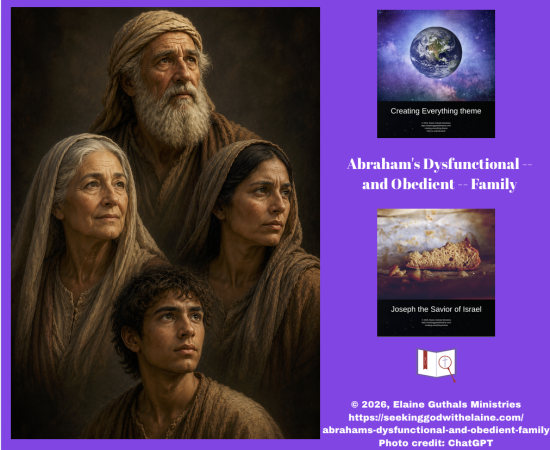
To wrap up the Book of Genesis, I thought we would look at Abraham’s family. For a long time, I have thought they were a dysfunctional family.
Face it, we’ve seen about everything with them. Some things probably surprise us that Jehovah didn’t go, “Deal’s off. The covenant is toast.”
But for all of their sins, almost all of them lived a life where they obeyed Jehovah.
What I an going to post here is just an excerpt on Abraham’s part in the covenant family. By the time I get Isaac and Jacob posted here, I hope to have a link for you to purchase the complete book.
Abraham
Abraham’s story shows us what it means to be a real, complex, and growing believer. It introduces us to the cost of obedience and how sanctification unfolds over time.
Abraham was the first of a long line of covenant people. Though his descendants would one day number like the stars in the sky (Gen. 15: 5), his family started out small — just a family learning to walk with Jehovah.
And that family was far from perfect.
Each had to choose whether to walk in obedience or follow their own path.
What can we learn from Abraham’s family about building our character through the sanctification process?
- Jehovah chooses flawed people.
- Jehovah works through flawed people.
- Jehovah sanctifies flawed people.
- Obedience matters more than perfection.
Let’s take a closer look at how this dysfunctional family learned to walk with Jehovah in obedience — not just outwardly, but from the heart.
Abraham: A Man of Faith Who Learned to Trust God
What Abraham Did Right
Abraham Obeyed Jehovah’s Call
One of Abraham’s greatest strengths was his willingness to obey. In two defining moments, we see that his obedience was immediate.
In Genesis 12: 4, we are simply told that Abraham did as he was instructed. We aren’t given details about his circumstances – only that he went. Whether he was settled or not, it would have taken time and effort to organize and uproot his household. Yet there is no hesitation recorded – he began obeying immediately.
Abraham showed us that obedience to Jehovah’s call is not dependent on understanding or comfort. It is a willingness to act when He speaks — even when it changes everything.
Abraham Believed Jehovah’s Promises
When Jehovah first called Abraham, He offered him many promises.
- Make him a great nation
- Give him many descendants
- Bless those who bless him
- Curse those who curse him
- Make him a blessing to others
Later, Jehovah added the promise of land. Abraham saw some of these promises begin to be fulfilled.
While Abraham had other children, he had to wait twenty-five years for the covenant son to be born.
Many of these promises would not be fulfilled in Abraham’s lifetime. Abraham showed us that Jehovah is faithful to fulfill His promises — whether we see their completion or not.
Abraham Believed Jehovah’s Promise
When Jehovah first called Abraham, He offered him many promises.
- Make him a great nation
- Give him many descendants
- Bless those who bless him
- Curse those who curse him
- Make him a blessing to others
Later, Jehovah added the promise of land. Abraham saw some of these promises begin to be fulfilled.
While Abraham had other children, he had to wait twenty-five years for the covenant son to be born.
Many of these promises would not be fulfilled in Abraham’s lifetime. Abraham showed us that Jehovah is faithful to fulfill His promises — whether we see their completion or not.
Abraham Interceded for Others
Abraham interceded with Jehovah when He told him about the coming destruction of Sodom and Gomorrah. It would be easy to say that he was interceding only for his nephew and his family — and no doubt he was.
Yet Abraham began his appeal at fifty.
Abraham was not just thinking about Lot — he was concerned that the righteous would share in the same judgment as the wicked. He hoped that the witness he and Lot had lived before others might have led more people to choose Jehovah when faced with judgment.
This reveals the compassion Abraham had for those who still lived in a pagan environment.
Abraham Ultimately Trusted Jehovah Above All Else
Through the journey to Mt. Moriah, Abraham’s steps never wavered. Though the weight of what he had been asked to do must have been immense, nothing in his actions showed hesitation — even as Isaac began to question what was missing.
Through it all, Abraham held to one truth: Jehovah will provide.
This is the kind of unshakable faith to which we are also called.
bound Isaac and laid him on the altar – still trusting Jehovah (Gen. 22: 9-10).
What Abraham Did Wrong
Abraham Acted in Fear Instead of Faith
Abraham was still learning to trust Jehovah in all things. One example was when he, Sarah, and probably Lot went to Egypt because of a famine. He didn’t lie, but he deceived Pharaoh (Gen. 12: 10-20).
Jehovah doesn’t disinherit us when we fail. He wants us to get it right the first time, but He is patient and gives us more chances when we don’t endure in the test.
Abraham acted out of fear again with Abimelech (Gen. 20). We would have thought that he learned.
Abraham reminds us that faith must be lived out consistently. We are called to trust Jehovah regardless of the circumstances in which we find ourselves.
Abraham Took Matters into His Own Hands
Abraham and Sarah had to wait 25 years for Isaac to be born. He was 75 years old when he received the promise — he was 100 when it was fulfilled.
Sarah either didn’t believe that she would get pregnant, or she got tired of waiting. So, she offered her servant girl to Abraham to have a child through her (Gen. 16).
As much as Abraham loved Ishmael, Isaac was the covenant son.
Abraham Didn’t Always Fully Understand Jehovah’s Plan
Abraham knew what Jehovah had promised him. He just didn’t always see how Jehovah would accomplish it.
Abraham couldn’t see how the 100-year-old man and the 90-year-old woman could have a child. Since that was physically impossible from a human perspective, he assumed that Eleazar would be his heir (Gen. 15: 2-3), and later that Ishmael would be the one (Gen. 17: 18).
But Jehovah is the God of the impossible. He is not bound by earthly laws. He transcends those limitations.
What Abraham Teaches Us
So, what does Abraham’s walk of faith as a whole teach us? He walked with Jehovah for 100 years.
We can look back and see his acts of obedience and faith, and we can also his acts of sin. But those acts – whether good or bad — are part of a whole. They are not isolated moments.
Abraham taught us that he wasn’t chosen because he was stable but because he
completely surrender his entire life to Him.
Our journey of faith is not made up of disconnected highs and lows. It is a continuous journey that begins at conversion and ends when we are called home to be with Jehovah.
There is no time off. There is no lesser moments. We can’t keep some pet sin hidden away from Jehovah’s eyes.
Sanctification is a process in which we grow. It is filled with testing and failure, but it is also filled with obedience, repentance, and renewal. Jehovah patiently works with us – flawed as we are – to accomplish His perfect purposes.
Abraham taught us that Jehovah doesn’t wait for functional people. He forms obedient ones.
From the very beginning, Abraham followed a call that led him into uncertainty. He never imagined that the promise of his son would take 25 years to be fulfilled. He never expected that he would be asked to surrender what He loved most.
Yet Jehovah did ask that of Abraham — and He may ask that of us.
Abraham taught us that the covenant didn’t rest on perfection but on faith.
Abraham went from a worshiper of idols to a worshiper of the One true God. He was neither a flawless saint, nor a reckless sinner.
Still, Jehovah counted him as righteous – and through him, blessed the entire world.
Jehovah calls us to obedience. That isn’t obedience only when it is easy. It isn’t obedience when our family allows it.
We have to always put God first – no ifs, ands, or buts.
Jehovah will call us to make hard sacrifices. If every choice would be between the easy and the easier, obedience wouldn’t mean anything.
Sarah: A Woman of Doubt Who Became a Woman of Faith
What Sarah Did Right
Sarah Followed Abraham in Faith
As we said, Sarah left her country and followed her father and husband to an unknown place. Not spelled out, is that meant the future was unknown.
As Abraham was beginning his journey of faith, Sarah was walking along side of him. We have no indication that Jehovah spoke directly to her, but her faith had to have been present.
Sarah Showed Courage in Dangerous Situations
When Abraham acted in fear and deceived Pharaoh (Gen. 12) and Abimelech (Gen. 20), Sarah was placed in a difficult situation. She was forced to be a party in the deception.
The deception allowed Sarah to be taken away from her husband and forced to live in what could become a dangerous situation.
Sarah met the challenges of the situations and endured until she was returned to Abraham. She showed resilience in dealing with the terror and uncertainty of the situation.
Sarah Gave Birth to the Child of Promise
One of the responsibilities of women at that time was to get married and have children, especially sons. We don’t know what type of pressure societal pressure was put on Sarah or how much pressure she put on herself.
When Jehovah first called Abraham (75 years old) that he and Sarah (65 years old) in 1885 BC (according to the timeline we’ve been using) He didn’t specifically say he would have a son. It was implied because He said he would have descendants (Gen. 12: 1-3).
In 1875 BC, Jehovah told the 85-year-old Abraham that he would have a son (Gen. 15: 4). That would have made Sarah 75 years old.
Finally, in 1861 BC, Jehovah said the child would be born the next year. Abraham was 99 and Sarah was 89.
The covenant with Jehovah hinged on Abraham and Sarah having a child. Sarah had to wait 25 years for the stigma of her barrenness to be removed. No, she didn’t always remain faithful, but she remained until the covenant promise was fulfilled.
She Ultimately Believed God’s Promise
Because of this, Sarah was deemed righteous. “It was by faith that even Sarah was able to have a child, though she was barren and was too old. She believed that God would keep his promise” (Heb. 11: 11 NLT).
What Sarah Did Wrong
Sarah Laughed at God’s Promise
When Jehovah told Abraham that they would have a child the next year, Sarah laughed. She may not have laughed when he told her when he got the call and Genesis 12, but she may have.
No, it is not good to laugh at Jehovah’s promises, but I can see it as a human reaction. For 24 years, Sarah had been waiting for the embarrassment for the curse of barrenness to be removed. All she had gotten for it was to be 24 years older – and no son.
Sarah compounded the disrespect to Jehovah of laughing with lying about laughing. She denied that she did (Gen. 18: 15).
Sarah Tried to Control God’s Timing
Sarah got impatient waiting for Isaac to be born. In fact, she took matters into her own hands to get the promise fulfilled.
It was a practice in the Ancient Near East that barren women could use a servant as what we would call a surrogate mother. She chose her servant Hagar to be Abraham’s concubine.
Sarah Treated Hagar Harshly
It was Sarah’s decision to give Hagar to Abraham to be his concubine so that a son could be born. But when that plan proved successful, Sarah treated Hagar harshly.
Sarah may have treated Hagar harshly because she felt inadequate when she couldn’t get pregnant and Hagar did. She could no longer blame their inability to have children on Abraham.
Sarah was probably reacting to how Hagar’s relationship with her changed. Hagar was now treating her with contempt.
Still, that didn’t give Sarah license to treat Hagar harshly. They all were in this situation because they did not wait for Jehovah to provide the covenant child.
The Final Testing of the Covenant Promise
Jehovah tested Abraham’s faith by requiring him to sacrifice his beloved son Isaac as a burnt offering (Gen. 22: 2 NLT). Abraham didn’t waver but journeyed to the mountain on which Jehovah told him to go.
An angel of the Lord stopped Abraham from killing his son (Gen. 22: 11-12). Jehovah provided a ram to be sacrificed.
We aren’t told what Abraham told Sarah — if anything – before he left. We know that Abraham didn’t tell Isaac (Gen. 22: 6-8).
If Abraham didn’t tell Isaac until he had to bind him, he probably didn’t tell Sarah before they left. But how would she reacted when they got home and told her what Jehovah had asked?
What Sarah Teaches Us
Sarah taught us to wait for Jehovah. He will always fulfill his promises on his timetable. He will never be early but he will never be late.
In our time of instant gratification, it is difficult to wait for God.
Waiting on God teaches us self-discipline that is a major area. We need to learn on our Sanctification Road when we wait. It puts a brick in our road.
Sarah, maybe even more than Abraham, taught us what the Sanctification Road is. It is where we develop and endure in our faith. It is the times we are reluctant to follow God’s Will.
It is a life-long process.
No, we don’t see Sarah as perfect or blameless. We don’t see her as a staunch believer.
We see Sarah as someone who chooses to take the next step on the Sanctification Road. She ultimately trusted Jehovah to give her the strength to take that step so she could receive what was promised.
Sarah taught us to stay on the Sanctification Road regardless of circumstances. The promises may seem delayed or loaded with negative components.
But we are called to endure to the end (Mt. 24: 13).
We don’t need faith that has a Hollywood splash. We don’t even need a faith that always remains up.
We need a persistent faith.
Honestly, it may have taken Sarah the 25 years before she truly believed in the covenant promise of a son. Oh, she saw Abraham’s promises being fulfilled.
But this one was hers, also. And she wasn’t given a quick fulfillment to solidify her faith.
Sarah had to solidify her faith in the face of her shame of barrenness. She had to set her eyes on the promise instead of looking at the struggles.
Sarah teaches us that we can be deeply human and still choose to trust Jehovah. We can be deeply human and stay on the Sanctification Road until we survive failure.
Hagar: The Seen and Heard Servant
What Hagar Did Right
Hagar Endured Unjust Treatment
The Ancient Near East had a practice for assuring family lines were continued even if the primary wife was barren. This was not something Sarah thought up on her own.
Husbands were allowed to take a female slave and have a child/children through her. Sarah saw this practice as a way to gain a son and, hopefully, fulfill Jehovah’s promise (Gen. 16: 2). We aren’t told if Abraham felt any reluctance of this plan. All we are told is he agreed (Gen. 16: 2).
We also aren’t told how Hagar was chosen for this duty. We don’t know how Sarah presented this her – whether she had any choice in the matter or not. We can assume as a shifchah (שפחה) — also transliterated as šip̄ḥâ – wouldn’t have been given the option.
Hagar was described as Abraham’s wife – isha (אִשָּׁה). However, it doesn’t seem that either Abraham or Sarah elevated her in their estimations.
So, we don’t know Abraham’s treatment of her, and we aren’t told Sarah’s treatment of her until Genesis 16: 6.
What we do know is Sarah treated her harshly. Did she abuse Hagar? Maybe, although we aren’t given any particulars of the treatment. Harshly does not always equate to abuse.
Hagar Obeyed Jehovah’s Instruction
Sarah’s treatment was harsh enough that Hagar ran away and fled to the wilderness. Wilderness represented a place of testing, dependence, and formation. That makes it a place of dependence, return, and restoration.
Jehovah gave Hagar instructions that she probably didn’t want to hear. “The angel of the Lord said to her, ‘Return to your mistress, and submit to her authority’” (Gen. 16: 9 NLT).
There are times that Jehovah does tell us to do things we don’t want to do. Abraham sure didn’t want to sacrifice Isaac (Gen. 22: 2).
But we – as Abraham and Hagar did – need to follow Jehovah’s instructions.
Hagar Recognized and Named Jehovah
Yes, Hagar was an Egyptian and, therefore, a Gentile. Jehovah still came to provide for and comfort her.
Based on the timeline we’ve been using, we estimated that – at this time – Hagar had been with Abraham and Sarah for five to ten years. An observant slave would have had some clue as to the God of her master and mistress. When the angel of the Lord found her beside a spring of water, Hagar recognized that it was either Jehovah or a messenger from Him.
Hagar Cared Faithfully for Her Son
It was obvious that Hagar love Ishmael, her son. When Abraham turned them out of his tents, he sent them off with food and water.
When the water ran out, Hagar placed Ishmael in the shade of a bush (Gen. 21: 16). She left him there and moved away.
No, she didn’t do that because she didn’t love him – it was because she did. She didn’t want to watch her son die.
What Hagar Did Wrong
Hagar Treated Sarah with Contempt
We are told that Sarah treated Hagar harshly (Gen. 16: 6). We have some insight as to why. “… But when Hagar knew she was pregnant, she began to treat her mistress, Sarai, with contempt” (Gen. 16: 4 NLT). Her pride stepped in. Insolence was given a breeding ground to flourish.
Both ladies treated the other badly. Both were wrong.
We are told that Hagar’s actions began when she knew she was pregnant. It is easy to assume that she scorned Sarah because she became pregnant and Sarah couldn’t.
Hagar Initially Ran from Her Situation
Hagar was an escaped slave. As much as we may want to cheer for her freedom, she legally was in the wrong.
When He met her at the spring, Jehovah didn’t elevate Hagar’s status. He called her Sarah’s shifchah – a lowest-level slave. He did not call her an isha (אִשָּׁה) – wife – or even pilegesh (פִּילֶגֶשׁ) – concubine.
While Jehovah came and found Hagar, He really didn’t cut her any slack. Some would think she was entitled to a pass because of the harsh treatment of Sarai against her. Instead in several places in Scripture, He told slaves to obey their masters — and it doesn’t mention how they are being treated (I Pet. 2: 18; Ti. 2: 9; Eph. 6: 5; Col. 3: 22).
Hagar Didn’t Teach Her Son to Accept the Covenant
Once Isaac was born, it would have been evident that he was the covenant child. Jehovah had spoken — Hagar and Ishmael should have accepted that.
Instead, they didn’t. It came to a head at the celebration of Isaac’s weaning. According to the timeline we have been using, he was born in 1860 BC.
A 16-year-old boy – or older – was mocking a 2-year-old boy? To me, Ishmael was being a bully.
Hagar’s contempt for Sarah gave Ishmael — in their minds — permission to show contempt for Isaac. Instead of teaching him compassion, it looks like she taught him entitlement and envy, traits Jehovah does not want us to have.
What Hagar Teaches Us
Hagar teaches us that Jehovah sees all, even those whom we may overlook. He hears their cries and provides for our needs.
We may see that time of distress as an impossible situation. Jehovah can rescue is from the impossible as He is the God of the impossible (Mt. 19: 26; Lk. 1: 37; Phil. 4: 13).
Hagar also teaches us that Jehovah does not save us from the trials we face. Instead, He meets us there and carries us through. He uses these situations to sanctify us, building our faith and trust in and obedience to Him.
Finally, we see that Hagar teaches us that even suffering can be used to provide Jehovah’s promises. We must focus on Him to provide that which He has planned for us.
In Hagar’s storyline we see her go from an unknown person to an unseeing servant to someone who is not only seen by Jehovah but sees Him. He doesn’t forget any of His creation.
Ishmael: A Son of Promise, Yet Outside of the Covenant Life
What Ishmael Did Right
Ishmael Survived in a Harsh Wilderness
After Abraham sent Hagar and Ishmael away, he grew up in the desert of Paran (Gen. 21: 21). This would have been a harsh way of life.
Instead of a forest as we might picture it, the Wilderness of Paran was a harsh desert landscape. It sported rocks plateaus instead of sand. It had gravel plains instead of grassy meadows. The steep wadis – dry streambeds – and scattered springs did not promote vegetation.
It would have been an empty land. It was here that the Wilderness Wanderers would find themselves years later.
It was in this environment that Ishmael survived – and thrived. He became an archer – an important skill in defending himself, others, and their possessions.
Wilderness living should have taught Ishmael to value what he has been given. It would have given him the good with the bad. Jehovah wants us to be content with where we are at and the path that He has for us.
There would have been an element of uncertainty. The wilderness could potentially take things away from us. We need to know that this world is temporary and should allow it to prepare us for a life with Jehovah.
Ishmael Honored His Father at Abraham’s Death
Whatever his feelings about being cast out by Abraham (Gen. 21: 14) and his feelings toward Isaac (Gen. 21: 9), Ishmael still stood with Isaac at Abraham’s burial (Gen. 25: 9).
Abraham’s love for Ishmael was obvious. He suggested Jehovah consider Ishmael the covenant son (Gen. 17: 18). However, Jehovah had other plans.
We like to think that Abraham and Ishmael had reconciled. We like to think that, as they grew, Ishmael and Isaac would have been able to have a relationship, if not as brothers at least as friends. That seems to have been the case, or I doubt Ishmael would have been at the burial.
Jehovah does not want us to hold a grudge, especially when things occur according to His plan. He wants us to let go of the anger, jealousy, and envy that plagues us. We are to put our trust in Him to know what is best for us.
Ishmael Became a Great People
Still, Jehovah had plans for Ishmael. He promised Abraham (Gen. 17: 20) and Hagar (Gen. 16: 10) that Ishmael would become a great people. He promised that Ishmael would sire 12 sons, and He promised Hagar that she would have many descendants.
Jehovah kept his promise. Ishmael’s descendants became some of the people called Arabs today.
It build our character when we wait on Jehovah’s promises to be fulfilled. We can kick and scream that things are taking too long – but that isn’t going to change Jehovah’s time.
We need to use the time of waiting to prepare us for the task ahead. Resource management, people management, and gaining new skills may be necessary for what Jehovah has called for us. We need to be willing to put in the work to get prepared for the promise fulfillment.
What Ishmael Did Wrong
Ishmael’s Character Was not What Jehovah Wanted
Jehovah described Ishmael’s character (Gen. 16: 12-13) to Hagar before he was born.
Ishmael would be a wild man. Jehovah calls for His children to be sober and even keeled.
Also, Ishmael would be an angry man. It is easy to think that Ishmael’s anger stemmed from Abraham’s treatment of him.
Because of that anger, Ishmael would be at odds with his neighbors and relatives – everyone. That anger has been – and still is – directed at Isaac and his descendants. Still, the Arab groups struggle to get along.
Ishmael Mocked Isaac
That anger – when directed at Isaac – manifested itself in Ishmael mocking Isaac (Gen. 21: 9). A 16- to 19-year-old mocked a 2- to 5-year-old. Those feelings of anger may have stemmed from jealousy and envy because Isaac was the covenant son.
Jehovah doesn’t want that to be the way humans respond to each other.
Ishmael Was Caught in Family Conflict
It is true. Ishmael was caught up in the consequences of Sarah’s and Abraham’s decisions. He had no choice in creating this situation.
That being said, Ishmael did nothing to eliminate the family conflict. In fact, his actions escalated the conflict – and eventually brought it to a head.
We each are in situations that we cannot control. What we can control is how we respond to that situation. Are we going to act according to Jehovah’s standards, or are we going to act sinfully?
Jehovah wants us to have a strong enough relationship with Him to know that, even in the difficult times, that He is with us – next to us and within our hearts.
What Ishmael Teaches Us
Ishmael teaches us that God cares for all human – whether we are part of the covenant line or not. All can be seen, heard, and cared for by Jehovah.
However, unless we admit we are sinners, believe in Yeshua as our Savior, confess Jehovah as Sovereign God and walk with Him daily, we are not blessed – saved.
Ishmael also teaches us that family conflict and the way we handle it can adversely shape our lives.
Still, Jehovah provides and protects us through these situations according to His plan.
Abraham loved Ishmael. Hagar loved Ishmael. Jehovah loved and blessed Ishmael.
Yet, Ishmael remained outside the covenant line. That is sobering.
A person can be loved, blessed, protected, and prosperous – and still not be in a covenant relationship with Jehovah.
This is a lesson that disciples today must learn.
- Material blessings does not signify covenant membership.
- Protection does not mean covenant membership has been attained.
- Family heritage does not guarantee covenant membership.
If being Abraham’s son wasn’t enough for Ishmael, being Tom, Sally, or Elaine’s child isn’t enough either.
Having a relationship with Jehovah is a personal experience. We must make our own decisions whether to obey Jehovah or not.
We have to realize that there are two definitions for the word blessing. One definition is about rewards. The other is about salvation.
A person can receive real blessings from Jehovah and still need salvation – a personal relationship with Him.
Jehovah chooses flawed people. He works through us to sanctify us. He is looking for obedience, not perfection.
Even though Ishmael stood against the covenant, Jehovah kept His promises to Ishmael because he is faithful to His promises.
To read devotions in the Creating Everything theme, click the button below.
If you don’t understand something and would like further clarification, please contact me.
If you have not signed up for the email providing the link to the devotions and the newsletter, do so below.
If God has used this devotion to speak with you, consider sharing it on social media.