In the last devotion, we discussed the death of Jacob. This devotional reading looks at his burial and the fear of Joseph’s brothers had after his death.
Nuggets
- Joseph took a minute and mourned his father.
- The preparation for burial of Jacob’s body was different than he would have received had he stayed in Hebron.
- Jacob remained tied – even in death – to the covenant land promised first to Abraham.
- Joseph had to ask permission to leave the country to take Jacob’s body for burial.
- At first glance, it seems like Joseph was not telling the exact truth about Jacob’s burial.
- What we would call the funeral service occurred at what was renamed Abel-mizraim, meaning mourning of Egypt.
- Jacob was buried in the cave Abraham purchased after Sarah died.
- The covenant family still remained outside the promised inheritance.
- Joseph’s brothers thought his kindness was offered only because of respect for their father.
- The brothers told Joseph that Jacob, too, thought he would take vengeance on his brothers after his death.
- Joseph reiterated that the brothers acted in Jehovah’s plan and their relationships were secure.
- Jehovah can use our sins to forward His plan.
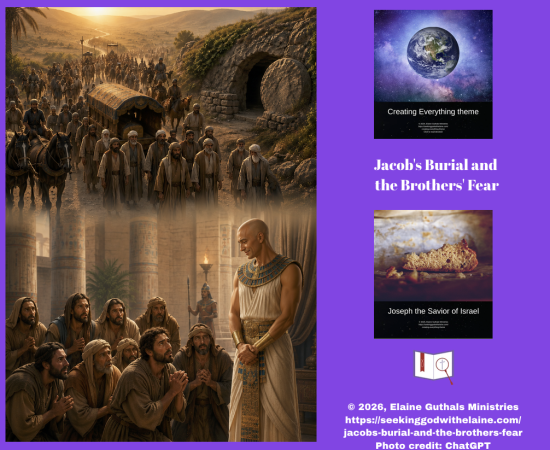
Jacob was dead. Not before he blessed his sons. Not before he took the covenant blessings that came to him as patriarch and distributed them among his children.
When we look at all the blessings together, we see the whole of Israel. We also see the whole of human nature.
But human nature often fears when circumstances change. Joseph’s brothers did. With Jacob gone, they feared Joseph would finally take revenge for what they had done to him decades earlier.
Joseph gave one of the most important theological statements in Genesis in response.
Let's Put It into Context
To read devotions in the Creating Everything theme, click the button below.
Devotions in the Joseph the Savior of Israel series
Preparing Jacob for Burial
“Joseph threw himself on his father and wept over him and kissed him. Then Joseph told the physicians who served him to embalm his father’s body; so Jacob was embalmed. The embalming process took the usual forty days. And the Egyptians mourned his death for seventy days” (Gen. 50: 1-3 NLT)
Joseph Wept
Joseph took a minute and mourned his father.
I am sure Joseph’s emotions were running deep at the death of his father. Once his brothers sold him into slavery, he probably thought he would never see him again.
But they were reunited! They had 17 years together.
Now, Jacob was gone – and permanently this time. We can imagine what he was feeling: gratitude for the gift of spending the last years of his life with him. Sorrow knowing this separation would be permanent until Joseph passed.
Kalisch noted that on the day of the person’s death, “… public lamentations, in covering the head and the face with mud (or dust), girding up the garments, and beating the breasts” ensued.
Resource
I always thought girding up the garments was rending the garments. They are both, however, normal ways mourners showed their grief. Girding meant altering their garments, and rending meant tearing them.
Joseph could have done either. He also could have accompanied it with any or all of the other ways grief was shown.
- Putting dust or ashes on the head
- Covering the face
- Bearing the breast
- Going barefoot
- Wearing sackcloth
Jacob Was Embalmed
The preparation for burial of Jacob’s body was different than he would have received had he stayed in Hebron.
We aren’t for sure what that preparation would entail as Genesis doesn’t say. Why would Moses tell his readers what they already knew?
Broader ancient customs indicates when someone died, their eyes ere closed. Their body was probably washed and wrapped. It may have been anointed.
The Israelites were not used to embalming their dead. Still, if they were going to take Jacob hundreds of miles back to Canaan, I would think they needed to do something.
It is interesting that Joseph asked the physicians to embalm the body instead of the priests, who were normally in charge of the embalming process. Neither Jacob or Joseph would have wanted the pagan practices, but the body would need to be prepared for the long journey to Canaan.
To the Egyptians, it was associated with honor, preservation, and preparation for burial. The process took 40 days for Jacob. Kalisch noted that the process usually took 70 days.
Resource
There were three processes of embalming that the Egyptians used. The determining factors on which process was used was the person’s status, wealth, and era.
- Removal of all organs except the kidneys and heart; spiced and rinsed the body; filled it with myrrh, cassia, and other aromatics; and steeped it in natrum for 70 days
- Filled the body with cedar oil without removing organs and steeped it in natrum for 70 days
- Rinsing the abdomen with symaea and steeped it in natrum for 70 days
Resource
The forty days that Moses described could be just the body-preparation stage.
We have to take that description of the embalming process with a grain of salt. We don’t know the exact time period Kalisch is describing because the practices changed over time.
Whatever the process used on Jacob, it didn’t complete the entire 70 days usually required. This could be because the body was not steeped for the usual time. In other words, the entire mummification process was not completed.
The Egyptians Mourned
It is a testament to the people of the time that the Egyptians did mourn Jacob.
The mourning period was 70 days. This would have been an extraordinary national mourning period. The Egyptians mourned Jacob — and this is where we should focus — as if he were royalty, not the lowly shepherd, an occupation they despised.
Jacob’s Burial
“When the period of mourning was over, Joseph approached Pharaoh’s advisers and said, ‘Please do me this favor and speak to Pharaoh on my behalf. Tell him that my father made me swear an oath. He said to me, “Listen, I am about to die. Take my body back to the land of Canaan, and bury me in the tomb I prepared for myself.” So please allow me to go and bury my father. After his burial, I will return without delay.’ Pharaoh agreed to Joseph’s request. ‘Go and bury your father, as he made you promise,’ he said. So Joseph went up to bury his father. He was accompanied by all of Pharaoh’s officials, all the senior members of Pharaoh’s household, and all the senior officers of Egypt. Joseph also took his entire household and his brothers and their households. But they left their little children and flocks and herds in the land of Goshen. A great number of chariots and charioteers accompanied Joseph. When they arrived at the threshing floor of Atad, near the Jordan River, they held a very great and solemn memorial service, with a seven-day period of mourning for Joseph’s father. The local residents, the Canaanites, watched them mourning at the threshing floor of Atad. Then they renamed that place (which is near the Jordan) Abel-mizraim, for they said, ‘This is a place of deep mourning for these Egyptians.’ So Jacob’s sons did as he had commanded them. They carried his body to the land of Canaan and buried him in the cave in the field of Machpelah, near Mamre. This is the cave that Abraham had bought as a permanent burial site from Ephron the Hittite” (Gen. 50: 4-13 NLT)
Take My Body Back
Jacob remained tied – even in death – to the covenant land promised first to Abraham.
Jacob’s insistence that his body be buried in the cave with the other patriarchs showed Jacob’s tie with the Promised Land.
Ancient Near Easterners believed that burial location spoke to a person’s identity. It represented ancestry and observant continuity.
Jacob insisted that his body be returned to Canaan even though – at that time – nothing was there except the cave. Jacob had brought everything else with him.
But the burial spot was there – at Mamre – in the Promised Land. Jacob’s insistence was an act of faith. “All these people died still believing what God had promised them. They did not receive what was promised, but they saw it all from a distance and welcomed it. They agreed that they were foreigners and nomads here on earth.” (Heb. 11: 13 NLT).
Joseph Approached Pharaoh’s Advisers
Joseph had to ask permission to leave the country to take Jacob’s body for burial.
Does it seem strange that Joseph would speak to Pharaoh’s household rather than to Pharaoh himself? Joseph is the second highest person in the community.
The reason Joseph didn’t go to Pharaoh himself – with whom he has always seems to have had a good working relationship — was probably because he was in mourning.
Pharaoh granted permission immediately.
Think about it. This sounds like there had been a very huge caravan exiting from Egypt. It wasn’t just Jacob’s 12 sons making the journey to bury Jacob. The caravan included
- Joseph and his entire household
- All of Pharaoh’s officials
- All the senior members of Pharaoh’s household
- All the senior officers of Egypt
- Joseph’s brothers and their households minus their little children, flocks, and herds
- Charioteers
That sounds like a lot of people.
Would countries and people groups between here and there think they were coming to invade them?
Swear an Oath
At first glance, it seems like Joseph was not telling the exact truth about Jacob’s burial.
Did Joseph misspeak, according to the way it is written in Hebrew. “ My father had me swear an oath. He said, ‘I am going to die. You are to bury me in my grave, which I dug for myself in the land of Kena’an.’ Therefore, I beg you, let me go up and bury my father; I will return” (Gen. 50: 5 CJB).
Jacob was going to be buried in the tomb with Abraham, Sarah, Isaac, Rebecca, and Leah that Abraham had purchased generations earlier. He would not have done any digging. The Hebrew verb kārāh (כָּרָה) is probably being used to mean preparing, designing, or making provision for a burial place.
Joseph wasn’t misleading Pharaoh. He was probably referring to the burial place Jacob claimed within the cave where his ancestors were buried.
Threshing Floor of Atad, Near the Jordan River
What we would call the funeral service occurred at what was renamed Abel-mizraim, meaning mourning of Egypt.
I know that is two uses of what was. What it shows is the importance of Jacob.
Was Jehovah foreshadowing when the Israelites would control the land?
Buried Him in the Cave
Jacob was buried in the cave Abraham purchased after Sarah died.
Kalisch believed Jacob was buried in the tomb inside a case of wood or stone. I had thought the Israelites did something differently.
Resource
They did. Usually, the corpse was placed in a shelf within the cave. After decomposition, the larger bones would then be placed in an ossuary area.
But, Jacob could have been buried in a coffin. Because he had been embalmed, his bones would have decomposed more slowly. Also, we aren’t told if his sons made a second journey in order to do place his decomposed bones in a box.
I can see the coffin being used for protection during transport. If Jacob was buried in it is a toss-up, but I think he would have been given the honor of being buried in a coffin rather than just placed on the cave floor.
The Egyptians had honored Jacob too much to do just that.
Regardless of the processes and tools that were used to bury Jacob, he was buried with his ancestors. He was buried in the Promised Land.
Joseph Reassures His Brothers
“After burying Jacob, Joseph returned to Egypt with his brothers and all who had accompanied him to his father’s burial. But now that their father was dead, Joseph’s brothers became fearful. ‘Now Joseph will show his anger and pay us back for all the wrong we did to him,’ they said. So they sent this message to Joseph: ‘Before your father died, he instructed us to say to you: “Please forgive your brothers for the great wrong they did to you — for their sin in treating you so cruelly.” So we, the servants of the God of your father, beg you to forgive our sin.’ When Joseph received the message, he broke down and wept. Then his brothers came and threw themselves down before Joseph. ‘Look, we are your slaves!’ they said. But Joseph replied, ‘Don’t be afraid of me. Am I God, that I can punish you? You intended to harm me, but God intended it all for good. He brought me to this position so I could save the lives of many people. No, don’t be afraid. I will continue to take care of you and your children.’ So he reassured them by speaking kindly to them” (Gen. 50: 14-21 NLT)
Joseph Returned to Egypt
The covenant family still remained outside the promised inheritance.
Joseph went back to Egypt.
Joseph was there. His brothers were there. They could have brought the kids and the animals. The famine was over, Then they could have just stayed in Canaan, right?
No, they went back to Egypt. It wasn’t in Jehovah’s plans for them to stay.
Joseph’s Brothers Became Fearful
Joseph’s brothers thought his kindness was offered only because of respect for their father.
So, for 39 years, Joseph’s brothers wrangled with unfinished business. They thought for sure that, while Jacob was alive, Joseph wouldn’t take revenge on them for selling him.
Now Jacob was dead. Everything changed.
And the brothers panicked.
But doesn’t that show us something very important? We may think that the guilt of sin has died, but it hasn’t.
Look what Vaughan said. He wrote, “No sorrow, and no sin, ever quite does. No lapse of time, no length of experience, no depth of repentance, can absolutely divide the one into two, while the person is the same …”
Resource
Can we change? Yes, that is what we do when we become disciples — we repent of the sins we have done and choose to walk with Jehovah.
That doesn’t mean that a wand is waved, and we no longer have committed that sin. It changed us — good or bad — into the people we are today. Nothing is going to change that.
Could Jacob have said that? Maybe. Just because it isn’t recorded in Scripture doesn’t mean he didn’t say it.
I just don’t see it. Jacob saw the man Joseph had become. He saw how firmly he believed that God had used that to get him where He wanted him to be.
Joseph would not have sought revenge for them doing what was in Jehovah’s plan.
Before Your Father Died
The brothers told Joseph that Jacob, too, thought he would take vengeance on his brothers after his death.
They didn’t say our father – because Jacob was all of their fathers – they just had different mothers. They said your father.
Of course, we aren’t told the reason why they did this. It is most probably, in my opinion, that the brothers were appealing to Joseph’s special relationship with Jacob. They were trying to persuade him by invoking the wishes of the father whom Joseph deeply loved.
Most of all, it shows how uncomfortable they still felt standing before the brother they had wronged. Even after seventeen years, they still don’t seem completely at ease around Joseph.
All of them – again – bowed before Joseph. What is this? At least the third time.
And don’t miss the fact that it was all of them acting as one again. All ten of them – remember Benjamin didn’t have anything to do with selling Joseph – were now shaking in their sandals.
The brothers thought that Joseph was only biding his time until Jacob died before turning on them.
Don’t be Afraid of Me
Joseph reiterated that the brothers acted in Jehovah’s plan and their relationships were secure.
Joseph gave the brothers two reasons why the matter was resolved in his eyes.
The first reason was that the word is vengeance. The act of vengeance is to punish a certain individual or group of individuals. The punishment is seen as retribution.
The person who is performing the act of vengeance does not feel like they are the one who “started it.” Their act is a response to an injury or a wrong.
Joseph knew that revenge is Jehovah’s job.
- “Do not seek revenge or bear a grudge against a fellow Israelite, but love your neighbor as yourself. I am the Lord” (Lev. 19: 18 NLT).
- “I will take revenge; I will pay them back. In due time their feet will slip. Their day of disaster will arrive, and their destiny will overtake them” (Deut. 32: 35 NLT).
You Intended Harm, but God Intended Good
Jehovah can use our sins to forward His plan.
The second reason was that it was Jehovah’s plan that it happen.
Let’s look at the Hebrew, the transliteration, and the literal rendering.
אַתֶּם חֲשַׁבְתֶּם עָלַי רָעָה אֱלֹהִים חֲשָׁבָהּ לְטֹבָה
atem chashavtem alai ra’ah Elohim chashavah letovah
You planned evil against me, God planned it for good.
The key word is chashay (חשב) — plan, intend, design. Human plan = evil. God’s plan = good.
Bersier had a fantastic observation. “Since the Scriptures call us to be imitators of God, like Him we must [endeavor] to draw good out of evil.”
Resource
.Think about it. Jehovah wants to transform evil into good. We do that by witnessing to others. That is part of our marching orders.
- “And then he told them, ‘Go into all the world and preach the Good News to everyone’” (Mk. 16: 15 NLT).
- “Therefore, go and make disciples of all the nations, baptizing them in the name of the Father and the Son and the Holy Spirit. Teach these new disciples to obey all the commands I have given you. And be sure of this: I am with you always, even to the end of the age” (Mt. 28: 19-20 NLT).
God provides for us to build our moral character and expand His kingdom.
Can we assume that Joseph meant that Jehovah took the evil and eventually made it into good/ No.
Maybe Jehovah changed His plans to use their choice. No.
Jehovah didn’t react after-the-fact to the brothers’ actions. That was in His plan all along.
No, that didn’t take away their free will any more than it took away their guilt. They choose, and they still had to pay the consequences.
God’s Will comes to pass every single time.
Father God. You are with us at the moment You call us home. You are with loved ones left behind. Help us — regardless of which situation we are in — that we will focus on You. Amen.
If you don’t understand something and would like further clarification, please contact me.
If you have not signed up for the email providing the link to the devotions and the newsletter, do so below.
If God has used this devotion to speak with you, consider sharing it on social media.