Jacob had one more son to bless – Benjamin. This devotional reading looks at that blessing and the death of Jacob.
Nuggets
- Benjamin was the second son of Jacob and Rachel and Jacob’s twelfth and last son.
- The “wolf” imagery Jacob used is seen by many older commentators as connected with passages where Isaiah, Jeremiah, and Ezekiel along with minor prophets attributed the leader of victorious battles as the Messiah.
- When it talks about morning and evening, it is saying what we would call something as continuous.
- By blessing Benjamin, Jacob had finished blessing – and I am sure some felt like they were cursing – his sons.
- Jacob instructed his sons on where he was to be buried.
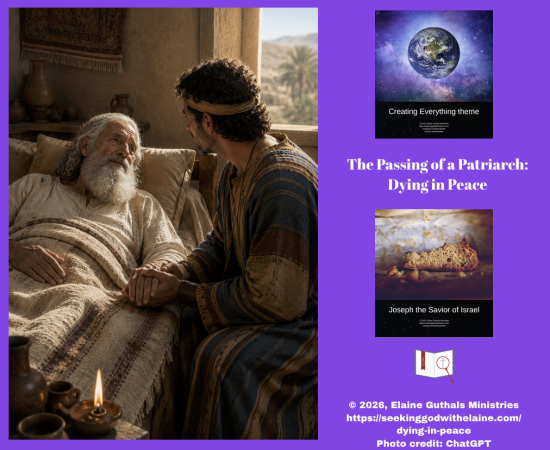
Jacob was coming to the end – of blessing his sons and of his life. Through the 12 chapters of Genesis that he is in, we see a transformation in His life. The man who thought he needed to deceive his father to receive the covenant blessing had learned to trust Him.
Let's Put It into Context
To read devotions in the Creating Everything theme, click the button below.
Devotions in the Joseph the Savior of Israel series
Benjamin
“Benjamin is a ravenous wolf, devouring his enemies in the morning and dividing his plunder in the evening” (Gen. 49: 27 NLT)
Benjamin was the second son of Jacob and Rachel and Jacob’s twelfth and last son.
We have to remember family dynamics. The ages of eleven sons were within six years apart. Benjamin was born 17 years after the youngest of the 11 were born.
That is a big gap. But that also explains why it seems like Benjamin was treated as a protected younger child – he was.
But hmmm. Was Benjamin’s prophecy a good one or a bad one?
This ambiguity seems strange because Jacob fawned over Benjamin. Before Benjamin was a year old, Jacob’s beloved wife and beloved son were gone – one for sure dead and one believed dead.
A Ravenous Wolf
The “wolf” imagery Jacob used is seen by many older commentators as connected with passages where Isaiah, Jeremiah, and Ezekiel along with minor prophets attributed the leader of victorious battles as the Messiah.
This is logical. The territory Benjamin was allotted contained the northern approaches to Jerusalem – which was in their territory. (But that also put them between Judah’s territory and Ephraim’s territory.)
If we go at it somewhat literally, the blessing speaks of great military success. He engages the enemy in the morning, finds victory sometime during the day, and receives the spoils of victory by the end of that day.
It isn’t a long, drawn-out battle. It is a quick victory.
Morning and Evening
When it talks about morning and evening, it is saying what we would call something as continuous.
That expands the victorious aspect to being more than a once-in-a-while victory. In Jehovah, we find unending victory.
Bradford had another take. He noted warriors from of Benjamin probably used the trade routes within their territory as an income source. These would have been short skirmishes with the traders in the caravans they attacked.
Resource
Let’s look at this figuratively. When we are younger – in the morning of our lives – we can see the world around us and want to explore it. We can be tempted by the bright, shiny aspect of sin.
Hopefully, when we get older – when we are in the evening of our lives – we turn back to Jehovah. Isn’t that what the Proverbs says? “Direct your children onto the right path, and when they are older, they will not leave it.” (Prov. 22: 6 NLT).
As warlike as the tribe may have been at its inception, those skills were useful to the Southern Kingdom when the nation split. Judah did not have to stand alone.
In the Exodus, Benjamin’s tribe was designated part of the West Division. In the first census, the tribe numbered 35,400 (Num. 1: 36-37). By the second census, they grew to 45,600 (Num. 26: 41).
The tribe of Benjamin received their allotment in Joshua 18: 11-28. It may have been a small allotment, but it was strategically important. The land laid between Judah to the south and Ephraim to the north. Cities included Jerusalem, Jericho, Bethel, Gibeah, and Mizpah.
The fighting part of the prophecy came to be (Jdgs. 19-21) – and not in a good way. The men of Gibeah committed a horrific crime. When the other tribes demanded justice, Benjamin refused.
As result of the civil war that broke out, the tribe of Benjamin was nearly decimated. Only 600 Benjaminite men survived.
Still, we know some of the names of people who came from the tribe of Benjamin.
- Ehud was one of the judges.
- Saul was the first king.
- Jonathan was a true friend of David.
- Mordecai and Esther – through Jehovah’s intervention – worked to preserve the nation during the time in Persia.
- The Apostle Paul also was a member of the tribe of Benjamin.
When the nation split, Benjamin stayed with Judah instead of going with Ephraim. That helped strengthened the Southern Kingdom.
In Conclusion
“These are the twelve tribes of Israel, and this is what their father said as he told his sons good-bye. He blessed each one with an appropriate message” (Gen. 49: 28 NLT)
By blessing Benjamin, Jacob had finished blessing – and I am sure some felt like they were cursing – his sons.
In a way, it seemed like Benjamin’s blessing was a summation of all the blessings for all the tribes.
I am not sure what I am thinking at the moment. This is translated appropriate. The Complete Jewish Bible translates it individual.
I guess both are correct. Jacob was talking about each son specifically, but also about the nation of Israel as a whole.
But how did the blessing shake out?
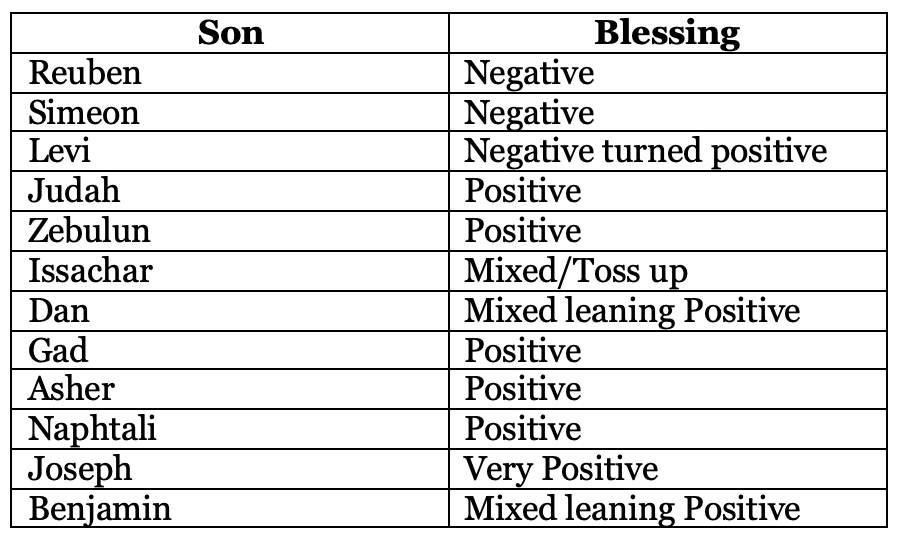
We know the content of the blessings had to come from Jehovah. Only He can see the future.
Did it hurt Jacob to give some of those blessings? Maybe. But he was obedient to Jehovah and gave His prophecy.
Jacob’s Burial Instructions
“Then Jacob instructed them, ‘Soon I will die and join my ancestors. Bury me with my father and grandfather in the cave in the field of Ephron the Hittite. This is the cave in the field of Machpelah, near Mamre in Canaan, that Abraham bought from Ephron the Hittite as a permanent burial site. There Abraham and his wife Sarah are buried. There Isaac and his wife, Rebekah, are buried. And there I buried Leah. It is the plot of land and the cave that my grandfather Abraham bought from the Hittites.’ When Jacob had finished this charge to his sons, he drew his feet into the bed, breathed his last, and joined his ancestors in death” (Gen. 49: 29-33 NLT)
Jacob instructed his sons on where he was to be buried.
Why did it matter where Jacob would be buried? Why not just be buried in Egypt?
Gathered to my people and bury me with my ancestors are not exactly what it means to us. To us, it would mean stick us in the family plot.
Though, it was spoken like an older person. “This is how you get to the cemetery. This is how you get to the plot. This is who is buried there.” The only thing he didn’t add was, “You can’t miss it.”
Bradford believed that Jacob believed in ancestor worship. This is what other Ancient Near Eastern societies believed.
Here is what Bradford said. He wrote, “Yet, in Israel, we DO find ancestor worship and respect for the dead and an understanding that there IS something beyond the grave, even if it is not fully evident.”
Resource
If you asked my opinion, I would say that it probably meant that Jacob respected the dead. He didn’t worship Abraham. He worshiped the God of Abraham and Isaac.
That God told Abraham, “As for you, you will join your ancestors in peace and be buried at a good old age” (Gen. 15: 15 CJB).
Jacob would have known this. Abraham would have told him that there was something after death.
Did they have a complete understanding of the concept of Heaven? No. We know they didn’t have it in first-century Israel, either.
But Abraham knew enough. He would be reunited with his people beyond the grave.
Therefore, gathered to his people suggests a future reunion with the covenant family under Jehovah’s care rather than the ancestor worship practiced by many surrounding cultures.
It is interesting. If we go back to the Hebrew, it says Jacob expired – gavaʿ (גָּוַע). This same word is used for Abraham (Gen. 25: 8), Ishmael (Gen. 25: 17), Isaac (Gen. 35: 29), and Jacob (Gen. 49: 33). We also see it translated as breathed his last.
So, they didn’t just die – even Ishmael. They expired, died, and were gathered to their people.
Died and gathered to his people wouldn’t be needed if expired encompassed everything. Instead, physical expiration – his life ebbing away – is separated from death and being gathered to his people.
On the other end, gathered to his people is more than a body ceasing to function. In my opinion, it is what many of us think of as passing into the next life – eternal life.
So, when we put what Genesis says together with other Scripture, we may possibly get a progression of what happens at death.
1. Expired – the end of physical life
2. Died – transition from death to life
3. Gathered – Reunion with family and friends while waiting the end of the age
Making the Connections #1
We would say that Jacob had a hard life.
- Jacob got Esau’s blessing – but then he also got exile almost immediately.
- Jacob thought he was marrying the love of his life – but he woke up with her sister.
- He probably wanted peace – but he got family conflict not only from his wives but also from his sons.
- He wanted to live in peace among the Canaanites – but then two of his sons killed all the men in a town.
- He may have thought that the tunic he gave Joseph would help protect him – but it got him removed from the family for decades.
- All he wanted to do was keep Benjamin safe – but he had to send him to Egypt because some crazy Egyptian couldn’t take his sons’ words that they weren’t spies.
- Once Jacob came back from Haran, it looks like he just wanted to stay in Canaan – but he ended up dying in Egypt.
How many times did Jehovah make Jacob surrender and just trust in Him and His plan and timetable?
Somewhere along the way, that is exactly what Jacob did. He is no longer trying to manipulate circumstances to force blessings.
We’ve heard of people’s lives flashing before their eyes. Maybe it was Jehovah showing Jacob how everything tied together.
Maybe it was Jacob, taking stock, realizing just how much Jehovah had done for him through His faithfulness.
Even more than that, Jacob can look at Joseph – his Joseph. The thing he wanted most of all was right before his eyes – his son was restored to him. Joseph wasn’t just the hero of his story. He was Jacob’s answer to his longest prayer.
And look at Joseph’s faith in Jehovah – even through all the trials that Joseph had to go through.
Because isn’t that what Jehovah basically told Abraham? “Believe in me, and I will provide for you.” Well, his actual words were, “Then the Lord said to Abram, “You can be sure that your descendants will be strangers in a foreign land, where they will be oppressed as slaves for 400 years. But I will punish the nation that enslaves them, and in the end they will come away with great wealth” (Gen. 15: 13-14 NLT).
Jacob knew his family were strangers in a foreign land. He knew it was going to get a lot worse for them before it got better. He knew it didn’t end there.
Jacob knew that Jehovah had everything under control. It was His plan, and He was going to work His plan.
What a comfort to Jacob! He knew he could die in peace because he had faith in Jehovah. Jehovah had proven to be faithful.
Making the Connections #2
Judah’s line gets the Messiah. Joseph’s line through Ephraim gets the Gentiles. Levi gets the priests because he was restored from his sin and was obedient on Sinai.
These three tribes shape the nation of Israel’s future.
None of them were the firstborn.
Making the Connections #3
This was a shift. The covenant was going from a family to a nation. Yes, it was still Abraham’s descendants – Paul’s one seed in Galatians 3: 29.
Yes, it was a family with many parts. But it no longer had a patriarch.
But it is also just one seed in the who knows – probably billions – of Abraham’s descendants between Jacob and Yeshua. That seed was Yeshua.
“God gave the promises to Abraham and his child. And notice that the Scripture doesn’t say ‘to his children,’ as if it meant many descendants. Rather, it says ‘to his child’ — and that, of course, means Christ” (Gal. 3: 16 NLT).
With Yeshua, all humans can come to Him. No one truly seeking a relationship with Jehovah will be turned aside. “There is no longer Jew or Gentile, slave or free, male and female. For you are all one in Christ Jesus. And now that you belong to Christ, you are the true children of Abraham. You are his heirs, and God’s promise to Abraham belongs to you” (Gal. 3: 28-29 NLT).
How Do We Apply This?
- Learn to rule ourselves (Reuben).
- Expect to reap what we sow if we do not repent (Simeon).
- Expect grace and mercy when we repent of our sins (Levi).
- Repent when we have sinned and find reward (Judah).
- Show up when it truly matters (Zebulun).
- Don’t become complacent or entitled when things are good (Issachar).
- Make sure we end strong so that we don’t lose everything (Dan).
- Stand up for what is right – even if we have to fight to do so (Gad).
- Put our faith in the Bread and Living Water (Asher).
- Enjoy our freedom in Jehovah and witness to others so they may enjoy the same (Naphtali).
- Keep trusting Jehovah in the hard times (Joseph).
If you don’t understand something and would like further clarification, please contact me.
If you have not signed up for the email providing the link to the devotions and the newsletter, do so below.
If God has used this devotion to speak with you, consider sharing it on social media.