Jacob had blessed Reuben, Simeon, Levi, and Judah – the first four sons by Leah. This devotional reading looks at his blessings for Zebulun, Issachar, Dan, Gad, Asher, and Naphtali.
Nuggets
- Zebulun’s territory had a link to the Messiah.
- Issachar showed up.
- Even though Dan had an encouraging blessing, the fate of the tribe was not.
- Sometimes, our circumstances cause us to fight.
- The tribe of Asher grew the most between the two censuses.
- Naphtali’s blessing was a clear picture of Christianity.
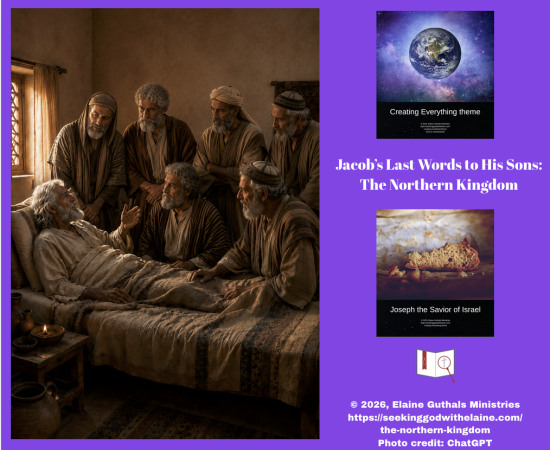
Once Jacob had given the covenant blessings to the first four sons in order, he turned to his other sons. There is the rub.
We really haven’t heard their names — other than when they were born. Whenever they come our radar, they have acted together as one. In fact, these six along with three other tribes, made up the Northern Kingdom.
Jacob’s sons weren’t, however, carbon copies. They each had their own peculiar characteristics.
Jacob focused on that in their blessing. But he didn’t address them in order of their age.
Let's Put It into Context
To read devotions in the Creating Everything theme, click the button below.
Devotions in the Joseph the Savior of Israel series
Zebulun
“Zebulun will settle by the seashore and will be a harbor for ships; his borders will extend to Sidon” (Gen. 49: 13 NLT)
Zebulun’s territory had a link to the Messiah.
Zebulun was the sixth and last son of Jacob and Leah (Gen. 30: 19-20). His name meant living together. He was Jacob’s tenth son.
Courageous in battle, Zebulun showed up when it mattered. They were willing to risk itself for Jehovah’s purposes.
In the Exodus, Zebulun’s tribe was designated part of the East Division. At the first census, the tribe numbered 57,400 (Num. 1: 30). By the second census, their number had grown to 60,500 (Num. 26: 47).
Zebulun’s future did occur as Jacob prophesied — sort of. The land allotted for the tribe in Joshua 19: 10-16 wasn’t on the coast. It was in lower Galilee.
The territory was in a strategic tradition. Not only did they have the benefits of the Sea of Galilee in the region, but they also had Mediterranean trade routes. Their border was near the city of Zidon, leading to commercial relations with the Phoenicians.
The tribe was known for its courage in battle. They supported David when he became king. They also fought with Deborah and Barak (Jdgs. 5: 15).
Zebulun’s linkage with Naphtali occurred frequently. Because of this, the two tribes were listed when the Messiah was prophesied. “But there will be no gloom for her who was in anguish. In the former time he brought into contempt the land of Zebulun and the land of Naphtali, but in the latter time he has made glorious the way of the sea, the land beyond the Jordan, Galilee of the nations” (Isa. 9: 1 ESV).
Yeshua began his ministry in Galilee, in the territory formerly held by Zebulun and Naphtali.
Issachar
“Issachar is a sturdy donkey, resting between two saddlepacks. When he sees how good the countryside is and how pleasant the land, he will bend his shoulder to the load and submit himself to hard labor” (Gen. 49: 14-15 NLT)
Issachar showed up.
Issachar was Jacob’s ninth son and the fifth son born to him and Leah (Gen. 30: 17-18). His name meant reward.
Issachar was born after Leah traded some of Reuben’s mandrakes to Rachel for a night with Jacob (Gen. 30: 17-18).
Ummm. Is being a donkey a compliment or a dig? Is it good to be a beast of burden?
Kind of unflattering, isn’t it? But it does sound complimentary at the same time.
Let’s think about where their territorial allotment was. It was the Jezreel Valley, which had excellent farmland. It was pleasant, fertile land.
We find a better report on the tribe in Judges 5: 15. “The princes of Issachar were with Deborah and Barak. They followed Barak, rushing into the valley …” (Jdgs. 5: 15 NLT).
The tribe of Issachar showed up. If we read Judges 4, it sounds like they really weren’t in the battle.
So, that probably means they supported Deborah and Barak, even if they didn’t fight.
But to me, this reads like there was something wrong. What if Issachar got complacent? It sounded like the strength was there even if the ambition wasn’t.
Taylor thought became complacent — and that life of ease wasn’t a good thing. He wrote, “Now all this reminds us of the truth that conflict is absolutely necessary to strength[en] character.”
Resource
What if he was willing to compromise to keep everything good? We have to remember that, even though we are living in Canaan, we can’t be of Canaan.
What I do see is Issachar showed up — but he doesn’t seem to be the leader. True, we all know too many leaders doesn’t work well.
We can’t become lazy or feel entitled. We have to show up daily and walk with Jehovah.

In the exodus, Issachar was designated as part of the East Division. During the first census, the tribe numbered 54,400 (Num. 1: 29). They were up to 64,300 by the second census (Num. 26: 25).
The tribe received its allotment in Joshua 19: 24-31. They were set up nicely. They had fertile land to grow grain, vineyards, and livestock. Trade routes ran through the territory.
One of the judges, Tola, did come from Issachar (Jdgs. 10: 1). He judged for 23 years. This represented a time of peace.
The tribe of Issachar supported King David. “Of Issachar, men who had understanding of the times, to know what Israel ought to do, 200 chiefs, and all their kinsmen under their command” (I Chron. 12: 32 ESV). They possessed wisdom and discernment to know King Saul’s reign was nearing an end.
The tribe of Issachar was steady and reliable if not a leader. They were hard workers.
Issachar, as part of the Northern Kingdom, was conquered in 722 BC. They were scattered among the other tribes, never to become an independent tribe again.
Dan
“Dan will govern his people, like any other tribe in Israel. Dan will be a snake beside the road, a poisonous viper along the path that bites the horse’s hooves so its rider is thrown off. I trust in you for salvation, O Lord!” (Gen. 49: 16-18 NLT).
Even though Dan had an encouraging blessing, the fate of the tribe was not.
Dan was Jacob’s fifth son, the first born to him and Rachel’s servant girl Bilhah (Gen. 30: 5-6). His name meant judged.
Dods helped us understand what the Old Testament definition of judge. He wrote,
“This word ‘judge’ we are perhaps somewhat apt to misapprehend; it means rather to defend than to sit in judgment on; it refers to a judgment passed between one’s own people and their foes, and an execution of such judgment in the deliverance of the people and the destruction of the foe.”
Resource
This is probably one reason the leaders after Joshua were called judges.
Think about it.
At the end of the age, Yeshua will judge us – He will defend those who have asked Him to be their Savior and Lord. He will deliver us from destruction.
Hmmm. Again, was Jacob giving Dan a compliment or slamming him?
Yes, snakes can be wise, so Dan could use wisdom and strategy. But they can also be cunning and deceitful.
The tribe of Dan was assigned to the North Division. The allotment for Dan was described in Joshua 19: 40-48. It is said that they didn’t like their allotment, so they wiped out a peaceful group and took their land.
The first census showed 62,700 (Num. 1: 39) – making Dan the second largest tribe. By the second census, they had grown to 64,400 (Num. 26: 43).
Over time, however, Dan’s distinct identity faded as the tribe was absorbed into other groups.
Dan’s most famous descendant is probably Samson (Jdgs. 16). He was a judge who defeated enemies through strategy, surprise, and unconventional methods.
Unfortunately, Dan became the center of idolatry (Jdgs. 18: 1-31). He stole an idol and established a rival worship center. Idolatry became entrenched within his tribe.
That is probably why Jeroboam put one of his golden calves in the territory trip of Dan. This happened in I Kings 12: 25-33.
Dan frequently appeared spiritually compromised.
Salvation
Ooo, baby. Jacob, who had a rocky start, but he put his faith and hope in Jehovah. Then he saw this from his sons – conflict, danger, spiritual failure.
Jacob called on the only One Who could save his son’s descendants – Snell thought it was the Messiah.
Resource
Think about all the trials Jacob had. He had a lot of sorrow in his life.
He was waiting for salvation.
Had Jacob understood what salvation meant in Jehovah’s plan? Probably not – the first-century Pharisees didn’t even understand.
Still, Jacob looked beyond human deliverers to Jehovah’s ultimate salvation.
I like what Vaughan said, He wrote, “These intervals of waiting must be filled up with four things: prayer, praise, fellowship, and work.”
Resource
We need to keep faith while waiting.

Gad
“Gad will be attacked by marauding bands, but he will attack them when they retreat” (Gen. 49: 19 NLT).
Sometimes, our circumstances cause us to fight.
Gad was Jacob’s seventh son, born to Leah’s servant girl Zilpah (Gen. 30: 9-10). His name meant good fortune.
The first thing that popped in my mind was the serpent’s curse in the Garden of Eden. “And I will cause hostility between you and the woman, and between your offspring and her offspring. He will strike your head, and you will strike his heel” (Gen. 3: 15 NLT).
He will overcome at last. Isn’t that what enduring is all about? Yes, we struggle, probably for a long time.
But in the end, we are victorious because we kept at it until the end. We kept trying to do what was right.
In the Exodus, Gad’s tribe was designated part of the South Division.
Gad received an allotment of land on the east side of the Jordan River in Joshua 13: 8-32. The first census listed the tribe at 45,650 (Num. 1: 25). By the second census, they were down to 40,500 (Num. 26: 18).
The history of Gad shows that it was a warlike people. This was accomplished by a marauding guerilla troop.
Why? They settled on the east side of the Jordan. This made them constantly exposed to raids and invasions, so they became fierce warriors.
Asher
“Asher will dine on rich foods and produce food fit for kings.” (Gen. 49: 20 NLT)
The tribe of Asher grew the most between the two censuses.
Asher was Jacob’s eighth son, the second born to Leah’s servant girl Zilpah (Gen. 30: 12-13). His name meant happy.
The verse is a little different in the Hebrew Bible. “Asher’s bread shall be rich, And he shall yield royal dainties” (Gen. 49: 20 TSB).
Resource
That brings to mind another verse. “Jesus replied, ‘I am the bread of life. Whoever comes to me will never be hungry again. Whoever believes in me will never be thirsty” (Jn. 6: 35 NLT).
Asher’s prophecy was fulfilled because his territory was fertile coastal territory. It specialized in olive oil and produced agricultural abundance. The allotment is recorded in Joshua 19: 24-31.
In the Exodus, Asher’s tribe was designated part of the North Division. The first census found his tribe to number 41,500 (Num. 1: 41). The tribe had significantly increased by the second census, growing to 53,400 (Num. 26: 47).
Naphtali
“Naphtali is a doe set free that bears beautiful fawns” (Gen. 49: 21 NLT)
Naphtali’s blessing was a clear picture of Christianity.
Naphtali was Jacob’s sixth son, born by Rachel’s servant girl Bilhah (Gen.30: 7-8). His name meant my wrestling.
The blessing for Naphtali is interesting. It is talking about freedom and descendants who are right with Jehovah.
Whitfield address this blessing this way. He wrote, “In Naphtali we have the Christian enjoying the liberty and freedom and happiness in Christ, and testifying of Christ to others.”
Resource
The liberty of our souls from sin is a joyous thing. Because Yeshua has paid the debt, we are no longer slaves stun sin. Our chains have been broken, and we are free.

In the Exodus, Naphtali’s tribe was designated part of the North Division. The first census found that there were 53,400 in the tribe (Num. 1: 42). Their numbers had declined to 45,400 at the second census (Num. 45: 50).
Joshua 19: 32-39 tells of the allotment to the tribe of Naphtali.
Naphtali’s linkage with Zebulun occurred frequently. They fought alongside Zebulun with Deborah and Barak They also fought with Deborah and Barak (Jdgs. 5: 15).
Because of this, the two tribes were listed when the Messiah was prophesied. “But there will be no gloom for her who was in anguish. In the former time he brought into contempt the land of Zebulun and the land of Naphtali, but in the latter time he has made glorious the way of the sea, the land beyond the Jordan, Galilee of the nations” (Isa. 9: 1 ESV).
Making the Connections #1
Okay. There is a list of the twelve tribes in Revelation. It is really interesting.
- Levi is listed instead of Dan.
- Joseph is listed instead of Ephraim (Manasseh is listed).
Just to get this one cleared up – in Numbers 1: 32-33, the tribe of Ephraim is called the tribe of Joseph.
Was Dan not mentioned because of the idolatry? Some think the antichrist will come from the tribe of Dan.
- “And of Dan he said, ‘Dan is a lion’s cub that leaps from Bashan’” (Deut. 33: 22 ESV).
- “The snorting of their horses is heard from Dan; at the sound of the neighing of their stallions the whole land quakes. They come and devour the land and all that fills it, the city and those who dwell in it” (Jer. 8: 16 NLT).
Making the Connections #2
Davidson also had some great questions.
“(1) Do you know what is meant by the salvation of the Lord?
“(2) Do you know what is meant by waiting for salvation — i.e., ardently but patiently looking forward to it?
“(3) Do you know what is meant by preparing while you wait for the salvation of the Lord?”
Resource
We need to ask ourselves those.
How Do We Apply This?
- Show up when Jehovah calls.
- Walk faithfully with Jehovah each day.
- Wait patiently for Jehovah’s salvation.
- Trust Jehovah when the path is unclear.
- Live as one whose chains have been broken.
Father God. We don’t have to be the Judah or Joseph who get all the attention. We want to be the other brothers who show up, keep walking, waiting, and trusting You so that we live in freedom. Amen.
If you don’t understand something and would like further clarification, please contact me.
If you have not signed up for the email providing the link to the devotions and the newsletter, do so below.
If God has used this devotion to speak with you, consider sharing it on social media.