Jacob knew he was dying and gave a covenant blessing to Reuben, Simeon, and Levi. This devotional reading looks at the covenant blessing for Judah.
Nuggets
- At first, Judah didn’t praise Jehovah; but when he learned to, he earned the praise of his brothers.
- Judah would be victorious.
- Judah would become the leader of the family.
- The lion symbolizes strength, authority, and royal destiny.
- Yeshua conquered his prey — Satan, sin, death, the powers of darkness — on the cross.
- Not only was the lion seen as a royal destiny, but it was also seen as a kind of Hebrew hero.
- Not all versions translate it as lioness.
- The scepter of Judah that Jacob talked about becomes one of the most familiar Messianic passages in Scripture.
- Also transliterated as meḥoqeq, מְחֹקֵק means one who establishes law, ruler, decree maker, and governor.
- It is talking here of authority, succession, and dynastic continuity.
- The Messiah would bring peace.
- The Messiah would call all the nations to Him.
- The reference to the grapevine and produced wine pointed toward the abundance of the Messianic age and, secondarily, the kingship.
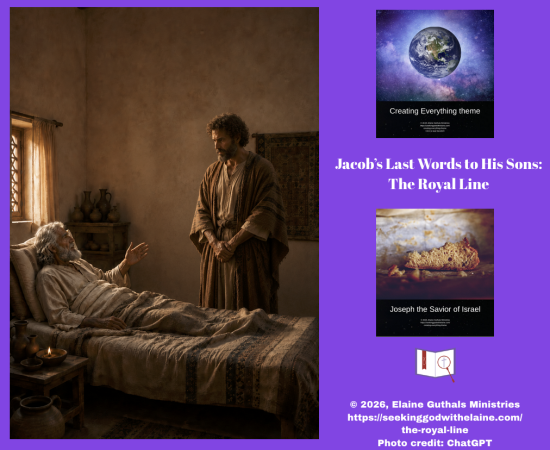
Judah was the fourth son of Jacob and Leah who became the covenant son, establishing the royal line.
It is probably safe to say that Judah didn’t expect to be named firstborn. Because we can see his arc from sin to repentance to forgiveness to elevation, we can know that he made his peace with Jehovah.
But we will see that, even as Judah was assigned as firstborn, his great…great grandson David also was chosen as king instead of his older brothers.
Judah was given leadership of the family.
Let's Put It into Context
To read devotions in the Creating Everything theme, click the button below.
Devotions in the Joseph the Savior of Israel series
Let's Put It into Context #2
Judah had a full, visible arc. His sin was selling Joseph to slave traders (Gen. 37). We are told that Judah did impregnate his daughter-in-law after both his sons were killed by God and his wife had died. He confessed his sin in Genesis 38, when he was confronted by Tamar.
Visible evidence of this transformation occurred in Genesis 44, when we see the culmination of his restoration when he offers himself in Benjamin’s place (Gen. 44). Now, Judah receives a blessing (Gen. 49). That change is one reason the leadership of the family eventually shifted toward Judah.
Judah as Firstborn
“Judah, your brothers will praise you. You will grasp your enemies by the neck. All your relatives will bow before you” (Gen 49: 8 NLT)
Your Brothers Will Praise You
At first, Judah didn’t praise Jehovah; but when he learned to, he earned the praise of his brothers.
Ooo, baby. One of Jacob’s sons being praised by the others? Seriously?
Think about it a second. All 11 sons that were born in Haran were born in the seven years that Jacob worked for Rachel – the second time.
During the first seven years, the wedding hadn’t taken place yet. When it did and Jacob got the wrong bride, he had to work seven more years for the right bride.
Joseph, the youngest until Benjamin came along, was born right at the end of Jacob’s fourteenth year of work. “Soon after Rachel had given birth to Joseph, Jacob said to Laban, “Please release me so I can go home to my own country” (Gen. 30: 25 NLT).
So, eleven young men all within six years age of each other would have provided for an interesting dynamic. It would be easy to see them always competing against each other.
Robertson thought Judah had a meekness that disarmed his brothers. This would have been evidence by a meekness.
Resource
We must begin and end praising Jehovah — and yes, that praise will never end. We must praise Him in our hearts and in our actions. We praise Him for His love and pardon.
You Will Grasp Your Enemies by the Neck
Judah would be victorious.
The tribe of Judah did lead the twelve tribes. It led the first assault into the Promised Land after Joshua died (Jdgs. 1: 1-7).
Geographically, the territory allotted to Judah provided natural defenses. Still, the tribe of Judah was known for its sophisticated military strategy and weapons.
Also, there were trade routes over which they had control.
King David, from the tribe of Judah, was also a fierce warrior. “This was their song: ‘Saul has killed his thousands, and David his ten thousands!’” (I Sam. 18: 7 NLT).
If we go back to the Hebrew, it says Judah’s hand — yā·ḏə·ḵā (יָדְךָ֖) will be doing the grasping. We can’t miss this because it is important.
Whose hand was Jacob really talking about? Jehovah’s — and eventually Yeshua’s.
This is huge.
- “Don’t be afraid, for I am with you. Don’t be discouraged, for I am your God. I will strengthen you and help you. I will hold you up with my victorious right hand” (Isa. 41: 10 NLT).
- “Your right hand, O Lord, is glorious in power. Your right hand, O Lord, smashes the enemy” (Ex. 15: 6 NLT).
We vanquish our foes — especially Satan — only through Jehovah’s and Yeshua’s power — not ours.
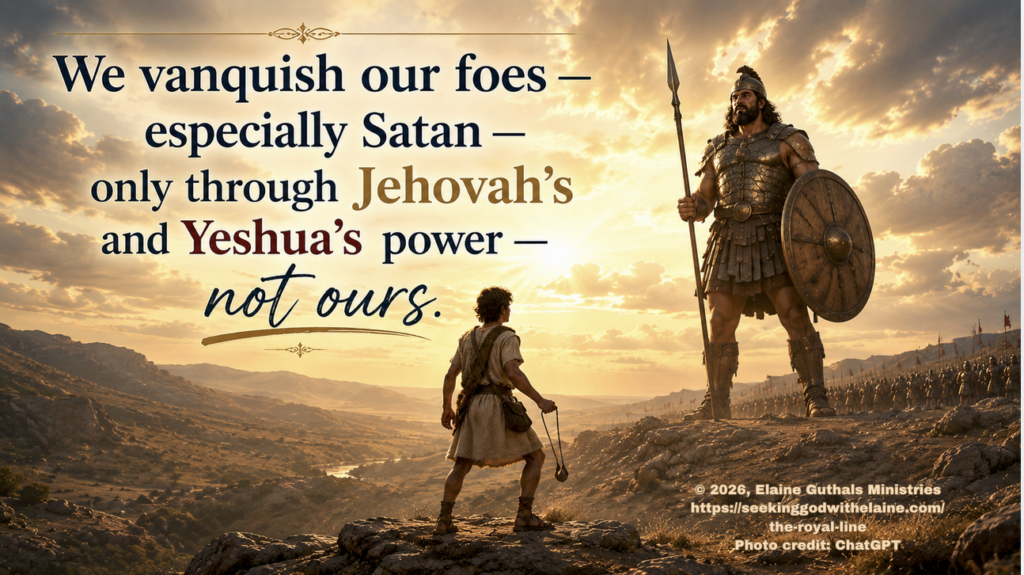
Yeshua will grasp His enemies with His hand. He will always be victorious
All Your Relatives Will Bow before You
Judah would become the leader of the family.
Well, I wonder how this terminology went over? It wasn’t well received when Joseph gave his brothers the visual of this from his dreams in Genesis 37: 5-10.
But what Jacob was doing here was making Judah the head of the family. No, I doubt they were going to bend the knee.
They were, though — in some cases, probably — bend their will. Judah would have the final say in the family.
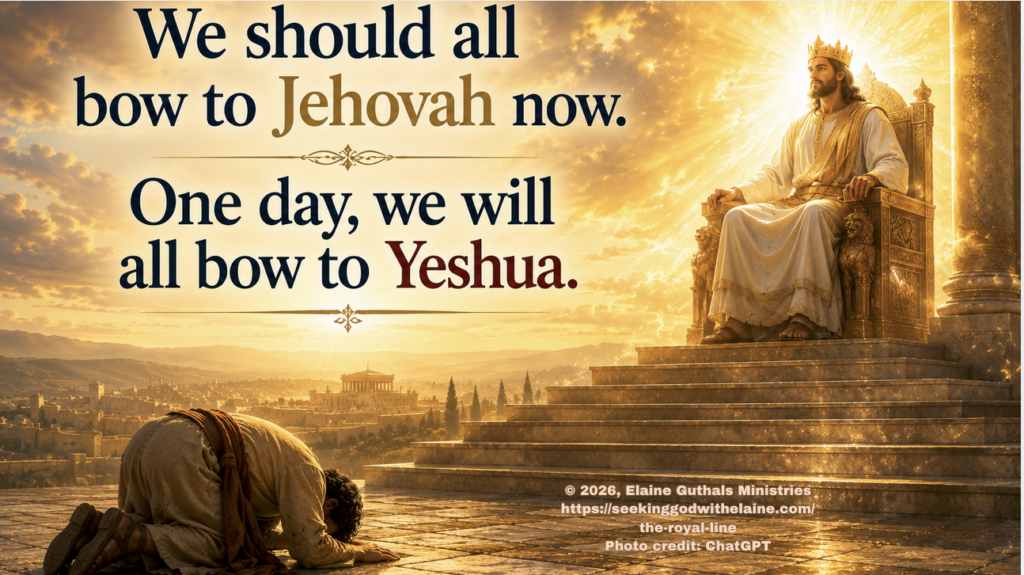
We should all bow to Jehovah now. One day, we will all bow to Yeshua.
“Therefore, God elevated him to the place of highest honor and gave him the name above all other names, that at the name of Jesus every knee should bow, in heaven and on earth and under the earth, and every tongue declare that Jesus Christ is Lord, to the glory of God the Father” (Phil. 2: 9-11 NLT).
The Lion of Judah
“Judah, my son, is a young lion that has finished eating its prey. Like a lion he crouches and lies down; like a lioness — who dares to rouse him? (Gen. 49: 9 NLT)
A Young Lion
The lion symbolizes strength, authority, and royal destiny.
We know the royal implications are fulfilled. One of Judah’s descendants is King David. Another descendant is Yeshua.
Judah and his descendants were associated with the characteristics of the lion: fearlessness, confidence, strength, and victory. Those qualities ultimately point to Yeshua, the Lion of Judah.
The Lion of Judah gives His people courage, confidence, and strength. We stand secure not because of our power, but because He protects and fights for us.
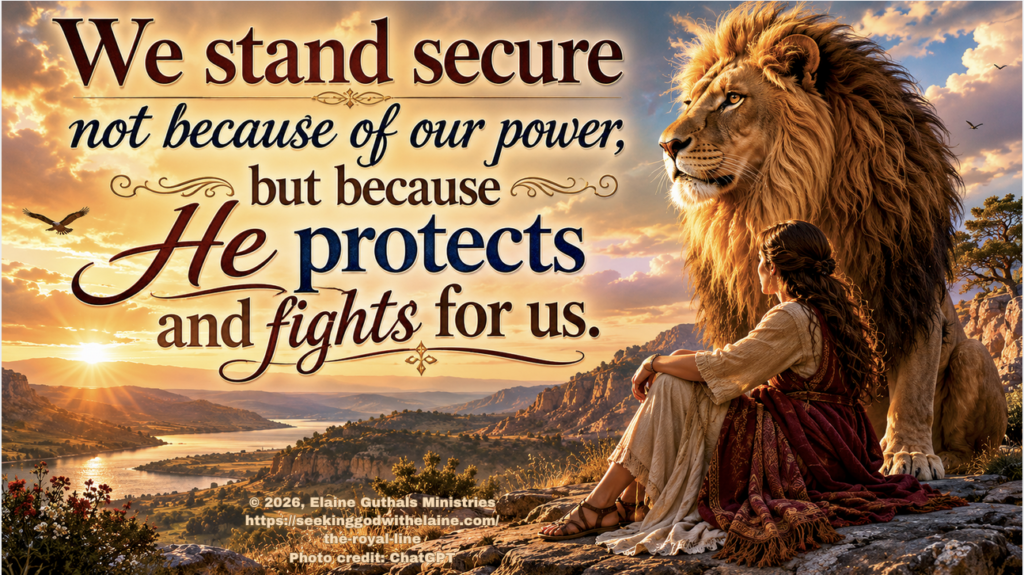
This section is talking about the Lion of Judah “But one of the twenty-four elders said to me, ‘Stop weeping! Look, the Lion of the tribe of Judah, the heir to David’s throne, has won the victory. He is worthy to open the scroll and its seven seals’” (Rev. 5: 5 NLT).
Finished Eating Its Prey
Yeshua conquered his prey — Satan, sin, death, the powers of darkness — on the cross.
If we look at a Hebrew Bible, it says something slightly different than the New Living Translation said. “A lion’s whelp, Yehuda — from torn-prey, my son, you have gone up! …” (Gen. 49: 9 TSB).
Resource
After tearing up His foe on the cross, Yeshua ascended to Heaven. He laid down His life only to victoriously take it back up.
Whitfield had a different take. He saw this as Yeshua’s return. His prey is those who have not accepted Him as their Savior.
Resource
“When he comes on that day, he will receive glory from his holy people — praise from all who believe. And this includes you, for you believed what we told you about him” (II Thess. 1: 10 NLT).
- “There is more than enough room in my Father’s home. If this were not so, would I have told you that I am going to prepare a place for you? When everything is ready, I will come and get you, so that you will always be with me where I am” (Jn. 14: 2-3 NLT).
- “And just as each person is destined to die once and after that comes judgment, so also Christ was offered once for all time as a sacrifice to take away the sins of many people. He will come again, not to deal with our sins, but to bring salvation to all who are eagerly waiting for him” (Heb. 9: 28 NLT).
He Crouches and Lies Down
Not only was the lion seen as a royal destiny, but it was also seen as a kind of Hebrew hero.
Judah would have been seen as strong against his enemies. This did come to be as the tribe of Judah had strong warriors.
Like a Lioness
Not all versions translate it as lioness.
If we go back to the Hebrew, we see that it doesn’t say anything about this being a lioness. “… like the lion, like the king-of-beasts, who dares rouse him up?” (Gen. 49: 9 TSB).
There should be no gender-altering surgery done here.
The Scepter of Judah
“ The scepter will not depart from Judah, nor the ruler’s staff from his descendants, until the coming of the one to whom it belongs, the one whom all nations will honor" (Gen. 49: 10 NLT)
The scepter of Judah that Jacob talked about becomes one of the most familiar Messianic passages in Scripture.
Before we do anything, we need to look at scepter as Jacob would have. Whitfield helped us there. He wrote,
“A sceptre is the symbol of regal command, and, in its earliest form, it was a long staff which the king held in his hand when speaking in public assemblies; when he sat upon his throne he rested it ‘between his feet’ inclining towards himself.”
Resource
I had always read this to reference Yeshua — and it does. His reign would be everlasting.
And that is correct. This verse forms the foundation of the royal line that leads to David and ultimately to Yeshua – the Messiah.
Robertson had a second take. When the ten tribes disappeared, the two remaining tribes combined to for Judah – the Jews.
That would make scepter a synonym for nationality.
Resource
Several Hebrew Bibles also have verse 10 saying something else. “The shevet (sceptre) shall not depart from Yehudah, nor a Mekhokek (Lawgiver) from between his raglayim, until Shiloh come; and unto him shall be the obedience of the amim (peoples, nations)” (Gen. 49: 10 OJB).
It starts out talking about the scepter, but it takes another track after that.
Nor a Mekhokek
Also transliterated as meḥoqeq, מְחֹקֵק means one who establishes law, ruler, decree maker, and governor.
As Jehovah and Yeshua are one (Jn. 10: 30), the law was given by Both. The law shows Jehovah’s character, so it also shows Yeshua’s character.
Wood noted that lawgiver referred to judicial and authority. He wrote that it “… is intended to express the continuance of both civil and ecclesiastical power until the coming of Shiloh.”
Resource
We must never forget that Jehovah is still Judge over His Creation.
From between His Raglayim
It is talking here of authority, succession, and dynastic continuity.
Raglayim (רַגְלַיִם) means from between his feet or a pair of feet. That is an ancient idiom associated with descendants.
The picture that popped in my mind was kiddos sitting on the floor around a man sitting in a chair.
What this is saying is that the royal line will continue through Judah’s descendants. Jacob wasn’t predicting one king but an ongoing royal dynasty.
Until Shiloh Come
The Messiah would bring peace.
What the Hebrew says is ‘ad ki-yavo Shiloh (עַד כִּי־יָבֹא שִׁילֹה) — until Shiloh come.
Shiloh, which means that one to whom kingship belongs, is seen as another title for the Messiah. Also, Shiloh means peace, rest, and quietness.
- “For a child is born to us, a son is given to us. The government will rest on his shoulders. And he will be called: Wonderful Counselor, Mighty God, Everlasting Father, Prince of Peace” (Isa. 9: 6 NLT).
- “And he will be the source of peace. When the Assyrians invade our land and break through our defenses, we will appoint seven rulers to watch over us, eight princes to lead us” (Mic. 5: 5 NLT).
One of the most wonderful things about this is Yeshua is bringing His peace to us. He will give tranquillity to disciples.
Unto Him Shall be the Obedience of the Amim
The Messiah would call all the nations to Him.
When Yeshua comes again, what will He be doing?
“And he will send out his angels with the mighty blast of a trumpet, and they will gather his chosen ones from all over the world — from the farthest ends of the earth and heaven” (Mt. 24: 31 NLT).
We can look at this two ways. Yeshua is the One doing the gathering. He is gathering His people unto Himself. “And when I am lifted up from the earth, I will draw everyone to myself” (Jn. 12: 32 NLT).
Who will be gathered to Shiloh? Those who are obedient and faithful.
One thing we can’t gloss over is Yeshua’s rule will be complete.
But remember, we said that all would bow before Him. That would mean Yeshua would be drawing all men to Himself.
The Vine and Wine
“He ties his foal to a grapevine, the colt of his donkey to a choice vine. He washes his clothes in wine, his robes in the blood of grapes. His eyes are darker than wine, and his teeth are whiter than milk” (Gen. 49: 11-12 NLT)
The reference to the grapevine and produced wine pointed toward the abundance of the Messianic age and, secondarily, the kingship.
Having established the coming King, Jacob now describes the blessings of His kingdom. The imagery is intentionally extravagant.
In the Ancient Near East, vineyards represented prosperity, peace, and abundance. Jacob described a future so prosperous that a man could tie his donkey to a choice vine without worrying about damaging one vine.
Wine would be so plentiful that it could be treated like water. We would think that would mean just for drinking. Jacob was indicating it would be so plentiful it could be used like water for washing.
Jacob wasn’t giving an agricultural forecast. This imagery ultimately points beyond David’s kingdom. He was describing the blessings of abundance, peace, and prosperity associated with the reign of Judah’s coming King.
Judah’s Tribe
The tribe of Judah’s supremacy was evident.
In the Exodus, Judah’s tribe was designated the lead of the East Division, with 74,600 (Num 2: 4). By the second census, the tribe had grown to 76,500 (Num. 26: 22).
After Joshua’s death, Judah led, along with the tribe of Simeon, in attacking the Canaanites. While they did chase the Canaanites out of the hill country, they weren’t able to defeat them in the plains (Jdg. 1: 14).
Besides King David and Yeshua, other people important to the history of the nation came from the tribe of Judah. Caleb was one of the two spies that urged the Israelites to take the Promised Land (Num. 13: 6). Later, Caleb’s nephew Othniel became the first judge (Jdg. 3: 9).
Judah got its allotment in Joshua 15. They received the largest and most important territory. Cities in their territory included Jerusalem, Bethlehem, and Hebron.
When the nation was divided into two kingdoms after King Solomon’s death, they made up the Southern Kingdom with Benjamin and many of the Levites. By then, they had assimilated the tribe of Simeon as their own. Because of this, they retained the Temple and Levitical worship.
They also retained the Davidic line. True, they had their bad kings, but they had Asa, Jehoshaphat, Hezekiah, and Josiah.
When the southern kingdom was taken into exile by the Babylonians, the tribe of Judah remained. In fact, they became the Jews.
This name acknowledged that they were no longer just the tribe of Judah but the covenant people as a whole. The use of this name started in the time of Ezra and Nehemiah.
The history of Judah demonstrates that Jacob’s prophecy was fulfilled both in Israel’s national history and ultimately in the Messiah.
Making the Connections #1
Fun fact. David wasn’t the firstborn in his family either, but Yeshua was. God didn’t do the unexpected.
Making the Connections #2
Wait! How can we say Judah would always have the scepter?
- The first king was from the the tribe of Benjamin!
- The Maccabeans were not from the tribe of Judah!!
Doesn’t that mean this prophecy didn’t come to pass?
No. The scepter is about authority and governing status.
Yes, it does address the Davidic dynasty.
We should take Genesis 49: 10 to mean, then, that it is not talking exclusively about earthly succession. It was talking about our spiritual King.
How Do We Apply This?
- Let repentance transform your future.
- Stand firm in Yeshua’s strength, not your own.
- Bow willingly to Jehovah today.
- Find security in the Lion of Judah.
- Look forward to Yeshua’s coming reign.
Father God. Thank You for the testimony of Judah. Thank You for showing us how he repented of his sins and was used by You. Forgive us where we sin. Use us to expand Your kingdom. Amen.
If you don’t understand something and would like further clarification, please contact me.
If you have not signed up for the email providing the link to the devotions and the newsletter, do so below.
If God has used this devotion to speak with you, consider sharing it on social media.