Jacob had sent ten of his sons to Egypt to buy grain because of the famine. This devotional reading looks at their arrival and meeting with their brother Joseph.
Nuggets
- The brothers came to Joseph because he was distributing grain.
- Joseph’s dream came true.
Joseph recognized his brothers immediately, but they didn’t recognize him. - True, he was speaking to his brothers through an interpreter, but Joseph had to tell the interpreter what to say.
- The brothers had to be honest.
- Joseph devised a way that he could test whether his brothers had changed or not.

Jacob was concerned that the family would starve to death in the famine. He sent ten of his sons to Egypt to buy grain.
Little did the brothers know they were on a collision course with their past and their future.
All hinged on the reception of one man.
Let's Put It into Context
To read devotions in the Creating Everything theme, click the button below.
Devotions in the Joseph the Savior of Israel series
Joseph’s Brothers Arrive
“Since Joseph was governor of all Egypt and in charge of selling grain to all the people, it was to him that his brothers came. When they arrived, they bowed before him with their faces to the ground. Joseph recognized his brothers instantly, but he pretended to be a stranger and spoke harshly to them. ‘Where are you from?’ he demanded. ‘From the land of Canaan,’ they replied. ‘We have come to buy food.’ Although Joseph recognized his brothers, they didn’t recognize him. And he remembered the dreams he’d had about them many years before ...” (Gen. 42: 6-9 NLT)
It Was to Him that His Brothers Came
The brothers came to Joseph because he was distributing grain.
It has always amazed me that Joseph would have had any part in the actual sale of grain to people. Wouldn’t his time have been best served in fulfilling his administrative duties?
Remember, we said that his position description would have been varied.
- Advisor
- Administrator
- Economic planner
- Judge
- Distributor
- Overseer of labor
- Overseer of storage
- Pharaoh’s executive authority.
It would be hard for Joseph to judge disputes if he was actually distributing grain himself. Maybe it was just in this day that Joseph had such a hands-on stake in the process.
This was the day Joseph needed to be exactly where he was.
But isn’t Jehovah like that? When He is orchestrating the situation, doesn’t everything just seem to fall into place?
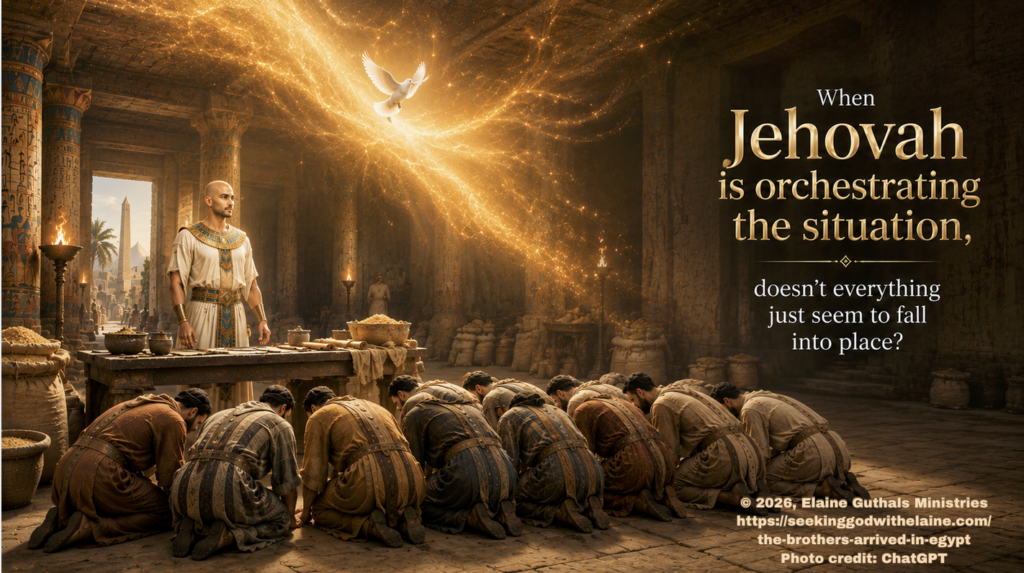
Since Jehovah knew the back story as well as the end of the story, He knew there was some healing that needed to take place.
As Joseph had named Ephraim saying, ‘God has made me fruitful in this land of my grief’” (Gen. 41: 52 NLT), we know he found contentment in his life. But I wonder what he felt in that first second when he spotted his brothers — the men who had betrayed him.
Yes, Joseph was content — he was also human. His heart had to have thumped at least once — from the surprise if nothing else.
Think about it. Joseph had probably closed that book in his life. His contentment now had to include letting go of his past.
But there they were — and not just standing in front of him.
They Bowed Before Him
Joseph’s dream came true.
The second thump of Joseph’s heart had to be the realization that his dream was coming true. His brothers were bowing before him.
And this wasn’t a bend-at-the-waist-bob-your-head sort of bow. The Hebrew word used — shāḥâ (שָׁחָה) meant prostrate oneself in submission or reverence.
That must have been a moment for Joseph. It may have been the a-ha moment when he realized Jehovah’s plan.
Even if he had been expecting them eventually, surely the poignancy of the moment didn’t escape him.
I debated using the word poignancy. If Joseph was content, did he feel great sorrow?
Joseph had lost 13 years of being with his father. Maybe he had a girl he was eyeing back then. He would have had friends that he was ripped away from.
Did Joseph have to take a minute? Joseph probably knew by then that he was exactly where Jehovah had designed for him to be.
But that doesn’t mean giving up everything to do God’s ministry is all rainbows and unicorns. It doesn’t have to be a sharp sense of loss.
I know I have wondered several times over the last three years what it would have been like if we would have stayed in the same town as my Springfield mom. I had thought we would always be there when she called, “Hey, can Adam come fix my computer” or whatever little chore she had for us. I thought I would be closer to my sister if and when she needed me.
That doesn’t mean I want to have things go back to where they were. I don’t want to give up the ministry that Jehovah has called us to do.
I don’t think Jehovah is upset when we are reminded what we gave up for Him — not when it is done in a way that reaffirms our choice in doing His Will.
Now if Joseph — or we — would start railing against Jehovah’s Will, that would be a different story. We wouldn’t be serving Him in obedience.
But Joseph had to have had some memories dancing through his head when he saw his brothers. That would be human nature.
Moses doesn’t give us a hint as to how the brothers were reacting. We’re they still the proud men that Joseph knew? Were they fearful being in a foreign court? They didn’t have Jacob there to smooth things over.
“His brothers responded, ‘So you think you will be our king, do you? Do you actually think you will reign over us?’ …” (Gen. 37: 8 ESV).
Pretended to be a Stranger
Joseph recognized his brothers immediately, but they didn’t recognize him.
We all change some as we age. If Joseph was 32 when the brothers showed up to buy grain, the brothers would be 32 to 37 or so. They would have changed some.
Joseph had changed dramatically. Oh, he may have looked somewhat the same — if he had hair and wasn’t dressed up as an Egyptian.
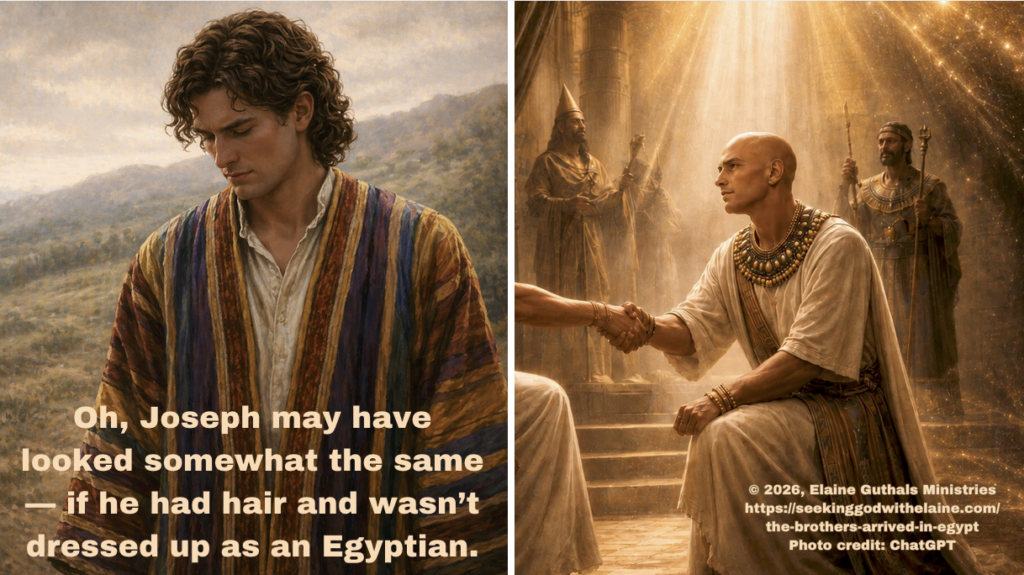
The brothers had no reason to believe the man in front of him was anything but what he was supposed to be — the Vizier of Egypt. Joseph did not speak to them directly, so they didn’t know he spoke Hebrew.
Besides, probably in their minds, their brother was dead or lost.
Joseph did not disabuse them of that thought.
So, when they were bowing down to the man in front of them, they had no clue that they were fulfilling the dream they scoffed at 13 years earlier. Jehovah had bided His time before making its fulfillment come to pass.
Was it Jehovah’s irony that these sheaves of grain that bowed down in Joseph’s dream were bowed before him to buy grain?
Recognition
Joseph recognized his brothers instantly, but he pretended to be a stranger and spoke harshly to them. ‘Where are you from?’ he demanded. ‘From the land of Canaan,’ they replied. ‘We have come to buy food.’ Although Joseph recognized his brothers, they didn’t recognize him. And he remembered the dreams he’d had about them many years before ... He said to them, “You are spies! You have come to see how vulnerable our land has become.’ ‘No, my lord!’ they exclaimed. ‘Your servants have simply come to buy food. We are all brothers — members of the same family. We are honest men, sir! We are not spies!’” Yes, you are!’ Joseph insisted. ‘You have come to see how vulnerable our land has become.’ ‘Sir,’ they said, ‘there are actually twelve of us. We, your servants, are all brothers, sons of a man living in the land of Canaan. Our youngest brother is back there with our father right now, and one of our brothers is no longer with us.’ But Joseph insisted, “As I said, you are spies! ” (Gen. 42: 6-9 NLT)
Spoke Harshly to Them
True, he was speaking to his brothers through an interpreter, but Joseph had to tell the interpreter what to say.
Joseph spoke roughly — qāšeh (קָשֶׁה) — hard, severe, or difficult. If he was content, if he recognized Jehovah was orchestrating everything, why would he be harsh with his brothers?
No, I don’t think Joseph was trying to pay back for the pit, the years of slavery, and the years of prison. He knew none of that was random.
Joseph accused them of being spies. Specifically, he said they were checking out ʿervat hāʾāreṣ (עֶרְוַת הָאָרֶץ) — the nakedness of the land.
Knohl noted evidence that invaders tried to take Egypt by force to capture grain depots during a famine.
Resource
That makes Joseph’s accusation more than empty words.
But Joseph never believed the brothers to be spies. He tested them to see what kind of men they had become.
The brothers were being accused of trying to find the following in Egypt’s security:
- exposed areas
- weak points
- undefended regions
- vulnerable borders
- places open to attack or exploitation
Wouldn’t the famine do that economically, politically, socially, and spiritually?
But where my mind flipped was to Joseph in the pit. He was stripped — not totally naked — but his identity, status, and righteousness. Instead, he was treated deceptively and made vulnerable.
Wasn’t — in a way — Joseph accusing the brothers of treating Egypt as they did him?
Joseph had to determine who his brothers were now. The best way to figure out their hearts was to put pressure on them.
There Are Actually Twelve of Us
The brothers had to be honest.
It was interesting how some versions described Joseph. “… and one is no longer living”” (Gen. 42: 13 CSB). Some say, “… one is no more” (Gen. 42: 13 ESV). The CJB says, “… another one is gone” (Gen. 42: 13 CJB).
Well, gone and is no more are accurate statements because they did not know what happened to Joseph. Since they sold Joseph into slavery, they may have thought – to them – he was dead. Not knowing how or where he ended up, they may have believed it was possible that he died.
It was interesting that they didn’t give the party line that he was killed by a wild animal, the line they fed Jacob at the time of the sale.
The Hebrew is kind of ambiguous. The phrase used is wĕhāʾeḥād ʾênennû (וְהָאֶחָד אֵינֶנּוּ). In Genesis, it is used to denote mysterious disappearances or loss.
Mysterious disappearance didn’t really fit in this case — except in the narrative the brothers created. Had they gotten to the point where they felt Joseph’s loss?
The brothers didn’t know at this point that the lost had been found.
The Test
“This is how I will test your story. I swear by the life of Pharaoh that you will never leave Egypt unless your youngest brother comes here! One of you must go and get your brother. I’ll keep the rest of you here in prison. Then we’ll find out whether or not your story is true. By the life of Pharaoh, if it turns out that you don’t have a younger brother, then I’ll know you are spies.’ So Joseph put them all in prison for three days” (Gen. 42: 15-17 NLT)
Joseph devised a way that he could test whether his brothers had changed or not.
Why did Joseph demand Benjamin? Think back.
The year was 1692 BC. Rachel was pregnant. She died in childbirth.
Who was Rachel’s child that was born? Benjamin.
Joseph was 17 years old. He went from being the youngest to having a baby brother.
But in — probably — a short amount of time, Joseph received a tunic from Jacob. This showed not only that Joseph was Jacob’s favorite, but — more than likely — Jacob was giving Joseph firstborn status. Then, he has his dreams.
Then, he is on a caravan bound and on his way to Egypt.
All in a year.
So, Joseph really didn’t know Benjamin. At the most, Benjamin may have been walking and cooing when Joseph was sold.
Joseph’s asking about Benjamin wasn’t necessarily about Benjamin — it was about his brothers’ repentance.
Joseph probably surmised — correctly — that Jacob transferred favorite son status to Benjamin. He was the only other son born to him by Rachel.
Will they sacrifice Benjamin as they did Joseph?
Making the Connections #1
Where did the arrogant brothers go? It is almost as if someone had kidnapped them and switched them with these fearful, doubting counterparts.
Did their consciences pull up the memory weekly? Or was it easy to forget they had another brother?
Watkinson’s description of the brothers seems fitting. He wrote,
“They were guilty of malice, falsehood, treachery, murder. Their conduct was unmanly, unbrotherly, unfilial. They were not spies, but they were liars, impostors, kidnappers, fratricides, monsters.”
Resource
It didn’t seem that they wanted to come to Egypt. It sure wasn’t their plan on how to beat starvation.
They get to Egypt, and their fears are justified. They are treated rudely, accused of a crime they weren’t even thinking about committing, and thrown in prison.
And Joseph was treated rudely by the brothers as they threw him into the pit and sold him, accused of attempting to rape a Mrs. Potiphar, and thrown in prison.
They may not have known Jehovah was tying off elements of the original sin. But He was.
Making the Connections #2
Look what Robertson said. He wrote, “Where sin is voluntary wrong-doing, the language of the human heart inevitably connects the penalty with the wrong-doing.”
Resource
Jehovah orchestrates testings that allow us to break free of the stain of sin. We don’t have to continue to carry the guilt. We can be restored with those we have wronged.
Making the Connections #3
We don’t know how long the brothers had an audience with the Vizier of Egypt. 15 minutes? Half an hour?
What we do know is that, throughout the whole time, Joseph loved his brothers.
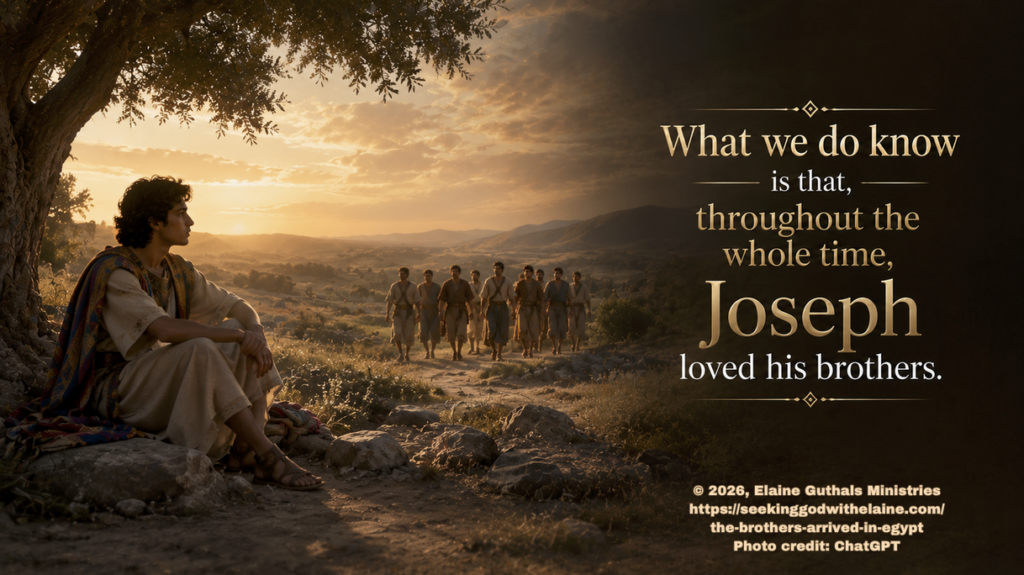
That didn’t mean Joseph didn’t do his duty as Vizier. He did.
How Do We Apply This?
- Confess the surface sin as well as the buried sin.
- Do not mistake delayed consequences for erased sin.
- Allow God to expose what needs healing instead of resisting conviction.
- Continue loving people even while dealing truthfully with them.
- Recognize that God may revisit painful places in order to bring healing.
- Wait on Jehovah instead of forcing situations into place yourself.
- Accept that sanctification may involve uncomfortable exposure before restoration.
Father God. You orchestrate everything. At the right time, things fall into place. Help us to wait on You. Help us when we are blindsided when You work. Amen.
If you don’t understand something and would like further clarification, please contact me.
If you have not signed up for the email providing the link to the devotions and the newsletter, do so below.
If God has used this devotion to speak with you, consider sharing it on social media.