Interpreting the dreams of the cupbearer and the baker set Joseph up for interpreting other dreams. This devotional reading looks at Pharaoh’s dreams that he will be asked to interpret.
Nuggets
- “Later” was long enough for the cupbearer to forget about Joseph.
- The Pharaoh in power in the chapters from here on out in Genesis is often associated with the Hyksos.
- The Pharaoh had two dreams.
- One dream featured seven cows; the other had grain.
- That the meaning of the dream alluded Pharaoh disturbed him.
- So, Pharaoh called his magicians and wise men to interpret the dreams for him.
- The cupbearer finally had his memory jogged.
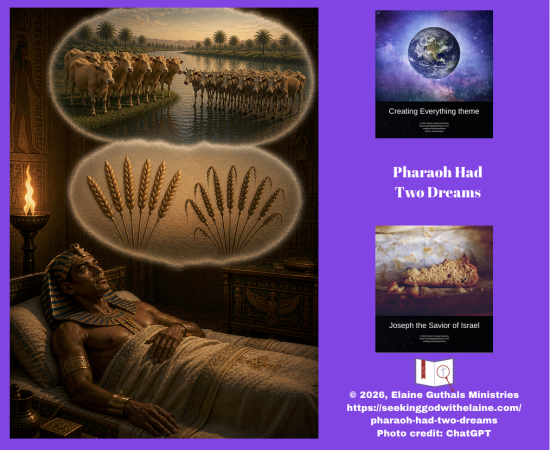
Joseph had asked one thing of the cupbearer. Help get me out of here.
But the cupbearer forgot about him. Until …..
Let's Put It into Context
To read devotions in the Creating Everything theme, click the button below.
Devotions in the Joseph the Savior of Israel series
Waiting for Dreams
“Two full years later, Pharaoh dreamed that he was standing on the bank of the Nile River” (Gen. 41: 1 NLT)
Two Full Years Later
“Later” was long enough for the cupbearer to forget about Joseph.
The Hebrew phrase used vayehi miqqēṣ shenatayim yamim (וַיְהִי מִקֵּץ שְׁנָתַיִם יָמִים) means at the completion of a fixed period or at the end two years of days.
Wait! What???
What does it mean by using days and years?
When the Hebrews used years in their writing, they didn’t always mean a full 365-day cycle the way we think of it. We sometimes do something similar.
One time when I was 45, halfway through my year I started saying I was 46. Of course, when my birthday rolled around, I said it was my 47th birthday.
My point is that people sometimes speak of years inclusively or round them conversationally. Adding of days clarified that Joseph had been there for two complete years — a full duration.
Joseph wasn’t forgotten because of a random delay. Jehovah worked on His timing. He waited until the fullness of time to work His plan.
I don’t think we should gloss over the fact that Joseph wasn’t elevated until Jehovah’s work with him was completed. Did he need a couple of more bricks on his Sanctification Road? Was He working on something dealing with Joseph’s moral character?
Was Jehovah was working on something dealing with Pharaoh’s journey or Egypt’s? We don’t know. Maybe Joseph didn’t.
How much we do have to realize what our Sanctification Road events are? I believe that Jehovah is working within us through the Holy Spirit that we may or may not be conscious of it happening.
Pharaoh
The Pharaoh in power in the chapters from here on out in Genesis is often associated with the Hyksos.
The Hyksos (heqa khasut or rulers of foreign lands) were a mixed-race people of primarily West Semitic origin. Their rule became known as the 15th Dynasty (1650 to 1550) or during the Second Intermediate Period. They probably came from what is modern-day Syria and the Levant.
It is believed that they were a ruling elite back in their country who were driven out by an invasion in their homeland. When they prospered in Egypt, they called for others to join them.
While Egyptian sources portray their rise as an invasion, archaeological evidence suggests a more gradual infiltration and consolidation of power rather than a sudden military conquest. Over time, they established themselves in Egypt’s Nile Delta, eventually gaining political control. They made their base in Avaris.
The Hyksos are credited with introducing or expanding the use of key military technologies in Egypt, including horse-drawn chariots and advanced bronze weaponry. These innovations would later become central to Egyptian military strength, including the pursuit of the Israelites in the Exodus account.
To native Egyptians living under Hyksos rule, the later rise and prosperity of the Hebrews in Egypt may have felt familiar — another Semitic people gaining influence and favor within the land. This context helps explain how Joseph, a Hebrew, could rise to such a position of authority in Egypt during this period.
In this light, Joseph’s rise is no longer an isolated miracle of politics, but a moment where divine providence intersects with a unique window in Egyptian history.
Pharaoh’s Dreams
“In his dream he saw seven fat, healthy cows come up out of the river and begin grazing in the marsh grass. Then he saw seven more cows come up behind them from the Nile, but these were scrawny and thin. These cows stood beside the fat cows on the riverbank. Then the scrawny, thin cows ate the seven healthy, fat cows! At this point in the dream, Pharaoh woke up. But he fell asleep again and had a second dream. This time he saw seven heads of grain, plump and beautiful, growing on a single stalk. Then seven more heads of grain appeared, but these were shriveled and withered by the east wind. And these thin heads swallowed up the seven plump, well-formed heads! Then Pharaoh woke up again and realized it was a dream” (Gen. 41: 2-7 NLT)
The Pharaoh had two dreams.
We’ve talked a lot about dreams – ḥălôm (חֲלוֹם) – in the past couple of devotions. They were considered divine revelations.
The Nile River
In his dream, Pharaoh was standing on the bank of the Nile River. This river was very important to the region. Its flooding each year brought water and silt to the desert.
The Nile would overflow following an established pattern.
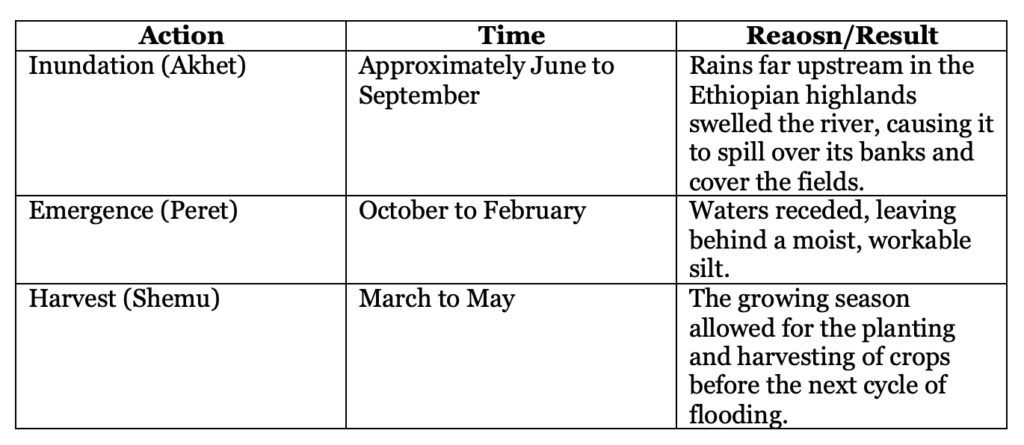
The growing season allowed for the planting and harvesting of crops before the next cycle of flooding.
If the Nile didn’t overflow, nothing grew. That made it the foundation of life itself.
- Agriculture depended on it
- The economy ran on grain production
- Transportation moved along it
- Religion even centered around it (they saw the flood as divine provision)
So, to me, it is very important that this was the location of the dream. It was like God was saying, “I can hit you in your seat of power. I control the Nile.”
The Dreams
One dream featured seven cows; the other had grain.
Seven healthy cows were eaten by seven skinny cows. Then seven plump and beautiful heads of grain were swallowed up by seven shriveled and withered heads of grain appeared, carried by the east wind.
When I was young, I had this hilarious vision of the skinny cows eating the fat cows. Living on a farm that had milk cows, I knew how big they could get.
In my mind, it was like the skinny cows eating elephants.
That would wake me up, too!
We might question how familiar Pharaoh would have been with cows and grain. In reality, he would have been very familiar.
The entire Egyptian economy was agricultural. As king, he would have been expected to maintain order (ma’at). That would have included overseeing grain production and storage and preventing famine.
Preventing famine? How could Pharaoh do that? Well, a large part of maintaining order would have been maintaining the Nile flood cycle.
In other words, Pharaoh would have been very involved in crop cycles, yield expectations, and grain supply logistics.
Grain would not only have been Egypt’s food source, but it was also used for trade and wages. Livestock – especially cattle – were economic indicators.
So, Pharaoh might have been seeing cows and grain in his dream. He would have been thinking national prosperity and collapse.
That isn’t even getting into the symbolism. Cattle symbolized fertility and abundance. Full grain heads would have symbolized a bountiful harvest.
Pharaoh wouldn’t have needed anyone to interpret that part of the dreams. He would see the record yields followed by total agricultural collapse.
Ooo, baby. Pharaoh would have been upset since he understood the imagery but not the meaning.
The Cupbearer Remembered
“The next morning Pharaoh was very disturbed by the dreams. So he called for all the magicians and wise men of Egypt. When Pharaoh told them his dreams, not one of them could tell him what they meant. Finally, the king’s chief cup-bearer spoke up. ‘Today I have been reminded of my failure,’ he told Pharaoh. ‘Some time ago, you were angry with the chief baker and me, and you imprisoned us in the palace of the captain of the guard. One night the chief baker and I each had a dream, and each dream had its own meaning. There was a young Hebrew man with us in the prison who was a slave of the captain of the guard. We told him our dreams, and he told us what each of our dreams meant. And everything happened just as he had predicted. I was restored to my position as cup-bearer, and the chief baker was executed and impaled on a pole’” (Gen. 41: 8-13 NLT)
Pharaoh Was Very Disturbed by the Dream
That the meaning of the dream alluded Pharaoh disturbed him.
Dreams were very important to people in those days because they could tell the future. Pharaoh’s ability to understand the imagery but inability to understand the meaning would have agitated him.
Wouldn’t that have terrified Pharaoh? He was this great ruler with an enormous army at his back.
But this was a divine revelation. What if the god was really God — which it was!
Called for All the Magicians and Wise Men
So, Pharaoh called his magicians and wise men to interpret the dreams for him.
He may have had the title Pharaoh, but he was not independent. He was dependent on advisors.
But sorcery comes from Satan, not God. Our wisdom and knowledge are far less than God’s.
- “For example, never sacrifice your son or daughter as a burnt offering. And do not let your people practice fortune-telling, or use sorcery, or interpret omens, or engage in witchcraft, or cast spells, or function as mediums or psychics, or call forth the spirits of the dead. Anyone who does these things is detestable to the Lord. It is because the other nations have done these detestable things that the Lord your God will drive them out ahead of you.” (Deut. 18: 10-12 NLT).
- “‘My thoughts are nothing like your thoughts, says the Lord. ‘And my ways are far beyond anything you could imagine. For just as the heavens are higher than the earth, so my ways are higher than your ways and my thoughts higher than your thoughts’” (Isa. 55: 8-9 NLT).
Here, only a true believer would be able to interpret the dream. I think it was more than just Joseph giving Jehovah the credit for the interpretation. Joseph’s humble attitude played a big part, in my opinion.
Finally, the Cupbearer Remembered
The cupbearer finally had his memory jogged.
Moses had warned us at the end of Genesis 40 that the cupbearer forgot the one thing Joseph had asked him to do. How many times have we mentally all but yelled at a man who has been long dead?
But when Pharaoh had his dreams, it all came flooding back to the cupbearer. He finally remembered.
We would say better late than never. God would say it happened right on time because He was never early or late.
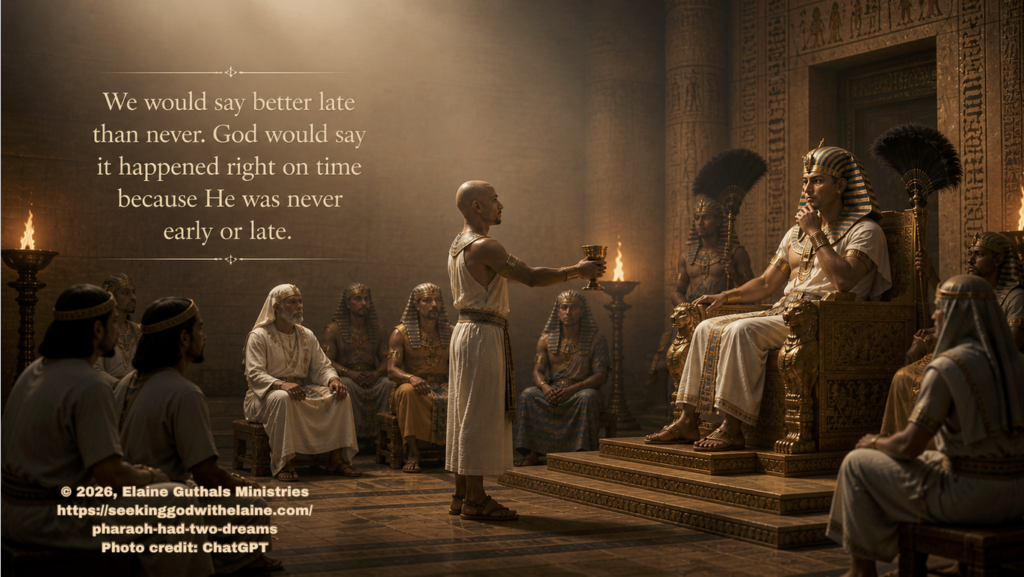
The first thing up of the cupbearer’s mouth was, “I messed up.” His conscience began to bother him.
It is important that we recognize and remember our faults. We all have them. God wants us to take responsibility for them and come to Him for healing.
What made the cupbearer remember? Someone was in the position he had been in two years earlier.
Mordecai told Esther, “… Who knows if perhaps you were made queen for just such a time as this?” (Est. 4: 14 NLT). I have long paraphrased this as, “Maybe something happened to prepare me or set me up for what is happening now.”
The cupbearer described Joseph as the Hebrew servant. It didn’t acknowledge how he had risen in the prison hierarchy. He was still described by a low status.
What the cupbearer said that I think Pharaoh would have gravitated to was that Joseph’s interpretations proved to be true.
Making the Connections #1
I wonder if Joseph had great hopes for the first day or two. Maybe he didn’t expect anything to happen for the first week.
But then the weeks turned to months, and the months turned to years.
Did Joseph suffer? Oh, yes. Was he content where he was? I think so.
We have to be content in whatever situation in which Jehovah allows for us. We shouldn’t focus on situations and circumstances. Our focus must be on Jehovah.

Making the Connections #2
Sometimes, God’s provision for us means we have to depend on others. I know. That is a big kick in the pants to our independence.
We want to do things for ourselves, especially our own way.
My mom was very independent. She knew what it was like to have your life planned one way and have God say, “Nope. I’ve got something else for you.”
When she got cancer, Mom got to the point where she couldn’t do for herself. I remember her saying, “I have to let other people do for me in order for them to get their blessing.”
Yes, they got their blessing, but this passage shows us how the person surrendering to dependence can be blessed and be a blessing to others.
Joseph, through his obedience during the seven years of plenty, didn’t just provide for the Egyptian people. He provided for the Hebrew people. I am sure if those in Canaan knew there was food in Egypt, people from surrounding nations and people groups found their way there also.
Jehovah’s salvation extends to all who will believe in His Son.
Making the Connections #3
Are we surprised that Jehovah allowed a non-believer to have such an important role in His plan? We shouldn’t.
Jehovah’s salvation is for anyone who believes. How is one of the best ways to convince them to believe?
To show them firsthand. To let them have a part in seeing how He provides.
How Do We Apply This?
- Be faithfulness in hidden seasons.
- Understand Jehovah will prepare us before He promotes us.
- Wait for Jehovah’s appointed time.
- Understand that Jehovah is working behind the scenes.
Father God. Even when we don’t see You working, You are. When the time is right, You will work Your plan. Help us to wait on You and to focus on You so we can listen to You. Amen.
If you don’t understand something and would like further clarification, please contact me.
If you have not signed up for the email providing the link to the devotions and the newsletter, do so below.
If God has used this devotion to speak with you, consider sharing it on social media.