After traveling on the caravan, Joseph arrived in Egypt. This devotional reading looks at how he fared after he was sold to an Egyptian.
Nuggets
- Meanwhile – while all we talked about in Genesis 38 was happening in Canaan – down in Egypt, Jehovah’s plan was going forward.
- Joseph was sold to an Egyptian officer named Potiphar.
- We don’t know how long Joseph had been in Egypt before Potiphar saw him, but there was a reason he did.
- Joseph was made the Overseer of the House.
- Mrs. Potiphar tempted Joseph to sin.
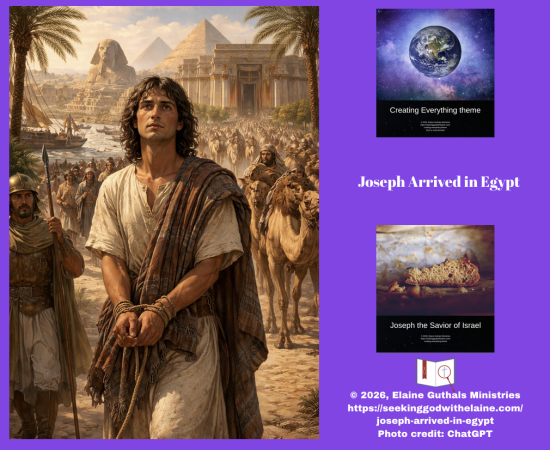
It was all part of Jehovah’s plan that Joseph go to Egypt. We might think it should have been a little easier on Joseph, but this was his Sanctification Road.
Let’s take a look.
Let's Put It into Context
To read devotions in the Creating Everything theme, click the button below.
Devotions in the Joseph the Savior of Israel series
Arrival in Egypt
“Meanwhile, the Midianite traders arrived in Egypt, where they sold Joseph to Potiphar, an officer of Pharaoh, the king of Egypt. Potiphar was captain of the palace guard” (Gen. 37: 36 NLT)
Meanwhile – while all talked about in Genesis 38 was happening in Canaan – down in Egypt, Jehovah’s plan was going forward.
In the past few devotions, we have been following the fall and rise of Judah. His story of sin, repentance, forgiveness, and restoration is vital to the story of the nation of Israel. The Messiah would come from his line.
Jehovah was multitasking. He was restoring Judah as He was watching over Joseph.
Aren’t we so glad Jehovah can do that? He can lead Tom through his trials while Sally is going through totally different ones. That doesn’t even get into the chaos Elaine is getting herself into — and yes — He is right there with her, too.
When we left our hero back in Genesis 37, Joseph was in a pickle. Ten of his brothers — all the ones who could walk and talk — all older (even if only up to seven years) — sold him. That was better than they were talking about – killing him.
Joseph had been sold to distant cousins, who had taken him to Egypt. The year would have been 1692 BC. What did Joseph see when he got off the caravan?
The Egypt Joseph first saw was at a moment when its systems were still strong. The year 1692 BC would have put it at the end of Egypt’s Middle Kingdom or just about ready to transition to the Second Intermediate Period.
That would mean that its foundations were strong. It was structured, bureaucratic, and confident.
But it was probably showing signs of starting to crack. Outside of the capital, the central authority was losing its power to the regional governors.
Still, it was well oiled enough to recognize Joseph’s abilities — and open enough to make use of those abilities. He wouldn’t have been the only foreigner in the country.
Joseph would probably have been brought to the Nile Delta in Lower Egypt. Called Lower Egypt – even though it was north of Upper Egypt – it referred primarily to the Nile Delta, the broad, fertile region where the river spread into many branches before reaching the Mediterranean Sea.
But think back to your history classes. The Nile River – specifically its annual flooding – brought life to the region. It would have had a large agricultural component. Storage systems would have already been in place.
But this area would have also been more cosmopolitan. It was an administrative center for the Egyptian government of the time. It would have boasted trade-heavy zones.
There were many layers to Egyptian society.
- Pharaoh (divine king)
- Royal officials (like Potiphar)
- Scribes (very important)
- Skilled workers
- Administrators
- Laborers
- Slaves (including foreigners)
That would have put Joseph at the bottom of society’s class structure.
Joseph in Potiphar’s House
“When Joseph was taken to Egypt by the Ishmaelite traders, he was purchased by Potiphar, an Egyptian officer. Potiphar was captain of the guard for Pharaoh, the king of Egypt. The Lord was with Joseph, so he succeeded in everything he did as he served in the home of his Egyptian master. Potiphar noticed this and realized that the Lord was with Joseph, giving him success in everything he did. This pleased Potiphar, so he soon made Joseph his personal attendant. He put him in charge of his entire household and everything he owned. From the day Joseph was put in charge of his master’s household and property, the Lord began to bless Potiphar’s household for Joseph’s sake. All his household affairs ran smoothly, and his crops and livestock flourished. So Potiphar gave Joseph complete administrative responsibility over everything he owned. With Joseph there, he didn’t worry about a thing — except what kind of food to eat! …” (Gen. 39: 1-6 NLT)
Purchased by Potiphar
Joseph was sold to an Egyptian officer named Potiphar.
Joseph’s brothers sold him to the Ishmaelite/Midianite traders for 20 shekels of silver. This was the price of a young slave at the time.
The imagery of being brought down is equivalent of that to Judah’s went down. This is talking about the spiritual descent imagery.
We’ll have to see if the outcome is the same.
Jehovah provided that Joseph would be placed in Potiphar’s house. Through his experiences in Potiphar house, Joseph was in a position to go on to the third phase of Jehovah’s plan.
We aren’t told how much Potiphar paid for him. Good business practice would be that the traders got paid more than that to recoup business expenses.
But that isn’t the issue.
The most important information in this passage is that Joseph was bought by Potiphar (Hebrew: Pôṭîfar). We aren’t given much information on who he was, but we are given enough to ground the story.
We can tell Potiphar was fully Egyptian because of his name. Potiphar is Pa-di-pa-Ra, which means Given by Ra. Remember, Ra was the Egyptian sun god.
Potiphar was not only an Egyptian officer, but he was also Captain of the Guard. He commanded an elite position in Pharaoh’s officers.
It really becomes interesting when we look at Potiphar’s job title in the Hebrew. The Hebrew phrase is śar haṭṭabbāḥîm (שַׂר הַטַּבָּחִים). That literally means chief of the slaughterers.
Ouch! But that isn’t the way that Egyptians looked at that. Potiphar was probably the head of royal security with execution authority. His job description probably included overseeing the royal prison, state executions, and protection of the Pharaoh.
While there is no historical evidence confirming his identification, records do indicate the framework in which he lived. High-ranking officials had estate and servants. They even managed prisons.
But this would have made Potiphar’s prison a royal prison. It would have been on the high-end scale as prisons of the day were categorized.
Some of the literal translations label Potiphar as a eunuch. I don’t see that as there is a Mrs. Potiphar. The Hebrew word used – śārîs – can also mean high-ranking official. I go with court official.
Whoever Potiphar was, he was an official in the elite ruling class powerful enough to buy, promote, and imprison Joseph. He couldn’t derail Jehovah’s plans for him.
Purchased by Potiphar
Joseph was sold to an Egyptian officer named Potiphar.
Joseph’s brothers sold him to the Ishmaelite/Midianite traders for 20 shekels of silver. This was the price of a young slave at the time.
The imagery of being brought down is equivalent of that to Judah’s went down. This is talking about the spiritual descent imagery.
We’ll have to see if the outcome is the same.
Jehovah provided that Joseph would be placed in Potiphar’s house. Through his experiences in Potiphar house, Joseph was in a position to go on to the third phase of Jehovah’s plan.
We aren’t told how much Potiphar paid for him. Good business practice would be that the traders got paid more than that to recoup business expenses.
But that isn’t the issue.
The most important information in this passage is that Joseph was bought by Potiphar (Hebrew: Pôṭîfar). We aren’t given much information on who he was, but we are given enough to ground the story.
We can tell Potiphar was fully Egyptian because of his name. Potiphar is Pa-di-pa-Ra, which means Given by Ra. Remember, Ra was the Egyptian sun god.
Potiphar was not only an Egyptian officer, but he was also Captain of the Guard. He commanded an elite position in Pharaoh’s officers.
It really becomes interesting when we look at Potiphar’s job title in the Hebrew. The Hebrew phrase is śar haṭṭabbāḥîm (שַׂר הַטַּבָּחִים). That literally means chief of the slaughterers.
Ouch! But that isn’t the way that Egyptians looked at that. Potiphar was probably the head of royal security with execution authority. His job description probably included overseeing the royal prison, state executions, and protection of the Pharaoh.
While there is no historical evidence confirming his identification, records do indicate the framework in which he lived. High-ranking officials had estate and servants. They even managed prisons.
But this would have made Potiphar’s prison a royal prison. It would have been on the high-end scale as prisons of the day were categorized.
Some of the literal translations label Potiphar as a eunuch. I don’t see that as there is a Mrs. Potiphar. The Hebrew word used – śārîs – can also mean high-ranking official. I go with court official.
Whoever Potiphar was, he was an official in the elite ruling class powerful enough to buy, promote, and imprison Joseph. He couldn’t derail Jehovah’s plans for him.
The Lord Was with Joseph
We don’t know how long Joseph had been in Egypt before Potiphar saw him, but there was a reason he did.
There are two very important statements in this passage.
- “The Lord was with Joseph, so he succeeded in everything he did as he served in the home of his Egyptian master” (Gen. 39: 2 NLT).
- “Potiphar noticed this and realized that the Lord was with Joseph, giving him success in everything he did” (Gen 39: 3 NLT).
Jehovah was with Joseph, so much so that even a non-believer could see His hand upon him.

The Hebrew describes why. “The Lord was with Joseph …” (Gen. 39: 2 NLT) utilizes the immô (עִמּוֹ יְהוָה֙) – with Yahweh. This signifies a covenant closeness.
This description of closeness was also strengthened by the use of favor – ḥēn (חֵן). That can be translated as grace that produces visible acceptance.
Made Joseph His Personal Attendant
Joseph was made the Overseer of the House.
Joseph had experience shepherding sheep. Okay, maybe it was good training for what was coming, but the sheep didn’t talk back and interact. Joseph needed more training.
So, Jehovah dropped Joseph into a large household. He had to deal with money as well as people. He had to learn everyday Egyptian life.
Part of Abraham’s covenant was those who blessed Abraham and his descendants would be blessed. We have already seen this with Laban (Gen. 30: 27).
Disaster Set Up
“… Joseph was a very handsome and well-built young man, and Potiphar’s wife soon began to look at him lustfully. ‘Come and sleep with me,’ she demanded. But Joseph refused. ‘Look,’ he told her, ‘my master trusts me with everything in his entire household. No one here has more authority than I do. He has held back nothing from me except you, because you are his wife. How could I do such a wicked thing? It would be a great sin against God.’ She kept putting pressure on Joseph day after day, but he refused to sleep with her, and he kept out of her way as much as possible” (Gen. 39: 6-10 NLT)
Mrs. Potiphar tempted Joseph to sin.
Joseph was described with same description used for his mother, Rachel. In Hebrew, it is yĕpēh tō’ar wĕyĕpēh mar’eh. Remember, Rachel was described as “… but Rachel had a beautiful figure and a lovely face” (Gen. 29: 17 NLT). That information is used to set up the temptation.
The problem came when Mrs. Potiphar began to notice Joseph.
There was one slight problem. The boss’s wife demanded a piece of Joseph.
Make no mistake. Mrs. Potiphar wasn’t looking for romance. She was asserting her power.
Mrs. Potiphar didn’t see that anyone else would be hurt by the act. Joseph begged to differ. So, she kept demanding Joseph obey her.
Joseph did the right thing. He said no thanks. He wasn’t going to disrespect Potiphar and God that way.
The responses that Joseph gave were interesting.
In his three reasons to Mrs. Potiphar, Joseph started with the two that affected her directly. “Your husband trusts me, and you are the only thing he hasn’t allowed me access. You have a covenant with him.”
Then, and only then, did Joseph give his most important reason, but one she may or may not have accepted. “It is a sin against God.”
Think about Joseph’s responses. They dealt with trust, integrity, and purity.
Satan tries to tell us what we should do would be a victimless crime. He would be wrong.
Joseph’s response wasn’t ultimately based on Mr. or Mrs. Potiphar. It was based on him – Joseph – being the man Jehovah required him to be.
All sin is a crime against Jehovah. We are disobeying His command to be pure and obedient.
Joseph didn’t need Mrs. Potiphar to accept his third reason. Our relationship with Sovereign God is our alone.
Making the Connections #1
Joseph didn’t rise because of Egypt, nor in spite of it. He rose to prominence as Israel’s savior because Jehovah had already determined his place within it.
Making the Connections#2
We are never told that Joseph went kicking and screaming to Egypt. There are no stories about him fighting back against his master.
What we are told is that Joseph did his job. He lived his life.
We can read into it that Joseph was what Paul called content. Yes, we’ll see the “payment” he requested of the baker and cup bearer showed he wanted to get out, but he continued to do his job.
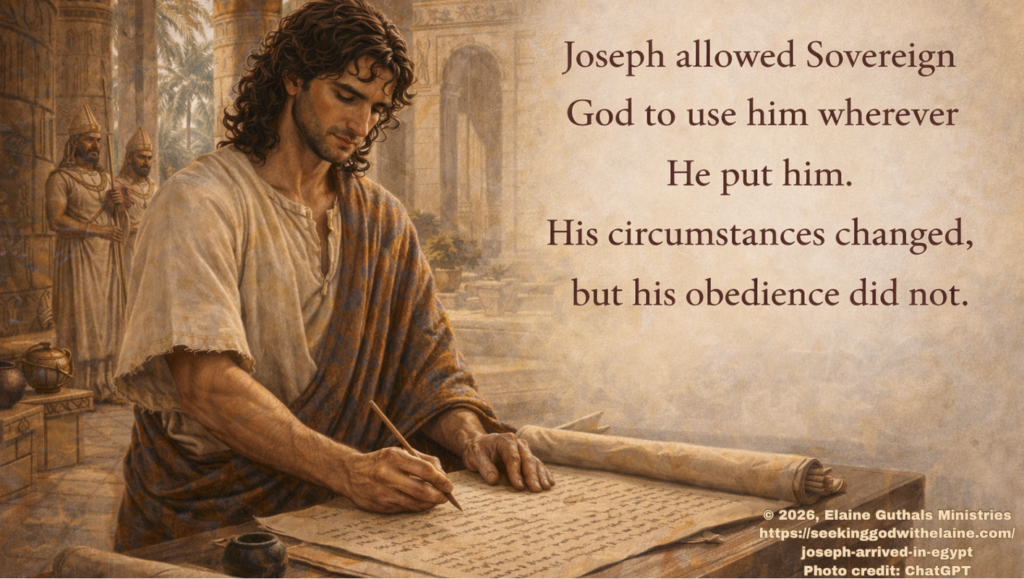
Joseph allowed Sovereign God to use him wherever He put him. His circumstances changed, but his obedience did not.
How Do We Apply This?
- Keep Jehovah’s laws and commandments.
- Remain obedient to Him.
Father God. Once our lives take a turn for the worse, we start kicking and screaming. Help us to be content where You put us and see You hand in all the events of our lives. Amen.
If you don’t understand something and would like further clarification, please contact me.
If you have not signed up for the email providing the link to the devotions and the newsletter, do so below.
If God has used this devotion to speak with you, consider sharing it on social media.