After Judah’s visit to a prostitute, he returns to his everyday life. This devotional reading looks at the restitution part of Judah’s repentance, forgiveness, and restitution process.
Nuggets
- Sin is never hidden from Jehovah.
Judah was concerned with reputation — not righteousness. - People find out the widow was pregnant.
- The very things Judah used to live and act as who he was become the evidence that forces him to face who he was.
- Judah repented and was forgiven and restored.
- Jehovah was ensuring the continuation of the covenant line.
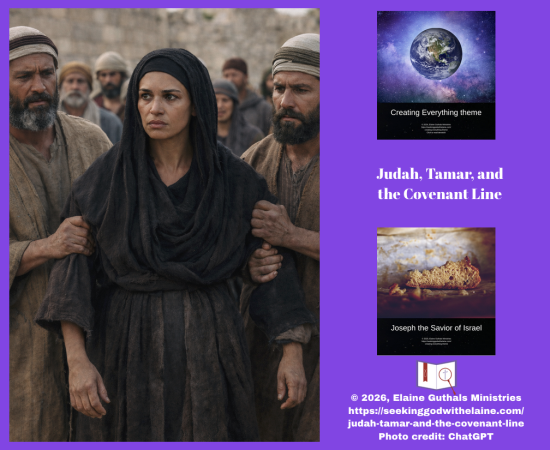
We’ve been following along on the story of Jacob’s son Judah. He and his brothers had sold their brother Joseph into slavery.
Now, Judah was continuing a descent into sin.
But time passes, and hidden things do not always stay hidden.
Let's Put It into Context
To read devotions in the Creating Everything theme, click the button below.
Devotions in the Joseph the Savior of Israel series
Aftermath
“Afterward she went back home, took off her veil, and put on her widow’s clothing as usual” (Gen. 38: 19 NLT)
Sin is never hidden from Jehovah.
I went back and forth about connecting this with the last section on the last devotion or letting it stand on its own. I think this is very important. We can’t bury it.
Judah went home convinced that the secret of his procuring the services of a prostitute was safe with him. He had every intention of making the payment.
Case closed.
But Tamar had a much bigger case against Judah than he realized. And she had the forensic-level proof to prove it.
How does this work into Jehovah’s opportunity for repentance, forgiveness, and renewal?
Judah thought – like we think – our sins are hidden. What is done in private is supposed to stay in private.
We only wish that.
Instead, Judah left – again, like we leave – undeniable evidence. People were changed. Situations were changed.
More importantly, Sovereign God – the all-knowing, all-seeing Supreme Being – knows our sin.

Nothing is hidden from Jehovah. We may think that. We may convince ourselves that He doesn’t care.
He does.
Payment Attempted
“Later Judah asked his friend Hirah the Adullamite to take the young goat to the woman and to pick up the things he had given her as his guarantee. But Hirah couldn’t find her. So he asked the men who lived there, ‘Where can I find the shrine prostitute who was sitting beside the road at the entrance to Enaim?’ ‘We’ve never had a shrine prostitute here,’ they replied. So Hirah returned to Judah and told him, ‘I couldn’t find her anywhere, and the men of the village claim they’ve never had a shrine prostitute there. Then let her keep the things I gave her,’ Judah said. ‘I sent the young goat as we agreed, but you couldn’t find her. We’d be the laughingstock of the village if we went back again to look for her’” (Gen. 38: 20-23 NLT)
Judah was concerned with reputation — not righteousness.
Yay, Judah! He did exactly what he said he would do.
Judah sent Hirah – the only other person who knew of Judah’s transgression – to make the payment. He kept his end of the bargain.
But that is where things began to fell apart.
We get another snippet of information. Hirah thought Tamar was a temple prostitute. At least that is how most versions translate it.
We have to dig in a bit here to look at a discrepancy.
When Judah first saw Tamar, he called her a זֹנָה (zonah) – a common prostitute. “Judah noticed her and thought she was a prostitute, since she had covered her face” (Gen. 38: 15 NLT).
Hirah, when he was delivering the payment, asked about the קְדֵשָׁה (qedeshah) – translated as either temple prostitute or cult prostitute.
There may or may not have been a pagan temple in the area. Qedeshah was connected to pagan religious practices, such as fertility cults and Canaanite worship systems. It could have been a localized shrine or sacred site. In fact, it may have just been a recognized category of women.
Fertility worship was common. We know how important family, especially sons, were in the Ancient Near Eastern society. So, qedeshah likely referred to women associated with these fertility practices.
Stop a second. It is an entirely different matter if Judah was procuring the services of a temple prostitute rather than a common prostitute. It deepens his compromise if he was engaging someone associating within the Canaanite moral-religious framework.
Judah left the covenant family. He went to live among those Jehovah did not want to associate with the covenant family. This shows that Judah was fully embedded in the Canaanite system.
To me, that meant Judah – the future patriarch of the family – turned his back on the covenant with Jehovah. (But remember, this is the story of repentance, forgiveness, and renewal. Stay tuned.)
Yes, living in the world is difficult. We may think it was harder then, but it is just as hard as now.
Still, Jehovah calls us now — as He called then — to be in the world but not of it (Jn. 15: 19). We can’t just say, “Oh, the circumstances I am in left me no other choice but to sin.”
We are called to be faithful to Jehovah regardless of our circumstances.
Of course, Tamar wasn’t around because she wasn’t a temple prostitute or any other kind.
This is what I don’t get. Judah had given her his identity to secure the payment. And he was just going to give it up so he doesn’t become the laughingstock of the village???? If what he gave Tamar was his identity, why did Judah give them up without a fight?
What did laughingstock mean?
Laughingstock, in the Ancient Near East, meant public ridicule, loss of honor, and damage to social standing. But it didn’t stop there.
Think about what people would ask if and when they learned of Judah looking for a woman. “Why is Judah looking for this woman? What kind of transaction did they make? What did he give her as security?”
It would come out that Judah gave his seal, cord, and staff. It would become public knowledge that he gave up his identity.
So, Judah had a couple of options. He could have kept searching and chance drawing attention to his search.
Or Judah could walk away. Keep the matter quiet. Make it go away.
Judah chose to keep quiet, protect the secret, and lose his identity. He chose to protect his reputation.
Yeah, it would come back and bite him.
The Secret Was Out
“About three months later, Judah was told, ‘Tamar, your daughter-in-law, has acted like a prostitute. And now, because of this, she’s pregnant.’ ‘Bring her out, and let her be burned!’ Judah demanded. But as they were taking her out to kill her, she sent this message to her father-in-law: ‘The man who owns these things made me pregnant. Look closely. Whose seal and cord and walking stick are these?’ Judah recognized them immediately and said, ‘She is more righteous than I am, because I didn’t arrange for her to marry my son Shelah.’ And Judah never slept with Tamar again” (Gen. 38: 24-26 NLT)
Acted Like a Prostitute
People find out the widow was pregnant.
I always laugh when I read that whoever told Judah accused Tamar of being a prostitute. Remember, Judah’s transgression was supposed to be a secret. I wonder if his face went pale when the man said that.
Ooo, baby. Judah still was sure quick to judge Tamar.
Even though he didn’t know he was the father of the baby at that time, Judah did know that he had frequented a prostitute. True, that may have been the only time he had.
Judah may have forgotten — probably did — about the episode by then.
Judah was quick to accuse – that is, until he was faced with irrefutable evidence. He couldn’t deflect, deny, or shift blame.
But why was there an uproar because of the pregnancy?
We can’t forget Tamar’s situation. She was a party to a levirate marriage even if she did not have a husband at that moment. That meant she was bound to Judah’s family.
Even though he had no plans on going through with the marriage, Judah did not release Tamar from that agreement. Tamar was not “free” – or divorced, as we would say.
That was all the community needed to know. Tamar’s sexuality was controlled by the family structure.
Probably the bigger questions in everyone’s mind – that wasn’t recorded here – was, “Who was the father?” That uncertainty could have threatened the family line. It may have impacted inheritance.
Any lineage confusion brought about social instability. (Did you ever wonder why there are so many genealogy lists in God’s Word?)
This was about Judah’s reputation. (Remember, that was the reputation he was trying to preserve.)
If Tamar was acting outside of social norms, Judah’s household was dishonored. He was seen as being weak.
That is why Judah’s verdict immediately went to execute her. He wanted to publicly purge this dishonor, restore his control, and protect the family name.
Judah got what he wanted. This made him appear righteous. It didn’t matter that Tamar appeared to be guilty when she wasn’t.
Let’s stop a second and think this through.
On the wedding night, Tamar’s guardianship would have passed from her father to Er, her new husband. It probably passed to Onan when he became her levirate husband.
What would have happened to it when Onan died?
It wouldn’t have passed to Shelah. He wasn’t her husband yet because he wasn’t of age.
Did it go back to Tamar’s father? She wouldn’t be tied to Judah’s family if it did.
Did it pass to Judah? If it did, he still had it.
Wherever the guardianship went, Judah was controlling the narrative. But then, no one was asking, “Why isn’t Tamar married to Shelah now that he is of age?”
Sent This Message
The very things Judah used to live and act as who he was become the evidence that forces him to face who he was.
Yep, up to this point, everything was stacked against Tamar. The evidence was irrefutable. Public opinion was against her, and Judah was firmly in control.
But remember, Tamar was a smart girl. She had irrefutable forensic-level evidence.
She didn’t come out accusing Judah, not our Tamar. She asked basically the same question Judah and brothers asked Jacob when they sent him Joseph’s tunic. “Do you recognize this?”
That is another big step in Jehovah’s practice of repentance, forgiveness, and restoration. We can’t repent of something that we don’t recognize as wrong.
So, in the end, the system that had failed Tamar was the one that exposed Judah’s sin.
She Is More Righteous than I
Judah repented and was forgiven and restored.
Was Tamar being righteous when she sinned by having sex — not just with any man but with her father-in-law? Yes, in this instance.
Tamar was following the levirate marriage law where Judah hadn’t. She held up the spirit of the law better than he did.
We have to watch when we think we are in an ends-justify-the-means situation. That isn’t our call. That call solely rests in Jehovah’s hands. Only He can identify what a sin is or isn’t.
But Genesis 38 is about Judah and his restoration to Jehovah.
This is where Judah’s transformation began. It wasn’t where his restoration began and was awarded to him elsewhere.
It was where Judah’s restoration took place.
When we sincerely repent and tell Jehovah we will obediently follow His Will, He will give us salvation. In the same way, He will restore our relationship with Him upon our sincere immediate repentance.
- “Come close to God, and God will come close to you. Wash your hands, you sinners; purify your hearts, for your loyalty is divided between God and the world” (Jas. 4: 8 NLT).
- “Create in me a clean heart, O God. Renew a loyal spirit within me. Do not banish me from your presence, and don’t take your Holy Spirit from me. Restore to me the joy of your salvation, and make me willing to obey you” (Ps. 51: 10-12 NLT).
- “But if we confess our sins to him, he is faithful and just to forgive us our sins and to cleanse us from all wickedness” (I Jn. 1: 9 NLT).
If you want a visual of this, look to the Parable of the Prodigal Son in Luke 15: 11-32. The Father came running to the son – running, which was considered undignified.
Does this passage say anything about Judah’s restoration? Well, yes and no.
Moses didn’t really get into Judah’s spiritual condition. But then, he was a man of few words.
There is one word that is a good clue of were Judah was at. Moses used the word righteous. That was not a word he would have used lightly.
Did Judah say he had become righteous? No. He said Tamar was better at it than he was.
But go back to what we said the reason this chapter was placed in this place. This chapter is in exactly the position it needs to be because we need to follow Judah on his transformation.
Genesis 38 shows Judah’s moral collapse and turning point. Jehovah recognizes and rewards our sincere turning point. Forgiveness and restoration is given; transformation begins.
The Covenant Line
“When the time came for Tamar to give birth, it was discovered that she was carrying twins. While she was in labor, one of the babies reached out his hand. The midwife grabbed it and tied a scarlet string around the child’s wrist, announcing, ‘This one came out first.’ But then he pulled back his hand, and out came his brother! ‘What!’ the midwife exclaimed. ‘How did you break out first?’ So he was named Perez. Then the baby with the scarlet string on his wrist was born, and he was named Zerah” (Gen. 38: 27-30 NLT)
Jehovah was ensuring the continuation of the covenant line.
At this point, it looks like Jacob had problems with who was going to be his firstborn son. Reuben staged a coup (Gen. 35: 22). Simeon and Levi committed murder (Gen. 34: 25).
Jehovah chose Judah to be the covenant son. Yeshua would be the great … grandson of Perez.
I thought it was interesting that the twins struggled within Tamar’s womb, just as Jacob and Esau did. However, Perez was the firstborn.
Making the Connections #1
Joseph was down in Egypt. Since we don’t know what year this was, we don’t know if he had just arrived or if he was getting ready to interpret Pharaoh’s dreams.
We get one chapter to see Judah hit rock bottom and turn back to Jehovah. If he didn’t turn back to Jehovah here, the chapter didn’t need to be placed here.
Making the Connections #2
We’ve been talking about the repentance, forgiveness, and restoration process. What is that process? When we genuinely repent:
- “He has removed our sins as far from us as the east is from the west.” (Ps. 103: 12 NLT).
- “It’s your sins that have cut you off from God. Because of your sins, he has turned away and will not listen anymore” (Isa. 59: 2 NLT).
- “But if we confess our sins to him, he is faithful and just to forgive us our sins and to cleanse us from all wickedness” (I Jn. 1: 9 NLT).
- “So now there is no condemnation for those who belong to Christ Jesus” (Rom. 8: 1 NLT).
- “This means that anyone who belongs to Christ has become a new person. The old life is gone; a new life has begun!” (II Cor. 5: 17 NLT).
- “Finally, I confessed all my sins to you and stopped trying to hide my guilt. I said to myself, ‘I will confess my rebellion to the Lord.’ And you forgave me! All my guilt is gone” (Ps. 32: 5 NLT).
- “He canceled the record of the charges against us and took it away by nailing it to the cross” (Col. 2: 14 NLT).
- “For the grace of God has been revealed, bringing salvation to all people. And we are instructed to turn from godless living and sinful pleasures. We should live in this evil world with wisdom, righteousness, and devotion to God” (Ti. 2: 11-12 NLT).
- “Restore to me the joy of your salvation, and make me willing to obey you” (Ps. 51: 12 NLT).
- “Come close to God, and God will come close to you. Wash your hands, you sinners; purify your hearts, for your loyalty is divided between God and the world.” (Jas. 4: 8 NLT).
- “So let us come boldly to the throne of our gracious God. There we will receive his mercy, and we will find grace to help us when we need it most” (Heb. 4: 16 NLT).
- “And I will forgive their wickedness, and I will never again remember their sins.” (Heb. 8: 12 NLT).
This reminds us that we cannot pick and choose what we read in God’s Word. We need to read it all to make all the connections.
We need to sincerely complete all these steps. We wouldn’t want to miss a step because we hadn’t read it.
How Do We Apply This?
- Walk in the paths Jehovah calls us to walk.
- Repent when we sin.
Father God. We are humbled that You come to bring our sins to the forefront so that we may repent of them. Lord, we sincerely repent. Forgive us. Restore us to full fellowship with You. Amen.
If you don’t understand something and would like further clarification, please contact me.
If you have not signed up for the email providing the link to the devotions and the newsletter, do so below.
If God has used this devotion to speak with you, consider sharing it on social media.