Joseph continued his life after receiving two revelations from God. This devotional reading looks at how Joseph’s life took a turn for the worst – at the hands of his brothers.
Nuggets
- The brothers were doing their job.
- Joseph obediently followed Jacob’s instructions.
- Jehovah was positioning Joseph for the future He had for him.
- The anger that Joseph’s brothers had for him reached a boiling point – without Joseph even saying anything.
- Only one brother cautioned restraint – but not stopping the plan.

In the last devotion, we talked about how Jehovah gave Joseph two dreams to tell him of his future. He knew how the story was going to end. People — including his brothers — were going to bow down to him.
Joseph was fixing to have to hold on tightly to that good ending. He was going to have a long, rocky road to get there.
Let's Put It into Context
To read devotions in the Creating Everything theme, click the button below.
Devotions in the Joseph the Savior of Israel series
Herding the Flock
“Soon after this, Joseph’s brothers went to pasture their father’s flocks at Shechem” (Gen. 37: 12 NLT)
The brothers were doing their job.
Ooo, baby. The brothers were going back to Shechem. The last time that we know they were there, it didn’t begin or end well.
Jacob had moved his family to Shechem upon return from Paddan-aram. Shechem, the local prince, had raped Jacob and Leah’s daughter Dinah.
The brothers were furious. After deceiving the men of Shechem to get circumcised after promising future marriages, Simeon and Levi killed all the men of the city.
How long had men from the neighboring area to forget that horrific event?
~1694 BC — Dinah was defiled
1692 — Joseph received his coat of many colors from his father Jacob.
1692 — At the age of 17, he was sold into slavery by his brothers (Gen. 37).
Based on Timeline from
Something that huge and bloody would live long in people’s minds.
We don’t know if Jacob still had the land he had bought there. “Jacob bought the plot of land where he camped from the family of Hamor, the father of Shechem, for 100 pieces of silver” (Gen. 33: 19 NLT).
Jacob may have kept the land for his sheep, but it wasn’t like farms today that have fences for boundaries. Since the soil was thin, shepherds had to move around to find the seasonal grass. That didn’t lend itself to a permanent pastureland.
The brothers would have shepherded the sheep in guided foraging. They would have gone where the grass was available. If this was the dry season, they may have had to go farther.
Still, Jacob was always known as being a sojourner in a foreign land. He called Hebron home but was not fully home. He owned land in Shechem but did not have true possession as Canaanites still possessed the land.
Status Report
“When they had been gone for some time, Jacob said to Joseph, ‘Your brothers are pasturing the sheep at Shechem. Get ready, and I will send you to them.’ ‘I’m ready to go,’ Joseph replied. ‘Go and see how your brothers and the flocks are getting along,” Jacob said. “Then come back and bring me a report.’ So Jacob sent him on his way, and Joseph traveled to Shechem from their home in the valley of Hebron” (Gen. 37: 13-14 NLT)
Joseph obediently followed Jacob’s instructions.
We don’t know how long the brothers had been gone. All we know is that it was long enough for Jacob to want a status report.
I just have two questions. Why wasn’t Joseph with them? We’ve already said that he worked with the sons of the concubines.
“… When Joseph was seventeen years old, he tended his father’s flocks. He worked for his half brothers, the sons of his father’s wives Bilhah and Zilpah …” (Gen. 37: 2 NLT).
If we look closely at that verse, it said Joseph often worked with them. While that word is relative, it wasn’t an everyday occurrence. This is the first time I saw that word.
There was one reason for the brothers’ anger at the coat Jacob gave Joseph that I didn’t in the last devotion. It was believed that the coat may have been one like those given to people who did no manual labor.
Shepherds did manual labor. Did that mean Jacob was making him firstborn when he gave him the coat?
Maybe it was a combination of several things. We do know the overall reason. Jehovah had set up circumstances to happen in the way He wanted.

What do we know? Jacob wanted an update on his sons and his flocks. Joseph was ready and willing to go get that report for him. Joseph was obedient.
They Weren’t There
“When he arrived there, a man from the area noticed him wandering around the countryside. ‘What are you looking for?’ he asked. ‘I’m looking for my brothers,’ Joseph replied. ‘Do you know where they are pasturing their sheep?’ ‘Yes,’ the man told him. ‘They have moved on from here, but I heard them say, “Let’s go on to Dothan.’” So Joseph followed his brothers to Dothan and found them there” (Gen. 37: 15-17 NLT)
Jehovah was positioning Joseph for the future He had for him.
Joseph followed the brothers to Shechem. Up to this point, he had done everything Jacob had asked.
That is where plans went awry. The brothers weren’t at Shechem.
Like we said, we don’t know the time of the year. It may have been the dry season, forcing them to move on to find water and grass.
The man who directed Joseph to Dothan was unnamed. That’s okay. The message was much more important than his name.
So, plans changed. Joseph needed a course correction to Dothan. Jehovah provided that.

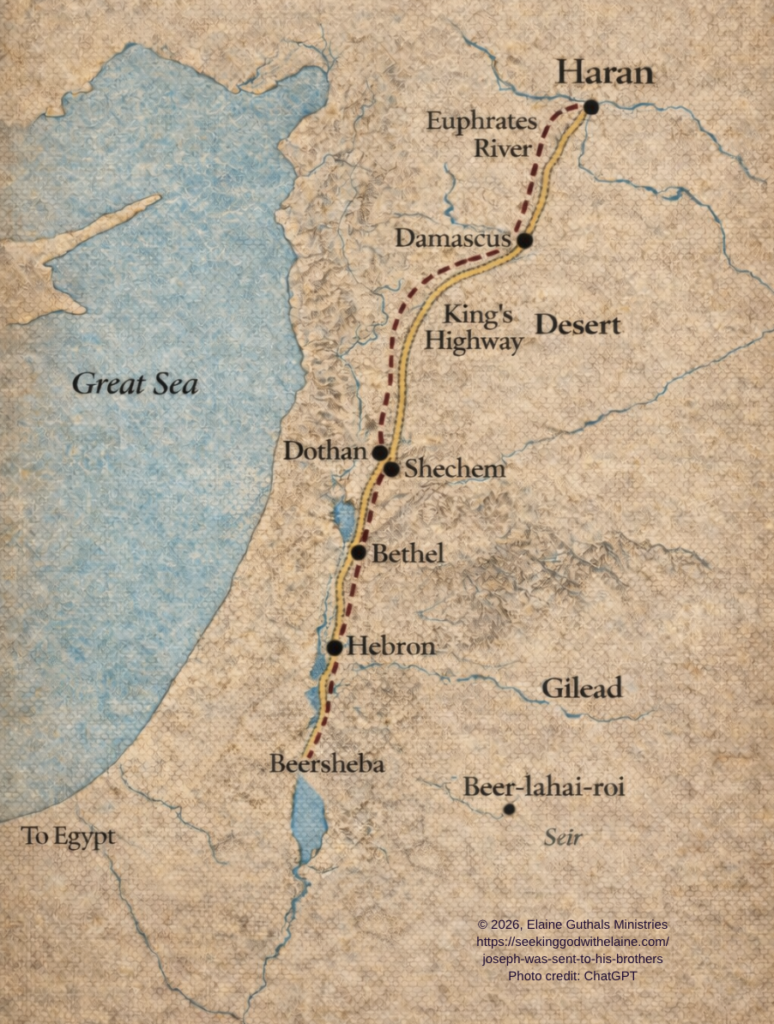
The Brothers’ Saw Joseph Coming
“When Joseph’s brothers saw him coming, they recognized him in the distance. As he approached, they made plans to kill him. ‘Here comes the dreamer!’ they said. ‘Come on, let’s kill him and throw him into one of these cisterns. We can tell our father, “A wild animal has eaten him.” Then we’ll see what becomes of his dreams!’” (Gen. 37: 18-20 NLT)
The anger that Joseph’s brothers had for him reached a boiling point – without Joseph even saying anything.
Up to this point, the brothers probably had just grumbled and done normal sibling rivalry things. If they did something worse, it didn’t make the narrative because it wasn’t important to the story.
In the last devotion, we talked about that their anger and jealousy had gone to the next level after the divine revelation of the dream. They hated Joseph even more (Gen. 37: 8).
That is why they identify Joseph as the dreamer. But that is important.
The brothers were attacking Jehovah and his revelation along with Joseph. They were saying, in essence, “We do not accept whatever form Joseph’s rule would be over us. We would rather kill him than submit to him”
Keep this in mind. Joseph hadn’t even make it to them yet. He was still off in the distance when they saw him coming (Gen. 37: 18).
Then their anger and jealousy escalated into attempted murder.
It is interesting that none of the boys were singled out by name. It doesn’t tell us if Dan got the idea first or Simon.
It says they made plans. That signifies unity.
The way it reads is there didn’t have to be any suggestion or discussion. All immediately knew what they were going to do.
One Dissenter
“But when Reuben heard of their scheme, he came to Joseph’s rescue. ‘Let’s not kill him,’ he said. ‘Why should we shed any blood? Let’s just throw him into this empty cistern here in the wilderness. Then he’ll die without our laying a hand on him.’ Reuben was secretly planning to rescue Joseph and return him to his father” (Gen. 37: 21-22 NLT)
Only one brother cautioned restraint – but not stopping the plan.
Well, maybe Reuben didn’t immediately know what to do with Joseph. Luckily, his cool head squashed the kill plan. Or did he have a cool head?
I wonder in whose dreamworld throwing Joseph into an empty pit to starve to death makes it better than killing him outright. The pit symbolized death without burial.
Yes, it says that Reuben was intending to get Joseph out of the pit. How was he going to accomplish that? The other nine brothers wouldn’t have liked it one bit and would have fought him if they found out about it. I am not sure Reuben could have taken on all of them at once.
On the other hand, alive is usually better than dead in Joseph’s way of thinking.
Let’s look for a minute at 22-year-old Reuben’s leadership success. We know that Reuben had already slept with his father’s concubine (Gen. 35: 22). His coup had failed.
Was he going to rescue Joseph and return him to Jacob to get back into Jacob’s good graces? I can see where that may have been a good plan for restoring Jacob’s faith in Reuben.
It was very risky, though. Reuben would have to keep watch over Joseph in the pit, and I’m not sure he could do that without the others finding out his scheme.
Wouldn’t it have been easier to confront the brothers with the fact that they were going to murder their brother? Reuben didn’t have that courage. Maybe he secretly wanted that outcome.
I know. It is hard to be in the minority – especially when there are so many in the majority.
It just seems to me that Reuben was out of his depth here. He was trying to stop a runaway freight train with his bare hands. His plan didn’t succeed because he wasn’t looking for what was right and true to do.
Reuben was looking at what could benefit him.
Jehovah expects us to be obedient regardless the circumstances in this world. We are to set our sights above (Col. 3: 1).
In reality, what Reuben didn’t have was the righteousness.
But it also shows why Reuben’s leadership was already fragile, making it feel uncertain or ineffective at times. He was trying to carry the responsibility of the firstborn – knowing he had fallen out of favor – in a very complicated household.
The intent switches from murder to starvation. The end would probably have been the same with different means.
Making the Connections #1
And all Joseph did was follow his father’s directions — go find your brothers and see how it is going.
Joseph went beyond what he originally thought the job to be. He thought he was just going to Shechem to talk with them. He had to go all the way to Dothan, instead.
Did Joseph dig in his heels and say he wasn’t going? No, he trotted off to Dothan.
It was well within Jacob’s rights to because he was their father. More than that, he was the owner of the sheep. Our employers have every right to expect some things from us — even if we don’t like them.
Making the Connections #2
Were Joseph’s brothers murderers or not? No, they didn’t take Joseph’s life – but they planned to do so. Doesn’t that make them murderers?
What did Yeshua say? “You have heard the commandment that says, ‘You must not commit adultery.’ But I say, anyone who even looks at a woman with lust has already committed adultery with her in his heart” (Mt. 5: 27-28 NLT).
Robertson explained why this is the case. He wrote,
“The thought is as bad as the act, because the act would be committed if it could. But if these brethren of Joseph had mourned over and repented of their sin, would we dare to say that the thought would have been as bad as the act? But we do say that the thought in this case was as bad as the act, because it was not restrained or prevented by any regret or repentant feeling; it was merely prevented by the coming in of another passion, it was the triumph of avarice over malice.”
Resource
I know. Robertson takes the scenic route in getting to his idea. What it boils down to, to me, is that we are guilty of doing the act by just thinking it – unless we repent and ask forgiveness from Jehovah.
Making the Connections #3
Lawson believed that the brothers disrespected Jehovah in their treatment of Joseph. Yes and no.
Resource
Yes, the brothers were wrong to want to kill Joseph. Yes, they were wrong to sell him into slavery.
But that is what Jehovah wanted to happen. If He could have gotten Joseph there in a smoother manner, I am sure He would have accomplished that.
How Do We Apply This?
- Expect persecution for Jehovah’s revelations from those who do not believe.
Resource
Father God. Navigating in this world is difficult. We have our own desires. Our family may have other desires for us. Help us to have Your righteousness – walking in the path You have for us Your way. Amen.
If you don’t understand something and would like further clarification, please contact me.
If you have not signed up for the email providing the link to the devotions and the newsletter, do so below.
If God has used this devotion to speak with you, consider sharing it on social media.