Even though Esau wasn’t the covenant son, he was blessed by Jehovah. This devotional reading looks at how Isaac’s blessing in Genesis 27 was fulfilled.
Nuggets
- Our allegiance to God is influenced by the company we keep, especially who we bring in as family.
- The country of Edom began as Seir.
- Esau’s genealogy list turned into a clan list.
- Moses gave us a list of people Esau displaced or assimilated into his clan.
- Just as the Israelites later did, the Edomites also wanted a king to rule them.
- Moses ended the chapter by giving a list of leaders.
We’ve read about the struggles Jacob and Esau had with each other even before they were born. We knew each were going to go on to found nations of their own.
They reconciled after Jacob came back from Paddan-aram. Both seemed ready and eager to do just that.
But did the reconciliation stick? More importantly, did their families become reconciled?
Let’s dig in.
Let's Put It into Context
To read devotions in the Creating Everything theme, click the button below.
Devotions in the Jacob the Patriarch series
Esau’s Wives and Sons
“This is the account of the descendants of Esau (also known as Edom). Esau married two young women from Canaan: Adah, the daughter of Elon the Hittite; and Oholibamah, the daughter of Anah and granddaughter of Zibeon the Hivite. He also married his cousin Basemath, who was the daughter of Ishmael and the sister of Nebaioth. Adah gave birth to a son named Eliphaz for Esau. Basemath gave birth to a son named Reuel. Oholibamah gave birth to sons named Jeush, Jalam, and Korah. All these sons were born to Esau in the land of Canaan” (Gen. 36: 1-5 NLT)
Our allegiance to God is influenced by the company we keep, especially who we bring in as family.
We have talked about Esau’s wives before.
- “At the age of forty, Esau married two Hittite wives: Judith, the daughter of Beeri, and Basemath, the daughter of Elon. But Esau’s wives made life miserable for Isaac and Rebekah” (Gen. 26: 34-35 NLT).
- “It was now very clear to Esau that his father did not like the local Canaanite women. So Esau visited his uncle Ishmael’s family and married one of Ishmael’s daughters, in addition to the wives he already had. His new wife’s name was Mahalath. She was the sister of Nebaioth and the daughter of Ishmael, Abraham’s son” (Gen. 28: 8-9 NLT).
Isaac and Rebekah alone could not dissuade Esau from marrying a Canaanite woman. Esau was without Abraham’s influence for 25 years, so he didn’t have any recent guidance from that area.
Since that had caused difficulties, Esau also married one of Uncle Ishmael’s daughters.
There is a big issue of names here. The wives’ names do not match up.
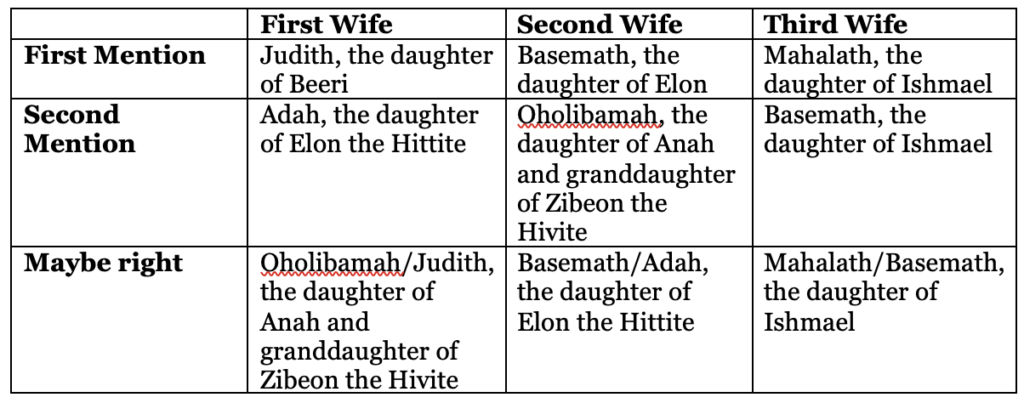
What gives? More than likely, when the women were first identified, their common name was given. Probably in Genesis 36 — being official lineage names — others are given.
Another reason for the switch is maybe the women were renamed. This would have following in line with Sairi getting renamed Sarah.
Could Esau have married within the covenant line? Well, yes. Remember, we talked about the reason why Leah’s eyes were considered weak. The midrash states that Leah was supposed to marry Esau. Upset at his violent and immoral w, we would say she cried her eyes out, making them soft.
It sounds like it was his choice not to marry the covenant cousin.
Esau had five sons of whom we know. Could there have been more sons? Couldn’t there have been some daughters? Maybe. Maybe not.
Bottom line is Esau didn’t choose wives who would bring him closer to Jehovah. In fact, they took him toward the world – even his cousin.
Living in Seir
“Esau took his wives, his children, and his entire household, along with his livestock and cattle — all the wealth he had acquired in the land of Canaan — and moved away from his brother, Jacob. There was not enough land to support them both because of all the livestock and possessions they had acquired. So Esau (also known as Edom) settled in the hill country of Seir” (Gen. 36: 6-8 NLT)
The country of Edom began as Seir.
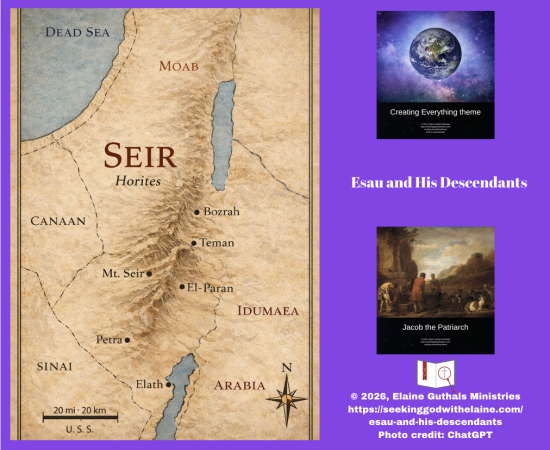
First, Sauter helped us locate the area. He wrote, “The Edomites controlled an area east of the Arabah, from the Zered to the Gulf of Aqaba. Their capital was Bozrah, which sat in the northern part of their territory.” It is located south of the Dead Sea, reaching into the Arabian Peninsula.
Resource
The region did not worship Jehovah. Their god’s name was Qaus (or Qos).
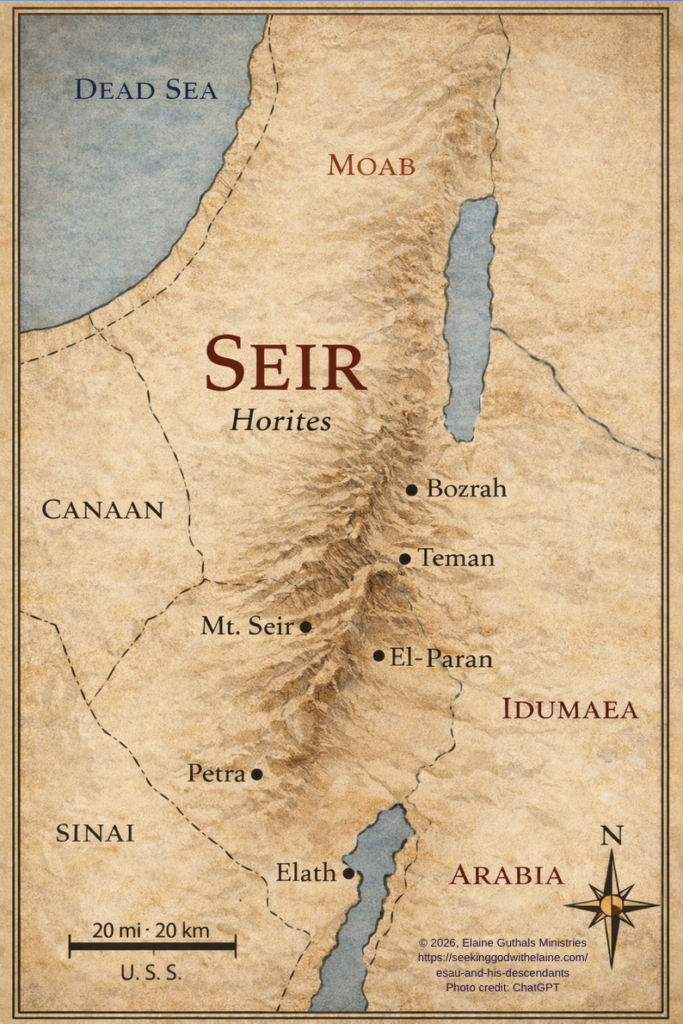
Okay. Wait a second. I’m confused.
When Jacob and Esau were breaking up their roadside reunion, Moses said that Esau was going back to Seir. “So Esau turned around and started back to Seir that same day” (Gen. 33: 16 NLT).
Plus, Esau had already married the women 37 years before Jacob left for Paddan-aram.
We have to look at this as a summary of Esau’s journey. It is explanation as to how Esau got to be where he was.
- Married two Canaanite women when he was 40 and still living with Isaac and Rebekah (Gen. 26)
- Maybe began expanding herd range
- Started living their with his wives, children, and at least 400 men
- Going back to Seir (Gen. 33)
- Fully living there (Gen. 36)
So, the move happened offstage.
When it says, “Esau took his wives, his children, and his entire household, along with his livestock and cattle — all the wealth he had acquired in the land of Canaan — and moved away from his brother, Jacob.” (Gen. 36: 6 NLT), it isn’t talking about a current event. It is explaining why the separation exists. It is more like an Abraham/Lot separation (Gen. 13). Too many flocks and herds on too little land.
Esau’s Descendants
“This is the account of Esau’s descendants, the Edomites, who lived in the hill country of Seir. These are the names of Esau’s sons: Eliphaz, the son of Esau’s wife Adah; and Reuel, the son of Esau’s wife Basemath. The descendants of Eliphaz were Teman, Omar, Zepho, Gatam, and Kenaz. Timna, the concubine of Esau’s son Eliphaz, gave birth to a son named Amalek. These are the descendants of Esau’s wife Adah. The descendants of Reuel were Nahath, Zerah, Shammah, and Mizzah. These are the descendants of Esau’s wife Basemath. Esau also had sons through Oholibamah, the daughter of Anah and granddaughter of Zibeon. Their names were Jeush, Jalam, and Korah. These are the descendants of Esau who became the leaders of various clans: The descendants of Esau’s oldest son, Eliphaz, became the leaders of the clans of Teman, Omar, Zepho, Kenaz, Korah, Gatam, and Amalek. These are the clan leaders in the land of Edom who descended from Eliphaz. All these were descendants of Esau’s wife Adah. The descendants of Esau’s son Reuel became the leaders of the clans of Nahath, Zerah, Shammah, and Mizzah. These are the clan leaders in the land of Edom who descended from Reuel. All these were descendants of Esau’s wife Basemath. The descendants of Esau and his wife Oholibamah became the leaders of the clans of Jeush, Jalam, and Korah. These are the clan leaders who descended from Esau’s wife Oholibamah, the daughter of Anah. These are the clans descended from Esau (also known as Edom), identified by their clan leaders” (Gen. 36: 9-19 NLT)
Esau’s genealogy list turned into a clan list.
I have to put this into perspective.
- Nation: Edom
- Tribe: Eliphaz
- Clan: Amalek
The clan heads, like Amalek, were semi-nomadic-tribal heads. It is good to know that because Amalek shows up again in Exodus 17 as a fierce enemy of Israel.
Amalek, Esau’s grandson, was the founder of the Amalekites. They attacked Israel when they were marching to the Promised Alan’s (Ex. 17: 8-16).
The Amalekites were raiders, not a kingdom. They operated out of the Negev and the wilderness zones.
Original Peoples of Edom
“These are the names of the tribes that descended from Seir the Horite. They lived in the land of Edom: Lotan, Shobal, Zibeon, Anah, Dishon, Ezer, and Dishan. These were the Horite clan leaders, the descendants of Seir, who lived in the land of Edom. The descendants of Lotan were Hori and Hemam. Lotan’s sister was named Timna. The descendants of Shobal were Alvan, Manahath, Ebal, Shepho, and Onam. The descendants of Zibeon were Aiah and Anah. (This is the Anah who discovered the hot springs in the wilderness while he was grazing his father’s donkeys.) The descendants of Anah were his son, Dishon, and his daughter, Oholibamah. The descendants of Dishon were Hemdan, Eshban, Ithran, and Keran. The descendants of Ezer were Bilhan, Zaavan, and Akan. The descendants of Dishan were Uz and Aran. So these were the leaders of the Horite clans: Lotan, Shobal, Zibeon, Anah, Dishon, Ezer, and Dishan. The Horite clans are named after their clan leaders, who lived in the land of Seir” (Gen. 36: 20-29 NLT).
Moses gave us a list of people Esau displaced or assimilated into his clan.
I know. We get tired of reading names of dead people.
But family relationships were very important. They wanted to show how they descended from Abraham.
More importantly, each one of us is important to God. He loves non-believers as He does believers.
Who are these people? How do they further our story?
- Before Esau came here to Seir to live, it was inhabited by an indigenous people led by named Seir, a Horite.
- They likely were cave dwellers.
- Anah had a daughter named Oholibamah, who married Esau.
So, that would mean Esau married the granddaughter.
- Nation: Seir
- Tribe: Anah
- Clan: Esau and Oholibamah – if he would have filtered in as Jacob did to Laban.
What happened later was that Esau’s descendants intermarried and absorbed the Horites. That way of integration and identity merging didn’t always have to follow conquest.
This is later confirmed. “In earlier times the Horites had lived in Seir, but they were driven out and displaced by the descendants of Esau, just as Israel drove out the people of Canaan when the Lord gave Israel their land.)” (Deut. 2: 12 NLT).
Rulers of Edom
“These are the kings who ruled in the land of Edom before any king ruled over the Israelites: Bela son of Beor, who ruled in Edom from his city of Dinhabah. When Bela died, Jobab son of Zerah from Bozrah became king in his place. When Jobab died, Husham from the land of the Temanites became king in his place. When Husham died, Hadad son of Bedad became king in his place and ruled from the city of Avith. He was the one who defeated the Midianites in the land of Moab. When Hadad died, Samlah from the city of Masrekah became king in his place. When Samlah died, Shaul from the city of Rehoboth-on-the-River became king in his place. When Shaul died, Baal-hanan son of Acbor became king in his place. When Baal-hanan son of Acbor died, Hadad became king in his place and ruled from the city of Pau. His wife was Mehetabel, the daughter of Matred and granddaughter of Me-zahab” (Gen. 36: 31-39 NLT)
Just as the Israelites later did, the Edomites also wanted a king to rule them.
It is interesting that the Edomites had kings long before Israel did.
But then it isn’t. Israel was putting their trust in God. The Edomites didn’t have that.
Leaders of Clans
“These are the names of the leaders of the clans descended from Esau, who lived in the places named for them: Timna, Alvah, Jetheth, Oholibamah, Elah, Pinon, Kenaz, Teman, Mibzar, Magdiel, and Iram. These are the leaders of the clans of Edom, listed according to their settlements in the land they occupied. They all descended from Esau, the ancestor of the Edomites” (Gen. 36: 40-43 NLT)
Moses ended the chapter by giving a list of leaders.
Okay. This is another big list. It is of the chiefs. One of them is named Oholibamah.
Wait. We’ve already been talking about someone by that name. That someone was Esau’s wife.
It probably isn’t the same person. This list is of chiefs, but it is also a list of territories or regions.
This Oholibamah would have been a tribal male.
Maybe Mrs. Esau’s wife’s descendants formed a clan, became associated with a region, and had a chief that took her name.
Remember we talked about intermarrying? Absorbing? Esau’s family wasn’t just biological. It was absorbing and organizing existing people.
So, Genesis 36: 41 is talking about a woman’s clan legacy, not the woman herself.
Making the Connections #1
“Finally, his father, Isaac, said to him [Esau], ‘You will live away from the richness of the earth, and away from the dew of the heaven above. You will live by your sword, and you will serve your brother. But when you decide to break free, you will shake his yoke from your neck’” (Gen. 27: 39-40 NLT)
Think back to Isaac’s blessing of Esau.
Yep. Edom stretched into the Arabian Peninsula. That is a scorched, unwelcoming land. Isaac nailed his blessing as prophecy.
When we read that it sounded like Esau’s descendants just kind of married into and took over the clan, we may say that his descendants didn’t have to live by the sword.
But Bradford said they did. He explained, “Esau’s descendants didn’t become shepherds……they became conquerors and bands of robbers who descended on caravans that passed through their lands. War was their way of life; war is even at the heart of what is now their religion; Islam.”
Resource
It took a while before the final blessing manifested itself. We’re going to talk about that in the next connection.
Esau did have a large family. He was able to form clans and build a nation, even establishing kings.
It is obvious to see that Jehovah kept His promise to bless Esau. Was he the covenant son? Well, no, but He had a different purpose for him. Not all blessings look like covenants.
Making the Connections #2
Fairy tale stories end with the saying, “And they lived happily ever after.” That doesn’t always happen in real life.
Esau’s Edom and Jacob’s Israel were often in conflict in future years. In fact, Jews in first-century Israel would have identified Edomites as their enemies.
That is one reason that it is very appropriate that this chapter be included. It can be used as a political map of the future.
One of Esau’s descendants was Amalek.
It is interesting (not really) that Israel is instructed not to attack Edom (Deut. 2: 4-5; 23: 7). Family means something to Jehovah – even rebellious family. He does not want us to respond in the same way to them.
Jehovah recommends restraint, not retaliation.
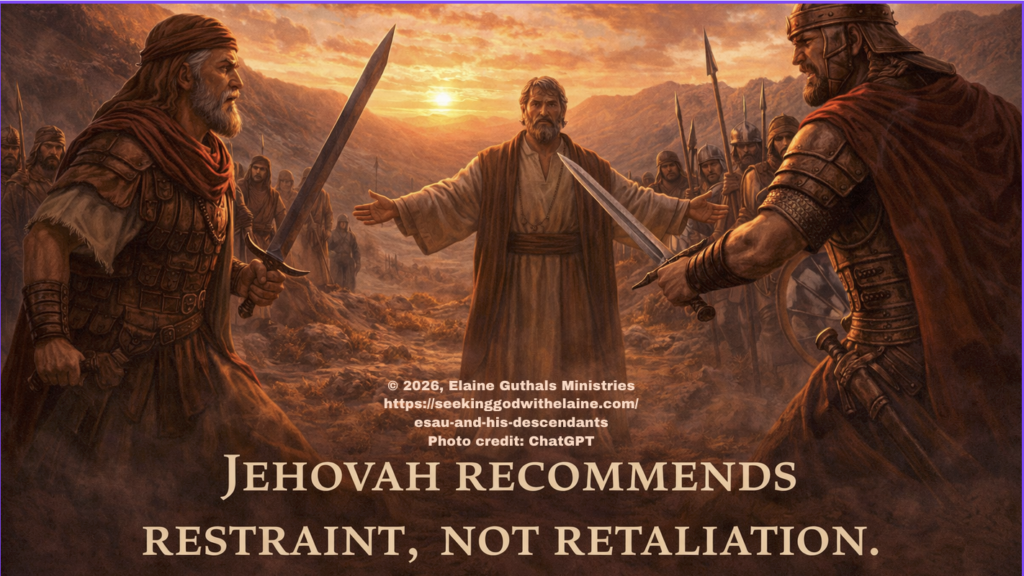
No, that didn’t last much longer than it took Israel to get a king. Saul fought the Edomites (I Sam. 14: 47). David eventually defeated them (II Sam. 8: 13-14).
Go back to Isaac’s blessing. “You will live by your sword, and you will serve your brother. But when you decide to break free, you will shake his yoke from your neck’” (Gen. 27: 39-40 NLT emphasis added).
David may have had a decisive victory, but the Edomites weren’t totally subdued. Hadad escaped to Egypt and came back to haunt Solomon.
The Edomites revolted during the reign of Jehoram of Judah. They did break off Israel’s yoke.
But of course, they couldn’t leave Israel alone. In II Chronicles 28: 17, the Edomites attached when Israel was weak. They were on hand when the Babylonians destroyed Jerusalem.
Yes, that was a brotherly betrayal. But here they were seen as cheering for their destruction (Ps. 137: 7).
Unfortunately, that isn’t the end.
- Ezekiel 25: 12-14, 35
- Amos 1: 11-12
- Isaiah 34: 63
- Jeremiah 49: 7-22
- Malachi 1: 2-4
Whatever started as a pair of twin brothers ended up with rivalry, hostility, and betrayal.
Making the Connections #3
Esau started out with the same opportunities Jacob had. Even if he was not chosen as the covenant son, he could still have been Jehovah’s son.
Having Isaac as a father and Abraham as a grandfather did not guarantee Esau anything with Jehovah. No elder can make it for us.

So, instead of one of the chosen, we see Esau in all his pride, violence, evil, and opposition.
What did it boil down to? The same test Cain had to go through – how do you treat your brother?
Making the Connections #4
Doesn’t it seem strange, though Jehovah had promised the land to Israel, that Edom was the first to obtain land? We would think it would have come about the reverse way.
The problem is we aren’t always on Jehovah’s timetable. He likes to say, “Wait.”
There are times I think that we don’t put enough honor in the covenant son. Jacob’s descendants put much stock in being Jehovah’s chosen people. Jehovah is most important.
How Do We Apply This?
- Be thankful that we are children of Jehovah.
- Repent when we do not choose Him.
Father God. You give each of us the same choice to make for ourselves: are we going to obey or disobey You? Help us to make the right decision. Forgive us when we get jealous of those we think You are using to do what we think we could. Help us to rely solely on Your Will. Amen.
If you don’t understand something and would like further clarification, please contact me.
If you have not signed up for the email providing the link to the devotions and the newsletter, do so below.
If God has used this devotion to speak with you, consider sharing it on social media.