Jacob finally made it back to Bethel. This devotional reading looks at how he worshiped Jehovah and how the covenant was reaffirmed.
Nuggets
- Jehovah will get us where He always wanted us to go.
- Where Jacob had erected a standing stone before, he now built an altar.
- God reiterated that He had changed Jacob’s name.
- We are told in the verse that El-Shaddai means God Almighty.
- The be fruitful and multiply promise occurs right after the name El -Shaddai.
- Jehovah reaffirmed the covenant promises that He had given to Abraham and Isaac.
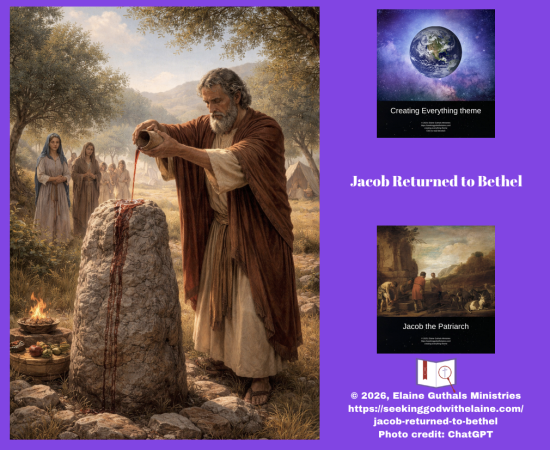
Jacob had spent 20 years in Paddan-aram working for his wives and animals. Then, he had spent 10 years wandering around Canaan.
Finally, finally, Jacob was going to fulfill his vow to return to Bethel. But he had some preparation to do first.
Now, he was ready to worship.
Let's Put It into Context
To read devotions in the Creating Everything theme, click the button below.
Devotions in the Jacob the Patriarch series
Jacob Built an Altar
“As they set out, a terror from God spread over the people in all the towns of that area, so no one attacked Jacob’s family. Eventually, Jacob and his household arrived at Luz (also called Bethel) in Canaan. Jacob built an altar there and named the place El-bethel (which means ‘God of Bethel’), because God had appeared to him there when he was fleeing from his brother, Esau’” (Gen. 35: 5-7 NLT)
They Set Out
Jehovah will get us where He always wanted us to go.
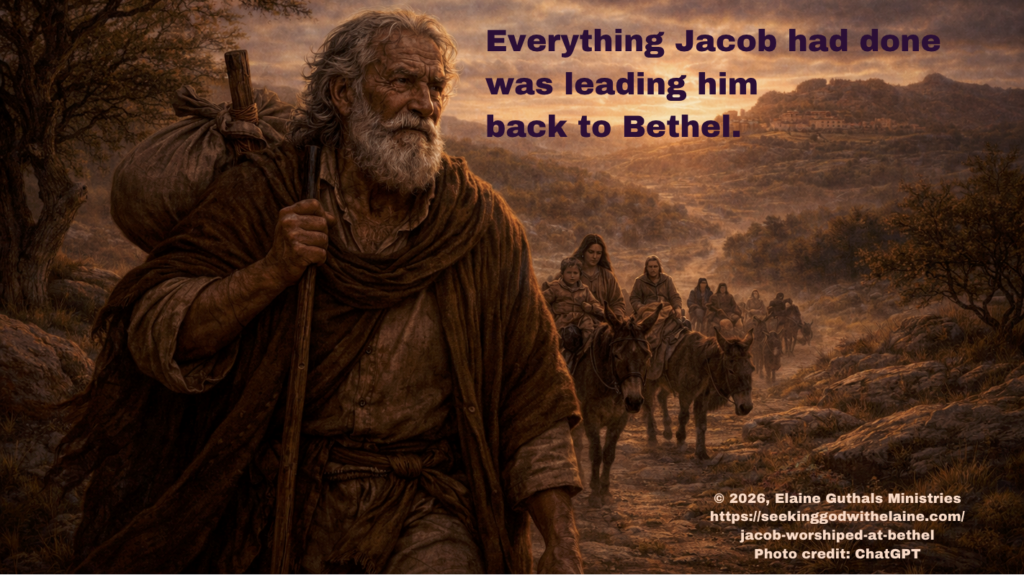
Jacob and his family set off for Bethel. I bet the people of the surrounding area did give them a wide berth. They would have heard about the massacre in the City of Shechem.
They wouldn’t have wanted to get on Jacob’s bad side.
But then one of the Proverbs has a good reminder. “When people’s lives please the Lord, even their enemies are at peace with them” (Prov. 16: 7 NLT).
As Pastor Steve says, there are blessings in the obedience.
But we can look at it another way. Jehovah goes before us and clears the path. That is a common theme throughout His Word.
- “Do not be afraid or discouraged, for the Lord will personally go ahead of you. He will be with you; he will neither fail you nor abandon you” (Deut. 31: 8 NLT).
- “You go before me and follow me. You place your hand of blessing on my head” (Ps. 139: 5 NLT).
- “The Lord replied, ‘I will personally go with you, Moses, and I will give you rest — everything will be fine for you” (Ex. 33: 14 NLT).
- “You will not leave in a hurry, running for your lives. For the Lord will go ahead of you; yes, the God of Israel will protect you from behind” (Isa. 52: 12 NLT).
Instead of allowing neighboring clans to retaliate, Jehovah kept them safe.
Why did Jehovah do that? He always wanted Jacob to come back to Bethel. He knew about Laban’s deception even before Laban knew he was going to switch the sisters as bride. He knew exactly how long Jacob was going to be gone.
Everything Jacob had done was leading him back to Bethel.
Built an Altar
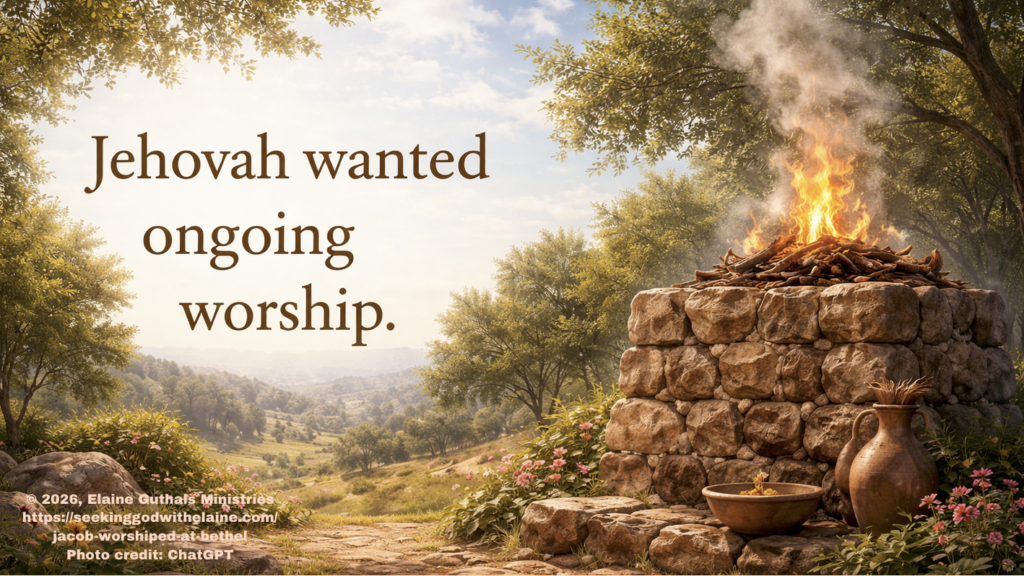
Where Jacob had erected a standing stone before, he now built an altar.
A lot had changed since Jacob had erected that standing stone when he left Canaan in 1723 BC. He had grown up a lot. More importantly, he had grown in his relationship with Jehovah.
Where he had seen the area as the house of God (Gen. 28: 19), Jacob now saw Jehovah Himself. He showed that by the name of the altar – God of Bethel.
The standing stone was a memorial to the memory of the dream. Jacob was alone and fleeing – until Jehovah appeared to him.
Now, Jacob knew this was a mizbeach – a place for sacrifice and worship. He needed to celebrate with his Creator that the promise made decades ago had come full circle.
Jacob knew what was expected of him. Jehovah wanted ongoing worship.
Jacob was no longer surprised by God. He didn’t need a conditional vow anymore.
More than that, Jacob didn’t need to just say, “God met me here.” He now chose to say, “I belong to You.”
Jacob had left as Jacob. He came back as Israel.
Covenant Reaffirmation
“Now that Jacob had returned from Paddan-aram, God appeared to him again at Bethel. God blessed him, saying, ‘Your name is Jacob, but you will not be called Jacob any longer. From now on your name will be Israel.’ So God renamed him Israel. Then God said, ‘I am El-Shaddai — ‘God Almighty.’ Be fruitful and multiply. You will become a great nation, even many nations. Kings will be among your descendants! And I will give you the land I once gave to Abraham and Isaac. Yes, I will give it to you and your descendants after you.’ Then God went up from the place where he had spoken to Jacob. Jacob set up a stone pillar to mark the place where God had spoken to him. Then he poured wine over it as an offering to God and anointed the pillar with olive oil. And Jacob named the place Bethel (which means ‘house of God’), because God had spoken to him there” (Gen. 35: 9-15 NLT)
Jehovah reaffirmed the promises to Jacob that He made to Abraham.
Nothing interrupts the covenant promise — even deaths of key players. Not even waiting ten years to make it to Bethel.
This is the only time where Jacob hears the complete covenant promises directly from Jehovah. He heard some in the blessing from Isaac – but that was Isaac, not Jehovah, and not all.
Jacob heard some from Jehovah the last time he stopped at Bethel. But he was running and not in a good place spiritually.
This affirmation is also important because it is the final time that the covenant will be confirmed to the patriarch himself. After this point, covenant responsibilities fall to Jacob’s descendants.
Your Name Will be Israel
God reiterated that He had changed Jacob’s name.
When Jacob was wrestling with the man the night before he was to encountered Esau, the man changed his name to Israel.
You know, I don’t remember Moses calling him Israel after that. I remember him still being called Jacob.
Maybe that is the reason God felt like He had to reiterate it here.
- You are Israel.
- You are going to be the nation of Israel.
- In fact, you are going to be a couple of nations.
- You great …. grandsons will be kings.
- I am going to give this land to your descendants.
What is mildly mind boggling is that, when Jehovah changed Abram’s name to Abraham, he forever thereafter went by the name Abraham. Not so with Jacob. He usually was called Jacob, not Israel.
Jewish tradition has some ideas about that. The names have two different meanings. Jacob means heel-grabber. Israel, on the other hand, means he struggled and prevailed.
Like we said, Jacob isn’t the same person that he was when he left. He is ready to walk into the role as patriarch.
I think it is a little more than that. It seems like Jacob is called that when it refers to his personal life. When talking about his spiritual or national role, he is called Israel.
Yeah, Jacob may now be the father of the covenant people, but he is still a fallible man. He continued to struggle and grow his faith.
Still, Jehovah acknowledged his transformation. He also acknowledged that this is the beginning of the family line.
If we look, though, we will the nation referred to as both Jacob’s names. The nation is Israel, but it is also the House of Jacob.
But here, at this altar in this moment, Rachel is probably pregnant with Benjamin. Everything is almost in place.
Jehovah confirmed that Jacob was a patriarch of the covenant people.
El-Shaddai
We are told in the verse that El-Shaddai means God Almighty.
This isn’t the first time that this name of Jehovah was used.
- “When Abram was ninety-nine years old, the Lord appeared to him and said, ‘I am El-Shaddai — “God Almighty.” Serve me faithfully and live a blameless life” (Gen. 17: 1 NLT).
- “May God Almighty bless you and give you many children. And may your descendants multiply and become many nations!” (Gen. 28: 3 NLT).
Think about it. The verse in Genesis 17 was the last recorded time that Jehovah and Abraham talked about the covenant. It was when he instituted circumcision.
The verse in Genesis 28 was the blessing Isaac gave Jacob knowing it was Jacob, knowing he was giving the covenant son the blessing.
This name was used during covenant discussions. Why is this name so important to the covenant?
Well, El means God. It emphasizes power, might, and authority.
Shaddai takes a little more explanation. That is because there are a couple of interpretations.
The traditional translation of Shaddai is Almighty. It speaks to overwhelming power. We would see this as Jehovah being all-sufficient – that He can keep His promises.
What are Jehovah’s promises? The wording says be fruitful and multiply, but that can only happen when He wills it to happen. And several times when He wills that to happen, the result will be the descendants will serve as King of Israel.
A second translation of Shaddai is that Jehovah is God of the Mountain. In other words, He is God of the high place.
Well, Jehovah is God in Heaven, the highest place there is. As Creator, He is sovereign over creation.
But that kind of smacks of Ancient Near East pagan culture.
The third and final translation is that Shaddai means God Who Nourishes or Sustains. It connects to the Hebrew word shad or breast.
This translation focuses on the provision, nourishment, and life-giving power.. It would follow the Ancient Near East’s fertility ideas. It, too, goes along with be fruitful and multiply.
Be Fruitful and Multiply
The be fruitful and multiply promise occurs right after the name El-Shaddai.
This is a restatement of past promises.
- “Then God blessed them and said, ‘Be fruitful and multiply. Fill the earth and govern it …’” (Gen. 1: 28 NLT).
- “Then God blessed Noah and his sons and told them, ‘Be fruitful and multiply. Fill the earth’” (Gen. 9: 1 NLT).
It is like Jehovah was saying, “I am the God who has the power to bring life and sufficient enough to accomplish promises.”
Wouldn’t that have been so comforting to Jacob at that time? Here he was struggling to deal with the chaos of Shechem. He went through the purification process and buried the idols (and maybe found out Rachel had Laban’s household gods all along). Now, he is reestablishing covenant identity.
And here Jehovah is saying, “Remember all those promises I gave Abraham? I am giving them to you. I have the power to pass them on to you, and nothing you will do is going to derail these promises. I have called you.”
The original human blessing (Gen. 1) is now flowing through the covenant family (Gen 12, 35). Creation’s purpose is coming through Abraham’s line.
A Great Nation, Kings among Descendants, and Give You the Land
Jehovah reaffirmed the covenant promises that He had given to Abraham and Isaac.
The best way to look at this is to dig out the chart again and update it.
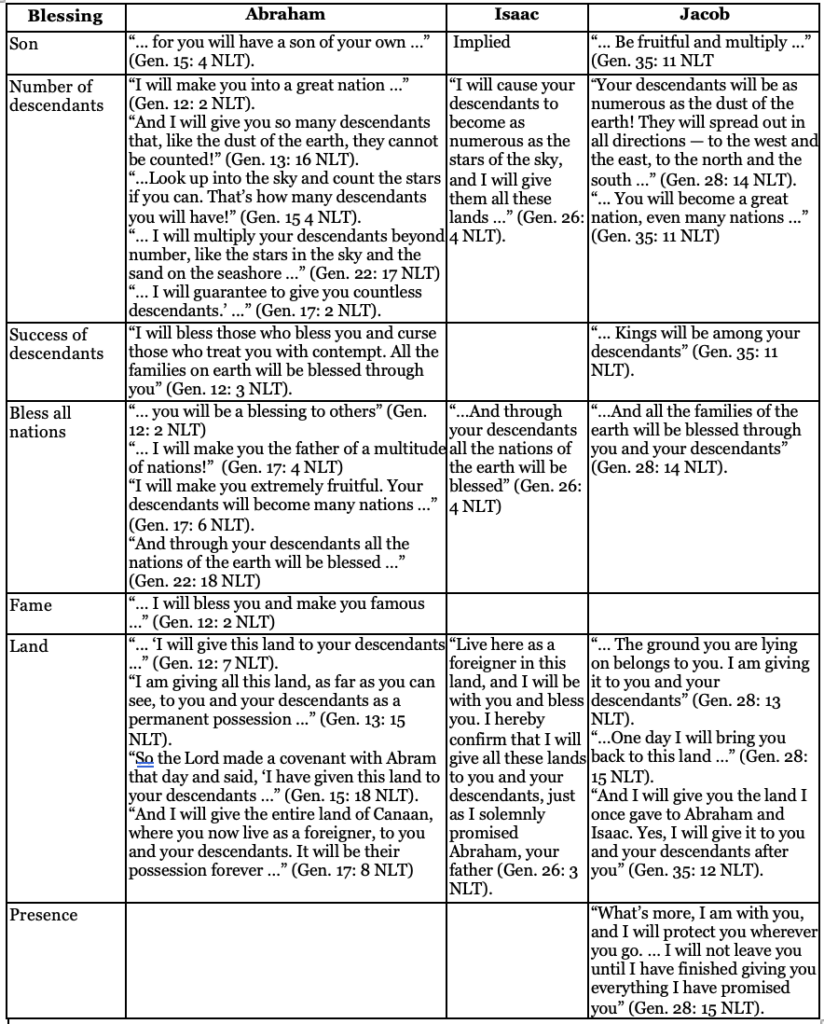
We can’t forget that the patriarchal covenant began near Bethel in Genesis 12. Jacob did experience exile, but Jehovah brought him back to Bethel.
A Stone Pillar
Jacob used the standing stone in worship to Jehovah.
We are told that Jacob offered a drink offering (nesek) and poured out oil. There is no mention of a burnt offering here where an animal was offered. That would have happened at the altar Jacob built if it did.
A drink offering in Moses’ time (and we have no difficulty in believing this is what happened in Jacob’s time) consisted of pouring our wine before Jehovah. This symbolized complete surrender.
It was notable that the drink offering occurred on the standing stone rather than the altar. It was all about honor because it was poured on the standing stone marking God’s presence.
Jacob also poured oil on the standing stone. In other words, he was consecrating it by setting it apart as holy.
True, Jacob already did this to the first standing stone he erected in Genesis 28. Now, he understands more. It means more because his relationship with Jehovah is more.
We could look at this as a vow offering. Jacob was fulfilling his vow made in Genesis 28. It could have been a peace offering that celebrated restored relationships.
Making the Connections #1
Did you catch this? Jacob erected a standing stone in Genesis 28: 18. Thirty years later, he built an altar in Genesis 35: 7 and a standing stone in Genesis 35: 14.
If Jacob used these as memorials, why did Jehovah outlaw them?
Standing stones were a part of the Ancient Near East culture. They were religious and boundary markers as well as covenant witnesses. Sometimes, they were even symbols of deities.
In other words, Jacob was using a cultural norm to commemorate when God revealed Himself to him.
Jacob used them to correctly here and when it was used as a boundary between him and Laban. He didn’t set up idols, just memorial markers.
But later, standing stones became more strongly associated with Canaanite idol worship. They were placed next to fertility shrines and Asherah poles and on Baal worship sites.
The stones themselves didn’t change. What changed was their use in the culture. What the standing stones represented had changed.
They had become a central feature of pagan worship. The law was made so that Israel did not compromise with the Canaanite pagan worship.
That is a good reminder to us. What may start out as something innocuous can change into something sinful if used to represent evil or used in an evil way.
But then, Jehovah allowed a standing stone memorial when the Israelites crossed the Jordan River into the Promised Land. The memorial was used in the correct way – as a memorial, not as a god.
Making the Connections #2
Robinson made a great observation. Jacob had changed – Jehovah hadn’t.
Robinson said Jehovah still hasn’t changed. He wrote, “The same Divine Being, with all attributes and characteristics unchanged, rules to-day as then.”
Resource
Have you ever thought about how Jehovah makes our relationship with Him work? I mean, think about it. We are independent, free-willed creatures.
And yes, that is we plural. He has billions of us to deal with daily.
But Jehovah chooses us. He chose Jacob over Esau. He chose Isaac over Ishmael. He chose the ones He knew would choose Him and would endure to the end (Mt. 24: 13).
What we can stand up and shout hallelujah at is that Jehovah is preparing us for the long haul. He is there to help us endure to the end.
Making the Connections #3
This gives us a good snapshot of early worship. It was simple, symbolic, and personal. It may not have been systematized, but it was already theologically rich and meaningful.
We get more about how Jacob worshiped than we were told with Abraham. But isn’t that to be expected? It shows growth over generations.
Jehovah remembered His vow, and now Jacob was living like he remembered his.
How Do We Apply This?
- Endure to the end.
- Recognize that even when obedient, we may still suffer losses.
- Learn more of Him while we learn more of ourselves.
- Recognize that Jehovah is sufficient to fulfill the promises that He has given us.
Resource
Father God. You patiently wait for us to come back to You. Yes, You expect us to come after we have repented and been purified. But You love us so much, You wait for us. Thank You. Amen
If you don’t understand something and would like further clarification, please contact me.
If you have not signed up for the email providing the link to the devotions and the newsletter, do so below.
If God has used this devotion to speak with you, consider sharing it on social media.