A great dishonor had been done to Jacob’s only daughter. This devotional reading looks at what Jacob’s sons did to get vengeance on the men of Shechem.
Nuggets
- Dinah’s brothers were not negotiating – they were planning revenge.
- It wasn’t unheard of having men from other countries completed the circumcision ceremony and became Israelites.
- Hamor and Shechem convinced the men of the city to agree to the alliance.
- The circumcision procedure left the men physically weakened, allowing Simon and Levi opportunity to commit an unjust and cruel sin.
- Jacob finally broke his silence after his sons carried out their vengeance.

When we ended the last devotion, we were learning that Jacob and his sons were in negotiations between and Hamor and Shechem, the man who had defiled Dinah. Shechem said, “No matter what dowry or gift you demand, I will gladly pay it — just give me the girl as my wife” (Gen. 34: 12 NLT).
Shechem wanted to marry the girl. What would her brothers say and do?
Let's Put It into Context
To read devotions in the Creating Everything theme, click the button below.
Devotions in the Jacob the Patriarch series
Jacob’s Sons Respond
“But since Shechem had defiled their sister, Dinah, Jacob’s sons responded deceitfully to Shechem and his father, Hamor. They said to them, ‘We couldn’t possibly allow this, because you’re not circumcised. It would be a disgrace for our sister to marry a man like you! But here is a solution. If every man among you will be circumcised like we are, then we will give you our daughters, and we’ll take your daughters for ourselves. We will live among you and become one people. But if you don’t agree to be circumcised, we will take her and be on our way’” (Gen. 34: 13-17 NLT)
Jacob’s Sons Responded Deceitfully
Dinah’s brothers were not negotiating – they were planning revenge.
Well, deceit travels from generation to generation. Abraham lied about Sarah. Isaac lied about Rebekah. Jacob lied about so many things.
Think about the times we’ve talked about deceit and manipulation already.
- Deceiving Isaac (Gen. 27: 35)
- Deceived by Laban (Gen. 29)
- Deceiving Esau (Gen. 33: 14)
- Used strategic manipulation in Genesis 30 against Laban
We shouldn’t be surprised the cycle hadn’t been broken.
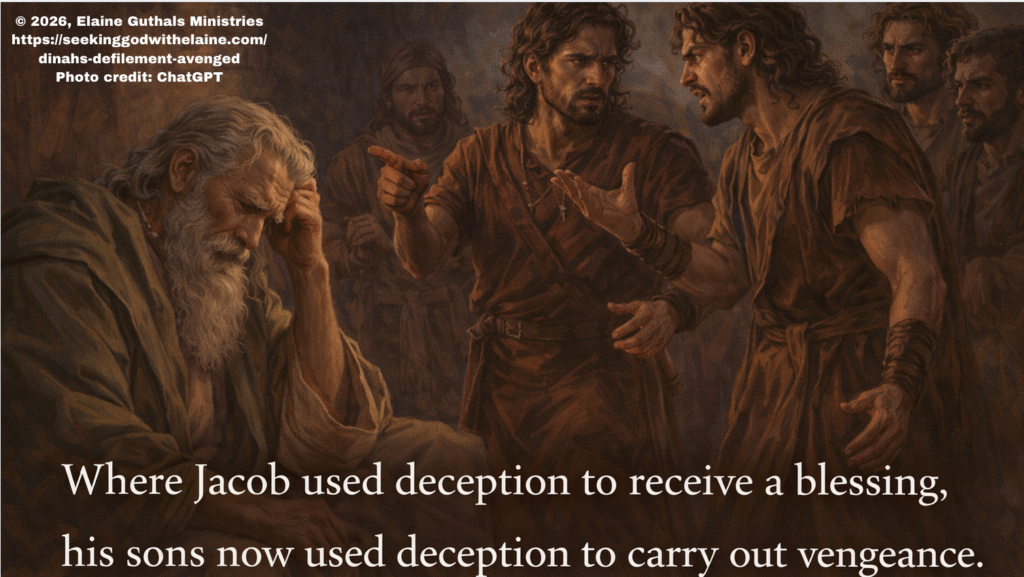
No, the sin grew. Where Jacob used deception to receive a blessing, his sons now used deception to carry out vengeance.
Let’s just stop a second because we really need to make sure we don’t miss this. This is the turning point in the chapter.
Before this verse, the emphasis was on diplomacy and negotiation. Afterwards, the emphasis is on deception and violence.
Moses didn’t distinguish between the brothers here. He does name names later, but here it looks like a united front. It is written like all brothers were in on the deception — even Joseph.
We think our sin is hidden. The problem is sin grows.
Not only that, but sin also travels. Our response to someone else’s sin can mushroom.
You’re not Circumcised
It wasn’t unheard of having men from other countries completed the circumcision ceremony and became Israelites.
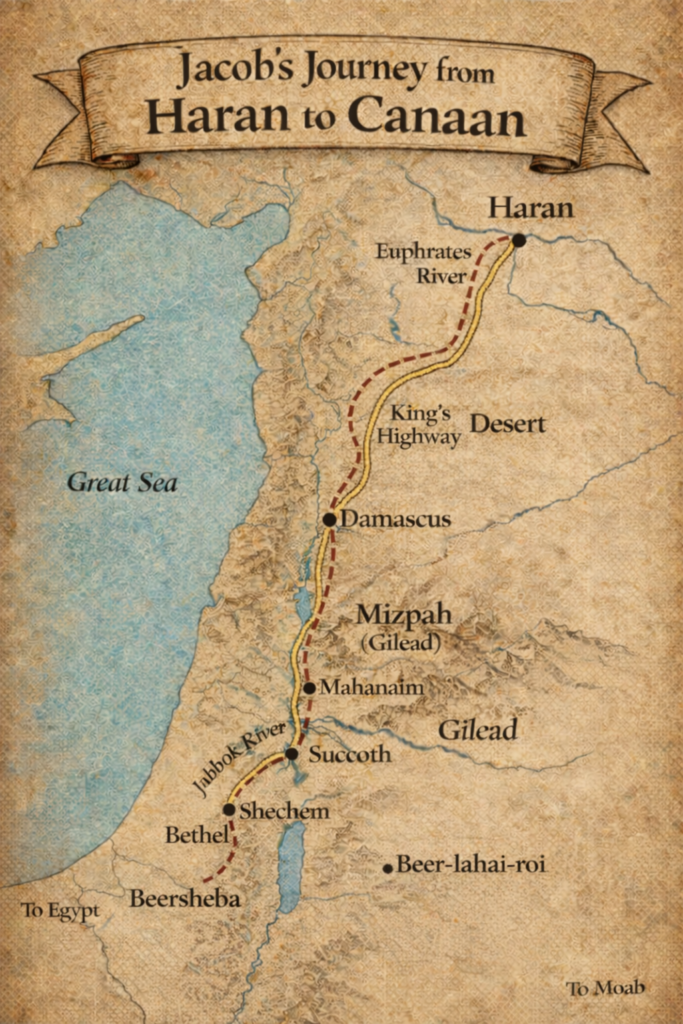
Sit back a second, and let’s take a look at ancient Shechem. It was a fortified settlement. Archaeological evidence shows that it had massive defensive walls with gates and towers.
Along with the 1,000 to 5,000 residents and surrounding farmland and villages, it functioned as a regional administrative center. It was on a major north-south trade route, the King’s Highway.
This would have been a big deal.
Well, they carried out their revenge by using a big deal. They used a covenant deal – circumcision.
Yes, Gentiles could become Jewish by being circumcised. But here it became a religious boundary marker. “You’ll only be accepted if you do this.”
Where was Jacob at in all of this? Was he even at the table? If he was, he gave the boys free reign and stayed silent.
We don’t know if Jacob approved or disapproved of his sons’ plan. All we know is that he didn’t stop it.
Convincing the Townsmen
“Hamor and his son Shechem agreed to their proposal. Shechem wasted no time in acting on this request, for he wanted Jacob’s daughter desperately. Shechem was a highly respected member of his family, and he went with his father, Hamor, to present this proposal to the leaders at the town gate. ‘These men are our friends,’ they said. ‘Let’s invite them to live here among us and trade freely. Look, the land is large enough to hold them. We can take their daughters as wives and let them marry ours. But they will consider staying here and becoming one people with us only if all of our men are circumcised, just as they are. But if we do this, all their livestock and possessions will eventually be ours. Come, let’s agree to their terms and let them settle here among us.’ So all the men in the town council agreed with Hamor and Shechem, and every male in the town was circumcised” (Gen. 34: 18-24 NLT)
Hamor and Shechem convinced the men of the city to agree to the alliance.
Hamor and Shechem fell for it. That was because they had dollar signs in their eyes. They thought they were going to steal Jacob’s wealth.
In that time period, court was held at the town gate. But what we see here is the extent of Hamor’s political authority.
Hamor and Shechem convinced the townsmen that Jacob and his sons were friends. Would they have let their daughter and sister’s attacker get off scott free? I don’t think so. They would have been gathering their clansmen and riding off to Jacob’s shelters.
The men of Shechem agreed to the plan because they, too, had dollar signs in their eyes. Not just a little, but “But if we do this, all their livestock and possessions will eventually be ours …” (Gen. 34: 23 NLT emphasis added).
Hamor and Shechem saw Jacob and his sons as easy marks. Remember how large we said Jacob’s possessions and livestock had to be to be able to split into two camps and still make it look like one camp was all of his wealth?
Wrong, but I wish the boys would have found another way to avenge Dinah.
The Deceit Revealed
“But three days later, when their wounds were still sore, two of Jacob’s sons, Simeon and Levi, who were Dinah’s full brothers, took their swords and entered the town without opposition. Then they slaughtered every male there, including Hamor and his son Shechem. They killed them with their swords, then took Dinah from Shechem’s house and returned to their camp. Meanwhile, the rest of Jacob’s sons arrived. Finding the men slaughtered, they plundered the town because their sister had been defiled there. They seized all the flocks and herds and donkeys—everything they could lay their hands on, both inside the town and outside in the fields. They looted all their wealth and plundered their houses. They also took all their little children and wives and led them away as captives” (Gen. 34: 25-29 NLT)
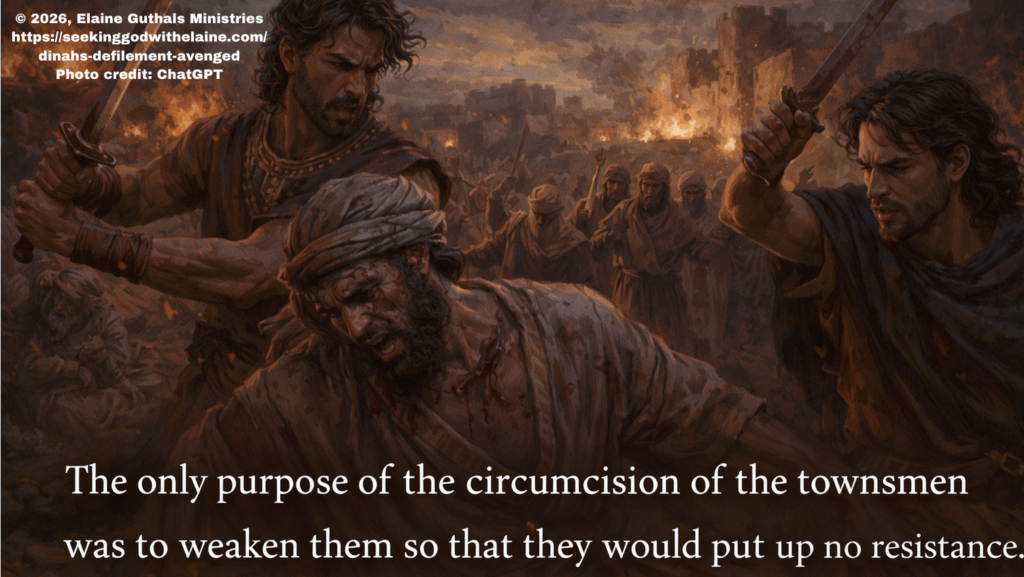
The circumcision procedure left the men physically weakened, allowing Simon and Levi opportunity to commit an unjust and cruel sin.
One man had committed a sin against Dinah. Jacob’s sons were going to take it out on the city – really, the city-state of Shechem.
Simon and Levi didn’t have to worry about the fortified gate. They didn’t need to be concerned about being outnumbered.
They got to focus on the killing.
Only two of Jacob’s sons did the actual killing. All, however, took part in plundering the city, taking livestock, rounding up women and children. Again, Joseph was included in the group.
Why just the two? One reason is the three of them were offspring of Leah. They were full brothers and sisters.
What about Reuben, Judah, Issachar, and Zebulun? If Dinah was 15, they would have been 21, 18, 16, and 15. (Simon would have been 20, and Levi would have been 19.) They were also children of Leah?
You know, reading this again, it doesn’t look like any but Simon and Levi knew that was what they were going to do. “Meanwhile, the rest of Jacob’s sons arrived. Finding the men slaughtered …” (Gen. 34: 27 NLT).
It seems a little strange that Dinah was at Shechem’s house. The marriage hadn’t taken place. Still, she was kept in Shechem’s household after the assault.
Was Dinah glad to be going home? Did they have to drag her kicking and screaming out of Shechem’s house? Was she appalled at the bloodshed?
Regardless of the rescue of Dinah, the way they wreaked their vengeance was a sin. Yes, rape is horrible, but killing the entire male population of the town for the actions of one man is way over the top. All but Shechem were innocent of the crime for which they were punished.
Don’t even think for one minute that they did it because of their religion. Leale called it a hypocritical pretense of religion. Bush addressed this, too. He wrote, “They knew that if the Shechemites were persuaded to submit to circumcision it would be a mere form, leaving them as to their relation to God just where they were before.”
Resources
Jacob’s sons may not have known the plan to steal all of Jacob’s wealth. They did know the men of Shechem weren’t going to be converts to Judaism.
The only purpose of the circumcision of the townsmen was to weaken them so that they would put up no resistance.
No, the eye-for-an-eye verse does not justify this (Ex. 21: 24, Lev. 24: 20, and Deut. 19:21). Eye-for-an-eye justice wasn’t about personal vengeance. It was actually a legal principle used by judges to regulate justice and limit retaliation.
Remember the culture of the day. Clans were very quick to defend their honor with out-of-control retaliation. They wanted to make sure the punishment must not exceed the offense.
Yep, it sure did in this instance.
Jacob Finally Weighs In
“Afterward Jacob said to Simeon and Levi, ‘You have ruined me! You’ve made me stink among all the people of this land — among all the Canaanites and Perizzites. We are so few that they will join forces and crush us. I will be ruined, and my entire household will be wiped out!’ ‘But why should we let him treat our sister like a prostitute?’ they retorted angrily” (Gen. 34: 30-31 NLT)
Jacob finally broke his silence after his sons carried out their vengeance.
I can get Jacob’s concerns, and I can get the boys’ anger. Both were right.
Jacob saw it as life is full of one thing after another. Jesus said that was the way it was going to be. “I have told you all this so that you may have peace in me. Here on earth you will have many trials and sorrows. But take heart, because I have overcome the world” (Jn. 16: 33 ESV).
We sometimes feel that we have to take everything into our own hands. We don’t wait and let God take care of it.
But this was bloodshed. This wasn’t self-defense. It was flat out murder.
And all Jacob was interested in was political retaliation. Now, Jacob would have to live in fear of of that threat.
Jacob was putting down roots in Shechem. He bought land. Yeah, what shepherd does that?
But since Jacob didn’t’ step up and say, “Boys, this plan of yours is wrong. It is murder!”, he had to move on.
Making the Connections #1
We see the focus on the family honor – which is good to have. But where were the boys’ individual morality? Even Joseph pitched in to ransack the city.
Were they so blinded by their anger at the dishonor done to Dinah that they lost their honor? Or was this an indication of the condition of their hearts?
We should never say, “Oh, this was Jacob and his family. Nothing bad like this should ever have happened to him.”
Remember, it is during experiences like this this that new bricks are laid on our Sanctification Road. Even Jacob – even Reuben – even Joseph – has their own Sanctification Road. It is how we grow closer to Jehovah.
Making the Connections #2
This story of violence and dishonor is sandwiched between Bethel stories.
Jacob and his family had just arrived at the end of Gensis 33. There was just one problem.
Jacob went to Shechem, not Bethel. Yes, Shechem was the location of Abraham’s first altar. It is where he landed upon reaching the Promised Land.
But that wasn’t where Jacob was commanded to go. He was supposed to go to Bethel. If we look at our timeline (which we’ll discuss more fully in the next devotion), it looks like Jacob could have stayed in Shechem for over 10 years.
That isn’t following Jehovah back to Bethel. “And this memorial pillar I have set up will become a place for worshiping God, and I will present to God a tenth of everything he gives me” (Gen. 28: 22 NLT).
We’ll find out in Genesis 35 that Jehovah clearly commands Jacob to go to Bethel. Good things happen, which we will get into next.
The takeaway here is that Sovereign God will pull us back when we sin.
Making the Connections #3
Let’s look at the escalation of sin.
- Dinah left the covenant compound.
- She was met with sexual violence.
- A political compromise was offered to lull believers into assimilation with non-believers.
- Jacob’s sons as well as Hamor and Shechem were deceitful.
- The boys used something sacred as a weapon of violence.
- Revenge became mass murder.
- Plundering and enslavement topped whole sad affair.
So, it started out with the sin of one man. It escalated to a family’s response. A whole town was destroyed.
How Do We Apply This?
- Understand no one is above God’s Laws.
- Don’t allow our grief or anger lead us into sin.
Resource
Father God. We say two wrongs don’t make a right. That was especially true in this case — and a whole town suffered because humans think it does. Forgive us when we struck back after suffering a devastating experience. Amen.
If you don’t understand something and would like further clarification, please contact me.
If you have not signed up for the email providing the link to the devotions and the newsletter, do so below.
If God has used this devotion to speak with you, consider sharing it on social media.