After Jacob and Esau’s emotional reunion, it was time to move on. This devotional reading will look at whether they stayed together or separated.
Nuggets
- The time had come for Jacob and Esau to leave where they were.
- Jacob refused Esau’s offer to send some of his men with Jacob as protection.
- Instead of going to Seir, Jacob ended up in Shechem.

The meeting with Esau turned out much better than Jacob had hoped or dream. They were reconciled.
But how was their parting? Did they stay together or part on bad terms again?
Let's Put It into Context
To read devotions in the Creating Everything theme, click the button below.
Devotions in the Jacob the Patriarch series
Moving On
“‘Well,’ Esau said, ‘let’s be going. I will lead the way.’ But Jacob replied, ‘You can see, my lord, that some of the children are very young, and the flocks and herds have their young, too. If they are driven too hard, even for one day, all the animals could die. Please, my lord, go ahead of your servant. We will follow slowly, at a pace that is comfortable for the livestock and the children. I will meet you at Seir’” (Gen. 33: 12-14 NLT)
Time had come for Jacob and Esau to leave where they were.
We may think it was nice that Esau had reconciled enough to offer to travel ahead of Jacob to offer mutual protection. What we may or may not know is that was probably Esau’s attempt attempt to form an alliance. Another reason may have been that Esau saw it as shared leadership.
What the Hebrew really said, though, was proceed at your pace. Going alongside of you is a whole lot different than blazing the trail, which is what the New Living Translation implies.
Smith suggested that Jacob was still a little afraid of Esau. We don’t know how long their hugging/weeping/kissing/catching up session lasted. Was it a couple of hours or a couple of days!
Resource
Maybe. But maybe Jehovah told Jacob that, deep down, Esau still was not following Him. He probably didn’t want an alliance between the twins.
Smith pointed out that Jacob would need to raise his sons to understand and follow the Abraham’s covenant. It wasn’t just the firstborn who would be the covenant son.
Jacob declined the offer politely. He noted they would have to move slower. That was true.
The reason Jacob gave first was probably correct. He would only be able to drive the herds and flocks only so quickly.
We estimated the age of the kids.
1716 BC – Jacob, 84, was tricked into marrying Leah. He agreed to work seven more years for Rachel
~1715 BC — Reuben born (Leah)
~1714 BC — Simeon born (Leah)
~1713 BC — Levi born (Leah)
~1712 BC — Judah born (Leah)
~1712 BC — Dan born (Bilhah)
~1711 BC — Naphtali born (Bilhah)
~1711 BC — Gad born (Zilpah)
~1710 BC — Asher born (Zilpah)
~1710 BC — Issachar born (Leah)
~1709 BC — Zebulun born (Leah)
1709 BC – Joseph was born (Rachel)
1703 BC – Jacob, 97, and his family left to return to Canaan (Gen. 31: 3)
1680 BC – Isaac died at the age of 180 (Gen. 35: 28-29)
Based on Timeline from
Joseph and Zebulun may have been 6. Issachar and Asher may have been 7. Gad and Naphtali may have been 8. Dan and Judah may have been 9. Levi, Simeon, and Reuben may have been 10, 11, and 12 respectively.
Kalisch thought Jacob’s fear of Jacob was exaggerated but warranted. He knew Esau’s character. If it had changed, it might revert at any time.
Resource
Jacob agreed to meet Esau in Seir. That may seem strange — especially since he didn’t go — but hospitality etiquette would have ensured that Esau would keep Jacob safe.
Moving Apart
“‘All right,’ Esau said, ‘but at least let me assign some of my men to guide and protect you.’ Jacob responded, ‘That’s not necessary. It’s enough that you’ve received me warmly, my lord!’ So Esau turned around and started back to Seir that same day. Jacob, on the other hand, traveled on to Succoth. There he built himself a house and made shelters for his livestock. That is why the place was named Succoth (which means ‘shelters’)” (Gen. 33: 15-17 NLT)
Jacob refused Esau’s offer to send some of his men with Jacob as protection.
Is it strange that Jacob didn’t want to travel with Esau or any of his men? Well, he had been on his own for 20 years. I bet that would have been an independent person.
But if Esau was going for a political alliance, Jacob didn’t seem like he wanted anything to do with that.
But where was Jacob heading to in the first place? Was he going to Esau or Isaac? If he was going to Isaac, that would have been through Sukkot and Shechem — the way he ended up going.
So, did Jacob lie?
HaCohen gave one explanation. What if Jacob previously lived in Seir? Look what HaCohen wrote.
“As I argued in my “Locating Beer-lahai-roi” (TheTorah 2014), the story of Jacob stealing his brother’s blessing (Genesis 27) is set in the area of Ein el-Chai, biblical Beer-lahai-roi, a site midway between Siq el-Bared (biblical Bered) and Ein el-Musa (biblical Kadesh), on the outskirts of Petra (Gen 16:14). In fact, the Torah is explicit elsewhere that this is where Isaac lived …”
Resource
Maybe Jacob was going to both Esau and Isaac. I do not believe — and God’s Word never tells us — that Jacob ever lived in Seir.
I have to process this. We know Isaac lived at Beer-lahai-roi before he and Rebekah were married (Gen. 24: 62). He was still there when Abraham died (Gen. 25: 11).
Genesis 26 talked about Isaac and Rebekah moving to Gerar. I am of the opinion that happened before the twins were born. Even if it happened after the boys were 15, it would be obvious that Rebekah was a mother. The whole Abimelech episode wouldn’t have happened if he would have known that.
Isaac moved to Beersheba in Genesis 26: 23. We know they are still there when Jacob leaves for Paddan-aram because that is from where he left (Gen. 27: 10).
Maybe Isaac had moved back to Beer-lahai-roi sometime in the 20 years. We do know, though, that when he died 23 years later, he lived in Mamre — renamed Hebron (Gen. 35: 27-29).
But the problem is that most think Beer-lahai-roi was not in Seir, as HaCohen had it.
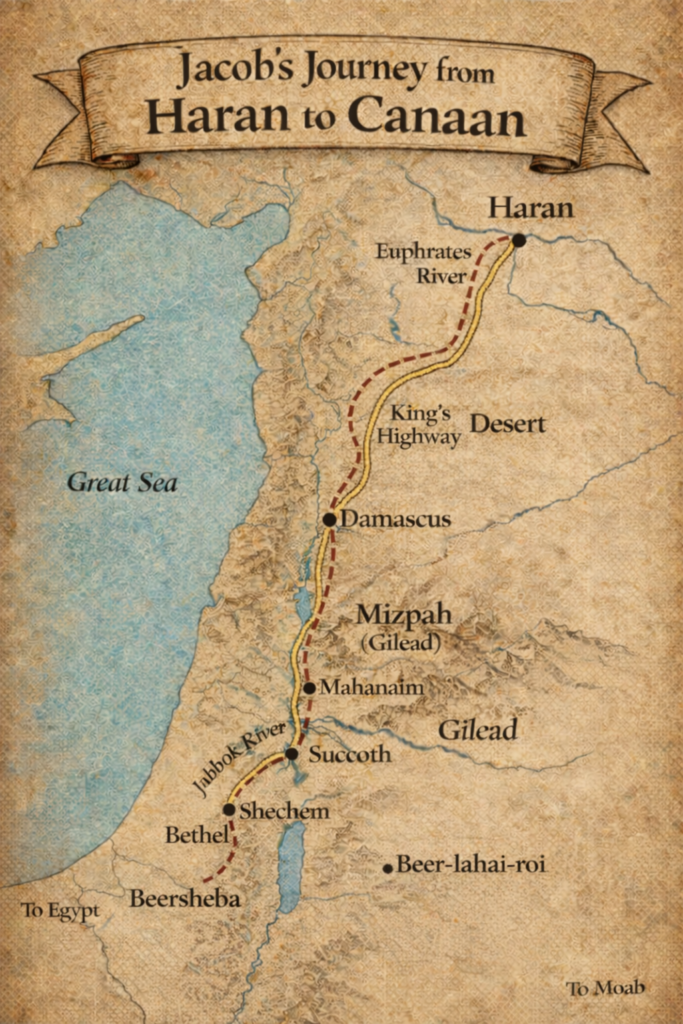
There may have been a deeper reason Jacob didn’t go with Esau to Seir. “And the Lord told her, ‘The sons in your womb will become two nations. From the very beginning, the two nations will be rivals. One nation will be stronger than the other; and your older son will serve your younger son’” (Gen. 25: 23 NLT).
They were to become separate nations. Jacob’s future had long been known to be Canaan. Esau’s territory was Seir/Edom.
To me, this might be another Abraham/Lot situation. We are told Jacob has a lot of livestock. We aren’t really told about Esau, but he probably had a herd and flock or two.
Jacob went to Succoth and, basically, built a house. He built shelters for the livestock.
Going a Different Ways
“Later, having traveled all the way from Paddan-aram, Jacob arrived safely at the town of Shechem, in the land of Canaan. There he set up camp outside the town. Jacob bought the plot of land where he camped from the family of Hamor, the father of Shechem, for 100 pieces of silver. And there he built an altar and named it El-Elohe-Israel” (Gen. 33: 18-20 NLT)
Instead of going to Seir, Jacob ended up in Shechem.
This is the first time Jacob is said to have built an altar. What he did at Bethel was a standing stone (a memorial).
We need to remember the significance of Shechem. “… When they arrived in Canaan, Abram traveled through the land as far as Shechem. There he set up camp beside the oak of Moreh. At that time, the area was inhabited by Canaanites.” (Gen. 12: 5-6 NLT).
Jehovah had not only brought Jacob back to the land promised to Abraham but also to the first place that we know Abraham built an altar.
So many emotions probably prompted Jacob to build this altar. He was thankful that Jehovah had brought him home — and given him comfort and guidance throughout the 20 years.
It was probably the first time that Jacob felt he could build an altar on which to worship God and how his faith. True, he probably lived on land owned by Laban — and you would think Laban should have been okay with that.
But this is the first time we are told that Jacob bought land. “Jacob bought the plot of land where he camped from the family of Hamor, the father of Shechem, for 100 pieces of silver” (Gen. 33: 19 NLT).
More importantly, Jacob now probably had the hope of the covenant — and the realization that he was truly the covenant son. Yes, he grew up hearing about it from Abraham and Isaac.
Now, after all that had happened, it was real. It was real because Jacob was walking more closely with Jehovah. He knew he could depend on Jehovah’s promises.
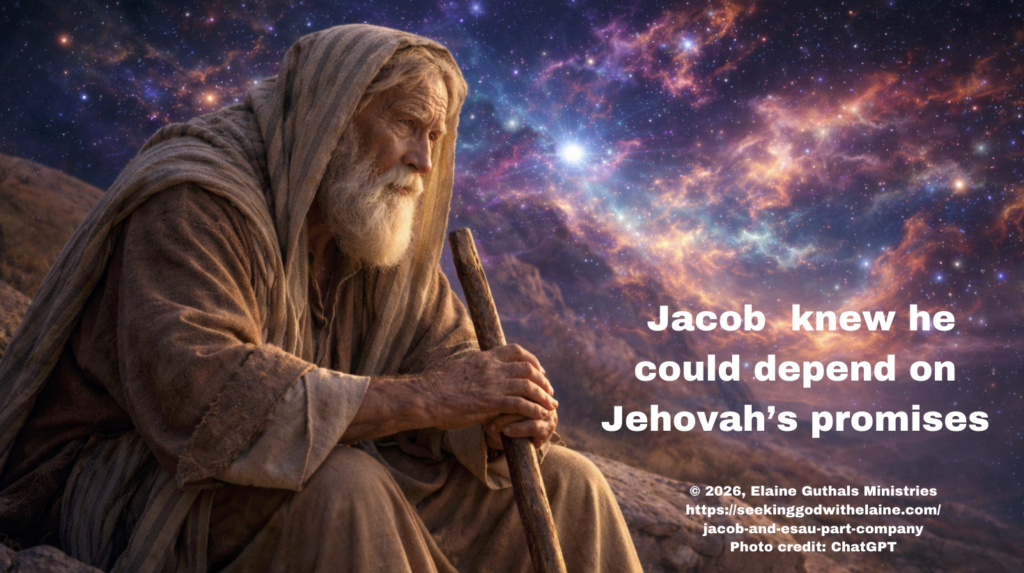
I like what Jacob called the altar that he built – El-Elohe-Israel (God, the God of Israel). Jacob was owning his new identity.
Look what Sherwood said. He wrote, “Only when he ceased to rely on his own strength, and resorted to the weapon of prayer, did he succeed. So it is ever with the Christian.”
Resource
We should follow Jacob’s example.
But I think Jacob’s destination was always Bethel. Shechem wasn’t far from Bethel.
Making the Connections #1
I love the story Guthrie told about reconciliation. He wrote,
“A man lying under sentence of death has sent off a petition for mercy, and waits the answer in anxious suspense. One day his ear catches rapid steps approach his door — they stop there. The chain is dropped; the bolts are drawn; a messenger enters with his fate; the sovereign pities the criminal, but cannot pardon the crime. His hopes dashed to the ground, he gives himself up for lost. And now the messenger draws near, and tells him that if the king’s son would change places with him and die in his room, that would satisfy justice, and set him free. Drowning men will catch at straws; not he at that. The king give up his son! If there is no hope but that, there is no hope at all! Now fancy, if you can, his astonishment, sinking to incredulity, and then rising into a paroxysm of joy, when the messenger says, I am the king’s son; it is my own wish, and my father’s will that I should die for you; take you the pardon, and give me the fetters. In me shall the crime be punished; in you shall the criminal be saved. Such love never was shown by man; only by God. Did David, when he considered the heavens the work of God’s fingers, exclaim, What is man that Thou art mindful of him? How much more may God’s people break out into expressions of adoring wonder, when they stand beneath the Cross.”
Resource
No, it really isn’t about Jacob and Esau.
But this story is about true reconciliation. That is true atonement.
Making the Connections #2
This chapter has had everything, hasn’t it?
- Divine provision
- Fear
- Transformation
- Covenant understanding and acceptance
- Reconciliation
- Mercy
Yes, we all have our own Sanctification Roads.
One thing we might not recognize is that the whole chapter reads like a formal reconciliation ceremony. Let’s look at the clear example of Ancient Near Eastern diplomacy.
- Fear of confrontation
- Tribute gifts
- Submission gestures
- Approach with bows
- Emotional reconciliation
- Gift exchange
- Escort offer
- Peaceful separation
According to established cultural rules of honor and reconciliation, Esau and Jacob’s relationship was fully restored.
Jacob apologized for his devotion. But he also restored Esau’s honor.
Making the Connections #3
One thing that it is easy to forget is that the twins were 97 years old. They were 77 when Jacob left, and that was 20 years ago.
They were not young heroes going to battle against their foe from their early adulthood. True, Isaac lived to 180, but Jacob didn’t.
I doubt that Esau was a reckless man charging toward Jacob. But he would have been a seasoned soldier by then.
Remember, Esau was his own nation. So, he was a patriarch as much as Jacob was.
How Do We Apply This?
- Put our faith and trust in Jehovah.
Father God. You want us to be at peace with others. We also know that there are those You don’t want us to be around. Help us to associate those who live for You. Amen.
If you don’t understand something and would like further clarification, please contact me.
If you have not signed up for the email providing the link to the devotions and the newsletter, do so below.
If God has used this devotion to speak with you, consider sharing it on social media.